

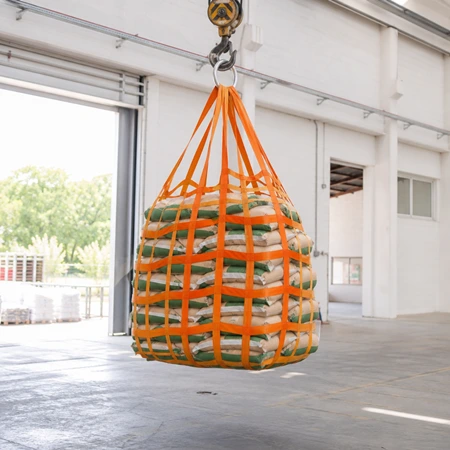
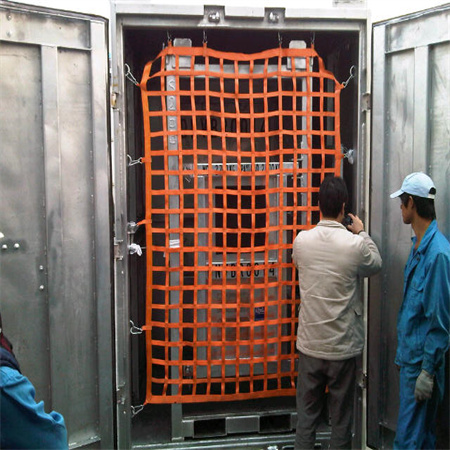
Lift sling rigging company produce Polyester Webbing Net for Lifting,Web Sling Lifting Cargo Net,Polyester Webbing Cargo Net,Flame Retardant Webbing Net,Cargo Nets Of Polyester Webbing,Cargo Lifting Net Web Sling,Polyester Nylon Webbing Lifting Cargo Net,Heavy-duty polyester cargo net with flat sling strap,Large Capacity Cargo Lifting Nets for Heavy-Duty Lifting.
Polyester Webbing Net for Lifting
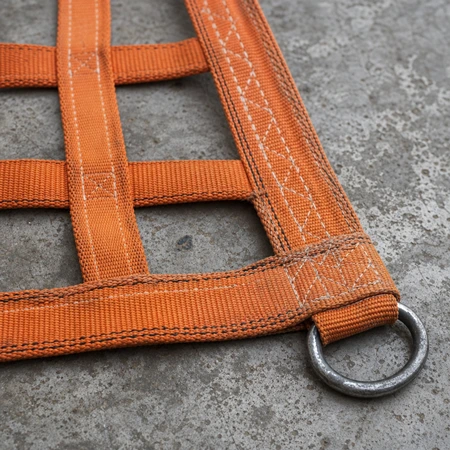
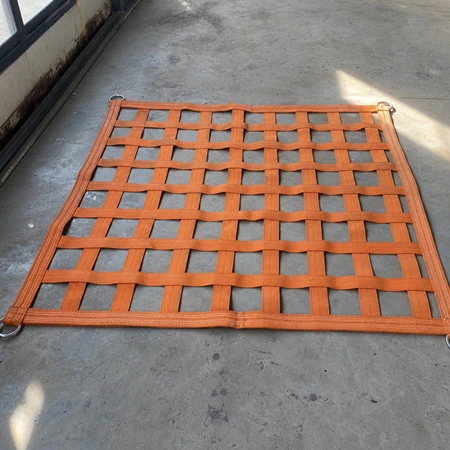
A polyester webbing net for lifting is a lattice of flat high-tenacity polyester (PET) bands, stitched into a square mesh with a doubled border and reinforced corner loops. The cargo goes in, the four loops are gathered onto the hook or a master ring, and the whole consignment travels as one unit – no pallet, no strapping, nothing to re-handle at the far end.
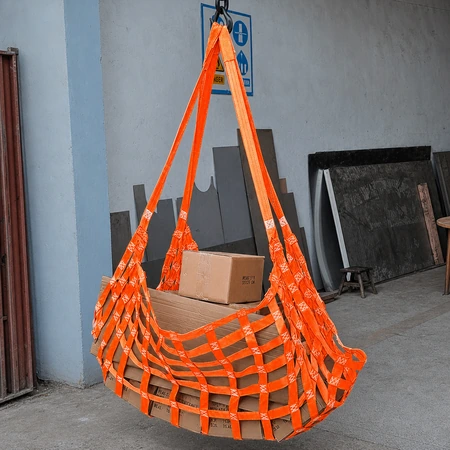
It is supplied in two forms. The flat net holds loads that keep their own shape – pallets, bundles, stillages, machine parts. The closed-bottom bag contains loads that would otherwise escape the mesh – sacks, bricks, offcuts, mixed cargo. Both are cut to the drawing rather than to a catalogue: band width, layer count, mesh, size, lifting points and colour are all set before the first metre of webbing is woven, and the finished net is proof-load tested with a material test report.
- Flat PET band, 25-200 mm – single, duplex or triplex, with a woven selvedge that does not fray.
- 2 t to 30 t as a net – the rating follows the band, the number of load-bearing bands under the cargo and the way the net is rigged.
- Low stretch, about 3-7 % at WLL – the net stays tight against the load instead of creeping open over a shift.
- Wet duty without loss of rating – polyester takes up almost no water and does not rot, so rain, wash-down and deck work are normal service.
- CE and GS certified – woven, stitched, marked and proof-load tested in one plant, with ISO 9001, CNAS and DNV behind it.
The load path: hook, loop, border, band, mesh
A polyester webbing net for lifting is not one component but five, and the load passes through them in a fixed order. Almost every net failure we are asked to investigate comes down to one link in that chain being built to a lower standard than the band itself – usually the stitching at the corner, which is the cheapest place to save money and the first place to fail.
Table 1 – The five links in the load path, and what each one has to do.
| Link | What carries the load | What fails there first | How we build it |
|---|---|---|---|
| Hook or master ring | All four loops gathered to one point | Loops binding on a sharp hook or a worn shackle | Master ring or grade 80 shackle offered with the net; loops sized to the fitting |
| Corner loop | The full rated capacity of one corner | Stitching pulling out of the border | Loop stitched through a doubled border with multi-row lock stitch, reinforced above 5 t |
| Border | The sum of the mesh, redistributed to the corners | Border folding or tearing at the corner radius | Doubled webbing, folded and stitched the full perimeter, wider at the corners |
| Load-bearing band | The cargo’s weight, band by band | Abrasion and cuts from pallet edges and nails | Woven selvedge, duplex or triplex where the net is dragged; sleeves at contact points |
| Mesh | Containment – keeping the cargo in | Items squeezing through an over-wide opening | Opening chosen from the smallest item in the load, 50-300 mm |
The practical consequence is that a net is not rated by its band alone. A 50 mm duplex band can carry 4 t as a single vertical leg, but the net it is woven into may be rated at 2 t because the corner stitching, not the band, sets the limit. That is why we test the finished net and print the net rating, never the band rating.
Polyester against nylon, polypropylene and wire rope
The fibre choice is usually made on price and then lived with for years. The four materials behave differently in ways that matter on a handling net, and none of them wins on every line.
Table 2 – The four net materials compared on the properties that decide service life.
| Property | Polyester (PET) | Nylon (PA) | Polypropylene (PP) | Wire rope |
|---|---|---|---|---|
| Elongation at WLL | About 3-7 % – the lowest of the soft fibres | Roughly twice polyester | Higher again, and it creeps | Under 1 %, but the net is stiff and heavy |
| Water | Takes up almost no water; strength unchanged wet | Absorbs several per cent and loses some strength wet | Does not absorb water | Corrodes unless galvanised or stainless |
| Rot and mildew | Immune | Can mildew if stored wet | Immune | Not applicable |
| UV outdoors | Good, and stabilised in the weave | Moderate | Poor unless heavily stabilised | Unaffected |
| Dry abrasion | Good – best of the soft fibres | Good, slightly behind polyester | Moderate | Excellent, but it abrades the cargo |
| Acids | Good against most dilute acids | Attacked by strong acids | Good | Depends on coating |
| Alkalis | Attacked by strong alkalis | Good | Good | Generally good |
| Contact with the load | Soft, flat, non-marking | Soft, non-marking | Soft but slippery | Marks and crushes; needs sleeves |
| Rigging by hand | Light, folds into a bag | Light, folds into a bag | Lightest | Needs two people and a trolley |
Two conclusions follow. Where the net works in cycles against pallets, concrete and truck beds, polyester is the default because low stretch keeps the mesh tight and dry abrasion is where it is strongest. Where the cargo shock-loads – scrap, demolition, rough castings – nylon’s give is an advantage and the heavy duty nylon cargo net sling is the better answer. And where the load is hot, or the net has to be rigid, neither soft fibre belongs on the job.
Band specification
The band is where a quotation is won or lost. Five numbers describe it, all five are printed on the label, and all five are fixed on the drawing before weaving.
Table 3 – The five numbers that describe a polyester lifting band.
| Number | What it is | Range we weave |
|---|---|---|
| Width | Flat width of the webbing | 25 / 50 / 75 / 100 / 150 / 200 mm; 50 mm standard |
| Layer count | How many webs are stitched into one band | Single, duplex (two) or triplex (three) |
| Thickness | Set by width and layer count | 1.8 mm – 6.0 mm |
| Weave density | Yarn count in warp and weft, which sets tenacity | Set to the EN 1492-1 basis for the rated capacity |
| Edge | How the selvedge is finished | Woven selvedge as standard; folded and stitched where the band is handled daily |
Table 4 – Working load limit per band, vertical single leg, EN 1492-1 basis.
| Band width | Single layer | Duplex | Triplex |
|---|---|---|---|
| 25 mm | 1 t | 2 t | 3 t |
| 50 mm | 2 t | 4 t | 6 t |
| 75 mm | 3 t | 6 t | 9 t |
| 100 mm | 4 t | 8 t | 12 t |
| 150 mm | 6 t | 12 t | 18 t |
| 200 mm | 8 t | 16 t | 24 t |
This is a band figure, not a net rating. The net’s capacity follows from how many load-bearing bands sit under the cargo and how the net is rigged – which is why we quote the net, not the band.
Mesh, border and edge: the three decisions left
Once the band is fixed, three choices remain. They are decided on the drawing, and changing one later means a new net rather than a modification.
Table 5 – Mesh, border and edge options.
| Decision | Options | Rule we apply |
|---|---|---|
| Mesh opening | 50 / 75 / 100 / 150 / 200 / 300 mm | Chosen from the smallest item in the load, never from the total weight |
| Border | Single fold or doubled and multi-row stitched | Doubled as standard; a single-fold border is only offered on nets under 1 t |
| Edge treatment | Woven selvedge, folded edge, PU coating | Folded where the net is handled daily; PU coating where it is dragged or stored outdoors |
| Corner reinforcement | Standard loop or reinforced corner | Reinforced above 5 t, and on any net used with a spreader beam |
| Protection | Sleeve, pad or double band at the contact point | Specified for pallets with nails, machined parts and any sharp edge |
Technical parameters
The figures below cover the standard polyester webbing net for lifting range. Every line is made to order, so treat the table as the starting point for a quotation rather than a fixed catalogue.
Table 6 – Polyester webbing net for lifting: technical parameters.
| Parameter | Specification |
|---|---|
| Product type | Polyester webbing lifting net – flat net or closed-bottom bag |
| Band material | 100 % high-tenacity polyester (PET) webbing |
| Band width | 25 / 50 / 75 / 100 / 150 / 200 mm (50 mm standard) |
| Band construction | Single layer, duplex or triplex; woven selvedge, not a cut edge |
| Band thickness | 1.8 mm – 6.0 mm depending on width and layer count |
| Mesh opening | 100 × 100 mm square standard; 50 mm – 300 mm to order |
| Net size | Length × width for a flat net; opening × depth for a bag; made to drawing |
| Border | Doubled webbing, folded and multi-row stitched, reinforced at every corner |
| Lifting points | Four reinforced corner loops standard; eight for a spreader beam |
| Rated capacity | 2 t – 30 t as a net, set by band, layer count, load-bearing bands and rigging |
| Safety factor | 5:1 / 6:1 / 7:1 |
| Elongation at WLL | About 3-7 % |
| Colour | Colour code by working load limit, or a custom house colour |
| Water and rot | Takes up almost no water; does not rot or mildew |
| Working temperature | -40 °C to +100 °C |
| Treatment | UV stabilised, anti-ageing, abrasion and tear resistant |
| Standard basis | Webbing rated to the EN 1492-1 basis |
| Certification | CE, GS, JIS on request; ISO 9001; CNAS laboratory; DNV |
| Customisation | OEM / ODM size, colour, printed band, label, logo and packing |
| HS code | 6307.90 – lifting nets of textile materials |
Standard sizes and rated capacities
Net size is measured along the border for a flat net, and as opening × depth for a bag. The load has to sit well inside the net: a net the same size as the cargo sheds it as soon as the crane takes up the slack.
Table 7 – Standard net sizes; custom sizes, mesh and lifting points are made to drawing.
| Net size | Mesh | Band | Typical capacity | Typical use |
|---|---|---|---|---|
| 1.0 × 1.0 m | 100 mm | 50 mm duplex | 2 – 3 t | Drums, machine parts, single pallets |
| 1.2 × 1.2 m (4 × 4 ft) | 100 mm | 50 mm duplex | 2 – 4 t | Standard pallet footprint, boxed cargo |
| 2.1 × 2.1 m (82 × 82 in) | 100 mm | 50 mm duplex | 3 – 5 t | Imperial pallet footprint |
| 2.5 × 2.5 m | 100 – 150 mm | 75 mm duplex | 4 – 8 t | Bagged cargo, container loading |
| 2.5 × 6.0 m | 150 mm | 100 mm duplex | 6 – 12 t | Pipe bundles, long cargo, trailer loading |
| 4.0 × 4.0 m | 150 – 200 mm | 150 mm duplex | 10 – 20 t | Bulk bagged cargo, large pallets |
| 6.0 × 6.0 m | 200 mm | 150 mm triplex | 20 – 30 t | Port, barge and heavy bulk handling |
| Made to drawing | 50 – 300 mm | 25 – 200 mm | 2 – 30 t+ | Truck bed, container, hold and hopper sizes |
Pallet-sized versions are quoted from the pallet footprint and are covered by the crane pallet cargo net; long bulk consignments by the polyester lifting hoisting net; and the tensioned version for holding loads down in transit is the cargo securing net.
Rigging arrangements and fittings
How the net is hung decides how much of the load it actually carries. Two arrangements cover most work, and both are rated for the net rather than assumed from the band.
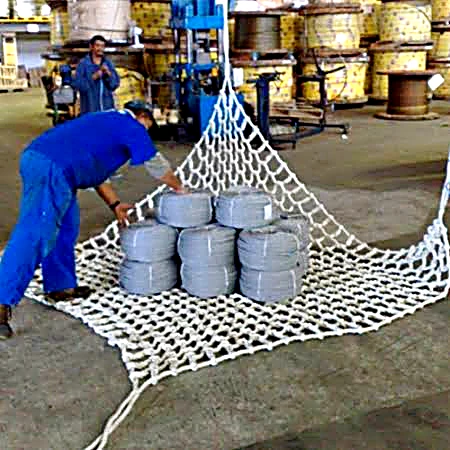
- Four loops on the hook – the standard. The loops gather on the hook or a master ring and the net closes on the cargo as the crane takes up the slack.
- Eight loops on a spreader beam – the net stays square, the load stays level and each corner carries a predictable share; the right answer for long or wide consignments, using a lifting spreader beam.
- Bag form, closed bottom – contains loose cargo that would otherwise fall through the mesh; the form used for loading and unloading.
- Flat net over a load – for pallets, bundles and stillages that keep their own shape and only need holding together.
Fittings supplied or fitted on request: sewn webbing loops, master rings and master links, grade 80 shackles for beam lifts, PU-coated band for high-abrasion and outdoor duty, protection sleeves and pads for sharp edges, and repair kits with matching band and thread for fleets that maintain their own equipment.
Colour coding, marking and identification
Flat webbing has one advantage a rope net does not: the band itself can carry the identification. We print the working load limit along the web and weave the standard colour into it, so a net can be read from across a yard before anyone picks up the label.
Table 8 – Standard colour code by working load limit.
| Working load limit | Band colour | Working load limit | Band colour |
|---|---|---|---|
| 1 t | Violet | 5 t | Red |
| 2 t | Green | 6 t | Brown |
| 3 t | Yellow | 7 t | Blue |
| 4 t | Grey | 8 t | Orange |
Two rules stand behind the colour. It is a convenience, not the identification – the label is, and it is read before every lift. And where a fleet uses a house colour, we weave that instead and print the capacity on the band, so no net is ever identified by colour alone. Nets ship folded in a bag or a crate; six nets take the space of one pallet.
Wet, hot and chemical: what polyester tolerates
Most net failures blamed on the material are really service conditions the buyer was never asked about. These are the limits we work to, and the questions we ask before quoting a net for a wash-down bay or a chemical plant.
Table 9 – Service conditions and how polyester behaves in them.
| Condition | Performance | What to do about it |
|---|---|---|
| Rain, wash-down, deck work | No water uptake, no rot, rating unchanged wet | Nothing – store wet if space is short, but dry before inspection |
| Sun and UV | Good resistance, stabilised in the weave | Store out of direct sun where possible; retire on colour or gloss change |
| Abrasion on concrete and pallets | Good dry abrasion, best of the soft fibres | Duplex or triplex band, and a sleeve where the net is dragged |
| Heat up to +100 °C | Within range; no loss of rating | Keep clear of hot cargo, weld spatter and exhausts |
| Above +100 °C, hot material | Outside the range – polyester softens and loses strength | Use a heat-rated construction or a different product entirely |
| Dilute acids | Good resistance | Rinse after exposure and inspect the stitching |
| Strong alkalis | Attacked – strength loss is not visible | Specify nylon instead, and tell us the chemical |
| Oils and grease | Not absorbed, but they hide damage | Clean before inspection so cuts and abrasion can be seen |
| Sharp edges | A textile cuts – this is the one limit that cannot be engineered out | Protection sleeve or pad at every contact point |
Testing, certification and traceability
- Forty years of lifting equipment manufacturing – founded in 1985 in Taizhou, Jiangsu, with more than 200 employees.
- Band woven in our own mill, so width, layer count, colour and printing stay under our control rather than being bought in.
- Every net proof-load tested on our own 1000 t horizontal machine – tested, not sampled – with a material test report travelling with the order.
- CE declaration of conformity and GS certification, with JIS certification on export orders.
- ISO 9001 quality management system, a CNAS-accredited laboratory and DNV certification behind the plant.
- Every net marked with its working load limit, size and mesh before packing, so the net and its paperwork always agree.
Certificates and test reports are available as PDFs for a tender file or a customs check – see the full certification set.
Care, inspection and retirement
- Read the printed marking and the capacity label before every lift, and check the load is inside the rating for the way the net is rigged.
- Inspect the corner loops and their stitching first, then the border, then the load-bearing bands – that is the order in which a webbing net wears.
- Look for cuts, abrasion, broken stitching, chemical staining, heat glazing and the colour or gloss change that signals UV degradation.
- Keep the cargo inside the mesh and off the border, and protect the bands from sharp edges with a sleeve or pad.
- Never exceed the rated capacity, never lift on fewer than the full set of loops, and never drag a loaded net sideways with the crane.
- Store clean and dry, off the ground and out of direct sun; never repair webbing by knotting, welding or heating it.
- Withdraw the net if a load-bearing band, the border, a loop or its stitching is damaged, and have nets inspected by a competent person at the interval your site requires.
Frequently asked questions
What is a polyester webbing net for lifting used for?
Moving bagged, boxed, palletised and mixed cargo as one unit on a crane hook. The flat form holds loads that keep their own shape; the closed-bottom bag contains loose cargo that would otherwise fall through the mesh. It replaces pallets, strapping and repacking at both ends of the trip.
Why polyester rather than nylon?
Because a handling net works in cycles. Polyester stretches far less at its working load, so the mesh does not creep open as the crane takes up the slack; it takes up almost no water, so the rating holds in wet duty; and it is stronger in dry abrasion against pallets and concrete. Choose nylon where the load shock-loads and a little give is safer.
Is the net rated by the band or as a finished net?
As a finished net. A 50 mm duplex band carries 4 t as a single vertical leg, but the corner stitching and the number of load-bearing bands may rate the net lower. We proof-load and mark the net, and quote the net capacity – the band table is only the starting point.
What mesh opening should I choose?
From the smallest item in the load, never from the total weight. 100 × 100 mm is standard and holds bags, block and boxed goods; small or loose items need 50-75 mm, and large indivisible loads can take 150-300 mm.
Can it be used in the rain or on deck?
Yes. Polyester takes up almost no water, does not rot, and does not lose strength wet, so rain, wash-down and deck work are normal service. Dry the net before inspection so damage is visible.
Can I lift hot material with it?
Up to +100 °C. Above that polyester softens and loses strength, and hot cargo – castings, slag, asphalt – needs a different construction. Tell us the temperature and we will say plainly whether a webbing net belongs on the job.
How is the capacity proved?
The webbing is rated to the EN 1492-1 basis and nets are supplied at 5:1, 6:1 or 7:1 as specified. Every net is proof-load tested on our own 1000 t machine and a material test report travels with the order; the products are CE and GS certified.
What else do you make in the same webbing?
The same band goes into our webbing slings and endless round slings, and the net range continues with the webbing cargo lifting net, the nylon flat webbing net and the nylon cargo lifting net. The whole category is listed under cargo lifting nets.
Request a quotation
To quote a polyester webbing net for lifting, send the load weight and shape, the net or bag size, the mesh opening, the band width and layer, the lifting points you need and how many cycles the net will run – or a drawing of the truck bed, container, skip or hopper it has to fit. Our engineers confirm the band, the layer count, the rated capacity and the packing, and quote it in one reply. To talk it through first, contact our engineers.
Lift Sling Rigging Company – Lifute Industrial Park, Taizhou City, Jiangsu Province, China
Tel: +86 523 8693 5818 | WhatsApp: +86 180 6600 2268 | E-mail: lift98@jslift.com