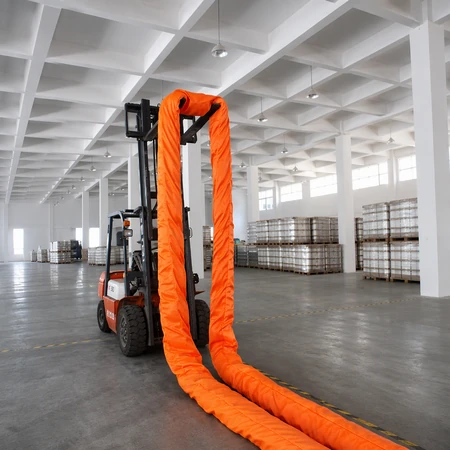
Lift sling rigging company produce Endless Round Sling.
Endless Round Sling — Closed-Loop Sling, 1–1000 t
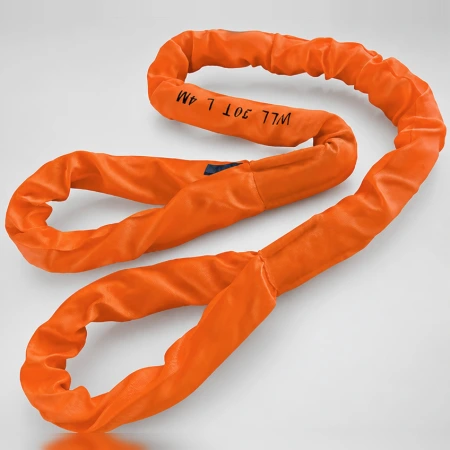
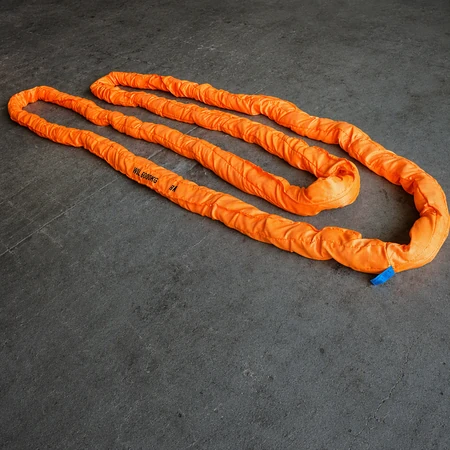
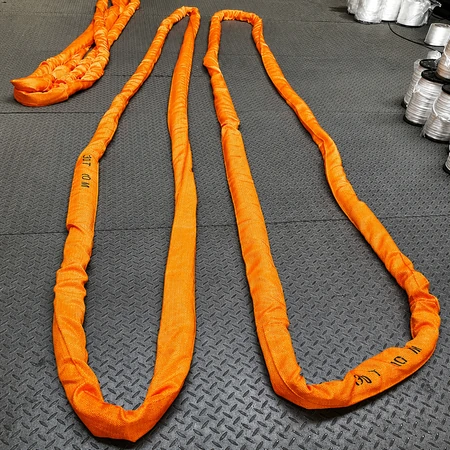
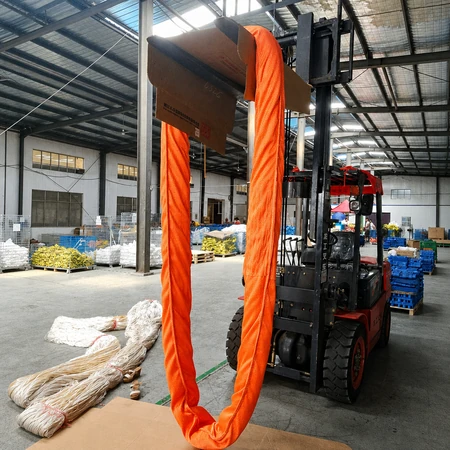
An endless round sling is a closed loop: the core runs continuously inside the sleeve and is closed on itself, so there is no eye, no thimble, no hook and no stitching anywhere in the load path. It is made in high-tenacity polyester across 27 LFTEERS articles, from 1,000 kg to 1,000,000 kg, in bodies from 0.5 m to 80 m. Because the loop has no ends it can be turned, re-reeved and re-oriented after a lift — which is why it is the usual choice for basket and choke work on plant that must not be marked.
- Working load limit1,000 kg to 1,000,000 kg
- Article rangeLFTEERS-1 to LFTEERS-1000, 27 sizes
- Body dimensions15 × 50 mm up to 610 × 1,060 mm
- Length0.5–80 m, effective or circumference
- Unit weight0.47 to 226 kg/m
- No metalNothing on the sling touches the load
What “endless” changes for the rigger
Endless describes the construction of the loop, not the length of the article. Nothing is spliced, sewn or fitted into the load path, and four things follow on site.
- The loop has no direction. Both halves are the same article, so the sling can be turned end for end and re-reeved after a lift. In a basket the two legs are identical, which is not true of a sling with an eye at one end and a fitting at the other.
- Wear can be spread. The contact point moves as the sling is rotated along the loop, so the sleeve is not destroyed in one place while the rest of the body is new.
- There is nothing to mismatch. No eye has to be offered to a hook of the right shape, and no fitting has to be rated with the sling. The hook goes through the loop, or the loop goes round the load.
- The sleeve is the whole inspection. The core cannot be opened and looked at, so the sleeve is the window: what it shows is what the core has been through.
Endless Round Sling specifications
| Product | Endless round sling — closed-loop polyester round sling, 1 t to 1000 t |
|---|---|
| Construction | Continuous parallel filament core in a woven tubular sleeve, closed into an endless loop; no metal and no stitching in the load path |
| Core | High-tenacity polyester multifilament, parallel lay, waxed; UHMWPE or aramid to order |
| Sleeve | Woven high-tenacity polyester, single layer standard; double sleeve to order |
| Working load limit | 1,000 kg to 1,000,000 kg, single leg vertical — 27 articles, LFTEERS-1 to LFTEERS-1000 |
| Breaking load | 7 × working load limit |
| Safety factor | 7:1 as standard; 5:1 to order for markets working to ASME B30.9 |
| Elongation at WLL | Approximately 2–3 % |
| Service temperature | −40 °C to +100 °C, polyester core |
| Length | 0.5 m to 80 m; minimum rises with the article, maximum is 80 m in every size |
| Colour | Stock orange or blue; EN 1492-2 capacity colour applied when the order asks for the standard code |
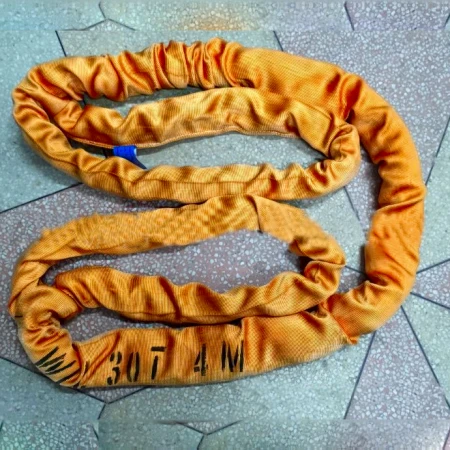
| Marking | Working load limit and length printed on the sleeve; sewn label with WLL, length, serial number and standard |
| Testing | Proof loaded before dispatch; test record matched to the serial number |
| Packing | Coiled in a poly bag, labelled carton; pallet or crate on request |
| HS code | 630790 — lifting slings of textile materials |
| MOQ / OEM | Low MOQ for a trial order; OEM on length, sleeve colour, core fibre, label layout and packing |
Article range: choose the model
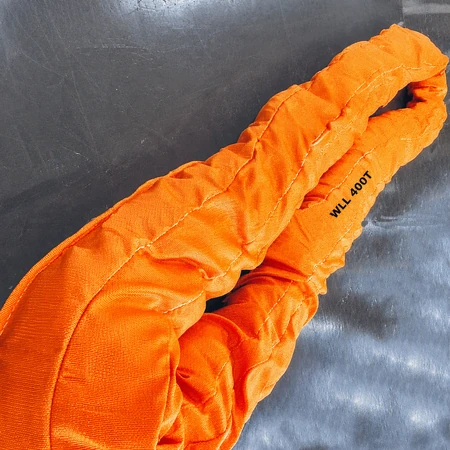
The article number carries the capacity — LFTEERS-10 is the 10,000 kg sling, LFTEERS-100 the 100,000 kg one. Thickness and width describe the body, the two length columns give the shortest and longest body made in that article, and the unit weight is what you add to the crane load.
| Art.No. | WLL (kg) | WLL (t) | Thickness (mm) | Width (mm) | Min (m) | Max (m) | Weight (kg/m) |
|---|---|---|---|---|---|---|---|
| LFTEERS-1 | 1,000 | 1 | 15 | 50 | 0.5 | 80 | 0.47 |
| LFTEERS-2 | 2,000 | 2 | 16 | 60 | 0.5 | 80 | 0.60 |
| LFTEERS-3 | 3,000 | 3 | 18 | 70 | 0.5 | 80 | 0.82 |
| LFTEERS-4 | 4,000 | 4 | 20 | 75 | 0.5 | 80 | 1.20 |
| LFTEERS-5 | 5,000 | 5 | 25 | 80 | 0.5 | 80 | 1.47 |
| LFTEERS-6 | 6,000 | 6 | 27 | 90 | 1.0 | 80 | 1.70 |
| LFTEERS-8 | 8,000 | 8 | 28 | 100 | 1.0 | 80 | 2.20 |
| LFTEERS-10 | 10,000 | 10 | 29 | 110 | 2.0 | 80 | 3.00 |
| LFTEERS-12 | 12,000 | 12 | 30 | 125 | 2.0 | 80 | 3.40 |
| LFTEERS-15 | 15,000 | 15 | 31 | 150 | 2.0 | 80 | 4.00 |
| LFTEERS-20 | 20,000 | 20 | 32 | 180 | 2.5 | 80 | 5.60 |
| LFTEERS-25 | 25,000 | 25 | 34 | 200 | 2.5 | 80 | 6.80 |
| LFTEERS-30 | 30,000 | 30 | 68 | 220 | 2.5 | 80 | 8.20 |
| LFTEERS-40 | 40,000 | 40 | 75 | 250 | 2.5 | 80 | 10.9 |
| LFTEERS-50 | 50,000 | 50 | 86 | 270 | 2.5 | 80 | 13.8 |
| LFTEERS-60 | 60,000 | 60 | 126 | 280 | 4.0 | 80 | 16.6 |
| LFTEERS-80 | 80,000 | 80 | 138 | 300 | 4.0 | 80 | 22.0 |
| LFTEERS-100 | 100,000 | 100 | 152 | 320 | 4.0 | 80 | 27.0 |
| LFTEERS-200 | 200,000 | 200 | 230 | 460 | 5.0 | 80 | 66.0 |
| LFTEERS-300 | 300,000 | 300 | 310 | 535 | 5.0 | 80 | 82.0 |
| LFTEERS-400 | 400,000 | 400 | 380 | 680 | 5.0 | 80 | 98.0 |
| LFTEERS-500 | 500,000 | 500 | 410 | 760 | 8.0 | 80 | 116.0 |
| LFTEERS-600 | 600,000 | 600 | 460 | 830 | 8.0 | 80 | 139.0 |
| LFTEERS-700 | 700,000 | 700 | 498 | 880 | 8.0 | 80 | 155.0 |
| LFTEERS-800 | 800,000 | 800 | 520 | 940 | 9.0 | 80 | 178.0 |
| LFTEERS-900 | 900,000 | 900 | 580 | 1,000 | 9.0 | 80 | 202.0 |
| LFTEERS-1000 | 1,000,000 | 1,000 | 610 | 1,060 | 9.0 | 80 | 226.0 |
The series code is shown as supplied on the factory sheet. In that sheet the 20,000 kg article carries the code LFTEERS-15 for a second time; it is shown here as LFTEERS-20 so that the code matches the capacity ladder. Thickness and width are the body dimensions specified for the article, and the minimum length is the shortest body that can be closed and sleeved at that capacity. If your price list uses a different prefix, replace it across the table — the rest of the code is the capacity.
Capacity changes with the hitch, not with the tonnage on the sleeve
The figure printed on the sleeve is the working load limit of one leg hanging vertically. It is the number the sling is proof loaded against, and the starting point of a lifting plan — not the tonnage it will pick up in the arrangement you are actually using. Apply the factor for the hitch, and remember that a set of legs is calculated on fewer legs than it has, because a real load never sits perfectly symmetrically.
| Arrangement | Factor | 5 t sling | 20 t sling |
|---|---|---|---|
| One sling, vertical | × 1.0 | 5.0 t | 20.0 t |
| One sling, choked | × 0.8 | 4.0 t | 16.0 t |
| One sling, basket 0–7° | × 2.0 | 10.0 t | 40.0 t |
| One sling, basket 7–45° | × 1.4 | 7.0 t | 28.0 t |
| One sling, basket 45–60° | × 1.0 | 5.0 t | 20.0 t |
| Two legs, 0–45° from vertical | × 1.4 | 7.0 t | 28.0 t |
| Two legs, 45–60° from vertical | × 1.0 | 5.0 t | 20.0 t |
| Four legs, 0–45° from vertical | × 2.1 | 10.5 t | 42.0 t |
| Four legs, 45–60° from vertical | × 1.5 | 7.5 t | 30.0 t |
Two lines in that table settle most orders. First, two 5 t slings do not make a 10 t set: at 0–45° from vertical they carry 7 t together, and past 45° they carry 5 t. Second, a four-leg set is worked on three legs, which is why the factor is 2.1 and not 2.8. Where the capacity is close to the limit, the honest answer is usually a lifting beam rather than a bigger sling — keeping the legs vertical recovers the factor that an open leg angle has just spent.
Length: effective length or circumference
An endless sling has no ends, so its length can be quoted two ways, a factor of two apart. This is the most common ordering error on a round sling and the most expensive to correct, because the sling has to be remade rather than adjusted.
| Quoted as | What you receive | Used for | Example |
|---|---|---|---|
| Effective working length | Half the circumference — hook down to the load and back up | Vertical and choked lifts, where the hanging height is known | 4 m EWL = 8 m loop |
| Circumference | The full loop length | Basket lifts, where the girth of the load drives the length | 8 m loop = 4 m EWL |
On the slings we supply the figure printed on the sleeve is the effective length, so the print and the quotation always agree. For a basket, measure the girth of the load, add the headroom to the hook, and quote that figure: the body takes the long way round the load, and a sling that only just reaches forces the legs wide — the same as buying a smaller sling.
Where an endless loop earns its place
- Precast beams and bridge segments picked in a basket at each end, where the sleeve protects the formed face and the chamfer.
- Steel coils sitting in a basket, where the doubled body gives twice the vertical capacity and follows the curve of the coil instead of bearing on one line.
- Transformers, generators and machine beds with small trunnions and painted surfaces — nothing metal touches the load.
- Moulds and dies whose lifting holes are drilled, not designed for a fitting, so a soft loop threaded through the hole is the whole method.
- Skids, frames and offshore baskets choked at each corner with 6–12 m bodies, the sleeve taking the corner abrasion so the core does not.
- Stage and studio work around truss and set pieces where a scratch is a re-spray.
Endless, eye-eye or flat webbing
| Criterion | Endless round sling | Eye-eye round sling | Flat endless webbing sling |
|---|---|---|---|
| Contact with the load | Round body, conforms to curves and corners | Round body with two loaded eyes | Wide flat face, spreads pressure over an area |
| Length | Set by the loop; either convention can be quoted | Fixed between the eyes | Set by the sewn loop |
| Load path | Continuous, no termination | Continuous core, eyes formed by the sleeve | Sewn join in the loop |
| Reeving | Can be turned and re-reeved after a lift | One orientation only | Can be turned, but the join takes the wear |
| Best for | Basket and choke work, awkward plant, long bodies | Repeated lifts on the same two points | Wide, flat and easily marked loads |
None of the three replaces another. For a fixed length and two known pick-up points see the eye-eye round sling; for a wide face and a visible load path see the endless flat webbing sling. Both round sling forms are built from the same core and sleeve, so the choice is a rigging decision rather than a capacity one. For hard service the double sleeve round sling adds a second wear layer at the same rating, for weight-critical work there is a UHMWPE round sling core, and for hot loads an aramid round sling.
Inspection and retirement
The core cannot be seen, so the sleeve is the record of what the sling has been through. Inspect before every use, and formally at the interval your regime requires.
- Check the full length of the sleeve for cuts, snags, glazing, melts and chemical staining, and open the sleeve at the join if anything looks wrong.
- Read the print and the label. If the working load limit or the length can no longer be read, the sling cannot be verified and comes out of service.
- Feel for grit inside the sleeve; it abrades the core from within long after the yard has been swept.
- Retire on any cut or hole that exposes the core, heat glazing, a core that has gone stiff or lumpy, chemical attack, or a missing label.
- Store coiled and off the floor, out of daylight and away from heat, solvents and weld spatter. Never store a sling wet in a closed bag.
- Never drag a loaded sling sideways, and never lift on a damaged sleeve.
Frequently asked questions
What is the difference between an endless round sling and a round sling with eyes?
An endless round sling is a closed loop with no termination: the core runs continuously inside the sleeve and nothing is spliced or sewn into the load path. A round sling with eyes has two defined eyes at a fixed distance, so its length is set by the eyes and it works in one orientation.
Is the length the circumference or the effective length?
Both are used and they differ by a factor of two. Effective length is half the loop — hook down to the load and back up. Circumference is the full loop. A 4 m effective length is an 8 m loop, so the convention has to be stated on the order.
How much capacity is lost in a choker?
A choked endless round sling is rated at 0.8 of its vertical working load limit, so a 5 t sling gives 4 t. A basket raises the figure to 2.0 at 0–7°, 1.4 at 7–45° and 1.0 at 45–60°. A four-leg set is calculated on three legs, giving 2.1 at 0–45° from vertical and 1.5 at 45–60°.
What does LFTEERS-10 mean?
The article number is the working load limit in tonnes: LFTEERS-10 is 10,000 kg vertical, LFTEERS-100 is 100,000 kg and LFTEERS-1000 is 1,000,000 kg. The range follows the 1-2-3-4-5-6-8-10-12-15-20-25-30-40-50-60-80-100-200-300-400-500-600-700-800-900-1000 ladder, so there is no 7 t, 9 t or 11 t article.
How heavy is a long endless sling?
The last column of the article table is the weight per metre: 0.47 kg/m at LFTEERS-1, 3.00 kg/m at LFTEERS-10 and 226 kg/m at LFTEERS-1000. Multiply by the loop length and add the label and packing to get the figure to put against the crane. Where that number is a problem, a UHMWPE core gives the same capacity at a fraction of the weight.
Can the same sling be used in a basket and a choke?
Yes, and that is one of the reasons for the endless form: the same article goes round the load either way. What changes is the working figure, so the rating has to be recalculated for the hitch actually used.
How is the sling tested and documented?
Each sling is proof loaded before dispatch and the test record is matched to the serial number on the sewn label. Breaking load is 7 × the working load limit, and the factor can be varied to order where the market requires it.
Request an endless round sling quotation
Send the load per leg, the hitch and the leg angle, the distance between pick-up points and the headroom to the hook — plus the length convention and any marking or documentation your site requires. We will confirm capacity, length and sleeve, and quote factory-direct with a drawing, a proof-load record and a sample. See the full round sling range for the rest of the series.