

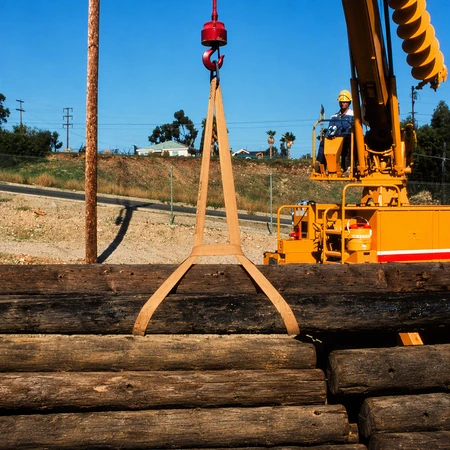
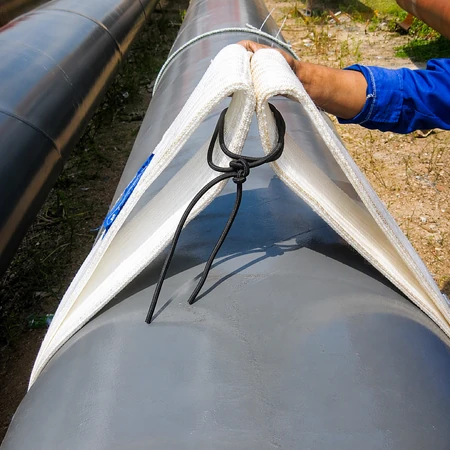
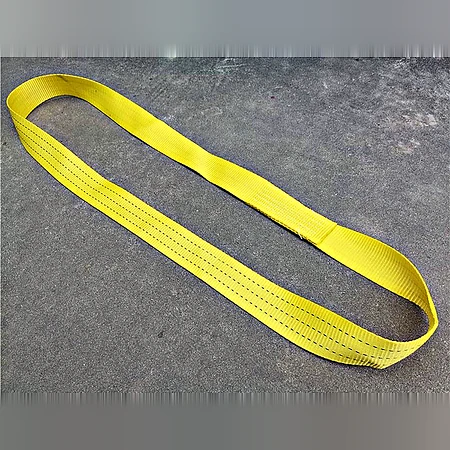
Lift sling rigging company produce Endless Type Webbing Sling.
Endless Type Webbing Sling
An endless type webbing sling is the form with no ends at all: a length of flat woven webbing is lapped back over itself and stitched to close the loop, so what comes off the shelf is one continuous band with no eyes to hook and no fittings to lose. Under EN 1492-1 it is the endless type A flat woven webbing sling, made from one or two layers of webbing, rated from 1 t to 24 t working load limit. Because nothing is fixed on it, the loop can be turned after every lift, so the wear point, the hook contact point and the joint keep moving instead of staying in one place.
Endless Means One Joint, Not None
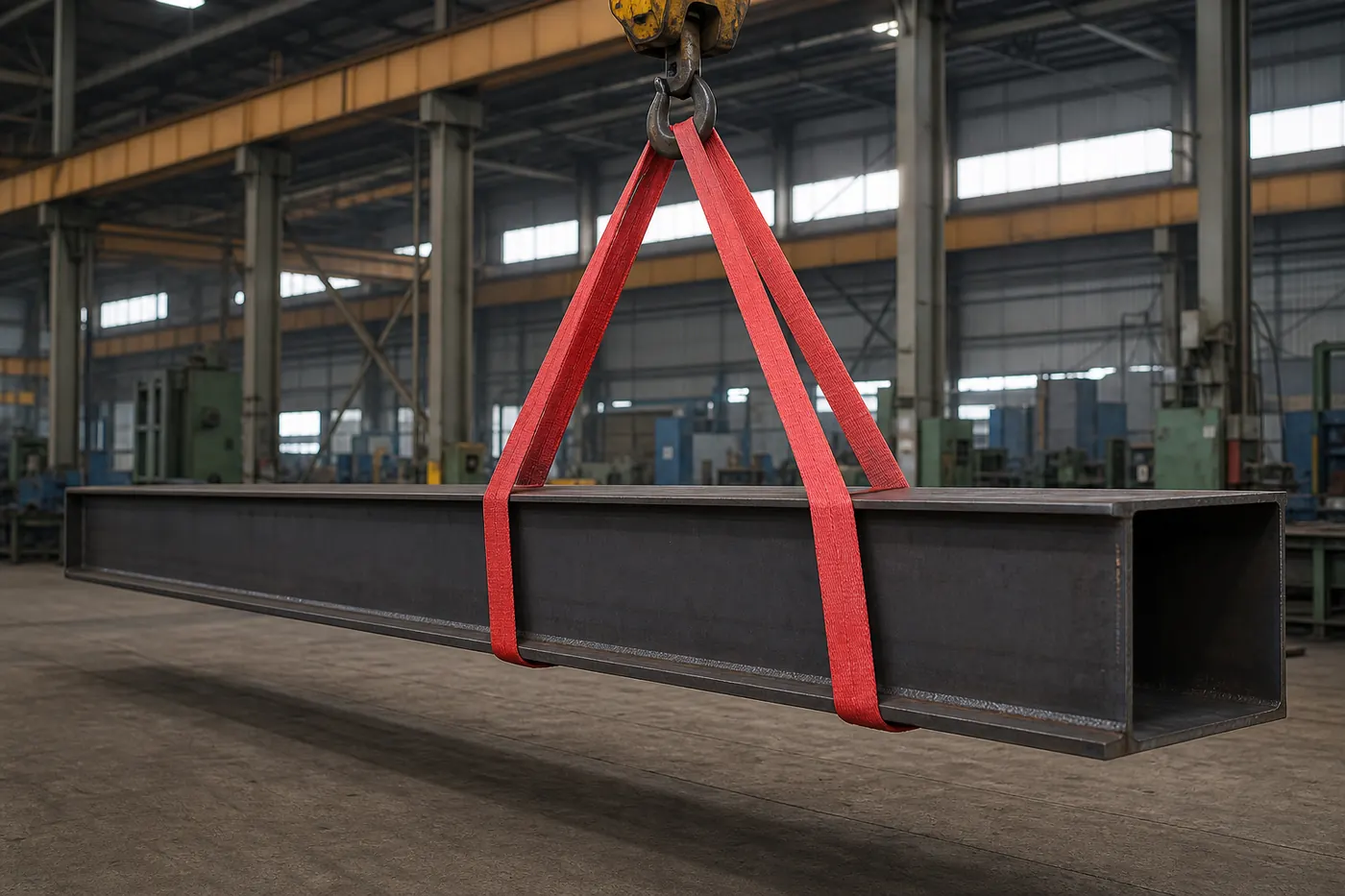
“Endless” is used loosely in the trade, and it is worth being precise, because two very different articles answer to the word. This sling is endless in use — no ends, no fittings — but it is not seamless. It has exactly one joint: the lap where the two ends are laid over each other and closed across the full width by several dense rows of stitching, built to carry the rated load.
That single fact decides how the sling is used and inspected. The lap is the one place where the load passes through a made connection, so it earns the first thirty seconds of every inspection — every stitch row, the step at each end of the lap, and whether the two layers still lie flat and parallel. It can also be rotated out of the bearing area and out of the hook contact area, so it is not repeatedly crushed in the same spot. If you need a loop with no joint in the load path at all, that is the endless round sling, where the core is continuous and only the sleeve is a tube.
Technical Specifications
| Parameter | Specification |
|---|---|
| Product | Endless type webbing sling / endless type A flat woven webbing sling / circular webbing sling |
| Standard | EN 1492-1 (7:1 series); AS 1353 referenced for Australian supply |
| Material | 100% high-tenacity polyester; polyamide and polypropylene on request |
| WLL range | 1 t – 12 t single ply standard; 2 t – 24 t double ply; multi-ply to 50 t on request |
| Design factor | 7:1 to EN 1492-1; 6:1 and 8:1 engineered to specification |
| Ply | Single ply (7.5 mm webbing) as standard; double ply (2 × 7.5 mm = 15 mm) on request |
| Webbing width | 25 mm – 300 mm, matched to the band |
| Length | Quoted by circumference or by effective working length; standard to 12 m, custom up to 200 m |
| Elongation | Max 3% at WLL; max 10% at breaking load |
| Temperature | -40 °C to +100 °C (polyester) |
| Marking | EN 1492-1 capacity colour, one black stripe per tonne, sewn label: WLL, material, standard, maker, length, batch code |
| Wear protection | Reinforced sleeves or coatings at wear points |
| Documentation | Batch MTC, test reports and DoC with each shipment; CE to 2006/42/EC on the 7:1 series |
| Packing | PE bag, carton, pallet; wooden cases for heavy or multi-leg sets |
Standard Sizes – Single Ply
Seven-and-a-half millimetre polyester webbing, one layer. Pick by the vertical WLL you need, then read across for the width, the minimum length and the weight per metre.
| Model | Colour | WLL vertical | WLL choker | WLL basket | Width | Thickness | Min length | Weight |
|---|---|---|---|---|---|---|---|---|
| EWS-1T | Violet | 1,000 kg | 800 kg | 2,000 kg | 30 mm | 7.5 mm | 1.1 m | 0.22 kg/m |
| EWS-2T | Green | 2,000 kg | 1,600 kg | 4,000 kg | 60 mm | 7.5 mm | 1.2 m | 0.45 kg/m |
| EWS-3T | Yellow | 3,000 kg | 2,400 kg | 6,000 kg | 90 mm | 7.5 mm | 1.3 m | 0.71 kg/m |
| EWS-4T | Grey | 4,000 kg | 3,200 kg | 8,000 kg | 120 mm | 7.5 mm | 1.4 m | 1.02 kg/m |
| EWS-5T | Red | 5,000 kg | 4,000 kg | 10,000 kg | 150 mm | 7.5 mm | 2 m | 1.21 kg/m |
| EWS-6T | Brown | 6,000 kg | 4,800 kg | 12,000 kg | 180 mm | 7.5 mm | 2 m | 1.42 kg/m |
| EWS-8T | Blue | 8,000 kg | 6,400 kg | 16,000 kg | 240 mm | 7.5 mm | 2 m | 1.89 kg/m |
| EWS-10T | Orange | 10,000 kg | 8,000 kg | 20,000 kg | 300 mm | 7.5 mm | 3 m | 2.34 kg/m |
| EWS-12T | – | 12,000 kg | 9,600 kg | 24,000 kg | 300 mm | 7.5 mm | 3 m | 2.98 kg/m |
Standard Sizes – Double Ply
Two 7.5 mm plies sewn into a 15 mm composite. Double ply buys capacity at the same width, and a band that resists cutting and abrasion better — which is why it is specified where the sling runs over an edge or does repeated choker work.
| Model | Colour | WLL vertical | WLL choker | WLL basket | Width | Thickness | Min length | Weight |
|---|---|---|---|---|---|---|---|---|
| EWSD-2T | Green | 2,000 kg | 1,600 kg | 4,000 kg | 30 mm | 15 mm | 1.5 m | 0.50 kg/m |
| EWSD-4T | Grey | 4,000 kg | 3,200 kg | 8,000 kg | 60 mm | 15 mm | 1.5 m | 0.86 kg/m |
| EWSD-6T | Brown | 6,000 kg | 4,800 kg | 12,000 kg | 90 mm | 15 mm | 1.5 m | 1.50 kg/m |
| EWSD-8T | Blue | 8,000 kg | 6,400 kg | 16,000 kg | 120 mm | 15 mm | 2 m | 1.96 kg/m |
| EWSD-10T | Orange | 10,000 kg | 8,000 kg | 20,000 kg | 150 mm | 15 mm | 2 m | 2.62 kg/m |
| EWSD-12T | – | 12,000 kg | 9,600 kg | 24,000 kg | 180 mm | 15 mm | 3 m | 2.86 kg/m |
| EWSD-16T | – | 16,000 kg | 12,800 kg | 32,000 kg | 240 mm | 15 mm | 3 m | 4.10 kg/m |
| EWSD-20T | – | 20,000 kg | 16,000 kg | 40,000 kg | 300 mm | 15 mm | 3 m | 5.46 kg/m |
| EWSD-24T | – | 24,000 kg | 19,200 kg | 48,000 kg | 300 mm | 15 mm | 3 m | 6.10 kg/m |
Final WLL is established for the complete sling construction, stitching and rated configuration. Dimensions refer to the standard sling body; the optional protective sleeve increases the outer dimension slightly. Longer lengths and higher capacities are engineered to order. Above 10 t the EN 1492-1 colour code no longer applies — the label and the black stripes govern.
Colour and Stripes – What the Marking Certifies
The webbing colour certifies one thing only: a working load limit band, in straight lift. It says nothing about the material, the length, the safety factor or the condition of the sling. Alongside it, one black transverse stripe per tonne lets the two markings be cross-checked. The label colour is separate again and tells you the fibre: blue for polyester, green for polyamide, brown for polypropylene — so green webbing is a 2 t band while a green label means nylon.
Hitch Mode Factors
The label figure is the straight lift. Every other arrangement is derived from it, and these factors reduce it — a basket does not give the sling a second, higher rating, it puts two parts of the same webbing into the load path.
| Hitch | Mode factor | In practice |
|---|---|---|
| Straight lift | 1.0 | The label figure; loop hangs as a U, both parts on the hook |
| Choked | 0.8 | Loop passes round the load and back through itself — a 4 t load needs a 5 t sling |
| Basket, legs 0-7° | 2.0 | Two parts share the load, legs near vertical |
| Basket, legs 7-45° | 1.4 | Tension rises as the legs open out |
| Basket, legs 45-60° | 1.0 | No more than a straight lift at this spread |
| Angled choke, 45° | 0.7 | Choked, with the legs opening away from vertical |
| Angled choke, 60° | 0.5 | The most heavily reduced arrangement in common use |
Specifying the Length
An endless sling has no ends to measure between, so it is quoted one of two ways — and the two differ by about a factor of two, which is the commonest reason a sling arrives at the wrong length. Circumference is the total perimeter, i.e. the webbing in the finished sling. Effective working length is the usable height you actually get, roughly half the circumference, because the loop is doubled when it hangs.
| Circumference ordered | Approx. working length | Typical use |
|---|---|---|
| 2 m | 1 m | Chokes and short lifts, tight rigging |
| 4 m | 2 m | The general-purpose size |
| 6 m | 3 m | Basket lifts on plant and fabrications |
| 8 m | 4 m | Long sections, bundles and pipework |
| 10 m | 5 m | Structure and large plant |
| 12 m | 6 m | Standard longest; longer to order |
The relationship is the point, not the exact figure: it depends on ply, band thickness and bend radius. State which convention your number is in, or simply give the distance from hook to load and we will size the loop to it.
Endless or Eye and Eye?
| Property | Endless type | Eye and eye |
|---|---|---|
| Ends | None — one continuous loop | Two flat eyes, one at each end |
| Length | Not fixed; can be doubled or taken up by another turn | Fixed between two pick-up points |
| Wear points | None fixed — the whole loop rotates | The same two bearing points and eyes |
| Service life | Longer, because wear and the joint move around the loop | Condemned when the fixed points wear out |
| Best for | Choked lifts, bundles, general yard and site work | Lifts with defined, repeated pick-up points |
Most sites carry both. If the method statement has to state where the sling attaches, the eye and eye webbing sling makes that explicit; if crews rig whatever is in front of them, the endless type is the better general-purpose article.
Handling, Inspection and the Rotation Habit
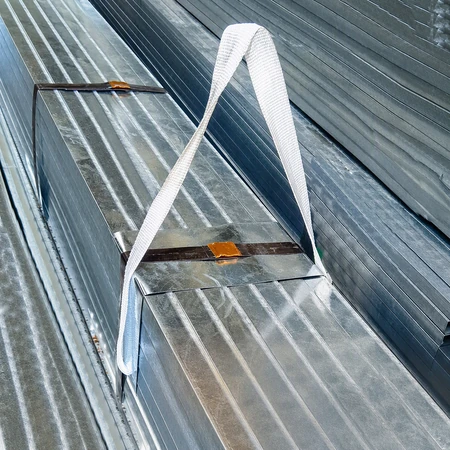
An endless sling is easier to inspect than a round sling, because the load path is the webbing itself and everything you need to see is on the surface. Work through it in this order.
- The lap joint first — every stitch row, the step at each end, and whether the two layers still lie flat and parallel. Broken, slack or pulled stitching condemns the sling.
- The bearing points where the band has wrapped on loads — cuts, abrasion, glazing, a worn edge.
- The hook contact area, where the loop sits in the hook bowl and folds over itself.
- The whole band — a flat band carries load across its full width, so a cut anywhere matters.
- Heat and chemical damage — shiny, stiff or discoloured fibre means it has met heat, friction, acid or solvent.
Rotate as policy, not as repair: turn the loop after every lift so the bearing point, the hook point and the joint keep moving. Keep the band flat and untwisted — a flat sling twisted into a rope concentrates the load on one edge and loses the contact area that is its whole advantage. Protect the band at edges and keep it within -40 °C to +100 °C, away from weld spatter.
Applications
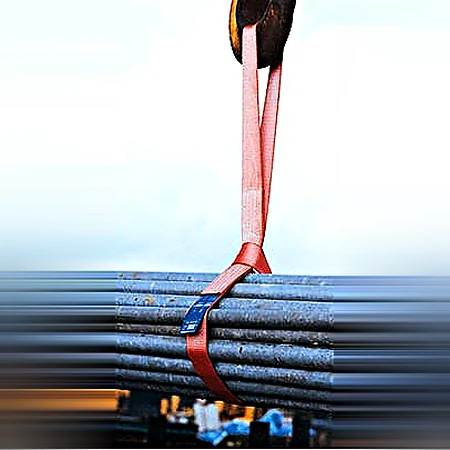
- Choked lifts on structural steel, beams and welded fabrications
- Basket lifts on plant, machinery, skids, dies and castings
- Bundles of tube, pipe and sections, choked or double wrapped
- Precast concrete units where a flat, broad bearing is wanted
- Crates, stillages and boxed goods; general yard and depot work
- Cold stores and cold-climate work down to -40 °C; wet conditions where a rust-free sling is wanted
For hot loads or sharp, unpadded edges the polyester build is the wrong choice — see the high temperature webbing sling or a wire rope sling instead.
Frequently Asked Questions
What is an endless type webbing sling?
Under EN 1492-1 it is the endless type A flat woven webbing sling: a length of webbing whose two ends are lapped back over one another and stitched to close the loop. One continuous band, no eyes to hook, no fittings to lose, one joint built to carry the rated load.
Is it really seamless?
No. It is endless in use, but there is one made connection — the lapped and stitched joint — and it is the first thing to inspect. If you need no joint at all in the load-bearing element, that is an endless round sling.
How much can it lift in a choke or a basket?
The label gives the straight lift. A choke takes it to 0.8, a basket at a narrow angle to 2.0, then 1.4 between 7 and 45 degrees and 1.0 between 45 and 60. An angled choke is reduced further, to 0.7 at 45 degrees and 0.5 at 60. Confirm the hitch and the angle before the lift.
Single ply or double ply?
Double ply gives more capacity at the same width and better resistance to cutting and abrasion; single ply is lighter and more flexible for general duty. Pick by the WLL you need and the working conditions, not by layer count alone.
What length should I order?
Say which convention your figure is in — circumference or effective working length; they differ by about a factor of two. If you know how far the hook will be from the load, send that instead and we will size the loop to it.
Does the colour tell me everything?
No. The webbing colour certifies the WLL band in straight lift only. The stripes give the tonne figure, and the label colour separately tells you the fibre: blue polyester, green polyamide, brown polypropylene.
Request a Quotation
Send the load and its shape, the hitch you intend to use, whether your length is a circumference or a working length, the fibre, and the standard and destination market. We confirm the band, ply, width, length, marking and test documentation before the webbing is cut — 1 t to 24 t, single or double ply, 7:1 to EN 1492-1 as standard.
Send your lift details for an endless sling quotation
Telephone / WeChat: +86 180 6600 2268 | E-mail: 702461526@qq.com
Address: Lifute Industrial Park, Taizhou City, Jiangsu Province, China