Lift sling rigging company produce Round Sling With Eyes,Round Sling With two eyes
Round Sling With Eyes — Double Eye Sling, 1–1000 t
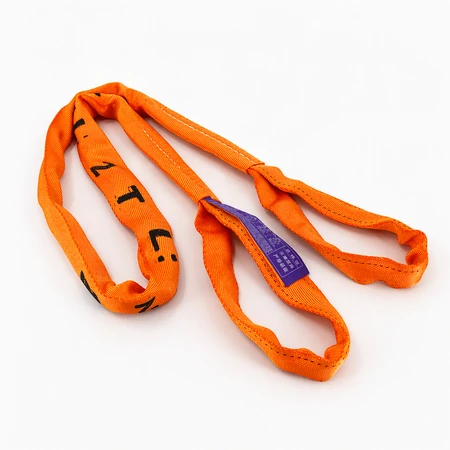
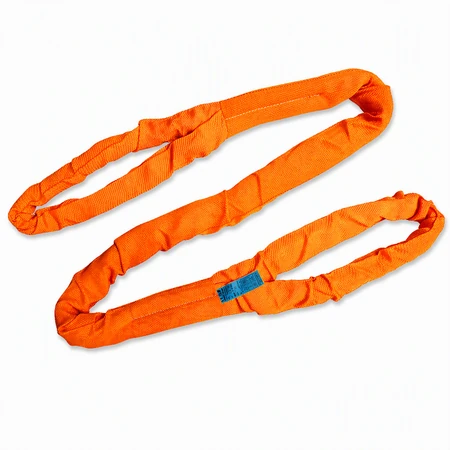
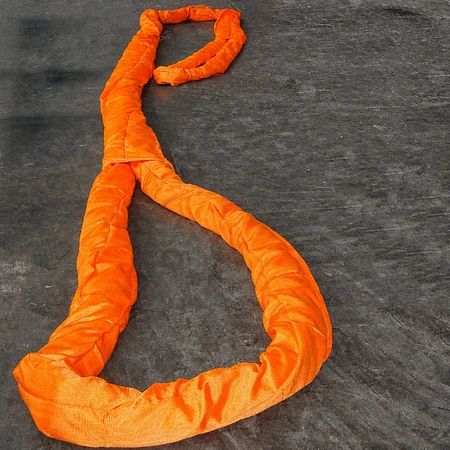
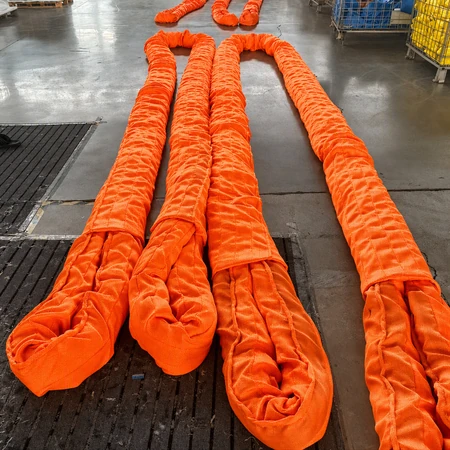
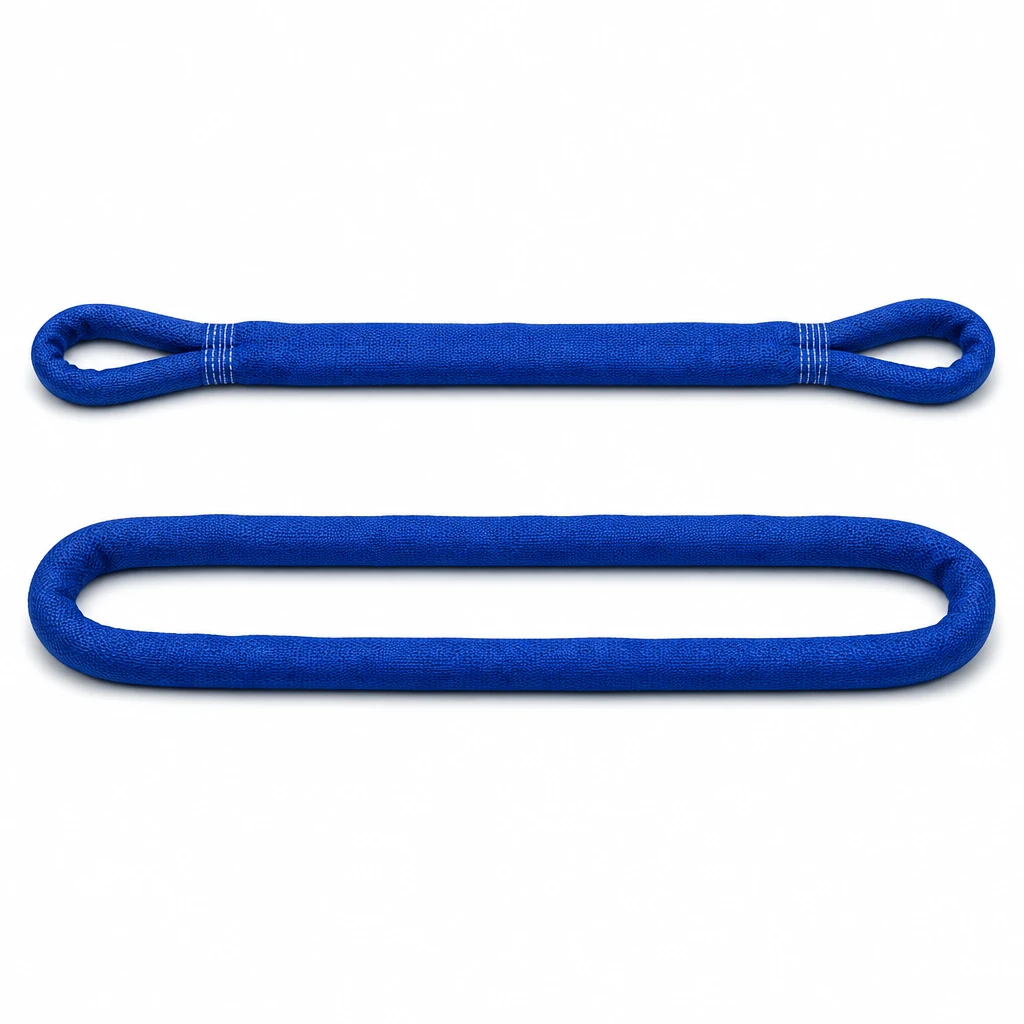
A round sling with eyes is a round sling whose sleeve is gathered and stitched into a reinforced eye at each end, so the article has a measured length and two pick-up points instead of an endless loop. It hooks and shackles like a webbing sling, keeps the round body that protects a machined or painted surface, and is built here in 27 LFTERS articles from 1,000 kg to 1,000,000 kg. The tables give the eye options, the article range with body dimensions, and the working figure for each hitch.
- Working load limit1,000 kg to 1,000,000 kg
- Article rangeLFTERS-1 to LFTERS-1000, 27 sizes
- Body6 × 40 mm up to 320 × 1,050 mm
- LengthEye to eye, 0.5–80 m
- Unit weight0.40 to 222 kg/m
- Safety factor7:1 to EN 1492-2 practice
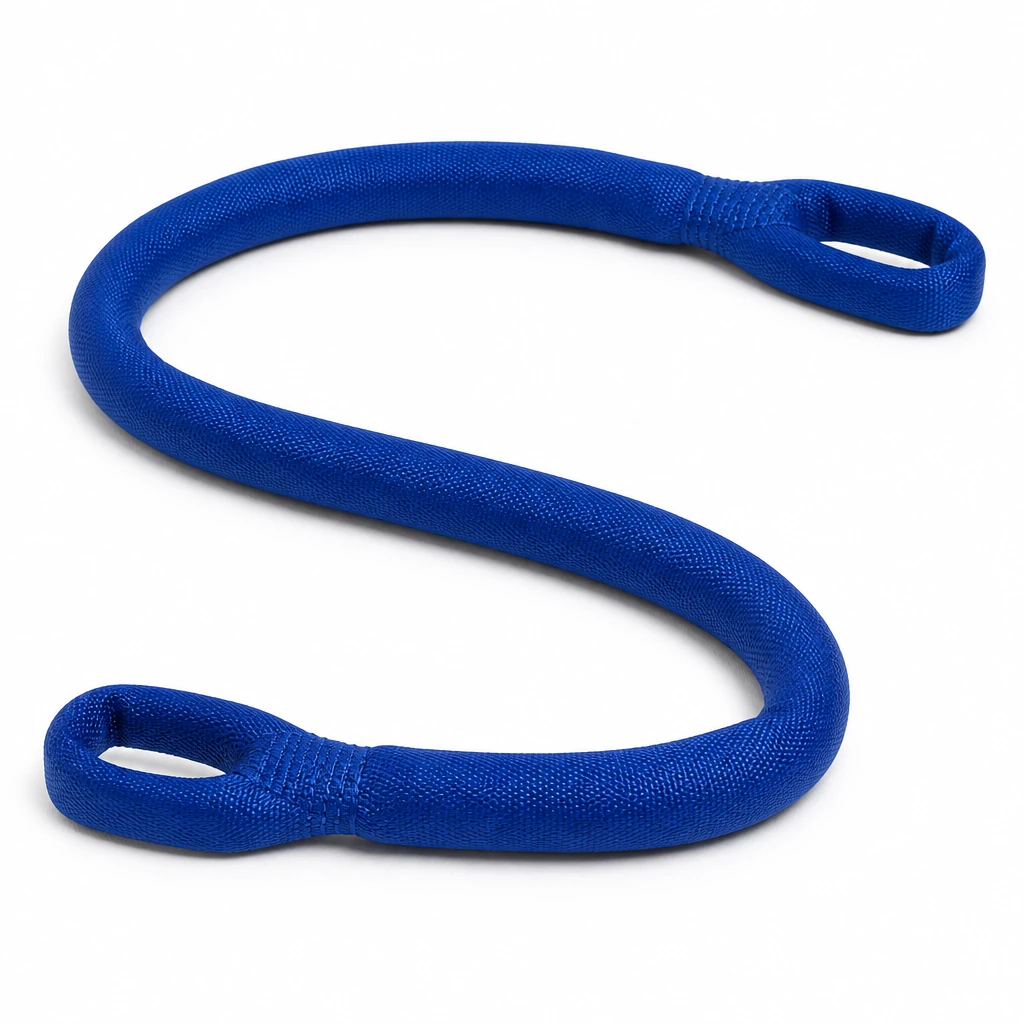
What the two eyes change
The core still runs unbroken from one end to the other and the sleeve still takes the abrasion. What changes is the termination, and four things follow from it.
- The length is a specification. The eye-to-eye distance is set on the order, so the same lift repeated next month uses the same geometry.
- Each end has a known pick-up point. On an endless loop the sleeve bites wherever it lands; here the eye sits where it was made to sit.
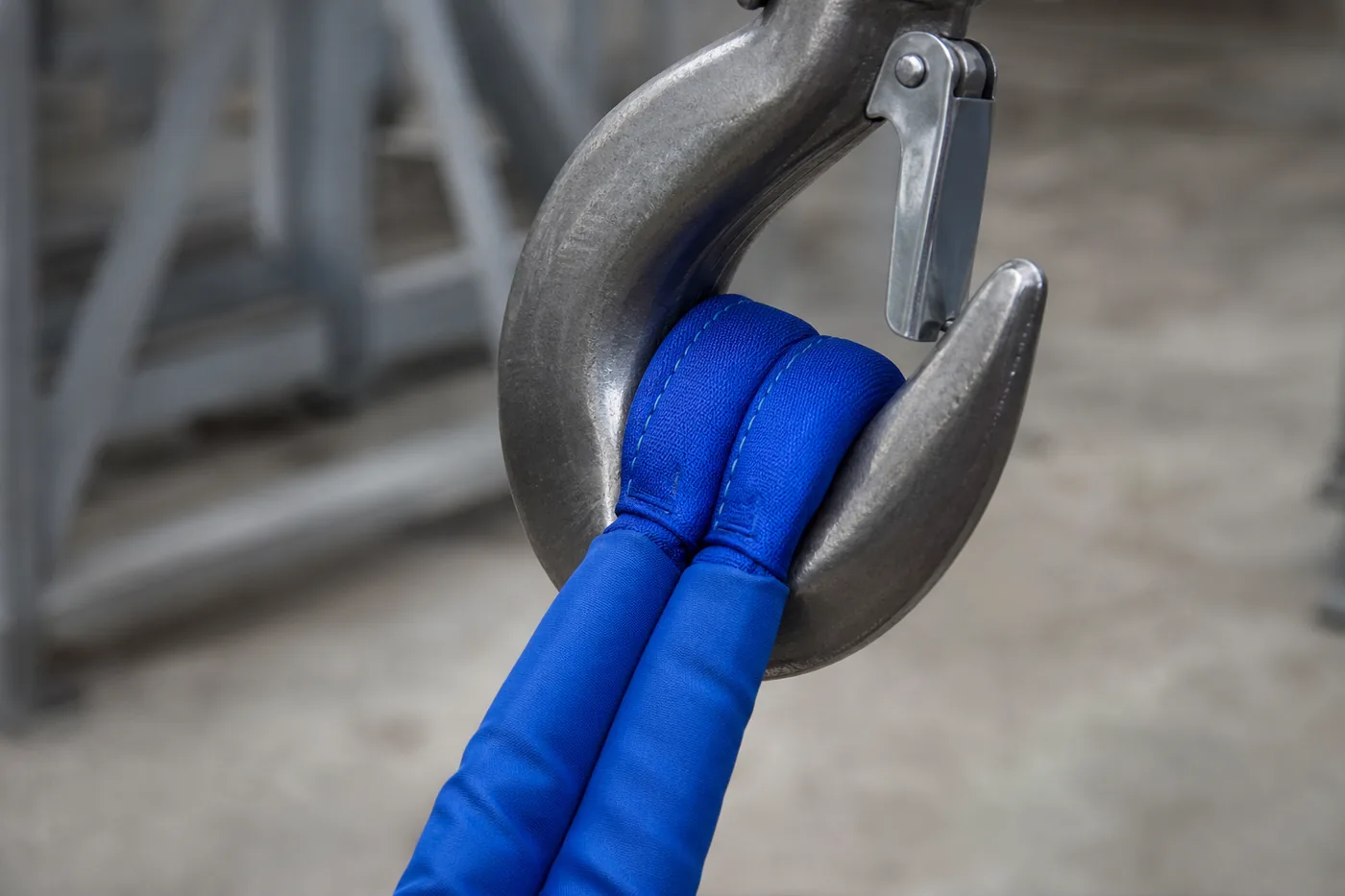
- It sits properly on hardware. A formed eye stays in a hook bowl or over a shackle pin instead of bunching, so the sling is quicker to rig and easier to hand over between shifts.
- Inspection has a starting point. Load crosses the two stitched eyes, so they are checked first — the body second.
Eye types: what gets stitched at the end
| Eye | How it is made | Chosen for |
|---|---|---|
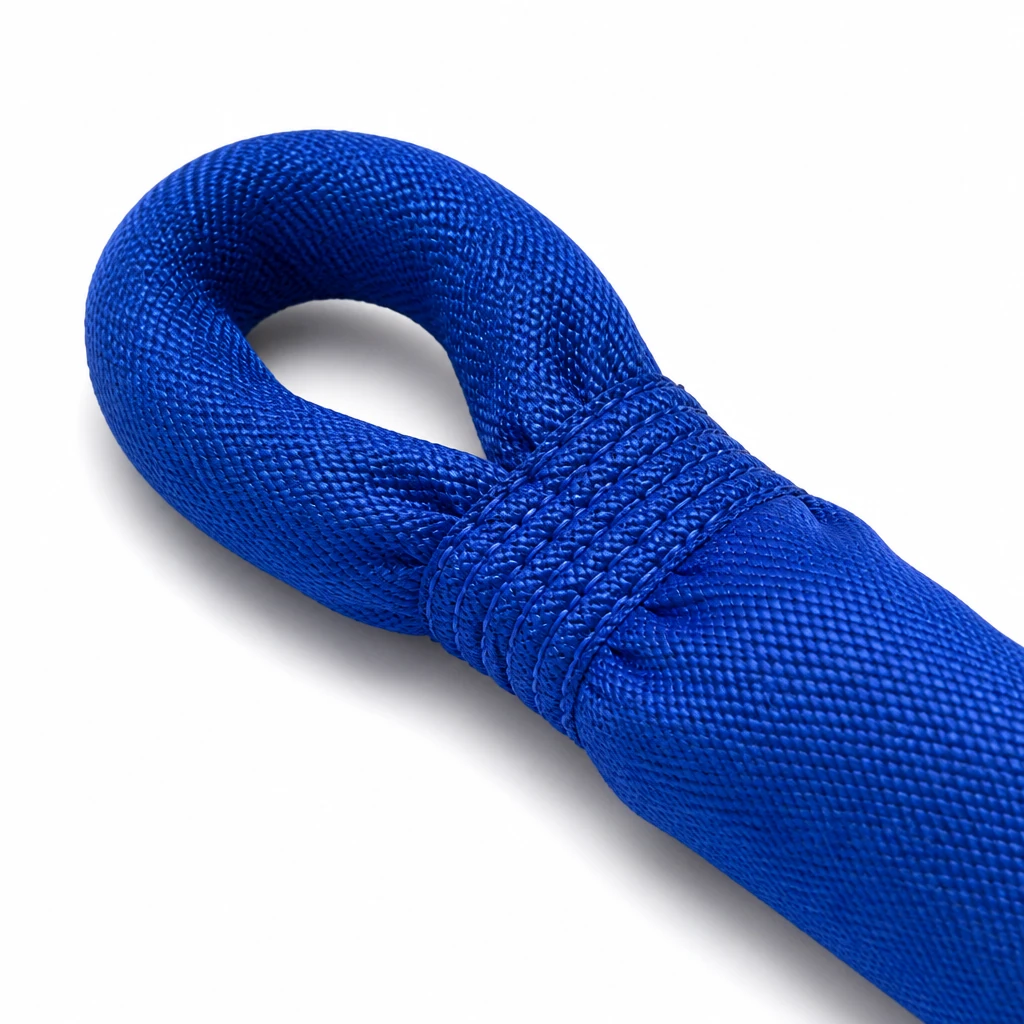
| Flat stitched eye (standard) | Sleeve gathered, laid flat and stitched in multiple rows | General service on hooks, shackles and beams; the lowest build height on the hook |
| Reinforced eye | Extra stitching and a heavier build at the throat | Hard service, worn hook bowls, repeated use on the same edge |
| Eye with wear pad | A sacrificial pad wrapped over the eye and throat | Steel hooks, rough shackles and sites where the eye is dragged into place |
Tell us the hardware the eye will sit on — hook bowl, shackle pin or lifting beam lug — and the eye is built to it. An eye that is too wide for the bowl loads the stitching unevenly; one that is too narrow is slow to rig and gets forced.
Round Sling With Eyes: key specifications
| Product | Round sling with eyes / round sling with two eyes / eye and eye round sling / double eye round sling |
|---|---|
| Construction | Continuous parallel core in a woven tubular sleeve, gathered and stitched at both ends into two eyes |
| Core | High-tenacity polyester parallel yarn, standard; UHMWPE and aramid cores on request |
| Sleeve | Woven high-tenacity polyester, single layer standard; double sleeve and heat-resistant sleeve to order |
| Working load limit | 1,000 kg to 1,000,000 kg, single leg vertical — 27 articles, LFTERS-1 to LFTERS-1000 |
| Body dimensions | Thickness 6–320 mm, width 40–1,050 mm; exact figure per article in the table below |
| Length | Eye to eye, 0.5 m to 80 m; the minimum rises with the article |
| Unit weight | 0.40 kg/m at LFTERS-1 to 222 kg/m at LFTERS-1000 |
| Safety factor | 7:1 to EN 1492-2 practice; other factors to order where the market requires |
| Colour | Stock orange or blue; EN 1492-2 capacity colour when the order asks for the standard code |
| Marking | Working load limit and eye-to-eye length printed on the sleeve; sewn label with WLL, length, serial number and standard |
| Packing | Coiled in a poly bag, labelled carton; pallet or crate on request |
| HS code | 630790 — lifting slings of textile materials |
| MOQ / OEM | Low MOQ for a trial order; OEM on article, length, eye type, sleeve colour, label layout and packing |
Article range: choose the model
The article number is the capacity: LFTERS-10 is the 10,000 kg sling, LFTERS-100 the 100,000 kg one. Thickness and width describe the body; the two length columns give the shortest and longest eye-to-eye distance built in that article; the last column is what the sling weighs per metre, which is what you add to the crane load.
| Art.No. | WLL (kg) | WLL (t) | Thickness (mm) | Width (mm) | Min (m) | Max (m) | Weight (kg/m) |
|---|---|---|---|---|---|---|---|
| LFTERS-1 | 1,000 | 1 | 6 | 40 | 0.5 | 80 | 0.40 |
| LFTERS-2 | 2,000 | 2 | 7 | 50 | 0.5 | 80 | 0.61 |
| LFTERS-3 | 3,000 | 3 | 8 | 60 | 0.5 | 80 | 0.75 |
| LFTERS-4 | 4,000 | 4 | 9 | 70 | 0.5 | 80 | 0.80 |
| LFTERS-5 | 5,000 | 5 | 11 | 75 | 0.5 | 80 | 0.84 |
| LFTERS-6 | 6,000 | 6 | 12 | 80 | 1.0 | 80 | 0.98 |
| LFTERS-8 | 8,000 | 8 | 13 | 90 | 1.0 | 80 | 1.10 |
| LFTERS-10 | 10,000 | 10 | 15 | 100 | 2.0 | 80 | 2.20 |
| LFTERS-12 | 12,000 | 12 | 16 | 110 | 2.0 | 80 | 3.20 |
| LFTERS-15 | 15,000 | 15 | 18 | 125 | 2.0 | 80 | 3.80 |
| LFTERS-20 | 20,000 | 20 | 20 | 150 | 2.5 | 80 | 5.20 |
| LFTERS-25 | 25,000 | 25 | 24 | 180 | 2.5 | 80 | 6.50 |
| LFTERS-30 | 30,000 | 30 | 32 | 200 | 2.5 | 80 | 7.80 |
| LFTERS-40 | 40,000 | 40 | 40 | 200 | 2.5 | 80 | 10.4 |
| LFTERS-50 | 50,000 | 50 | 45 | 220 | 2.5 | 80 | 13.0 |
| LFTERS-60 | 60,000 | 60 | 65 | 220 | 4.0 | 80 | 15.6 |
| LFTERS-80 | 80,000 | 80 | 70 | 260 | 4.0 | 80 | 20.8 |
| LFTERS-100 | 100,000 | 100 | 80 | 290 | 4.0 | 80 | 25.0 |
| LFTERS-200 | 200,000 | 200 | 120 | 450 | 5.0 | 80 | 64.0 |
| LFTERS-300 | 300,000 | 300 | 160 | 525 | 5.0 | 80 | 79.0 |
| LFTERS-400 | 400,000 | 400 | 200 | 670 | 5.0 | 80 | 95.5 |
| LFTERS-500 | 500,000 | 500 | 220 | 750 | 8.0 | 80 | 113.4 |
| LFTERS-600 | 600,000 | 600 | 240 | 820 | 8.0 | 80 | 136.0 |
| LFTERS-700 | 700,000 | 700 | 260 | 870 | 8.0 | 80 | 152.0 |
| LFTERS-800 | 800,000 | 800 | 280 | 930 | 9.0 | 80 | 175.0 |
| LFTERS-900 | 900,000 | 900 | 300 | 990 | 9.0 | 80 | 199.0 |
| LFTERS-1000 | 1,000,000 | 1,000 | 320 | 1,050* | 9.0 | 80 | 222.0 |
* The factory sheet marks the LFTERS-1000 width 1,050 mm with an asterisk: the width column steps up by roughly 60 mm per 100 t from LFTERS-900 (990 mm), and 1,050 mm is the figure consistent with the listed 222 kg/m. Confirm that one cell against the drawing before the sling is made — everything else in the row is unaffected. The maximum length is 80 m in every article; the minimum is the shortest distance the body can be gathered and stitched into two eyes.
Capacity in each arrangement
The article table gives the vertical rating of one leg. Choking or basketing the same sling changes what it may lift: multiply by the factor for the arrangement you will actually rig, and do not add factors together.
| Arrangement | Factor | LFTERS-10 | LFTERS-50 |
|---|---|---|---|
| Vertical | × 1.0 | 10,000 kg | 50,000 kg |
| Choked | × 0.8 | 8,000 kg | 40,000 kg |
| Basket, 0–7° | × 2.0 | 20,000 kg | 100,000 kg |
| Basket, 7–45° | × 1.4 | 14,000 kg | 70,000 kg |
| Basket, 45–60° | × 1.0 | 10,000 kg | 50,000 kg |
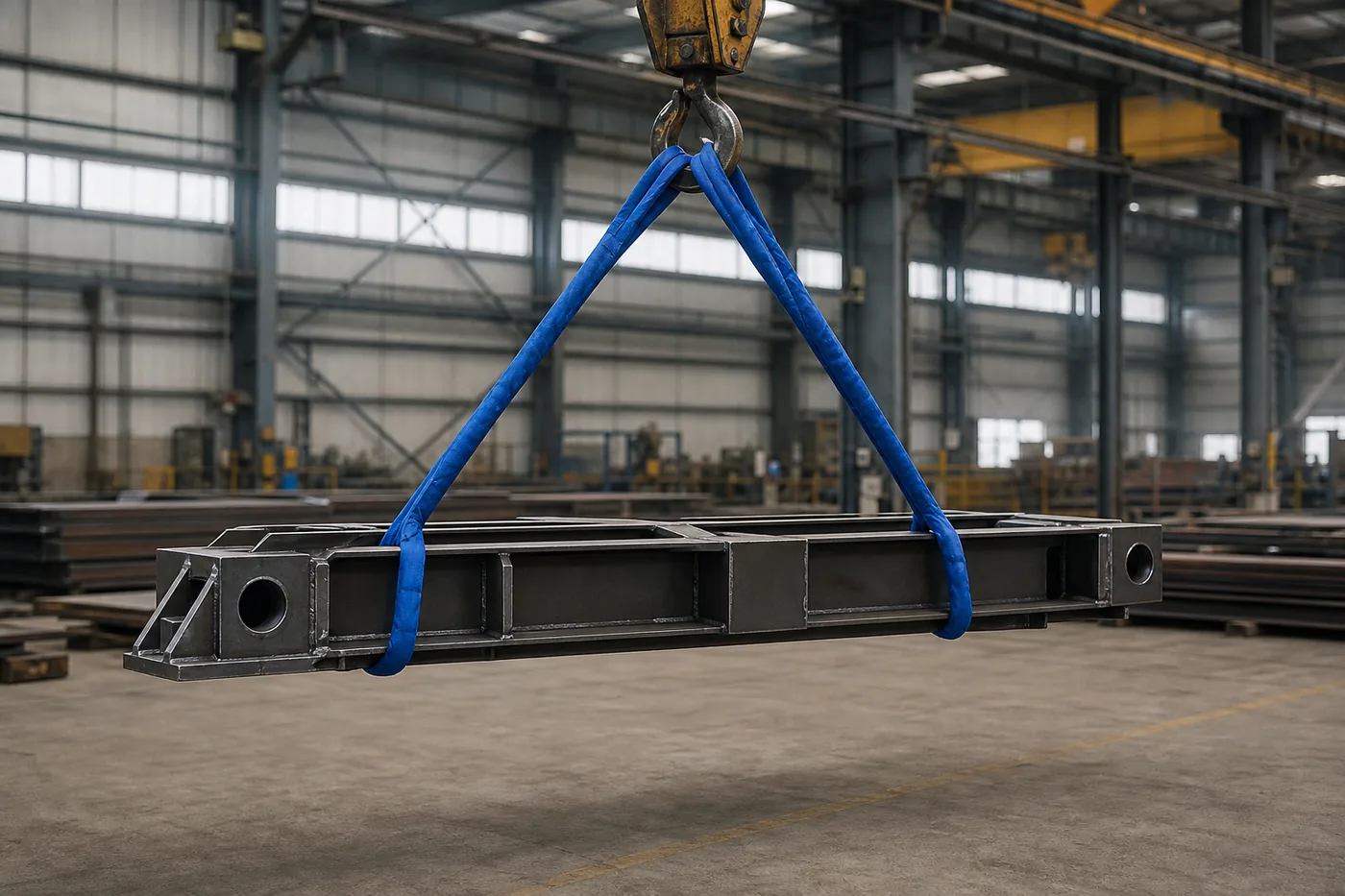
In a basket the round body runs under the load, so the eye-to-eye length has to cover the path round the load plus the headroom to the hook — not just the height of the load. Two legs at an angle share the load by the angle factor of the set, which is why a pair of slings is never simply twice one sling; where the legs would go wide, a lifting beam keeps them vertical and recovers the capacity.
Length: what “eye to eye” means
| Figure | Measured | Used for |
|---|---|---|
| Eye-to-eye length | Inside of one eye to inside of the other | The working length, and the figure printed on the sleeve |
| Overall length | Tip of one eye to tip of the other | Packing, and fitting the sling into a case or a stillage |
| Reach in a basket | Down one side, under the load, up the other, plus headroom | Choosing the length for a basket lift on a known load |
Give us the distance between your two pick-up points and the headroom to the hook; the eye-to-eye figure follows from those two numbers. A sling that only just reaches forces the legs into a wide angle, which costs capacity — the same as buying a smaller sling.
Where it is used
- Repeat lifts of the same machine, mould or precast unit, where the geometry must not change between shifts.
- Rigging eye-to-eye onto a hook, a shackle or a beam lug, with the legs kept vertical.
- Basket lifts under rolls, pipes and machined shafts, where the round body wraps the curve and the eyes gather at the hook.
- Painted, coated or polished plant where a chain or a wire rope sling would mark the surface.
- Yard and rental work where the sling is handed between shifts and the pick-up points have to be obvious.
- Heavy work at the top of the range — the WLL 30T polyester round slings follow the same construction with a heavier body.
With eyes, endless, or flat webbing
| Property | Round sling with eyes | Endless round sling | Flat webbing sling |
|---|---|---|---|
| Ends | Two stitched eyes | None — closed ring | Two eyes on a flat band |
| Length | Defined, eye to eye | Loop circumference or effective length | Defined, eye to eye |
| Wear point | Fixed at the eyes | Rotatable round the loop | Fixed along the band |
| Contact with the load | Round body conforms | Round body conforms | Wide flat face |
| Best for | Repeat lifts, hooking and shackling, fixed geometry | Basket and choke work, awkward shapes, long bodies | Narrow openings, visible load path |
All three are made on the same line. For the closed-loop form see the endless round sling; for the flat form see flat webbing slings. Where the eye has to survive hard service, the double sleeve round sling adds a second wear layer at the same rating; where weight is the problem, a UHMWPE round sling core does the same job at a fraction of the mass.
Inspection and limits
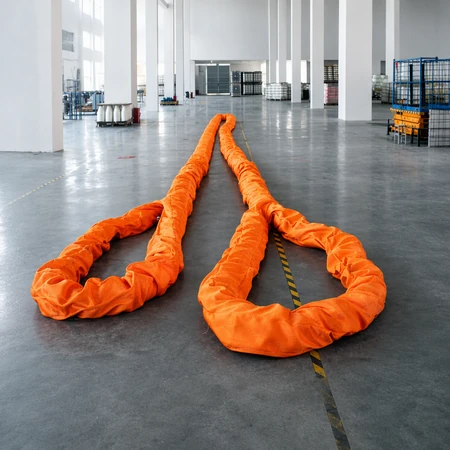
- Eyes first, then the sleeve, then the body — every use, in that order.
- Retire on broken, slack or pulled stitching, a sleeve worn thin at the throat, core visible through the sleeve, heat glazing or chemical staining.
- Never choke on the eye: the eyes are rated terminations, not a place to thread the body back through.
- Protect the edge wherever the body crosses a cut edge; the sleeve is abrasion protection, not armour.
- Do not drag a loaded sling, and store coiled, dry, off the floor and out of daylight.
- Record the lifts and any damage; follow your national practice and the training you have received.
Frequently asked questions
What is a round sling with eyes?
A round sling whose sleeve is gathered and stitched into a reinforced eye at each end instead of being closed into an endless ring. The core and sleeve construction are the same as any round sling; the difference is two defined ends, a measured length and two pick-up points.
Which eye should I order — flat, reinforced or with a wear pad?
Flat stitched eyes for normal service on hooks, shackles and beams. Reinforced eyes where the hook bowl is worn or the sling is repeated on the same edge. A wear pad where the eye is dragged into place on rough hardware. All three are built on the same body at the same rating.
How is the length measured?
Between the eyes — from the inside of one eye to the inside of the other. That figure is the working length and the one printed on the sleeve; the eyes add to the overall length but are not part of it. For a basket, add the path under the load and the headroom to the hook.
Does it hold less than an endless round sling?
No. The working load limit is set by the core and the sleeve, which are the same. What changes is the load path: here the load crosses two stitched eyes instead of running continuously round a loop, so the eyes are the part to inspect first.
What does LFTERS-10 mean?
The article number is the working load limit in tonnes: LFTERS-10 is 10,000 kg vertical, LFTERS-100 is 100,000 kg and LFTERS-1000 is 1,000,000 kg. The range follows the 1-2-3-4-5-6-8-10-12-15-20-25-30-40-50-60-80-100-200-300-400-500-600-700-800-900-1000 ladder — there is no 7 t, 9 t or 11 t article.
Can the capacity be read from the sleeve colour?
Where the EN 1492-2 code is specified on the order, yes: purple 1 t, green 2 t, yellow 3 t, grey 4 t, red 5 t, brown 6 t, blue 8 t, orange 10 t and above. Stock slings are orange or blue regardless of capacity, with the working load limit printed on the sleeve — read the printed figure.
Do you make custom lengths and eye types?
Yes. Any eye-to-eye length inside the Min–Max range of the article, flat, reinforced or wear-pad eyes, aramid or UHMWPE cores, double or heat-resistant sleeves, and your own label layout, language and packing. Send the load, the pick-up points, the headroom and the hardware the eye will sit on.
Request a quote for round slings with eyes
Send the article number or the load, the distance between your pick-up points, the arrangement you will rig, the hook or shackle the eye will sit on, and any marking your market requires. We will come back with the body, the eye, the length, a sample and a factory-direct price. The rest of the series is on the round sling range page.