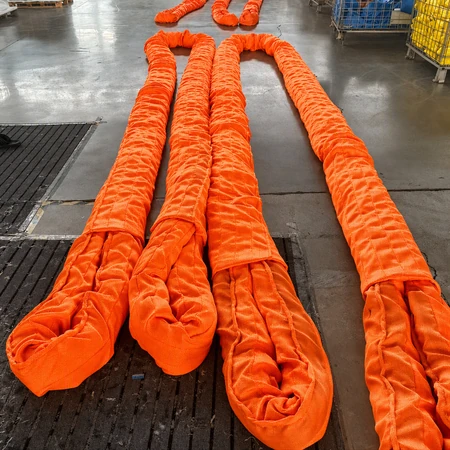
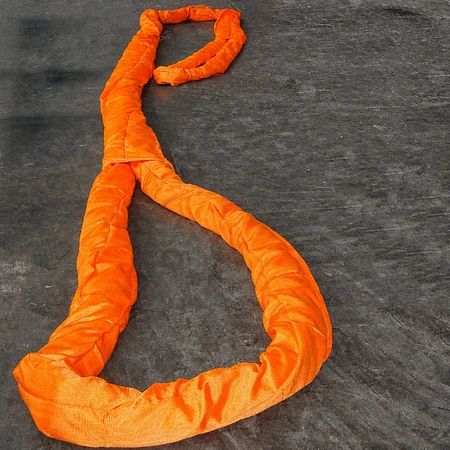
Lift sling rigging company produce Eye-Eye Round Sling,Eye & Eye Round Sling,Eye and Eye Polyester Round Sling,double-eye round sling.
Eye-Eye Round Sling — Double Eye Sling, 1–1000 t
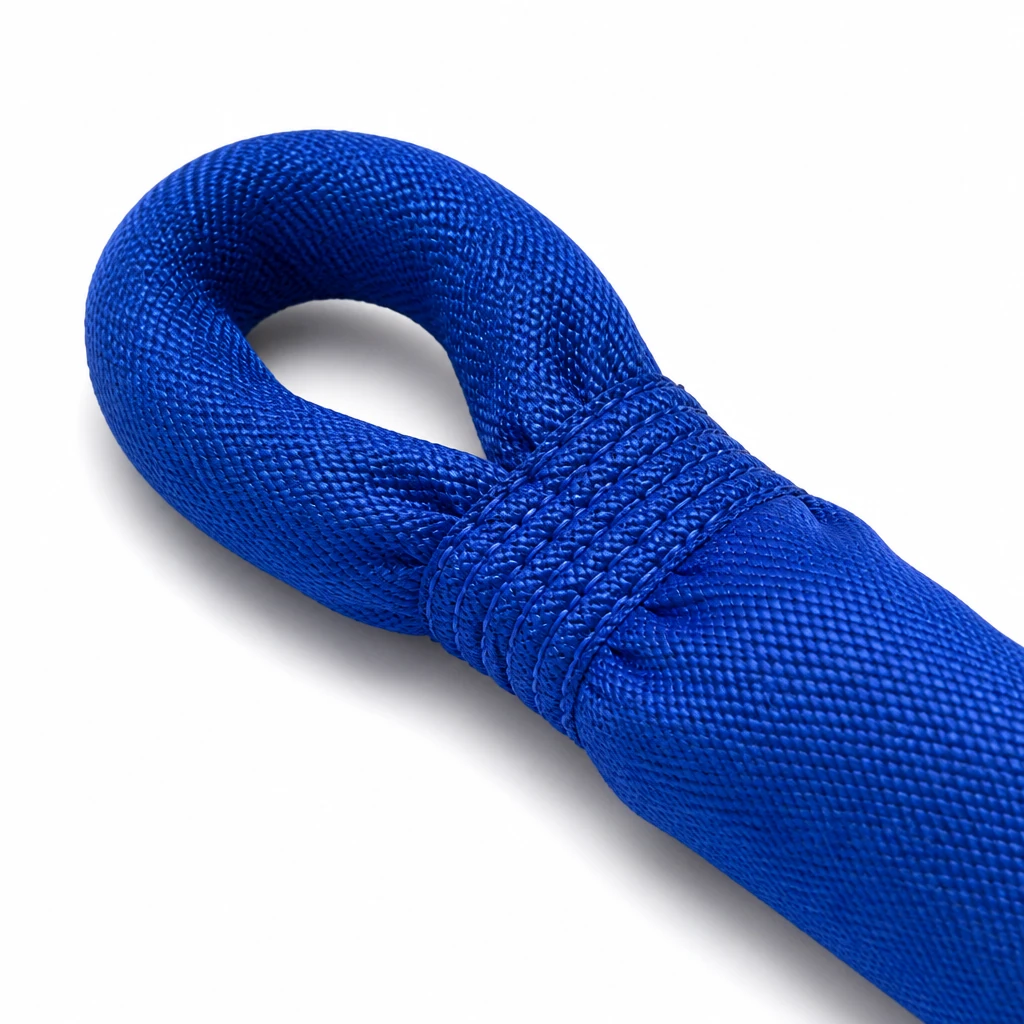
An eye-eye round sling is a round sling terminated at each end: the woven sleeve is gathered and stitched into two reinforced eyes, so the sling has a fixed length and two known pick-up points instead of an endless loop. It is made in high-tenacity polyester across 27 LFTERS articles, from 1,000 kg to 1,000,000 kg, in eye-to-eye lengths from 0.5 m to 80 m. The table below gives the article, the working load limit, the body thickness and width, the length range and the weight per metre — enough to pick the model before you send the enquiry.
- Working load limit1,000 kg to 1,000,000 kg
- Article rangeLFTERS-1 to LFTERS-1000, 27 sizes
- Body dimensions6 × 40 mm up to 320 × 1,050 mm
- Length0.5–80 m eye-to-eye
- Unit weight0.4 to 222 kg/m
- Safety factor7:1 to EN 1492-2 practice
Why specify an eye-eye round sling rather than an endless one
An endless round sling goes round anything and spreads its own wear. An eye and eye round sling gives up a little of that freedom for something a rigging team values more on a repeated lift: certainty. The length you ordered is the length you get, the eyes land in the same place every time, and the hook or shackle takes a formed eye instead of a bunch of sleeve.
- A length that repeats. The eye-to-eye distance is a specification, not a result, so a lift carried out next month matches the one carried out today.
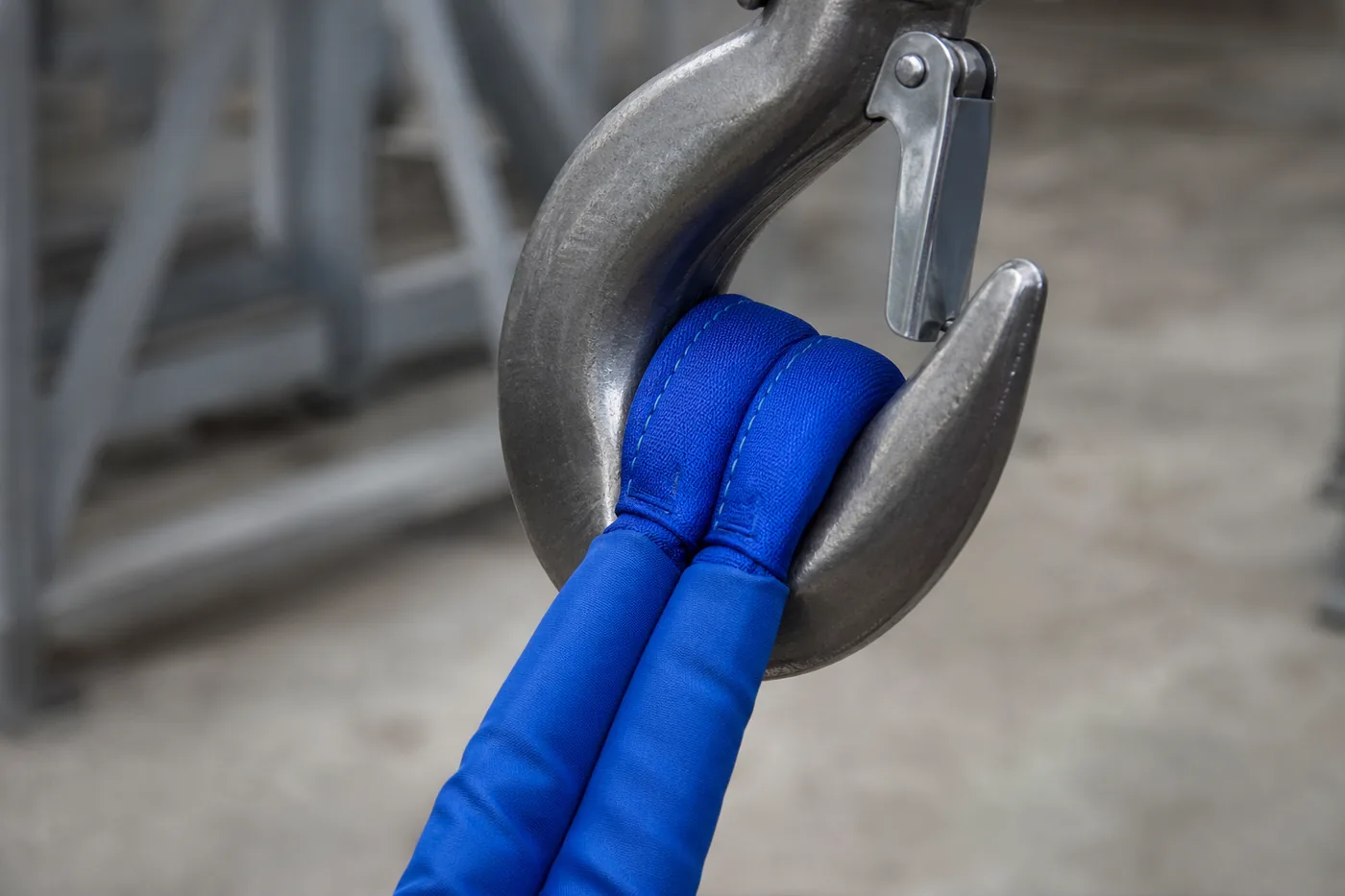
- Two defined pick-up points. The eye sits in the hook bowl or the shackle pin as a unit — quick to rig, quick to check, easy to hand over between shifts.
- The round body is unchanged. Under the load the sleeve still conforms to a roll, a pipe, a trunnion or a machined face, so nothing is marked and nothing is point-loaded.
- One place to look first. Load transfers through the two stitched eyes, so inspection starts and usually ends there.
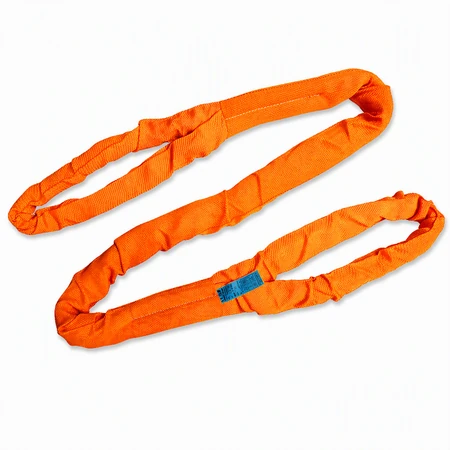
Eye-Eye Round Sling specifications
| Product name | Eye-eye round sling / eye and eye round sling / eye to eye round sling / double eye round sling |
|---|---|
| Construction | Continuous parallel core inside a woven tubular sleeve, gathered and stitched at both ends into two reinforced eyes |
| Core | High-tenacity polyester parallel yarn, standard; UHMWPE and aramid cores on request |
| Sleeve | Woven high-tenacity polyester, single or double layer; heat-resistant sleeve to order |
| Working load limit | 1,000 kg to 1,000,000 kg across 27 articles — LFTERS-1 · -2 · -3 · -4 · -5 · -6 · -8 · -10 · -12 · -15 · -20 · -25 · -30 · -40 · -50 · -60 · -80 · -100 · -200 · -300 · -400 · -500 · -600 · -700 · -800 · -900 · -1000 |
| Body | Thickness 6–320 mm, width 40–1,050 mm; see the article table for the exact figure of each size |
| Length | Eye-to-eye, 0.5 m to 80 m; the minimum rises with the article — 0.5 m at LFTERS-1, 9.0 m at LFTERS-1000 |
| Unit weight | 0.4 kg/m at LFTERS-1 to 222 kg/m at LFTERS-1000, used for shipping and for crane load calculations |
| Safety factor | 7:1 to EN 1492-2 practice; other factors to order where the market requires |
| Eye type | Flat stitched eye standard; reinforced eye and wear pad optional |
| Colour | Stock orange or blue; EN 1492-2 capacity colour applied when the order asks for the standard code |
| Marking | Sewn label: article number, working load limit, eye-to-eye length, batch number |
| Packing | Coil in poly bag or carry bag, labelled carton, export packing |
| MOQ / OEM | Low MOQ for trial orders; full OEM on article, length, sleeve colour, label layout and packing |
Article range: choose the model
The article number carries the capacity — LFTERS-10 is the 10,000 kg sling, LFTERS-100 the 100,000 kg one. Thickness and width describe the body; the last columns give the shortest and longest eye-to-eye length made in that article, and what the sling weighs per metre so it can be added to the crane load.
| Art.No. | WLL (kg) | WLL (t) | Thickness (mm) | Width (mm) | Min (m) | Max (m) | Weight (kg/m) |
|---|---|---|---|---|---|---|---|
| LFTERS-1 | 1,000 | 1 | 6 | 40 | 0.5 | 80 | 0.40 |
| LFTERS-2 | 2,000 | 2 | 7 | 50 | 0.5 | 80 | 0.61 |
| LFTERS-3 | 3,000 | 3 | 8 | 60 | 0.5 | 80 | 0.75 |
| LFTERS-4 | 4,000 | 4 | 9 | 70 | 0.5 | 80 | 0.80 |
| LFTERS-5 | 5,000 | 5 | 11 | 75 | 0.5 | 80 | 0.84 |
| LFTERS-6 | 6,000 | 6 | 12 | 80 | 1.0 | 80 | 0.98 |
| LFTERS-8 | 8,000 | 8 | 13 | 90 | 1.0 | 80 | 1.10 |
| LFTERS-10 | 10,000 | 10 | 15 | 100 | 2.0 | 80 | 2.20 |
| LFTERS-12 | 12,000 | 12 | 16 | 110 | 2.0 | 80 | 3.20 |
| LFTERS-15 | 15,000 | 15 | 18 | 125 | 2.0 | 80 | 3.80 |
| LFTERS-20 | 20,000 | 20 | 20 | 150 | 2.5 | 80 | 5.20 |
| LFTERS-25 | 25,000 | 25 | 24 | 180 | 2.5 | 80 | 6.50 |
| LFTERS-30 | 30,000 | 30 | 32 | 200 | 2.5 | 80 | 7.80 |
| LFTERS-40 | 40,000 | 40 | 40 | 200 | 2.5 | 80 | 10.4 |
| LFTERS-50 | 50,000 | 50 | 45 | 220 | 2.5 | 80 | 13.0 |
| LFTERS-60 | 60,000 | 60 | 65 | 220 | 4.0 | 80 | 15.6 |
| LFTERS-80 | 80,000 | 80 | 70 | 260 | 4.0 | 80 | 20.8 |
| LFTERS-100 | 100,000 | 100 | 80 | 290 | 4.0 | 80 | 25.0 |
| LFTERS-200 | 200,000 | 200 | 120 | 450 | 5.0 | 80 | 64.0 |
| LFTERS-300 | 300,000 | 300 | 160 | 525 | 5.0 | 80 | 79.0 |
| LFTERS-400 | 400,000 | 400 | 200 | 670 | 5.0 | 80 | 95.5 |
| LFTERS-500 | 500,000 | 500 | 220 | 750 | 8.0 | 80 | 113.4 |
| LFTERS-600 | 600,000 | 600 | 240 | 820 | 8.0 | 80 | 136.0 |
| LFTERS-700 | 700,000 | 700 | 260 | 870 | 8.0 | 80 | 152.0 |
| LFTERS-800 | 800,000 | 800 | 280 | 930 | 9.0 | 80 | 175.0 |
| LFTERS-900 | 900,000 | 900 | 300 | 990 | 9.0 | 80 | 199.0 |
| LFTERS-1000 | 1,000,000 | 1,000 | 320 | 1,050* | 9.0 | 80 | 222.0 |
* LFTERS-1000 body width is 1,050 mm. The width column steps up by roughly 60 mm per 100 t from LFTERS-900 (990 mm), and 1,050 mm is the figure consistent with the listed 222 kg/m; the source sheet carries one zero too many. Maximum length is 80 m in every article, and the minimum is the shortest eye-to-eye distance the body can be gathered and stitched into.
What the sling lifts in each arrangement
The working load limit in the article table is the vertical figure. Choking or basketing the same sling changes what it may lift, and the multipliers below are applied to that figure — they are not added to it. Three articles are worked out; the same factors apply to all 27.
| Arrangement | Factor | LFTERS-10 | LFTERS-50 | LFTERS-100 |
|---|---|---|---|---|
| Vertical | × 1.0 | 10,000 kg | 50,000 kg | 100,000 kg |
| Choked | × 0.8 | 8,000 kg | 40,000 kg | 80,000 kg |
| Basket, 0–7° | × 2.0 | 20,000 kg | 100,000 kg | 200,000 kg |
| Basket, 7–45° | × 1.4 | 14,000 kg | 70,000 kg | 140,000 kg |
| Basket, 45–60° | × 1.0 | 10,000 kg | 50,000 kg | 100,000 kg |
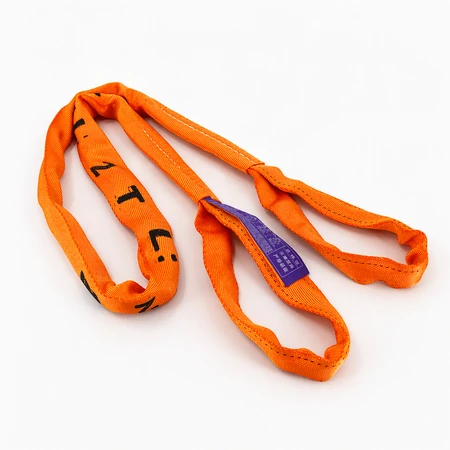
How to order
- The article. Take the load at each leg, divide by the arrangement factor above, and choose the first article whose working load limit covers the result.
- The eye-to-eye length. Measure inside eye to inside eye, then add headroom so the legs do not splay into a wide angle that costs capacity. It has to sit between the Min and Max columns of that article.
- The eye type. Flat stitched eyes for normal service; reinforced eyes or wear pads where the hook bowl is worn or the sling is repeated on the same edge.
- The environment and the marking. Temperature, chemicals, water, daylight, and the identification or certificate the receiving site has to read.
Quote it as article, length and option — for example LFTERS-10, 6 m eye-to-eye, flat stitched eye, single polyester sleeve. Any article can be built in any length inside its range, and the weight per metre lets you confirm the total before the crane is booked.
Construction: what carries the load, and what protects it
Three parts decide the service life of an eye to eye round sling. The core is a bundle of parallel polyester yarn running unbroken from eye to eye; it carries the entire load and elongates very little. The sleeve is a woven tube over the core that takes abrasion, dirt and daylight, and carries the colour, the printed working load limit and the label. The eyes are the two places where the sleeve is gathered and the stitching takes the load path.
That hierarchy explains most retirements: a sleeve cut through so the core is visible retires the sling even when the core still looks sound, and stitching that is broken, slack or pulled retires it even when the sleeve is intact. On an endless sling the load passes continuously round the loop; here it has to cross two stitched terminations, and those terminations are where it will fail first.
Eye-eye, endless or flat webbing: which one for the lift
| Property | Eye-eye round sling | Endless round sling | Flat webbing sling |
|---|---|---|---|
| Ends | Two stitched eyes | None — closed ring | Two eyes, flat body |
| Length | Defined, eye to eye | Loop circumference | Defined, eye to eye |
| Wear point | Fixed at the eyes | Rotatable round the loop | Fixed along the band |
| Contact with the load | Round body conforms | Round body conforms | Wide flat face |
| Capacity in a slim profile | High — parallel core | High — parallel core | Needs width and plies |
| Best for | Repeat lifts, hooking and shackling, fixed geometry | Awkward shapes, spreading wear, very large capacities | Narrow openings, visible load path |
Both round sling forms are made on the same line from the same core and sleeve, so the choice between them is a rigging decision, not a capacity one. For the endless form see our endless round sling range; for the flat form see flat webbing slings.
Where an eye-eye sling earns its place
- Repeated lifts of the same machine or mould, where the geometry must not change between shifts.
- Rigging eye-to-eye onto a hook, a shackle or a lifting spreader beam that keeps the legs vertical.
- Basket lifts under rolls, pipes, tubes and machined shafts, where the round body wraps the curve.
- Steel plate, sheet and coil packs that need soft bearing and high capacity in one slim sling.
- Painted, coated or polished plant where a chain or a wire rope sling would mark the surface.
- Very heavy work at the top of the range — the WLL 30T polyester round slings and the 1100 tonne UHMWPE round sling take the same construction further.
Inspection, care and limits
- Eyes first, then sleeve, then body — in that order, before every use.
- Retire on broken or pulled stitching, a sleeve worn thin at the eye, core visible through the sleeve, heat glazing, or chemical staining.
- Protect the edge. The sleeve is abrasion protection, not armour; use an edge protector wherever the body crosses a cut edge.
- Do not choke on the eye. The eyes are rated terminations, not a place to thread the body back through.
- Never drag a loaded sling, and store it dry, off the floor and out of daylight.
- Record the lifts and any damage, and follow the practice of your national governing body and the training you have received.
Frequently asked questions
What is an eye-eye round sling?
A round sling whose sleeve is gathered and stitched into a reinforced eye at each end, instead of being closed into an endless ring. The core and the sleeve-over-core construction are the same as any round sling; the difference is two defined ends, a defined length and two defined pick-up points.
What do the LFTERS article numbers mean?
The number is the working load limit in tonnes on the 1-2-3-4-5-6-8-10-12-15-20-25-30-40-50-60-80-100-200-300-400-500-600-700-800-900-1000 ladder. LFTERS-10 is rated 10,000 kg vertical, LFTERS-100 is 100,000 kg and LFTERS-1000 is 1,000,000 kg. There is no article for 7 t, 9 t or 11 t — the range steps in the sequence shown.
How is the length measured on an eye and eye round sling?
Between the eyes — from the inside of one eye to the inside of the other. The eyes add to the overall measurement but are not part of the working length. Each article has its own minimum, from 0.5 m at LFTERS-1 to 9.0 m at LFTERS-1000, and 80 m is the maximum in every size.
How much does the sling weigh?
The last column of the article table is the weight per metre: 0.40 kg/m at LFTERS-1, 2.20 kg/m at LFTERS-10 and 222 kg/m at LFTERS-1000. Multiply by the eye-to-eye length and add the eyes and fittings to get the figure to put against the crane’s capacity.
What can a 10,000 kg eye-eye round sling lift in a basket?
20,000 kg at a basket angle of 0–7°, 14,000 kg between 7° and 45°, and 10,000 kg between 45° and 60°. Choked, the same sling is rated 8,000 kg. The 10,000 kg figure printed on the sleeve is the vertical rating only.
Can the capacity be identified from the sleeve colour?
Where the EN 1492-2 code is specified on the order, yes: purple 1 t, green 2 t, yellow 3 t, grey 4 t, red 5 t, brown 6 t, blue 8 t and orange from 10 t upward. Stock slings are orange or blue regardless of capacity, with the working load limit and article number printed on the sleeve — so read the printed figure, not the colour.
Do you make custom lengths, eye types and sleeve colours?
Yes. Any eye-to-eye length inside the Min–Max range of the article, flat stitched eyes as standard with reinforced eyes and wear pads optional, aramid or UHMWPE cores, heat-resistant sleeves, and your own label layout, language and packing. Send the load, the pick-up points, the headroom and the environment for a sized quotation.
Request a quote for eye-eye round slings
Send the article number or the load, the distance between your pick-up points, the arrangement you will rig, the headroom, and any marking or certification your market requires. We will come back with the sleeve, the length, a sample and a factory-direct price. Related specifications: double sleeve heavy duty round sling for hard service, and UHMWPE round slings where weight matters more than cost. For the termination on its own, without the ordering detail, see the shorter round sling with eyes overview.