

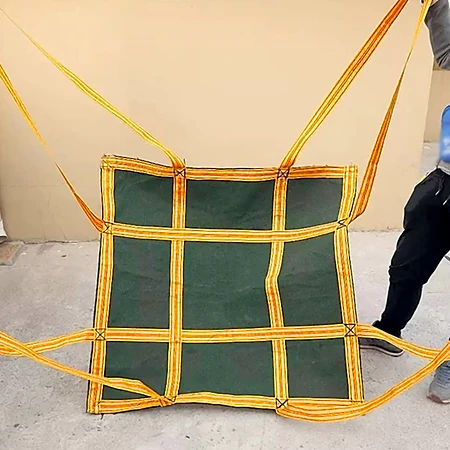
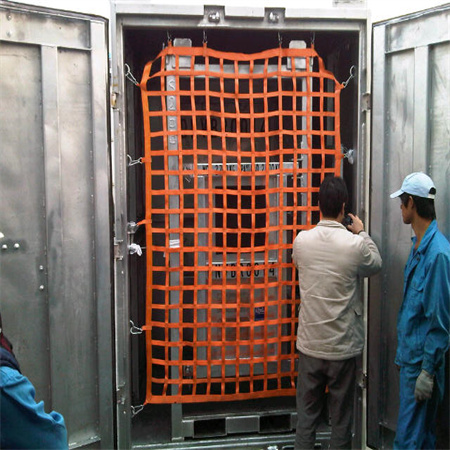
Lift sling rigging company produce Crane Pallet Cargo Net,Air Cargo Pallet Net,Cargo Lifting Pad Net,Cargo Net Hoist Crane Pallet Bag with Reinforced Handles,Military Pallet Net,Crane Pallet Cargo Net.
Crane Pallet Cargo Net
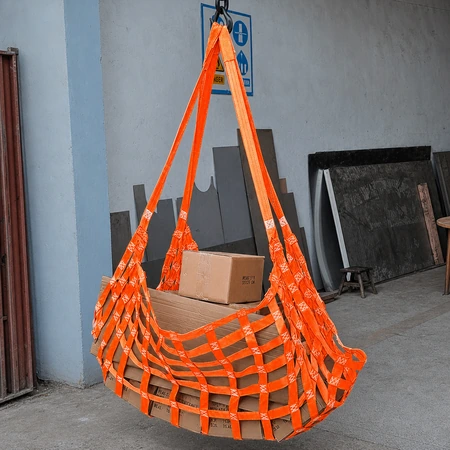
A crane pallet cargo net is a webbing net cut to a pallet, so that a pallet and everything stacked on it travel as one unit on the crane hook. The net is spread on the ground, the pallet is set down on it, the load is stacked as it normally would be, and the four corner loops are drawn up past the stack and gathered onto the hook. The pallet never leaves the load, and nothing is re-stacked at the far end.
The net is quoted from the pallet footprint rather than from the load. We cut it 100 to 200 mm larger than the pallet on every side, so the border clears the pallet corners and the stack stays square inside the mesh – which is the whole discipline of a pallet net. We weave the webbing in our own mill in Taizhou, so footprint, mesh, band width and rated capacity are set to your pallet rather than picked from a catalogue, and nets run from 0.5 t to 20 t with every net proof-load tested before it ships.
- Sized to the pallet, not the load – quoted from the footprint plus a 100-200 mm overhang, so the border clears the pallet corners and the stack stays square.
- 100 mm mesh as standard – holds cartons, bags, drums and bricks without strapping; 50 mm to 300 mm to order.
- Four reinforced corner loops – a doubled, multi-stitched border carries the whole load out of the mesh and into the loops.
- Flat, soft webbing – the load is carried on a distributed pressure instead of a point load, so cartons are not crushed and stretch wrap is not cut through.
- CE and GS certified – 0.5 t to 20 t, proof-load tested on our own 1000 t machine, with ISO 9001, CNAS and DNV behind the plant.
Why a pallet net rather than forks, banding or a cage
A pallet can be moved by forklift, by crane with a net, in a steel cage, or held together with banding and stretch wrap. On crane work the webbing net usually wins for reasons that have nothing to do with strength – and the comparison is worth making explicit, because buyers often arrive already committed to a cage.
Table 1 – The four ways of moving a pallet load, and where each one stops working.
| Method | What it is good at | Where it falls short |
|---|---|---|
| Forklift forks | Speed on flat ground and inside a warehouse | Cannot reach over a wall, into a hold, onto a roof or across a barge |
| Steel cage or pallet collar | Rigid protection and stacking | Heavy, expensive, bulky to store and to return, and it is lifted with the load every time |
| Banding and stretch wrap | Cheap, light, and it keeps a stack tidy for transit | One trip only; cut at the far end, crushes the bottom cartons, and carries no load for a crane lift |
| Webbing pallet net | Crane access anywhere, reusable for years, folds away between jobs | Needs the correct footprint and a rated loop arrangement – it is not a universal size |
The practical difference comes down to three points. A net weighs a fraction of a cage and folds into a bag when the truck has gone. It is reusable for years instead of one trip, so the cost per lift falls with every use. And because the band is flat and wide, the bottom cartons arrive in the condition they left in – which is the complaint that banding and strapping most often attract.
Sizing a crane pallet cargo net: footprint plus overhang
Almost every pallet net that fails in service was ordered to the wrong footprint. Two rules settle it: measure the pallet, not the load, and add 100 to 200 mm on every side. The overhang is what keeps the border clear of the pallet corners; reduce it to save width and the net will not drop cleanly over a full stack.
Table 2 – Standard pallet footprints and the net size that fits each one.
| Pallet type | Pallet footprint | Recommended net | Where it is standard |
|---|---|---|---|
| Display / half pallet | 600 × 400 mm | 800 × 600 mm | Retail display units, Europe |
| Half pallet | 800 × 600 mm | 1000 × 800 mm | Europe; display and half-size units |
| EPAL / Euro pallet | 1200 × 800 mm | 1400 × 1000 mm | Europe – the most common pallet in the world |
| ISO1 / industrial pallet | 1200 × 1000 mm | 1400 × 1200 mm | Europe and Asia |
| GMA / North American | 48 × 40 in (1219 × 1016 mm) | 1420 × 1220 mm | North America – the grocery standard |
| ISO2 / square pallet | 1200 × 1200 mm | 1400 × 1400 mm | Europe, Asia and Australia |
| Australian standard | 1165 × 1165 mm | 1365 × 1365 mm | Australia |
Measured with the load off the pallet. A net that only just fits an empty pallet will not go over a full one, and a net that fits with the load on but not off has been cut by the pallet, not by us.
Load height works differently. It does not change the length or width of the net; it sets how far the mesh has to drop from the loops to the bottom of the stack. Tell us the finished load height and we set the leg length, so the loops gather above the stack instead of disappearing into it.
Base lift or top cover – four ways to rig it
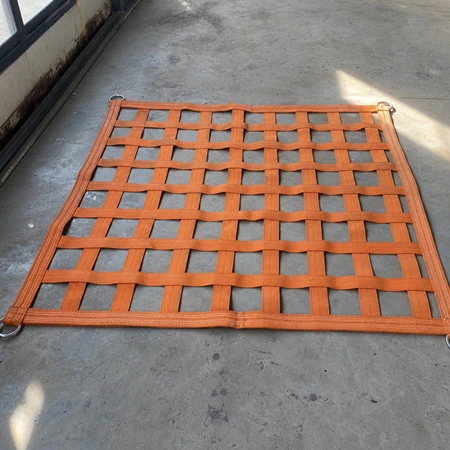
This is the decision that most often goes wrong, and it is cheaper to settle before the order than after the first lift. The four arrangements are not interchangeable, and only two of them are lifting duty.
Table 3 – How the net goes on the pallet, and what each arrangement is for.
| Arrangement | How it is rigged | Used when |
|---|---|---|
| Base net (lifting) | Net on the ground, pallet set on it, load stacked, four loops pulled up past the load onto the hook | The standard crane lift – pallet and load leave the ground together and the pallet is part of the consignment |
| Top cover only (not lifting) | Net dropped over an already-loaded pallet and hooked down | Holding a stack together in transit or against wind; the pallet is lifted separately on base slings |
| Closed-bottom bag on a pallet | Pallet carries loose goods inside the bag, and the bag is lifted from its loops | Bricks, bagged material, offcuts and reject parts presented on a pallet |
| Eight-loop lift on a beam | Loops spread onto a spreader beam instead of gathered on one hook | Wide or heavy pallets where the stack must stay square and level |
One warning we give every buyer: a net fitted as a top cover is not automatically a lifting net. Lifting duty has to be designed in – rated capacity, safety factor, loop construction and a proof test per net. The tensioned version for holding loads down in transit is a cargo securing net, and it is rated differently on purpose.
Where the load cannot be palletised at all – sacks, bulk material, loose aggregate – the right product is a polyester lifting hoisting net, which is sized from the cargo rather than from a pallet.
Technical parameters
The figures below cover the standard crane pallet cargo net range. Footprint, mesh, band, layer count, loop arrangement and rated capacity are all made to order, so treat this as the starting point for a quotation rather than a fixed catalogue.
Table 4 – Crane pallet cargo net: technical parameters.
| Parameter | Specification |
|---|---|
| Product type | Pallet cargo net for crane lifting – base net, closed-bottom bag or eight-loop net for beam lifts |
| Band material | 100 % high-tenacity polyester (PET) webbing; high-tenacity nylon on request |
| Band width | 25 / 50 / 75 / 100 mm (50 mm standard) |
| Band construction | Single layer or duplex; woven selvedge, not a cut edge |
| Band thickness | 1.8 mm – 4.0 mm depending on width and layer count |
| Mesh opening | 100 × 100 mm square standard; 50 mm – 300 mm to order |
| Net size | Pallet footprint plus 100 – 200 mm overhang on every side |
| Standard footprints | 600 × 400, 800 × 600, 1200 × 800, 1200 × 1000, 1200 × 1200, 1165 × 1165 mm and 48 × 40 in; made to drawing |
| Leg length | Set from the finished load height, so the loops gather above the stack |
| Border | Doubled webbing, folded and multi-row stitched, reinforced at every loop |
| Lifting points | Four corner loops standard; eight for a spreader beam |
| Rated capacity (WLL) | 0.5 t – 20 t, set by footprint, band, layer count and lifting arrangement |
| Safety factor | 5:1 / 6:1 / 7:1 |
| Elongation at WLL | 7 % or less |
| Colour | Colour code by working load limit, or a custom house colour |
| Working temperature | -40 °C to +100 °C |
| Treatment | UV stabilised, anti-ageing, abrasion and tear resistant, rot-proof |
| Standard basis | Webbing rated to the EN 1492-1 basis |
| Certification | CE, GS, ISO 9001, JIS on request; CNAS laboratory; DNV |
| Customisation | OEM / ODM size, colour, printed band, label, logo and packing |
| HS code | 6307.90 – lifting nets of textile materials |
Net sizes and rated capacities
Capacity follows the footprint, the band and the number of lifting points together. At four corner loops the figures below apply; heavier duty is quoted from a wider or duplex band rather than from a bigger net, because a larger net on the same band only spreads the same strength more thinly.
Table 5 – Net sizes and rated capacities at four corner loops.
| Net size | Mesh | Band | Rated capacity | Typical pallet load |
|---|---|---|---|---|
| 1000 × 800 mm | 100 mm | 50 mm single | 0.5 – 1.5 t | Half pallets, display units, small cartons |
| 1400 × 1000 mm | 100 mm | 50 mm duplex | 1 – 3 t | Euro pallet of cartons, bags or tinned goods |
| 1400 × 1200 mm | 100 mm | 50 mm duplex | 2 – 4 t | ISO1 pallet, drums, boxed machine parts |
| 1420 × 1220 mm | 100 mm | 50 mm duplex | 2 – 4 t | North American 48 × 40 in pallet |
| 1400 × 1400 mm | 100 mm | 50 mm duplex | 2 – 5 t | ISO2 square pallet, denser loads |
| 2000 × 2000 mm | 100 – 150 mm | 75 mm duplex | 4 – 8 t | Oversized pallets, two pallets carried together |
| 2500 × 2500 mm | 150 mm | 75 – 100 mm duplex | 6 – 12 t | Pallet frames and stillages |
| Made to drawing | 50 – 300 mm | 25 – 100 mm | 0.5 – 20 t | Any footprint, including truck bed and container sizes |
Ratings assume four loops gathered on one hook and a load that stays inside the net. A two-loop basket under the pallet de-rates the net – ask for the derated figure rather than reading across from this table.
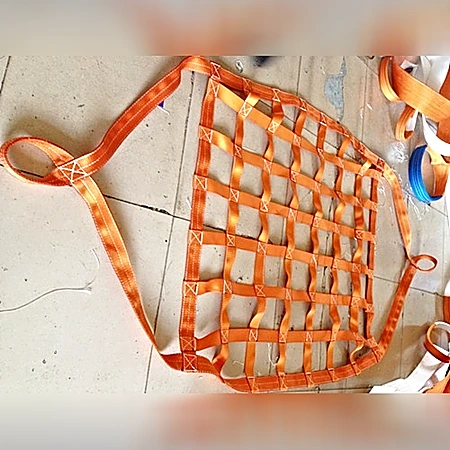
Band, mesh and corner options
Three choices decide how a pallet net behaves in service: the band, the mesh and the corner. All three are fixed on the drawing, and changing one later means a new net.
Table 6 – Band, mesh and corner options.
| Option | What it does | Choose it when |
|---|---|---|
| 50 mm single band | The lightest band we weave | Half pallets and loads under 1.5 t where net weight matters |
| 50 mm duplex band | Two layers stitched as one band – the pallet standard | Almost every pallet load; roughly double the wear life of a single band |
| 75 / 100 mm duplex | Wider band, lower pressure per band | Dense loads, and any load with hard or square edges |
| 100 mm square mesh | Our standard pallet mesh | Cartons, bags, drums, bricks and boxed goods |
| 50 mm mesh | Tighter mesh | Small items that could squeeze through a 100 mm opening |
| 150 – 300 mm mesh | Wider mesh, lighter net | Large unit loads that cannot escape the lattice |
| Reinforced corner | Extra webbing and multi-row stitching at each loop | All lifting duty, and always above 3 t |
| Protection sleeve | PU sleeve or wear pad at the contact point | Pallets with nails or splinters, or sharp-edged loads |
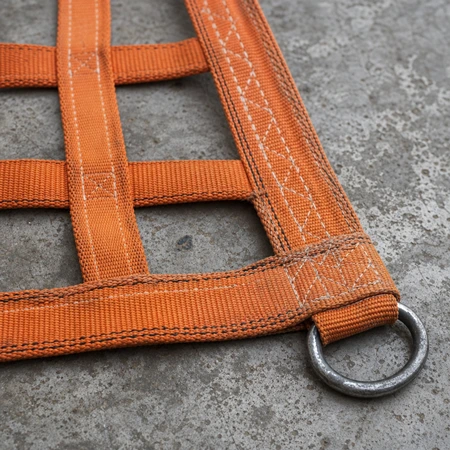
Lifting configurations and fittings
How the net is hung decides how much of the pallet it actually carries. These are the arrangements we fit most often, in the order we recommend them.
- Four loops on the hook – the standard. The loops gather on the hook or a master ring and the net closes on the stack as the crane takes up the slack.
- Eight loops on a spreader beam – the net stays square, the load stays level and each corner carries a predictable share; the right answer for wide or heavy pallets, see our lifting spreader beam range.
- Two-loop basket under the pallet – base slings run under the pallet and up two sides. Fast to rig, but it de-rates the net; ask for the derated capacity.
- Choke through the pallet voids – only where the pallet is sound and the void is a designed lift point, and only at a derated capacity.
Fittings supplied or fitted on request: sewn webbing loops, master rings and master links, grade 80 shackles for beam lifts, PU-coated band for outdoor and high-abrasion duty, protection sleeves for nailed pallets, and repair kits with matching band and thread for fleets that maintain their own equipment.
Two rules survive every arrangement. The load goes into the corners and the border, never into the middle of a panel. And the net is never dragged sideways with the crane while loaded – that is how a pallet net is destroyed in a single shift.
Marking and fleet identification
A pallet net moves between bays, trucks and sites, so the marking has to travel with it and stay readable.
- Working load limit, net size and mesh printed along the band, where the marking cannot be peeled off or washed away.
- Colour code by capacity – violet 1 t, green 2 t, yellow 3 t, grey 4 t, red 5 t, brown 6 t, blue 7 t, orange 8 t – so the net can be read across a bay.
- Pallet footprint printed on the band as well, which is what stops a 1400 × 1200 net being used on a 1400 × 1000 pallet.
- A sewn capacity label in addition to the print, so the net and its paperwork always agree at inspection.
- OEM orders can carry your brand, address, warning text or certificate number printed on the band.
- Nets ship folded into a bag or a crate – ten pallet nets take the space of one pallet.
Testing, certification and traceability
- Forty years of lifting equipment manufacturing – founded in 1985 in Taizhou, Jiangsu, with more than 200 employees.
- Webbing woven in our own mill, so band width, layer count, colour and printing stay under our control rather than being bought in.
- Every net proof-load tested on our own 1000 t horizontal machine – tested, not sampled – with a material test report travelling with the order.
- CE declaration of conformity and GS certification, with JIS certification on export orders.
- ISO 9001 quality management system, a CNAS-accredited laboratory and DNV certification behind the plant.
- Every net marked with its working load limit, footprint and mesh before packing, so the net and its paperwork always agree.
Certificates and test reports are available as PDFs for a tender file or a customs check – see the full certification set.
What a pallet net will not fix
A net carries a sound pallet; it does not make an unsound one safe. Three things are worth checking before the first lift, because they decide whether the net can do its job at all.
- Broken boards and protruding nails. A nail head will cut a band in one lift. Repair or reject the pallet, or fit a protection sleeve at the contact point.
- Loads wider than the pallet. An overhanging load puts the band on the overhang instead of on the pallet edge, and the net will pull in as it tightens. Re-stack to the footprint or specify a bag form.
- Loads that cannot stand a side load. A net closes inward as it takes up the slack. Crates and cartons are fine; unsupported glass, tall thin packs and loose drums need the bag form or a spreader beam, not a four-loop gather.
Where crane pallet cargo nets are used
Table 7 – Applications by sector.
| Sector | What the net lifts | Why a pallet-sized net suits it |
|---|---|---|
| Ports and terminals | Palletised cargo into holds, onto barges, between quay and ship | The pallet stays under the load, so nothing is re-stacked at the ship’s side |
| Warehousing and distribution | Pallets to mezzanine floors, roof level and racking a forklift cannot reach | Extends a crane or hoist into places forks cannot go |
| Construction and roofing | Palletised bricks, block, tiles and insulation onto roofs and upper floors | Banding is cut at ground level; the net lifts the whole pallet intact |
| Food and beverage | Palletised cartons, cans, drums and big bags | Pressure is spread across the pallet face, so bottom cartons are not crushed |
| Steel and metal processing | Palletised sheet packs, boxed parts and offcuts | Non-marking, and it holds a pallet that is past its best |
| Chemicals and drums | Drum pallets, IBCs on pallets and bagged material | Soft band contact; the net does not spark or corrode |
| Cold stores | Palletised frozen and chilled goods | Polyester keeps its properties at freezer temperatures |
| Rental and hire fleets | Palletised loads moved by crane on building and event sites | One net replaces a cage for every pallet size, and it folds away between jobs |

Care, inspection and retirement
- Read the printed marking and the capacity label before every lift, and check that the load is inside the rating for the way the net is actually rigged.
- Inspect the corner loops and their stitching first – a webbing net wears there before anywhere else – then the border, then the load-bearing bands.
- Look for cuts, abrasion, broken stitching, chemical staining, heat glazing, and the colour or gloss change that signals UV degradation.
- Check the pallet as well as the net. Broken boards and nails damage the band, and a pallet that is falling apart is not a safe unit to lift.
- Never exceed the rated capacity, never lift on fewer than the full set of loops, and never drag a loaded net sideways with the crane.
- Store clean and dry, off the ground and out of direct sun; never repair webbing by knotting, welding or heating it.
- Withdraw the net if a load-bearing band, the border, a loop or its stitching is damaged, and have nets inspected by a competent person at the interval your site requires.
Frequently asked questions
How do I know what net size my pallet needs?
Measure the pallet footprint with the load off, then add 100 to 200 mm on every side. A 1200 × 800 mm Euro pallet takes a 1400 × 1000 mm net; a 1200 × 1000 mm ISO1 pallet takes 1400 × 1200 mm. If you only know the pallet type, Table 2 already has the size.
Does the load height change the net size?
No. Load height sets the leg length, not the length and width. A tall stack needs longer legs so the loops gather above it and the mesh still reaches the bottom of the pallet; a short stack does not. Tell us the finished load height and we set the legs.
Should the net go under the pallet or over the load?
Under, when the pallet and its load have to leave the ground together – that is the standard crane lift and the pallet stays part of the consignment. Over the load only, when the net is holding a stack together in transit and the pallet is lifted separately on base slings.
Can one net fit different pallet sizes?
Only downwards, and only with care. A net cut for a 1200 × 1000 mm pallet is loose on a 1200 × 800 mm pallet, and a loose net slips or catches on the pallet corners. If you handle several pallet sizes, order one net per size and print the footprint on the band.
What capacity do I need?
The gross weight of the pallet plus its load, for the arrangement you will actually use. Four loops on the hook and a two-loop basket give different ratings for the same net. Tell us the arrangement and we rate the net for it rather than quoting the highest figure on the sheet.
Will the net crush or mark the cartons?
No – the opposite. A flat band spreads the load across its full width instead of concentrating it on a steel edge, so bottom cartons and stretch-wrapped packs arrive undamaged. That is why banding and strapping attract the opposite complaint.
Can the net stay on the pallet during transport?
A lifting net can be left on a loaded pallet as a cover, but check two things first: that transport duty is intended, and that the net is not tensioned over the load unless it is also rated for lashing. A top cover is not automatically a lifting net, and the reverse is also true.
What else do you make for palletised cargo?
The same webbing goes into our webbing slings and endless round slings, the wire rope range sits under wire rope slings, and the wider net range covers the webbing cargo lifting net, the nylon flat webbing net and the heavy duty nylon cargo net sling. The whole category is listed under cargo lifting nets.
Request a quotation
To quote a crane pallet cargo net, send the pallet footprint or pallet type, the gross load weight and finished load height, whether the net goes under the pallet or over the load, the mesh opening and the lifting points you need – plus how many lifts a day the net will run. Our engineers will confirm the size, the band, the rated capacity and the packing, and quote it in one reply. To talk it through first, contact our engineers.
Lift Sling Rigging Company – Lifute Industrial Park, Taizhou City, Jiangsu Province, China
Tel: +86 523 8693 5818 | WhatsApp: +86 180 6600 2268 | E-mail: lift98@jslift.com