

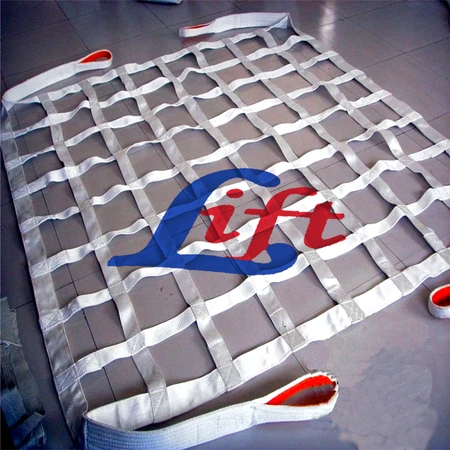

Lift sling rigging company produce Nylon Flat Webbing Net,Flat webbing cargo net,Safety Cargo Lifting Net Straps, Flat Nylon Sling Hoisting Net,Nylon flat belt hanging net,Cargo secure webbing net,Safety Lifting Net Strap,Nylon Flat Webbing Lifting Net.
Nylon Flat Webbing Net
Open flat lattice · 0.5 t – 10 t · 25–100 mm high-tenacity webbing · printable band
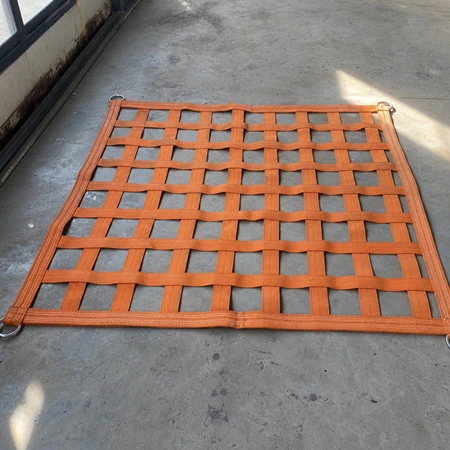
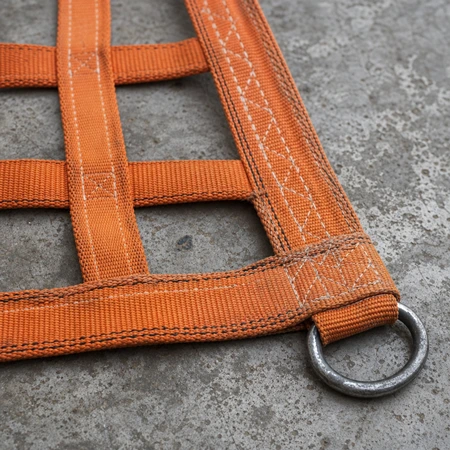
A nylon flat webbing net is an open lifting lattice, not a bag. High-tenacity webbing bands cross at right angles into a square mesh, a folded double-stitched border runs round the perimeter, and four reinforced corner loops are what the crane lifts from. The load sits inside the mesh and is carried as one unit, with the weight spread across the full width of every band underneath instead of a few contact points.
Lift Sling Rigging Company weaves the band, stitches the net and proof-tests every one in Taizhou, Jiangsu. Band width runs from 25 mm to 100 mm, mesh from 50 mm to 300 mm, rated capacity from 0.5 t to 10 t, and net size, corner loops and printing are made to your drawing. Because the band is flat, the working load limit, net size and your own brand can be printed straight onto it — identification that cannot be pulled off or washed away.
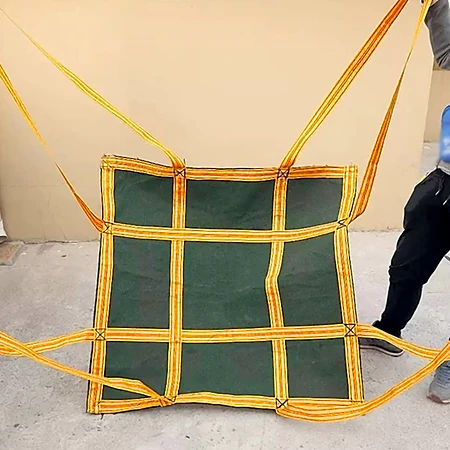
- Three flat webbing materials — nylon for shock loads, high-strength polyester for the lowest stretch, polypropylene for wet and chemical duty.
- Non-marking, wide-face contact — the flat band lies against painted, plated, bagged and boxed cargo without denting or scuffing it.
- Printable identification — WLL, net size, mesh, fleet number and own brand printed along the band, plus a sewn capacity label.
- Built to your size — 25–100 mm band, 50–300 mm mesh, four or eight lifting points, square or diamond lattice.
- Certified and tested — CE, GS and JIS certified, ISO 9001 works, and every net breaking-load tested on our own 1000 t machine.
Flat lattice, not a bag — what that changes
The difference between this net and a net sling is the bottom. A flat webbing net is an open lattice: the load sits on top of it and the net is lifted from four corner loops, so the mesh stays flat under the cargo. There is no closed pocket, no lifting legs gathering at a master ring, and nothing wraps the load. That is why it suits palletised, boxed and stacked cargo that already holds its own shape, and why it is quicker to load: the net is laid out, the load is set down on it, and the four loops go on the hook.
Where the cargo is loose, rounded or likely to shift, a closed-bottom net sling is the better tool — it contains rubble, scrap and bagged material without strapping. For pallet footprints, the purpose-built crane pallet cargo net uses the same flat lattice with a tighter mesh and a pallet-sized border.
Because the lattice is open, the net weighs very little for the area it covers: a 2.5 × 2.5 m net in 50 mm band is light enough for one person to lay out, fold and carry, while still carrying several tonnes across its bands. That combination — wide soft bearing face, low weight, fast rigging — is what makes flat webbing the default construction in ports, warehouses and steel service centres.
Technical parameters
The table covers the standard nylon flat webbing net. Band width, layer count, mesh, net size, lifting points and printing are all made to order, so treat it as the starting point for a quotation rather than a fixed catalogue.
| Parameter | Specification |
|---|---|
| Product type | Open flat webbing lattice (no closed bottom), four or eight corner lifting points |
| Band material | 100 % high-tenacity nylon (PA); high-strength polyester (PET) or polypropylene (PP) on request |
| Band width | 25 mm / 30 mm / 50 mm / 75 mm / 100 mm |
| Band thickness | 1.5 mm – 3.2 mm depending on width |
| Band layer | Single layer; duplex (double layer) for abrasion resistance |
| Mesh opening | 50 – 300 mm; 100 × 100 mm standard |
| Mesh form | Square (standard) or diamond on request |
| Net size | 1.0 × 1.0 m to 4.0 × 4.0 m standard; 2.5 × 6 m and made to drawing |
| Border | Folded band, double-stitched along the full perimeter |
| Lifting points | Four reinforced corner loops standard; eight for a spreader beam |
| Corner fitting | Sewn webbing loop, reinforced loop with pad, or master link on request |
| Rated capacity | 0.5 t – 10 t; heavier nets built to order |
| Safety factor | 5:1 / 6:1 / 7:1 |
| Elongation at break | About 12 % – 20 % (nylon); 7 % or less at working load (polyester) |
| Surface | Soft, flexible, non-marking |
| Colour | Natural white, orange, blue, green, black or custom |
| Printing | WLL, net size, mesh, fleet number and own brand printed along the band; sewn label as standard |
| Working temperature | −40 °C to +80 °C nylon; −40 °C to +100 °C polyester |
| Standard basis | Webbing rated to EN 1492-1 |
| Certification | CE / GS / JIS; ISO 9001; CNAS laboratory; DNV |
| HS code | 630790 — lifting nets of textile materials |
Net sizes and working load limits
Net size is always quoted as length × width measured along the border, never as the mesh area. The load has to sit well inside the border: a net the same size as the load will let the cargo slide out at the edges. Every size below is also made to drawing.
| Net size (L × W) | Mesh opening | Band width | Typical capacity | Typical use |
|---|---|---|---|---|
| 1.0 × 1.0 m | 100 mm | 25 / 30 mm | 0.5 t – 1 t | Small components, drums, single pallets |
| 1.2 × 1.2 m | 100 mm | 50 mm | 1 t – 3 t | Standard pallet footprint, machine parts |
| 2.0 × 2.0 m | 100 mm | 50 mm | 2 t – 5 t | Bagged cargo, cartons, block |
| 2.5 × 2.5 m | 100 – 150 mm | 50 mm | 2 t – 5 t | Palletised and bagged cargo, container loading |
| 2.5 × 6.0 m | 150 mm | 50 / 75 mm | 4 t – 10 t | Long cargo, pipe bundles, truck loading |
| 4.0 × 4.0 m | 150 – 200 mm | 75 / 100 mm | 8 t – 10 t+ | Large pallets, bulk bagged cargo |
| Made to drawing | 50 – 300 mm | 25 – 100 mm | 0.5 t – 10 t | Truck bed, container, hold and spreader dimensions |
Where the load is long or wide, the net is lifted from a beam rather than a single hook: the lifting spreader beam takes the eight corner loops, keeps the net square and keeps the cargo level.
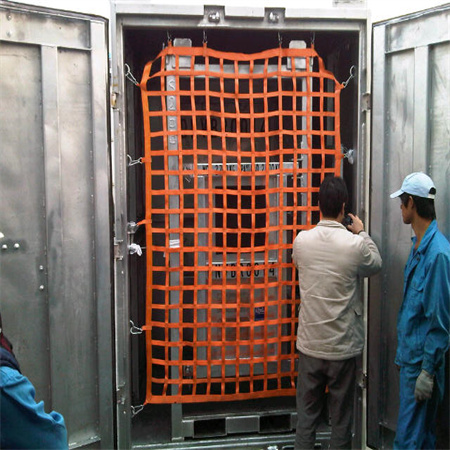
Nylon, polyester or polypropylene
All three nets are built identically — same lattice, same folded border, same corner loops. What changes is the polymer in the band, and that decides the strength, the stretch and the environment the net survives. Nylon is the material this page is named after; the other two are stocked because they answer jobs nylon does not.
| Property | Nylon (PA) | Polyester (PET) | Polypropylene (PP) |
|---|---|---|---|
| Strength for weight | High | High | Lowest |
| Elongation at break | 12 – 20 %, absorbs shock | Low, 7 % or less at WLL | 15 – 20 % |
| UV / outdoor life | Good | Best of the three | Needs UV stabiliser |
| Water and rot | Rust-free, slow to dry | Rust-free, quick to dry | Floats, absorbs under 0.1 % |
| Chemical resistance | Moderate | Good | Best against acids and alkalis |
| Abrasion | Toughest of the three | Very good, duplex standard | Moderate |
| Typical capacity | 0.5 t – 10 t | 1 t – 10 t | 0.3 t – 5 t |
| Best for | Shock loads, rough handling, printed white bands | Most lifting duty; outdoor and long service | Wet quays, wash-down, chemicals, floating duty |
In practice: nylon where the load shifts as it is lifted, or where the marking has to print cleanly on a light band; polyester for the lowest stretch and the longest outdoor life; polypropylene where the net works wet, may go over the side, or meets acids and alkalis. The polyester construction is described in more detail on the webbing cargo lifting net and polyester webbing net for lifting pages.
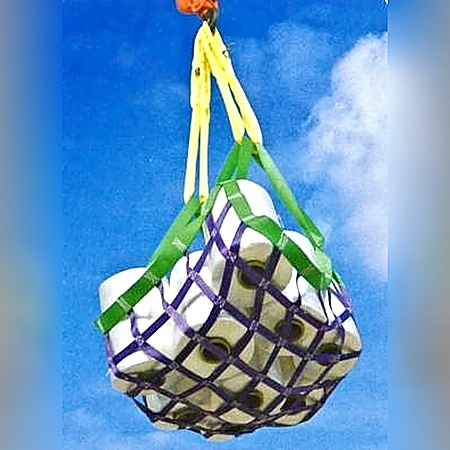
Band, mesh and edge options
Two nets of the same size and capacity can behave quite differently depending on band width, layer count and how the edge is finished. These are the options quoted most often.
| Option | What it does | Choose it when |
|---|---|---|
| 25 / 30 mm band | Lightest net per square metre | Small nets, light loads, handling weight matters most |
| 50 mm band | The standard lifting band | Most palletised and bagged cargo; best balance of strength, weight and cost |
| 75 / 100 mm band | Fewer, wider bands carry the load | Heavy or abrasive cargo, large bearing area needed |
| Single layer | Thinner, lighter, cheaper band | Light duty, clean and dry handling |
| Duplex (double layer) | Two layers stitched as one band | Dragging across pallets or concrete; high-wear duty |
| Folded border | Border band turned over and stitched | Every net — stops the edge band unrolling |
| Reinforced corner | Extra stitching and doubled band at each corner | Every net; corners carry the whole load |
| Square mesh | Bands run parallel to the net edges | Stacked, palletised and rectangular loads |
| Diamond mesh | Lattice rotated 45° so the bands close on the load | Loose or rounded loads that need containing |
| PU coating | Coating stiffens the mesh and resists abrasion | High-abrasion duty, or where the net must hold shape when empty |
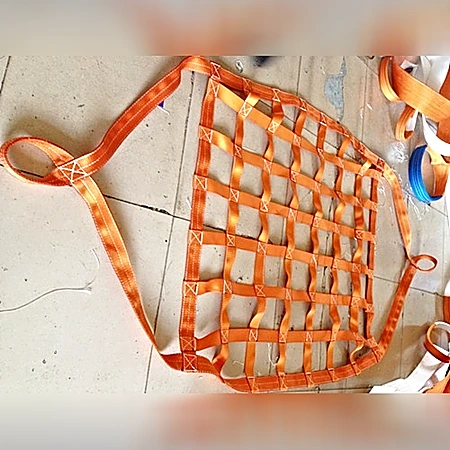
Corner loops and lifting configurations
How the net is hung decides how much of the load it actually carries. These are the four arrangements built most often.
- Four-loop lift — the standard. The four corner loops are gathered onto a single hook or master ring and the load hangs in the middle of the net.
- Eight-point spreader lift. The net is lifted from eight loops on a beam: the net stays square, the load stays level and each corner carries a predictable share.
- Basket or bag form. The net is closed around the load and picked from one point for loose or awkward cargo — see the polyester lifting hoisting net.
- Lashing or securing duty. Tensioned over or across a load rather than lifted from four corners — a different duty with a different rating, quoted separately from the lifting net.
| Fitting | Used with | Note |
|---|---|---|
| Sewn webbing loop | Flat webbing nets, single hook | Standard; stitched through the border with a doubled band |
| Reinforced loop with pad | Heavy and abrasive cargo | Extra webbing protects the loop where it meets the hook |
| Master link / master ring | Four-loop lift | Gathers all four loops onto one point under the hook |
| Shackle or hook | Eight-point spreader lift | Grade 80 fittings supplied with the beam on request |
| Protection sleeve | Any sharp-edged load | Slips over the band at the contact point; cheapest way to extend net life |
Printing, marking and OEM
Flat webbing has one advantage the rope nets do not: the identification can be printed directly onto the band, where it cannot be pulled off, washed away or lost. That is the reason most of our net orders are printed rather than labelled.
- Working load limit, net size and mesh opening printed along the band on every net.
- Fleet numbers, inspection dates, contract numbers or a certificate number printed for operators and rental fleets.
- Own brand, address and warning text printed for OEM and distributor orders.
- A sewn capacity label is fitted as standard in addition to the print, so the net and the paperwork always match.
- Natural white nylon takes print most cleanly; orange, blue, green and black bands are also available.
- Nets ship folded in a bag or a crate — a set of six 2.5 m nets takes the space of one pallet.
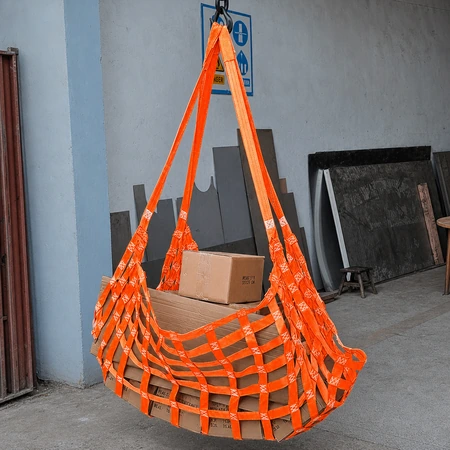
Quality control and certification
Weaving the band ourselves is what makes a made-to-order net practical: width, layer, colour, mesh and printing are all set inside our own plant, so the net is tuned to the load instead of assembled from whatever band a supplier happens to stock.
- 40 years of lifting equipment manufacturing — founded in 1985 in Taizhou, Jiangsu, more than 200 employees, one of China’s largest lifting sling and net production bases.
- Own weaving mill — the same looms supply our webbing slings and endless round slings.
- Own testing laboratory with CNAS accreditation, plus CE and DNV certification of the facilities.
- 1000 t horizontal test machine — the breaking load of every net is tested and documented, and a material test report travels with the order.
- CE and GS certified lifting products, with JIS certification on export orders.
- Every net is marked with its rated capacity, band width and mesh before packing.
Where flat webbing nets are used
| Industry | What the net lifts | Why flat webbing suits it |
|---|---|---|
| Ports and terminals | Bagged and palletised cargo, container stuffing | Soft enough to pull around cargo inside a container |
| Steel service centres | Plate packs, sheet packs, machined parts | Non-marking; wide band spreads load over the pack face |
| Construction | Bricks, blocks, bagged materials, formwork | Holds small units in the mesh without strapping each one |
| Manufacturing and assembly | Painted, plated and finished components | No marking, no edge damage on finished surfaces |
| Warehousing and distribution | Pallets, cartons, mixed loads | Fast four-loop lift; folds away when not in use |
| Agriculture | Bulk bags, feed, produce | Duplex band takes the wear of repeated pallet handling |
| Marine and offshore | Deck cargo and transfer loads | Rust-free and quiet on a moving deck |
| Military and disaster relief | Palletised relief cargo by crane or helicopter | Printable identification and a net that folds into a bag |
For the wire rope construction used on hot, sharp and abrasive bulk, see the cargo lifting net; for the round-rope version of this lattice, the nylon cargo lifting net. The raw band itself is described under nylon ropes and the wider range under cargo lifting nets.
How to specify your net
A lifting net is made to order, and eight pieces of information are enough to quote it correctly the first time. If you have a drawing of the truck bed, container or hold it has to fit, send that instead — we work from drawings regularly.
| Information we need | Why it matters |
|---|---|
| Load weight and load shape | Sets the rated capacity and how many load-bearing bands sit under the load |
| Net length × width | The net must be larger than the load footprint so the load sits inside the mesh |
| Mesh opening | Holds the items in; a smaller mesh is needed for small or loose pieces |
| Band width and layer | Sets the strength, the wear life and the weight of the net |
| Material | Nylon, high-strength polyester or polypropylene |
| Lifting points | Four corner loops as standard, or eight for a spreader beam |
| Crane, hook or spreader | Determines the ring or shackle fitted to the corner loops |
| Environment and documents | UV, salt water, chemicals, temperature; CE marking, test report, own-brand printing |
Frequently asked questions
What is a nylon flat webbing net made of?
Flat high-tenacity webbing — nylon as standard, with polyester and polypropylene available — woven into an open square lattice, finished with a folded double-stitched border and four reinforced corner loops. The band, not the lattice, is what separates it from a rope net.
How is it different from a net sling?
The bottom. A net sling is a bag with a closed bottom and lifting legs that gather at a master ring, so it contains loose material. A flat webbing net is an open lattice lifted from four corner loops, so it suits cargo that holds its own shape and is quicker to load.
What capacity can you supply?
From 0.5 t to 10 t in nylon, 1 t to 10 t in polyester and 0.3 t to 5 t in polypropylene, set by band width, layer count and mesh. A 2.5 × 2.5 m net in 50 mm band covers most palletised and bagged duty; larger nets and heavier bands are built to order.
Can the net carry our own brand?
Yes — this is the main reason to choose a flat band. Working load limit, net size, mesh, fleet number, your brand or a certificate number can be printed along the band, where it cannot be pulled off or washed away. Colour and packing are configurable as well.
Which mesh size do I need?
Size the mesh from the smallest item in the load, never from the total weight. A 100 mm opening holds bags, boxes, bricks and small components; 150 mm to 200 mm suits larger block and bundles. Send us the smallest piece and we will size the mesh to it.
Will it mark painted or plated cargo?
No. The flat band lies against the load instead of biting into it, and the load is shared across the full width of every band underneath, so packaging, paint, plating and machined faces come through the lift unmarked — which is the difference from wire rope and chain.
How is the capacity proved?
Nets are supplied at 5:1, 6:1 or 7:1 as specified, with the webbing rated on the EN 1492-1 basis. The breaking load of every net is tested on our own 1000 t machine and a material test report travels with the order; the facilities hold CNAS, CE and DNV certification.
Can it be used for lashing rather than lifting?
A net tensioned across a load is a securing net, rated differently from a lifting net. Tell us at quotation stage which duty it is for — the tensioned version is the cargo securing net, and the two are not interchangeable.
Request a quotation
Send the load weight and shape, the net size, the mesh opening, the band width and the material you have in mind — or a drawing of the truck bed, container or hold it has to fit. Our engineers confirm the band, the layer count, the rated capacity, the printing and the packing, and quote in one reply. To talk it through first, contact our engineers.
Lift Sling Rigging Company — Lifute Industrial Park, Taizhou City, Jiangsu Province, China
Tel: +86 523 8693 5818 | WhatsApp: +86 180 6600 2268 | E-mail: lift98@jslift.com