


Lift sling rigging company produce Nylon Cargo Lifting Net,Polypropylene Cargo Net Sling,Polyester Nylon Webbing Lifting Cargo Net,Nylon Rope Cargo Lifting Net,Nylon Webbing Cargo Lifting Net,Nylon Strap Cargo Lifting Net,Nylon Belt Cargo Lifting Net,Polypropylene rope Cargo Net,Lifting Rope Cargo Net.
Nylon Cargo Lifting Net
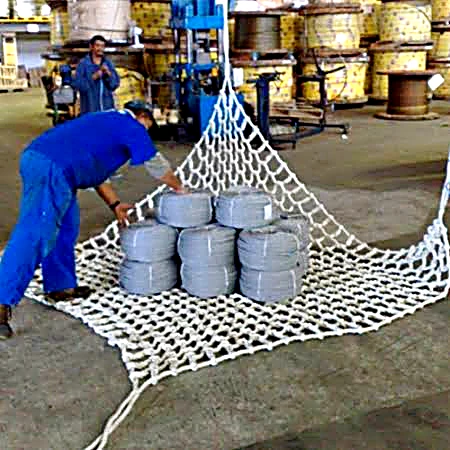
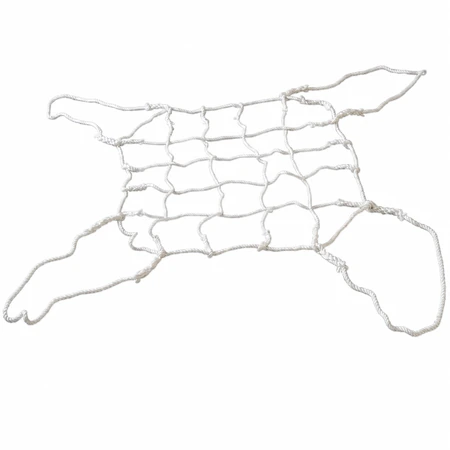
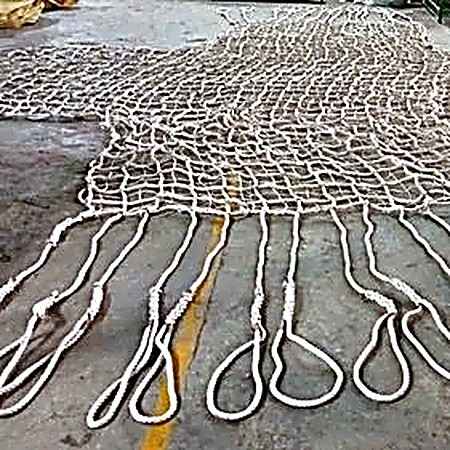
A nylon cargo lifting net is a knotted or braided rope net that lifts a whole consignment in one movement. Made from high-tenacity nylon (polyamide) rope with a doubled border and reinforced corner eyes, it settles around an irregular load instead of sitting on top of it, and its high elongation absorbs the shock when the crane takes up the slack.
We weave nylon rope cargo lifting nets in 8 mm to 24 mm rope, with mesh openings from 100 mm to 300 mm, square or diamond, for rated capacities of 1 t to 50 t. Four corner eyes are standard; eight eyes are fitted for spreader beam work. Net size, mesh, rope diameter, border and fittings are made to your drawing, and every net leaves the plant proof-load tested with a capacity label and material test report.
- Rope: 100% high-tenacity nylon multifilament, 3-strand laid or 8 / 12-strand braided
- Rope diameter: 8 mm – 24 mm standard, up to 32 mm on request
- Mesh: 100 mm – 300 mm, knotted or knotless braided, square or diamond
- Rated capacity: 1 t – 50 t, stated for the rigging arrangement used
- Lifting points: 4 spliced corner eyes standard, 8 eyes for a spreader beam
- Safety factor: 5:1 / 6:1 / 7:1 | Elongation: 18 – 22% at break
- Documentation: capacity label, material test report, CE marking
When a nylon rope net is the right choice
Nylon sits between polyester webbing and polypropylene rope in the way it behaves. It is not the lightest net and not the cheapest, but it is the most forgiving, and that is what decides most enquiries.
- Irregular loads that have to settle. Each strand can move slightly inside its knot, so the mesh closes around logs, stone, scrap, drums and tyres instead of bridging them.
- Shock loading. Nylon elongates 18 – 22% at break. That stretch takes the jolt out of a crane pickup, which matters when the load shifts as it leaves the ground.
- Repairable in service. A damaged strand can be re-knotted or re-spliced locally and the net re-inspected. A wire rope net has to go back to a press; a webbing net has to be re-stitched.
- Wet deck and marine work. Nylon is rot-proof. It absorbs about 4% water and loses some strength when saturated, so the working load has to allow for it – but it will not rust, and it drains freely.
- Soft contact without a flat face. Round strands spread the load over the cargo without the wide, flat bearing face of a webbing net – useful where the load is rough but must not be cut.
Where the cargo is bagged, boxed or palletised and weight matters, a webbing cargo lifting net is usually the better answer. Where the duty is wet, chemical or floating, a polypropylene rope cargo net sling is the marine choice. The full comparison across all constructions sits on the cargo lifting net hub page.
Flat net or bag net: sizing the geometry
Two shapes cover almost every enquiry, and they are sized differently. Getting this wrong is the most common reason a net arrives too small.
Sizing a flat net
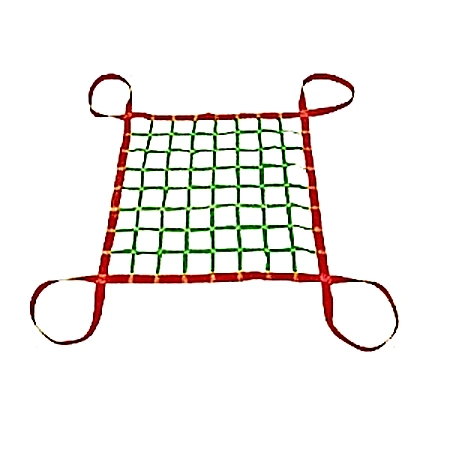
A flat net has to be larger than the load footprint, so the cargo sits inside the lattice and the border can close over the edges. We work to an overhang of at least 100 – 150 mm on every side, and more where the load is loose or the sides are vertical. A 1.2 x 1.0 m pallet therefore takes a net of at least 1.5 x 1.3 m, and the four corner legs must then reach the hook without the border being pulled up over the cargo.
Sizing a bag net
A bag net is a three-dimensional net: the flat net is wide enough to wrap up the sides and close over the load, and the spare width becomes the bag depth. The rule is simple: flat width = footprint + 2 x required bag depth. A bag 1.0 m deep over a 1.2 m footprint needs about 3.2 m across; a 0.6 m deep bag over the same footprint needs about 2.4 m. Confirm the bag depth against the height of the load plus 10 – 15% for settlement, and check that the four corner legs are long enough to gather on the hook without lifting the bag off the ground first.
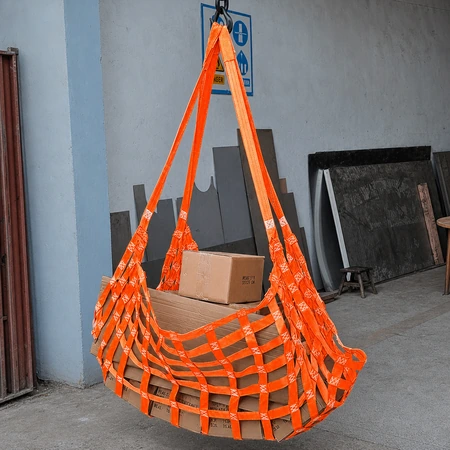
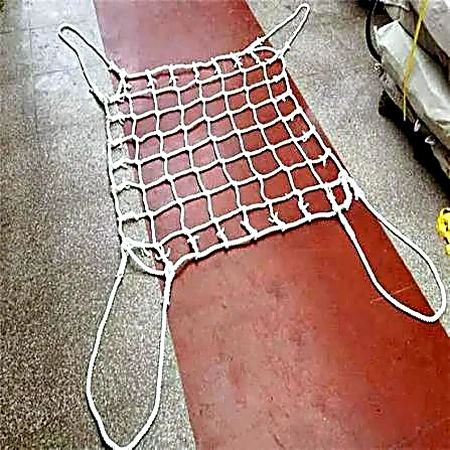
Rope diameter, mesh opening and rated capacity
The table below is the standard range we build. A net’s capacity is set by the rope diameter, the number of load-bearing strands under the load and the rigging arrangement – not by the net size alone, which is why two nets of the same footprint can be rated very differently.
| Net size (L x W) | Rope diameter | Usual mesh | Typical capacity | Typical use |
|---|---|---|---|---|
| 2.0 x 2.0 m | 12 mm | 100 mm | 1 t – 3 t | Drums, machine parts, small pallets |
| 2.5 x 2.5 m | 12 – 16 mm | 100 – 150 mm | 2 t – 5 t | Bagged cargo, container loading |
| 2.5 x 6.0 m | 16 mm | 150 mm | 4 t – 10 t | Timber, pipe bundles, truck loading |
| 4.0 x 4.0 m | 20 mm | 150 – 200 mm | 8 t – 20 t | Logs, scrap, stone |
| 6.0 x 6.0 m | 24 mm | 200 mm | 15 t – 30 t | Bulk cargo, quarry and port work |
| Built to drawing | 8 – 24 mm | 100 – 400 mm | 1 t – 50 t | Truck bed, container, hold and spreader dimensions |
Mesh opening against the smallest cargo dimension
Mesh is chosen from the load, not from the net. The aperture must be smaller than the smallest piece that must not escape, and a diamond mesh closes tighter around loose material than a square mesh of the same nominal size.
| Smallest cargo dimension | Typical cargo | Mesh to specify |
|---|---|---|
| Under 75 mm | Small castings, bottles, components in bulk | 100 mm diamond, or a closed bag net |
| 75 – 150 mm | Bricks, bagged goods, split stone, drums | 100 – 150 mm |
| 150 – 250 mm | Logs, sawn packs, cartons, scrap | 150 – 200 mm |
| Over 250 mm | Blocks, large stone, demolition debris | 200 – 300 mm |
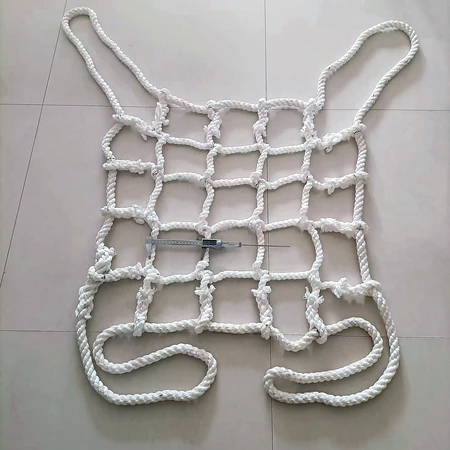
Knotted or knotless braided mesh
Both are nylon rope nets; the difference is what sits against the cargo and how the net behaves when it is repaired.
| Option | What it does | Specify it when |
|---|---|---|
| Knotted mesh | Strands are tied at every intersection; each can move inside its knot | The load is irregular and has to settle into the net; the net must be repairable strand by strand on site |
| Knotless braided mesh | Intersections are braided or spliced, so no knot presses on the cargo | The cargo surface must not be marked, or the net is dragged over the load |
| Square mesh | Rows and columns parallel to the net edges | Palletised, rectangular or container loads |
| Diamond mesh | Lattice rotated 45 degrees, so the strands close around the load | Bag-shaped, loose or rounded loads that must be contained |
| Doubled border rope | A second rope runs the full perimeter, spliced at each corner | Every lifting net – it is what stops the edge pulling out under load |
Nylon cargo lifting net technical parameters
| Parameter | Specification |
|---|---|
| Material | 100% high-tenacity nylon (polyamide PA6 / PA66) multifilament |
| Rope construction | 3-strand laid, or 8-strand / 12-strand braided |
| Rope diameter | 8 mm – 24 mm standard; up to 32 mm on request |
| Mesh opening | 100 mm – 300 mm (100 – 400 mm on request), square or diamond |
| Knot type | Knotted (netmaker’s knot) or knotless braided intersections |
| Border | Doubled border rope, spliced into each corner |
| Lifting points | 4 spliced corner eyes standard; 8 eyes for spreader beam work |
| Rated capacity | 1 t – 50 t; heavier nets built to order |
| Safety factor | 5:1 / 6:1 / 7:1 |
| Elongation at break | 18% – 22% – shock absorbing |
| Treatment | UV stabilised, anti-ageing; optional PU or PVC coating |
| Colour | Natural white, orange, green, black or custom |
| Working temperature | -40 C to +80 C |
| Certification | CE / ISO 9001; material test report with each order |
| Customisation | OEM / ODM net size, label, logo and printed markings |
How a nylon cargo lifting net is made and tested
A rope net is a hand-built assembly, and the four operations below are what separate a lifting net from a net that merely looks like one.
- Knotting or braiding the mesh. Rope is cut to length, knotted at every intersection with a netmaker’s knot, or braided knotless where the cargo surface must not be marked. Mesh pitch is set from the drawing, not from a stock mould.
- Building the border. A second, doubled rope runs the full perimeter and is spliced into each corner, so the load path from the corner eyes runs continuously round the net instead of ending at the first knot.
- Forming the lifting points. Corner eyes are spliced into the border rope itself – not sewn on – and can be thimble-lined where the hook or shackle is rough.
- Proof-load testing and marking. Each nylon cargo lifting net is loaded on our own test bed, then fitted with a capacity label carrying the working load limit, the configuration it applies to and the net’s identification.
The same works weaves webbing and presses wire rope ferrules, which is why a rope net, a webbing sling and a wire rope sling on the same lift can be matched in rating and colour coding rather than bought from three suppliers.
Corner fittings and lifting configurations
| Fitting | Used with | Note |
|---|---|---|
| Spliced rope eye | Four-corner lift from a single hook | Lightest option; the eye is formed in the border rope itself |
| Thimble-lined eye | Frequent lifts, rough hooks and shackles | Protects the eye from wear; recommended where the net works daily |
| Master link or master ring | Four-corner lift | Gathers all four eyes onto one point under the hook |
| Shackle or hook, grade 80 | Eight-point spreader lift | Supplied with the beam on request |
| Reinforced corner patch | Heavy abrasion at the corners | Extra protection where the net rubs on steel or concrete |
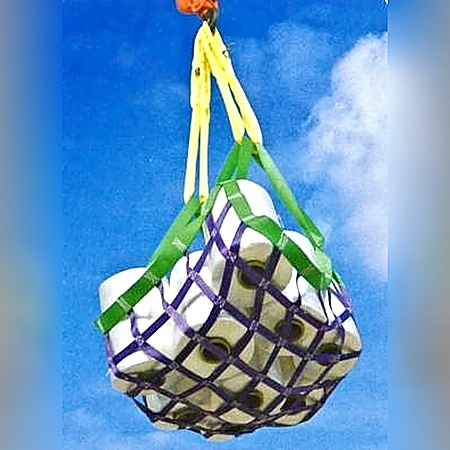
Four-point lifts from a single hook are the standard arrangement: the four eyes gather on the hook and the net closes as it takes up. Long or wide consignments are lifted from eight points on a lifting spreader beam, which keeps the net square and the load level.
Wet, UV and chemical duty: what changes
Nylon is strong and rot-proof, but it is not indifferent to its environment. The table sets out what each exposure does and what we specify in response.
| Exposure | Effect on a nylon net | What to specify |
|---|---|---|
| Continuous wet or salt water | About 4% water absorption; some strength loss when saturated, no rot | Allow headroom in the working load; rinse after salt-water use and dry before storage |
| Outdoor UV | Untreated nylon degrades in sunlight over time | UV-stabilised rope as standard; store out of direct sun |
| Strong acids | Nylon has only fair acid resistance | Polypropylene or polyester net instead – tell us the chemical and concentration |
| Abrasion on concrete or steel | Strands abrade at the contact points and at the corners | Larger rope diameter, PU / PVC coating, reinforced corner patches |
| Heat | Service limit around +80 C | Keep below the limit; above it, a wire rope net or an aramid net is the correct construction |
How to specify a nylon cargo lifting net
| Information | Why it matters |
|---|---|
| Load weight and shape | Sets the rated capacity and how many load-bearing strands sit under the load |
| Net size, or the load footprint | The net must overhang the load, or wrap it if a bag form is needed |
| Bag depth (bag form only) | Flat width = footprint + 2 x bag depth; the depth stops the load escaping |
| Mesh opening | Must be smaller than the smallest piece of cargo |
| Rope diameter or capacity required | Sets strength, net weight and how the net handles on site |
| Number of lifting points | Four eyes for a single hook, eight for a spreader beam |
| Fittings | Eyes, thimbles, master link, shackles – matched to your hook and beam |
| Environment and documentation | UV, salt water, chemicals, temperature; CE marking, test report, own-brand label |
Inspection, repair and retirement
Inspect before every lift, record a formal inspection at the interval your site sets, and have the net examined by a competent person at least annually. Check the corner eyes and their splices first: that is where a rope net wears and where a repair is cheapest.
| Check | Retire or repair if |
|---|---|
| Corner eyes and splices | A splice is drawn up, the eye is deformed, or the rope is cut at the throat |
| Border rope | The border is cut, flattened or has pulled out of a corner |
| Load-bearing strands | Any strand is cut, deeply abraded, heat-glazed or has more than a few broken filaments |
| Knots | A knot has slipped or opened, or the rope at the knot is glazed from friction |
| Coating and colour | PU / PVC coating is worn through at contact points, or the rope has faded and powdered from UV |
| Label | The capacity label is missing or illegible – an unlabelled net cannot be rated |
A single damaged strand can be re-spliced or re-knotted with the same rope and the net re-inspected; a damaged border or corner has to be rebuilt. Never knot two rope ends together to bridge a break, never heat-seal a nylon strand in place of a splice, and never put a net back into service without a new inspection record. Store nets clean, dry, off the ground and out of direct sun.
Where nylon cargo lifting nets are used
| Sector | What the net lifts | Usual specification |
|---|---|---|
| Timber and forest products | Logs, sawn packs, poles | Knotted, diamond mesh, 16 – 20 mm rope |
| Stone, quarry and aggregates | Split stone, blocks, cobbles | Knotted bag form, 150 – 200 mm mesh, 20 – 24 mm rope |
| Ports and terminals | Bagged and palletised cargo, quay and hold work | Nylon rope for irregular loads, webbing for unitised cargo |
| Steel and fabrication | Bundles, sections, stillage loads | Knotless mesh where the surface must not be marked |
| Scrap and recycling | Mixed, abrasive and sharp scrap | Large mesh, 20 – 24 mm rope, corner patches |
| Marine and offshore | Deck and over-the-side transfer | UV-stabilised, PU coated where abrasion is severe |
| Agriculture | Bags and big bags of fertiliser, grain, seed | Bag form, 100 – 150 mm mesh |
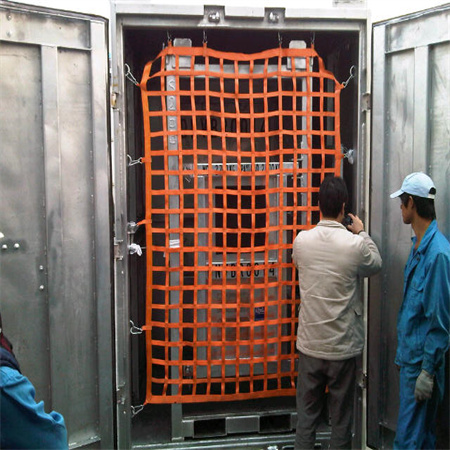
Two neighbouring ranges are often quoted with a rope net: crane pallet cargo nets for pallet footprints, and truck lifting gear with polyester net for vehicle loading. For lashing rather than lifting, see container cargo nets; a securing net is not rated for lifting. Where the net protects people on the same site rather than holding cargo, the correct product is a safety rope net, and for palletised loads that must stay square, a nylon flat webbing net.
Frequently asked questions
What load can a nylon cargo lifting net carry?
Our standard range is 1 t to 50 t, set by rope diameter, net size and the number of lifting points. A 2.5 x 2.5 m net in 12 – 16 mm rope typically covers 2 t to 5 t; a 6 x 6 m net in 24 mm rope covers 15 t to 30 t. The rating on the label applies to the arrangement it was tested in – the same net can be rated differently for four and eight points.
Is nylon stronger than polyester for a lifting net?
Per unit weight nylon is strong, but polyester webbing carries more load along a flat band and stretches far less. Nylon wins where the load is irregular, the pickup is shocky, or the net has to be repaired locally. Polyester wins where the cargo is bagged or palletised and the net must stay square.
Does a nylon net lose strength when it is wet?
Yes. Nylon absorbs roughly 4% water and loses some strength when saturated, although it does not rot. For continuous wet or marine duty we recommend allowing headroom in the working load, or specifying polypropylene, which absorbs almost nothing.
Knotted or knotless – which should I choose?
Knotted for irregular loads that need to settle into the mesh, and where the net has to be repaired strand by strand on site. Knotless where the cargo surface must not be marked, or where the net is dragged across the load. Both are supplied in the same rope diameter and rating.
How big should the net be for my load?
For a flat net, allow at least 100 – 150 mm of overhang on every side beyond the load footprint. For a bag net, the flat width must be the footprint plus twice the bag depth. Send the footprint, the load height and the hook height and we will confirm the size.
Can the net be used with a spreader beam?
Yes – specify eight spliced eyes instead of four. The beam keeps the legs vertical, the mesh stays square and a long load stays level. Grade 80 shackles and the beam can be supplied with the net.
What mesh opening do I need for stone or scrap?
The aperture must be smaller than the smallest piece that must not escape. Split stone usually needs 150 – 200 mm in diamond mesh; demolition debris and large blocks take 200 – 300 mm. For fine or sharp material, a smaller mesh in a larger rope is normally the better answer.
Can a broken strand be repaired?
A single damaged strand can be re-spliced or re-knotted with matching rope and the net re-inspected and re-recorded. A cut border rope, a drawn splice at a corner eye or widespread abrasion means the net should be retired rather than patched.
What safety factor is standard?
5:1, 6:1 or 7:1, depending on the standard your site works to. Tell us the standard at enquiry – the same net is built to different factors for different markets, and the factor is marked on the label.
Can you add our brand and capacity markings?
Yes. Capacity labels, own-brand labels, printed markings and colour coding for fleet identification are all available, and the net can be supplied with a repair kit and a spare length of matching rope.
Can a nylon cargo lifting net be used as a net bag for loose goods?
Yes – that is the bag form. The flat width is the footprint plus twice the bag depth, the four corner legs gather on the hook, and the mesh closes as the load comes off the ground. For very fine or very sharp material, specify a smaller mesh in a larger rope rather than a bigger net.
Do you supply the net with a test certificate and label?
Every nylon cargo lifting net is supplied with a capacity label and a material test report, and our facility holds CE, ISO 9001, CNAS and DNV certification. Own-brand labels and printed markings are available on OEM orders.
Why buy nylon cargo lifting nets from Lift Sling Rigging Company
- 40 years of lifting equipment manufacturing – founded in 1985 in Taizhou, Jiangsu, more than 200 employees, one of China’s largest sling and net production bases.
- Rope nets made and knotted in house – rope diameter, knot type, mesh, border and fittings are under our control, so the net is built to the load rather than bought in.
- Own testing laboratory and a 1000 t horizontal test machine – breaking load tested per net and documented; CNAS, CE and DNV certified facility with 15 authorised patents.
- One supplier for the whole cargo range – cargo nets, webbing slings, endless round slings, wire rope slings, spreader beams and nylon ropes.
- OEM and ODM – own-brand labels, custom colour, printed markings and export packing for distributors.
Request a nylon cargo lifting net quotation
Send the load weight and shape, the footprint or the required net size, the bag depth if a bag form is needed, the mesh, the number of lifting points and the environment the net will work in. Our engineers will confirm the rope diameter, the construction, the rating and the packing, and quote in one reply. To talk it through first, contact our engineers; our certification and test records are available on request.
Lift Sling Rigging Company
Lifute Industrial Park, Taizhou City, Jiangsu Province, China
Tel: +86 523 8693 5818 | WhatsApp: +86 180 6600 2268 | E-mail: 702461526@qq.com
HS code: 630790