

Hiki 'a e kautaha rigging sling ngaohi 'a e Polyester Webbing Kupenga ki he Hiki,Uepi Sling Hiki Uta Neti,Kupenga Uta Polyester,Kupenga Webbing fakaʻehiʻehi mei he afí,Ngaahi Kupenga Uta 'o e Polyester Webbing,Uta Hiki Kupenga Uepi Sling,Polyester Nailoni Webbing Hiki hake 'a e Kupenga Uta,Kupenga uta polyester mamafa mo e ha'i 'o e sling 'oku palapala,Ngaahi Kupenga Hiki Uta Lahi ki he Hiki Fatongia Mamafa.
Kupenga 'o e uepi 'o e polyester ki he hiki
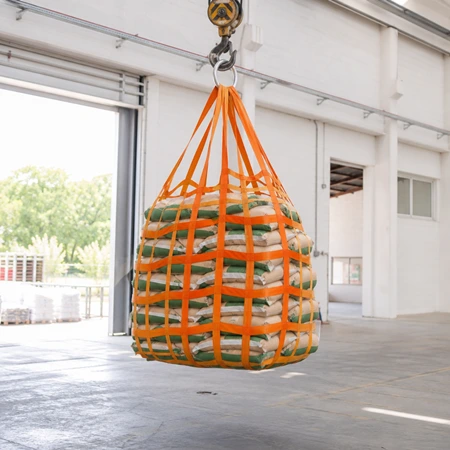
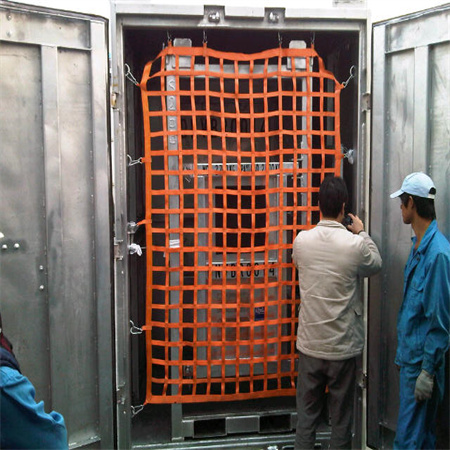
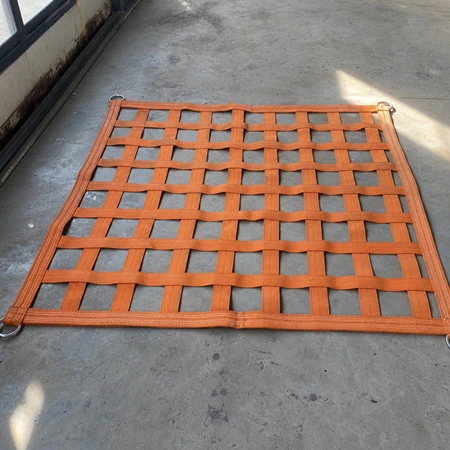
A polyester webbing net for lifting is a lattice of flat high-tenacity polyester (MONUMANU OHI) ngaahi kulupu, stitched into a square mesh with a doubled border and reinforced corner loops. The cargo goes in, the four loops are gathered onto the hook or a master ring, and the whole consignment travels as one unit – 'ikai ha paleti, no strapping, nothing to re-handle at the far end.
It is supplied in two forms. The flat net holds loads that keep their own shape – ngaahi paleti, ngaahi fuʻu ʻakau, ngaahi fakatātā, ngaahi konga 'o e misini. The closed-bottom bag contains loads that would otherwise escape the mesh – tangai, piliki, ngaahi motuhi, mixed cargo. Both are cut to the drawing rather than to a catalogue: laulahi ʻo e foʻi hiva, lau 'o e la'i, kupenga, fālahi, lifting points and colour are all set before the first metre of webbing is woven, and the finished net is proof-load tested with a material test report.
- Flat PET band, 25-200 mm – te'eki mali, duplex or triplex, with a woven selvedge that does not fray.
- 2 t ki he . 30 t hange ha kupenga . – the rating follows the band, the number of load-bearing bands under the cargo and the way the net is rigged.
- Fakaloloa ma'ulalo, fekauʻaki 3-7 % 'i he WLL – the net stays tight against the load instead of creeping open over a shift.
- Wet duty without loss of rating – polyester takes up almost no water and does not rot, so rain, wash-down and deck work are normal service.
- CE mo e GS fakamo'oni'i . – lalanga, tuitui, marked and proof-load tested in one plant, with ISO 9001, CNAS and DNV behind it.
Ko e hala 'o e uta .: huka, loop, kauāfonua, kautāme'a, kupenga
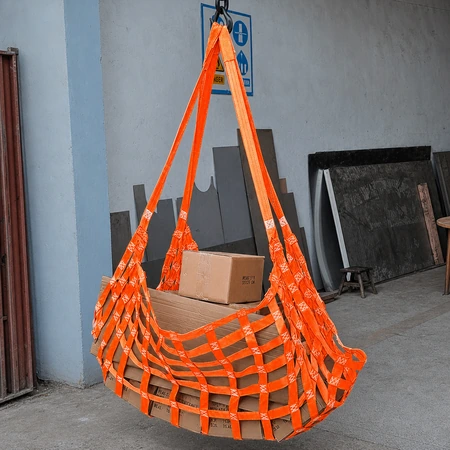
A polyester webbing net for lifting is not one component but five, and the load passes through them in a fixed order. Almost every net failure we are asked to investigate comes down to one link in that chain being built to a lower standard than the band itself – usually the stitching at the corner, which is the cheapest place to save money and the first place to fail.
Tēpile 1 – The five links in the load path, and what each one has to do.
| Link | Ko e hā ʻokú ne ʻave ʻa e kavengá . | What fails there first | How we build it |
|---|---|---|---|
| Hook or master ring | All four loops gathered to one point | Loops binding on a sharp hook or a worn shackle | Master ring or grade 80 shackle offered with the net; loops sized to the fitting |
| Corner loop | The full rated capacity of one corner | Stitching pulling out of the border | Loop stitched through a doubled border with multi-row lock stitch, reinforced above 5 t |
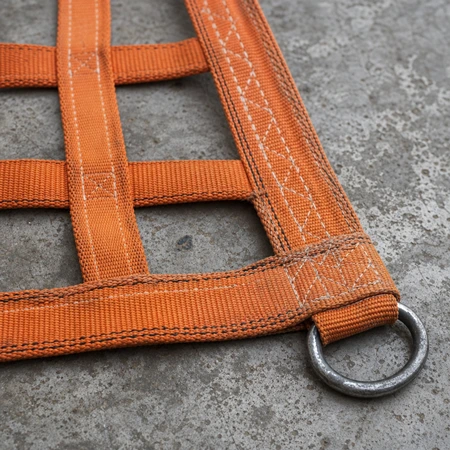
| Kauāfonua | The sum of the mesh, redistributed to the corners | Border folding or tearing at the corner radius | Doubled webbing, folded and stitched the full perimeter, wider at the corners |
| Load-bearing band | The cargo’s weight, band by band | Abrasion and cuts from pallet edges and nails | Lalanga selvedge, duplex or triplex where the net is dragged; sleeves at contact points |
| Mesh | Taʻofi – keeping the cargo in | Items squeezing through an over-wide opening | Opening chosen from the smallest item in the load, 50-300 mm |
The practical consequence is that a net is not rated by its band alone. HA 50 mm duplex band can carry 4 t as a single vertical leg, but the net it is woven into may be rated at 2 t because the corner stitching, 'ikai ko e kau hiva, fokotuʻu ʻa e fakangatangatá. That is why we test the finished net and print the net rating, never the band rating.
Polyester against nylon, polypropylene and wire rope
The fibre choice is usually made on price and then lived with for years. The four materials behave differently in ways that matter on a handling net, and none of them wins on every line.
Tēpile 2 – The four net materials compared on the properties that decide service life.
| Api | Poliesita (MONUMANU OHI) | Nailoni (PA) | Polipolopileni (PP) | Wire rope |
|---|---|---|---|---|
| Fakaloloa 'i he WLL . | Fekauʻaki 3-7 % – ko e maʻulalo taha ʻo e ngaahi filo molū . | Roughly twice polyester | Higher again, and it creeps | I lalo 1 %, but the net is stiff and heavy |
| Vai | Takes up almost no water; strength unchanged wet | Absorbs several per cent and loses some strength wet | Does not absorb water | Corrodes unless galvanised or stainless |
| Rot and mildew | Malu'i | Can mildew if stored wet | Malu'i | Not applicable |
| UV outdoors | Sai, and stabilised in the weave | Kiʻi | Poor unless heavily stabilised | 'Ikai uesia |
| Dry abrasion | Sai – best of the soft fibres | Sai, slightly behind polyester | Kiʻi | Tōtōatu, but it abrades the cargo |
| Acids | Good against most dilute acids | Attacked by strong acids | Sai | Depends on coating |
| Alkalis | Attacked by strong alkalis | Sai | Sai | Generally good |
| Fetu'utaki mo e uta . | Molū, feleti, 'ikai faka'ilonga'i | Molū, 'ikai faka'ilonga'i | Soft but slippery | Marks and crushes; needs sleeves |
| Rigging by hand | Maama, folds into a bag | Maama, folds into a bag | Ma'ama'a taha | Needs two people and a trolley |
Two conclusions follow. Where the net works in cycles against pallets, concrete and truck beds, polyester is the default because low stretch keeps the mesh tight and dry abrasion is where it is strongest. Where the cargo shock-loads – toenga, demolition, rough castings – nylon’s give is an advantage and the fatongia mamafa nailoni uta kupenga sling is the better answer. And where the load is hot, or the net has to be rigid, neither soft fibre belongs on the job.
Band specification
The band is where a quotation is won or lost. ʻOku fakamatalaʻi ia ʻe ha fika ʻe nima ., all five are printed on the label, and all five are fixed on the drawing before weaving.
Tēpile 3 – The five numbers that describe a polyester lifting band.
| Fika | Ko e hā ia . | Range 'oku mau lalanga |
|---|---|---|
| Maokupu | Flat width of the webbing | 25 / 50 / 75 / 100 / 150 / 200 mm; 50 mm tu'unga |
| Lau 'o e la'i | Ko e hā e lahi ʻo e ngaahi uepi ʻoku tuitui ki ha fuʻu ʻakau ʻe taha . | Te'eki mali, fale ua (ua) pe fale tolu . (tolu) |
| Matolu | Seti 'e he laulahi mo e lau 'o e la'i | 1.8 mm – 6.0 mm |
| Weave density | Yarn count in warp and weft, 'a ia 'oku ne fokotu'u 'a e tenacity | Seti ki he EN . 1492-1 makatu'unga ki he malava kuo fakafuofua'i |
| Mui'i me'a | How the selvedge is finished | Lalanga 'a e selvedge ko e tu'unga .; folded and stitched where the band is handled daily |
Tēpile 4 – Working load limit per band, va'e taha tu'u, ʻI LOTO 1492-1 makatu'unga.
| Lalahi 'o e fo'i hiva | Layer 'e taha | Fale ua | Tolu |
|---|---|---|---|
| 25 mm | 1 t | 2 t | 3 t |
| 50 mm | 2 t | 4 t | 6 t |
| 75 mm | 3 t | 6 t | 9 t |
| 100 mm | 4 t | 8 t | 12 t |
| 150 mm | 6 t | 12 t | 18 t |
| 200 mm | 8 t | 16 t | 24 t |
This is a band figure, not a net rating. The net’s capacity follows from how many load-bearing bands sit under the cargo and how the net is rigged – which is why we quote the net, 'ikai ko e kau hiva.
Mesh, border and edge: the three decisions left
Once the band is fixed, three choices remain. They are decided on the drawing, and changing one later means a new net rather than a modification.
Tēpile 5 – Mesh, border and edge options.
| Decision | Ngaahi Fili | Rule we apply |
|---|---|---|
| Fakaava 'o e mesh | 50 / 75 / 100 / 150 / 200 / 300 mm | Chosen from the smallest item in the load, 'ikai 'aupito mei he mamafa fakakatoa . |
| Kauāfonua | Single fold or doubled and multi-row stitched | Doubled as standard; a single-fold border is only offered on nets under 1 t |
| Edge treatment | Lalanga selvedge, folded edge, PU coating | Folded where the net is handled daily; PU coating where it is dragged or stored outdoors |
| Corner reinforcement | Standard loop or reinforced corner | Reinforced above 5 t, and on any net used with a spreader beam |
| Maluʻi | Nima 'o e sote pe kofu, pad or double band at the contact point | Specified for pallets with nails, machined parts and any sharp edge |
Ngaahi fakangatangata fakatekinikale
The figures below cover the standard polyester webbing net for lifting range. Every line is made to order, so treat the table as the starting point for a quotation rather than a fixed catalogue.
Tēpile 6 – Polyester webbing net for lifting: ngaahi fakangatangata fakatekinikale.
| Paramita | Fakaikiiki |
|---|---|
| Fa'ahinga koloa | Kupenga hiki uepi polyester – flat net or closed-bottom bag |
| Naunau 'o e band | 100 % polyester ma'olunga-fefeka (MONUMANU OHI) uepi |
| Lalahi 'o e fo'i hiva | 25 / 50 / 75 / 100 / 150 / 200 mm (50 mm tu'unga) |
| Band construction | Layer 'e taha, duplex or triplex; woven selvedge, not a cut edge |
| Matolu 'o e fo'i hiva | 1.8 mm – 6.0 mm makatu'unga 'i he laulahi mo e lau 'o e layer . |
| Fakaava 'o e mesh | 100 × 100 mm tu'unga tapafā; 50 mm – 300 mm ke 'ota . |
| Lahi 'o e kupenga | Length × width for a flat net; opening × depth for a bag; ngaohi ki he tā |
| Kauāfonua | Doubled webbing, folded and multi-row stitched, reinforced at every corner |
| Ngaahi poini hiki | Four reinforced corner loops standard; valu mo ha fuʻu ʻakau fakamafola . |
| Fakafuofua'i 'a e malava | 2 t – 30 t hange ha kupenga ., seti 'e he kulupu, lau 'o e la'i, load-bearing bands and rigging |
| Ko e meʻa malu | 5:1 / 6:1 / 7:1 |
| Fakaloloa 'i he WLL . | Fekauʻaki 3-7 % |
| Lanu | Kouti lanu 'aki 'a e fakangatangata 'o e kavenga ngaue ., pe ko ha lanu fale angamaheni . |
| Vai mo e pala . | Takes up almost no water; does not rot or mildew |
| Mafana 'o e ngaue | -40 °C ki he . +100 °C |
| Faito'o | UV fakatu'uma'u, fakafepaki ki he motu'a, abrasion mo e lo'imata 'oku ne taliteke'i |
| Makatu'unga tu'unga | Webbing 'oku fakafuofua'i ki he EN . 1492-1 makatu'unga |
| Fakamo'oni | T.S., GS, JIS on request; ISO 9001; Fale fakatotolo fakakemi CNAS; DNV |
| Fakaleleiʻi | OEM / Lahi 'o e ODM, lanu, printed band, faka'ilonga, logo and packing |
| Kouti HS | 6307.90 – lifting nets of textile materials |
Standard sizes and rated capacities
Net size is measured along the border for a flat net, and as opening × depth for a bag. The load has to sit well inside the net: a net the same size as the cargo sheds it as soon as the crane takes up the slack.
Tēpile 7 – Ngaahi lahi kupenga angamaheni; ngaahi lahi angamaheni, mesh mo e ngaahi poini hiki 'oku fai ki he fakatata ..
| Lahi 'o e kupenga | Mesh | Kautāme'a | Ko e malava angamaheni | Ngaue'aki angamaheni |
|---|---|---|---|---|
| 1.0 × 1.0 m | 100 mm | 50 mm fale ua | 2 – 3 t | Ngaahi meʻalea, ngaahi konga 'o e misini, paleti 'e taha |
| 1.2 × 1.2 m (4 × 4 ft) | 100 mm | 50 mm fale ua | 2 – 4 t | La'iva'e 'o e paleti tu'unga, uta puha |
| 2.1 × 2.1 m (82 × 82 ʻi loto) | 100 mm | 50 mm fale ua | 3 – 5 t | La'iva'e 'o e paleti 'o e 'Imipeli |
| 2.5 × 2.5 m | 100 – 150 mm | 75 mm fale ua | 4 – 8 t | Uta 'i he kato, uta koniteina |
| 2.5 × 6.0 m | 150 mm | 100 mm fale ua | 6 – 12 t | Pipe bundles, long cargo, trailer loading |
| 4.0 × 4.0 m | 150 – 200 mm | 150 mm fale ua | 10 – 20 t | Uta lahi 'i he kato, ngaahi paleti lalahi |
| 6.0 × 6.0 m | 200 mm | 150 mm tolu | 20 – 30 t | Taulanga, barge and heavy bulk handling |
| Ngaohi ki he fakatata . | 50 – 300 mm | 25 – 200 mm | 2 – 30 t+ | Mohenga loli, koniteina, hold and hopper sizes |
Pallet-sized versions are quoted from the pallet footprint and are covered by the kupenga uta paleti crane; long bulk consignments by the polyester hiki kupenga hiki; and the tensioned version for holding loads down in transit is the kupenga malu'i 'o e uta.
Rigging arrangements and fittings
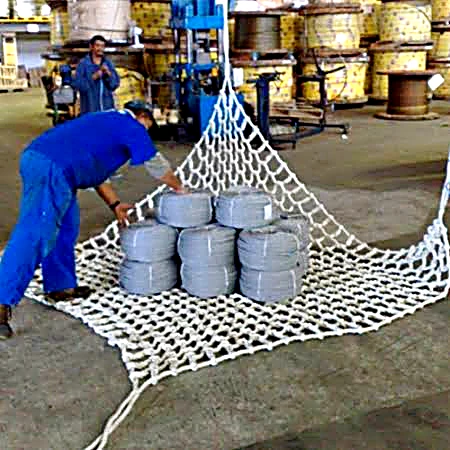
Ko e founga ‘oku tautau ai ‘a e kupengá ‘okú ne fakapapau‘i ‘a e lahi ‘o e kavenga ‘okú ne fua mo‘oní .. Two arrangements cover most work, and both are rated for the net rather than assumed from the band.
- Four loops on the hook – ko e tuʻunga. The loops gather on the hook or a master ring and the net closes on the cargo as the crane takes up the slack.
- Eight loops on a spreader beam – the net stays square, 'oku nofo 'a e kavenga 'i he tu'unga pea 'oku 'ave 'e he tuliki takitaha ha vahevahe 'oku lava ke tomu'a tala .; the right answer for long or wide consignments, using a hiki hake 'a e pou spreader.
- Foomu kato, closed bottom – contains loose cargo that would otherwise fall through the mesh; the form used for loading and unloading.
- Flat net over a load – for pallets, bundles and stillages that keep their own shape and only need holding together.
Fittings supplied or fitted on request: sewn webbing loops, master rings and master links, tu'unga 80 shackles for beam lifts, PU-coated band for high-abrasion and outdoor duty, protection sleeves and pads for sharp edges, and repair kits with matching band and thread for fleets that maintain their own equipment.
Kouti lanu, faka'ilonga'i mo e faka'ilonga'i
Flat webbing has one advantage a rope net does not: the band itself can carry the identification. We print the working load limit along the web and weave the standard colour into it, so a net can be read from across a yard before anyone picks up the label.
Tēpile 8 – Kouti lanu tu'unga 'e he fakangatangata 'o e kavenga ngaue.
| Fakangatangata 'o e kavenga ngaue | Lanu 'o e band | Fakangatangata 'o e kavenga ngaue | Lanu 'o e band |
|---|---|---|---|
| 1 t | Vaioleti | 5 t | Kulokula |
| 2 t | Lanu mata | 6 t | Lanu koko |
| 3 t | Lanu engeenga | 7 t | Lanu pulū |
| 4 t | Kulei | 8 t | Moli |
Two rules stand behind the colour. It is a convenience, not the identification – ko e fakaʻilonga ko e, and it is read before every lift. And where a fleet uses a house colour, we weave that instead and print the capacity on the band, so no net is ever identified by colour alone. Kupenga vaka 'oku peluki 'i ha kato pe ko ha puha .; six nets take the space of one pallet.
Viku, hot and chemical: what polyester tolerates
Most net failures blamed on the material are really service conditions the buyer was never asked about. These are the limits we work to, and the questions we ask before quoting a net for a wash-down bay or a chemical plant.
Tēpile 9 – Service conditions and how polyester behaves in them.
| Condition | Faiva | What to do about it |
|---|---|---|
| Uha, wash-down, deck work | No water uptake, 'ikai pala, rating unchanged wet | Hala – store wet if space is short, but dry before inspection |
| Sun and UV | Good resistance, stabilised in the weave | Store out of direct sun where possible; retire on colour or gloss change |
| Abrasion on concrete and pallets | Good dry abrasion, best of the soft fibres | Duplex or triplex band, and a sleeve where the net is dragged |
| Heat up to +100 °C | Within range; no loss of rating | Keep clear of hot cargo, weld spatter and exhausts |
| ʻolunga +100 °C, hot material | Outside the range – polyester softens and loses strength | Use a heat-rated construction or a different product entirely |
| Dilute acids | Good resistance | Rinse after exposure and inspect the stitching |
| Strong alkalis | Attacked – strength loss is not visible | Specify nylon instead, and tell us the chemical |
| Oils and grease | Not absorbed, but they hide damage | Clean before inspection so cuts and abrasion can be seen |
| Ngaahi tafaʻaki māsila | A textile cuts – this is the one limit that cannot be engineered out | Protection sleeve or pad at every contact point |
Sivi, certification and traceability
- Forty years of lifting equipment manufacturing – na‘e fokotu‘u ‘i he 1914 . 1985 ʻi Taisou, Jiangsu, mo e lahi ange ʻi he 100. 200 kau ngāue.
- Band woven in our own mill, ko ia laulahi, lau 'o e la'i, colour and printing stay under our control rather than being bought in.
- Every net proof-load tested on our own 1000 t horizontal machine – kuo sivi'i, not sampled – with a material test report travelling with the order.
- CE declaration of conformity and GS certification, mo e fakamo'oni JIS 'i he ngaahi 'ota 'o e 'ave ki tu'apule'anga.
- ISO 9001 quality management system, a CNAS-accredited laboratory and DNV certification behind the plant.
- Every net marked with its working load limit, lahi mo e mesh kimu'a pea toki fakafonu ., ko ia 'oku feongoongoi ma'u pe 'a e kupenga mo hono ngaahi pepa ..
Certificates and test reports are available as PDFs for a tender file or a customs check – see the full fakamo'oni seti.
Tokanga'i, sivi mo e malolo .
- Lau ʻa e fakaʻilonga kuo paaki mo e fakaʻilonga ʻo e malavá kimuʻa ʻi he hiki kotoa pē ., and check the load is inside the rating for the way the net is rigged.
- Inspect the corner loops and their stitching first, pea ko e kauʻāfonua ., pea ko e ngaahi fusi fua kavenga . – that is the order in which a webbing net wears.
- Kumi ki he ngaahi motu'a ., kovi, tuitui motu'a, valivali fakakemikale, vela glazing mo e lanu pe ngingila liliu 'oku faka'ilonga'i 'a e UV faka'auha ..
- Keep the cargo inside the mesh and off the border, and protect the bands from sharp edges with a sleeve or pad.
- 'Oua 'aupito na'a ke laka hake 'i he malava kuo fakafuofua'i ., 'oua 'aupito na'a ke hiki hake 'i ha si'isi'i ange 'i he seti kakato 'o e ngaahi loop, and never drag a loaded net sideways with the crane.
- Tauhi ke ma'a mo momoko ., mei he kelekelé pea mei he laʻā fakahangatonú .; never repair webbing by knotting, uelo pe fakamafana ia ..
- Withdraw the net if a load-bearing band, ko e kauʻāfonua, a loop or its stitching is damaged, pea 'ai ke sivi'i 'a e ngaahi kupenga 'e ha taha taukei 'i he vaha'a taimi 'oku fie ma'u 'e ho'o saiti ..
Ngaahi fehu'i 'oku toutou 'eke .
What is a polyester webbing net for lifting used for?
Moving bagged, puha, palletised and mixed cargo as one unit on a crane hook. The flat form holds loads that keep their own shape; the closed-bottom bag contains loose cargo that would otherwise fall through the mesh. It replaces pallets, strapping and repacking at both ends of the trip.
Why polyester rather than nylon?
Koe‘uhi ‘oku ngāue ha kupenga to‘oto‘o ‘i he ngaahi siakale .. Polyester stretches far less at its working load, so the mesh does not creep open as the crane takes up the slack; it takes up almost no water, so the rating holds in wet duty; and it is stronger in dry abrasion against pallets and concrete. Choose nylon where the load shock-loads and a little give is safer.
Is the net rated by the band or as a finished net?
As a finished net. HA 50 mm duplex band carries 4 t as a single vertical leg, but the corner stitching and the number of load-bearing bands may rate the net lower. We proof-load and mark the net, and quote the net capacity – the band table is only the starting point.
Ko e hā e fakaava mesh ʻoku totonu ke u filí .?
Mei he ki'i me'a si'isi'i taha 'i he uta ., 'ikai 'aupito mei he mamafa fakakatoa .. 100 × 100 mm is standard and holds bags, poloka mo e ngaahi koloa puha .; small or loose items need 50-75 mm, and large indivisible loads can take 150-300 mm.
Can it be used in the rain or on deck?
ʻIo. Polyester takes up almost no water, does not rot, and does not lose strength wet, so rain, wash-down and deck work are normal service. Dry the net before inspection so damage is visible.
Can I lift hot material with it?
A'u ki he 100.00. +100 °C. Above that polyester softens and loses strength, and hot cargo – ngaahi lī, slag, asphalt – needs a different construction. Tell us the temperature and we will say plainly whether a webbing net belongs on the job.
‘Oku anga-fēfē hono fakamo‘oni‘i ‘a e malavá .?
'Oku fakafuofua'i 'a e webbing ki he EN . 1492-1 makatu'unga mo e ngaahi kupenga 'oku 'oatu 'i he . 5:1, 6:1 pē 7:1 hange ko ia kuo fakapapau'i. Every net is proof-load tested on our own 1000 t misini mo ha lipooti sivi naunau fononga mo e 'ota .; the products are CE and GS certified.
Ko e ha ha toe me'a 'oku ke ngaohi 'i he webbing tatau .?
The same band goes into our ngaahi sling uepi mo e ngaahi sling takai taʻe ngata, pea 'oku hoko atu 'a e 'atakai 'o e kupenga mo e . webbing uta hiki kupenga, ko e kupenga uepi palakū nailoni pea ko e . kupenga hiki uta nailoni. The whole category is listed under ngaahi kupenga hiki uta.
Kole ha fakamatala
To quote a polyester webbing net for lifting, send the load weight and shape, ko e lahi 'o e kupenga pe kato ., ko e fakaava 'o e mesh, ko e laulahi 'o e band mo e la'i, the lifting points you need and how many cycles the net will run – pe ko ha fakatātā ʻo e mohenga ʻo e lolí ., koniteina, skip pe hopper kuo pau ke fe'unga ia. Our engineers confirm the band, ko e lau 'o e la'i, ko e malava fakafuofua'i mo e fakafonu ., pea quote ia 'i ha tali 'e taha .. Ke talanoa'i 'o fakafou 'i he 'uluaki ., fetu'utaki mai ki he'emau kau 'enisinia.
Kautaha Rigging 'o e Sling Hiki – Paaka Ngaue'anga 'o Lifute, Kolo ko Taizhou, Vahefonua Jiangsu, Siaina
Tel: +86 523 8693 5818 | WhatsApp: +86 180 6600 2268 | ʻĪ-meili: hiki98@jslift.com