

Hiki sling rigging kautaha ngaohi 'a e Polyester Hiki Hiki Kupenga,Kupenga Uta Poliesita,Malu Hiki Kupenga Strap,Kupenga Uta Bungee,Kupenga Hiki Uta Polyester,Kupenga Sling Hiki,Kupenga Hiki Maea,Kupenga Uta Paleti,Kupenga Kaka Ngoue.
Kupenga Hiki Polyester
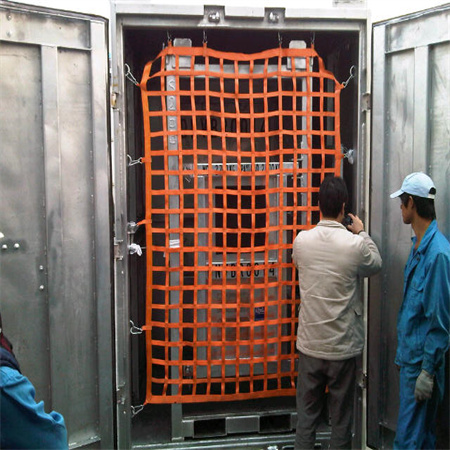
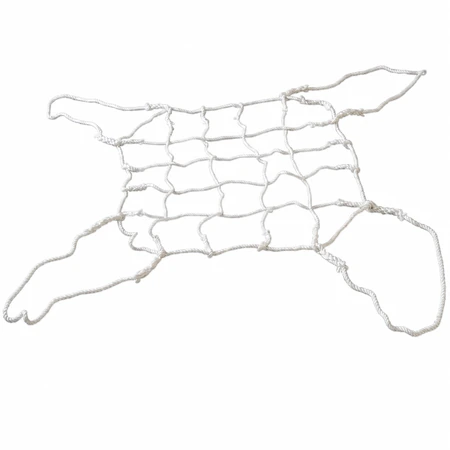
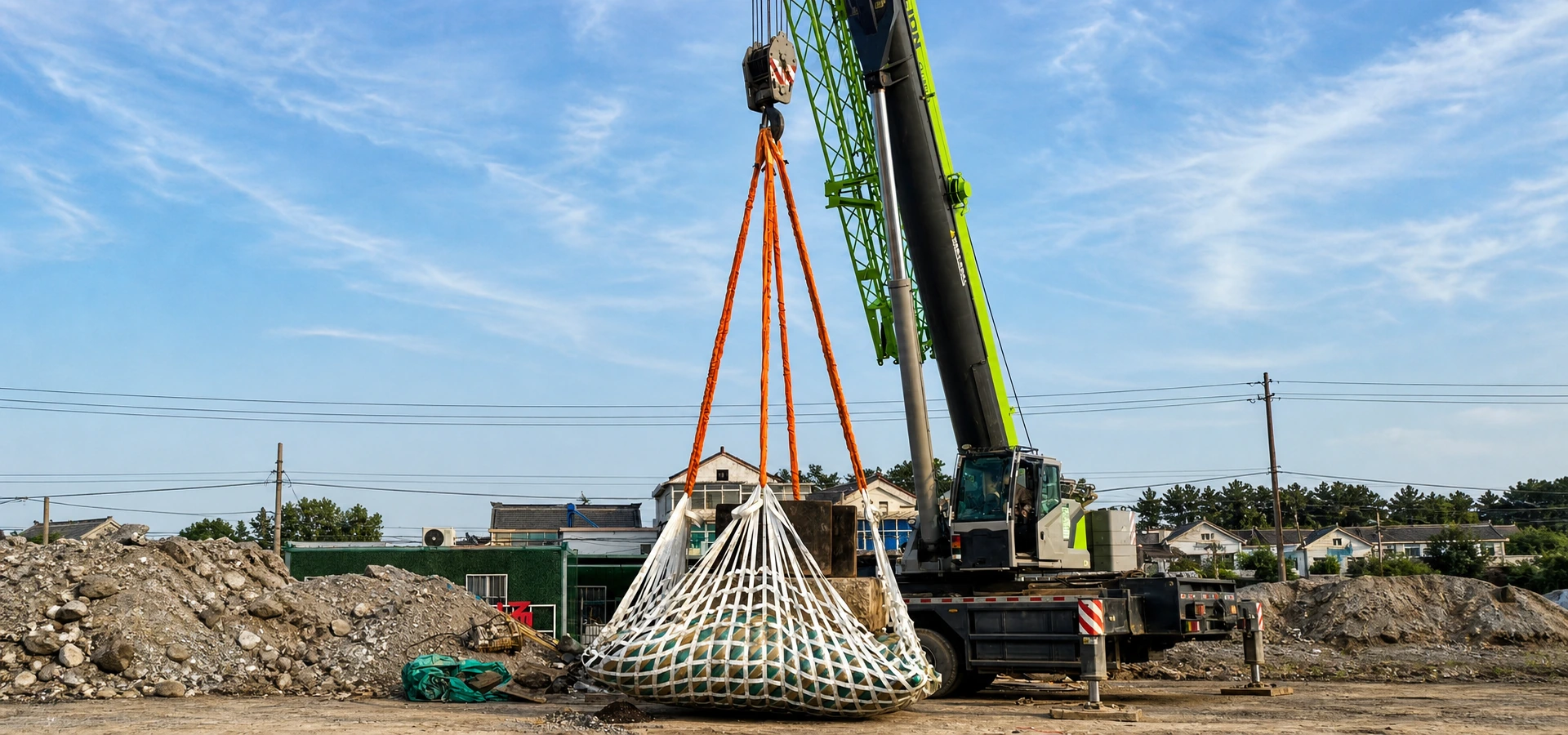
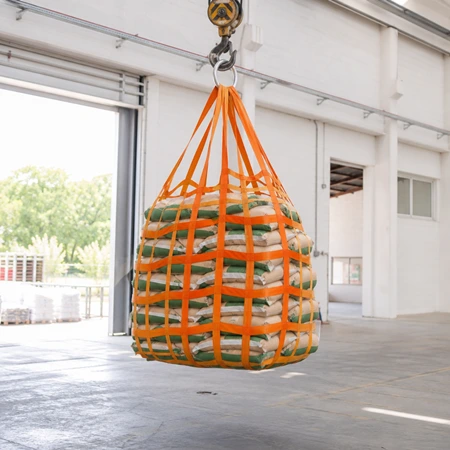
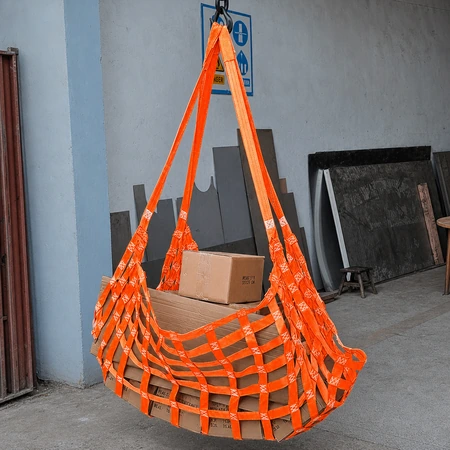
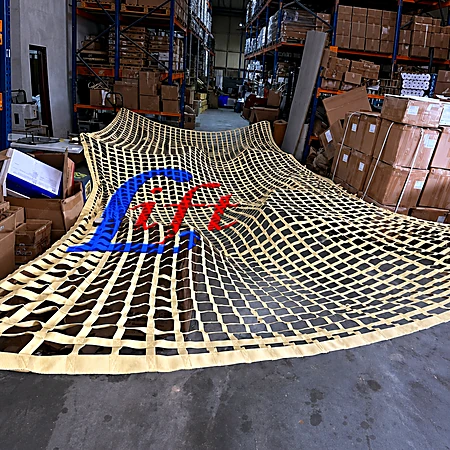
A polyester lifting hoisting net is a soft bag woven from high-tenacity polyester webbing, built to move bagged goods and bulk material in a single crane lift. The load is tipped into the bag, or the bag is laid flat and drawn up around a stack, and four corner loops carry the whole consignment to the hook. There is no pallet to return, no strapping to cut, and nothing to re-handle at the far end.
Because we weave the webbing in our own mill in Taizhou, Jiangsu, ko e fakaava 'o e mesh, bag footprint, loloto, bottom construction and working load limit are all set to the cargo rather than to a fixed catalogue. Standard nets cover 0.5 t ki he . 20 t mo e . 0.6 m3 ki he 'olunga 10 m3, every net is proof-load tested before packing, and each shipment travels with a material test report. Nets are CE and GS certified, with webbing rated to the EN 1492-1 makatu'unga.
- Fully custom build – kupenga, lahi 'o e kato, loloto, colour and safety factor (5:1, 6:1 pē 7:1) set to your specification.
- High-tenacity polyester webbing – 25 mm ki he . 100 ngaahi fusi mm, te'eki mali, duplex or triplex, UV stabilised and rot-proof.
- Wear and heat resistant – working range -40 °C ki he . +100 °C, with a reinforced bottom for abrasive loads.
- Molū, 'oku fe'unga mo e ma'ama'a – the flat band contacts the load over a wide area, so bags, cartons and finished surfaces are neither crushed nor marked.
- CE mo e GS fakamo'oni'i . – tested on our own 1000 t misini ., with an ISO 9001 quality system and a CNAS-accredited laboratory behind it.
Why a webbing net bag, and not a rope net or a big bag
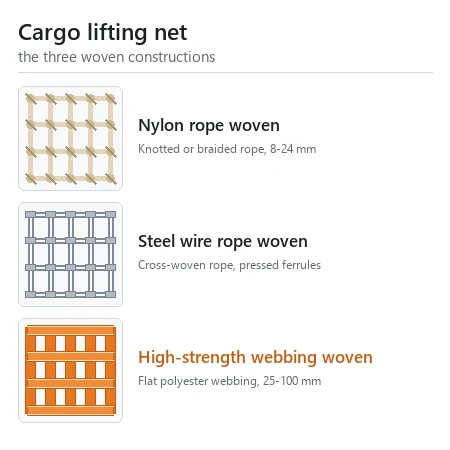
Three products are sold for the same job and they behave very differently once the load is in the air. A rope net concentrates the load on a few contact points. A big bag carries one free-flowing product and is itself the package. A webbing net bag spreads the pressure across flat bands, holds a stacked or mixed load together, and goes back to the store empty.
Tēpile 1 – How the four common ways of lifting loose cargo compare.
| Fili | Fokotu'utu'u | Fetu'utaki mo e uta . | Best cargo | Limitation |
|---|---|---|---|---|
| Polyester webbing net bag | Flat woven bands, 25-100 mm, 25-300 mm kupenga | Wide flat bands, low pressure per cm² | Fakakato, stacked, mixed and bulk cargo | Needs a crane or hook; not a sealed package for powder |
| Kupenga maea nailoni | Knotted or braided rope, 8-24 mm | Line contact at every rope | Irregular and heavy single items | Ropes mark soft cargo; a tight mesh adds weight |
| FIBC / big bag | Woven PP fabric with a liner | Full surface, sealed | One free-flowing product per bag | Single product only; the bag is the packaging |
| Pallet and strapping | Timber or plastic pallet plus bands | Rigid base | Unitised cartons | Pallet returned or lost; bands cut and discarded; no drainage |
Five decisions that set the specification
A polyester lifting hoisting net is quoted from five numbers. Get them right and the net arrives right; get the mesh wrong and no amount of extra tonnage will fix it later.
Tēpile 2 – What we need to know, and why each answer changes the net.
| Decision | Ko e me'a 'oku ne fakalelei'i . | What to tell us |
|---|---|---|
| 1. Cargo form | Whether the net is a bag or a flat sheet, and how the bottom is built | How the cargo arrives: tangai, kato lalahi, pale, or loose material |
| 2. Weight per lift | Band width and layer count, and therefore the rated capacity | Ko e mamafa fakakātoa ‘okú ke fakataumu‘a ke hiki haké ., not the weight of the net |
| 3. Voliume kuo fakafonu | Footprint and depth of the bag | Ko e lahi 'o e density (t/m3) for loose material, or the height of the stack for bagged goods |
| 4. Fakaava 'o e mesh | The largest gap the cargo can pass through | The smallest unit in the load: ha 25 kg bag, uite, aggregate or scrap |
| 5. Founga faka'ata | Tāpuni, laced, chute pe laine lalo | Whether the bag is tipped, untied over a hopper, or emptied by hand |
Weight and volume are two separate limits, and for light bulk the volume arrives first. Ko e tengaʻi ʻakau ʻi he 100 nai. 0.7 t/m3 mo e ngaahi fo'i 'akau 'i he 100 nai. 0.3 t/m3 fakatou'osi fakafonu ha . 3.6 m³ bag, but one lift weighs about 2.5 t and the other about 1 t. Send the bulk density with the tonnage and we will size the bag so that a full bag is also a legal bag.
Ngaahi fakangatangata fakatekinikale
Ko e ngaahi fakatata 'i lalo 'oku ne 'ufi'ufi 'a e tu'unga bagged mo e lahi 'o e ngaahi me'a .. Mesh, la'iva'e, loloto, bottom, loops and capacity are made to order, so treat this as the starting point for a quotation rather than a fixed catalogue.
Tēpile 3 – Polyester lifting hoisting net: ngaahi fakangatangata fakatekinikale.
| Paramita | Fakaikiiki |
|---|---|
| Hingoa koloa | Polyester lifting hoisting net (kato kupenga uepi poliesita) |
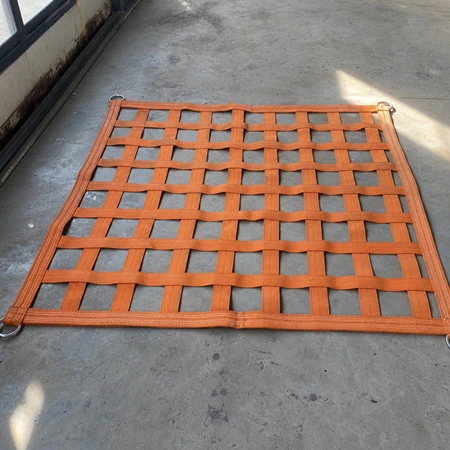
| Configurations | Closed bag, release-bottom bag, or flat lifting net |
| Naunau 'o e uepi | 100 % polyester ma'olunga-fefeka (MONUMANU OHI); nailoni ma'olunga-fefeka 'i he kole |
| Lalahi 'o e fo'i hiva | 25 / 38 / 50 / 75 / 100 mm (50 mm tu'unga) |
| Band construction | Layer 'e taha, duplex or triplex; woven selvedge, not a cut edge |
| Matolu 'o e fo'i hiva | 1.8 mm – 4.5 mm makatu'unga 'i he laulahi mo e lau 'o e layer . |
| Fakaava 'o e mesh | 100 × 100 mm tu'unga; 25 – 300 mm ngaohi ke 'ota . |
| Lahi 'o e kupenga | Ngaohi ki he va'e 'o e kavenga ., truck bed or receiving hopper; see Table 4 |
| Loloto 'o e kato | 0.8 m – 2.5 m, pe ki he tā . |
| Voliume kuo fakafonu | Fekauʻaki 0.6 m3 ki he 'olunga 10 m3, set by footprint and depth |
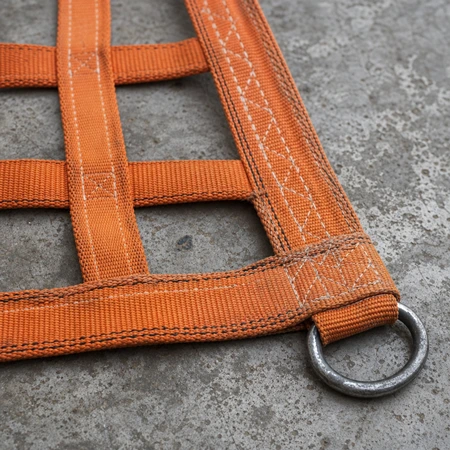
| Kauāfonua | Folded and double-stitched, reinforced at every lifting point |
| Ngaahi poini hiki | Tuliki 'o e ngaahi loop tuliki 'e fā .; valu mo ha fuʻu ʻakau fakamafola .; loops 'i 'olunga mo lalo 'i he kole |
| Fakafuofua'i 'a e malava (WLL) | 0.5 t – 20 t, seti 'e he kulupu, lau 'o e layer mo e fokotu'utu'u 'o e hiki |
| Ko e meʻa malu | 5:1 / 6:1 / 7:1 |
| Fakaloloa 'i he WLL . | 7 % pe si'i hifo . |
| Lanu | Kouti lanu 'aki 'a e fakangatangata 'o e kavenga ngaue ., pe ko ha lanu fale angamaheni . |
| Mafana 'o e ngaue | -40 °C ki he . +100 °C |
| Weather and chemical | UV fakatu'uma'u, rot-proof, unaffected by rain, sea water and wash-down |
| Faka'ilonga'i | WLL, mesh and batch printed on the belt, plus a sewn capacity label |
| Makatu'unga tu'unga | Webbing fakafuofua'i ki he EN . 1492-1 |
| Fakamo'oni | T.S., GS, ISO 9001, JIS on request; Fale fakatotolo fakakemi CNAS; DNV |
| Fakaleleiʻi | OEM / Lahi 'o e ODM, lanu, fakaʻilonga kuo paaki, faka'ilonga mo e fakafonu |
| Kouti HS | 6307.90 – nets and netting of textile materials |
Ngaahi lahi angamaheni, volumes and working load limits
These six lines cover the great majority of bagged and bulk work. Filled volume is calculated from the footprint and the depth with an allowance for the rounded shape a loaded bag takes, so a material that settles well will carry slightly more and one that bridges will carry less.
Tēpile 4 – Standard net sizes at four corner loops gathered on one hook.
| Lahi 'o e kupenga (L × W) | Depth | Voliume kuo fakafonu | Mesh | Kautāme'a | WLL | Uta angamaheni |
|---|---|---|---|---|---|---|
| 1.0 × 1.0 m | 1.0 m | 0.6 m3 | 50-100 mm | 50 mm taha | 0.5-1.5 t | 25 kato kg, fanga ki'i tangai ., pale |
| 1.5 × 1.5 m | 1.2 m | 1.6 m3 | 50-100 mm | 50 mm fale ua | 1-2.5 t | Ko e tengaʻi ʻakau ʻoku ʻi he kato, me'akai, fa'u |
| 2.0 × 2.0 m | 1.5 m | 3.6 m3 | 50-100 mm | 50 mm fale ua | 2-4 t | Ko e tengaʻi ʻakau lahi, 'one'one, maka laiki |
| 2.5 × 2.5 m | 1.8 m | 6.8 m3 | 50-150 mm | 75 mm fale ua | 3-6 t | Me'akai lahi, tofunanga, toenga, ika |
| 3.0 × 3.0 m | 2.0 m | 10.8 m3 | 100-150 mm | 75 mm fale ua | 4-8 t | Ngaahi uta lahi ., quay mo e pukepuke ngaue . |
| To drawing | 0.8-2.5 m | Ke 'ota . | 25-300 mm | 25-100 mm | 0.5-20 t | Ko ha fa'ahinga la'iva'e ., loloto mo e uta . |
The working load limits above assume a four-loop lift. A two-loop basket de-rates the net – ask for the derated figure rather than reading across from this table.
Fakaava 'o e mesh, chosen from the cargo
Mesh is the one dimension that cannot be adjusted after the net is sewn, so it is sized from the smallest unit in the load rather than from the total weight.
Tēpile 5 – Mesh opening by cargo.
| Uta | Fokotu'u atu 'a e mesh | Uhinga |
|---|---|---|
| 50 tangai kg, kato lalahi, pale | 100 mm | The sacks are far larger than the opening; the mesh only has to keep the stack together |
| 25 kato kg, fanga ki'i tangai . | 50-75 mm | Small bags can squeeze through 100 mm once the load settles in the air |
| Uite, tenga, meʻakai kuo fakamāfanaʻi | 25-50 mm, pe ko ha laine tāpuni . | Fine material must not sift out on the hook or in transit |
| Me'akai, prills, efuefu | 25-50 mm, pe ko ha laine tāpuni . | Fine and moisture-sensitive: a liner keeps the product in and the weather out |
| One'one, makamaka, maka laiki | 50-100 mm | Fine fe'unga ke pukepuke 'a e lahi ., open enough for rainwater to drain |
| Tofunanga, koke | 100-150 mm | Large lumps; ko ha mesh lahi ange 'oku ne tauhi 'a e maama 'o e kupenga pea 'oku tafe lelei |
| Ngaahi ukamea toenga, ngaahi motuhi | 100-150 mm | Open mesh with a reinforced bottom and wear pads at the contact points |
| Ika, ika 'anga'anga, fua momoko | 25-50 mm | Holds the catch, drains freely, keeps the weight honest |
| Ngaahi ʻakau, fefie, ngaahi motuhi lalahi | 150-300 mm | Indivisible pieces: a wide mesh saves weight without losing the load |
Bottom construction and discharge
How the load comes out is a design decision in its own right. For bagged cargo the answer is usually a person with a knife; for bulk it is usually gravity.
Tēpile 6 – Bottom options and how each one is emptied.
| Takele | Founga 'ene ngaue . | Chosen when |
|---|---|---|
| Tāpuni, tuitui kakato | The bag holds the cargo permanently and is emptied by tipping or by hand | Uta 'i he kato, and bulk tipped over a hopper or onto a pile |
| Release bottom, laced | Ko ha tuitui laced 'i he tafa'aki 'o e lalo 'oku vete 'i he feitu'u 'oku tukuange ai pea 'oku to 'a e kavenga ki tu'a . | Free-flowing bulk – 'one'one, uite, fakatahataha'i – discharged without tipping the bag |
| Chute lalo | The bag narrows to a chute opened over the receiving hopper | Controlled discharge into a hopper, ko ha vakapuna pe ko ha meʻalele fetuku . |
| Closed with a liner | 'Oku tangutu ha liner tupenu 'i loto 'i he kupenga . | Dusty or moisture-sensitive bulk: uite, me'akai, efuefu |
| Panel lalo kuo fakamālohia | An extra layer of webbing is stitched across the base | Abrasive and heavy bulk: fakatahataha'i, maka, toenga |
| Loops top and bottom | Loops at both ends, so the bag can be lifted either way up | Loading at height, pea faka‘ata‘atā ‘aki hono fakafetongi ‘a e kato ‘i he matau . |
Lifting arrangements and fittings
Ko e founga ‘oku tautau ai ‘a e kató ‘okú ne fakapapau‘i ‘a e lahi ‘o e kavenga ‘okú ne fua mo‘oní ., pea ko e bulk 'oku ta'efakamolemole he 'oku kei nga'unu pe 'a e uta 'i loto 'i he kato lolotonga 'ene 'i he 'ea ..
- Four loops on the hook – the standard for bagged and bulk work; the loops gather on the hook or a master ring and the bag closes around the cargo as the crane takes up the slack.
- Eight loops on a spreader beam – the bag stays square, 'oku nofo levolo 'a e kavenga, pea 'oku 'ave 'e he loop takitaha ha vahevahe 'oku lava ke tomu'a tala .; the right arrangement for large bags and high tonnage, vakai ki he'etau . hiki hake 'a e pou spreader kehekehe.
- Two-loop basket – faster to rig, ka 'oku ne de-rate 'a e kupenga .; ask for the derated capacity instead of reading across from the four-loop figure.
- Loops top and bottom – lets the bag be lifted either way up, ko e founga ia 'oku faka'ata'ata ai ha kato tapuni 'aki hono fakafetongi ia 'i ha hopper ..
Fittings supplied or fitted on request: sewn webbing loops, master ring or master link, tu'unga 80 ngaahi haʻi, laced release bottoms, chutes and discharge sleeves, inner liners, wear pads and protection sleeves for scrap and aggregate, and repair kits for fleets that maintain their own equipment.
Naunau, stitching and finish
The belt is the product. We weave it on needle looms from high-tenacity polyester yarn, with a woven selvedge rather than a cut edge, so the band does not fray from the outside in.
- 100 % polyester ma'olunga-fefeka, fakaloloa ma'ulalo (7 % pe si'i hifo 'i he WLL .), UV fakatu'uma'u, rot-proof and unaffected by moisture.
- Locked stitching in high-tenacity polyester thread, run in multiple rows along the border and box-X at every loop – on a cheap net it is the stitch line, 'ikai ko e fusi ., that fails first.
- Ko e kauʻāfonua kuo fakafonu mo tuitui lōua, so the edge of the mesh cannot unravel under load.
- Galvanised or stainless steel rings and master links on request.
- Polyester holds its strength from -40 °C ki he . +100 °C; above that, or in chemical exposure, tell us and we will quote nylon or another construction.
Sivi, certification and traceability
- Forty years of lifting equipment manufacturing – na‘e fokotu‘u ‘i he 1914 . 1985 ʻi Taisou, Jiangsu, mo e lahi ange ʻi he 100. 200 employees and one of China’s largest lifting sling and net production bases.
- Every net is proof-load tested on our own 1000 t misini sivi fakahosite . – kuo sivi'i, not sampled.
- A material test report travels with each shipment, quoting the belt batch and the test load.
- CE declaration of conformity and GS certification, mo e fakamo'oni JIS 'i he ngaahi 'ota 'o e 'ave ki tu'apule'anga.
- ISO 9001 quality management system, a CNAS-accredited laboratory and DNV certification behind the plant.
- Every net is marked with its working load limit, kupenga, rated volume and batch number before packing, ko ia 'oku fe'unga ma'u pe 'a e kato mo hono ngaahi pepa ..
Certificates and test reports are available as PDFs for your tender or customs file – see the full fakamo'oni seti.
Where these nets work
A polyester lifting hoisting net is used wherever loose cargo has to travel between a stack and a hook – quay, ngaohi, quarry, yard or hold. The sectors below are the ones where the bagged and bulk version earns its place.
Tēpile 7 – Ngaahi tohi kole 'i he sekitoa.
| Sekitoa | Ko e me'a 'oku to'oto'o 'e he kupenga . | Ko e hā ʻoku feʻunga ai ha kupenga polyester mo ia . |
|---|---|---|
| Ngaahi Taulanga, ngaahi taulanga mo e ngaahi taulanga | Uta 'i he kato, uite, fertilizer and bulk between quay, barge and hold | Ko e kato 'e taha ki he hiki, 'ikai ha paleti, pea 'oku tafe 'a e kavenga 'i he'ene fononga . |
| Ngoue mo e ngaahi ngaohi'anga me'akai . | Tenga, uite, fafanga, me'akai mo e koloa 'oku 'i he kato | Ko ha mesh fufuu pe ko ha liner 'oku ne tauhi 'a e koloa 'i loto mo e 'ea 'i tu'a . |
| Ngaahi naunau langa . | One'one, makamaka, maka momosi mo e sima kato . | Fine fe'unga ke pukepuke 'a e lahi ., open enough for rainwater to drain |
| Keli mo e keli maka . | Fakakatoa, maka mo e minerale lahi | 'Oku to'o 'e ha lalo fakaivia 'a e abrasion 'oku ne tui ha kupenga ki tu'a . |
| Toutai mo e ngaohi me'akai . | Ika momoa ., ika 'anga'anga mo e ngaahi me'a 'oku ngaohi . | Fakaava tau'ataina 'a e ngaahi tafe'anga mesh, which keeps the weight honest |
| Toe ngaue'aki mo e veve . | Ngaahi pelesitiki vetevete, sio'ata, ukamea mo e naunau fefiofi . | Contains loose material that would otherwise blow or fall |
| Biomass and power | Ngaahi foʻi ʻakau, kālou, pellets mo e lolo lahi . | Ko ha kato lahi ki ha toni faka'apa'apa ., fakafehoanaki ki he fakangatangata 'o e voliume . |
| Construction sites and relief work | Bagged materials raised to upper floors, field cargo | No pallet, 'ikai ha ha'i, pea ‘e lava ke lilingi hangatonu ia ki he kelekelé . |
Customisation and branding
A net that moves between quays, holds and yards has to be identifiable from a distance and has to keep its marking. Lanu, fakaʻilonga kuo paaki, working load limit and cargo type are all applied in our own plant, so the marking cannot be washed off or pulled away with a label.
- Kouti lanu 'aki 'a e fakangatangata 'o e kavenga ngaue ., or a custom house colour to separate your fleet from a competitor’s.
- Logo, brand name, warning text or certificate number printed on the belt, or woven in on larger orders.
- Cargo type printed on the bag, which stops a fine-mesh grain net being sent out for scrap.
- Sewn capacity label in addition to the print, so the net and its paperwork agree at every inspection.
- Packing folded into a bag or a crate – a set of ten net bags takes the space of one pallet.
Tokanga'i, sivi mo e malolo .
- Inspect the loops and their stitching first, pea ko e kauʻāfonua ., then the bottom closure – on a bulk net the bottom and the corners wear before the mesh does.
- Faka'ata'ata kakato 'a e kato kimu'a pea toki tauhi .; material left inside holds moisture, tānaki atu ‘a e mamafá pea fufū ‘a e maumaú ..
- Kumi ki he ngaahi motu'a ., kovi, tuitui motu'a, valivali fakakemikale, vela glazing mo e lanu pe ngingila liliu 'oku faka'ilonga'i 'a e UV faka'auha ..
- Weigh a wet bag before lifting it. Uha, sea water and wet bulk can add far more than the cargo was rated at, pea ʻoku ʻikai ʻilo ʻe ha kupenga hono faikehekehé ..
- 'Oua 'aupito na'a ke laka hake 'i he malava kuo fakafuofua'i ., 'oua 'aupito na'a ke hiki hake 'i ha si'isi'i ange 'i he seti kakato 'o e ngaahi loop, pea ‘oua ‘aupito na‘á ke toho ha kato kuo uta ki he tafa‘akí ‘aki ‘a e crane ..
- Tauhi ke ma'a mo momoko ., mei he kelekelé pea mei he laʻā fakahangatonú .; never repair webbing by knotting, uelo pe fakamafana ia ..
Ngaahi fehu'i 'oku toutou 'eke .
What is the difference between a polyester lifting hoisting net and a cargo net?
A lifting net is rated, marked and tested to carry a load on a crane hook. A cargo net is a restraint: it holds a load down in transit and is not designed to be lifted. If the net is going onto a hook, it must be the rated version – vakai ki he'etau . kupenga malu'i 'o e uta for the tie-down case.
How do I choose the mesh opening?
From the smallest unit in the load, 'ikai mei he toni .. HA 25 kg bag needs 50-75 mm; grain or fertilizer needs 25-50 mm or a closed liner; scrap and coal can take 100-150 mm. Once the net is sewn the mesh cannot be changed, so this is the one number worth checking twice.
Why does the volume matter as much as the weight?
He 'oku fakafonu 'e he light bulk 'a e kato kimu'a pea toki a'u ki he mamafa 'oku fakafuofua'i .. A bag that is full at half its rating doubles the number of lifts and the crane time. Give us the bulk density with the tonnage and we will size the bag so a full bag is also a legal bag.
'E lava ke faka'ata'ataa 'a e kato 'o 'ikai ke tipi'i ia .?
ʻIo. A laced release bottom or a chute bottom lets a free-flowing load be discharged straight into a hopper, ko ha vakapuna pe ko ha meʻalele fetuku .. Bagged cargo is normally emptied by hand or with a forklift at the far end.
‘E puke ‘e he kupengá ‘a e uta ‘oku momokó?
The net itself is unaffected – polyester does not absorb water and does not rot, so rain, sea water and wash-down do no harm. Ko e ongo fakatokanga .: wet cargo is heavier, and fine wet material can clog the mesh, ‘a ia ‘okú ne tānaki atu ‘a e mamafá pea ta‘ofi ‘ene tafe ..
How is the working load limit proved?
'Oku fakafuofua'i 'a e webbing ki he EN . 1492-1 makatu'unga mo e ngaahi kupenga 'oku 'oatu 'i he . 5:1, 6:1 pē 7:1 hange ko ia kuo fakapapau'i. Every net is proof-load tested on our own 1000 t misini ., a material test report travels with the order, pea 'oku 'ave 'e he ngaahi koloa 'a e CE mo e GS fakamo'oni ..
Do you make a flat version for palletised cargo?
ʻIo – the flat lifting net is the kupenga uta paleti crane, and the material-led range is covered by the kupenga uepi polyester ki hono hiki. The rope constructions sit alongside as the kupenga hiki uta nailoni pea ko e . fatongia mamafa nailoni uta kupenga sling.
What else do you make from the same webbing?
The same belt goes into our ngaahi sling uepi mo e ngaahi sling takai taʻe ngata, and the wider cargo range is listed under ngaahi kupenga hiki uta – including the webbing uta hiki kupenga for flat work.
Kole ha fakamatala
Send the cargo and whether it is bagged or bulk, ko e density lahi kapau 'oku ke 'ilo'i ia ., ko e mamafa 'oku ke fie ma'u 'i he hiki, ko e fakaava 'o e mesh, the discharge method and the environment the net will work in – or a sketch of the bag you have in mind. 'E fakapapau'i 'e he'etau kau 'enisinia 'a e lahi 'o e kupenga ., loloto, langa lalo, band and packing and quote it in one reply. Ke talanoa'i 'o fakafou 'i he 'uluaki ., fetu'utaki mai ki he'emau kau 'enisinia.
Kautaha Rigging 'o e Sling Hiki – Paaka Ngaue'anga 'o Lifute, Kolo ko Taizhou, Vahefonua Jiangsu, Siaina
Tel: +86 523 8693 5818 | WhatsApp: +86 180 6600 2268 | ʻĪ-meili: hiki98@jslift.com