

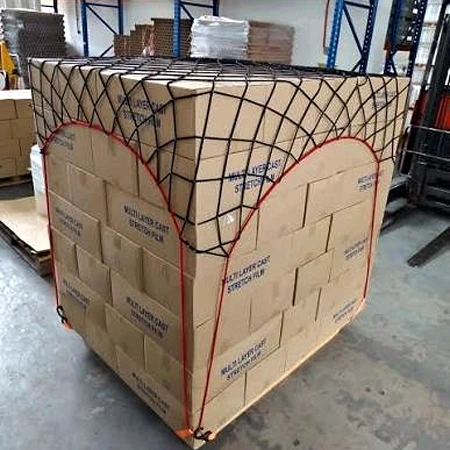
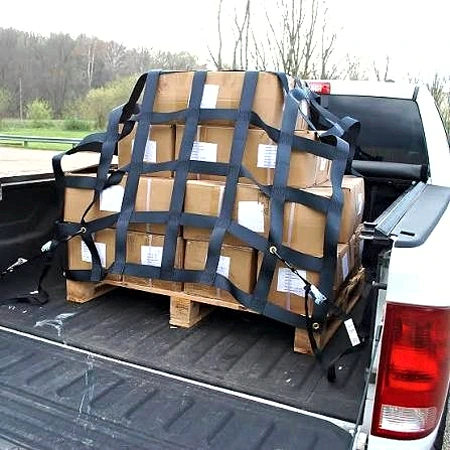
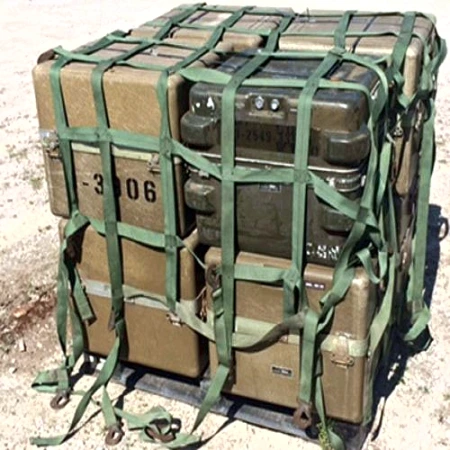
Hiki sling rigging kautaha ngaohi 'a e Uta Malu'i 'o e Kupenga,Kupenga Malu'i 'o e Uta,Kupenga malu'i 'o e uta mesh si'isi'i,Kupenga malu'i 'o e koniteina,Uta malu webbing kupenga ..
Kupenga Malu'i 'o e Uta
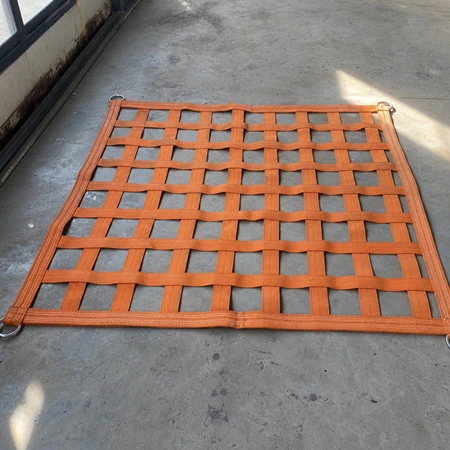
A cargo securing net is a flat-belt restraint net laid over a load and tensioned down to the deck, so that the cargo cannot slide, rock or topple on the way. The belts are woven from high-tenacity polyester into an open lattice, the border is folded and double-stitched, and the edge carries rated attachment points that are pulled down with ratchet tensioners until the load is pressed onto the vehicle or container floor.
The distinction that matters on this product is duty, not appearance. A cargo securing net restrains; it does not lift. Its label carries a lashing capacity (LC) and a standard tension force (STF) 'i he daN, the arrangement is calculated to EN 12195-1 and the belts are type-tested to EN 12195-2 – not to a lifting working load limit. We weave the belts in our own mill in Taizhou, so net size, kupenga, belt width, fittings and markings are set to your load, your vehicle and your anchor points.
- Restraint rating, 'ikai ko ha fakafuofua hiki – LC and STF marked in daN, calculated to EN 12195-1, belts type-tested to EN 12195-2.
- Flat high-tenacity polyester belts – 25 mm ki he . 100 mm, single or duplex, UV stabilised and rot-proof.
- Sized to the load or the aperture – cover nets, container doorway nets, partition nets and bag form, ngaohi kotoa ke 'ota.
- Rated fittings and tensioners – ratchets, matau, D-rings and lashing points, with anti-slip mats where the deck friction is low.
- CE mo e GS fakamo'oni'i . – lalanga, tuitui, marked and tested in one plant, with ISO 9001, CNAS and DNV behind it.

Restraint is not lifting – and the label says which one you have
The two products look alike, are made from the same belt and are often bought by the same fleet. They are not interchangeable, and the difference is not a formality: one is sized so a load cannot move, the other is sized so a load cannot fall. Using a restraint net on a crane hook, or a lifting net as a tensioned tie-down, is a safety failure rather than a paperwork problem.
Tēpile 1 – Why a securing rating and a lifting rating are not interchangeable.
| Poini 'o e fakafehoanaki . | Kupenga malu'i 'o e uta (peesi ko eni) | Kupenga hiki |
|---|---|---|
| Ko e meʻa ʻokú ne faí . | Ta'ofi ha kavenga 'oku nofo 'i he me'alele . | 'Oku ne 'ave 'a e mamafa kakato 'o ha kavenga 'i he 'ea . |
| Puleʻi ʻe he . | ʻI LOTO 12195-1 (fika'i 'o e ngaahi malohi malu'i) mo e EN . 12195-2 (ngaahi ha'i 'o e uepi) | Hiki ha ngaahi tuʻunga moʻui ., with webbing rated on the EN 1492-1 makatu'unga |
| Fakafuofua'i 'i he 2019. | Lashing malava (LC) mo e malohi 'o e tension angamaheni . (STF), 'i he daN | Fakangatangata 'o e kavenga ngaue (WLL), ʻi he toni |
| How it is sized | Sized to resist the acceleration and friction case for the journey | Lahi 'aki ha . 5:1, 6:1 pē 7:1 factor mo e fakamo'oni-sivi'i 'i he sling . |
| How it is tested | Belt and tensioner type-tested to EN 12195-2 | Every sling break-tested on our own 1000 t misini . |
| Founga 'oku ne ta'elavame'a ai . | The load moves – a road accident | The sling breaks – a dropped load |
If the requirement is to lift – a pallet onto a roof, a bag into a hold – the right product is a lifting net: ko e kupenga uta paleti crane, ko e polyester hiki kupenga hiki pe ko e . fatongia mamafa nailoni uta kupenga sling. If the requirement is to keep a load still from the loading bay to the delivery point, this page is the right one.
The forces the net has to answer for
A load on a moving vehicle is pushed in three directions, and each one is a design case rather than an accident. The accelerations below are the ones EN 12195-1 uses for road transport; other modes and national rules differ, which is why we ask where the load is travelling before we size the net.
Tēpile 2 – Design accelerations for road transport and what resists each one.
| Direction | Design acceleration | What resists it |
|---|---|---|
| Forward (braking) | 0.8 g | Blocking or a headboard first, then direct lashings to the front; friction contributes |
| Rearward (acceleration) | 0.5 g | Rear lashings and a tailboard; the net’s rear edge lines |
| Sideways (cornering) | 0.5 g | Side lashings, containment by the lattice, and friction from the pre-tension |
| Hangatonu | Not a road design case | Held down by pre-tension and containment; a net reduces bounce but is not a substitute for blocking |
The practical consequence is that a net alone rarely carries the whole case. Blocking against a headboard does more for the braking case than any strap, and a net laid over the top does the rest. A good securing arrangement is a combination, and we will say so when a net is the wrong answer for your load.
Ko e founga ‘oku pukepuke ai ‘e ha kupenga fusi-palasa ha kavenga .
‘Oku ngāue ha kupenga malu‘i ‘o fakafou ‘i ha founga ‘e tolu ‘i he taimi pē ‘e taha .. Which one dominates depends on how the net is fitted, and that is decided at the vehicle rather than at the factory.
Tēpile 3 – The three mechanisms a securing net uses.
| Mekanisini | Founga 'ene ngaue . | What it depends on |
|---|---|---|
| Fefiofi (fusi-hifo) | Ko e kupenga tensioned 'oku ne lomi'i 'a e kavenga ki he deck ., mo e friction 'i he vaha'a 'o e kavenga mo e deck 'oku ne fakafepaki'i 'a e 'alu holo .. This is the main effect of a cover net | Ko ha maʻa ., dry deck or anti-slip mats. Ka 'ikai ha friction 'oku ta'ofi 'e he kupenga tatau 'a e mama'o si'isi'i ange . |
| Taʻofi | 'Oku ta'ofi fakatu'asino 'e he lattice 'a e mafola 'a e kavenga ., rocking, or throwing individual items out | A mesh fine enough for the smallest item, and a net fitted tight rather than draped |
| Direct lashing | Where the edge belts run down to rated points on the vehicle, ko e fusi 'iate ia pe 'oku ne 'ave 'a e ivi ta'ofi . | Certified anchor points on the vehicle – never a random protrusion or a load’s own packaging |
Two numbers decide whether the arrangement works, and both are usually ignored. The first is the angle: a tie-down belt is most effective between 75 mo e 90 tikili ki he fungavaka ., and its effective capacity follows LC_eff = LC × sin α. ʻi 30 degrees you keep roughly half the belt’s rating, so a net pulled down almost flat looks tidy and holds very little. The second is friction: the coefficient between a steel load and a steel deck is about 0.1 ki 0.2, steel on timber about 0.2 ki 0.3, timber on timber about 0.3 ki 0.4, and a good anti-slip mat takes a pallet on a deck to about 0.5 ki 0.6. Viku, oily or icy surfaces take all of these figures down, which is why the same net restrains very different loads on two different days.
Ngaahi fakangatangata fakatekinikale
Ko e ngaahi fakatata 'i lalo 'oku ne 'ufi'ufi 'a e tu'unga malu'i 'o e .. Leta, kupenga, lahi 'o e kupenga, 'oku ngaohi kotoa 'a e ngaahi me'a fakapipiki 'i he tafa'aki mo e ngaahi tensioners ke 'ota ., ko ia fai ki he tēpile ko ʻení ko e kamataʻanga ia ki ha kupuʻi lea kae ʻikai ko ha kataloko tuʻu maʻu ..
Tēpile 4 – Kupenga malu'i 'o e uta: ngaahi fakangatangata fakatekinikale.
| Paramita | Fakaikiiki |
|---|---|
| Fa'ahinga koloa | Kupenga malu'i 'o e uta (kupenga ta'ofi uta) – cover net, partition net, container doorway net or bag form. 'Ikai ko ha me'angaue hiki . |
| Belt material | 100 % polyester ma'olunga-fefeka (MONUMANU OHI); nailoni ma'olunga-fefeka 'i he kole |
| Lalahi ʻo e fusi | 25 / 35 / 50 / 75 / 100 mm |
| Belt construction | Layer 'e taha pe duplex ., woven selvedge, not a cut edge |
| Belt thickness | 1.8 mm – 4.0 mm makatu'unga 'i he laulahi mo e lau 'o e layer . |
| Fakaava 'o e mesh | 100 × 100 mm tu'unga; 50 mm – 300 mm ngaohi ke 'ota . |
| Lahi 'o e kupenga | Ngaohi ki he va'e 'o e kavenga ., ko e mohenga 'o e me'alele, pe ko e koniteina pe ko e ava ‘o e matapaá . |
| Lashing malava (LC) | Fekauʻaki 750 daN on a 25 mm belt to about 5,000 daN on a 100 mm duplex belt, marked per net |
| Kimu'a 'i he mafasia (STF) | 250 – 500 daN depending on the tensioner supplied; marked on the label |
| Makatu'unga tu'unga | ʻI LOTO 12195-1 for the securing calculation; ʻI LOTO 12195-2 for the webbing lashing |
| Kauāfonua | Folded and double-stitched; fakamālohia ʻi he feituʻu fakapipiki kotoa pē . |
| Ngaahi meʻa fakapipiki | Ngaahi meʻa fakamālohiʻi ʻo e ratchet, matau, D-ngaahi mama, cam buckles and lashing points, tu'unga 80 steel where steel is used |
| Lanu | Orange for high visibility as standard; lanu pulū, lanu mata, black or a custom colour |
| Faito'o | UV fakatu'uma'u, fakafepaki ki he motu'a, abrasion mo e lo'imata 'oku ne taliteke'i, rot-proof |
| Mafana 'o e ngaue | -40 °C ki he . +100 °C |
| Fakamo'oni | T.S., GS, ISO 9001, JIS on request; Fale fakatotolo fakakemi CNAS; DNV |
| Fakaleleiʻi | OEM / Lahi 'o e ODM, lanu, printed belt, faka'ilonga, logo and packing |
| Kouti HS | 6307.90 – nets and netting of textile materials |
Ngaahi lahi angamaheni, mesh and lashing capacity
A securing net is sized to the load it covers or the aperture it closes, never to a tonnage. The load has to be fully covered, and the border has to land on the deck or on the anchor points instead of hanging in mid-air, because an unsupported edge is an edge that can be pulled sideways.
Tēpile 5 – Standard securing net sizes, with the belt and capacity that normally go with them.
| Lahi 'o e kupenga (L × W) | Mesh | Leta | LC per edge line | Ngaue'aki angamaheni |
|---|---|---|---|---|
| 1.2 × 1.2 m (4 × 4 ft) | 100 mm | 35 – 50 mm | 1,000 – 2,000 Mo e | Single pallet in a van or light truck |
| 2.5 × 1.2 m (8 × 4 ft) | 100 mm | 50 mm | 2,000 Mo e | Two pallets abreast in a van or curtain-sider |
| 2.5 × 2.5 m | 100 mm | 50 mm | 2,000 Mo e | Ngaahi uta 'o e flatbed, misini, mixed cargo |
| 5.0 × 2.5 m | 100 – 150 mm | 50 – 75 mm | 2,000 – 3,500 Mo e | Flatbed loloa kakato mo e ngaahi uta 'o e treila |
| 2.4 × 2.6 m (koniteina) | 100 mm | 75 mm | 3,500 Mo e | Container doorway net, load held back from the doors |
| 1.5 × 1.5 m bag form | 50 – 100 mm | 50 mm | 2,000 Mo e | Loose or bagged goods that would spread on the deck |
| Ngaohi ki he fakatata . | 50 – 300 mm | 25 – 100 mm | To calculation | Ko ha fa'ahinga la'iva'e ., aperture or vehicle bed |
The capacity column is the restraint available per edge line, not a lifting limit. The number of edge lines, their angle and the friction under the load decide what the arrangement actually restrains.
Four forms of securing net
The same lattice is supplied in four arrangements, and choosing the right one is most of the job. 'Oku kehekehe 'a e ngaahi me'a fakapipiki 'i hona vaha'a .; ko e tefito‘i mo‘oni ‘o e ta‘ofi ‘oku ‘ikai ..
Tēpile 6 – Cover, partition, container and bag forms.
| Fōomu | Founga hono fakafe'unga'i . | Ngāue‘aki ‘i he taimi . |
|---|---|---|
| Kupenga 'ufi'ufi | Spread over the load and tensioned down to the deck or to the vehicle’s rated points | Mohenga palapala, curtain-sider and container loads that must not move in any direction – the most common arrangement |
| Partition net | Fixed upright across the vehicle body and tensioned against its own frame | Separating two loads in one vehicle, or holding cargo away from a bulkhead |
| Container doorway net | Fitted across the door aperture and hooked to the container’s own rings | Stopping cargo migrating to the doors during the journey, so the container is safe to open |
| Foomu kato | Closed at the bottom, with the cargo sitting inside the lattice | Loose or bagged goods that would otherwise spread across the deck |
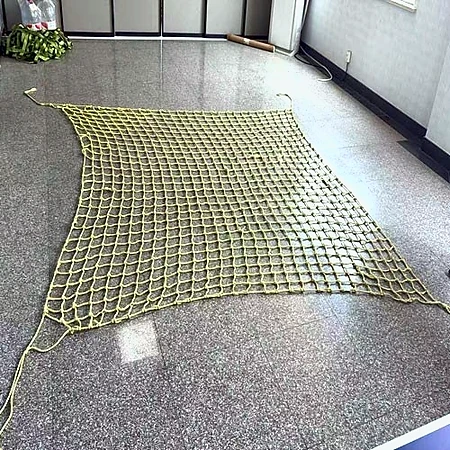
Ngaahi meʻa fakapipiki, tensioners and anti-slip
A securing net is only as good as the tensioner that pre-tensions it and the anchor point it pulls against. These are the parts that get specified last and fail first.
Tēpile 7 – Ngaahi me'a fakapipiki mo e ngaahi me'a fakamālohi.
| Fe'unga | Fakaʻaongaʻi mo e . | Tohi'i |
|---|---|---|
| Ngaahi fepakipaki 'o e Ratchet | Kupenga 'ufi'ufi, foomu kato | Seti 'a e tomu'a mafasia . (STF). A ratchet that cannot reach the marked STF makes the net ineffective, whatever its LC |
| Ha'i 'o e Cam | Fatongia ma'ama'a | Faster than a ratchet but reaches a much lower pre-tension – for light loads only |
| Ngaahi matau mo e ngaahi mama D | Ha fa'ahinga fokotu'utu'u pe . | The link between net and anchor point; tu'unga 80 ukamea 'a ia 'oku faka'aonga'i ai ha me'angaue ukamea . |
| Ngaahi poini lashing | Kupenga 'ufi'ufi | Rated anchor points in the vehicle structure – the restraint force has to go somewhere rated |
| Fala fakafepaki-heke | Fakata'ofi 'o e frictional | Raises the friction coefficient under the load; usually the single most effective addition on a smooth deck |
| Nima malu'i | Ngaahi uta mata-māsila | Fits 'i 'olunga 'i he fusi 'i he feitu'u fetu'utaki .; ko e founga ma'ama'a taha ke fakaloloa 'a e mo'ui 'a e kupenga . |
| Me'angaue fakalelei'i | Fleet maintenance | Matching belt, filo tuitui mo ha meʻa fakamālohi |
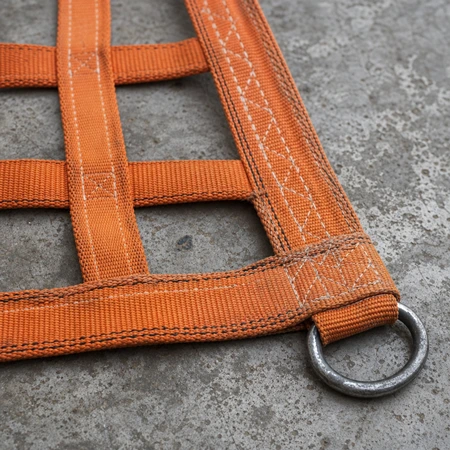
Faka'ilonga'i, colour and identification
A securing net is checked by the driver before every trip and by an inspector at the roadside, so the marking has to be readable at a distance and has to survive being dragged over a deck.
- Lashing capacity and standard tension force printed along the belt in daN – the units load securing is actually calculated in.
- Net size and date of manufacture printed as well, so the net can be matched to the vehicle and its age judged on the spot.
- A sewn capacity label in addition to the print, ko ia 'oku feongoongoi ma'u pe 'a e kupenga mo hono ngaahi pepa ..
- Orange as the standard high-visibility colour, with blue, lanu mata, black or a house colour for fleet identification.
- OEM orders can carry your brand, warning text or certificate number printed on the belt.
- Nets ship folded into a bag or a crate – a fleet order takes a fraction of the space of the same number of loose straps.
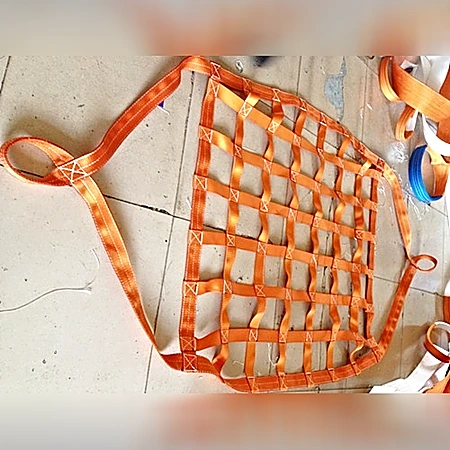
Sivi, certification and traceability
- Forty years of lifting equipment manufacturing – na‘e fokotu‘u ‘i he 1914 . 1985 ʻi Taisou, Jiangsu, mo e lahi ange ʻi he 100. 200 kau ngāue.
- Belts woven in our own mill, ko ia laulahi, layer count and colour are under our control rather than bought in.
- Webbing strength-tested on our own 1000 t horizontal machine before it is cut into nets.
- Belts supplied to the EN 12195-2 material requirements for securing duty, with the securing calculation following EN 12195-1.
- CE declaration of conformity and GS certification, with JIS on export orders; ISO 9001, CNAS laboratory accreditation and DNV certification behind the plant.
- Every net marked with its lashing capacity, pre-tension, lahi mo e mesh kimu'a pea toki fakafonu ., and supplied with a material test report on request.
Certificates and test reports are available as PDFs for a tender file or a customs check – see the full fakamo'oni seti.
Where cargo securing nets are used
The same net covers a road trailer, a container, a rail wagon and a barge. What changes is the number of anchor points, the mesh and how the net is tensioned – not the product itself.
Tēpile 8 – Applications by transport mode.
| Mode or sector | What the net restrains | Why a flat-belt net suits it |
|---|---|---|
| Road – mohenga palapala | Misini, ukamea, ʻakau, ngaahi paleti, drums and mixed cargo | 'Ufi'ufi 'a e kavenga kotoa 'i ha ngaue 'e taha pea fakataha'i 'a e friction mo e containment . |
| Road – puipui-taha | Palletised and boxed goods that shift against a soft curtain | 'Oku 'i ai 'a e kavenga 'a ia 'oku 'ikai ke 'ave ai 'e he puipui 'iate ia pe ha ta'ofi . |
| Fefononga'aki koniteina | Uta 'i mui 'i he ngaahi matapa ., and cargo that must not migrate in transit | A doorway net makes the container safe to open and stops the load moving forward |
| Uta lēlue | Palletised and loose cargo in wagons and on flat wagons | ‘Oku ‘ufi‘ufi ‘e he ngaahi kupenga lōloá ha mohenga saliote pea ‘e lava ke fakamālohi‘i ia ‘i ha ngaahi vaha‘a taimi pau . |
| Tahi mo e hala vai ki loto fonua . | Uta 'i he vakapuna, mo e uta 'i loto 'i he ngaahi vaka mo e ngaahi hold . | Fakamo'oni'i 'a e pala, UV stabilised and unaffected by salt water |
| Uta mamafa mo e uta poloseki . | Ngaahi meʻa liliu, ngoue mo e ngaahi kavenga 'i tu'a-me'afua | Fakataha'i mo e lashings fakahangatonu mo e poloka ki he ngaahi kavenga 'oku 'ikai lava ke vahevahe . |
| Fakamole, toe ngaue'aki mo e ngoue . | Bales, ta'etali, faka'auha mo e ngaahi uta lahi 'i he ngaahi me'alele 'oku fakaava . | ʻOku taʻofi ʻe he fakaʻehiʻehí ʻa e ngaahi meʻa ʻoku vetevete ʻo tuku ʻa e meʻalelé ʻi he fefonongaʻakí |
| Military and relief transport | Palletised and loose cargo in trucks and aircraft | Kupenga 'e taha ki he uta ., vave hono faka'aonga'i mo toe faka'aonga'i 'i he ngaahi fononga lahi . |
Tokanga'i, sivi mo e malolo .
- Check the net before every trip and record the check: the tensioner first, pea ko e tuitui 'i he feitu'u fakapipiki kotoa pe ., pea ko e ngaahi fusi ..
- Fakafisingaʻi ha fusi ʻoku ʻi ai ha ngaahi motuʻa ., maumau 'i he tafa'aki, tuitui motu'a, valivali fakakemikale, sio'ata vela, or the colour and gloss change that signals UV degradation.
- Check the vehicle’s anchor points as carefully as the net. A perfect net on a corroded lashing point restrains nothing.
- Tauhi e deck ke ma'a mo momoko ., and fit anti-slip mats wherever load-to-deck friction is low. That is a securing measure, 'ikai ko ha fakalelei'i ..
- Never use a securing net to lift, and never use a lifting net as a tensioned tie-down unless its label carries both ratings.
- Tauhi ke ma'a mo momoko ., mei he kelekelé pea mei he laʻā fakahangatonú .; never repair a webbing belt by knotting, uelo pe fakamafana ia ..
- Withdraw the net if a belt, kuo maumau ha laine tuitui pe ko ha tensioner ., pea ‘ai ke sivi‘i ‘a e ngaahi kupengá ‘e ha taha taukei ‘i he vaha‘a taimi ‘oku fiema‘u ‘e ho‘o vakapuná ..
Ngaahi fehu'i 'oku toutou 'eke .
Can a cargo securing net be used to lift a load?
ʻIkai. It is rated for restraint, 'ikai hiki, pea 'oku fika'i 'a e ongo me'a 'i he ngaahi makatu'unga kehekehe 'aupito .. If the load has to go onto a hook, use a lifting net with a working load limit and a per-sling proof test – the crane pallet cargo net or the polyester lifting hoisting net, both linked earlier on this page.
Ko e ha e kehekehe 'o e LC mo e STF .?
LC (malava ke taa'i) ko e ivi ta'ofi 'oku fakafuofua'i 'a e fusi ke ne 'ave .. STF (malohi 'o e mafasia angamaheni) ko e fefe 'a e fefeka 'e lava ke tomu'a fakamalohi'i 'e he ratchet tensioner 'a e fusi .. Both are marked in daN. LC mahu'inga taha 'i he lashing fakahangatonu ., ‘a ia ‘oku pukepuke ai ‘e he fusi ‘iate ia pē ‘a e kavengá .; STF mahu'inga taha 'i he fusi-hifo lashing ., where the pre-tension creates the friction that does the holding.
‘Oku totonu ke fufuu‘i fēfē ‘a e kupengá .?
Mafuu fe'unga ke a'u ki he pre-tension 'oku faka'ilonga'i 'i he faka'ilonga ., with the belts running as steeply to the deck as the load allows – 75 ki 90 degrees is where a tie-down belt works best. A belt laid almost flat keeps only about half its capacity, ko ia ko ha kupenga ‘oku hā ngali ‘ufi‘ufi maau ‘e lava ke ne puke ‘a e me‘a si‘isi‘i ‘aupito ..
'Oku ou fie ma'u ha ngaahi fala fakafepaki'i 'o e 'alu?
If the restraint relies on friction – which is what a cover net does – then usually yes. On steel, aluminium or plastic surfaces the friction coefficient is low, and a mat often adds more restraint than an extra strap does. Ko ha maʻa ., dry deck is the other half of the same measure.
Ko e hā e lahi ʻo e ngaahi lashings pe taula ʻoku ou fie maʻú .?
'Oku muimui mai mei he kavenga ., ko e fepakipaki 'o e fungavaka, the vehicle and the journey rather than from a rule of thumb. Direct lashing normally needs at least four anchor lines, ua ki he tafa'aki pea kolosi ., with the vertical and plan-view angles between 30 mo e 60 tikili. Send mai 'a e uta mo e fakaikiiki 'o e me'alele pea te mau ngaue'i 'a e fokotu'utu'u 'o fakafou 'iate koe.
Will a net stop cargo moving inside a container?
Ko ha matapā pe kupenga vahevahe ‘okú ne ta‘ofi ‘a e hiki ‘a e kavengá ki he ngaahi matapaá pea ‘okú ne ‘ai ‘a e koniteiná ke malu ke fakaava .. For the journey itself the load still has to be restrained as a whole, ko ia 'oku fa'a malu'i ha koniteina 'aki ha kupenga vahevahe mo e poloka pe dunnage kae 'ikai ko ha kupenga tokotaha pe ..
Ko e hā e fakaava mesh ʻoku totonu ke u filí .?
Fine enough that the smallest item in the load cannot pass through. 100 mm ko 'etau tu'unga pea 'oku ne pukepuke 'a e ngaahi paleti ., ngaahi kato, kato mo e ngaahi me'alea .; 'oku fie ma'u 'e he ngaahi me'a vetevete pe iiki ha mesh kaukaua ange ., pea ko e ngaahi kavenga lalahi ‘oku ‘ikai lava ke vahevahe ‘e lava ke ne to‘o ha taha ‘oku lahi ange ..
Ko e ha ha toe me'a 'oku ke ngaohi ki he to'oto'o 'o e kavenga .?
The same belts go into our ngaahi sling uepi mo e ngaahi sling takai taʻe ngata, the wire rope range is under ngaahi slings maea uaea, the rope itself under ngaahi maea nailoni, and RoRo and breakbulk work is covered by the kupenga hiki me'alele. The lifting side of the net range starts at ngaahi kupenga hiki uta.
Kole ha fakamatala
Send the transport mode, the load weight and dimensions, whether it can spread or topple, the deck material, ko e kupenga pe lahi 'o e ava ., the belt width and the anchor points you have – or a drawing of the load and the vehicle. 'E fakapapau'i 'e he'etau kau 'enisinia 'a e kupenga ., ko e ngaahi meʻa fakapipiki, ko e lahi 'o e ngaahi laine lashing mo e fakafonu ., pea quote ia 'i ha tali 'e taha .. Ke talanoa'i 'o fakafou 'i he 'uluaki ., fetu'utaki mai ki he'emau kau 'enisinia.
Kautaha Rigging 'o e Sling Hiki – Paaka Ngaue'anga 'o Lifute, Kolo ko Taizhou, Vahefonua Jiangsu, Siaina
Tel: +86 523 8693 5818 | WhatsApp: +86 180 6600 2268 | ʻĪ-meili: hiki98@jslift.com