

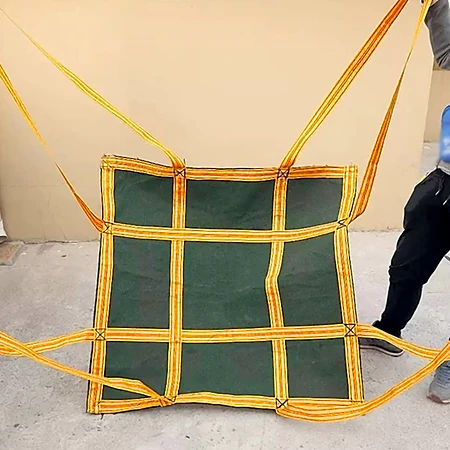
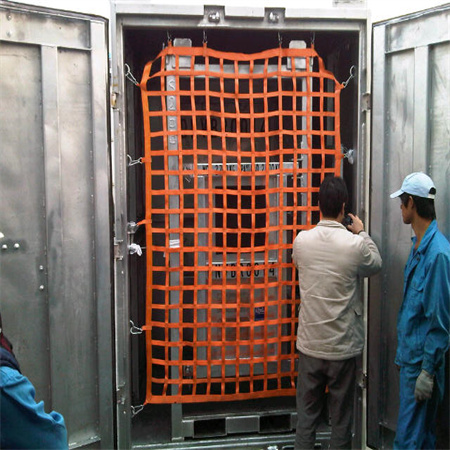
Hiki 'a e kautaha rigging sling ngaohi 'a e Crane Pallet Uta Kupenga,Kupenga Paleti Uta ʻEa,Kupenga Pad Hiki Uta,Uta Kupenga Hoist Crane Pallet kato mo e ngaahi nima fakamālohia,Kupenga Paleti Fakakautau,Kupenga Uta Paleti Crane.
Kupenga Uta Paleti Crane
A crane pallet cargo net is a webbing net cut to a pallet, koeʻuhí ke fononga ha paleti mo e meʻa kotoa pē ʻoku fakatoka ʻi aí ko ha ʻiuniti ʻe taha ʻi he matau ʻo e crane .. The net is spread on the ground, the pallet is set down on it, the load is stacked as it normally would be, and the four corner loops are drawn up past the stack and gathered onto the hook. The pallet never leaves the load, and nothing is re-stacked at the far end.
The net is quoted from the pallet footprint rather than from the load. We cut it 100 ki 200 mm lahi ange 'i he paleti 'i he tafa'aki kotoa pe ., so the border clears the pallet corners and the stack stays square inside the mesh – which is the whole discipline of a pallet net. We weave the webbing in our own mill in Taizhou, ko ia la'iva'e, kupenga, band width and rated capacity are set to your pallet rather than picked from a catalogue, and nets run from 0.5 t ki he . 20 t with every net proof-load tested before it ships.
- Fakalahi ki he paleti ., 'ikai ko e kavenga . – quoted from the footprint plus a 100-200 mm overhang, so the border clears the pallet corners and the stack stays square.
- 100 mm mesh as standard – holds cartons, ngaahi kato, drums and bricks without strapping; 50 mm ki he . 300 mm ke 'ota ..
- Ko e ngaahi foʻi takai tuliki fakamālohia ʻe fā . – a doubled, multi-stitched border carries the whole load out of the mesh and into the loops.
- Feleti, soft webbing – the load is carried on a distributed pressure instead of a point load, so cartons are not crushed and stretch wrap is not cut through.
- CE mo e GS fakamo'oni'i . – 0.5 t ki he . 20 t, proof-load tested on our own 1000 t misini ., with ISO 9001, CNAS and DNV behind the plant.
Why a pallet net rather than forks, banding or a cage
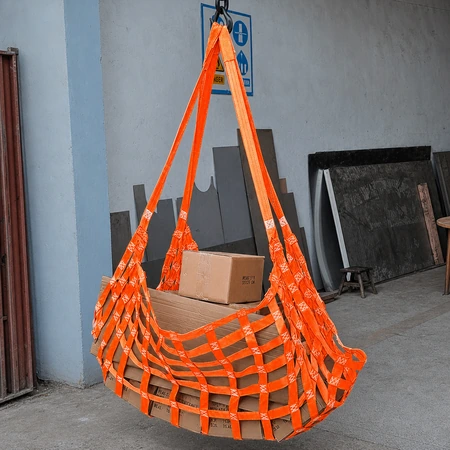
A pallet can be moved by forklift, by crane with a net, in a steel cage, or held together with banding and stretch wrap. On crane work the webbing net usually wins for reasons that have nothing to do with strength – and the comparison is worth making explicit, because buyers often arrive already committed to a cage.
Tēpile 1 – The four ways of moving a pallet load, and where each one stops working.
| Founga | What it is good at | Ko e feitu'u 'oku tōnounou ai . |
|---|---|---|
| Ngaahi fo'i 'akau hiki | Speed on flat ground and inside a warehouse | Cannot reach over a wall, ki ha pukepuke, onto a roof or across a barge |
| Ko e 'ai'angakai ukamea pe kola paleti . | Rigid protection and stacking | Mamafa, mamafa, lahi ke tauhi pea ke fakafoki ., and it is lifted with the load every time |
| Banding and stretch wrap | Ma'ama'a, maama, and it keeps a stack tidy for transit | One trip only; cut at the far end, crushes the bottom cartons, and carries no load for a crane lift |
| Webbing pallet net | Crane access anywhere, reusable for years, folds away between jobs | Needs the correct footprint and a rated loop arrangement – it is not a universal size |
The practical difference comes down to three points. A net weighs a fraction of a cage and folds into a bag when the truck has gone. It is reusable for years instead of one trip, so the cost per lift falls with every use. And because the band is flat and wide, the bottom cartons arrive in the condition they left in – which is the complaint that banding and strapping most often attract.
Sizing a crane pallet cargo net: footprint plus overhang
Almost every pallet net that fails in service was ordered to the wrong footprint. Two rules settle it: measure the pallet, 'ikai ko e kavenga ., pea tānaki atu 100 ki 200 mm 'i he tafa'aki kotoa pe .. Ko e overhang ko e me'a ia 'oku ne tauhi 'a e kau'afonua ke mahino mei he ngaahi tuliki 'o e pallet .; reduce it to save width and the net will not drop cleanly over a full stack.
Tēpile 2 – Standard pallet footprints and the net size that fits each one.
| Fa'ahinga paleti | La'iva'e 'o e paleti | Recommended net | Ko e feitu'u 'oku tu'unga . |
|---|---|---|---|
| Faka'ali'ali / half pallet | 600 × 400 mm | 800 × 600 mm | Retail display units, ʻIulope |
| Paleti vaeua | 800 × 600 mm | 1000 × 800 mm | ʻIulope; display and half-size units |
| ĀPELE / Paleti ʻIulope | 1200 × 800 mm | 1400 × 1000 mm | ʻIulope – the most common pallet in the world |
| ISO1. / paleti fakangaue'anga | 1200 × 1000 mm | 1400 × 1200 mm | ʻIulope mo ʻĒsia . |
| GMA / North American | 48 × 40 ʻi loto (1219 × 1016 mm) | 1420 × 1220 mm | ʻAmelika Tokelau – the grocery standard |
| ISO2. / paleti tapafā | 1200 × 1200 mm | 1400 × 1400 mm | ʻIulope, Asia and Australia |
| Tu'unga 'Aositelelia . | 1165 × 1165 mm | 1365 × 1365 mm | Australia |
Measured with the load off the pallet. A net that only just fits an empty pallet will not go over a full one, and a net that fits with the load on but not off has been cut by the pallet, not by us.
Load height works differently. It does not change the length or width of the net; it sets how far the mesh has to drop from the loops to the bottom of the stack. Tell us the finished load height and we set the leg length, so the loops gather above the stack instead of disappearing into it.
Base lift or top cover – four ways to rig it
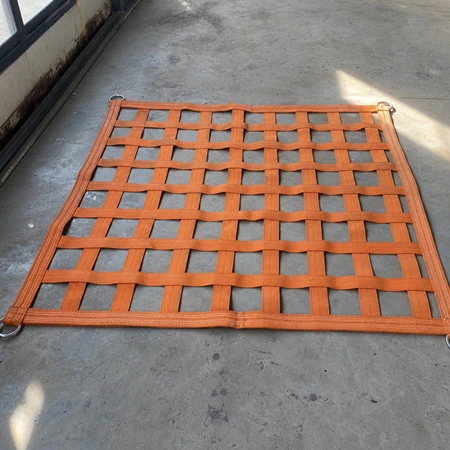
Ko e tu'utu'uni 'eni 'oku fa'a hala lahi taha ., and it is cheaper to settle before the order than after the first lift. The four arrangements are not interchangeable, and only two of them are lifting duty.
Tēpile 3 – How the net goes on the pallet, and what each arrangement is for.
| Fokotu'utu'u | Ko e founga hono rigged . | Ngāue‘aki ‘i he taimi . |
|---|---|---|
| Kupenga fakavaʻe (hiki) | Net on the ground, pallet set on it, load stacked, four loops pulled up past the load onto the hook | Ko e hiki crane angamaheni . – pallet and load leave the ground together and the pallet is part of the consignment |
| Top cover only ('ikai hiki) | Net dropped over an already-loaded pallet and hooked down | Holding a stack together in transit or against wind; the pallet is lifted separately on base slings |
| Ko e kato tāpuni-lalo ʻi ha paleti | Pallet carries loose goods inside the bag, and the bag is lifted from its loops | Piliki, naunau 'oku 'i he kato, offcuts and reject parts presented on a pallet |
| Eight-loop lift on a beam | Loops spread onto a spreader beam instead of gathered on one hook | Wide or heavy pallets where the stack must stay square and level |
One warning we give every buyer: a net fitted as a top cover is not automatically a lifting net. Lifting duty has to be designed in – fakafuofua'i 'a e malava, me'a malu, loop construction and a proof test per net. The tensioned version for holding loads down in transit is a kupenga malu'i 'o e uta, pea 'oku kehekehe hono fakafuofua'i 'i he taumu'a ..
Where the load cannot be palletised at all – tangai, bulk material, loose aggregate – the right product is a polyester hiki kupenga hiki, which is sized from the cargo rather than from a pallet.
Ngaahi fakangatangata fakatekinikale
The figures below cover the standard crane pallet cargo net range. La'iva'e, kupenga, kautāme'a, lau 'o e la'i, loop arrangement and rated capacity are all made to order, so treat this as the starting point for a quotation rather than a fixed catalogue.
Tēpile 4 – Crane pallet cargo net: ngaahi fakangatangata fakatekinikale.
| Paramita | Fakaikiiki |
|---|---|
| Fa'ahinga koloa | Pallet cargo net for crane lifting – base net, closed-bottom bag or eight-loop net for beam lifts |
| Naunau 'o e band | 100 % polyester ma'olunga-fefeka (MONUMANU OHI) uepi; nailoni ma'olunga-fefeka 'i he kole |
| Lalahi 'o e fo'i hiva | 25 / 50 / 75 / 100 mm (50 mm tu'unga) |
| Band construction | Layer 'e taha pe duplex .; woven selvedge, not a cut edge |
| Matolu 'o e fo'i hiva | 1.8 mm – 4.0 mm makatu'unga 'i he laulahi mo e lau 'o e layer . |
| Fakaava 'o e mesh | 100 × 100 mm tu'unga tapafā; 50 mm – 300 mm ke 'ota . |
| Lahi 'o e kupenga | Pallet footprint plus 100 – 200 mm 'o 'olunga 'i he tafa'aki kotoa pe . |
| Standard footprints | 600 × 400, 800 × 600, 1200 × 800, 1200 × 1000, 1200 × 1200, 1165 × 1165 mm mo e . 48 × 40 ʻi loto; ngaohi ki he tā |
| Loloa 'o e va'e | Set from the finished load height, so the loops gather above the stack |
| Kauāfonua | Doubled webbing, folded and multi-row stitched, fakamālohia ʻi he foʻi loop kotoa pē . |
| Ngaahi poini hiki | Tuliki 'o e ngaahi loop tuliki 'e fā .; valu mo ha fuʻu ʻakau fakamafola . |
| Fakafuofua'i 'a e malava (WLL) | 0.5 t – 20 t, set by footprint, kautāme'a, lau 'o e layer mo e fokotu'utu'u 'o e hiki |
| Ko e meʻa malu | 5:1 / 6:1 / 7:1 |
| Fakaloloa 'i he WLL . | 7 % pe si'i hifo . |
| Lanu | Kouti lanu 'aki 'a e fakangatangata 'o e kavenga ngaue ., pe ko ha lanu fale angamaheni . |
| Mafana 'o e ngaue | -40 °C ki he . +100 °C |
| Faito'o | UV fakatu'uma'u, fakafepaki ki he motu'a, abrasion mo e lo'imata 'oku ne taliteke'i, rot-proof |
| Makatu'unga tu'unga | Webbing 'oku fakafuofua'i ki he EN . 1492-1 makatu'unga |
| Fakamo'oni | T.S., GS, ISO 9001, JIS on request; Fale fakatotolo fakakemi CNAS; DNV |
| Fakaleleiʻi | OEM / Lahi 'o e ODM, lanu, printed band, faka'ilonga, logo and packing |
| Kouti HS | 6307.90 – lifting nets of textile materials |
Net sizes and rated capacities
Capacity follows the footprint, the band and the number of lifting points together. At four corner loops the figures below apply; heavier duty is quoted from a wider or duplex band rather than from a bigger net, because a larger net on the same band only spreads the same strength more thinly.
Tēpile 5 – Net sizes and rated capacities at four corner loops.
| Lahi 'o e kupenga | Mesh | Kautāme'a | Fakafuofua'i 'a e malava | Typical pallet load |
|---|---|---|---|---|
| 1000 × 800 mm | 100 mm | 50 mm taha | 0.5 – 1.5 t | Half pallets, display units, small cartons |
| 1400 × 1000 mm | 100 mm | 50 mm fale ua | 1 – 3 t | Euro pallet of cartons, bags or tinned goods |
| 1400 × 1200 mm | 100 mm | 50 mm fale ua | 2 – 4 t | ISO1 pallet, ngaahi meʻalea, boxed machine parts |
| 1420 × 1220 mm | 100 mm | 50 mm fale ua | 2 – 4 t | North American 48 × 40 in pallet |
| 1400 × 1400 mm | 100 mm | 50 mm fale ua | 2 – 5 t | ISO2 square pallet, denser loads |
| 2000 × 2000 mm | 100 – 150 mm | 75 mm fale ua | 4 – 8 t | Ngaahi paleti lahi fau, ongo paleti 'oku 'ave fakataha . |
| 2500 × 2500 mm | 150 mm | 75 – 100 mm fale ua | 6 – 12 t | Pallet frames and stillages |
| Ngaohi ki he fakatata . | 50 – 300 mm | 25 – 100 mm | 0.5 – 20 t | Ko ha fa'ahinga la'iva'e ., kau ai 'a e mohenga 'o e loli mo e lahi 'o e koniteina . |
Ratings assume four loops gathered on one hook and a load that stays inside the net. A two-loop basket under the pallet de-rates the net – ask for the derated figure rather than reading across from this table.
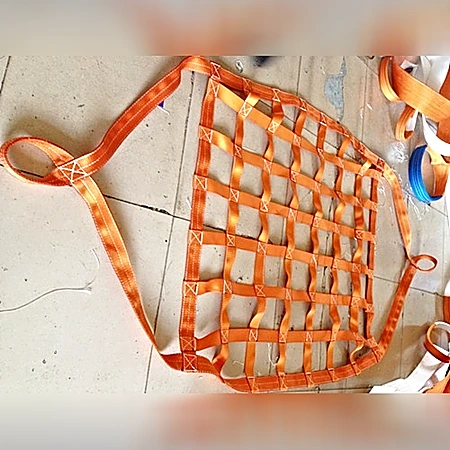
Kautāme'a, mesh and corner options
Ko e ngaahi fili ʻe tolu ʻoku nau fakapapauʻi ʻa e founga ʻoku ʻulungaanga ai ha kupenga paleti ʻi he ngāue tokoní .: ko e kau hiva, the mesh and the corner. All three are fixed on the drawing, and changing one later means a new net.
Tēpile 6 – Kautāme'a, mesh and corner options.
| Fili | Ko e meʻa ʻokú ne faí . | Fili ia ʻi he taimi . |
|---|---|---|
| 50 mm 'a e fo'i hiva 'e taha | Ko e fusi ma'ama'a taha 'oku tau lalanga . | Ko e ngaahi paleti vaeua mo e ngaahi uta 'i lalo . 1.5 t where net weight matters |
| 50 mm 'o e fo'i hiva | Two layers stitched as one band – the pallet standard | Meimei ko e uta paleti kotoa pe .; fakafuofua ki he liunga ua 'o e mo'ui 'o e tui 'o ha fo'i hiva 'e taha |
| 75 / 100 mm fale ua | Lahi ange 'a e band, lower pressure per band | Dense loads, and any load with hard or square edges |
| 100 mm tapafā mesh | Ko 'etau mesh pallet angamaheni . | Ngaahi kato, ngaahi kato, ngaahi meʻalea, piliki mo e koloa puha . |
| 50 mm kupenga | Mesh fufuu ange | Small items that could squeeze through a 100 mm fakaava |
| 150 – 300 mm kupenga | Mesh lahi ange, kupenga maʻamaʻa ange | Large unit loads that cannot escape the lattice |
| Tuliki fakamālohia | Extra webbing and multi-row stitching at each loop | Fatongia hiki kotoa, and always above 3 t |
| Nima malu'i | PU nima pe tui pad 'i he feitu'u fetu'utaki . | Paleti mo e ngaahi fa'o pe ngaahi fo'i 'akau ., pe ngaahi kavenga mata māsila . |
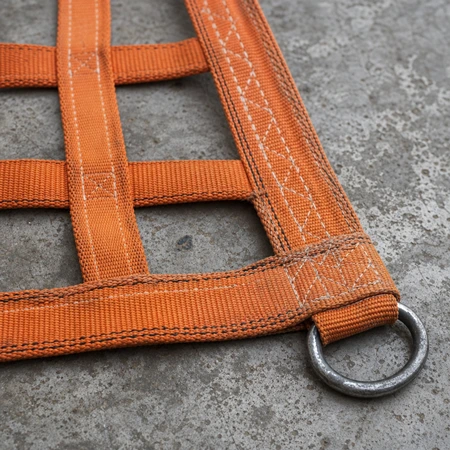
Hiki hake 'a e ngaahi configurations mo e ngaahi me'a
How the net is hung decides how much of the pallet it actually carries. Ko e ngaahi fokotu'utu'u 'eni 'oku mau fa'a fe'unga taha mo ia ., in the order we recommend them.
- Four loops on the hook – ko e tuʻunga. The loops gather on the hook or a master ring and the net closes on the stack as the crane takes up the slack.
- Eight loops on a spreader beam – the net stays square, 'oku nofo 'a e kavenga 'i he tu'unga pea 'oku 'ave 'e he tuliki takitaha ha vahevahe 'oku lava ke tomu'a tala .; the right answer for wide or heavy pallets, vakai ki he'etau . hiki hake 'a e pou spreader kehekehe.
- Two-loop basket under the pallet – base slings run under the pallet and up two sides. Fast to rig, ka 'oku ne de-rate 'a e kupenga .; ask for the derated capacity.
- Choke through the pallet voids – only where the pallet is sound and the void is a designed lift point, pea 'i ha malava pe 'oku derated ..
Fittings supplied or fitted on request: sewn webbing loops, master rings and master links, tu'unga 80 shackles for beam lifts, PU-coated band for outdoor and high-abrasion duty, protection sleeves for nailed pallets, and repair kits with matching band and thread for fleets that maintain their own equipment.
Two rules survive every arrangement. The load goes into the corners and the border, 'oua 'aupito na'a ke 'alu ki he lotolotonga 'o ha panel .. And the net is never dragged sideways with the crane while loaded – that is how a pallet net is destroyed in a single shift.
Marking and fleet identification
‘Oku nga‘unu ha kupenga paleti ‘i he vaha‘a ‘o e ngaahi matātahí ., loli mo e ngaahi saiti ., so the marking has to travel with it and stay readable.
- Fakangatangata 'o e kavenga ngaue, net size and mesh printed along the band, where the marking cannot be peeled off or washed away.
- Colour code by capacity – vaioleti 1 t, lanu mata 2 t, lanu engeenga 3 t, kulei 4 t, kulokula 5 t, lanu koko 6 t, lanu pulū 7 t, moli 8 t – so the net can be read across a bay.
- Pallet footprint printed on the band as well, which is what stops a 1400 × 1200 kupenga ‘oku ngāue‘aki ‘i ha . 1400 × 1000 paleti.
- A sewn capacity label in addition to the print, so the net and its paperwork always agree at inspection.
- OEM orders can carry your brand, tu'asila, warning text or certificate number printed on the band.
- Nets ship folded into a bag or a crate – ten pallet nets take the space of one pallet.
Sivi, certification and traceability
- Forty years of lifting equipment manufacturing – na‘e fokotu‘u ‘i he 1914 . 1985 ʻi Taisou, Jiangsu, mo e lahi ange ʻi he 100. 200 kau ngāue.
- Webbing woven in our own mill, ko ia ko e laulahi 'o e band, lau 'o e la'i, colour and printing stay under our control rather than being bought in.
- Every net proof-load tested on our own 1000 t horizontal machine – kuo sivi'i, not sampled – with a material test report travelling with the order.
- CE declaration of conformity and GS certification, mo e fakamo'oni JIS 'i he ngaahi 'ota 'o e 'ave ki tu'apule'anga.
- ISO 9001 quality management system, a CNAS-accredited laboratory and DNV certification behind the plant.
- Every net marked with its working load limit, footprint and mesh before packing, ko ia 'oku feongoongoi ma'u pe 'a e kupenga mo hono ngaahi pepa ..
Certificates and test reports are available as PDFs for a tender file or a customs check – see the full fakamo'oni seti.
What a pallet net will not fix
A net carries a sound pallet; it does not make an unsound one safe. Three things are worth checking before the first lift, because they decide whether the net can do its job at all.
- Broken boards and protruding nails. A nail head will cut a band in one lift. Repair or reject the pallet, or fit a protection sleeve at the contact point.
- Loads wider than the pallet. An overhanging load puts the band on the overhang instead of on the pallet edge, and the net will pull in as it tightens. Re-stack to the footprint or specify a bag form.
- Loads that cannot stand a side load. A net closes inward as it takes up the slack. Crates and cartons are fine; unsupported glass, tall thin packs and loose drums need the bag form or a spreader beam, not a four-loop gather.
Ko e feitu'u 'oku ngaue'aki ai 'a e ngaahi kupenga uta crane pallet .
Tēpile 7 – Ngaahi tohi kole 'i he sekitoa.
| Sekitoa | Ko e me'a 'oku hiki hake 'e he kupenga . | Ko e hā ʻoku feʻunga ai ha kupenga lahi hangē ha paletí . |
|---|---|---|
| Ngaahi taulanga mo e ngaahi taulanga | Palletised cargo into holds, onto barges, between quay and ship | 'Oku nofo 'a e paleti 'i lalo 'i he kavenga ., ko ia ‘oku ‘ikai ke toe fakatoka ha me’a ‘i he tafa’aki vaka . |
| Fale koloa mo e tufaki'anga koloa . | Paleti ki he faliki mezzanine ., 'oku 'ikai lava ke a'u ki he levolo 'o e fungavaka mo e racking 'o ha forklift . | Extends a crane or hoist into places forks cannot go |
| Langa mo e 'aofi 'o e fale . | Ngaahi piliki paleti, poloka, ngaahi taila mo e ngaahi meʻa fakaʻehiʻehi mei he ngaahi ʻaá mo e ngaahi fungavaka ʻi ʻolungá . | 'Oku motuhi 'a e Banding 'i he levolo 'o e kelekele .; 'oku hiki hake 'e he kupenga 'a e paleti kotoa 'oku kei hao |
| Meʻakai mo e inu . | Ngaahi kato paleti, hina, ngaahi meʻalea mo e ngaahi kato lalahi . | Pressure is spread across the pallet face, ko ia 'oku 'ikai ke laiki 'a e ngaahi kato 'i lalo . |
| Ukamea mo e ngaue'aki 'o e ukamea . | Palletised sheet packs, ngaahi konga puha mo e ngaahi offcuts . | 'Ikai faka'ilonga'i, pea 'oku ne pukepuke ha paleti kuo 'osi 'i hono lelei taha . |
| Kemikale mo e ngaahi me'alea . | Ngaahi paleti drum, IBCs 'i he pallets mo e naunau 'oku 'i he kato . | Fetu'utaki 'a e band molumalu; 'oku 'ikai ke ulo pe 'auha 'a e kupenga . |
| Ngaahi falekoloa momoko | Palletized 'a e ngaahi koloa 'aisi mo e chilled . | 'Oku tauhi 'e he polyester hono ngaahi koloa 'i he mafana 'o e freezer . |
| Ngaahi vaka totongi mo totongi . | Palletised kavenga hiki 'e he crane 'i he ngaahi feitu'u langa mo e ngaahi me'a 'oku hoko | 'Oku fetongi 'e he kupenga 'e taha ha 'ai'angakai 'o e manu ki he lahi 'o e pallet kotoa pe ., pea 'oku ne fold away 'i he vaha'a 'o e ngaahi ngaue . |
Tokanga'i, sivi mo e malolo .
- Lau ʻa e fakaʻilonga kuo paaki mo e fakaʻilonga ʻo e malavá kimuʻa ʻi he hiki kotoa pē ., and check that the load is inside the rating for the way the net is actually rigged.
- Inspect the corner loops and their stitching first – a webbing net wears there before anywhere else – pea ko e kauʻāfonua ., pea ko e ngaahi fusi fua kavenga ..
- Kumi ki he ngaahi motu'a ., kovi, tuitui motu'a, valivali fakakemikale, sio'ata vela, and the colour or gloss change that signals UV degradation.
- Vakai'i 'a e paleti pea pehe ki he kupenga .. Broken boards and nails damage the band, pea ko ha paleti ‘oku tō ‘oku ‘ikai ko ha ‘iuniti malu ia ke hiki hake ..
- 'Oua 'aupito na'a ke laka hake 'i he malava kuo fakafuofua'i ., 'oua 'aupito na'a ke hiki hake 'i ha si'isi'i ange 'i he seti kakato 'o e ngaahi loop, and never drag a loaded net sideways with the crane.
- Tauhi ke ma'a mo momoko ., mei he kelekelé pea mei he laʻā fakahangatonú .; never repair webbing by knotting, uelo pe fakamafana ia ..
- Withdraw the net if a load-bearing band, ko e kauʻāfonua, a loop or its stitching is damaged, pea 'ai ke sivi'i 'a e ngaahi kupenga 'e ha taha taukei 'i he vaha'a taimi 'oku fie ma'u 'e ho'o saiti ..
Ngaahi fehu'i 'oku toutou 'eke .
'E anga fefe ha'aku 'ilo'i 'a e lahi 'o e kupenga 'oku fie ma'u 'e he'eku pallet .?
Measure the pallet footprint with the load off, pea tānaki atu 100 ki 200 mm 'i he tafa'aki kotoa pe .. HA 1200 × 800 mm 'Oku to'o 'e he paleti 'o e 'Iulope ha . 1400 × 1000 mm kupenga; ha 1200 × 1000 mm ISO1 pallet takes 1400 × 1200 mm. Kapau 'oku ke 'ilo'i pe 'a e fa'ahinga pallet ., Tēpile 2 already has the size.
'Oku liliu 'e he ma'olunga 'o e kavenga 'a e lahi 'o e kupenga .?
ʻIkai. Load height sets the leg length, not the length and width. A tall stack needs longer legs so the loops gather above it and the mesh still reaches the bottom of the pallet; a short stack does not. Tell us the finished load height and we set the legs.
‘Oku totonu ke ‘alu ‘a e kupengá ‘i lalo ‘i he paletí pe ‘i ‘olunga ‘i he kavengá .?
I lalo, when the pallet and its load have to leave the ground together – that is the standard crane lift and the pallet stays part of the consignment. Over the load only, when the net is holding a stack together in transit and the pallet is lifted separately on base slings.
Can one net fit different pallet sizes?
Ko e hifo pe ., pea 'i he tokanga pe .. A net cut for a 1200 × 1000 mm pallet is loose on a 1200 × 800 mm paleti, and a loose net slips or catches on the pallet corners. Kapau te ke tokanga'i ha ngaahi lahi 'o e pallet ., order one net per size and print the footprint on the band.
Ko e hā e malava ʻoku ou fie maʻú?
Ko e mamafa fakakatoa 'o e pallet pea mo hono kavenga ., mo e fokotu‘utu‘u te ke ngāue‘aki mo‘oní .. Four loops on the hook and a two-loop basket give different ratings for the same net. Tell us the arrangement and we rate the net for it rather than quoting the highest figure on the sheet.
‘E laiki pe faka‘ilonga‘i ‘e he kupengá ‘a e ngaahi kato .?
ʻIkai – the opposite. A flat band spreads the load across its full width instead of concentrating it on a steel edge, so bottom cartons and stretch-wrapped packs arrive undamaged. That is why banding and strapping attract the opposite complaint.
'E lava ke nofo 'a e kupenga 'i he pallet lolotonga 'a e fefononga'aki .?
'E lava ke tuku ha kupenga hiki 'i ha paleti kuo uta ko ha 'ufi'ufi ., ka ke vakaiʻi muʻa ha meʻa ʻe ua .: ko e totongi fefononga'aki 'oku fakataumu'a, and that the net is not tensioned over the load unless it is also rated for lashing. A top cover is not automatically a lifting net, pea 'oku mo'oni foki 'a e reverse ..
What else do you make for palletised cargo?
Ko e webbing tatau 'oku 'alu ia ki he'etau . ngaahi sling uepi mo e ngaahi sling takai taʻe ngata, the wire rope range sits under ngaahi slings maea uaea, and the wider net range covers the webbing uta hiki kupenga, ko e kupenga uepi palakū nailoni pea ko e . fatongia mamafa nailoni uta kupenga sling. The whole category is listed under ngaahi kupenga hiki uta.
Kole ha fakamatala
To quote a crane pallet cargo net, send the pallet footprint or pallet type, the gross load weight and finished load height, pe 'oku 'alu 'a e kupenga 'i lalo he paleti pe 'i 'olunga 'i he kavenga ., the mesh opening and the lifting points you need – plus how many lifts a day the net will run. Our engineers will confirm the size, ko e kau hiva, ko e malava fakafuofua'i mo e fakafonu ., pea quote ia 'i ha tali 'e taha .. Ke talanoa'i 'o fakafou 'i he 'uluaki ., fetu'utaki mai ki he'emau kau 'enisinia.
Kautaha Rigging 'o e Sling Hiki – Paaka Ngaue'anga 'o Lifute, Kolo ko Taizhou, Vahefonua Jiangsu, Siaina
Tel: +86 523 8693 5818 | WhatsApp: +86 180 6600 2268 | ʻĪ-meili: hiki98@jslift.com