

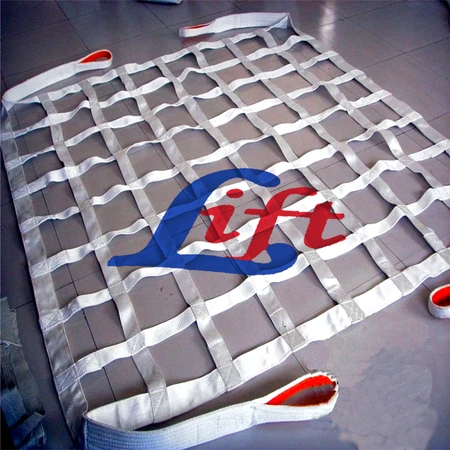
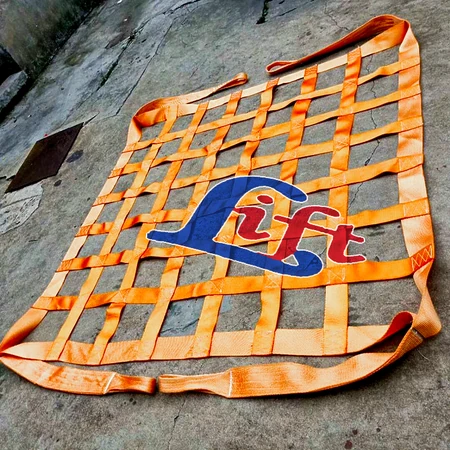
Lift sling rigging company produce Nylon Flat Webbing Net,Kupenga uta uepi palakū,Safety Cargo Lifting Net Straps, Kupenga Hiki 'o e Nailoni Sling,Nylon flat belt hanging net,Uta malu webbing kupenga .,Malu Hiki Kupenga Strap,Nylon Flat Webbing Lifting Net.
Nailoni Flat Webbing Kupenga
Open flat lattice · 0.5 t – . 10 t · 25–100 mm high-tenacity webbing · printable band
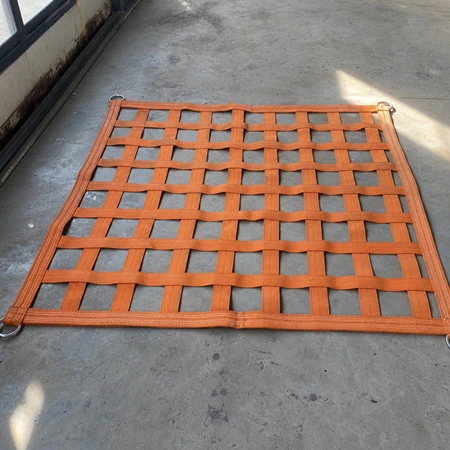
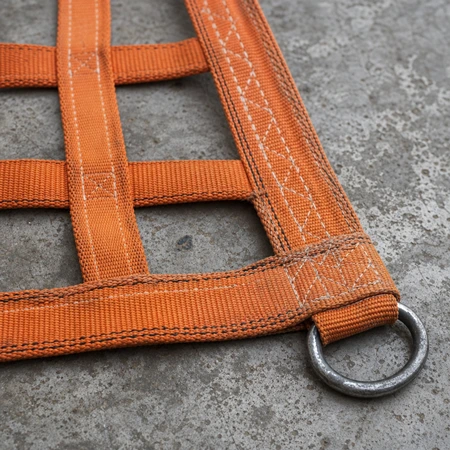
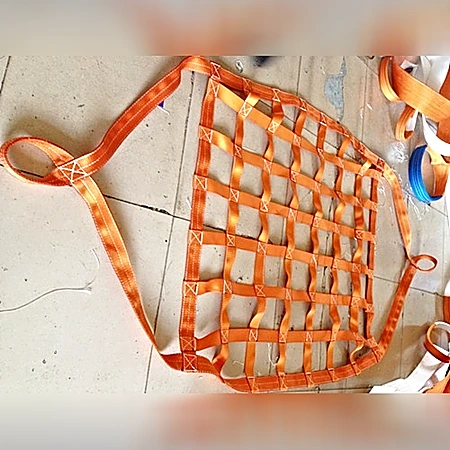
HA kupenga uepi palakū nailoni is an open lifting lattice, 'ikai ko ha kato. High-tenacity webbing bands cross at right angles into a square mesh, a folded double-stitched border runs round the perimeter, and four reinforced corner loops are what the crane lifts from. The load sits inside the mesh and is carried as one unit, with the weight spread across the full width of every band underneath instead of a few contact points.
'Oku lalanga 'e he Kautaha Lift Sling Rigging 'a e fusi, tuitui 'a e kupenga mo e fakamo'oni-sivi 'a e taha kotoa pe 'i Taizhou ., Jiangsu. 'Oku lele 'a e laulahi 'o e band mei he . 25 mm ki he . 100 mm, mesh mei he 50 mm ki he . 300 mm, rated capacity from 0.5 t ki he . 10 t, and net size, corner loops and printing are made to your drawing. Because the band is flat, ko e fakangatangata 'o e kavenga ngaue, net size and your own brand can be printed straight onto it — identification that cannot be pulled off or washed away.
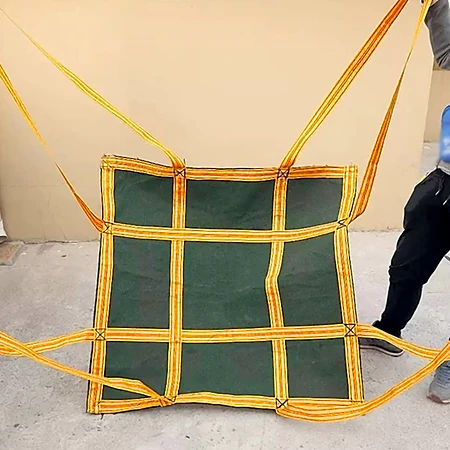
- Three flat webbing materials — nylon for shock loads, high-strength polyester for the lowest stretch, polypropylene for wet and chemical duty.
- 'Ikai faka'ilonga'i, wide-face contact — the flat band lies against painted, plated, bagged and boxed cargo without denting or scuffing it.
- Printable identification — WLL, lahi 'o e kupenga, kupenga, fleet number and own brand printed along the band, plus a sewn capacity label.
- Built to your size — 25–100 mm band, 50–300 mm mesh, four or eight lifting points, square or diamond lattice.
- Certified and tested — CE, GS and JIS certified, ISO 9001 ngaue, and every net breaking-load tested on our own 1000 t misini ..
Flat lattice, not a bag — what that changes
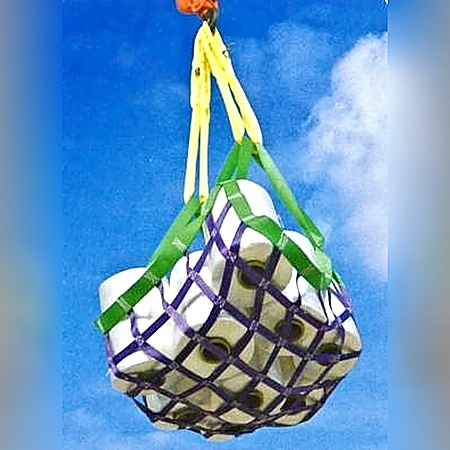
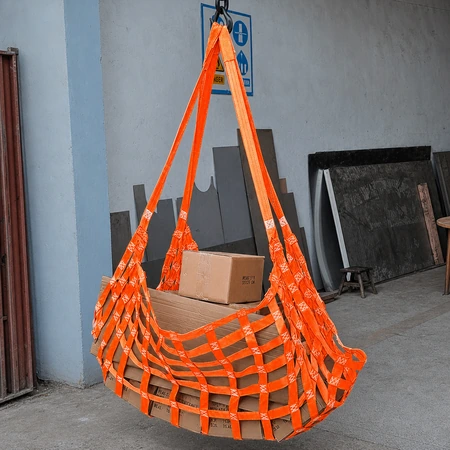
The difference between this net and a net sling is the bottom. A flat webbing net is an open lattice: the load sits on top of it and the net is lifted from four corner loops, so the mesh stays flat under the cargo. There is no closed pocket, no lifting legs gathering at a master ring, and nothing wraps the load. That is why it suits palletised, boxed and stacked cargo that already holds its own shape, and why it is quicker to load: the net is laid out, the load is set down on it, and the four loops go on the hook.
Where the cargo is loose, rounded or likely to shift, a closed-bottom net sling is the better tool — it contains rubble, scrap and bagged material without strapping. For pallet footprints, the purpose-built kupenga uta paleti crane uses the same flat lattice with a tighter mesh and a pallet-sized border.
Because the lattice is open, the net weighs very little for the area it covers: ha 2.5 × 2.5 m net in 50 mm band is light enough for one person to lay out, fold and carry, while still carrying several tonnes across its bands. That combination — wide soft bearing face, low weight, fast rigging — is what makes flat webbing the default construction in ports, warehouses and steel service centres.
Ngaahi fakangatangata fakatekinikale
The table covers the standard nylon flat webbing net. Lalahi 'o e fo'i hiva, lau 'o e la'i, kupenga, lahi 'o e kupenga, lifting points and printing are all made to order, so treat it as the starting point for a quotation rather than a fixed catalogue.
| Paramita | Fakaikiiki |
|---|---|
| Fa'ahinga koloa | Open flat webbing lattice (no closed bottom), four or eight corner lifting points |
| Naunau 'o e band | 100 % nailoni māʻolunga-fefeka (PA); polyester malohi-ma'olunga (MONUMANU OHI) or polypropylene (PP) 'i he kole |
| Lalahi 'o e fo'i hiva | 25 mm / 30 mm / 50 mm / 75 mm / 100 mm |
| Matolu 'o e fo'i hiva | 1.5 mm – 3.2 mm fakatatau ki he laulahi . |
| Layer 'o e band | Layer 'e taha; fale ua (la'i ua) for abrasion resistance |
| Fakaava 'o e mesh | 50 – 300 mm; 100 × 100 mm tu'unga |
| Mesh form | Square (tu'unga) or diamond on request |
| Lahi 'o e kupenga | 1.0 × 1.0 m ki he . 4.0 × 4.0 m tu'unga; 2.5 × 6 m and made to drawing |
| Kauāfonua | Folded band, double-stitched along the full perimeter |
| Ngaahi poini hiki | Four reinforced corner loops standard; valu mo ha fuʻu ʻakau fakamafola . |
| Fakafe'unga'i 'o e tuliki | Tuitui 'a e loop 'o e uepi, reinforced loop with pad, or master link on request |
| Fakafuofua'i 'a e malava | 0.5 t – . 10 t; kupenga mamafa ange langa ke 'ota . |
| Ko e meʻa malu | 5:1 / 6:1 / 7:1 |
| Fakaloloa 'i he malolo | Fekauʻaki 12 % – 20 % (nailoni); 7 % pe si'isi'i ange 'i he kavenga ngaue . (poliesita) |
| Fukahi | Molū, mapiko, 'ikai faka'ilonga'i |
| Lanu | Hinehina fakanatula, moli, lanu pulū, lanu mata, 'uli'uli pe angamaheni . |
| Paaki | WLL, lahi 'o e kupenga, kupenga, fleet number and own brand printed along the band; sewn label as standard |
| Mafana 'o e ngaue | −40 °C ki he . +80 °C nailoni; −40 °C ki he . +100 °C poliesita |
| Makatu'unga tu'unga | Webbing fakafuofua'i ki he EN . 1492-1 |
| Fakamo'oni | T.S. / GS / NE; ISO 9001; Fale fakatotolo fakakemi CNAS; DNV |
| Kouti HS | 630790 — hiki kupenga 'o e ngaahi naunau tupenu . |
Net sizes and working load limits
Net size is always quoted as length × width measured along the border, never as the mesh area. The load has to sit well inside the border: a net the same size as the load will let the cargo slide out at the edges. Every size below is also made to drawing.
| Lahi 'o e kupenga (L × W) | Fakaava 'o e mesh | Lalahi 'o e fo'i hiva | Ko e malava angamaheni | Ngaue'aki angamaheni |
|---|---|---|---|---|
| 1.0 × 1.0 m | 100 mm | 25 / 30 mm | 0.5 t – . 1 t | Small components, ngaahi meʻalea, paleti 'e taha |
| 1.2 × 1.2 m | 100 mm | 50 mm | 1 t – . 3 t | La'iva'e 'o e paleti tu'unga, ngaahi konga 'o e misini |
| 2.0 × 2.0 m | 100 mm | 50 mm | 2 t – . 5 t | Uta 'i he kato, ngaahi kato, poloka |
| 2.5 × 2.5 m | 100 – 150 mm | 50 mm | 2 t – . 5 t | Ko e uta paleti mo e kato ., uta koniteina |
| 2.5 × 6.0 m | 150 mm | 50 / 75 mm | 4 t – . 10 t | Uta loloa ., ngaahi fuʻu paipa, uta loli |
| 4.0 × 4.0 m | 150 – 200 mm | 75 / 100 mm | 8 t – . 10 t+ | Large pallets, bulk bagged cargo |
| Ngaohi ki he fakatata . | 50 – 300 mm | 25 – 100 mm | 0.5 t – . 10 t | Mohenga loli, koniteina, pukepuke mo e ngaahi tafa'aki 'o e spreader . |
Where the load is long or wide, the net is lifted from a beam rather than a single hook: ko e hiki hake 'a e pou spreader takes the eight corner loops, keeps the net square and keeps the cargo level.

Nailoni, polyester or polypropylene
All three nets are built identically — same lattice, same folded border, same corner loops. What changes is the polymer in the band, and that decides the strength, the stretch and the environment the net survives. Nylon is the material this page is named after; the other two are stocked because they answer jobs nylon does not.
| Api | Nailoni (PA) | Poliesita (MONUMANU OHI) | Polipolopileni (PP) |
|---|---|---|---|
| Malohi mo e mamafa . | Ma'olunga | Ma'olunga | Ma'ulalo taha |
| Fakaloloa 'i he malolo | 12 – 20 %, 'oku ne to'o 'a e 'oho | Ma'olalo, 7 % pe si'i hifo 'i he WLL . | 15 – 20 % |
| UV / outdoor life | Sai | Lelei taha 'i he tolu . | Needs UV stabiliser |
| Vai mo e pala . | Ta'e'ume'umea, slow to dry | Ta'e'ume'umea, quick to dry | Ngaahi float, absorbs under 0.1 % |
| Fakafepaki'i 'o e kemikale | Kiʻi | Sai | Best against acids and alkalis |
| Faka'auha | Toughest of the three | Sai 'aupito, duplex standard | Kiʻi |
| Ko e malava angamaheni | 0.5 t – . 10 t | 1 t – . 10 t | 0.3 t – . 5 t |
| Lelei taha ki he | Shock loads, rough handling, printed white bands | Most lifting duty; outdoor and long service | Ngaahi taulanga momoko, wash-down, kemikale, fatongia 'oku 'alu holo |
'I he ngaue .: nylon where the load shifts as it is lifted, or where the marking has to print cleanly on a light band; polyester for the lowest stretch and the longest outdoor life; polypropylene where the net works wet, may go over the side, or meets acids and alkalis. The polyester construction is described in more detail on the webbing uta hiki kupenga mo e kupenga uepi polyester ki hono hiki peesi.
Kautāme'a, mesh mo e ngaahi fili tafa'aki
Two nets of the same size and capacity can behave quite differently depending on band width, layer count and how the edge is finished. These are the options quoted most often.
| Fili | Ko e meʻa ʻokú ne faí . | Fili ia ʻi he taimi . |
|---|---|---|
| 25 / 30 mm 'o e fusi | Lightest net per square metre | Small nets, ngaahi kavenga ma'ama'a, handling weight matters most |
| 50 mm 'o e fusi | The standard lifting band | Most palletised and bagged cargo; best balance of strength, weight and cost |
| 75 / 100 mm 'o e fusi | Fewer, wider bands carry the load | Heavy or abrasive cargo, large bearing area needed |
| Layer 'e taha | Thinner, maʻamaʻa ange, cheaper band | Fatongia ma'ama'a, clean and dry handling |
| Fale ua (la'i ua) | Two layers stitched as one band | Dragging across pallets or concrete; high-wear duty |
| Kauʻāfonua kuo peluki | Border band turned over and stitched | Every net — stops the edge band unrolling |
| Tuliki fakamālohia | Extra stitching and doubled band at each corner | Every net; corners carry the whole load |
| Mesh tapafā | Bands run parallel to the net edges | Fakatoka, palletised and rectangular loads |
| Kupenga taimani | Lattice rotated 45° so the bands close on the load | Loose or rounded loads that need containing |
| PU coating | Coating stiffens the mesh and resists abrasion | Fatongia ma'olunga-abrasion, or where the net must hold shape when empty |
Corner loops and lifting configurations
Ko e founga ‘oku tautau ai ‘a e kupengá ‘okú ne fakapapau‘i ‘a e lahi ‘o e kavenga ‘okú ne fua mo‘oní .. These are the four arrangements built most often.
- Hiki 'o e loop 'e fa — ko e tu'unga .. The four corner loops are gathered onto a single hook or master ring and the load hangs in the middle of the net.
- Hiki 'o e spreader poini 'e valu. The net is lifted from eight loops on a beam: the net stays square, 'oku nofo 'a e kavenga 'i he tu'unga pea 'oku 'ave 'e he tuliki takitaha ha vahevahe 'oku lava ke tomu'a tala ..
- Basket or bag form. The net is closed around the load and picked from one point for loose or awkward cargo — see the polyester hiki kupenga hiki.
- Lashing or securing duty. Tensioned over or across a load rather than lifted from four corners — a different duty with a different rating, quoted separately from the lifting net.
| Fe'unga | Fakaʻaongaʻi mo e . | Tohi'i |
|---|---|---|
| Tuitui 'a e loop 'o e uepi | Flat webbing nets, matau taha | Tu'unga; tuitui 'o fakafou 'i he kau'āfonua 'aki ha fusi 'oku liunga ua . |
| Reinforced loop with pad | Heavy and abrasive cargo | Extra webbing protects the loop where it meets the hook |
| Fehokotaki'anga 'o e 'Eiki / mama 'eiki | Hiki ha fo'i loop 'e fa | Tānaki kotoa ʻa e ngaahi foʻi tautau ʻe faá ki ha poini ʻe taha ʻi lalo ʻi he matau . |
| Ha'i pe matau | Hiki 'o e spreader poini 'e valu | Tu'unga 80 fittings 'oku 'oatu mo e pou 'i he kole |
| Nima malu'i | Ko ha fa'ahinga kavenga mata'i-mata . | Slips 'i he funga 'o e fo'i hiva 'i he feitu'u fetu'utaki .; cheapest way to extend net life |
Paaki, marking and OEM
Flat webbing has one advantage the rope nets do not: the identification can be printed directly onto the band, where it cannot be pulled off, washed away or lost. That is the reason most of our net orders are printed rather than labelled.
- Fakangatangata 'o e kavenga ngaue, net size and mesh opening printed along the band on every net.
- Fleet numbers, inspection dates, contract numbers or a certificate number printed for operators and rental fleets.
- Own brand, address and warning text printed for OEM and distributor orders.
- A sewn capacity label is fitted as standard in addition to the print, so the net and the paperwork always match.
- Natural white nylon takes print most cleanly; moli, lanu pulū, green and black bands are also available.
- Nets ship folded in a bag or a crate — a set of six 2.5 m nets takes the space of one pallet.
Pule'i 'o e tu'unga lelei mo e fakamo'oni
Weaving the band ourselves is what makes a made-to-order net practical: maokupu, fakaleia, lanu, mesh and printing are all set inside our own plant, so the net is tuned to the load instead of assembled from whatever band a supplier happens to stock.
- 40 ta'u 'o e ngaohi 'o e ngaahi me'angaue hiki — fokotu'u 'i he 1990. 1985 ʻi Taisou, Jiangsu, lahi ange ʻi he 100.00. 200 kau ngāue, ko e taha ‘o e ngaahi tu’unga ngaohi’anga sling mo e kupenga hiki lahi taha ‘a Siaina.
- Own weaving mill — the same looms supply our ngaahi sling uepi mo e ngaahi sling takai taʻe ngata.
- Own testing laboratory with CNAS accreditation, plus CE and DNV certification of the facilities.
- 1000 t horizontal test machine — the breaking load of every net is tested and documented, pea ko ha lipooti sivi naunau 'oku fononga mo e 'ota ..
- CE mo e GS fakamo'oni'i 'a e ngaahi koloa hiki ., mo e fakamo'oni JIS 'i he ngaahi 'ota 'o e 'ave ki tu'apule'anga.
- Every net is marked with its rated capacity, band width and mesh before packing.
Where flat webbing nets are used
| Fale ngaohi'anga koloa | Ko e me'a 'oku hiki hake 'e he kupenga . | Why flat webbing suits it |
|---|---|---|
| Ngaahi taulanga mo e ngaahi taulanga | Ko e uta 'oku 'i he kato mo e paleti, container stuffing | Soft enough to pull around cargo inside a container |
| Steel service centres | Ngaahi puha peleti, ngaahi puha la'ipepa, ngaahi konga misini | 'Ikai faka'ilonga'i; wide band spreads load over the pack face |
| Fokotu'utu'u | Piliki, ngaahi poloka, ngaahi naunau 'oku 'i he kato, foomu | Holds small units in the mesh without strapping each one |
| Manufacturing and assembly | Valivali, plated and finished components | No marking, no edge damage on finished surfaces |
| Fale koloa mo e tufaki'anga koloa . | Ngaahi Paleti, ngaahi kato, mixed loads | Hiki vave 'a e loop 'e fa; folds away when not in use |
| Founga tō ngoue | Ngaahi kato lahi, fafanga, fa'u | Duplex band takes the wear of repeated pallet handling |
| Tahi mo e 'uta . | Deck cargo and transfer loads | Rust-free and quiet on a moving deck |
| Tokoni fakakautau mo fakatamaki . | Palletised relief cargo by crane or helicopter | Printable identification and a net that folds into a bag |
For the wire rope construction used on hot, sharp and abrasive bulk, vakai ki he . kupenga hiki uta; for the round-rope version of this lattice, ko e kupenga hiki uta nailoni. The raw band itself is described under ngaahi maea nailoni and the wider range under ngaahi kupenga hiki uta.
How to specify your net
A lifting net is made to order, and eight pieces of information are enough to quote it correctly the first time. Kapau 'oku 'iai ha'o fakatata 'o e mohenga 'o e loli ., koniteina pe puke ia kuo pau ke fe'unga ., 'ave 'a e me'a ko ia kae 'ikai — 'oku mau ngaue mei he ngaahi fakatata ma'u pe ..
| Ngaahi fakamatala 'oku tau fiema'u . | Ko e hā ʻoku mahuʻinga aí |
|---|---|
| Ko e mamafa 'o e uta mo e fotunga 'o e uta . | Sets the rated capacity and how many load-bearing bands sit under the load |
| Loloa 'o e kupenga × laulahi | Kuo pau ke lahi ange 'a e kupenga 'i he va'e 'o e uta ko ia 'oku tangutu 'a e uta 'i loto 'i he mesh . |
| Fakaava 'o e mesh | Pukepuke 'a e ngaahi me'a 'i he .; 'oku fie ma'u ha mesh si'isi'i ange ki he fanga ki'i konga iiki pe vetevete . |
| Lalahi 'o e fo'i hiva mo e la'i | Seti 'a e malohi ., the wear life and the weight of the net |
| Naunau | Nailoni, high-strength polyester or polypropylene |
| Ngaahi poini hiki | Ko e ngaahi fo'i 'uhiki'i tuliki 'e fa ko e tu'unga ., pe valu ki ha fuʻu ʻakau fakamafola . |
| Keleni, matau pe fakamafola | Fakapapau'i 'a e mama pe shackle 'oku fakapipiki ki he ngaahi loop 'o e tuliki . |
| Environment and documents | UV, vai māsima, kemikale, fua mafana; Faka'ilonga CE, lipooti sivi, own-brand printing |
Ngaahi fehu'i 'oku toutou 'eke .
What is a nylon flat webbing net made of?
Flat high-tenacity webbing — nylon as standard, with polyester and polypropylene available — woven into an open square lattice, finished with a folded double-stitched border and four reinforced corner loops. Ko e kau hiva, not the lattice, is what separates it from a rope net.
How is it different from a net sling?
Ko e lalo .. A net sling is a bag with a closed bottom and lifting legs that gather at a master ring, so it contains loose material. A flat webbing net is an open lattice lifted from four corner loops, so it suits cargo that holds its own shape and is quicker to load.
Ko e hā e malava te ke lava ʻo ʻoatu .?
Mei 0.5 t ki he . 10 t in nylon, 1 t ki he . 10 t in polyester and 0.3 t ki he . 5 t 'i he polipolopilini, set by band width, layer count and mesh. HA 2.5 × 2.5 m net in 50 mm band covers most palletised and bagged duty; larger nets and heavier bands are built to order.
Can the net carry our own brand?
Yes — this is the main reason to choose a flat band. Fakangatangata 'o e kavenga ngaue, lahi 'o e kupenga, kupenga, fika vakapuna, your brand or a certificate number can be printed along the band, where it cannot be pulled off or washed away. Colour and packing are configurable as well.
Ko e fē ʻa e lahi ʻo e mesh ʻoku ou fie maʻú?
Size the mesh from the smallest item in the load, 'ikai 'aupito mei he mamafa fakakatoa .. HA 100 mm fakaava 'oku ne pukepuke 'a e ngaahi kato ., ngaahi puha, bricks and small components; 150 mm ki he . 200 mm suits larger block and bundles. Send us the smallest piece and we will size the mesh to it.
Will it mark painted or plated cargo?
ʻIkai. The flat band lies against the load instead of biting into it, and the load is shared across the full width of every band underneath, ko ia ko hono fakafonu, vali, plating and machined faces come through the lift unmarked — which is the difference from wire rope and chain.
‘Oku anga-fēfē hono fakamo‘oni‘i ‘a e malavá .?
Nets are supplied at 5:1, 6:1 pē 7:1 hange ko ia kuo fakapapau'i, mo e webbing 'oku fakafuofua'i 'i he EN . 1492-1 makatu'unga. The breaking load of every net is tested on our own 1000 t misini mo ha lipooti sivi naunau fononga mo e 'ota .; the facilities hold CNAS, CE mo e DNV fakamo'oni.
Can it be used for lashing rather than lifting?
A net tensioned across a load is a securing net, rated differently from a lifting net. Tell us at quotation stage which duty it is for — the tensioned version is the cargo securing net, and the two are not interchangeable.
Kole ha fakamatala
Fekau'i atu 'a e mamafa 'o e uta mo e fotunga ., ko e lahi 'o e kupenga, ko e fakaava 'o e mesh, the band width and the material you have in mind — or a drawing of the truck bed, koniteina pe puke ia kuo pau ke fe'unga .. Our engineers confirm the band, ko e lau 'o e la'i, ko e malava kuo fakafuofua'i, the printing and the packing, pea quote 'i he tali 'e taha .. Ke talanoa'i 'o fakafou 'i he 'uluaki ., fetu'utaki mai ki he'emau kau 'enisinia.
Kautaha Hiki Sling Rigging — Paaka Fakangaue'anga 'o Lifute, Kolo ko Taizhou, Vahefonua Jiangsu, Siaina
Tel: +86 523 8693 5818 | WhatsApp: +86 180 6600 2268 | ʻĪ-meili: hiki98@jslift.com