

Lift sling rigging company manufacture Eye and Eye Webbing Sling,Flat Eye Web Sling,Fa'ahinga Mata 'o e Uepi Sling,Flat-Eye Web Sling,Polyester Eye-eye Webbing Sling,Flat Eye & Eye Web Sling,2-Ply Eye-Eye Polyester Flat Webbing Sling,Webbing Sling with Eyes.
Mata mo e Mata Webbing Sling .
A two-eye flat webbing sling for lifting, bundling and pulling heavy loads — flat eye or twisted eye, made to order in Taizhou, Siaina
Fakamatala nounou .
An eye and eye webbing sling is a flat webbing sling with a sewn eye at each end. It is made for lifting, bundling and pulling heavy loads — the three jobs a two-eye sling does better than anything else. The eyes carry the load onto the hook or the shackle, the flat webbing body carries it across the load, and there is no metal anywhere in the sling to scratch a finished surface or to fatigue.
It is supplied with flat eyes or twisted eyes, sewn from high-tenacity polyester webbing in single, duplex or triplex plies, in widths from 25 mm ki he . 200 mm and working load limits from 1 t ki he . 24 t. The standard is EN 1492-1, the safety factor is 7:1, and every sling carries a sewn label with its working load limit, lōlōa, mode, tu'unga mo e 'aho.
The three uses are not interchangeable, mo e Vahe 1 . 3 sets out why: a sling made for lifting is rated on a working load limit, a sling used for bundling or tying down is rated on a lashing capacity, and a sling used for pulling is not covered by a lifting rating at all. We mark each sling for the job it was made for. Tell us which of the three you need and the specification follows. For the net range see the ngaahi kupenga hiki uta, and for the rest of the sling range the ngaahi sling uepi fakakalakalasi.
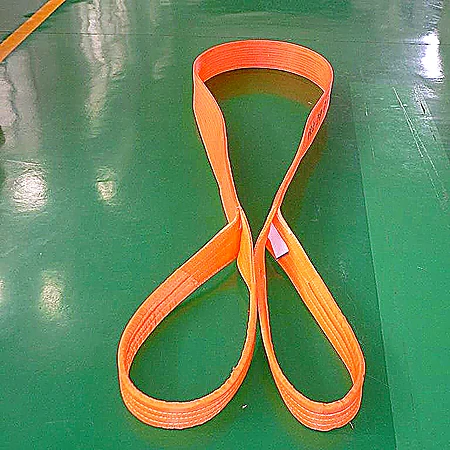
Fōtunga 1 — An eye and eye webbing sling: a sewn eye at each end, 'ikai ha ukamea, and the working load limit printed and labelled on the sling.
1. What an eye and eye webbing sling is
Five features define the product, and each one decides how it is used.
- An eye at each end. Two sewn eyes, not a continuous loop. That is what separates an eye and eye sling from an endless sling, and it is what allows the sling to be used vertically, in a basket and in a choke hitch.
- Flat webbing, not round rope. Ko ha fusi palakū ‘okú ne fakamafola ‘a e kavengá ‘i hono fālahí kotoa ., so it does not mark or crush what it lifts. A round sling of the same capacity contacts on a much narrower line.
- Polyester ma'olunga-fefeka. Ma'ulalo 'a e 'otu — fekau'aki mo e . 7 % or less at the working load limit — which keeps the load stable, and good resistance to ultraviolet light and to abrasion for an outdoor sling.
- Sewn, not metal-ended. The eyes are stitched, so there is no hook, no thimble and no ferrule to scratch a load, to corrode or to fail. The label and the stitching are the two things to inspect on every sling.
- Rated on a working load limit, with a mode factor. The figure on the label applies to the mode you use — vertical, basket or choked — and the mode changes the capacity. Kupu 6 sets out the factors.
It is worth knowing the two other shapes in the range so you can place this one. An endless webbing sling has no eyes at all: it is a continuous loop of webbing, which is convenient but cannot be choked through its own eye. A round sling is a continuous loop of polyester yarn inside a woven sleeve: softer and heavier, and rated differently. The eye and eye sling is the version you buy when you want to choose how it is hitched.
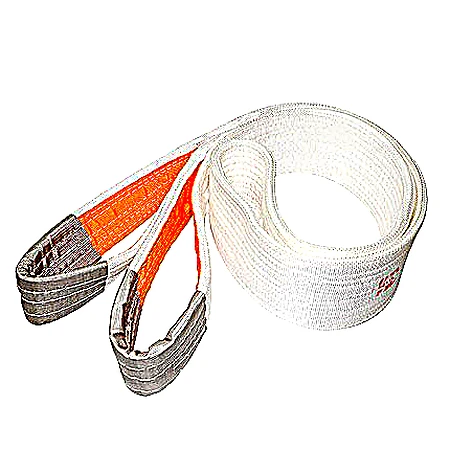
White polyester webbing with a reinforced eye and a protective sleeve — no metal anywhere in the sling |
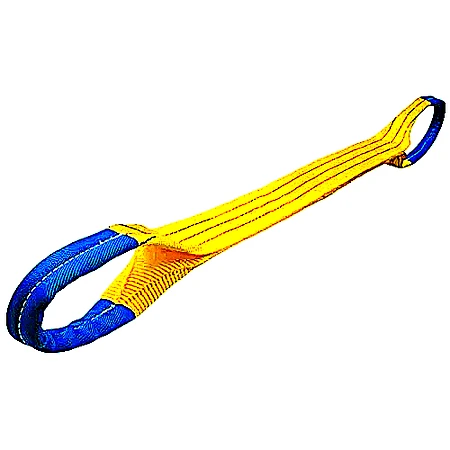
The two eyes are the load path and the flat webbing body carries the load across the cargo |
The other two shapes are on the same site: ko e sling hiki ta'e ngata pea ko e . ngaahi sling takai.
2. Flat eye or twisted eye
Both ends carry a sewn eye; the difference is the plane the eye sits in, and that single detail decides how the sling sits on a hook and whether it can be choked cleanly.
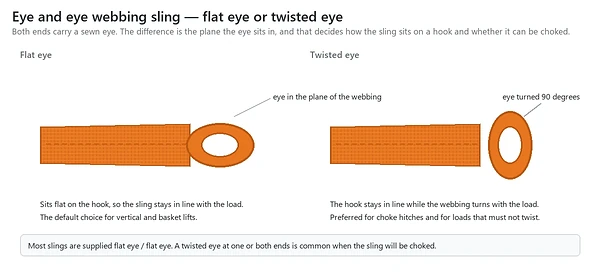
Fōtunga 2 - Toʻohema: a flat eye, lying in the plane of the webbing. Tonu: a twisted eye, turned 90 degrees to the webbing.
| Fa'ahinga mata | How it sits | Lelei taha ki he | Ko e me'a ke sio ai . |
|---|---|---|---|
| Mata palakū | The eye lies in the same plane as the webbing, so it presents a wide, flat opening to the hook | Vertical lifts, basket lifts and general hook work — the sling stays in line with the load | On a choke hitch the webbing has to twist along its length to let the eye pass through itself |
| Twisted eye | The eye is turned 90 degrees to the webbing, so it presents at right angles to the band | Ngaahi fakaʻilonga ʻo e choke, loads that must not be allowed to rotate, and slings that live on a hook between lifts | The eye root carries more stitching; confirm the eye length and bearing width you need |
| Flat eye one end, twisted eye the other | One eye flat, one turned — the most useful combination for a choke hitch | Choked lifts where the choke eye should present squarely to the load | Order the pair in the order you intend to use them |
Tēpile 1 — Flat eye, twisted eye, and the combination.
Most eye and eye slings are supplied flat eye / mata palakū, and that is the right default for general work. A twisted eye at one end is what you specify when the sling will be choked: the twisted eye presents squarely to the load while the webbing turns, and the choke seats properly instead of rolling the band over on itself.
If you are not sure which you need, tell us how the sling will be hitched — vertical, kato, or choked around the load — and we will specify the eye type rather than leaving it to default.
3. Ngaue 'e tolu ., three different ratings
An eye and eye sling is bought for lifting, for bundling and for pulling, and the same length of the same webbing can serve all three. What must not be blurred is the rating: the three jobs are governed by different rules, they are marked differently, and a sling made for one job is not automatically safe for another.
| Ngāue | What the sling does | Which rating applies | What governs the specification |
|---|---|---|---|
| Hiki hake | The eyes sit on a hook, a shackle or a beam, and the sling carries the load off the ground | Fakangatangata 'o e kavenga ngaue (WLL), rated per EN 1492-1 with the mode factor applied | Webbing width and ply, the mode of lift, ko e tuliki va'e, and the standard the sling is made to |
| Bundling and tying down | The sling holds a bundle together or holds cargo down on a vehicle or a pallet | Lashing malava (LC) — a restraint rating, 'ikai ko ha fakafuofua hiki | The tension the buckle or winch can apply, the friction between the load and the deck, and the restraint forces the arrangement must resist |
| Toho mo toho . | The sling pulls a load along, or recovers a stuck vehicle | No lifting rating applies at all | Uta faka'ohovale, abrasion on the ground, vehicle mass, and fittings that are safe to recover from. This is a recovery-strap product, not a rated lifting sling |
Tēpile 2 — Lifting, bundling and pulling: three jobs, three different ratings.
The reason this matters is that the three look identical in a photograph. Ko ha sling 'oku fakafuofua ki he . 5 t for lifting is not thereby a 5 t lashing, and a lashing is not a lifting sling. 'Oku tau ngaohi kotoa 'a e tolu ., and we mark each one for the job it was made for, so the label on the sling tells you which rules apply. Where the job is tying cargo down rather than lifting it, the dedicated product is the kupenga malu'i 'o e uta, which is rated as a restraint and tested on that basis. Where the job is pulling over a long distance or recovering a vehicle, say so at the enquiry stage — the specification changes.
4. Ngaahi fakangatangata fakatekinikale
The figures below cover the standard range. Maokupu, ply, lōlōa, fa'ahinga mata, loloa 'o e mata, colour and marking are all made to order, ko ia fai ki he tēpile ko ʻení ko e kamataʻanga ia ki ha kupuʻi lea kae ʻikai ko ha kataloko tuʻu maʻu ..
| Paramita | Fakaikiiki |
|---|---|
| Fa'ahinga koloa | Eye and eye flat webbing sling with a sewn eye at each end |
| Naunau 'o e uepi | 100 % polyester ma'olunga-fefeka (MONUMANU OHI); uepi nailoni 'i he kole |
| Lalahi 'o e uepi | 25 / 30 / 35 / 50 / 60 / 75 / 100 / 150 / 200 mm |
| Ply | Te'eki mali (1-ply), fale ua (2-ply) pe fale tolu . (3-ply) |
| Matolu 'o e uepi | 1.8 mm – 6.0 mm depending on width and ply |
| Fa'ahinga mata | Flat eye or twisted eye, at either end or one of each |
| Fo'imata | Sewn with high-tenacity thread; reinforced eye with extra stitching on request |
| Eye length | 100 mm – 1000 mm, pe ke 'ota . |
| Bearing width | Set by the webbing width and the eye fold — stated so the hook or shackle can be checked |
| Lōlōa | 0.5 m ki he . 100 m overall, ngaohi ke 'ota |
| Fakangatangata 'o e kavenga ngaue | 1 t – . 24 t for a single leg in the vertical mode |
| Ko e meʻa malu | 7:1 tu'unga; 5:1 mo e 6:1 'i he kole |
| Fakaloloa | 7 % pe si'i hifo 'i he fakangatangata 'o e kavenga ngaue . |
| Ngaahi me'a 'o e founga | Hangatonu 1.0 · Faka'auha 0.8 · Basket (0–45°) 2.0 · Basket (45–60°) 1.4 |
| Lanu | ʻI LOTO 1492-1 lanu 'o e code 'e he ngaue 'a e fakangatangata 'o e kavenga ., pe ko ha lanu angamaheni . |
| Faito'o | Ultraviolet-resistant, fakafepaki ki he motu'a, abrasion-fakafepaki'i |
| Mafana 'o e ngaue | -40 °C ki he . +100 °C |
| Tu'unga | ʻI LOTO 1492-1; other national standards made on request |
| Fakamo'oni | T.S. / GS / NE; ISO 9001; Fale fakatotolo fakakemi CNAS; DNV |
| Faka'ilonga | Sewn label carrying the working load limit, lōlōa, mode, tu'unga, manufacturer and date |
| Fakaleleiʻi | OEM / ODM width, lōlōa, ply, lanu, uepi kuo paaki, leipa 'a'ana mo e fakafonu |
Tēpile 3 — Eye and eye webbing sling: ngaahi fakangatangata fakatekinikale.
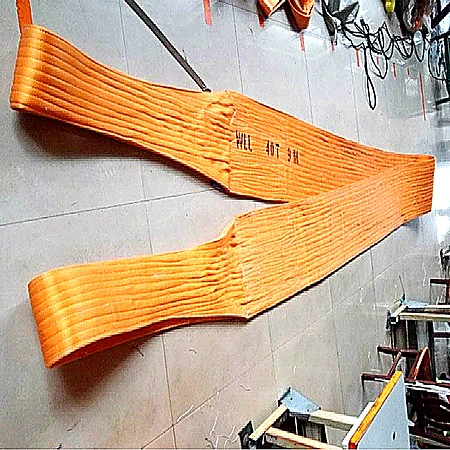
A heavy sling with the working load limit and length printed on the webbing itself — WLL 40 T, 9 m |
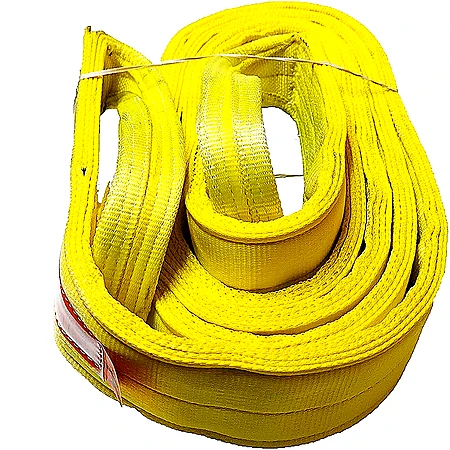
Polyester webbing holds its colour and its weave under load, which is what makes the printed marking legible for the life of the sling |
5. Maokupu, ply and working load limit
Two numbers set the capacity of a flat webbing sling: how wide the band is, and how many plies are sewn into it. A duplex sling is not twice as strong as a single because the plies are stitched together, but it is close, and it wears far better because the outer ply takes the abrasion.
| Lalahi 'o e uepi | Ply 'e taha (1-ply) | Fale ua (2-ply) | Tolu (3-ply) | Fatongia angamaheni |
|---|---|---|---|---|
| 25 mm | 1 t | 2 t | 3 t | Light loads, ngaahi naunau ngāue, ngaahi konga iiki |
| 50 mm | 2 t | 4 t | 6 t | Hiki fakalukufua, ngaahi konga 'o e misini, ngaahi meʻalea |
| 75 mm | 3 t | 6 t | 9 t | Hiki fakalukufua, palletised and bundled cargo |
| 100 mm | 4 t | 8 t | 12 t | Heavy lifting, steel and concrete units |
| 150 mm | 6 t | 12 t | 18 t | Heavy and long loads, towing and pulling duty |
| 200 mm | 8 t | 16 t | 24 t | The heaviest standard range, large fabricated loads |
Tēpile 4 — Working load limit by webbing width and ply, for a single leg in the vertical mode.
Capacities in the table are for one leg hanging vertically. In a basket the sling carries more, in a choke it carries less, and in a multi-leg arrangement the leg angle takes its share — the factors are in the next section. Widths of 30 mm, 35 mm mo e . 60 mm, mo e ngaahi malava fakavaha'apule'anga ., are made to order.
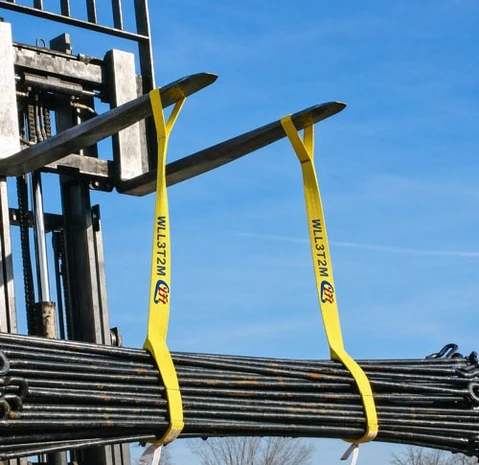
Duplex slings in a bundle duty: the outer ply takes the abrasion and the inner ply carries the load |
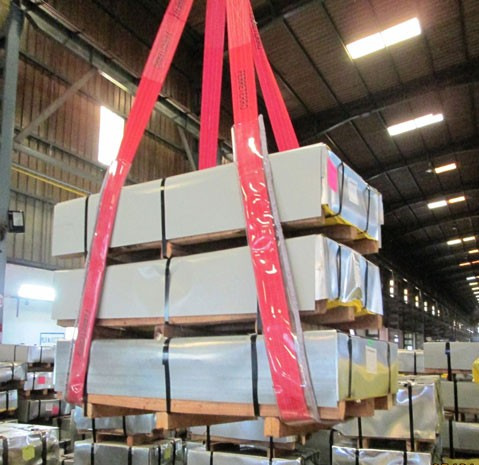
The same webbing on a straight lift — a flat band spreads the load and leaves no mark on a finished surface |
6. Mode factors and the leg angle
The working load limit on the label is not a single number: it is the figure that applies in the vertical mode, and it is multiplied by the factor for the mode you actually use. The factor is measured from the vertical, not from the deck.
| Mode | How the sling is hitched | Fakatupunga | Worked example on a 2 t single-ply sling |
|---|---|---|---|
| Hangatonu | One eye on the hook, the load hanging directly below | 1.0 | 2 t |
| Kafo | The sling passes around the load and through its own eye | 0.8 | 1.6 t |
| Kato, 0–45° | The sling passes under the load; both eyes on the hook, legs close together | 2.0 | 4 t |
| Kato, 45–60° | Hange ko ia 'i 'olunga ., with the legs spread wider | 1.4 | 2.8 t |
Tēpile 5 — Mode factors for a flat webbing sling (ʻI LOTO 1492-1 makatu'unga).
Two practical points follow from this table. ʻuluaki, the number printed on the webbing is normally the vertical working load limit, so a sling used in a choke is working below its printed figure and must be understood that way. Fika ua, in a two-leg or four-leg arrangement the legs share the load, but the share is governed by the angle and by how evenly the load sits — the same logic that governs a four-loop net.
Ko e feituʻu ʻoku tautau ai ʻa e vaʻé ʻi ha fuʻu ʻakau kae ʻikai ko ha matau ʻe taha ., 'oku fokotu'u 'a e fakafuofua 'e he 'akau. Ko e hiki hake 'a e pou spreader pea ko e . ngaahi meʻangāue hiki in our range are made to take the same fittings.
7. Eye length, effective length and how to measure
More slings are returned or replaced for a length misunderstanding than for any other reason, so it is worth being precise about the three measurements.
| Fua | Ko e hā ia . | Ko e hā ʻoku mahuʻinga aí |
|---|---|---|
| Eye length | The internal length of the eye, from the bearing point inside the eye out to the tip of the eye | It sets how much of the eye is available over a hook or a shackle, and how far a choke eye can reach through the other eye |
| L — overall length | The sling as supplied, measured from the tip of one eye to the tip of the other | It is the figure printed on the label and the figure buyers normally quote, but it is not the length the lift actually uses |
| EL — effective length | The length in service, normally from the bearing point of one eye to the bearing point of the other | It is the reach of the lift. If you order on L but lift on EL, the load will sit lower than expected |
Tēpile 6 — Eye length, L and EL, and which one you should quote.
Our quotation will state which figure is being quoted, and we recommend putting both on the enquiry: the reach you need and the eye length that suits your hook. ʻolunga 100 mm of webbing width, the eye length and the bearing width together decide whether your hook or shackle actually fits — a 200 mm sling may need a longer eye simply to clear the hook body.
A sling sized for a specific hook, beam or load is worth drawing once. If your lift is repetitive, ko e sling founga 'e taha pea ko e . kupenga uta paleti crane are the two directions that repeat lift tends to take.
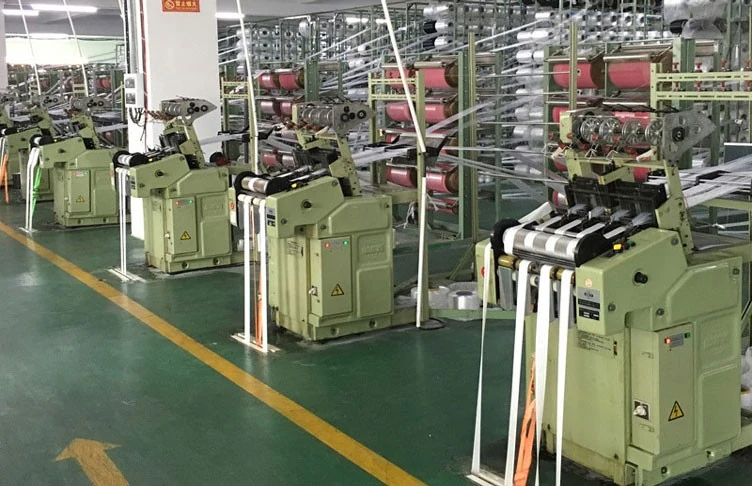
Fōtunga 3 — Ko 'etau faliki lalanga 'atautolu pe .: the polyester webbing that every sling on this page is sewn from.
8. Colour code and identification
A flat webbing sling is identified by colour first and by label second. The colour tells the user the capacity at a glance; the sewn label carries the figures that the colour cannot.
| Fakangatangata 'o e kavenga ngaue | Standard colour | Fakangatangata 'o e kavenga ngaue | Standard colour |
|---|---|---|---|
| 1 t | Vaioleti | 5 t | Kulokula |
| 2 t | Lanu mata | 6 t | Lanu koko |
| 3 t | Lanu engeenga | 7 t | Lanu pulū |
| 4 t | Kulei | 8 t | Moli |
Tēpile 7 — The standard colour code for flat webbing slings.
- The colour code follows the working load limit, not the width, so a duplex 50 mm sling and a single-ply 100 mm sling are different colours at the same duty.
- Ngaahi malava 'i 'olunga 8 t, and non-standard slings, carry the manufacturer’s own colour scheme, printed on the sewn label.
- Everything a colour cannot say is on the label: fakangatangata 'o e kavenga ngaue, lōlōa, mode, tu'unga, manufacturer and date of manufacture. A sling with a missing or illegible label comes out of service, pe ko e ha pe hono lanu ..
- The webbing can also be printed along its length — working load limit, length and your own brand. Printing is the most durable identification on a sling that spends its life being dragged across loads.
- Packing can carry the same information, which matters for fleets that store slings by size and colour rather than individually.
9. Eye protection, wear pads and fittings
An eye and eye sling is deliberately free of metal. What protects it instead is stitching and fabric.
| Fili | Ko e meʻa ʻokú ne faí . | Fili ia ʻi he taimi . |
|---|---|---|
| Standard sewn eye | The eye as stitched with high-tenacity thread | General lifting and bundling duty |
| Mata kuo fakamālohia | Extra stitching at the eye root, 'a ia 'oku fakatefito ai 'a e kavenga . | Toutou hiki ., fatongia mamafa, and use in a choke hitch |
| Wear pad in the eye | A fabric pad inside or over the eye | Frequent use on a hook or a shackle, where the eye would otherwise polish and thin |
| Protective sleeve on the body | A sleeve or wear pad over the webbing at the contact point | Sharp-edged loads — steel plate, concrete, machined components |
| Anti-cut edge protection | A heavier sleeve where the band meets a cutting edge | Loads with a genuinely sharp edge, which is the failure mode we see most in returns |
| Round sling instead | A sleeved continuous loop, no exposed stitching | Where the load is very abrasive or where a flat band may slip |
Tēpile 8 — Protection and eye options.
Ko e fefakatau'aki 'oku faitotonu .: a metal end fitting can be inspected more easily and can be replaced, but it scratches loads and it can corrode or fatigue. A sewn eye cannot corrode and cannot mark a load, which is why a flat webbing sling is the default choice wherever a finished surface has to arrive undamaged. What it cannot do is survive a sharp edge unassisted — that is what the sleeve in the table is for.
For loads that are genuinely abrasive and cannot be sleeved, the right answer is usually a different product rather than a thicker sling: ko e fatongia mamafa nailoni uta kupenga sling pe ko ha . ngaahi slings maea uaea arrangement.
10. Pule'i 'o e tu'unga lelei mo e fakamo'oni
We weave the webbing and sew the slings in the same plant, ko ia laulahi, ply, lanu, pulusi, eye type and eye length are under our control rather than bought in.
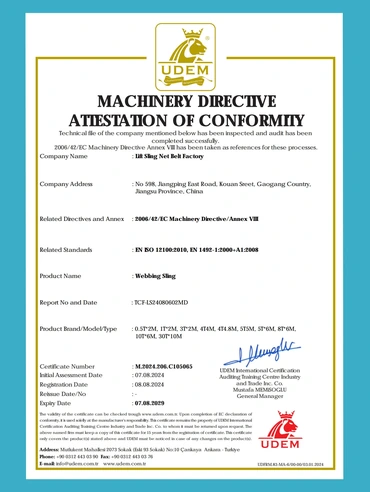 CE attestation of conformity covering our webbing slings to EN 1492-1 |
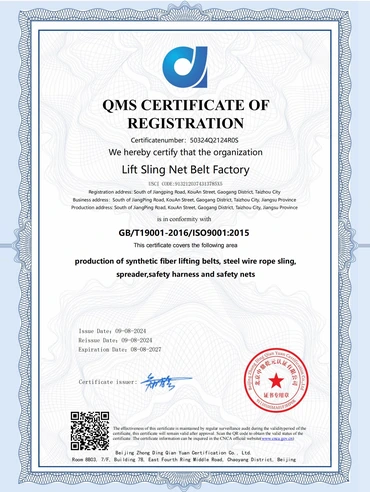 ISO 9001 tohi fakamo'oni ako ki he sisitemi pule'i 'o e tu'unga lelei |
- 40 ta'u 'o e ngaohi 'o e ngaahi me'angaue hiki — fokotu'u 'i he 1990. 1985 ʻi Taisou, Jiangsu, mo e lahi ange ʻi he 100. 200 kau ngāue, one of China’s largest lifting sling production bases.
- CE mo e GS fakamo'oni'i ., mo e fakamo'oni JIS 'i he ngaahi 'ota 'o e 'ave ki tu'apule'anga, and a declaration of conformity to EN 1492-1 available for each order.
- Fale fakatotolo fakakemi 'a'ana — 'oku ma'u 'e he'etau ngaahi ngaue'anga 'a e fakamo'oni 'o e fale fakatotolo fakakemi CNAS ., Ko e fakamo'oni CE 'a 'Iulope mo e fakamo'oni DNV ., mo 15 pateni fakamafai'i 'i he'etau ngaahi koloa hiki ..
- 1000 t misini sivi fakahosite — 'oku sivi'i mo fakatohi 'a e kavenga motuhi 'o e sling kotoa pe kae 'ikai ko e sipinga ., pea ko ha lipooti sivi naunau 'oku fononga mo e 'ota ..
- Every sling is measured, weighed and fitted with its sewn label before packing, and the label carries the working load limit, lōlōa, mode, tu'unga, manufacturer and date.
The full set of certificates is on our fakamo'oni peesi 10 ..
11. How to specify an eye and eye webbing sling
Nine pieces of information are enough to quote correctly the first time. The two most often left out are the mode of lift and the eye type, and both of them change the answer.
| Ngaahi fakamatala 'oku tau fiema'u . | Ko e hā ʻoku mahuʻinga aí |
|---|---|
| Which job: hiki, bundling or pulling | It decides which rating applies and how the sling is marked. This is the first question we ask |
| Load weight per lift | Sets the webbing width and the ply |
| Mode of lift | Hangatonu, basket or choked — the mode factor changes the capacity, and a choke needs a twisted eye |
| Eye type and eye length | Flat or twisted, and how long the eye must be to clear your hook or shackle |
| Length you need: L or EL | The reach of the lift, and how much of the sling hangs below the hook |
| Webbing width and ply | Driven by the load and by how abrasive the duty is |
| Lanu mo e faka'ilonga . | The standard colour code is normally required; own-brand printing is optional |
| Maluʻi | Sleeves or wear pads where the band meets a hook or an edge |
| 'Atakai mo e ngaahi tohi . | Fua mafana, kemikale, ultraviolet exposure, me'a malu, test report and export packing |
Tēpile 9 — What we need to quote an eye and eye webbing sling.
12. Where eye and eye webbing slings are used
| Sekitoa | What the sling does | Why this sling suits it |
|---|---|---|
| General engineering | Lifting machined parts, fabrications and assemblies | The flat band does not mark a finished surface or a painted one |
| Steel and metal stock | Bundling bar, tube and sheet into a safe bundle; lifting it | Duplex and triplex plies take the abrasion of sharp stock |
| Construction and concrete | Lifting precast units, formwork and materials | High capacity for the weight, and no metal to damage formwork faces |
| Logistics and warehousing | Lifting palletised and bundled loads a forklift cannot reach | Two eyes can be hitched in more than one way on the same sling |
| Vehicle recovery and pulling | Pulling a load along a bed or a slipway | Only when ordered as a recovery strap — see Section 3 |
| Towing and plant movement | Moving plant, trailers and equipment short distances | Supplied with the rating that matches the job |
| Marine and offshore support | Handling equipment and stores on a quay or a deck | Polyester is unaffected by water and resists ultraviolet light |
| Utilities and telecoms | Lifting drums, cable reels, poles and hardware | Bundling duty and lifting duty in one sling |
| Ngaahi vaka totongi mo totongi . | Whatever the customer brings to the counter | One design covers vertical, basket and choked use, in a colour-coded set |
| Agricultural and grounds work | Bales, ngaahi kato, fence posts and machinery | Fā lahi, soft contact with no metal to tear a bag or scratch a machine |
Tēpile 10 — Where eye and eye webbing slings are used.
13. Tokanga'i, sivi mo e malolo .
- Inspect the eyes and their stitching first, then the body of the webbing, pea ko e faka'ilonga .. On a sewn sling the stitching at the eye root is the first thing to fail.
- Look for cut or frayed webbing, broken or pulled stitching, splits across the band, and the stiffening and colour loss that signal ultraviolet or heat damage.
- Reject any sling with a cut edge, with stitching pulled out at the eye, with chemical or heat damage, or with a missing or illegible label. There is no repair for a webbing sling — an eye is either sewn to specification or the sling is scrapped.
- Never knot a webbing sling, and never use a knot to shorten one. A knot reduces the capacity and damages the webbing.
- Keep the band clear of sharp edges, and use the sleeve or wear pad where you cannot. Do not drag a loaded sling across a rough floor.
- Store slings flat or hung, out of direct sunlight, away from heat and away from chemicals, and never with a wet sling left coiled against damp concrete.
- Lekooti ʻa e siví .. A fleet that records which sling was inspected and when is the fleet that knows which slings to retire, and the date on the sewn label is what makes that possible.
14. Ngaahi fehu'i 'oku toutou 'eke .
What is the difference between an eye and eye sling and an endless sling?
An eye and eye sling has a sewn eye at each end; an endless sling is a continuous loop with no ends. The endless sling is simpler and has no stitching to inspect at the ends, but it cannot be threaded through its own eye, so a choke hitch is much less practical. Choose eye and eye when you want to choose how the sling is hitched.
Flat eye or twisted eye — which should I order?
Flat eye for vertical and basket lifts and for general hook work: it sits flat and keeps the sling in line with the load. Twisted eye when the sling will be choked, or when the load must not be allowed to rotate. If you tell us how the sling will be hitched, we will specify it.
Why is the capacity lower in a choke hitch?
Because the choke bends the webbing back on itself at the eye and concentrates the load there. The standard factor for a choked flat webbing sling is 0.8, ko ia ko ha 2 t single-ply sling carries 1.6 t kafo. The number on the webbing is the vertical figure, which is why the mode matters.
Can I use one sling for lifting and for tying down?
Not on the strength of one rating. Lifting is rated on a working load limit with a 7:1 me'a malu; tying down is a restraint duty rated on lashing capacity and governed by how much tension the buckle can apply and how much friction the deck gives you. 'Oku tau ngaohi fakatou'osi ., and we mark each for its job. Do not assume a 5 t lifting sling is a 5 t lashing.
Can I use a lifting sling to tow or recover a vehicle?
Use a product made for it. A recovery or towing strap is a different specification, designed for shock loading and for being dragged, and it does not carry a lifting rating. Using a rated lifting sling for recovery, or a recovery strap for lifting, is the interchange that causes the accidents. Tell us the job and we will supply the right one.
How long should the eyes be?
Long enough to clear your hook or shackle with the bearing width you need. On wide slings — 150 mm mo e . 200 mm — the eye must be longer simply to clear the hook body. Give us the hook or shackle you intend to use, or the eye length you have on the sling you are replacing.
Should I order on L or EL?
Quote the reach you need and we will state which figure we are quoting. L is the sling as supplied, tip to tip, and it is what is printed on the label; EL is the effective length in service, poini 'o e fua ki he poini 'o e fua, and it is the reach of the lift. Ordering on one and lifting on the other is the most common length mistake.
How is the sling proved?
It is made to EN 1492-1 ʻi 7:1, pē 5:1 mo e 6:1 if you specify. Ko e kavenga motuhi 'o e sling kotoa pe 'oku sivi'i 'iate kitautolu pe . 1000 t machine and documented, pea ko ha lipooti sivi naunau 'oku fononga mo e 'ota .. Our products are CE and GS certified and our facilities hold CNAS, CE mo e DNV fakamo'oni.
What else do you make?
The sling range continues with webbing slings in other forms, ko e haʻi maluʻi pea ko e . ngaahi maea nailoni, alongside our net and rope ranges.
15. Why buy eye and eye webbing slings from Lift
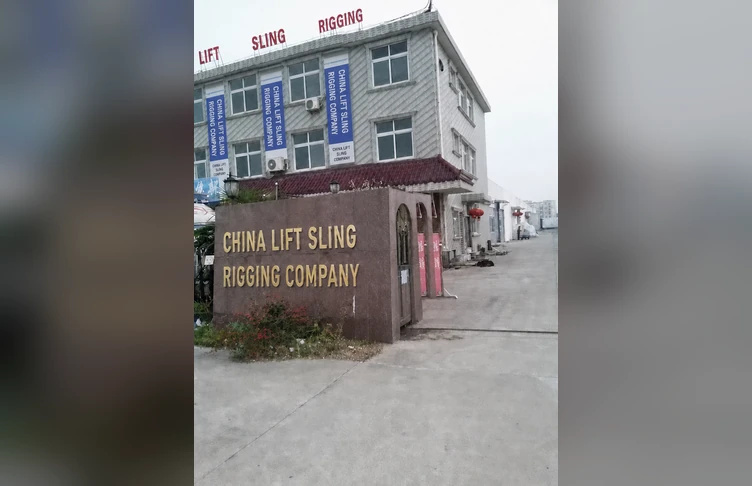
Fōtunga 4 — Ko ‘emau ngaahi ngāue ‘i Taizhou ., Jiangsu: weaving, tuitui mo e sivi 'i he lalo 'ato 'e taha ..
- 40 ta'u 'o e ngaohi 'o e ngaahi me'angaue hiki — fokotu'u 'i he 1990. 1985 ʻi Taisou, Jiangsu, lahi ange ʻi he 100.00. 200 kau ngāue, pea ko e taha ‘o e ngaahi tu’unga ngaohi’anga sling hiki lahi taha ‘i Siaina ..
- Weaving and stitching in one plant — width, ply, lanu, pulusi, eye type and eye length are all under our control, so the sling is made to your job rather than selected from a catalogue.
- Both eye types from the same line — flat eye, twisted eye or one of each, with eye lengths set to your hook and bearing widths stated on the quotation.
- Rated honestly for the job — a lifting sling, a lashing and a recovery strap are marked for what they are, and we will say when the job you describe calls for a different product.
- Fale sivi 'a'ana mo e . 1000 t test machine — breaking load tested per sling and documented, mo T.S., GS, NE, CNAS mo e DNV fakamo'oni 'i mui 'i he ngaahi koloa ..
- One supplier for the whole lifting range — webbing slings, endless slings, ngaahi sling takai, founga 'e taha slings, ngaahi slings maea uaea, hiki hake 'o e ngaahi pou spreader, harnesses and the cargo lifting net range.
Lahi ange mei he ngaahi ngaue tatau .: ngaahi kupenga maea maluʻi · · kupenga uepi polyester ki hono hiki
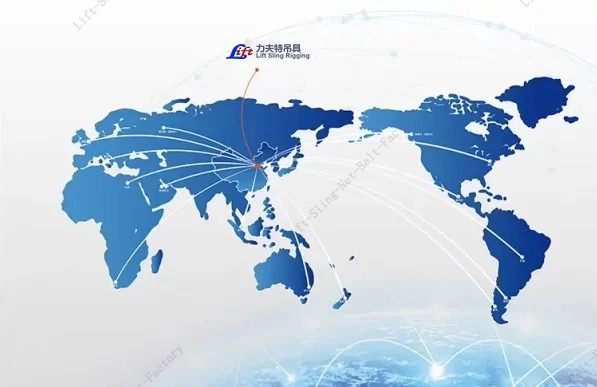
Fōtunga 5 — Our lifting products ship worldwide, through distributors and directly to fleets, yards and terminals.
16. Kole ha fakamatala
Tell us the job first — lifting, bundling or pulling — then the load weight, the mode of lift, the eye type and eye length you need, ko e loloa ., the width and ply, and the environment the sling will work in. Our engineers will confirm the specification and quote it in one reply. Ke talanoa'i 'o fakafou 'i he 'uluaki ., fetu'utaki mai ki he'emau kau 'enisinia.
Kautaha Hiki Sling Rigging — Paaka Fakangaue'anga 'o Lifute, Kolo TaiZhou, Vahefonua JiangSu, Siaina
Tel: +86 523 8693 5818 | WhatsApp: +86 180 6600 2268 | ʻĪ-meili: 702461526@qq.com
Kouti HS 630790 — hiki hake 'a e ngaahi slings 'o e ngaahi naunau tupenu ..
Appendix A — Ngaahi fakamatala SEO ki he peesi ko 'eni .
Ko e ngaahi mahu’inga ‘i lalo ‘oku mateuteu ke fakapipiki ki he ngaahi mala’e SEO ‘o e peesi .. The keyword set is drawn from eye type and sling configuration language, which is what separates this page from the endless sling and round sling pages in the same category.
| Mala'e | Mahu'inga |
|---|---|
| URL Taketi | /webbing-sling/eye-and-eye-webbing-slings-flat-eye-or-twisted-eye/ |
| Lea mahu'inga tefito | Mata mo e Mata Webbing Sling . |
| Ngaahi lea mahu'inga fika ua | flat eye web sling; twisted eye webbing sling; eye type webbing sling; eye-eye webbing sling; 2-ply eye-eye polyester flat webbing sling; webbing sling with eyes; polyester eye and eye sling; flat eye and eye web sling; two eye webbing sling; eye and eye sling |
| Hiku loloa / fakatātā | eye and eye webbing sling 5 toni; flat eye vs twisted eye sling; 2-ply eye-eye polyester sling 3 m; webbing sling with eyes for bundling; eye and eye sling for steel plate; twisted eye sling for choke hitch; eye and eye sling 50 mm hono laulahi |
| Taumu'a fekumi | Fefakatau'aki / transactional — the searcher is specifying a two-eye webbing sling |
| SEO hingoa . (51 ngaahi ʻulungaanga) | Mata mo e Mata Webbing Sling . | Mata Pala pe Mata Mio . |
| Fakamatala meta (147 ngaahi ʻulungaanga) | Eye and eye webbing sling for lifting, bundling and pulling heavy loads. Flat eye or twisted eye, 25-200 mm laulahi, ʻI LOTO 1492-1, CE mo e GS fakamo'oni'i .. |
| H1. | Mata mo e Mata Webbing Sling . |
| Seini 'ulu | H1 Eye and Eye Webbing Sling → H2 per section → H3 for sub-blocks |
| Faka-Kanoni | https://www.xulft.com/webbing-sling/eye-and-eye-webbing-slings-flat-eye-or-twisted-eye/ |
| Fakamu'omu'a 'o e mape 'o e saiti | 0.8 (peesi fakaikiiki 'o e koloa, one level below the webbing sling category) |
| Lau 'o e ngaahi lea | Fekauʻaki 6,050 ngaahi lea fakakātoa — fakafuofua ki he . 3,500 ngaahi lea 'o e sino tatau plus . 2,550 ngaahi lea 'o e ngaahi tepile fakaikiiki |
| Ngaahi ʻata ʻi he peesi 11 . | 13 ngaahi 'ata, ko e taha kotoa pe mo e fakamatala alt text |
| Ngaahi fehokotaki'anga 'i loto | 17 ngaahi fehokotaki'anga fakalotofonua makehe (vakai ki he ʻApenitiki B .) |
| Ngaahi Tepile | 18 ngaahi tepile — . 14 fakaikiiki mo e ngaahi tepile fakamatala pea mo e 4 ngaahi fakatātā |
| Sitaila tohi taula | Fakamatala mo kehekehe .; 'ikai ha ongo taula 'i he peesi 'oku na toe lea'aki 'a e kupu'i lea tatau . |
Tēpile 11 — 'I he peesi SEO 'o e lave ..
Appendix B — Fehokotakiʻanga ʻi loto mo e palani ʻo e peesi-mamafa .
Ko e ngaahi fehokotaki'anga ki tu'a 'oku ne tala ki he Google 'a e ngaahi peesi 'oku fekau'aki mo e taha ko 'eni .. Inbound links are what actually push weight and ranking power into the page.
B1 — Ngaahi fehokotaki'anga fakakonisitutone 'i tu'a mei he peesi ko 'eni .
| URL Taketi | Tohi taula | Ko e feitu'u 'oku tangutu ai . |
|---|---|---|
| /koloa/uta-hiki-kupenga/ | ngaahi kupenga hiki uta | Short description — the net category |
| /products/webbing-sling/ | ngaahi sling uepi | Short description and Section 14 — ko e hub 'o e vahenga . |
| /products/endless-lifting-sling/ | sling hiki ta'e ngata | Kupu 1 — the shape without eyes |
| /products/round-sling/ | ngaahi sling takai | Kupu 1 — the sleeved continuous loop |
| /uta-hiki-kupenga/uta-malu'i-kupenga/ | kupenga malu'i 'o e uta | Kupu 3 — the restraint-rated alternative for tying down |
| /koloa/hiki-mafola-pou/ | hiki hake 'a e pou spreader | Kupu 6 — beam lifts |
| /products/lifting-devices/ | ngaahi meʻangāue hiki | Kupu 6 — fittings for multi-leg lifts |
| /products/one-way-sling/ | sling founga 'e taha | Kupu 7 — repetitive single-use lifting |
| /uta-hiki-kupenga/crane-paleti-uta-kupenga/ | kupenga uta paleti crane | Kupu 7 — repeated pallet lifts |
| /uta-hiki-kupenga/mamafa-fatongia-nailoni-uta-kupenga-sling/ | fatongia mamafa nailoni uta kupenga sling | Kupu 9 — the abrasive-load alternative |
| /koloa/uaea-maea-sling/ | ngaahi slings maea uaea | Kupu 9 — sharp and abrasive duty |
| /fakamo'oni/ | fakamo'oni | Kupu 10 — ko e peesi tohi fakamo'oni ako . |
| /products/safety-harness/ | haʻi maluʻi | Kupu 14 — the rest of the sling range |
| /ngaahi koloa/nailoni-maea/ | ngaahi maea nailoni | Kupu 14 |
| /products/safety-rope-net/ | ngaahi kupenga maea maluʻi | Kupu 15 |
| /uta-hiki-kupenga/polyester-webbing-kupenga-ki-he-hiki/ | kupenga uepi polyester ki hono hiki | Kupu 15 |
| /fetu'utaki-kiate kimautolu/ | fetu'utaki mai ki he'emau kau 'enisinia | Kupu 16 |
Tēpile 12 — Ngaahi taula 'i tu'a 'i he peesi ko 'eni ..
B2 — Ngaahi fehokotaki'anga 'oku hu mai ke tanaki atu ., ko ia 'oku ma'u 'e he peesi ko 'eni 'a e mamafa .
Ko e ngaahi fehokotaki’anga ‘eni ‘oku ne langa hake ‘a e ivi fakahokohoko ‘o e peesi ko ‘eni .. Add each one to an existing, already-indexed page, pointing at the eye and eye sling URL with the anchor shown. Kehekehe ʻa e taulá ʻo hangē ko ia ʻoku lisi atú kae ʻikai ko hono toutou leaʻaki ha kupuʻi lea ʻe taha ʻi he peesi maʻuʻanga fakamatala kotoa pē ..
| Peesi maʻuʻanga fakamatala | Ko e tohi taula ke fakaʻaongaʻí | Ko e hā ʻoku langa ai ʻe he fehokotakiʻanga ko ʻení ʻa e mamafá . |
|---|---|---|
| /products/webbing-sling/ (category hub) | eye and eye webbing sling | A link from the category hub is the strongest internal signal for a child product page |
| /uepi-sling/ (peesi vahe 1 .) | flat eye web sling | Passes section-level relevance together with the hub link |
| /products/endless-lifting-sling/ | eye and eye sling | The endless sling page is the natural place to route buyers who actually need eyes |
| /products/round-sling/ | twisted eye webbing sling | Round sling buyers often compare against a flat two-eye sling |
| /products/one-way-sling/ | webbing sling with eyes | One-way and eye-and-eye slings are bought by the same repetitive-lift customer |
| /products/lifting-devices/ | 2-ply eye-eye polyester flat webbing sling | Fittings and slings are specified together |
| Peesi 'uluaki (lisi 'o e ngaahi koloa pe footer) | ngaahi sling uepi | One homepage link to the category is enough; 'oua 'e tuhu hangatonu ki he peesi 'uluaki 'i he peesi ko 'eni . |
Tēpile 13 — Palani fehokotaki'anga 'i loto 'o e inbound ..
Ko e ongo tu'utu'uni 'oku ne tauhi 'a e kulupu ke mo'ui lelei .. ʻuluaki, keep these anchors distinct from each other and from the anchors used on the endless sling and round sling pages — repeating one phrase across many internal links is the fastest way to create keyword cannibalisation inside your own site. In particular, this page should own the eye-type and configuration language (mata palakū, twisted eye, two-eye, mata mo e mata .) and should not compete for the general term webbing sling. Fika ua, keep the page one click from the category hub and no deeper: fo'i ma 'Api > Ngaahi koloa > Sling Uepi > Mata mo e Mata Webbing Slings ..
Appendix C — Google fakahokohoko mo e lisi fakahokohoko .
| Meʻa | Me'a ke fai ki he peesi ko eni . |
|---|---|
| Fakahokohoko | Fakafoki HTTP 200, tauhi 'a e peesi mei he noindex, pea fakapapau'i 'oku 'ikai ke poloka ia 'i he robots.txt . |
| Faka-Kanoni | Self-referencing canonical to the eye and eye sling URL |
| Mape saiti XML | Fakakau 'a e URL 'i he sitemap 'o e koloa ., pea toe fakahu mai 'a e mape 'o e saiti 'i he Google Fekumi Fakafiemalie . |
| Ngaahi fehokotaki'anga 'i loto | Ngāue‘aki ‘a e ongo tēpile ‘i he ‘Apenitiki B .. The page currently has no inbound internal links, so this is the priority |
| Hingoa mo e fakamatala . | Ngāue‘aki ‘a e ongo mahu‘inga ‘i he ‘Apenitiki A .. The page currently carries the Yoast placeholder pattern rather than a written title and description |
| Fa'unga 'o e 'ulu'i tohi | Taha H1., pea H2 ki he konga ., pea H3 ki he ngaahi poloka si'isi'i — 'oua 'aupito na'a ke fakalaka 'i ha tu'unga . |
| 'Imisi SEO . | Fakamatala alt text 'i he kotoa 13 ngaahi 'ata, ngaahi hingoa 'o e faile 'i he mata'itohi iiki mo e ngaahi faka'ilonga, Fotunga WebP, mo e uta paie 'i lalo 'i he fold . |
| Ngaahi fakamatala fokotu'utu'u | Tānaki atu ʻa e Koloa JSON-LD mo e hingoa, īmisi, fakamatala, brand mo e kautaha ngaohi, pea mo e BreadcrumbList ki he hala 'o e breadcrumb mo e Kautaha 'i he tu'unga 'o e saiti . |
| Ngaahi Me'a Mahu'inga 'o e Uepi Tefito | Fakapipiki 'a e ngaahi 'ata ki he WebP ., seti 'a e laulahi mo e ma'olunga 'i he 'imisi kotoa pe ke faka'ehi'ehi mei he liliu 'o e fokotu'utu'u, pea toloi 'a e ngaahi tohi 'oku 'ikai fakaanga'i . |
| Page is currently thin | The live page carries a single repeated product-name paragraph and no datasheet, no eye-type explanation and no technical content. Everything in this document is new copy; replace the placeholder text rather than appending to it |
| Ko e ngaahi me'a 'oku 'i ai ke tauhi | The product-name list already on the page — Eye and Eye Webbing Sling, Flat Eye Web Sling, Fa'ahinga Mata 'o e Uepi Sling, Flat-Eye Web Sling, Polyester Eye-eye Webbing Sling, Flat Eye & Eye Web Sling, 2-Ply Eye-Eye Polyester Flat Webbing Sling, Webbing Sling with Eyes. These are useful keyword variants; move them into the body copy or the meta keywords rather than leaving them as a repeated paragraph |
| Image mismatch to review | The page gallery currently includes an orange endless-style sling. If that image is not an eye and eye sling, replace it or move it to the endless sling page, so the gallery matches the product the page sells |
| Fekumi Fakafiemalie | Fakahu mai e URL ki hono fakahokohoko, pea vakaiʻi leva ʻa e ngaahi lipooti ʻo e Fakaʻilongaʻi ʻo e Peesí mo e Ngaahi Meʻa Mahuʻinga ʻo e Uepi Tefitó hili ha uike ʻe taha mei ai . |
| Muimui'i 'o e tu'unga | Track the primary keyword plus the three main eye-type secondary keywords weekly against the endless sling page and the top three competitors |
Tēpile 14 — Google indexing mo e lisi 'o e fakahokohoko ..