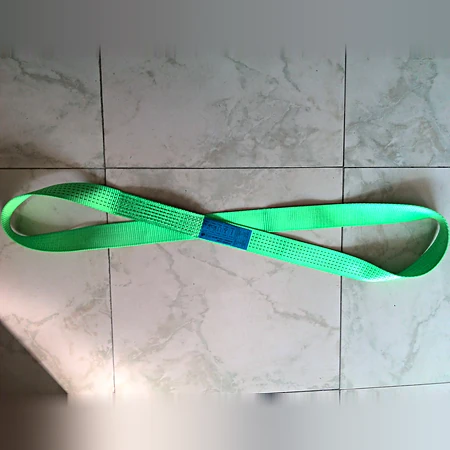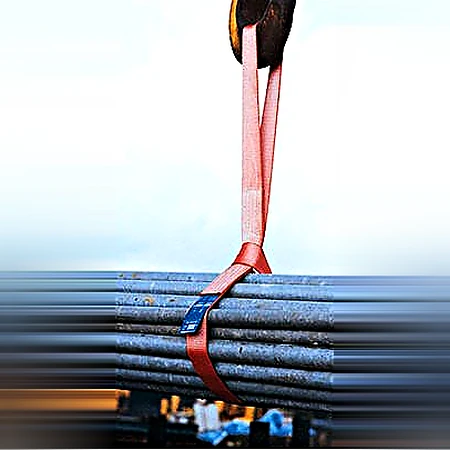
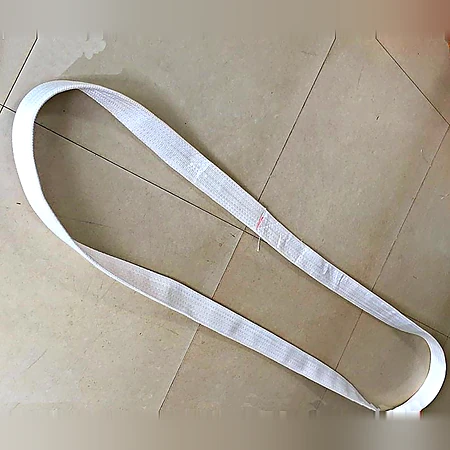
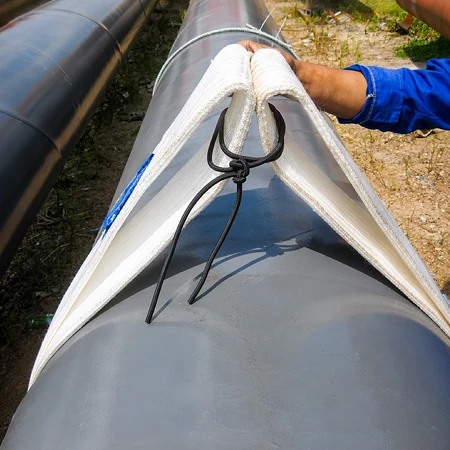
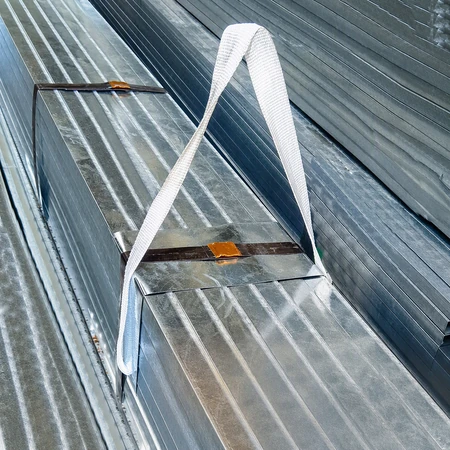
Lift sling rigging company manufacture heavy-duty endless loop strap slings,endless loop strap sling,heavy-duty endless loop sling,heavy-duty endless web sling.
Heavy-Duty Endless Loop Strap Slings
A heavy-duty endless loop strap sling is the flat woven webbing band closed into a continuous loop and then built for the top of the range: two or more layers of webbing instead of one, a wider and denser band, and a reinforced bearing area where the loop takes the load. There are still no ends, no eyes and no metal fittings on the article — the loop goes over the hook and the whole circumference is a soft, load-bearing face.
We build heavy-duty endless loop strap slings from 6 t to 30 t in duplex and multi-ply polyester, with a 7:1 safety factor to EN 1492-1, in loops from 0.5 m to 100 m and in any width the load and the hook will take. Where the ladder runs out, we say so and move you to the sleeved round form rather than stretch a flat band past what it can do.
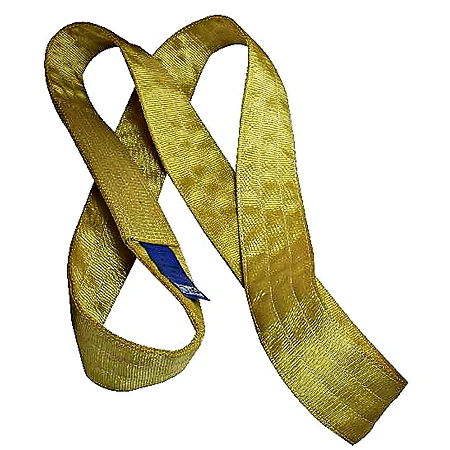
What Makes a Loop Strap “Heavy Duty”
Heavy duty is not a colour or a label — it is four changes to the same closed article, and each one can be seen and measured.
| What changes | Standard duty | Heavy duty |
|---|---|---|
| Ply | One layer of webbing forms the loop. | Two layers (duplex) as standard in this class, stitched through and quilted; three or four layers to order. |
| Band width | Matched to the capacity ladder. | 150 mm to 300 mm and wider, so the bearing is spread over more of the load. |
| Webbing | Standard 4 mm weave. | A thicker, denser weave — this is what carries the higher figure at a workable width. |
| Bearing area | The band itself. | A stitched-on wear pad or sleeve, and a reinforced hook seat where the loop sits in the bowl. |
| Typical duty | General factory, yard and warehouse lifting. | Steel pipe and coil, plate stacks, heavy fabricated sections, precast segments, port and depot work. |
Two consequences follow. A heavy-duty loop is stiffer and sits flatter under load than a single-layer band, which is what keeps it stable over an edge. And it is thicker in the hook: a duplex band occupies more of the hook bowl, so check that the hook will seat the band before you specify the ply.
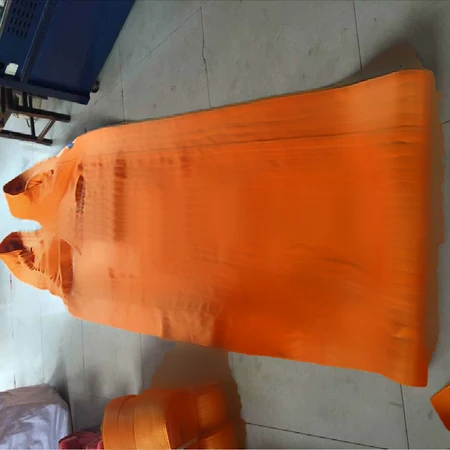
Technical Parameters — Heavy-Duty Endless Loop Strap Slings
The table below is our heavy-duty class to EN 1492-1, quoted in straight lift. Reference widths and the 6 t to 10 t weights are the published figures for this range; widths and weights above 10 t are confirmed on the order acknowledgement, and the minimum breaking load is the 7:1 multiple of the working load limit.
| WLL, straight lift | Webbing colour | Reference band width | Ply | MBL at 7:1 | Choked (× 0.8) | Approx. weight |
|---|---|---|---|---|---|---|
| 6 t | Brown | 150 mm | Duplex | 42 t | 4.8 t | 0.96 kg/m |
| 8 t | Blue | 200 mm | Duplex | 56 t | 6.4 t | 1.34 kg/m |
| 10 t | Orange | 250 mm | Duplex | 70 t | 8.0 t | 1.64 kg/m |
| 12 t | No colour code | 300 mm | Duplex | 84 t | 9.6 t | On request |
| 15 t | No colour code | Confirm on order | Duplex or multi-ply | 105 t | 12.0 t | On request |
| 20 t | No colour code | Confirm on order | Multi-ply | 140 t | 16.0 t | On request |
| 30 t | No colour code | Confirm on order | Multi-ply | 210 t | 24.0 t | On request |
Above 10 t there is no colour to read, so the working load limit on the sewn label governs. Read the label, not the colour.
| Characteristic | Specification |
|---|---|
| Product names | Heavy-duty endless loop strap slings · heavy-duty endless loop sling · heavy-duty endless web sling · endless loop strap · type V web sling · endless type A flat woven webbing sling |
| Type and standard | Endless type A flat woven webbing sling to EN 1492-1; ASME B30.9 type V (endless loop) also built; ISO 4878 and JB/T 8521 available |
| Material | 100% high-tenacity polyester (PES) as standard; polyamide / nylon (PA) and polypropylene (PP) to order |
| Construction | Duplex (two layers) as standard in this class; three and four layer multi-ply to order; layers stitched through and quilted |
| Closure | One lapped and stitched joint with dense parallel stitch rows — the only made connection in the load path, and the first thing to inspect |
| Working load limit | 6 t to 30 t in the heavy-duty class; heavier bands built to order |
| Safety factor | 7:1 to EN 1492-1 as standard; 5:1 to ASME B30.9 and 8:1 to AS 1353 built to order |
| Elongation | Maximum 3% at the working load limit and maximum 10% at the breaking load, polyester build |
| Temperature range | −40 °C to +100 °C for the standard polyester build |
| Bearing protection | Stitched-on wear pad or sleeve to order, plus a reinforced seat where the loop sits in the hook |
| Length | 0.5 m to 100 m as a finished loop; quoted by circumference or by effective working length |
| Marking | EN 1492-1 capacity colour with one black transverse stripe per tonne, plus a sewn label carrying the straight-lift WLL, the mode factors, the fibre, the standard reference, the manufacturer, the length and a traceability code |
| Testing and documentation | Proof tested in our own laboratory on a 1000 t horizontal test machine; test certificate per batch on request |
| Packing and OEM | Coiled and bagged in a labelled carton, or custom export packing; full OEM on fibre, ply, width, length, colour, label layout and packing |
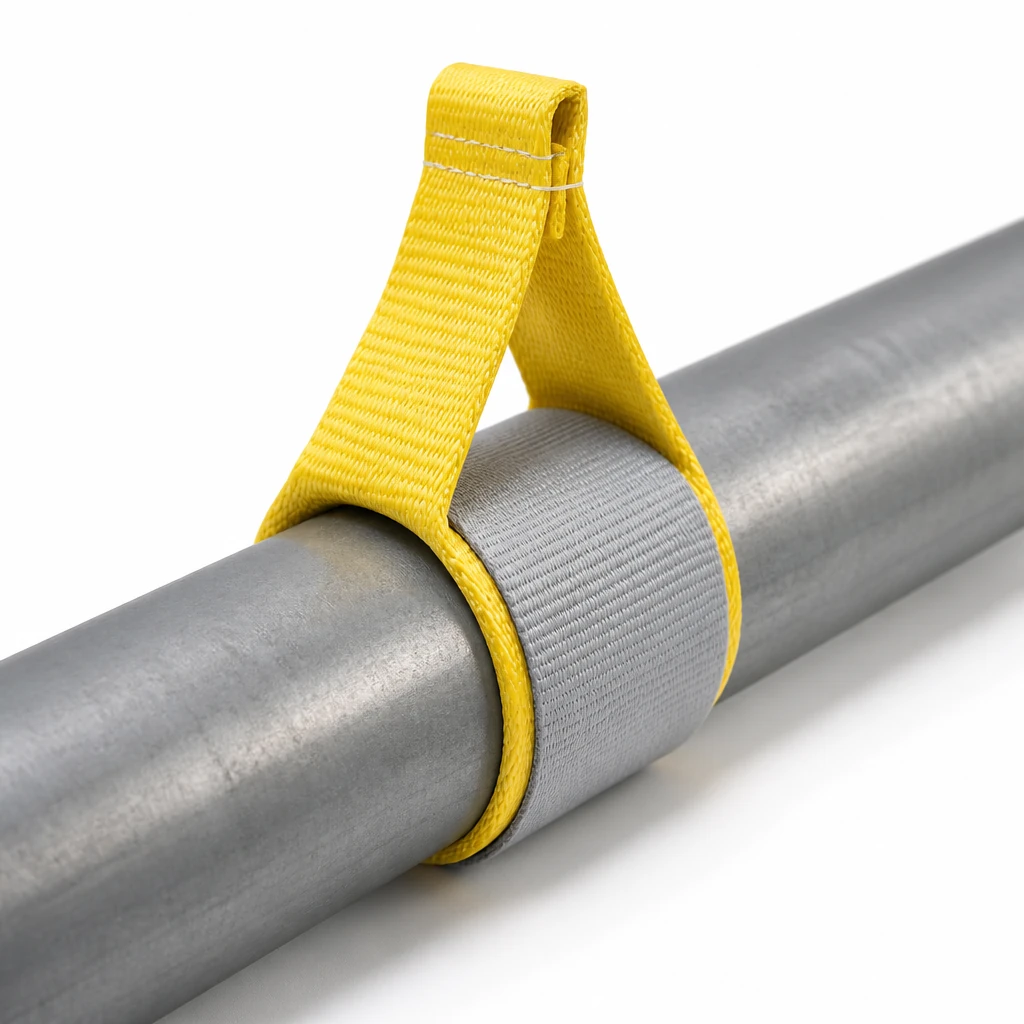
Choosing One — Three Decisions, in This Order
- The ply. Duplex or multi-ply sets how much capacity you get at a workable width, and how stiff the band sits over an edge. It also sets the thickness in the hook bowl.
- The width. Width sets the bearing pressure on the load, not the capacity. Order the narrowest band that carries the figure without marking the load, or the widest the load geometry and the hook will accept.
- The bearing protection. A band cut by an edge starts as a notch and ends as a failure. Where the load has a sharp corner, a machined lip, a burr or weld spatter, the sleeve or pad is ordered with the sling rather than added afterwards.
Then state the hitch the crew will actually rig, and size the capacity from that figure — not from the load. A choke keeps 0.8 of the straight-lift rating, so a 10 t load in a choke works out at 12.5 t and the band to order is the 15 t. The full mode factor table by hitch sets out every arrangement, including the angled choke.
When the Loop Outgrows the Flat Band
Above roughly 30 t a flat woven band becomes difficult to handle and awkward to seat, and the sleeved round form takes over: a parallel fibre core inside a protective cover, built to EN 1492-2 and available far higher up the range. The trade is honest about this — the endless round sling is the answer past the top of the webbing ladder, and a better answer than a flat band stretched beyond it. Heavy-duty loop straps are also normally rigged with equipment built for their size: lifting devices and spreader beams, master links, and hooks whose bowl will actually seat the band.
Where Heavy-Duty Endless Loop Strap Slings Are Used
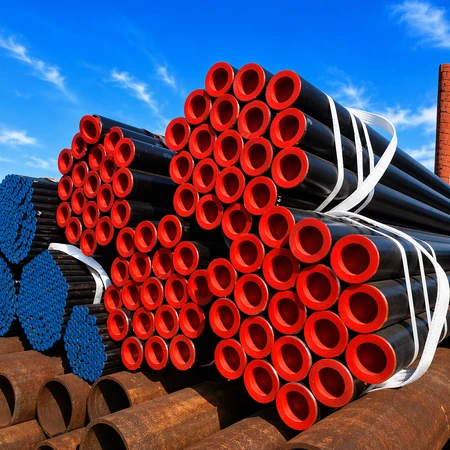
- Steel pipe, tube and casing bundles, choked or in a basket
- Steel coils and plate stacks, where the surface must come off unmarked
- Heavy fabricated sections, box girders and welded assemblies
- Precast concrete segments, kerbs and blocks
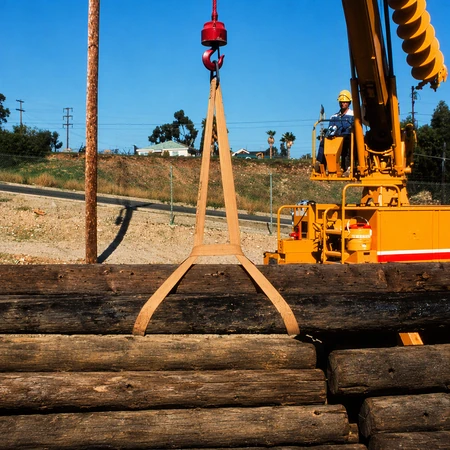
- Timber and log packs in the yard
- Machinery, dies, castings and machine beds
- Port, depot and site work, where one loop has to serve many different rigs
Inspection and Safe Use
A flat web sling shows you its whole load path, which is the reason it can be inspected on the floor rather than in a laboratory. Inspect before every use, and formally at the interval your site rules set.
- The lap joint first — every stitch row, the webbing at each step of the lap, and that the layers are still lying flat and parallel. Broken, slack or pulled stitching condemns the sling.
- The sleeve or pad, where ordered — the stitching that holds it, and the webbing underneath it.
- The bearing points and the hook seat — cuts, abrasion, glazing or a worn edge where the band has wrapped the load.
- The whole band width. A flat band carries the load across its full width, so a cut anywhere matters.
- Contamination. Acid or alkali attack leaves little visible outside and destroys the fibre within.
- Rotate as policy, not as repair. Turn the loop after each lift so the bearing point, the hook seat and the joint keep moving.
Never repair a sling — no stitching, no splicing, no knotting, and a knot in a webbing sling can lose half its capacity. Keep the band flat and untwisted in use, store it clean and dry and out of sunlight, and log the lifts and any damage so a wear pattern shows before it becomes a failure.
Safety notice: lifting operations are inherently dangerous. Follow the instructions of the equipment manufacturer, the practice of your national governing body and the training you have received, and never exceed the working load limit for the configuration you are using — a straight lift, a choke and a basket are three different ratings on the same sling. If you are unsure whether a sling is fit for use, ask us before you lift, and if in doubt take it out of service.
Frequently Asked Questions
What is a heavy-duty endless loop strap sling?
It is a flat woven webbing band closed into a continuous loop and built for the top of the range: two or more layers of webbing rather than one, a wider and denser band, and a reinforced bearing area. There are no ends, no eyes and no metal fittings on the article. We build the class from 6 t to 30 t in duplex and multi-ply polyester at a 7:1 safety factor to EN 1492-1.
Is a loop strap sling the same as an endless web sling?
Yes — they are the same article under different trade names. “Loop strap” is the North American name; under ASME B30.9 it is the type V web sling, and under EN 1492-1 it is the endless type A flat woven webbing sling. One article, three names, and the standard on the label is what tells you which set of rules it was built to.
How is a heavy-duty loop different from a standard endless sling?
Ply, width, weave density and bearing protection. A standard endless sling is a single layer of standard webbing; the heavy-duty class is duplex or multi-ply, wider, in a denser weave, usually with a stitched-on wear pad or sleeve. That is what moves the same shape from general lifting up to the 6 t to 30 t duty.
What safety factor do you build to?
7:1 to EN 1492-1 as standard. The same working load limit can be built at 5:1 to ASME B30.9, or to AS 1353 at 8:1 — and a higher factor needs a wider band for the same capacity. Tell us the standard your site works to and we will supply to it.
How do I state the length?
By circumference, the perimeter of the loop, or by effective working length, the usable height, which works out at roughly half the circumference because the loop is doubled when it hangs. The two differ by about a factor of two. Name the convention, or tell us the girth of the article the loop must go round, and we will confirm it on the order acknowledgement.
Related Products
- Endless web sling — the full technical page for this article, joint and mode factors included
- Flat endless slings — the whole flat closed-loop range and which build to pick
- Single ply endless flat sling — the single-layer loop, 1 t to 12 t, with the size and weight tables
- Endless flat belt lifting slings — the heavier, stiff-belt form
- Flat lifting sling — the flat band with a formed eye at each end
- Endless sling — the term itself, and the three articles that answer to it
- Endless round sling — the round-section closed loop for duty past the webbing ladder
- Heavy-duty endless lifting web slings — the same class in the webbing sling range
- Steel pipe lifting strap — wide bands and sleeves for pipe duty
- Lifting devices and spreader beams — the rigging these loops are normally used with
- Endless lifting sling — the full closed-loop category
Request a Quote for Heavy-Duty Endless Loop Strap Slings
Send us the load and its shape, the hitch the crew will actually rig, the working load limit you need, the width the load surface and the hook will accept, whether the band needs a sleeve or pad, and the standard and destination market the sling must be built to. We will come back with a ply, a width, a length, a sample and a factory-direct price.
Lift Sling Rigging Company — Lifute Industrial Park, Taizhou City, Jiangsu Province, China. Tel: +86 523 8693 5818 | WhatsApp: +86 180 6600 2268 | E-mail: 702461526@qq.com | HS code 630790