

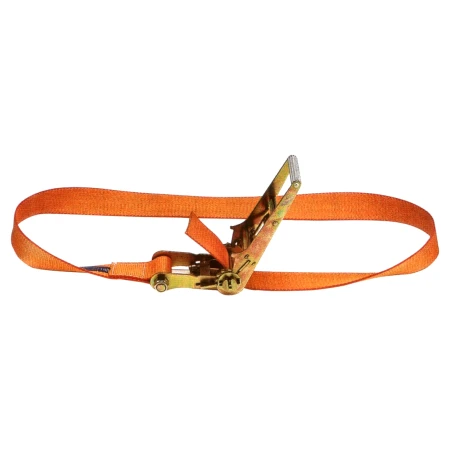
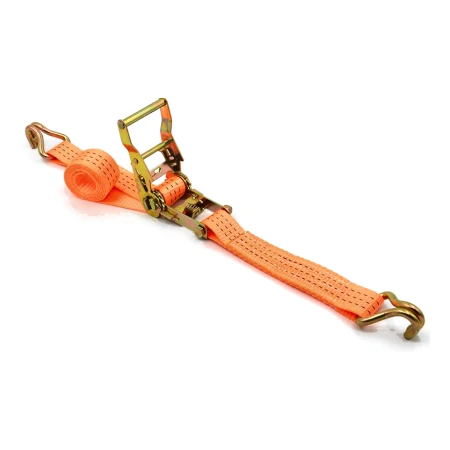
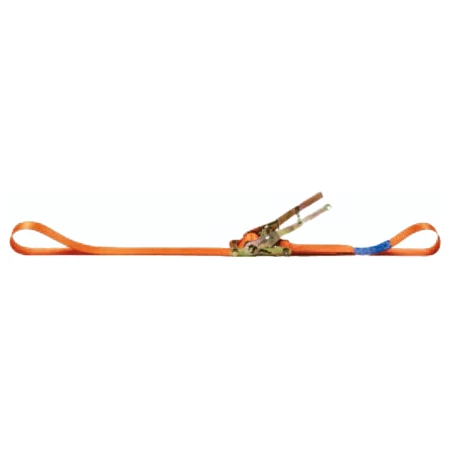
Lift sling rigging company produce Ratchet Tie-Down Straps,Heavy Duty Ratchet Strap,Ratchet Lashing Belt,Tie Down Strap,ratchet tie-down straps with s-hook,Ratchet Tie Down Straps,Heavy Duty Cargo Straps,ratchet tie-down straps with J-hook.
Ratchet Tie-Down Straps
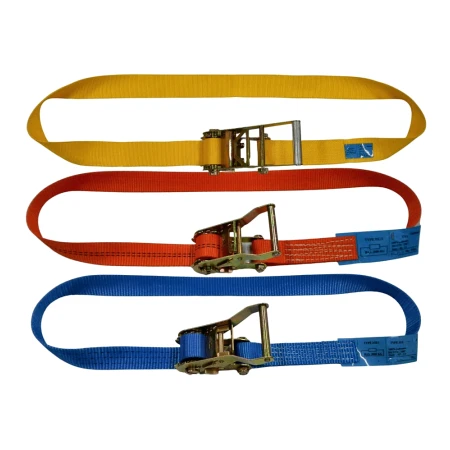
Ratchet tie-down straps are high-tenacity polyester webbing assemblies with a ratchet tensioner in the run and a hook at each end, used to hold a load on a trailer, in a van, in a container or on a deck. This range runs from 25 mm (1 in) to 100 mm (4 in) wide, in 3 m, 5 m and 8 m lengths or in feet to order, and is rated in lashing capacity up to 10 t (10,000 daN) per assembly. They are load restraint, never lifting gear.
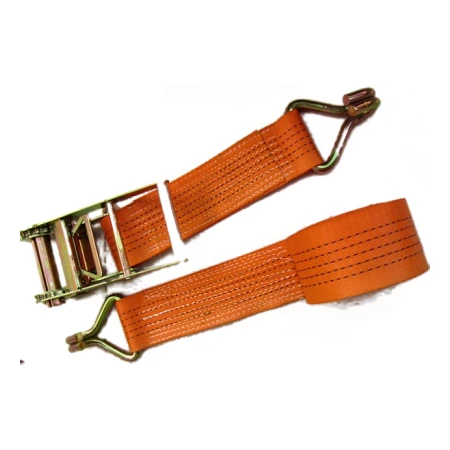
Ratchet Tie-Down Straps – Specifications
Every line is fixed on the order, because the lashing capacity applies to the finished assembly and not to the band on the roll.
| Parameter | Specification |
|---|---|
| Product | Ratchet tie-down strap / ratchet lashing belt / cargo strap |
| Webbing | High-tenacity polyester, woven in-house; 25 mm – 100 mm (1 – 4 in) |
| Lashing capacity (LC) | Up to 10 t (10,000 daN) per assembly |
| Tensioner | Ratchet with short lever; long lever on the heavy sizes; cam buckle on 25 mm |
| Ends | S-hook, double-J hook, flat hook, ring, or no hook (endless) |
| Length | 3 m / 5 m / 8 m and 10 ft / 15 ft / 27 ft; cut to order |
| Colour | Black, blue, orange, yellow, red, green, or to your sample |
| Marking | LC, length, width and maker on a sewn label; EN 12195-2 on request |
| Packing | Poly bag and header card, colour box, bulk carton, OEM label |
| Duty | Load restraint in tension only – never for lifting |
| HS code | 630790 |
Choose the Model by Width and End
Buyers decide three things in this order: the width the job needs, the end that fits the anchor point, and the length that reaches it. Five models cover the range, and the LC of the strap you receive is the figure printed on its own label.
| Model | Band width | LC per assembly | Usual end | Standard length | Packing |
|---|---|---|---|---|---|
| RTD-25 | 25 mm / 1 in | 0.4 – 0.8 t | S-hook, cam buckle | 3 m / 10 ft | 2- or 4-piece set |
| RTD-35 | 35 mm / 1 3/8 in | 0.8 – 1.5 t | S-hook, J-hook | 5 m / 15 ft | 2-piece set, carton |
| RTD-50 | 50 mm / 2 in | 1.5 – 3.0 t | Double-J, flat hook | 8 m / 27 ft | Single, set, carton |
| RTD-75 | 75 mm / 3 in | 4.0 – 6.0 t | Flat hook, ring | To order | Bulk carton |
| RTD-100 | 100 mm / 4 in | 8.0 – 10.0 t | Flat hook, ring | To order | Bulk carton |
The LC range is the usual manufacturing span for that width, not a choice within it: the assembly is made to one LC and marked with it. Send the load and the anchor point and we return the model, the LC and the length that go on the label.
Four Steps to the Right Strap
- Duty. Hold down, hold back, bundle or locate – the four jobs load a strap in different directions, and the table below shows which one you are buying for.
- Width. 25 mm for motorcycles, ATV, garden machinery and light cargo; 35 mm for small trailers and white goods; 50 mm for flatbeds, timber and containers; 75 – 100 mm for plant, steel and coils. A narrow band crushes a soft load; a wide one is awkward on a bike.
- End. Choose the hook that matches the anchor point rather than the one that looks strongest – S-hook for a ring or a hole, double-J for a lashing point or a container fitting, flat hook for the edge of a load bed.
- Length. Quote the distance between the two anchor points, not the strap length: the ratchet, the hooks and the tail all take up reach. 10 ft is 3.05 m, 15 ft is 4.57 m, 27 ft is 8.23 m – and a 10 ft strap is 5 cm short of a 3 m specification.
LC, WLL and Breaking Strength
One strap, three labels. Europe and most export markets rate the assembly in lashing capacity; North America quotes breaking strength and takes a third of it as the working load limit. A 10 t LC strap and a “22,000 lb” strap can be the same article – or two very different ones, if the label quotes breaking strength and the buyer reads it as the working limit.
| Figure on the label | Where it is read | What it means |
|---|---|---|
| LC, in daN or t | Europe and most export markets | The load the assembly is rated to hold. This is the figure quoted for this range. |
| Breaking strength, in lb | North America, trade | The load at which the assembly fails in a pull test; the working limit is a third of it. |
| WLL, in lb | North America, retail shelf | The comparable figure, rounded and printed large; breaking strength is on the back of the card. |
Ask for the rating in the unit your market prints, and say which one you mean. The same distinction separates a tie-down strap from a webbing sling: same loom, same band, different rating and a different duty.
Which End Fits
The hook decides whether a ratchet tie-down strap fits the vehicle the buyer already owns, so it is the part to specify first – four ends cover the market.
- S-hook. Drops into a ring, a hole or a rail; quick and cheap, and the standard end on 25 mm and 35 mm straps. It is also the end most easily straightened by a load that shifts.
- Double-J hook. Two prongs with a closed throat, for lashing points and container fittings – the end to specify above a van.
- Flat hook. Sits on the edge of a load bed or a rail, marks the load least, and is the flatbed trailer end.
- Ring or no hook. A ring takes a shackle or a second strap; a plain end lets the strap be passed around the load and tensioned against itself, which is what a bundle needs.
Tell us the anchor point rather than the hook. Shackles and the hardware that goes with a ring end are on the lifting devices page.
Where Ratchet Tie-Down Straps Are Used
| The job | How it is rigged | What it loads |
|---|---|---|
| Hold down | Over the load, hook to hook on the deck, ratchet in the run | Band in tension; the load is held by friction under it |
| Hold back | From the load forward to a headboard or a rail | Anchor and headboard, in the direction of braking |
| Bundle | Around the load, tensioned against itself, no hook at one end | Band in a loop; the load is compressed, so soft goods need a wider band |
| Locate | Through a ring or a purpose-made point, ratchet outside the load | The ring and the hook throat; the band carries little |
Where the load is loose rather than packed, a cargo lifting net covers the shape a strap cannot.
Sets, Packing and Your Label
On a ratchet tie-down strap the packing is half the specification, and most of the buying decision. A two-piece set is the norm for trailer work and a four-piece set for retail; the card carries the working load limit, the length, the quantity and a barcode, printed to your artwork. Retail chains take a colour box with a window and a hang tab; distributors take 20, 25 or 50 straps to a carton, banded, with the LC and length on the outside.
The sewn label is the one part that cannot be changed after the fact: your brand, your part number, the LC or the breaking strength in the unit your market reads, and the batch if your system needs it.
Care and Retirement
- Sunlight. Polyester takes UV better than polypropylene, but a ratchet tie-down strap left coiled on an open trailer for a season fades, stiffens and loses strength before it looks worn.
- A cut or a nick at an edge. The band fails from a damaged edge inward; a nick that reaches the warp is the end of the strap.
- A straightened hook. Once an S-hook has opened it will open again under a smaller load.
- A worn ratchet. Salt, grit and a pawl that no longer snaps give no warning from outside the drum.
- An unreadable label. Without the LC the strap cannot be matched to a load.
Frequently Asked Questions
What is a ratchet tie-down strap?
Ratchet tie-down straps are polyester webbing straps with a ratchet tensioner in the run and a hook at each end, used to hold a load on a trailer, in a van, in a container or on a deck. One is the same article an industrial buyer calls a cargo lashing: a ratchet lashing belt in the freight trade, cargo straps on a builder’s merchant’s shelf.
What does 10 t mean on a ratchet tie-down strap?
It is the lashing capacity of the heaviest assembly in the range – 10 t, or 10,000 daN, of restraint. It is not a lifting capacity and it is not the breaking strength: the assembly is rated to hold 10 t, not to fail at 10 t.
What is the difference between 1 inch and 2 inch ratchet straps?
Width, and therefore what the strap is for. 25 mm is the motorcycle, ATV and light-cargo size; 50 mm is the trailer, plant and container size. The width spreads the pressure on the load, so a soft or hollow load needs the wider band even when the tonnage is modest.
Is the working load limit the same as the lashing capacity?
They are the same idea expressed in two markets. Europe prints LC in daN or tonnes; North America prints a working load limit derived from breaking strength, and the working limit is a third of it. Compare like with like before you compare prices.
Should I choose an S-hook or a J-hook?
Choose the hook that matches the anchor point. An S-hook for a ring or a hole in light duty, a double-J hook with a closed throat for lashing points and container fittings, a flat hook for the edge of a load bed.
Can a tie-down strap be used for lifting?
No. It is rated for restraint in tension, marked in LC or in breaking strength, and never for a lift. A lifting sling carries a working load limit and a safety factor and is a different article with a different label.
Do you supply sets and private-label packing?
Yes. Two- and four-piece sets, a poly bag with a printed header card, colour boxes for retail, bulk cartons for distributors, and a sewn label with your brand and part number. Send the artwork and the carton quantity and the packing is quoted with the strap.
What lengths are standard for ratchet tie-down straps?
3 m, 5 m and 8 m in metric markets and 10 ft, 15 ft and 27 ft in imperial ones, with anything between cut to order. Quote the distance between the anchor points rather than the strap length, and the tail is sized with the reach.
Request a Quotation
Send the width and the duty, the length and whether you mean band length or reach, the end fitting, the unit your market prints, and the packing. We confirm the assembly, the marking and the carton quantity before anything is cut – 25 mm to 100 mm, up to 10 t LC, with your reference on the label.
Send your strap specification for a quotation
Telephone / WeChat: +86 180 6600 2268 | E-mail: 702461526@qq.com
Address: Lifute Industrial Park, Taizhou City, Jiangsu Province, China | HS code: 630790