

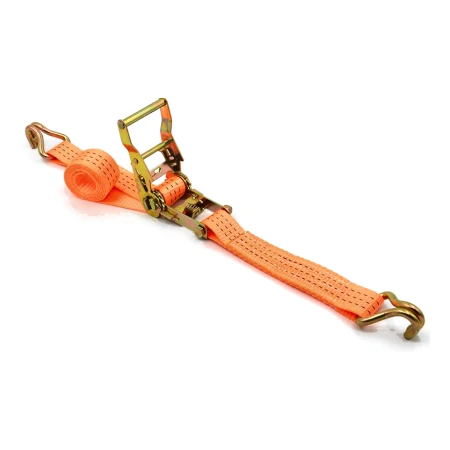
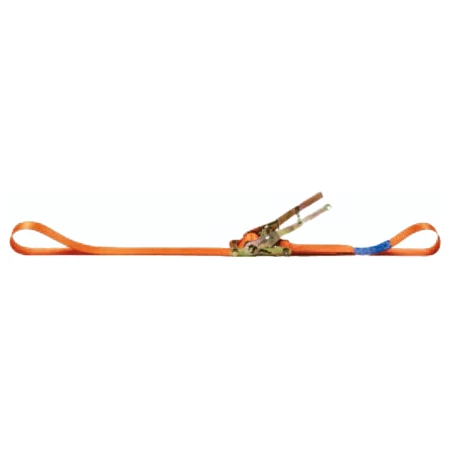
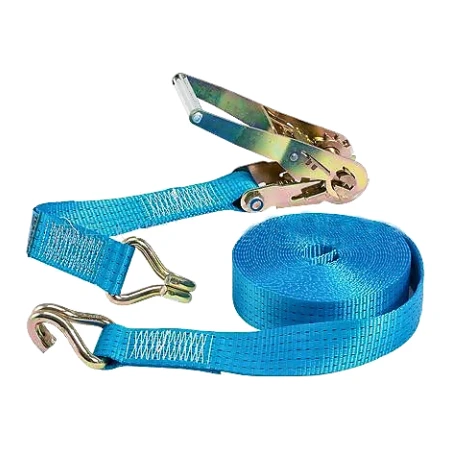
Lift sling rigging company produce Cargo Lashing,Cargo Lashing Belt,Cargo Lashing strap,Container Lashing,Container Lashing strap,Cargo Lashing Ratchet Belt,Cargo Lashing Rope with Hook.
Cargo Lashing
A cargo lashing is a high-tenacity polyester webbing strap with a ratchet tensioner in its run and a hook at each end – bought to stop a load moving, never to lift it. It is rated in lashing capacity, LC, not in working load limit: the figure on the label is the load it can hold, not the load it can carry. The heaviest assembly in this range is rated at 10 t (10,000 daN).
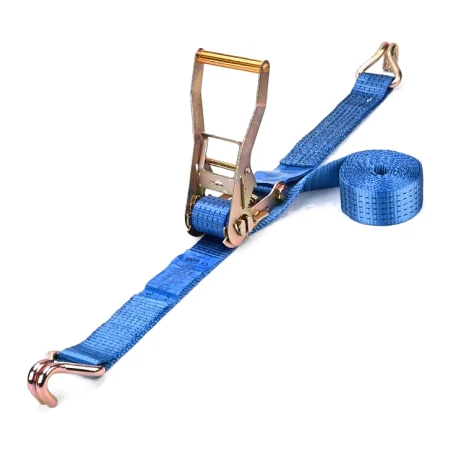
Three Parts, One Rating
A lashing is a system, and the weakest part sets the rating. The band carries the tension and is specified by elongation as well as strength, because a band that stretches lets the load move and then shocks the system when it catches. The hooks decide what the lashing can be attached to. The ratchet decides how much tension one person can put in – a lever, a drum and a pawl that turns a hand force of a few hundred newtons into a tension measured in hundreds of deca-newtons.
That tension is the standard tension force, STF, printed on the label beside the LC. It matters because a lashing does not hold a load by wrapping it: it holds it by pressing it onto the deck, and the friction between load and deck is proportional to that pressure. On a slippery or wet deck, the answer is an anti-slip mat, not another turn on the handle.
Cargo Lashing – Specifications
The table is the standard build. Width, LC, hooks, length and marking are fixed on the order, because the LC applies to the finished assembly and not to the band on the roll.
| Parameter | Specification |
|---|---|
| Product | Cargo lashing / ratchet lashing strap / container lashing belt |
| Webbing | High-tenacity polyester, woven in-house; 25 mm – 100 mm nominal width |
| Lashing capacity (LC) | Up to 10 t (10,000 daN) on the heaviest assembly |
| Standard tension force (STF) | Stated on the label with the LC |
| Tensioner | Ratchet with short (fixed) lever or long (endless) lever |
| End fittings | Double-J hook, flat hook, S-hook, ring, or no hook (endless) |
| Length | 1 m – 12 m to the load; usable reach is shorter once ratchet and hooks are counted |
| Elongation | Low-elongation lashing band, woven denser and stiffer than sling band |
| Marking | LC, STF, length, width and maker on a sewn label; EN 12195-2 on request |
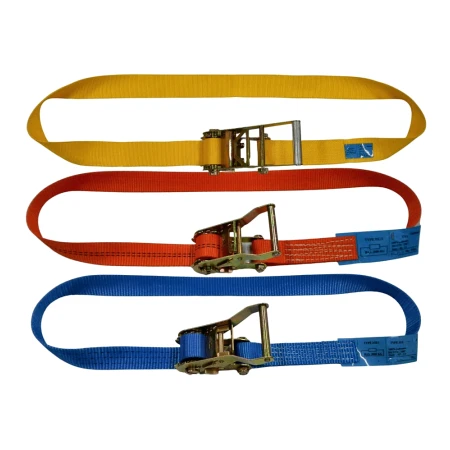
| Colour | Colour-coded by size (blue, orange, yellow and others); to order |
| Duty | Restraint only – never for lifting |
| HS code | 630790 |
Size and Model Selection
Buy by the LC the load needs, then take the width that carries it. The bands below are the sizes we weave; the exact LC is confirmed per assembly on the label, because it depends on the band strength, the stitching and the end fittings together.
| Model | Band width | LC range | Tensioner | Typical duty |
|---|---|---|---|---|
| CL-25 | 25 mm | 0.4 – 0.8 t | Ratchet, short lever | Light vans, pallets, small plant |
| CL-35 | 35 mm | 0.8 – 1.5 t | Ratchet, short lever | Vans and light flatbeds, cartons |
| CL-50 | 50 mm | 1.5 – 3.0 t | Ratchet, short or long lever | Flatbeds, containers, timber packs |
| CL-75 | 75 mm | 4.0 – 6.0 t | Ratchet, long lever | Steel, coils, heavy plant |
| CL-100 | 100 mm | 8.0 – 10.0 t | Ratchet, long lever | Heavy steel, machinery, deck cargo |
The LC range is the working span for that width, not a choice within it: the assembly is made to one LC and marked with it. Send the load and the duty and we return the model, the LC and the STF that go on the label. Where a market requires EN 12195-2, say so on the enquiry – the label is printed to the order, not to a default.
LC Is Not WLL
A lashing strap and a webbing sling can look identical and come off the same loom, and they are rated in different units for different duties. This is the confusion that matters most at the counter: “a 10 tonne strap” may mean either.
| Cargo lashing | Webbing sling | |
|---|---|---|
| Rated in | LC, lashing capacity, in daN or tonnes of restraint | WLL, working load limit, in tonnes of lift |
| Factor | Lashing factor on the assembly | Safety factor, typically 7:1 for flat webbing |
| Loaded | Continuously, in tension, in transit, unattended | Briefly, visibly, with a standing load |
| Marking | LC, STF, length, maker | WLL, length, factor, maker |
| Must never | Lift a load | Be used as a lashing or a tow rope |
Hooks, and What They Hold
- Double-J hook – two prongs that drop into a lashing point or over a rail; the general-purpose end for flatbeds and container fittings.
- Flat hook – sits on the edge of a load bed or rail without marking it; common on flatbed trailers.
- S-hook – simple hook for a ring or eye; quick, and the one most easily bent open by a shifting load.
- Ring or no hook – ring end for a shackle, or a plain end for a strap passed around the load and tensioned against itself.
The hook has to match the lashing point, so tell us the point rather than the hook. A J-hook sitting half in its point is the commonest reason a lashing comes loose in service – and it lets go under braking.
How Many Straps?
The weight of the cargo is the start of the calculation, not the answer. Three things decide the restraint a consignment needs, and they are the three questions we ask before quoting.
- Mass and direction. The load is held against acceleration in three directions, and the forward case is normally the worst: most road markets size a lashing against a deceleration of the order of 0.8 g, so a 20 t load is held against roughly 16 t of forward force before any factor is applied.
- Angle. A strap running at an angle to the deck gives only a component of its tension vertically – at 45 degrees about seven tenths of it does useful work, and the rest pulls the load sideways against the opposite strap.
- Friction. Timber on timber is helpful; steel on steel is not, and a steel coil on an aluminium deck needs mats as well as straps.
The arithmetic is short – required restraint divided by what one strap contributes at its angle, rounded up – and we run it for the consignment rather than selling a number of straps by habit.
Where a Cargo Lashing Is Used
| Setting | What the lashing does | What decides the spec |
|---|---|---|
| Container | Holds cartons, drums and pallets against doors and walls | Floor lashing rings, gap between load and wall |
| Flatbed and trailer | Top-over lashings from load to deck rail, tensioned by ratchet | Deck height, rail type, strap angle to the deck |
| Timber and sawn packs | Wraps and top-over in combination; the pack is the structure | Pack mass, arris condition, whether the band may bear on the sawn edge |
| Steel, coils, machinery | Restraint where the load has no give and the surface is smooth | Friction, edge protection, lashing points rated for the load |
Five Ways a Lashing Fails
- Over-tension. A ratchet puts far more into a band than the load needs; the excess crushes the cargo and pre-loads the hooks. Tension to the STF, then check.
- A hook that is half in. It will come out when the load moves, which is under braking.
- No edge protection. A sawn arris, a coil edge or a fabricated corner cuts webbing. A sleeve is part of the lashing, not an accessory.
- Worn ratchet teeth. A worn pawl or a weak spring releases under vibration, and it gives no warning from outside the drum.
- The wrong duty. A sling used as a lashing, or a lashing used to lift. Two ratings, two markings, no shortcuts.
Inspection and End of Life
Inspect before every trip, and formally at the interval your system sets. Remove a lashing from service for: cuts, snags and abrasion in the band, especially over an edge; broken or worn stitching at the hook and ratchet ends; glazed, stiff or discoloured fibre from heat or chemicals; worn teeth, a weak pawl spring, a bent lever or a drum that does not turn freely; and a label whose LC or STF can no longer be read.
Store coiled, clean and dry, off the floor and out of sunlight, and wash with water and mild detergent – never solvent. A lashing left on a truck bed for a season is not the lashing that was delivered.
Frequently Asked Questions
What is a cargo lashing?
A polyester webbing strap with a ratchet tensioner and a hook at each end, rated in lashing capacity for holding a load on a vehicle, in a container or on a deck. It is restraint equipment, not lifting equipment, and it is marked differently for that reason.
What does the 10 t figure mean?
It is the lashing capacity of the largest assembly in this range – 10 t, or 10,000 daN, of restraint. It is not a lifting capacity, and a 10 t lifting sling is a different article with a different marking.
How can one person tension a strap that strong?
Because the ratchet is a lever and a winch at once: the handle multiplies the hand force, the drum winds a few centimetres per stroke, and the pawl keeps what has been gained. The result is the STF printed on the label next to the LC.
Do I need one strap or several?
It depends on mass, direction of travel, strap angle and friction between load and deck. Send those four and the count comes back with the LC required – one strap is rarely the answer above a few tonnes.
Can a lashing be used for lifting?
No. It is rated for continuous tension in transit, not for a lift, and it is marked in LC rather than WLL.
How long should the strap be?
Long enough to reach from the hook to the rail with the ratchet clear of the load and enough tail to grip. Usable length is shorter than the band once ratchet and hooks are counted – quote the distance between the two points and the length follows.
Request a Quotation
Send the load and its mass, the lashing points and their spacing, the angle the strap will run at, and the surface it sits on. We confirm the LC, the hooks, the length and the marking before the straps are cut – from 1 m to 12 m, up to 10 t LC, with your reference on the label.
Send your load details for a lashing quotation
Telephone / WeChat: +86 180 6600 2268 | E-mail: 702461526@qq.com
Address: Lifute Industrial Park, Taizhou City, Jiangsu Province, China | HS code: 630790