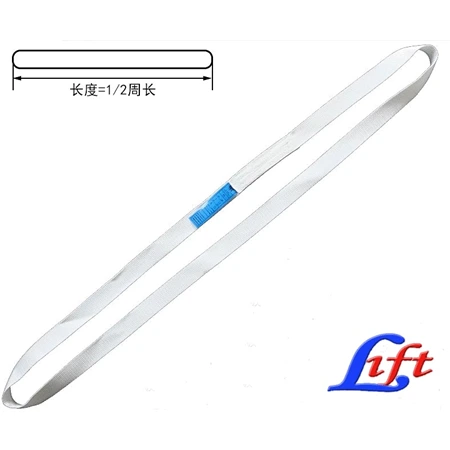
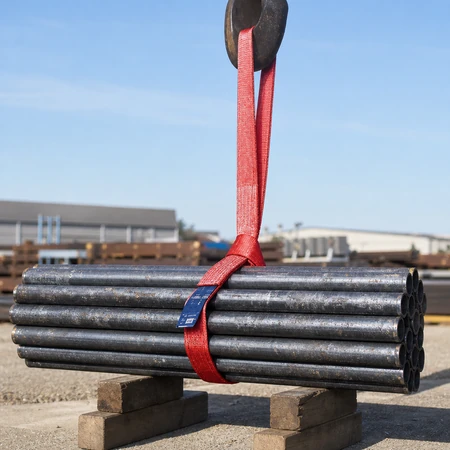
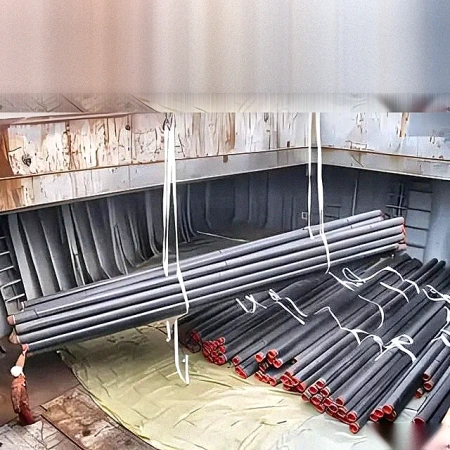
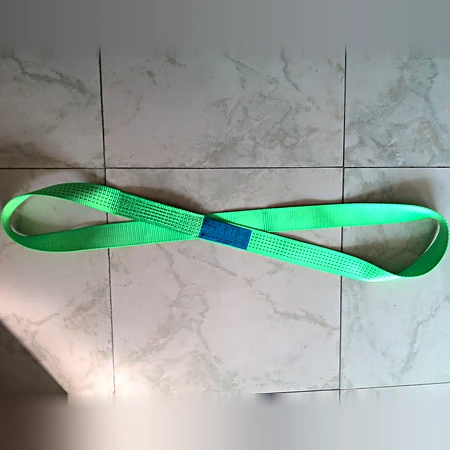
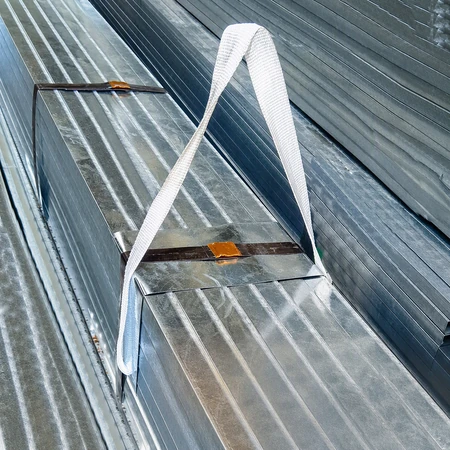
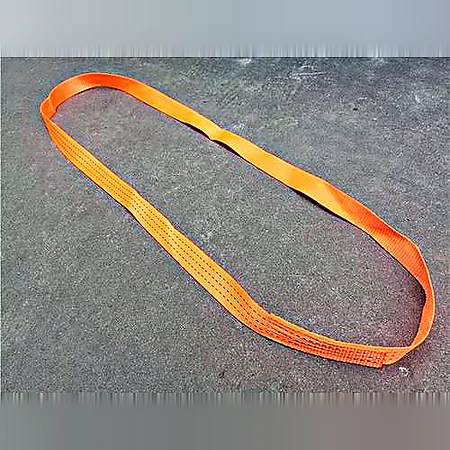
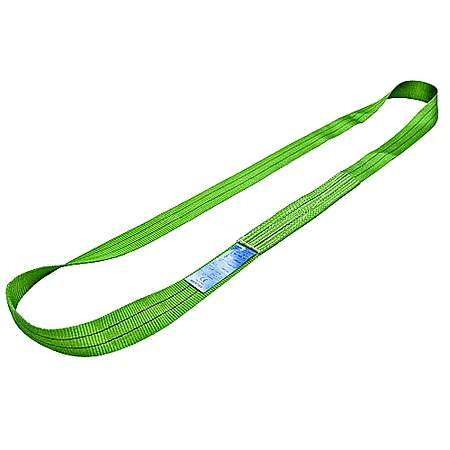
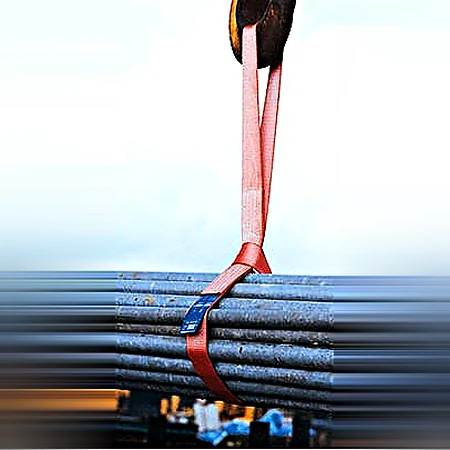
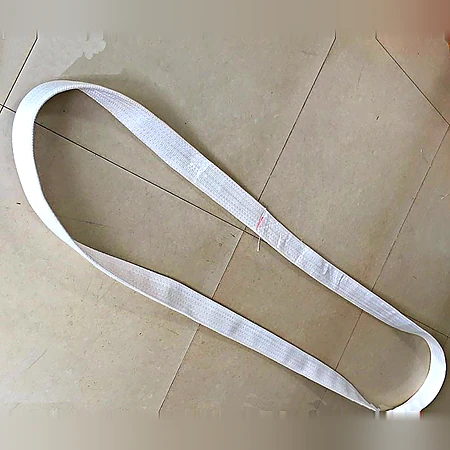
An majajjawa mai ɗagawa mara iyaka rufaffiyar madauki ce mara iyaka: the band is joined to itself, so there is nothing to thread, no eye to place and no metal fitting anywhere on the article. That one property is why it is the sling most often chosen for loads that must not be marked — metal pipe and tube, rubber products, katako, sassan aluminum da takarda, and copper tube among them.
The same loop works in the vertical, basket and choker arrangements, it is bought in flat woven or sleeved round form, and it is made to the width, thickness and length the load needs. Faɗa mana kaya, its diameter or girth, and how it will be picked, and we will confirm the loop that fits it.
Choosing an endless lifting sling by the load, ba da ton
A closed loop is bought from the load outwards. The tonnage decides the band, but the load decides everything else: its section, its girth, its finish, and whether the loop will be used doubled around the article or passed through itself. The five loads this range is most often bought for are different in exactly those respects, and the table below is the practical reading of them.
What each load decides about the loop
| lodi |
Why a closed soft loop suits it |
Abin da za a rubuta akan oda |
| Metal pipe and tube |
An nade wani yanki na zagaye maimakon ɗaure: kaya yana shiga madauki ta hanyar zagayawa da bututun, so there is no eye to be lined up against a machined end and no fitting to bruise a coating. |
The outside diameter and girth at each pick position, the spacing of the two positions, and the coating condition. |
| Rubber products and hose |
Rubber is easily cut by a narrow edge and easily marked by hardware; a wide woven band spreads the force and presents no metal at all. |
The section and its surface, taro, and whether a compression mark at the contact is a rejection. |
| Fakitin katako da katako |
Kaifi taso yanke wata kunkuntar band; a wide loop spreads the pressure and carries the pack without printing a line into dressed stock. |
Yawan fakitin yayin da yake tafiya, the girth at the pick positions, and any edge protection required. |
| Aluminum sassan da takarda |
The softest load in this table, and the one where a mark is most likely to be a rejection; synthetic fibre is chosen here because it is softer than the load. |
Ƙarshen (niƙa, anodised ko fenti), tsayinsa, kuma ko alamar shaida abin karba ne. |
| Copper tube and fittings |
Mai laushi, expensive and unforgiving of a burr: the absence of any fitting on the article is the whole protection. |
The tube diameter and wall, the surface condition, and the girth at each position. |
What having no ends changes on the job
The closed form is not a sling with its ends hidden; labari ne na daban, kuma sakamakon aiki guda uku ya biyo baya. There is no end to measure from, so the size the sling was made to exists in the marking and in the order rather than in the article. There is no end to attach to, so the arrangement — vertical, basket or choker — is decided at the load and changes what the loop carries. And there is no end from which an inspection can begin, so on a closed loop the printed figures are the whole record of what the article is, which is why the marking has to be legible rather than merely present.
Tsawon, da kuma taron da aka ambata a ciki
A loop has no ends to measure between, and this trade quotes the same article under two conventions — the circumference of the loop, and the length of the band laid flat — which for the same sling differ by about a factor of two. Dukansu halal ne; only one of them is the figure you meant. State the convention with the figure on the enquiry, or state the use instead (for example, the girth of the article the loop must go round), and the ambiguity disappears before the band is cut.
Materials and forms
- Flat woven endless belt — one band closed on itself, the simplest closed article, with a wide face for soft loads.
- Sleeved round sling — a load-bearing core inside a protective cover, which keeps the fibre away from the load and shows the capacity clearly on the sleeve.
- Polyester - ƙananan shimfiɗa kuma barga a ƙarƙashin nauyin nauyi; the general-purpose choice for repetitive handling.
- Nailan — tough and abrasion-resistant, and the one to consider where shock loads are expected.
- UHMWPE da aramid — for the highest strength to weight, and for high-temperature or flame exposure respectively.
Whatever the fibre, no metal part is fitted to the article: the loop is the whole sling. Where a fitting is unavoidable at the hook end, it belongs to the lifting set rather than to the sling, which keeps the contact with the load entirely soft.
Yawan tambaya
Can an endless lifting sling be used in a choker? Ee, and the arrangement has to be stated, because what the loop carries changes with it. A tsaye, basket and choker are three different duties on the same article.
How do I state the length? With the convention named, or with the use stated instead — the girth of the article the loop goes round. The two conventions differ by about a factor of two.
Will it mark a copper or aluminium surface? The band is synthetic fibre and no fitting touches the load, don haka ba zai taso ba ko kuma ba zai yi ba. Nisa shine ma'aunin kariya: da fadi da band, the lower the pressure on the surface.
Can it be made to my diameter? Yes — width, thickness and length are made to order against the load, and the marking is put on as it is made.
Inda za a je gaba
For the closed forms in this family see majajjawa mara iyaka kuma majajjawa mara iyaka; for the flat closed belt see circular flat lifting belt; for the one-trip version of the same loop see yarwa hanya guda majajjawa kuma madauwari mai iya zubarwa; for pipe duty specifically see fitarwa karfe bututu majajjawa. Rukunin masu alaƙa: dagawa majajjawa.
Tuntuɓar
Abubuwan da aka bayar na Lift Sling Rigging Co., Ltd., Ltd - waya da WeChat 18066002268, e-mail 702461526@qq.com, Lifute Industrial Park, Birnin Taizou, Lardin Jiangsu, China. HS code 630790. Aika kaya, its girth and the arrangement, and we will confirm the loop before the band is cut.