

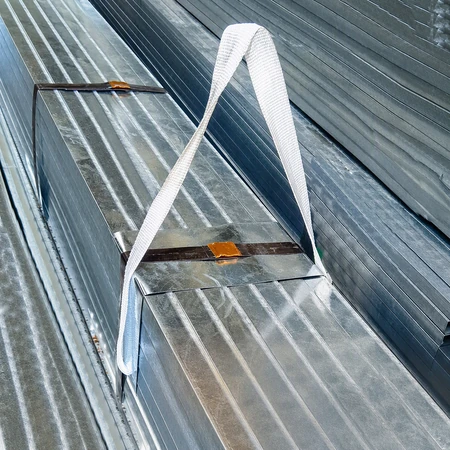
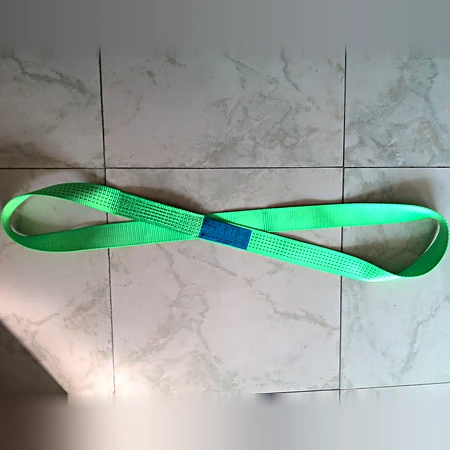
Lift sling rigging company produce One Way Single Ply Endless Polyester Flat Lifting Webbing Sling,single ply endless flat sling,Endless 1Ply Flat Sling,One Way Endless Webbing Sling Single Eye For Lifting Steel Pipe And Tubing,1 Ply Flat PES Webbing Sling,.
One Way Single Ply Endless Polyester Flat Lifting Webbing Sling
A one way single ply endless polyester flat lifting webbing sling is a closed loop of flat woven polyester webbing – one ply, joined to itself, with no eye, no end and no fitting anywhere on the article. It is bought for one journey and supplied with the load rather than drawn from a sling store. Standard range: 1 t zuwa 12 t working load limit on 4 mm gizo, fadi 25 mm ku 300 mm a a 5:1, 6:1 ko 7:1 dalili, loop lengths 0.5 m zuwa 100 m, colour coded to BS EN 1492-1 and supplied with a blue label stating the working load limit, tsayinsa, the factor and the batch.
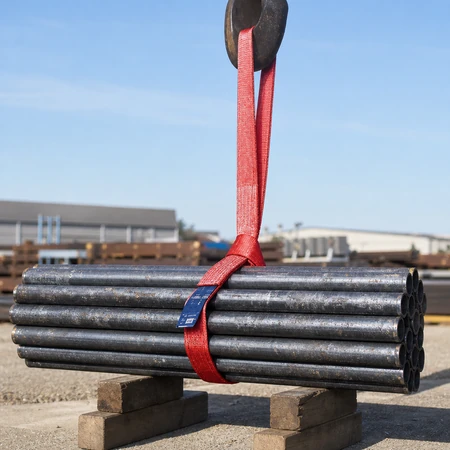
Why a Loop Suits a One-Trip Band
The two halves of this name answer two different questions. Hanya daya is commercial: the band travels with the pack, is used once, and is not recovered or re-issued. Mara iyaka is structural: the band is joined to itself, so there is nothing to thread and nothing to align.
Put together, they answer what actually goes wrong at the far end of a consignment: the person re-slinging the load has no rigging plan, no sling store and no second choice, and a loop asks nothing of them.
- Nothing to align. An eye has to meet a hook of the right size the right way round. A loop is dropped over the load or passed round it, and the pick works whichever way it lands.
- Nothing to bruise a finish. No stitching stack at the bearing point, no thimble, no shackle in contact with the load. On coated pipe, anodised section or polished sheet that is the whole protection.
- Nothing to lose. A band with fittings can arrive with the fittings gone. A loop is one piece of webbing and it is either there or it is not.
- Nothing to get wrong on length. The one exception on this list, and it is the one that matters most – see the section on length below, because a loop is quoted two ways and they differ by nearly a factor of two.
Ƙayyadaddun bayanai
| Siga | Zabuka |
|---|---|
| Samfura | One way single ply endless polyester flat lifting webbing sling / single ply endless flat sling |
| Siffar | Rufe madauki, flat woven, joined to itself; no eye, no end fitting |
| Build | Guda ɗaya – one layer of webbing forms the whole loop |
| Fiber | Polyester mai ƙarfi (PES); nylon and polypropylene available for specific duties |
| Web thickness | 4 mm misali |
| Iyakar nauyin aiki | 1 t – 12 t, takarda guda ɗaya |
| Fadin bandeji | 25 mm – 300 mm, set by the working load limit and the factor |
| Safety factor | 5:1 / 6:1 / 7:1, selected at order |
| Loop length | 0.5 m – 100 m, minimum rising with the width |
| Launi | BS EN 1492-1 capacity colour; special colours and printed logos on OEM orders |
| Lakabi | Blue label: aiki iyaka, tsayi, aminci factor, lambar tsari |
| Rayuwar sabis | Tafiya daya – ba a dawo da su ba, ba a sake fitowa ba |
| HS code | 630790 |
Girman girma: Width Follows the Figure and the Factor
Width is not a free choice: it follows from the working load limit and from the factor, which is why the same tonnage appears three times below with three widths. A 7:1 band is wider and heavier than a 5:1 band of the same figure – that is the cost of the extra factor, not a different grade of webbing.
| WLL | 5:1 | 6:1 | 7:1 | Min. loop | kg/m ku 7:1 |
|---|---|---|---|---|---|
| 1 t | 25 mm | 25 mm | 30 mm | 0.5 m | 0.20 |
| 2 t | 50 mm | 50 mm | 60 mm | 1.0 m | 0.60 |
| 3 t | 75 mm | 75 mm | 90 mm | 1.0 m | 0.78 |
| 4 t | 100 mm | 100 mm | 120 mm | 1.5 m | 0.90 |
| 5 t | 125 mm | 125 mm | 150 mm | 1.5 m | 1.14 |
| 6 t | 150 mm | 150 mm | 180 mm | 1.5 m | 1.33 |
| 8 t | 200 mm | 200 mm | 240 mm | 2.0 m | 1.85 |
| 10 t | 250 mm | 250 mm | 300 mm | 2.0 m | 2.05 |
| 12 t | 300 mm | 300 mm | 300 mm | 2.0 m | 2.70 |
The same width ladder, in the looped-end form, is published on the amfani guda daya dagawa majajjawa shafi – useful when a consignment needs eyes at the top and a loop at the bottom, which is two articles rather than one.
Maximum length is 100 m in one continuous loop. Longer lengths, intermediate widths, extra-wide loops and special colours are made to order. Nothing in the table is a stock size: the figure, dalilin, the width and the length together describe a band made to your line.
Two readings catch buyers out. The minimum length follows the width, ba ton: 25 mm daukan 0.5 m, 50 kuma 75 mm dauka 1.0 m, 100 ku 150 mm dauka 1.5 m kuma 200 mm da sama dauka 2.0 m. Neman bandeji mai faɗi don ƙasa mai laushi yana nufin karɓar ƙarami mafi tsayi, wanda a cikin ɗan gajeren fakiti shine layin da ke yanke tsari. Da kuma weight column is a handling figure: a saman tsani mita dari na 300 mm band is over a quarter of a tonne, Kuma makada na tafiya a matsayin kaya kafin su ɗaga wani abu.
Tsawon: the Two Conventions, and Why It Matters More Here
A loop has no ends to measure between, so this trade quotes the same article two ways: da kewaye of the loop, da kuma length of the band laid flat. For the same sling the two figures differ by about a factor of two. Both are legitimate; only one of them is the figure you meant.
On a reusable sling the mistake shows up at the next lift and is corrected from the store. On a one-way band it shows up at the far end, in front of a customer, with no second band to swap in – which is why this is the single line worth getting right on the enquiry. State the convention with the figure, or state the use instead (the girth of the article the loop must go round), and the ambiguity disappears before the band is cut.
| You write | It means | When to use it |
|---|---|---|
| Loop circumference 4.0 m | One full turn round the load, measured round the closed loop | The band is ordered to wrap a known girth |
| Band length 2.0 m, laid flat | The webbing cut length before joining, rabin zagaye | The band is priced and cut by the metre |
| Girth at the pick 1.6 m, two picks | The dimension of the load itself, and the number of bands | The safest form on a first order: it needs no convention at all |
The Three Hitches, and What Each One Carries
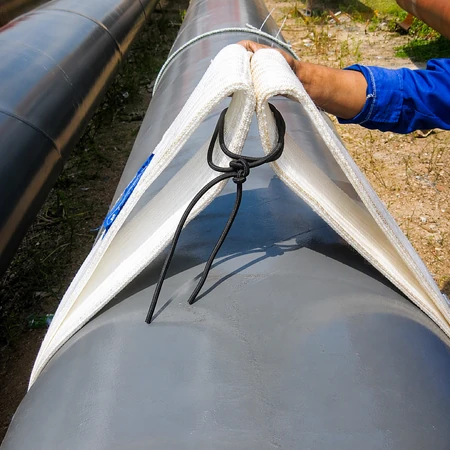
The same loop works in three arrangements, and the figure on the label only describes the first of them. This is the most common error on an endless band, because all three are rigged without any change to the article.
| Shirye-shirye | Factor | A 5 t loop gives |
|---|---|---|
| A tsaye – loop hangs, load on one side | 1.0 | 5.0 t |
| An shake – round the load and back through itself | 0.8 | 4.0 t |
| Kwando, legs 0-45° | 2.0 | 10.0 t |
| Kwando, legs 45-60° | 1.4 | 7.0 t |
The choke is the arrangement a loop is bought for – it is what grips a pipe, a pole or a drum – and it is also the one that costs 20 % of the figure. So a 4.5 t pipe bundle choked on a 5 t loop is an overload, not a margin, and the answer is the next width up rather than a longer band. Where the loop is used as a basket under a bundle, both sides carry and the figure doubles; where it is used vertically, the label figure applies as printed.
One Way Is a Commercial Life, Not a Lower Grade
The word describes the journey, and nothing else: zaren, saƙa, fadi, dalili, working load limit and marking are specified exactly as for a band used for years, and buying a narrower band or a lower factor because it is only going one way is not a saving – Margin ne da ba a ƙididdigewa ba da aka fitar daga cikin dagawa. What does change is the record. On a reusable sling the inspection history is the evidence; on a single-trip band there is no history after the lift, haka the print on the band and the packing list carry the whole traceability. The returnable version of the same loop, inspected between lifts and drawn from a store, shine single ply endless flat sling.
- Marking is part of the specification, not the paperwork. Iyakar nauyin aiki, tsayi, dalili, da kuma bayanin da aika aika a zahiri ke amfani da shi – lambar fakitin, an order number, your own part number. That reference is what ties a band on a quay to a line on a packing list in an office.
- Ana iya karantawa bayan tafiya, ba bayan samarwa ba. alkalumman dole su tsira daga tirela, akwati da wurin lodi. Buga wanda yake karami, low-contrast, or on a face that enters the choke is print that will not be read.
- Launi azaman tashar ta biyu. Launi ɗaya a kowane nau'in fakiti, kowane abokin ciniki ko kowace ton yana juya akwati na makaɗa iri ɗaya zuwa wani abu wanda za'a iya jerawa a kallo., and on a made-to-order band it costs nothing.
Counting: One Band per Pick Point, per Pack
One-trip bands are bought in the same arithmetic as the packing, and it is done once because nothing comes back. Ƙidaya daga fakitin, ba daga tonnage ba: two picks per pack is two bands, dagawa mai maki hudu hudu ne, and ninety packs at two picks is 180 makada. Ƙara izinin kulawa da gangan – two to five per cent covers the band cut on a sheet edge while the pack is made up – so a shortfall becomes a line on the order instead of a delay at the dock. Where the bands are packed inside a crate, an ɗaure shi zuwa abin da ya rage ko an buga shi a cikin dam, the sling becomes a line on the bill of materials: lambar sashi, a loop length, a colour and a print that does not change between shipments.
Where a One-Trip Loop Is the Right Order
| Loda | What decides the band | Usual build |
|---|---|---|
| Rufe karfe bututu, a cikin gidajen abinci | Band width is the coating’s only protection from the band doing the lift; measure the two pick positions from an end | 100-150 mm, 4-6 t, 7:1 |
| Bututu ko bututu a cikin daure | Kundin shine kaya; kowane matsayi yana ɗaukar rabonsa na duka fakitin, and the girth sets the loop | 150-200 mm, 6-8 t, 7:1 |
| Steel sheet and plate stacks | Gefen zanen da aka yanke shine ruwan wukake a kan bandejin da aka saka, so the height of the stack and the direction of the band both matter | 100-150 mm, 4-6 t, 7:1 |
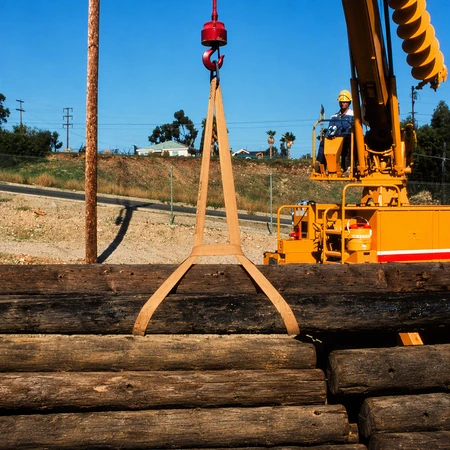
| katako, logs and packs | The arris prints a line into dressed stock and cuts the weave on a narrow band | 125-200 mm, 5-8 t, 7:1 |
| Coils, sassa na dutse da zagaye | A closed loop is the natural form; the choke grips and the width spreads the pressure | 150-300 mm, 6-12 t, 7:1 |
| Machinery and finished assemblies | Nothing metallic touches the load at either end, which on a painted or ground surface is the reason to buy it | 50-125 mm, 2-5 t, 7:1 |
The Single Inspection, and What It Looks At
A one-trip band has one inspection in its life and it happens before the load, lokacin da za a iya maye gurbin kuskure daga kaya iri ɗaya. Abu hudu ake kallo, a cikin wannan tsari: the weave where it meets the load (yanke, abrasion, a glazed or pinched face), the join where the loop closes, the label – because an unreadable figure cannot be matched to the pack it was cut for – and what the band has been lying in. Grit, swarf, mai da ruwa a tsaye suna tafiya cikin lamba, and a clean band is the cheapest protection on the list.
Kare shi daga kaifi masu kaifi, hot surfaces and welding spatter with a sleeve or a padded protector, never shorten a sling with a knot, never join two slings by knotting them, and never repair webbing by stitching, welding or heating. At the destination the band is disposed of, ba a adana: a one-trip band that comes home to a rack gets issued again, and its marking then states something that is no longer true.
Tambayoyin da ake yawan yi
What is a one way single ply endless polyester webbing sling?
A closed loop of flat woven polyester webbing, one ply thick, joined to itself with no eye, no end and no fitting. It is bought for one journey, supplied with the load and not recovered. The standard range runs 1 t zuwa 12 t on 4 mm gizo, 25 mm ku 300 mm fadi, with loop lengths from 0.5 m zuwa 100 m.
How is the length of an endless sling loop measured?
Two ways, and they differ by about a factor of two: the circumference of the closed loop, and the length of the band laid flat before joining. Sunan taron al'ada, or name the girth of the load instead – that is the form that leaves nothing to interpret.
Is a one-trip endless band weaker than a reusable one?
A'a. Width follows the working load limit and the factor in exactly the same way, kuma alkalumman da aka buga a kan band ɗin su ne alkalumman da suka shafi ɗagawa. What changes is that the band is not recovered, so the print and the packing list carry the whole record of it.
Which safety factor should I order – 5:1, 6:1 ko 7:1?
7:1 is the design factor used for general-purpose flat woven webbing slings under European practice and is the usual choice with colour coded bands under BS EN 1492-1. 5:1 is the customary North American figure for synthetic webbing slings and 6:1 zaune a tsakaninsu. Tonnage iri ɗaya a wani yanayi daban shine labarin daban tare da faɗin daban, don haka abin da ya kamata ya kasance a kan bincike.
Can an endless webbing loop be used in a choker hitch?
Ee, and it is what a loop is best at – it is how a pipe, a pole or a drum is gripped. Siffar da aka shake ita ce 0.8 of the vertical figure, haka a 5 t loop chokes 4 t. Select the width for the arrangement you will really use, not for the vertical figure on the label.
Single ply or double ply endless sling?
Single ply is the lighter, more flexible and more economical build, and it is the right answer for most lifts up to 12 t and for anything that has to be threaded through a tight space or wrapped round a small diameter. Double ply buys a higher figure at the same width, or a stiffer, wider bearing face – at more weight and more cost per band.
Can the band be printed with our own reference or packed with our product?
Yes to both, and they are usually ordered together. Iyakar nauyin aiki, the loop length and your own pack, order or part number can be printed as a production instruction, in the exact string and case you send; the bands can be packed inside a crate, an ɗaure shi zuwa abin da ya rage ko an buga shi a cikin dam, labelled per pack and listed on the packing list with the reference that matches the print.
Nemi Magana
Send the pack and its travelling mass, the pick points and their spacing, tsari, the girth at each pick, the safety factor your market works to, and the reference to print. We come back with the width, the loop length, the finished weight and the marking – on a drawing, before the band is cut.
Send your loop specification for a quotation
Waya / WeChat: +86 180 6600 2268 | Imel: 702461526@qq.com
Adireshi: Lifute Industrial Park, Birnin Taizou, Lardin Jiangsu, China | HS code: 630790