

Lift sling rigging company manufacture Aramid braided rope,Aramid Fiber Rope,Braided Aramid Cord,Aramid Fibre Braided Ropes 400 °C.
Aramid ya miƙe igiya
Para-aramid 12-strand braid for heat, stretch and strength — 4 mm ku 24 mm, sanya don yin oda
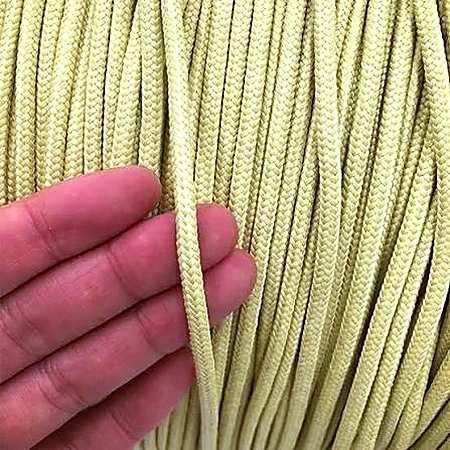
Mu aramid lanƙwasa igiya is a 12-strand single braid made from 100 % para-aramid filament. It is the rope to specify when the duty combines heat with strength: it has no melting point, it keeps working above 150 °C, and it holds far more of its strength at high temperature than nylon or polyester. Because it barely stretches under load, the load stays where it was set — which is why braided aramid cord is used for furnace and ladle work, heat-shield rigging, guy lines and high-temperature pulling, as well as for industrial lifting where a igiya nailan would be too elastic. Standard braids run from 4 mm ku 24 mm, tare da raba idanu, cin duri, hooks or buckles fitted at the ends.
- Works hot - babu wurin narkewa; strength falls to zero only near 455 °C, and long-term service is above 150 °C
- Ƙananan shimfiɗa — a 70–100 GPa modulus keeps a suspended load steady instead of letting it settle or swing
- Strong for its weight — specific strength 5–6 times that of steel wire at roughly one fifth of the weight
- Yanke da jurewa abrasion — a dense 12-strand braid with a hard-wearing surface
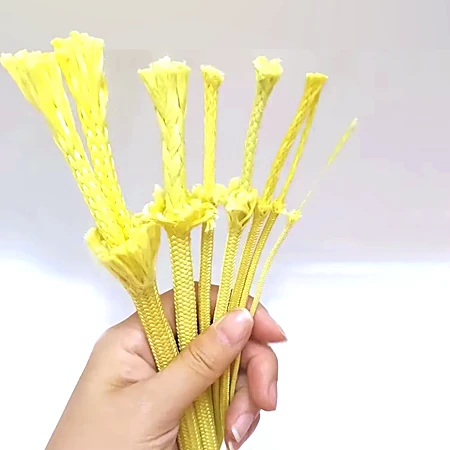
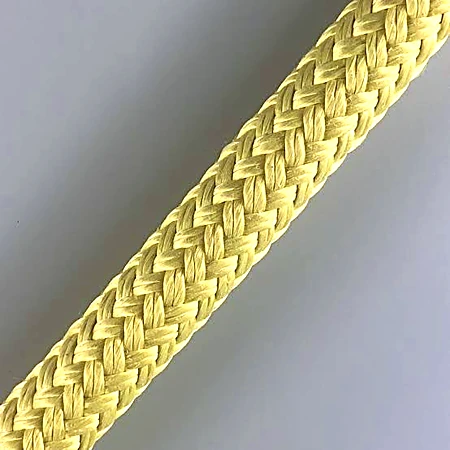
Key Features of Our Aramid Braided Rope
Heat Resistance Where Nylon and Polyester Fail
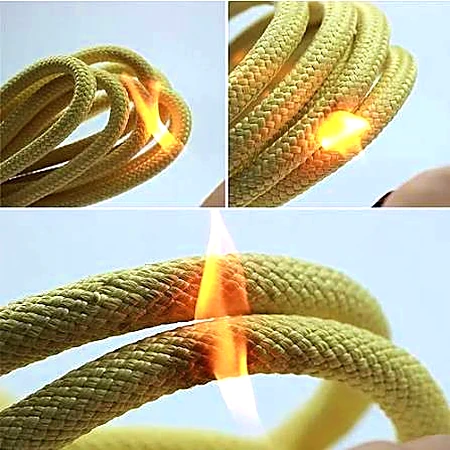
Para-aramid does not melt and does not drip. It can be used continuously above 150 °C, retains about 75 % of its tenacity after 100 hours at 200 °C, and reaches zero strength only at about 455 °C. That is the reason this rope is specified for areas where ordinary synthetic rope would soften, glaze or fail — see also our high zafi juriya mooring igiya.
Karancin Tsawaitawa, So the Load Stays Put
A 70–100 GPa tensile modulus means the rope gives very little under load. Where a nylon rope absorbs shock by stretching, an aramid braided rope is chosen for the opposite reason: a suspended load keeps its height, a tensioned line stays tensioned, and there is no stored energy to release when the load is set down.
12-Strand Single Braid
Twelve strands are braided without a core, so the rope is torque-free, round and even, and takes a splice that keeps most of the rope’s strength. The braid angle and density are controlled per batch, which is what fixes the finished diameter and the way the rope behaves in a hand, on a capstan or over a sheave.
Spliced Ends, Not Knotted
A knot gives away a large part of the rope’s strength and becomes the weakest point. We finish aramid rope with hand-spliced eyes, idanuwansu, ƙugiya, swivels or buckles, and whip or heat-seal the free ends so the braid cannot unravel.
Ƙididdiga na Fasaha
| Abu | Specification range |
|---|---|
| Sunan samfur | Aramid ya miƙe igiya / aramid fibre braided rope / braided aramid cord / Kevlar braided rope |
| Kayan abu | 100 % para-aramid (aromatic polyamide) multifilament, natural yellow |
| Gina | 12-madaidaicin rigar guda ɗaya (zagaye); 8-madauri, 16-strand and double braid on request |
| Daidaitaccen diamita | 4 · 6 · 8 · 10 · 12 · 14 · 16 · 18 · 20 · 24 mm (custom range 3–32 mm) |
| Daidaitaccen tsayi | 100 m · 200 m · 500 m coil, 1000 m spool; any cut length to order |
| Launi | Natural yellow · black · custom colours |
| Tufafi / gama | Mara rufi, or PU-coated for extra abrasion resistance and a locked braid |
| Yanayin aiki | Continuous service above 150 °C; strength falls to zero at about 455 °C; babu wurin narkewa |
| Tsawaitawa | Low — chosen where a suspended load must not settle or swing |
| Kariyar UV | Protective jacket or cover recommended for permanent outdoor exposure |
| Ƙarshen ƙarewa | Hand-spliced eye · thimble eye · hook · swivel · buckle; whipped or heat-sealed ends |
| Shiryawa | Nada mai lakabin, spool or carton; lakabin al'ada da lambar lamba akwai |
| MOQ & OEM | Low MOQ don umarnin gwaji; cikakken OEM - diamita, launi, tsayi, splicing, bugu tambari, packaging |
Standard ƙayyadaddun kewayon - sauran diamita, braid constructions and lengths are produced to order.
Diamita da Ƙarfin Ƙarfi
Diameter follows from the load and from what the hardware will accept. Heavier diameters carry more, stand up to abrasion for longer and are easier to grip; lighter diameters are quicker to handle and cheaper to ship.
| Diamita | Kimanin. nauyi (g/m) | Ƙarfin karya na al'ada | Reference aiki load a 5:1 |
|---|---|---|---|
| 4 mm | ≈ 11 | ≈ 15 kN (1.5 t) | ≈ 3.0 kN |
| 6 mm | ≈ 24 | ≈ 34 kN (3.5 t) | ≈ 6.8 kN |
| 8 mm | ≈ 43 | ≈ 60 kN (6.1 t) | ≈ 12.0 kN |
| 10 mm | ≈ 68 | ≈ 94 kN (9.6 t) | ≈ 18.8 kN |
| 12 mm | ≈ 97 | ≈ 135 kN (13.8 t) | ≈ 27.0 kN |
| 14 mm | ≈ 132 | ≈ 185 kN (18.9 t) | ≈ 37.0 kN |
| 16 mm | ≈ 173 | ≈ 240 kN (24.5 t) | ≈ 48.0 kN |
| 18 mm | ≈ 219 | ≈ 305 kN (31.1 t) | ≈ 61.0 kN |
| 20 mm | ≈ 270 | ≈ 377 kN (38.4 t) | ≈ 75.4 kN |
| 24 mm | ≈ 389 | ≈ 540 kN (55.0 t) | ≈ 108.0 kN |
Typical reference values for standard 12-strand aramid braid. Breaking strength and working load are confirmed by the test certificate issued for your batch — always work from that figure, not from this table.
Material Properties of Para-Aramid
| Dukiya | Typical value |
|---|---|
| Density | 1.43 - 1.47 g/cm³ (para-aramid filament, grade dependent) |
| Specific strength | 5 - 6 × that of steel wire, at roughly one fifth of the weight |
| Tensile modulus | 70 - 100 GPa at room temperature |
| Glass transition temperature | 320 - 380 °C |
| Strength retention | Game da 75 % after 100 hours at 200 °C |
| Zero-strength temperature | Game da 455 °C |
| Wurin narkewa | None — the fibre decomposes rather than melting (from about 500 °C) |
| Iyakance ma'aunin iskar oxygen | 25 - 29 (flame retardant, kashe kai) |
| Moisture regain | 4.0 - 7.0 %, grade dependent (Kevlar 29 ≈ 7.0 %, Kevlar 49 ≈ 4.0 %) |
| Juriya na sinadaran | Good against most organic solvents; degraded by strong acids and alkalis, especially hot and concentrated |
Typical published values for para-aramid filament; confirm against the yarn datasheet used for your order.
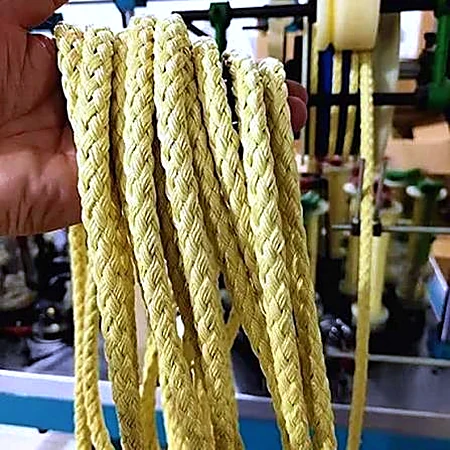
Zafi, Chemical and UV Behaviour
- Zafi - babu wurin narkewa; the fibre decomposes from about 500 °C and reaches zero strength near 455 °C. Continuous service is above 150 °C.
- Sinadaran — resistant to most organic solvents, but degraded by strong acids and alkalis, especially when hot and concentrated.
- UV — for permanent outdoor exposure, ask about a protective jacket or covered construction rather than leaving the braid bare.
Aikace-aikace
- Furnace, ladle and foundry rigging where radiant heat is present
- Heat shields, insulation blankets and refractory handling
- Guy lines, static lines and high-temperature pulling
- Industrial lifting and tensioning where the load must not settle
- Utility and winch duty, including the heavier forms of layin winch mai amfani
- Cut-resistant cordage for slings and lanyards, alongside igiya ja kuma igiya hawa
Keɓancewa da sabis na OEM
- Diamita — 4–24 mm standard, 3–32 mm on request
- Gina — 12-strand single braid, ko kuma 8-strand, 16-madauri da kwarjini biyu
- Ƙarshe — spliced eye, mata ido, ƙugiya, swivel, buckle, or plain cut ends
- Tsawon - kowane tsayin yanke; 100 m, 200 m kuma 500 m kujeru, 1000 m spools
- Ƙarshe — PU coating, launi, mid-rope marking, buga lakabin, retail packaging
- Abubuwan haɗin gwiwa - majajjawa ta yanar gizo, zagaye majajjawa kuma kayan aikin aminci supplied as matched sets
Kula da inganci
Each batch is checked on diameter, madaidaicin yawa, braid density and end finish, and sampled for breaking strength. We have manufactured rope and webbing for industrial, aminci da abokan cinikin wasanni kusan shekaru talatin. On request we supply the yarn certificate, the batch test report and a sample length for you to handle and test before volume production begins.
Tambayoyin da ake yawan yi
What temperature can aramid braided rope take?
There is no melting point. Long-term service is above 150 °C, it keeps roughly 75 % of its tenacity after 100 hours at 200 °C, and its strength approaches zero at about 455 °C. Tell us the working temperature and for how long, and we will confirm the construction and whether a heat-resistant cover is needed.
Aramid braided rope or nylon rope — which one do I need?
Choose aramid for heat and low stretch; choose nylon where shock absorption and elasticity matter more than stability. If both heat and shock are present, tell us the duty rather than a fibre, and we will recommend the construction that suits it.
Can the ends be spliced?
Ee. A 12-strand single braid takes a hand-spliced eye that keeps most of the rope’s strength, and thimbles, ƙugiya, swivels and buckles can be fitted to the eye. A finished end shortens the usable length, so allow for it when you order.
Do you supply kevlar braided cord in small quantities?
Ee. We keep the minimum order low for trial orders and will send a sample length to handle and test before volume production. Aika diamita, tsayinsa, the working temperature and the end finish you need.
Request a Quote for Aramid Braided Rope
Send us the diameter, tsayinsa, the working temperature and how the rope is loaded, plus any marking or certification your market requires. Ƙungiyarmu za ta dawo da ƙayyadaddun bayanai, tsawon samfurin da farashin masana'anta-kai tsaye.
Tuntuɓar: Abubuwan da aka bayar na Lift Sling Rigging Co., Ltd., Ltd - waya da WeChat 18066002268, imel 702461526@qq.com, Lifute Industrial Park, Birnin Taizou, Lardin Jiangsu, China. HS code 630790.