

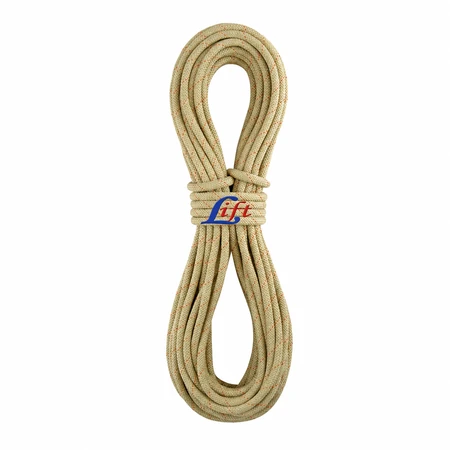
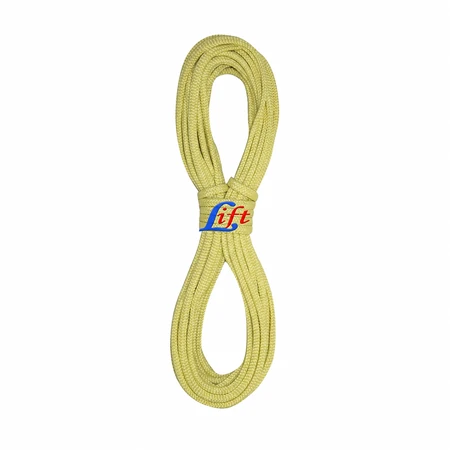
Lift sling rigging company produce Fire Rescue Rope, Fire Climbing Rope,Fire Suppression Rope.
Igiyar Ceto Wuta
Heat-Resistant Kernmantle Escape Rope & Life Safety Rope — 8 mm ku 16 mm, OEM & Tsawon Al'ada
Mu igiyar ceto wuta is a low-stretch kernmantle safety rope built for fire escape, firefighting and high-rise emergency descent. A 32-strand braided high-tenacity polyester sheath wraps a parallel filament core, so the rope keeps a firm round profile, resists abrasion against window sills and concrete edges, and still runs smoothly through descenders, figure-eight devices and pulley systems. Choose heat-resistant aramid construction or a cut-resistant steel wire core for anti-theft escape routes. Available from 8 mm ku 16 mm, a tsawon daga 10 m zuwa 100 m, tare da raba idanu, stainless steel thimbles and custom colours.
- Low elongation — controlled stretch for stable, predictable descending
- Zafi & flame resistant — polyester sheath, optional aramid version
- High abrasion resistance — dense 32-strand braided sheath
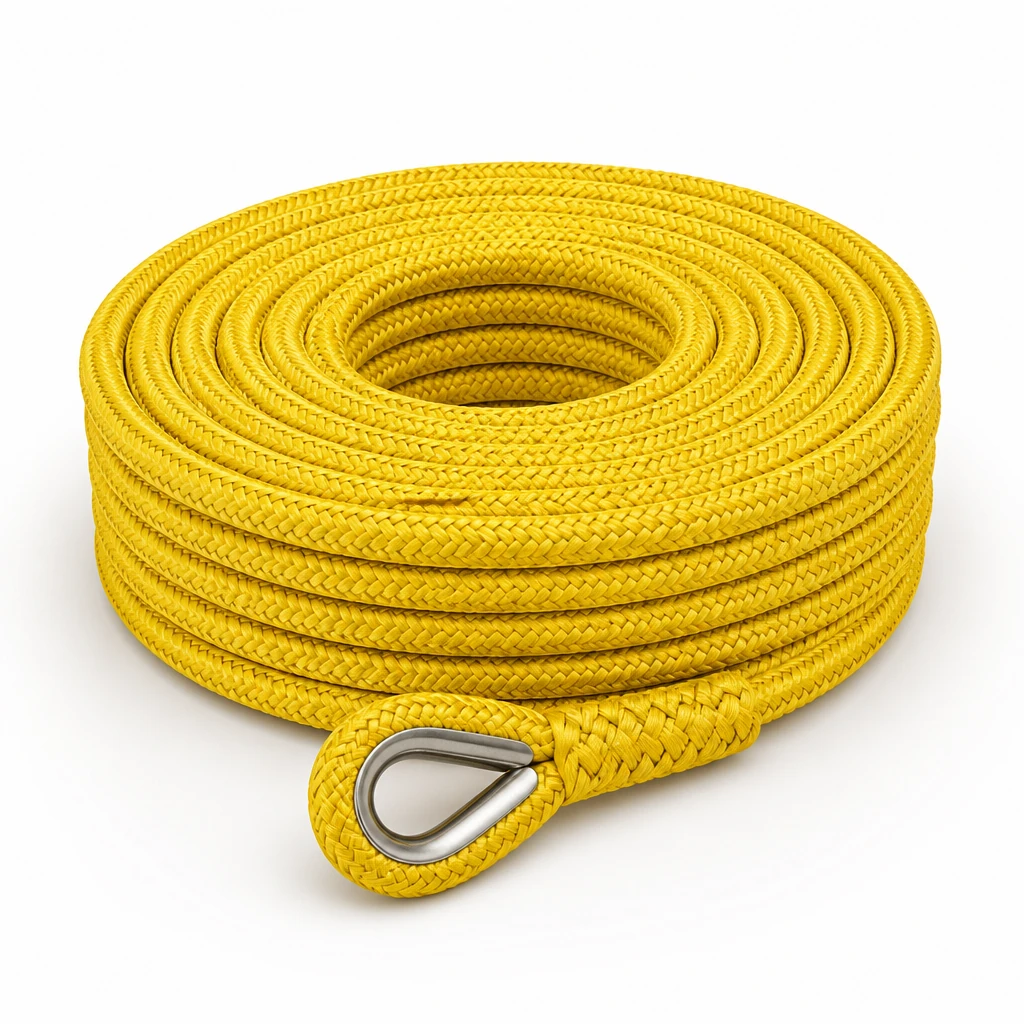
- Custom finished — spliced eye with thimble, ido-da-ido, or plain ends
Key Features of Our Fire Rescue Rope
Zafi & Flame Resistance
High-tenacity polyester sheath with an optional aramid (Nau'in Kevlar) upgrade for high-temperature rescue work and hot-slag environments.
Low-Stretch Kernmantle Design
Parallel core keeps elongation low, so the rope absorbs less energy and gives the operator a firmer, more predictable feel under load.
Steel Wire Core Option
An integrated galvanised steel wire core resists cutting and theft — a popular specification for fixed high-rise escape and fire-escape routes.
High Abrasion Resistance
The tight 32-strand braided sheath protects the load-bearing core against friction from concrete, metal frames and sharp window sills.
Firm, Non-Kinking Handling
Balanced sheath-to-core ratio keeps the rope round and supple — easy to coil, easy to deploy, and tangle-resistant in an emergency.
Full OEM Customisation
Diamita, tsayi, launi, sheath material, core type, end terminations, printed logos and retail packaging — all made to order.
Ƙididdiga na Fasaha
| Sunan samfur | Wuta ceto igiya / igiyar tserewa wuta / fire safety rope / life safety rope |
|---|---|
| Gina | Kernmantle — 32-strand braided sheath over a parallel filament core (software core or steel wire core) |
| Sheath abu | Polyester mai ƙarfi (na zaɓi: aramid, flame-retardant treated yarn) |
| Babban abu | Parallel polyester / nylon filaments (na zaɓi: aramid; galvanised steel wire core) |
| Daidaitaccen diamita | 8 mm · 10 mm · 11 mm · 12 mm · 14 mm · 16 mm (custom range 6–20 mm) |
| Haƙurin diamita | ± 0.3 mm |
| Zaɓuɓɓukan tsayi | 10 m · 20 m · 30 m · 50 m · 100 m — cut to any length on request |
| Ƙarfin karya mafi ƙarancin | 8 mm ≥ 13.5 kN · 10 mm ≥ 21 kN · 11 mm ≥ 24 kN · 12 mm ≥ 30 kN · 14 mm ≥ 40 kN · 16 mm ≥ 50 kN |
| Tsawaitawa | Low stretch — approx. 2–4 % a 10 % of minimum breaking strength |
| Zamewar sheath | ≤ 1 % |
| Iyakar nauyin aiki | Apply a safety factor of at least 5:1 to the minimum breaking strength; confirm against the rescue-operations standard of your market |
| Narkewa / wurin bazuwar | Polyester sheath approx. 255 °C · aramid sheath approx. 500 °C |
| Working temperature range | Polyester version −40 °C to +80 °C · aramid version up to +200 °C |
| Ruwan sha | < 1 % (polyester) — the rope stays light and does not stiffen when wet |
| Juriya UV | Mai kyau zuwa mai kyau; additional UV-stabilised treatment available |
| Juriya na sinadaran | Resistant to most acids, alkalis and organic solvents |
| Launi | Safety yellow (misali) — custom colours and traceable strand colours available |
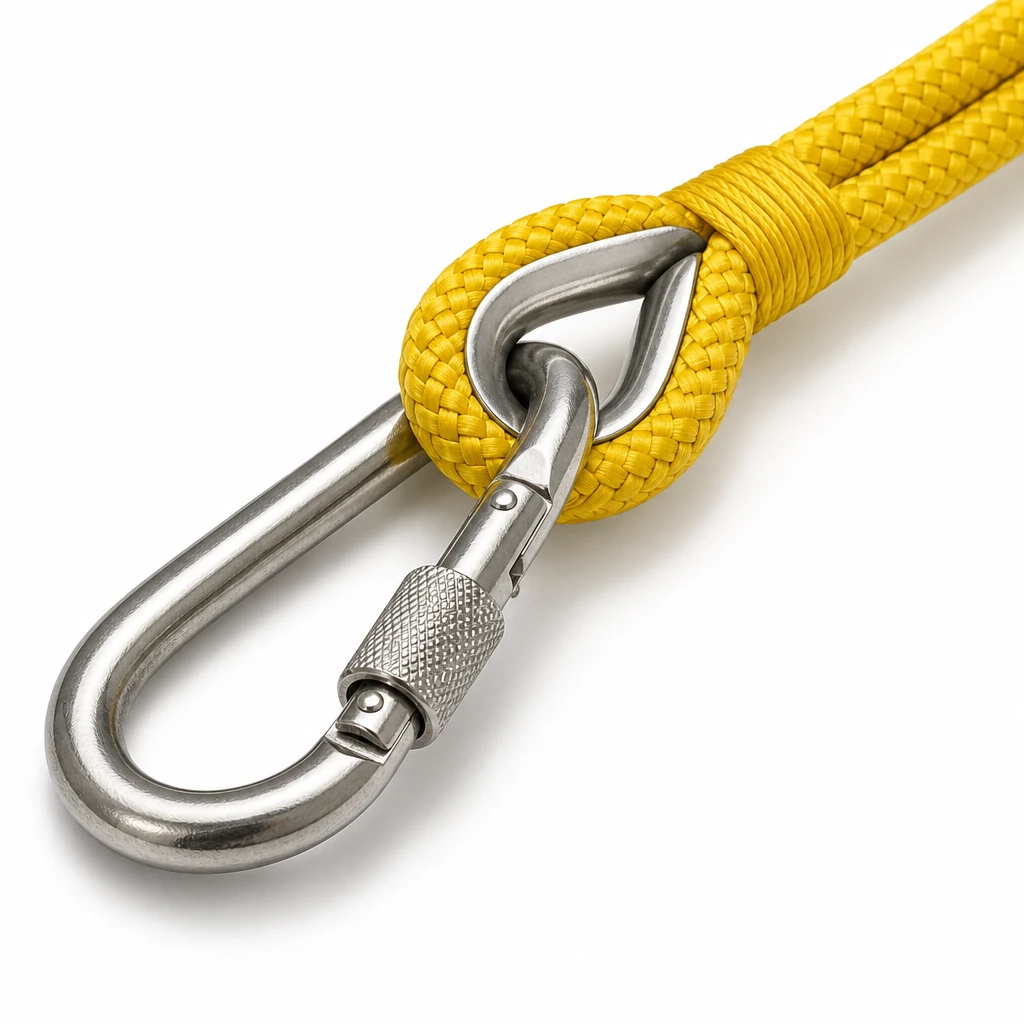
| End terminations | Spliced eye with stainless steel thimble · eye-to-eye · plain cut end · with screw-lock carabiner · with steel wire core loop |
| Ma'aunin magana | Designed with reference to EN 1891 (low-stretch kernmantle rope) and XF 494 / GA 494 (fire and fall-protection equipment) — certification and detail test reports issued on request |
| Shiryawa | Coiled in poly bag, carry bag or carton; lakabin al'ada da lambar lamba akwai |
| MOQ & OEM | Low MOQ don umarnin gwaji; full OEM — custom length, launi, bugu tambari da marufi |
| Lokacin jagora | Confirmed per order — sample and volume production schedules quoted on enquiry |
Gina igiya: Sheath da Core
A fire rescue rope has to survive two very different jobs at once. The cibiya carries the load, so it is built from parallel filaments that keep the rope’s elongation low and its breaking strength high. The sheath takes the punishment — window sills, parapet edges, zafi, and repeated contact with hardware — so we braid it from 32 high-tenacity yarns into a dense, tightly packed sleeve that locks the core in place and limits sheath slippage.
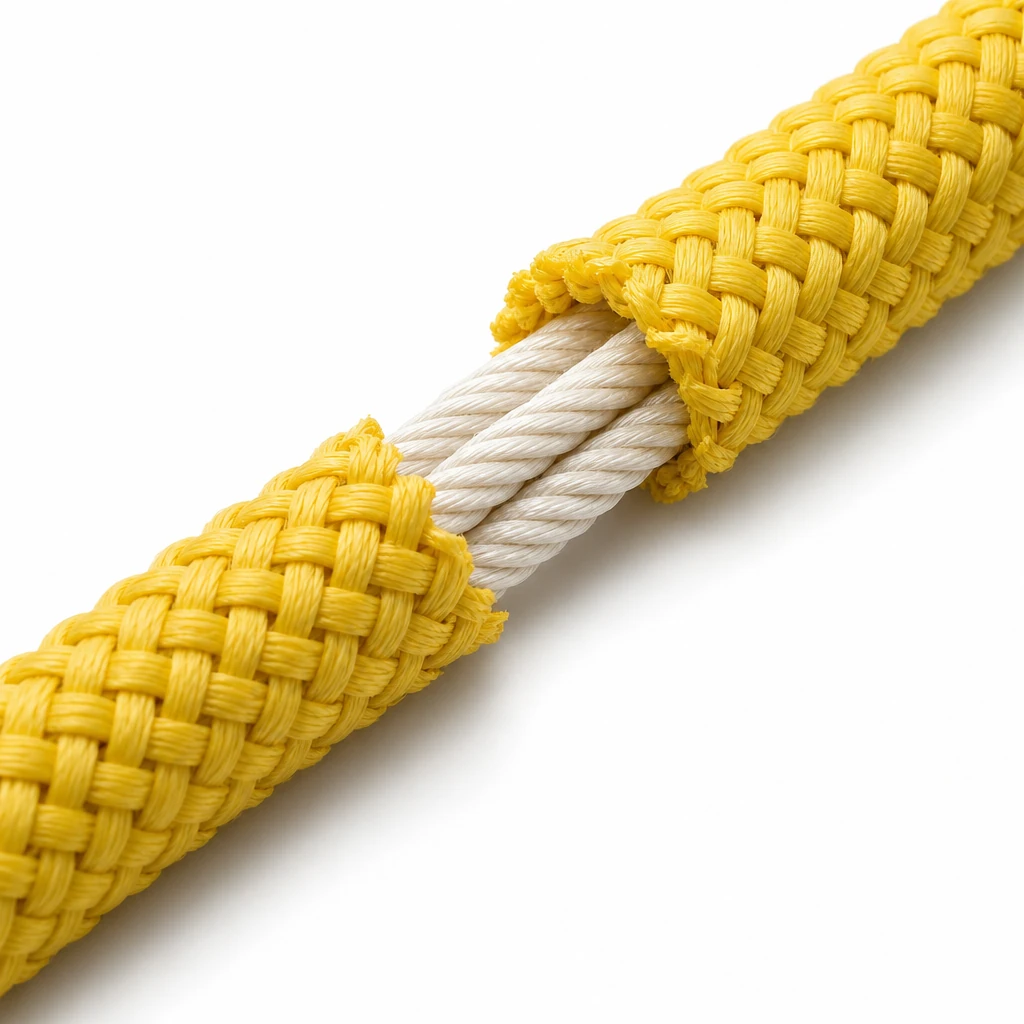
Which core should you choose?
- Polyester core — the standard choice for escape ropes and general rescue work; haske, low-stretch and economical.
- Nylon core — slightly higher energy absorption, useful where some dynamic cushioning is wanted.
- Aramid core — for high-temperature environments and where the rope must resist contact with hot surfaces.
- Steel wire core — added cut resistance and anti-theft protection, typically specified for fixed high-rise fire escape routes.
Heat and Flame Resistance
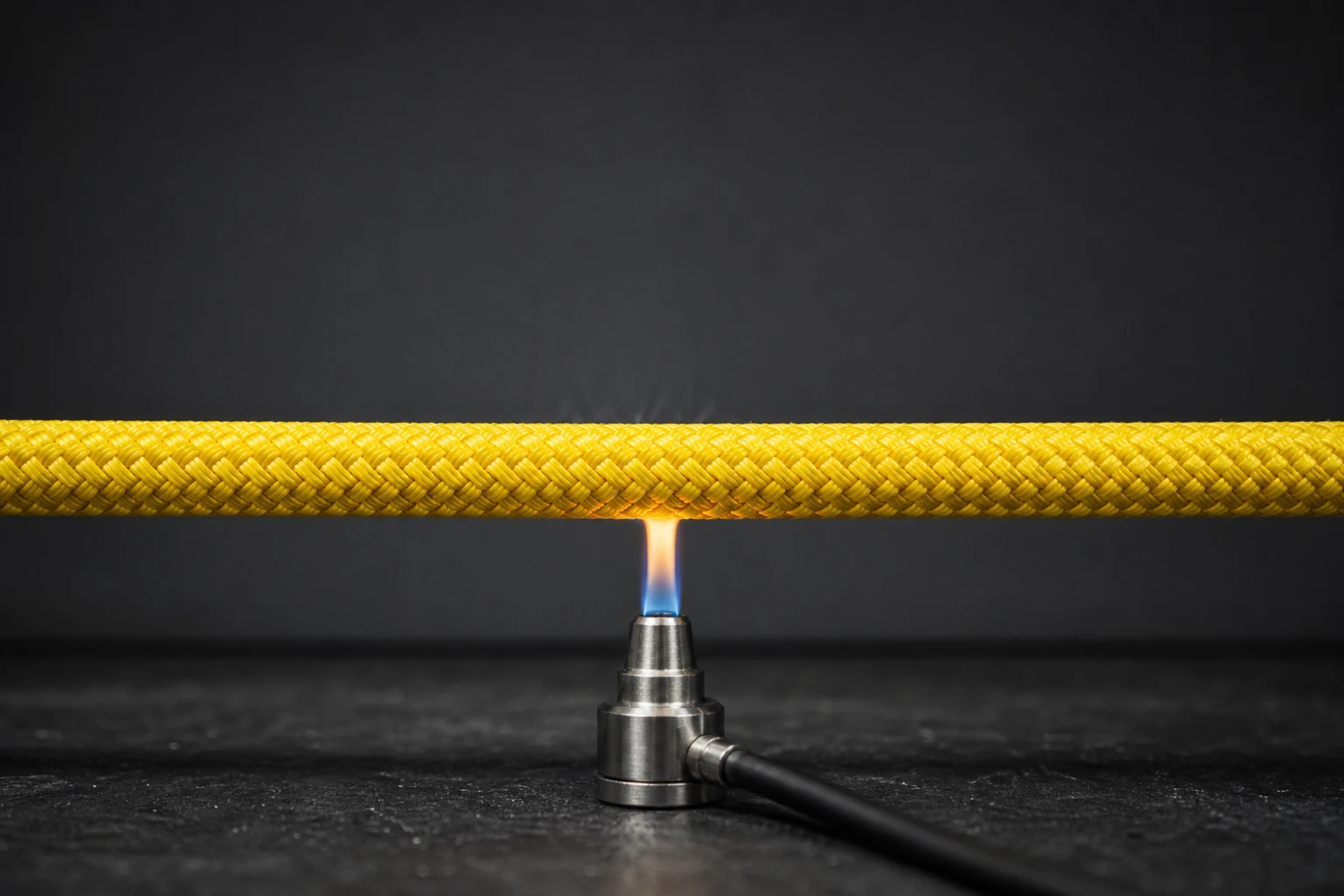
In a real fire, radiant heat reaches a rope long before the flame does. Polyester sheaths begin to soften around 255 °C, so the standard rope is intended for escape and rescue work where direct flame contact is brief. Where the operating environment is consistently hot — industrial rescue, hot slag areas, or routes close to burning structures — specify the aramid version, whose sheath tolerates far higher temperatures before decomposing. Both versions use the same kernmantle architecture, so the handling and hardware compatibility stay the same.
Aikace-aikace
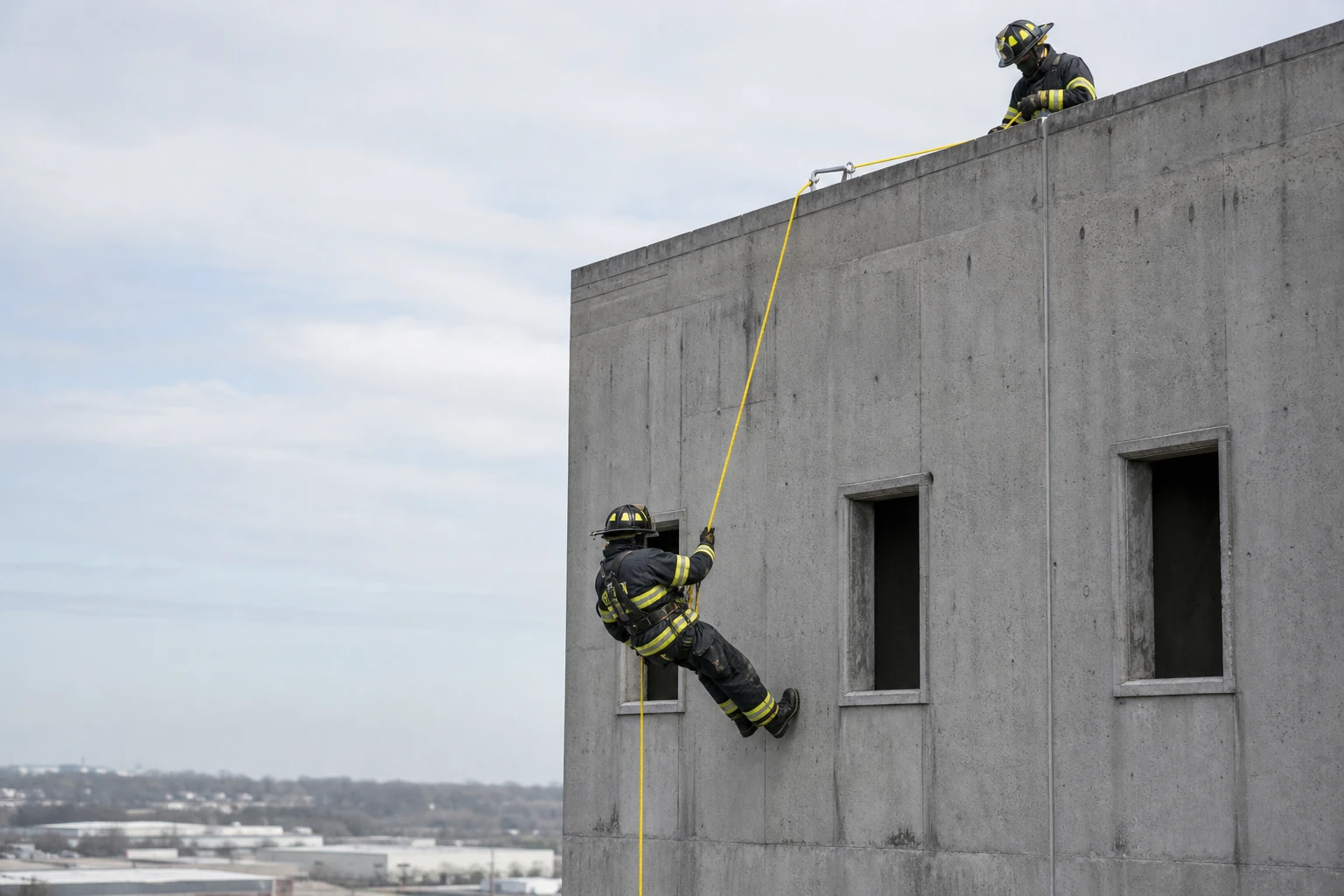
Our fire escape ropes are supplied to fire departments, building-safety contractors, industrial plants and distributors worldwide. Aikace-aikace na yau da kullun sun haɗa da:
- Fire escape and emergency evacuation from high-rise buildings and towers
- Firefighting operations, search and rescue, and roof or above-fire-floor work
- Window cleaning and façade access where a heat- or abrasion-resistant line is required
- Industrial height rescue and confined-space recovery
- Utility and power-line work, cable pulling and insulated guide ropes
- Arborist work, rigging and general static rigging lines
- Marine, dock and outdoor rescue training
- Fixed escape-route ropes with steel wire core for public buildings and schools
Keɓancewa da sabis na OEM
As a manufacturer, we build to your specification rather than to a fixed catalogue. Tell us the working load, the operating temperature, the environment and the hardware you already use, kuma za mu ba da shawarar diamita daidai, core type and sheath material. Abubuwan gama gari sun haɗa da:
- Diameter and length — 6–20 mm, any cut length, plus metre markings woven or printed on the sheath
- Launi da alama - rawaya aminci, lemu, ja, fari, black or custom Pantone; printed or woven logo and part number
- Ƙarshen ƙarewa — spliced eye with stainless steel thimble, ido-da-ido, bulala ya ƙare, or a fitted carabiner
- Marufi — poly bag, polyester carry bag, rope bag, or retail carton with your own label and barcode
- Na'urorin haɗi — rope bags, descenders, figure-eight devices, anchors and escape kits supplied as a complete set
Kula da inganci
Every production batch is checked on diameter, madaidaicin yawa, sheath tightness and splice integrity, and sampled for breaking strength. We have supplied lifting and safety rope products to industrial and public-safety customers for close to three decades, kuma muna kiyaye tsari a bayyane: on request we provide the material certificate, the test report for the delivered batch, and a sample before volume production begins.
Tambayoyin da ake yawan yi
What is a fire rescue rope used for?
A fire rescue rope is a low-stretch safety rope used for emergency escape from buildings, firefighting operations, high-rise evacuation and technical rescue. It is designed to hold a person or a load under controlled descent and to resist heat, abrasion and cutting.
What diameter fire escape rope do I need?
Most escape and rescue work uses 10 mm ku 12 mm igiya: 10–11 mm is comfortable in the hand and works with standard descenders, while 12 mm gives a higher breaking strength and better grip. Sauƙaƙe 8 mm rope suits personal escape kits where weight and packed volume matter most.
Is the rope flame retardant or heat resistant?
Both options are available. The standard polyester sheath resists brief contact with flame and has a melting point around 255 °C. For continuous or repeated high-temperature exposure choose the aramid version, which tolerates far higher temperatures.
Can you supply a steel wire core fire rope?
Ee. A galvanised steel wire core can be added inside the kernmantle construction. It adds cut resistance and anti-theft protection, which is why it is commonly specified for fixed escape routes in public buildings, schools and dormitories.
What lengths and end fittings can you make?
Standard lengths are 10 m, 20 m, 30 m, 50 m kuma 100 m, and any custom cut length is possible. Ends can be plain, whipped, spliced into an eye with a stainless steel thimble, ido-da-ido, or supplied with a screw-lock carabiner already fitted.
Do you provide test reports and OEM branding?
Ee. We supply material certificates and batch test reports on request, kuma muna ba da cikakken sabis na OEM - diamita na al'ada, tsayi, launi, sheath material, bugu logo da kiri marufi.
Request a Quote for Fire Rescue Rope
Send us the diameter, tsayi, core type, working load and the standard that applies in your market. Ƙungiyarmu za ta dawo da ƙayyadaddun bayanai, jadawalin samfurin da farashin masana'anta kai tsaye.