

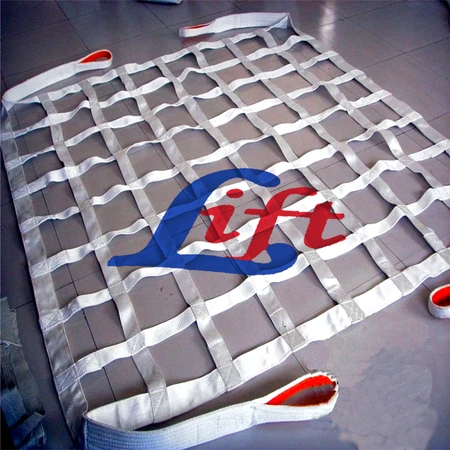
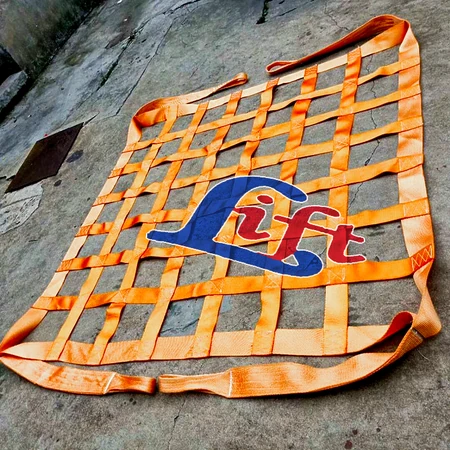
Lift sling rigging company produce Nylon Flat Webbing Net,Flat webbing cargo net,Safety Cargo Lifting Net Straps, Flat Nylon Sling Hoisting Net,Nylon flat belt hanging net,Kaya amintaccen gidan yanar gizo,Madaidaicin Safety Daga Net,Nylon Flat Webbing Lifting Net.
Nylon Flat Webbing Net
Open flat lattice · 0.5 t - 10 t · 25–100 mm high-tenacity webbing · printable band
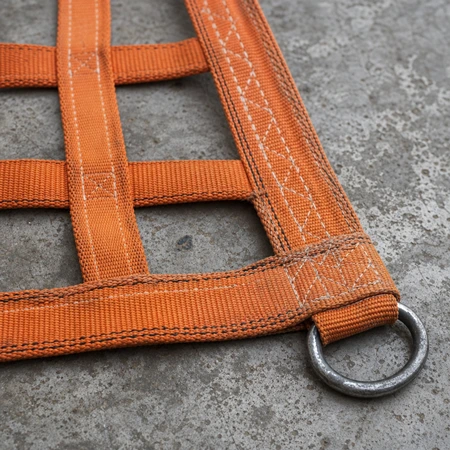
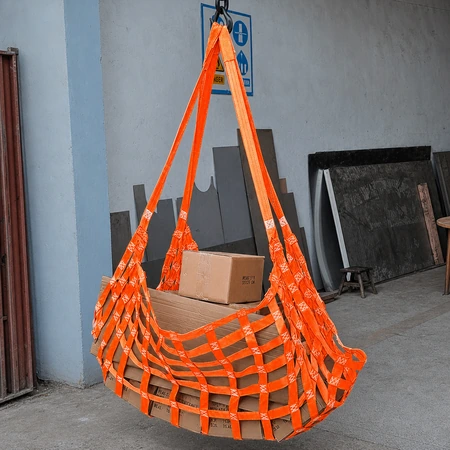
A nailan flat webbing net is an open lifting lattice, not a bag. High-tenacity webbing bands cross at right angles into a square mesh, a folded double-stitched border runs round the perimeter, and four reinforced corner loops are what the crane lifts from. The load sits inside the mesh and is carried as one unit, with the weight spread across the full width of every band underneath instead of a few contact points.
Kamfanin Lift Sling Rigging ya saƙa bandeji, dinke gidan yanar gizo kuma yana gwada kowane daya a Taizhou, Jiangsu. Faɗin bandeji yana gudana daga 25 mm ku 100 mm, raga daga 50 mm ku 300 mm, rated capacity from 0.5 t zuwa 10 t, and net size, corner loops and printing are made to your drawing. Because the band is flat, iyakar nauyin aiki, net size and your own brand can be printed straight onto it — identification that cannot be pulled off or washed away.
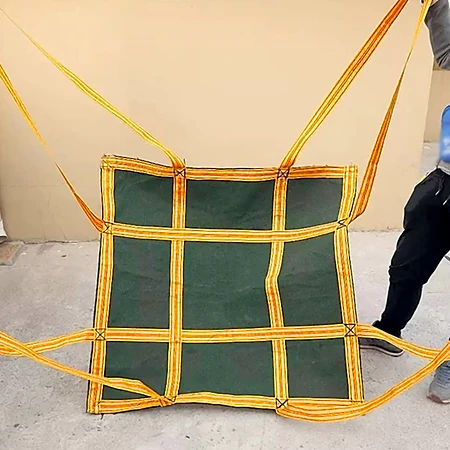
- Three flat webbing materials — nylon for shock loads, high-strength polyester for the lowest stretch, polypropylene for wet and chemical duty.
- Non-marking, wide-face contact — the flat band lies against painted, plated, bagged and boxed cargo without denting or scuffing it.
- Printable identification — WLL, girman net, raga, fleet number and own brand printed along the band, plus a sewn capacity label.
- Built to your size — 25–100 mm band, 50–300 mm mesh, maki hudu ko takwas dagawa, square or diamond lattice.
- Certified and tested — CE, GS and JIS certified, ISO 9001 aiki, and every net breaking-load tested on our own 1000 t mashin.
Flat lattice, not a bag — what that changes
The difference between this net and a net sling is the bottom. A flat webbing net is an open lattice: the load sits on top of it and the net is lifted from four corner loops, so the mesh stays flat under the cargo. There is no closed pocket, no lifting legs gathering at a master ring, and nothing wraps the load. That is why it suits palletised, boxed and stacked cargo that already holds its own shape, and why it is quicker to load: the net is laid out, the load is set down on it, and the four loops go on the hook.
Where the cargo is loose, rounded or likely to shift, a closed-bottom net sling is the better tool — it contains rubble, scrap and bagged material without strapping. For pallet footprints, the purpose-built crane pallet kaya net uses the same flat lattice with a tighter mesh and a pallet-sized border.
Because the lattice is open, the net weighs very little for the area it covers: a 2.5 × 2.5 m net in 50 mm band is light enough for one person to lay out, fold and carry, while still carrying several tonnes across its bands. That combination — wide soft bearing face, low weight, fast rigging — is what makes flat webbing the default construction in ports, warehouses and steel service centres.
Siffofin fasaha
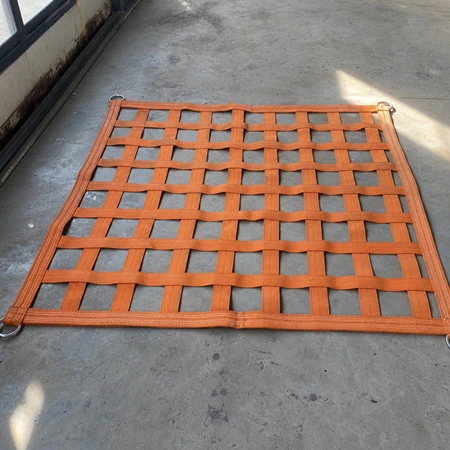
The table covers the standard nylon flat webbing net. Fadin bandeji, Layer ƙidaya, raga, girman net, wuraren ɗagawa da bugu duk an yi su don yin oda, so treat it as the starting point for a quotation rather than a fixed catalogue.
| Siga | Ƙayyadaddun bayanai |
|---|---|
| Nau'in samfur | Bude lattice mai lebur (babu rufaffiyar kasa), four or eight corner lifting points |
| Kayan bandeji | 100 % nailan mai ƙarfi (PA); polyester mai ƙarfi (PET) ko polypropylene (PP) akan bukata |
| Fadin bandeji | 25 mm / 30 mm / 50 mm / 75 mm / 100 mm |
| Band kauri | 1.5 mm - 3.2 mm dangane da faɗin |
| Band Layer | Layer guda ɗaya; duplex (Layer biyu) for abrasion resistance |
| Bude raga | 50 - 300 mm; 100 × 100 mm misali |
| Tsarin raga | Dandalin (misali) ko lu'u-lu'u akan buƙata |
| Girman gidan yanar gizo | 1.0 × 1.0 m zuwa 4.0 × 4.0 m misali; 2.5 × 6 m and made to drawing |
| Iyaka | Folded band, double-stitched along the full perimeter |
| Abubuwan ɗagawa | Four reinforced corner loops standard; takwas don katako mai shimfidawa |
| Corner fitting | Dinka madauki na yanar gizo, reinforced loop with pad, or master link on request |
| Ƙarfin ƙima | 0.5 t - 10 t; raga masu nauyi da aka gina don yin oda |
| Safety factor | 5:1 / 6:1 / 7:1 |
| Tsawaitawa a lokacin hutu | Game da 12 % - 20 % (nailan); 7 % ko žasa a aikin lodi (polyester) |
| Surface | Mai laushi, m, rashin yin alama |
| Launi | Farin halitta, lemu, blue, kore, baki ko al'ada |
| Bugawa | WLL, girman net, raga, fleet number and own brand printed along the band; sewn label as standard |
| Yanayin aiki | -40 °C zuwa +80 °C nailan; -40 °C zuwa +100 ° C polyester |
| Daidaitaccen tushe | Ƙididdigar yanar gizo zuwa EN 1492-1 |
| Takaddun shaida | CE / GS / HE; ISO 9001; CNAS dakin gwaje-gwaje; DNV |
| HS code | 630790 - ɗaga raga na kayan yadi |
Net sizes and working load limits
Net size is always quoted as length × width measured along the border, never as the mesh area. The load has to sit well inside the border: a net the same size as the load will let the cargo slide out at the edges. Every size below is also made to drawing.
| Girman gidan yanar gizo (L × W) | Bude raga | Fadin bandeji | Matsakaicin iya aiki | Amfani na yau da kullun |
|---|---|---|---|---|
| 1.0 × 1.0 m | 100 mm | 25 / 30 mm | 0.5 t - 1 t | Small components, ganguna, pallets guda ɗaya |
| 1.2 × 1.2 m | 100 mm | 50 mm | 1 t - 3 t | Standard pallet footprint, injin sassa |
| 2.0 × 2.0 m | 100 mm | 50 mm | 2 t - 5 t | Kaya mai jaka, kartani, toshe |
| 2.5 × 2.5 m | 100 - 150 mm | 50 mm | 2 t - 5 t | Kaya mai palletis da jaka, kwantena lodi |
| 2.5 × 6.0 m | 150 mm | 50 / 75 mm | 4 t - 10 t | Dogon kaya, bututun bututu, truck loading |
| 4.0 × 4.0 m | 150 - 200 mm | 75 / 100 mm | 8 t - 10 t+ | Large pallets, bulk bagged cargo |
| An yi shi don yin zane | 50 - 300 mm | 25 - 100 mm | 0.5 t - 10 t | Babban gadon mota, ganga, riƙe da girman girman |
Where the load is long or wide, the net is lifted from a beam rather than a single hook: da dagawa shimfidawa katako takes the eight corner loops, keeps the net square and keeps the cargo level.
Nailan, polyester ko polypropylene
All three nets are built identically — same lattice, same folded border, same corner loops. What changes is the polymer in the band, and that decides the strength, the stretch and the environment the net survives. Nylon is the material this page is named after; the other two are stocked because they answer jobs nylon does not.
| Dukiya | Nailan (PA) | Polyester (PET) | Polypropylene (PP) |
|---|---|---|---|
| Ƙarfin nauyi | Babban | Babban | Mafi ƙasƙanci |
| Tsawaitawa a lokacin hutu | 12 - 20 %, absorbs shock | Ƙananan, 7 % ko kadan a WLL | 15 - 20 % |
| UV / outdoor life | Yayi kyau | Mafi kyawun guda uku | Needs UV stabiliser |
| Ruwa da rube | Rust-free, slow to dry | Rust-free, quick to dry | Yawo, absorbs under 0.1 % |
| Juriya na sinadaran | Matsakaici | Yayi kyau | Best against acids and alkalis |
| Abrasion | Toughest of the three | Yayi kyau sosai, duplex standard | Matsakaici |
| Matsakaicin iya aiki | 0.5 t - 10 t | 1 t - 10 t | 0.3 t - 5 t |
| Mafi kyau ga | Shock loads, m handling, printed white bands | Most lifting duty; outdoor and long service | Wet quays, wash-down, sunadarai, floating duty |
A aikace: nylon where the load shifts as it is lifted, or where the marking has to print cleanly on a light band; polyester for the lowest stretch and the longest outdoor life; polypropylene where the net works wet, may go over the side, or meets acids and alkalis. The polyester construction is described in more detail on the gidan yanar gizo mai ɗaukar kaya kuma polyester webbing net don dagawa shafuka.
Band, mesh and edge options
Two nets of the same size and capacity can behave quite differently depending on band width, layer count and how the edge is finished. These are the options quoted most often.
| Zabin | Abin da yake yi | Zaba shi lokacin |
|---|---|---|
| 25 / 30 mm band | Lightest net per square metre | Small nets, nauyi nauyi, handling weight matters most |
| 50 mm band | The standard lifting band | Most palletised and bagged cargo; best balance of strength, nauyi da farashi |
| 75 / 100 mm band | Fewer, wider bands carry the load | Heavy or abrasive cargo, large bearing area needed |
| Layer guda ɗaya | Thinner, mai sauƙi, cheaper band | Hasken wajibi, clean and dry handling |
| Duplex (Layer biyu) | Two layers stitched as one band | Dragging across pallets or concrete; high-wear duty |
| Folded border | Border band turned over and stitched | Every net — stops the edge band unrolling |
| Reinforced corner | Extra stitching and doubled band at each corner | Every net; corners carry the whole load |
| Square mesh | Bands run parallel to the net edges | Stacked, palletised and rectangular loads |
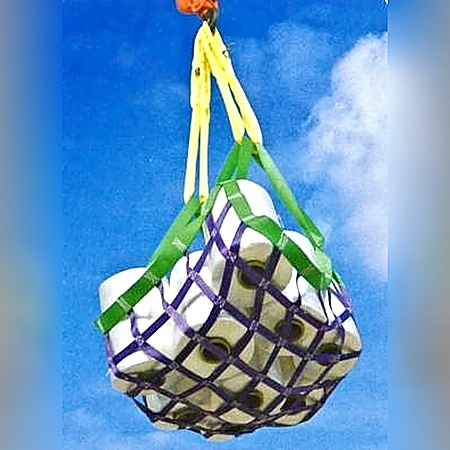
| Diamond mesh | Lattice rotated 45° so the bands close on the load | Loose or rounded loads that need containing |
| PU shafi | Coating stiffens the mesh and resists abrasion | High-abrasion duty, or where the net must hold shape when empty |
Corner loops and lifting configurations
How the net is hung decides how much of the load it actually carries. These are the four arrangements built most often.
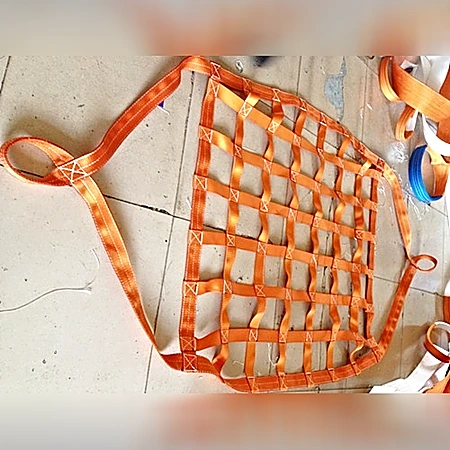
- Four-loop lift — the standard. The four corner loops are gathered onto a single hook or master ring and the load hangs in the middle of the net.
- Eight-point spreader lift. The net is lifted from eight loops on a beam: the net stays square, the load stays level and each corner carries a predictable share.
- Basket or bag form. The net is closed around the load and picked from one point for loose or awkward cargo — see the polyester dagawa hoisting net.
- Lashing or securing duty. Tensioned over or across a load rather than lifted from four corners — a different duty with a different rating, quoted separately from the lifting net.
| Daidaitawa | Amfani da | Lura |
|---|---|---|
| Dinka madauki na yanar gizo | Flat webbing nets, ƙugiya ɗaya | Daidaitawa; stitched through the border with a doubled band |
| Reinforced loop with pad | Heavy and abrasive cargo | Extra webbing protects the loop where it meets the hook |
| Jagora mahada / zoben master | Hawan madaukai hudu | Gathers all four loops onto one point under the hook |
| Shackle ko ƙugiya | Eight-point spreader lift | Daraja 80 kayan aiki da aka kawo tare da katako akan buƙata |
| Hannun kariya | Any sharp-edged load | Zamewa kan bandeji a wurin tuntuɓar; cheapest way to extend net life |
Bugawa, marking and OEM
Flat webbing has one advantage the rope nets do not: the identification can be printed directly onto the band, where it cannot be pulled off, washed away or lost. That is the reason most of our net orders are printed rather than labelled.
- Iyakar nauyin aiki, net size and mesh opening printed along the band on every net.
- Fleet numbers, inspection dates, contract numbers or a certificate number printed for operators and rental fleets.
- Own brand, address and warning text printed for OEM and distributor orders.
- A sewn capacity label is fitted as standard in addition to the print, so the net and the paperwork always match.
- Natural white nylon takes print most cleanly; lemu, blue, green and black bands are also available.
- Nets ship folded in a bag or a crate — a set of six 2.5 m nets takes the space of one pallet.
Kula da inganci da takaddun shaida
Weaving the band ourselves is what makes a made-to-order net practical: fadi, Layer, launi, mesh and printing are all set inside our own plant, so the net is tuned to the load instead of assembled from whatever band a supplier happens to stock.
- 40 shekaru na dagawa kayan aiki masana'antu - kafa a 1985 in Taizhou, Jiangsu, fiye da 200 ma'aikata, daya daga cikin mafi girma daga kasar Sin ta daga majajjawa da net samar sansanonin.
- Own weaving mill — the same looms supply our webbing majajjawa kuma zagaye majajjawa mara iyaka.
- Own testing laboratory with CNAS accreditation, plus CE and DNV certification of the facilities.
- 1000 t horizontal test machine — the breaking load of every net is tested and documented, kuma rahoton gwajin kayan yana tafiya tare da tsari.
- CE da GS ƙwararrun samfuran ɗagawa, tare da takaddun shaida na JIS akan odar fitarwa.
- Every net is marked with its rated capacity, band width and mesh before packing.
Where flat webbing nets are used
| Industry | Abin da net ke ɗagawa | Why flat webbing suits it |
|---|---|---|
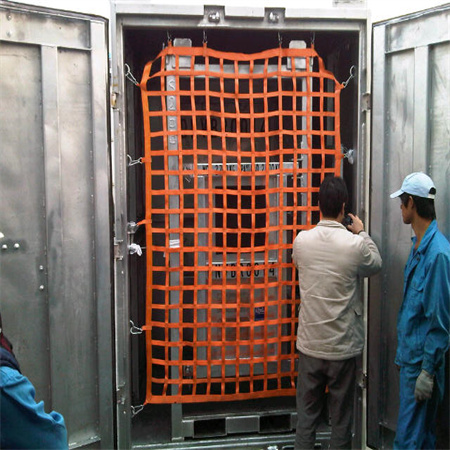
| Tashoshi da tashoshi | Bagged and palletised cargo, container stuffing | Soft enough to pull around cargo inside a container |
| Steel service centres | Fakitin faranti, fakitin takarda, machined parts | Non-marking; wide band spreads load over the pack face |
| Gina | Tubali, tubalan, bagged materials, formwork | Holds small units in the mesh without strapping each one |
| Manufacturing and assembly | Fentin, plated and finished components | No marking, no edge damage on finished surfaces |
| Warehousing and distribution | Pallets, kartani, mixed loads | Fast four-loop lift; folds away when not in use |
| Agriculture | Jakunkuna masu yawa, ciyarwa, kera | Duplex band takes the wear of repeated pallet handling |
| Marine and offshore | Deck cargo and transfer loads | Rust-free and quiet on a moving deck |
| Soja da agajin bala'i | Palletised relief cargo by crane or helicopter | Printable identification and a net that folds into a bag |
For the wire rope construction used on hot, sharp and abrasive bulk, duba da net ɗin daga kaya; for the round-rope version of this lattice, da nailan kaya daga net. The raw band itself is described under igiyoyin nailan and the wider range under ragamar ɗaga kaya.
How to specify your net
A lifting net is made to order, and eight pieces of information are enough to quote it correctly the first time. Idan kana da zanen gadon motar, ganga ko rike ya dace, aika da cewa maimakon - muna aiki daga zane akai-akai.
| Bayanan da muke bukata | Me ya sa yake da mahimmanci |
|---|---|
| Load nauyi da siffar kaya | Sets the rated capacity and how many load-bearing bands sit under the load |
| Tsawon gidan waya × nisa | The net must be larger than the load footprint so the load sits inside the mesh |
| Bude raga | Yana riƙe kayan a ciki; a smaller mesh is needed for small or loose pieces |
| Band width and layer | Sets the strength, the wear life and the weight of the net |
| Kayan abu | Nailan, high-strength polyester or polypropylene |
| Abubuwan ɗagawa | madaukai na kusurwa huɗu a matsayin ma'auni, or eight for a spreader beam |
| Crane, ƙugiya ko shimfidawa | Determines the ring or shackle fitted to the corner loops |
| Environment and documents | UV, ruwan gishiri, sunadarai, zafin jiki; Alamar CE, rahoton gwaji, own-brand printing |
Tambayoyin da ake yawan yi
What is a nylon flat webbing net made of?
Flat high-tenacity webbing — nylon as standard, with polyester and polypropylene available — woven into an open square lattice, finished with a folded double-stitched border and four reinforced corner loops. Ƙungiyar, not the lattice, is what separates it from a rope net.
How is it different from a net sling?
Kasa. A net sling is a bag with a closed bottom and lifting legs that gather at a master ring, so it contains loose material. A flat webbing net is an open lattice lifted from four corner loops, so it suits cargo that holds its own shape and is quicker to load.
Wane iko za ku iya bayarwa?
Daga 0.5 t zuwa 10 t in nylon, 1 t zuwa 10 t in polyester and 0.3 t zuwa 5 t in polypropylene, set by band width, layer count and mesh. A 2.5 × 2.5 m net in 50 mm band covers most palletised and bagged duty; larger nets and heavier bands are built to order.
Can the net carry our own brand?
Yes — this is the main reason to choose a flat band. Iyakar nauyin aiki, girman net, raga, lambar jiragen ruwa, your brand or a certificate number can be printed along the band, where it cannot be pulled off or washed away. Colour and packing are configurable as well.
Wane girman raga nake buƙata?
Size the mesh from the smallest item in the load, taba daga jimlar nauyi. A 100 mm buɗewa yana riƙe da jakunkuna, kwalaye, bricks and small components; 150 mm ku 200 mm suits larger block and bundles. Send us the smallest piece and we will size the mesh to it.
Will it mark painted or plated cargo?
A'a. The flat band lies against the load instead of biting into it, and the load is shared across the full width of every band underneath, haka marufi, fenti, plating and machined faces come through the lift unmarked — which is the difference from wire rope and chain.
Ta yaya aka tabbatar da iya aiki?
Nets are supplied at 5:1, 6:1 ko 7:1 as specified, with the webbing rated on the EN 1492-1 tushe. The breaking load of every net is tested on our own 1000 t inji da rahoton gwajin kayan yana tafiya tare da tsari; the facilities hold CNAS, CE da DNV takardar shaida.
Can it be used for lashing rather than lifting?
A net tensioned across a load is a securing net, rated differently from a lifting net. Tell us at quotation stage which duty it is for — the tensioned version is the cargo securing net, and the two are not interchangeable.
Nemi zance
Aika nauyin nauyin da siffar, girman net, bude raga, the band width and the material you have in mind — or a drawing of the truck bed, ganga ko rike ya dace. Our engineers confirm the band, the layer count, da rated iya aiki, the printing and the packing, kuma ka faɗi amsa ɗaya. Don yin magana ta farko, tuntuɓi injiniyoyinmu.
Kamfanin Lift Sling Rigging - Lifute Industrial Park, Birnin Taizou, Lardin Jiangsu, China
Tel: +86 523 8693 5818 | WhatsApp: +86 180 6600 2268 | Imel: lift98@jslift.com