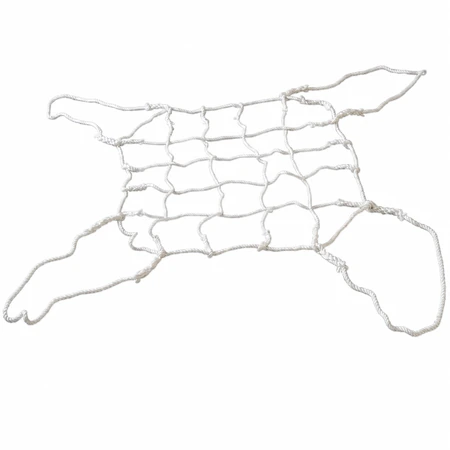
Rukunin samfuran

Polyester Lifting Hoisting Net

Takaitaccen Bayani:

Kamfanin Lift sling rigging yana samar da Polyester Lifting Hoisting Net,Polyester Cargo Net,Madaidaicin Safety Daga Net,Bungee Cargo Net,Polyester Cargo Lifting Net,Dagawa Sling Net,Igiya Daga Net,Pallet Cargo Net,Lambun Hawan Lambu.

Polyester Lifting Hoisting Net

A polyester lifting hoisting net is a soft bag woven from high-tenacity polyester webbing, built to move bagged goods and bulk material in a single crane lift. The load is tipped into the bag, or the bag is laid flat and drawn up around a stack, and four corner loops carry the whole consignment to the hook. There is no pallet to return, no strapping to cut, and nothing to re-handle at the far end.

Because we weave the webbing in our own mill in Taizhou, Jiangsu, bude raga, bag footprint, zurfin, bottom construction and working load limit are all set to the cargo rather than to a fixed catalogue. Standard nets cover 0.5 t zuwa 20 t kuma 0.6 m³ zuwa sama 10 m³, every net is proof-load tested before packing, and each shipment travels with a material test report. Nets are CE and GS certified, with webbing rated to the EN 1492-1 tushe.

  • Fully custom build – raga, girman jaka, zurfin, colour and safety factor (5:1, 6:1 ko 7:1) set to your specification.
  • High-tenacity polyester webbing – 25 mm ku 100 mm band, guda ɗaya, duplex or triplex, UV yana daidaitawa kuma mai jujjuyawa.
  • Wear and heat resistant – working range -40 °C ku +100 °C, with a reinforced bottom for abrasive loads.
  • Mai laushi, m da haske – the flat band contacts the load over a wide area, so bags, cartons and finished surfaces are neither crushed nor marked.
  • CE da GS sun tabbatar – gwada da kanmu 1000 t mashin, with an ISO 9001 quality system and a CNAS-accredited laboratory behind it.
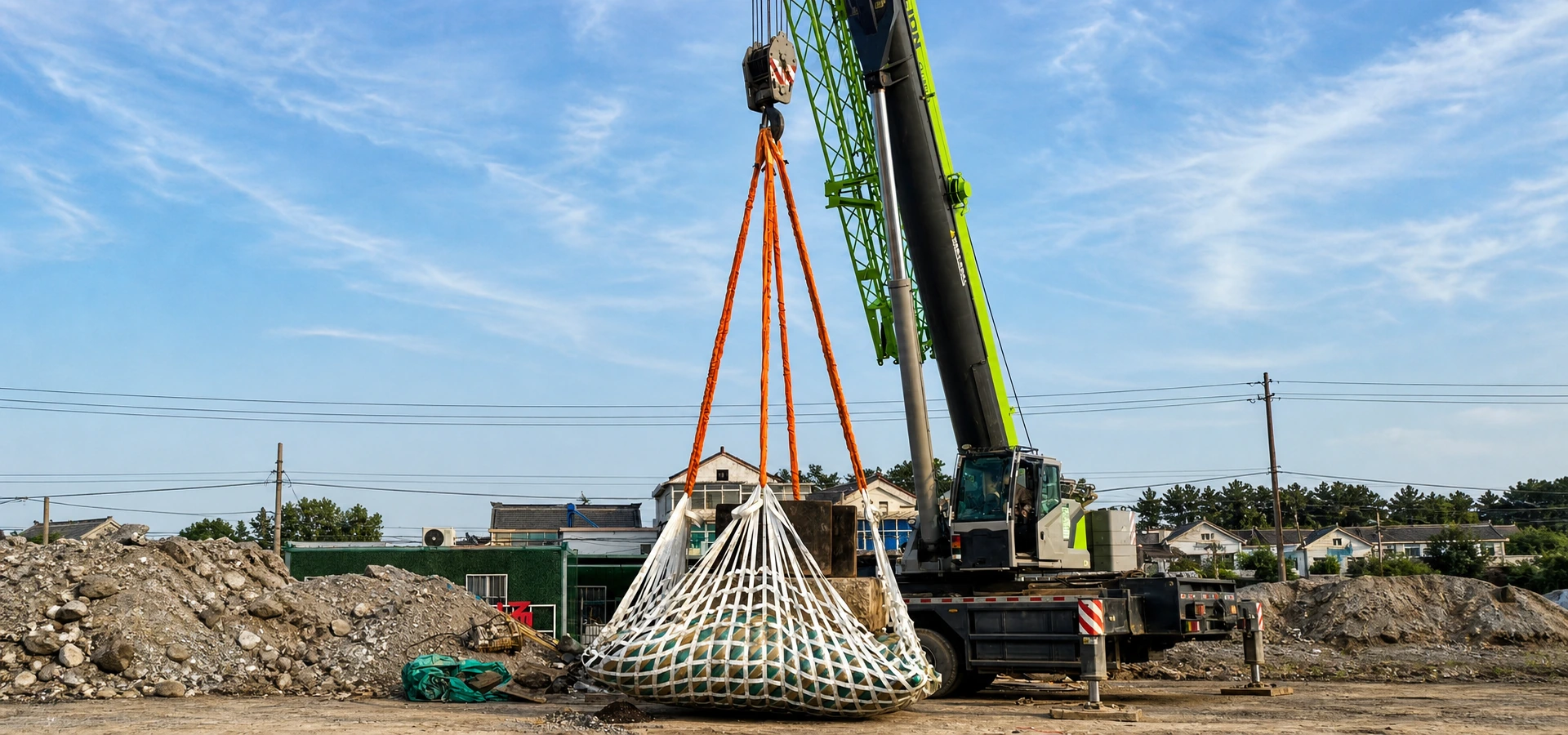
Polyester lifting hoisting net under a mobile crane carrying broken stone
A polyester lifting hoisting net in bulk service – the bag is filled with broken stone and lifted from its four loops by a mobile crane.

Why a webbing net bag, and not a rope net or a big bag

Three products are sold for the same job and they behave very differently once the load is in the air. A rope net concentrates the load on a few contact points. A big bag carries one free-flowing product and is itself the package. A webbing net bag spreads the pressure across flat bands, holds a stacked or mixed load together, and goes back to the store empty.

Tebur 1 – How the four common ways of lifting loose cargo compare.

Zabin Gina Tuntuɓi tare da kaya Best cargo Limitation
Polyester webbing net bag Flat woven bands, 25-100 mm, 25-300 mm raga Wide flat bands, low pressure per cm² Jaka, tari, mixed and bulk cargo Needs a crane or hook; not a sealed package for powder
Nylon rope net Knotted or braided rope, 8-24 mm Line contact at every rope Irregular and heavy single items Ropes mark soft cargo; a tight mesh adds weight
FIBC / big bag Woven PP fabric with a liner Full surface, sealed One free-flowing product per bag Single product only; the bag is the packaging
Pallet and strapping Timber or plastic pallet plus bands Rigid base Unitised cartons Pallet returned or lost; bands cut and discarded; no drainage
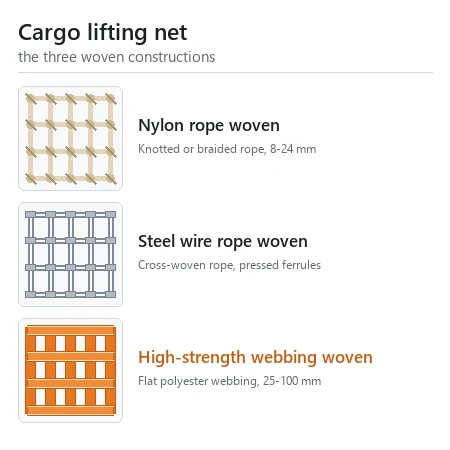
Diagram comparing nylon rope, steel wire rope and polyester webbing net constructions
Three woven constructions for cargo nets: igiya nailan, steel wire rope and high-strength polyester webbing.

Five decisions that set the specification

A polyester lifting hoisting net is quoted from five numbers. Get them right and the net arrives right; get the mesh wrong and no amount of extra tonnage will fix it later.

Tebur 2 – What we need to know, and why each answer changes the net.

Yanke shawara Abin da yake gyarawa What to tell us
1. Cargo form Whether the net is a bag or a flat sheet, and how the bottom is built How the cargo arrives: buhuna, manyan jaka, bales, or loose material
2. Weight per lift Band width and layer count, and therefore the rated capacity Babban nauyin da kuke son ɗauka, not the weight of the net
3. Cikakkun girma Footprint and depth of the bag Yawan yawa (t/m³) for loose material, or the height of the stack for bagged goods
4. Bude raga The largest gap the cargo can pass through The smallest unit in the load: a 25 kg bag, hatsi, aggregate or scrap
5. Hanyar fitarwa An rufe, laced, yanke ko layi na kasa Whether the bag is tipped, untied over a hopper, or emptied by hand

Weight and volume are two separate limits, and for light bulk the volume arrives first. hatsi a game da 0.7 t/m³ da guntun itace a kusan 0.3 t/m³ duka sun cika a 3.6 m³ bag, but one lift weighs about 2.5 t and the other about 1 t. Send the bulk density with the tonnage and we will size the bag so that a full bag is also a legal bag.
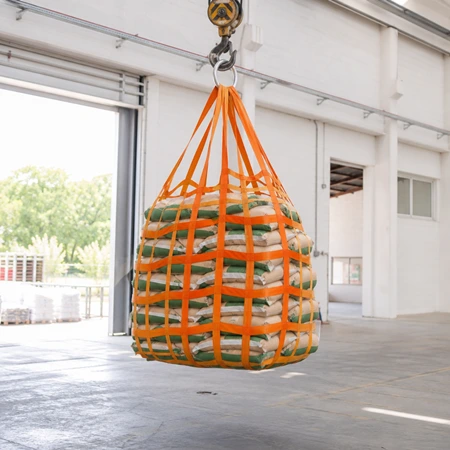
Polyester net bag lifting stacked 25 kg sacks in one crane lift
Bagged cargo in a polyester net bag – a stack of 25 kg sacks is closed in by the mesh and lifted as a single load.

Siffofin fasaha

Hotunan da ke ƙasa sun rufe daidaitattun jaka da kewayon yawa. raga, footprint, zurfin, bottom, loops and capacity are made to order, so treat this as the starting point for a quotation rather than a fixed catalogue.

Tebur 3 – Polyester lifting hoisting net: sigogi na fasaha.

Siga Ƙayyadaddun bayanai
Sunan samfur Polyester lifting hoisting net (polyester webbing net bag)
Tsarin tsari Closed bag, release-bottom bag, or flat lifting net
Kayan yanar gizo 100 % polyester mai ƙarfi (PET); nailan mai ƙarfi akan buƙata
Fadin bandeji 25 / 38 / 50 / 75 / 100 mm (50 mm misali)
Band construction Layer guda ɗaya, duplex or triplex; sakar kai, ba yankan gefe ba
Band kauri 1.8 mm – 4.5 mm dangane da faɗi da ƙidaya Layer
Bude raga 100 × 100 mm misali; 25 – 300 mm sanya don yin oda
Girman gidan yanar gizo Anyi zuwa sawun kaya, truck bed or receiving hopper; see Table 4
Zurfin jaka 0.8 m – 2.5 m, ko don yin zane
Cikakkun girma Game da 0.6 m³ zuwa sama 10 m³, set by footprint and depth
Iyaka Ninke kuma mai dinke biyu, reinforced at every lifting point
Abubuwan ɗagawa Madaidaitan madaukai na kusurwa huɗu; takwas don katako mai shimfidawa; madaukai sama da ƙasa akan buƙata
Ƙarfin ƙima (WLL) 0.5 t – 20 t, saita ta band, Layer count da kuma dagawa tsari
Safety factor 5:1 / 6:1 / 7:1
Canje-canje a cikin WLL 7 % ko ƙasa da haka
Launi Colour code by working load limit, ko kalar gidan al'ada
Yanayin aiki -40 °C ku +100 °C
Weather and chemical UV ya daidaita, rot-proof, unaffected by rain, sea water and wash-down
Alama WLL, mesh and batch printed on the belt, plus a sewn capacity label
Daidaitaccen tushe Ƙididdigar yanar gizo zuwa EN 1492-1
Takaddun shaida CE, GS, ISO 9001, JIS akan buƙata; CNAS dakin gwaje-gwaje; DNV
Keɓancewa OEM / Girman ODM, launi, bugu tambari, lakabi da shiryawa
HS code 6307.90 – gidajen sauro da tarukan kayan yadi

Adadin masu girma dabam, volumes and working load limits

These six lines cover the great majority of bagged and bulk work. Filled volume is calculated from the footprint and the depth with an allowance for the rounded shape a loaded bag takes, so a material that settles well will carry slightly more and one that bridges will carry less.

Tebur 4 – Standard net sizes at four corner loops gathered on one hook.

Girman gidan yanar gizo (L × W) Depth Cikakkun girma raga Band WLL Kaya na al'ada
1.0 × 1.0 m 1.0 m 0.6 m³ 50-100 mm 50 mm guda 0.5-1.5 t 25 kg jaka, kananan buhuna, bales
1.5 × 1.5 m 1.2 m 1.6 m³ 50-100 mm 50 mm duplex 1-2.5 t Jakar hatsi, taki, kera
2.0 × 2.0 m 1.5 m 3.6 m³ 50-100 mm 50 mm duplex 2-4 t Girman hatsi, yashi, nikakken dutse
2.5 × 2.5 m 1.8 m 6.8 m³ 50-150 mm 75 mm duplex 3-6 t Yawan taki, gawayi, guntu, kifi
3.0 × 3.0 m 2.0 m 10.8 m³ 100-150 mm 75 mm duplex 4-8 t Manyan kaya masu yawa, yi aiki da sauri
To drawing 0.8-2.5 m Don yin oda 25-300 mm 25-100 mm 0.5-20 t Duk wani sawun ƙafa, zurfin da kaya

The working load limits above assume a four-loop lift. A two-loop basket de-rates the net – ask for the derated figure rather than reading across from this table.

Bude raga, chosen from the cargo

Mesh is the one dimension that cannot be adjusted after the net is sewn, so it is sized from the smallest unit in the load rather than from the total weight.

Tebur 5 – Mesh opening by cargo.

Kaya Nasihar raga Reason
50 kg buhu, manyan jaka, bales 100 mm The sacks are far larger than the opening; the mesh only has to keep the stack together
25 kg jaka, kananan buhuna 50-75 mm Small bags can squeeze through 100 mm once the load settles in the air
hatsi, iri, busasshen amfanin gona 25-50 mm, ko rufaffiyar layi Fine material must not sift out on the hook or in transit
Taki, prills, foda 25-50 mm, ko rufaffiyar layi Fine and moisture-sensitive: a liner keeps the product in and the weather out
Yashi, tsakuwa, nikakken dutse 50-100 mm Yayi kyau don riƙe da yawa, open enough for rainwater to drain
Kwal, koke 100-150 mm Large lumps; raga mai fadi yana kiyaye hasken gidan yanar gizon kuma yana magudana da kyau
Ƙarfe mai yatsa, kashe-kashe 100-150 mm Open mesh with a reinforced bottom and wear pads at the contact points
Kifi, kifi kifi, rigar samar 25-50 mm Holds the catch, drains freely, keeps the weight honest
Logs, itacen wuta, manyan kashe-kashe 150-300 mm Indivisible pieces: a wide mesh saves weight without losing the load
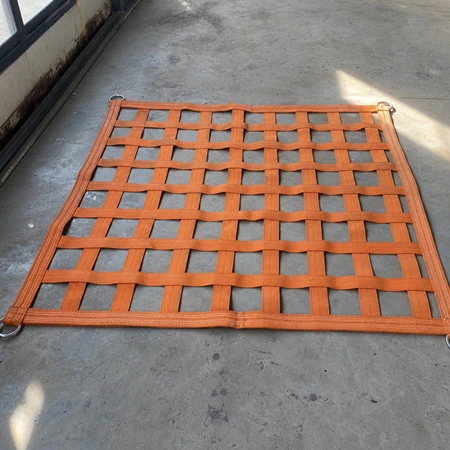
Orange polyester webbing lifting net laid flat with steel corner rings
A square polyester webbing net laid out flat: 100 mm raga, 50 mm band, reinforced border and a steel ring at each corner.

Bottom construction and discharge

How the load comes out is a design decision in its own right. For bagged cargo the answer is usually a person with a knife; for bulk it is usually gravity.

Tebur 6 – Bottom options and how each one is emptied.

Kasa Yadda yake aiki Chosen when
An rufe, cikakken dinki The bag holds the cargo permanently and is emptied by tipping or by hand Kaya mai jaka, and bulk tipped over a hopper or onto a pile
Release bottom, laced An kwance lased ɗin ɗinki a saman ƙasa a wurin fitarwa kuma lodin ya faɗi Free-flowing bulk – yashi, hatsi, tara – discharged without tipping the bag
Kasa kasa The bag narrows to a chute opened over the receiving hopper Controlled discharge into a hopper, jirgin ruwa ko abin hawa
Closed with a liner Rigar masana'anta tana zaune a cikin gidan yanar gizo Dusty or moisture-sensitive bulk: hatsi, taki, foda
Ƙarfafa panel na ƙasa An extra layer of webbing is stitched across the base Abrasive and heavy bulk: tara, ore, guntu
Loops top and bottom Loops at both ends, so the bag can be lifted either way up Loading at height, da komai ta hanyar juyar da jakar a ƙugiya

Lifting arrangements and fittings

Yadda aka rataye jakar yana ƙayyade adadin nauyin da gaske yake ɗauka, kuma girma ba ya gafartawa saboda nauyin yana ci gaba da tafiya a cikin jakar yayin da yake cikin iska.

  • Four loops on the hook – the standard for bagged and bulk work; the loops gather on the hook or a master ring and the bag closes around the cargo as the crane takes up the slack.
  • Eight loops on a spreader beam – the bag stays square, kaya yana tsayawa matakin, kuma kowane madauki yana ɗaukar rabon da ake iya faɗi; the right arrangement for large bags and high tonnage, ga mu dagawa shimfidawa katako iyaka.
  • Two-loop basket – faster to rig, amma yana lalata net ɗin; ask for the derated capacity instead of reading across from the four-loop figure.
  • Loops top and bottom – lets the bag be lifted either way up, wanda shine yadda ake zubar da jakar da aka rufe ta hanyar jujjuya ta a kan hopper.

Fittings supplied or fitted on request: sewn webbing loops, master ring or master link, daraja 80 dauri, laced release bottoms, chutes and discharge sleeves, inner liners, wear pads and protection sleeves for scrap and aggregate, and repair kits for fleets that maintain their own equipment.

Kayan abu, stitching and finish

The belt is the product. We weave it on needle looms from high-tenacity polyester yarn, with a woven selvedge rather than a cut edge, so the band does not fray from the outside in.

  • 100 % polyester mai ƙarfi, low elongation (7 % ko kadan a WLL), UV ya daidaita, rot-proof and unaffected by moisture.
  • Locked stitching in high-tenacity polyester thread, run in multiple rows along the border and box-X at every loop – on a cheap net it is the stitch line, ba bel ba, that fails first.
  • Ninkewa da iyaka mai dinki biyu, so the edge of the mesh cannot unravel under load.
  • Galvanised or stainless steel rings and master links on request.
  • Polyester holds its strength from -40 °C ku +100 °C; above that, or in chemical exposure, tell us and we will quote nylon or another construction.
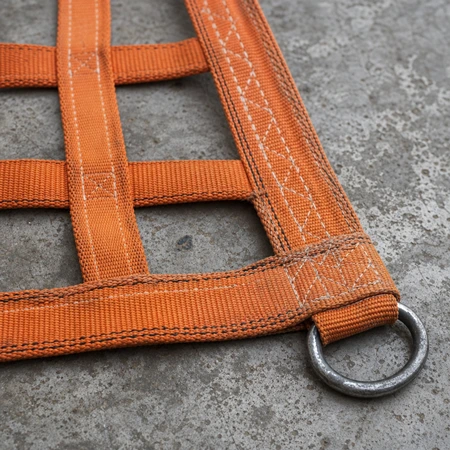
Close-up of webbing net border stitching and a galvanised D-ring
Border stitching and a galvanised D-ring at the corner – the two places a webbing net bag is most often overloaded.

Gwaji, takaddun shaida da ganowa

  • Shekaru arba'in na dagawa kayan aiki masana'antu – kafa a 1985 in Taizhou, Jiangsu, tare da fiye da 200 employees and one of China’s largest lifting sling and net production bases.
  • Every net is proof-load tested on our own 1000 t injin gwajin kwance – gwada, not sampled.
  • A material test report travels with each shipment, quoting the belt batch and the test load.
  • Bayanin CE na daidaituwa da takaddun shaida na GS, tare da takaddun shaida na JIS akan odar fitarwa.
  • ISO 9001 quality management system, a CNAS-accredited laboratory and DNV certification behind the plant.
  • Every net is marked with its working load limit, raga, rated volume and batch number before packing, don haka jaka da takaddunta koyaushe suna yarda.

Certificates and test reports are available as PDFs for your tender or customs file – ga cikakken takardar shaida saita.

Where these nets work

A polyester lifting hoisting net is used wherever loose cargo has to travel between a stack and a hook – quay, niƙa, quarry, yard or hold. The sectors below are the ones where the bagged and bulk version earns its place.

Tebur 7 – Aikace-aikace ta bangare.

Bangaren Abin da net ɗin ke ɗauka Me yasa gidan yanar gizon polyester ya dace da shi
Tashoshi, quays da tashoshi Kaya mai jaka, hatsi, fertilizer and bulk between quay, barge and hold Jaka ɗaya a kowace ɗagawa, babu pallet, kuma kaya yana malala yayin tafiya
Noma da masana'antar abinci iri, hatsi, ciyarwa, taki da kayan jaka Ƙunƙarar raga ko layin layi yana kiyaye samfurin a ciki kuma yanayin waje
Kayan gini Yashi, tsakuwa, nikakken dutse da buhun siminti Yayi kyau don riƙe da yawa, open enough for rainwater to drain
Hako ma'adinai da fasa dutse Tari, tama da ma'adinai yawa Ƙaƙƙarfan ƙasa yana ɗaukar abrasion wanda ke sa gidan yanar gizo
Kamun kifi da sarrafa abinci Jikakken kifi, shellfish da samar Bude magudanan raga kyauta, which keeps the weight honest
Sake amfani da sharar gida Robobi maras kyau, gilashin, karfe da kayan hade Contains loose material that would otherwise blow or fall
Biomass and power Gilashin katako, haushi, pellets da yawan mai Babban jaka don matsakaicin ton, daidai da iyakar ƙara
Construction sites and relief work Bagged materials raised to upper floors, field cargo No pallet, babu bandeji, kuma ana iya zubar dashi kai tsaye a kasa
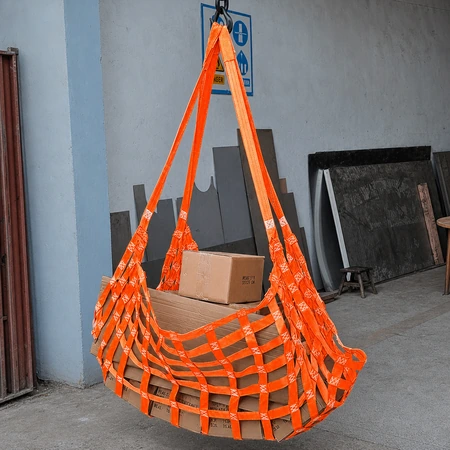
Orange webbing net bag lifting a carton with soft wide bands
Mixed cargo on site: a net bag takes a carton as readily as a stack of sacks, and the flat webbing spreads the load rather than cutting into it.

Customisation and branding

A net that moves between quays, holds and yards has to be identifiable from a distance and has to keep its marking. Launi, bugu tambari, working load limit and cargo type are all applied in our own plant, so the marking cannot be washed off or pulled away with a label.

  • Colour code by working load limit, or a custom house colour to separate your fleet from a competitor’s.
  • Logo, brand name, rubutun gargadi ko lambar takardar shaida da aka buga akan bel, or woven in on larger orders.
  • Cargo type printed on the bag, which stops a fine-mesh grain net being sent out for scrap.
  • Sewn capacity label in addition to the print, so the net and its paperwork agree at every inspection.
  • Packing folded into a bag or a crate – a set of ten net bags takes the space of one pallet.
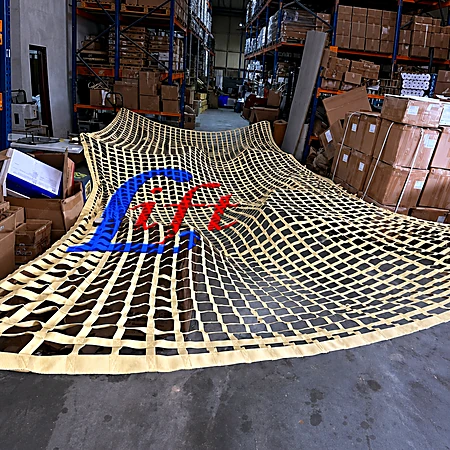
Polyester webbing cargo net printed with a customer logo in a warehouse
Buyer branding applied at the mill: the customer mark is printed directly on the webbing bands, not on a tag.
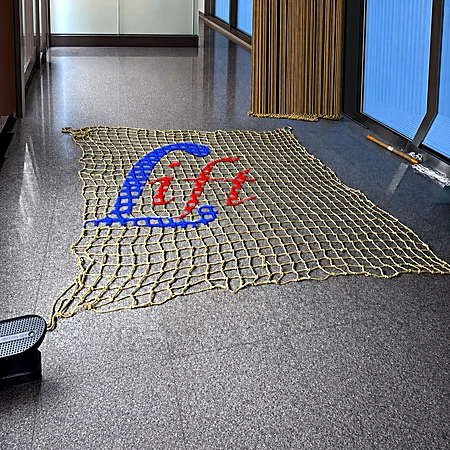
Beige polyester webbing net with printed logo laid out for inspection
Final inspection before packing – launi, bugu tambari, mesh and working load limit are checked on the finished net.

Kulawa, dubawa da ritaya

  • Inspect the loops and their stitching first, sai iyaka, then the bottom closure – on a bulk net the bottom and the corners wear before the mesh does.
  • Cire jakar gaba daya kafin ajiya; material left inside holds moisture, yana ƙara nauyi kuma yana ɓoye lalacewa.
  • Nemo yanke, abrasion, karya dinki, sinadarai tabo, zafi glazing da launi ko kyalkyali canza cewa sigina lalacewa UV.
  • Weigh a wet bag before lifting it. Ruwan sama, sea water and wet bulk can add far more than the cargo was rated at, kuma net bai san bambanci ba.
  • Kar a taɓa wuce ƙarfin ƙididdigewa, kar a taɓa ɗaga ƙasa da cikakken saitin madaukai, kuma kar a taɓa ja jakar da aka ɗora a gefe tare da crane.
  • Ajiye tsabta kuma bushe, kashe kasa kuma daga rana kai tsaye; never repair webbing by knotting, walda ko dumama shi.

Tambayoyin da ake yawan yi

What is the difference between a polyester lifting hoisting net and a cargo net?

A lifting net is rated, marked and tested to carry a load on a crane hook. A cargo net is a restraint: it holds a load down in transit and is not designed to be lifted. If the net is going onto a hook, it must be the rated version – ga mu kayan aiki net for the tie-down case.

How do I choose the mesh opening?

From the smallest unit in the load, ba daga tonnage ba. A 25 kg bag needs 50-75 mm; grain or fertilizer needs 25-50 mm or a closed liner; scrap and coal can take 100-150 mm. Once the net is sewn the mesh cannot be changed, so this is the one number worth checking twice.

Why does the volume matter as much as the weight?

Domin babban nauyi yana cika jakar kafin ya kai nauyin da aka kimanta. A bag that is full at half its rating doubles the number of lifts and the crane time. Give us the bulk density with the tonnage and we will size the bag so a full bag is also a legal bag.

Za a iya zubar da jakar ba tare da tipping ta ba?

Ee. A laced release bottom or a chute bottom lets a free-flowing load be discharged straight into a hopper, jirgin ruwa ko abin hawa. Bagged cargo is normally emptied by hand or with a forklift at the far end.

Gidan yanar gizon zai rike rigar kaya?

The net itself is unaffected – polyester does not absorb water and does not rot, so rain, sea water and wash-down do no harm. Hankali biyu: wet cargo is heavier, and fine wet material can clog the mesh, wanda ke kara nauyi kuma yana dakatar da shi.

How is the working load limit proved?

The webbing is rated to the EN 1492-1 basis and nets are supplied at 5:1, 6:1 ko 7:1 as specified. Every net is proof-load tested on our own 1000 t mashin, a material test report travels with the order, kuma samfuran suna ɗaukar takaddun CE da GS.

Do you make a flat version for palletised cargo?

Ee – the flat lifting net is the crane pallet kaya net, and the material-led range is covered by the polyester webbing net don dagawa. The rope constructions sit alongside as the nailan kaya daga net da kuma majajjawa mai nauyi na nailan kaya.

What else do you make from the same webbing?

The same belt goes into our webbing majajjawa kuma zagaye majajjawa mara iyaka, and the wider cargo range is listed under ragamar ɗaga kaya – including the gidan yanar gizo mai ɗaukar kaya for flat work.

Nemi zance

Send the cargo and whether it is bagged or bulk, yawan yawa idan kun san shi, nauyin da kuke so kowace dagawa, bude raga, the discharge method and the environment the net will work in – or a sketch of the bag you have in mind. Injiniyoyin mu za su tabbatar da girman gidan yanar gizon, zurfin, kasa gini, band and packing and quote it in one reply. Don yin magana ta farko, tuntuɓi injiniyoyinmu.

Kamfanin Lift Sling Rigging – Lifute Industrial Park, Birnin Taizou, Lardin Jiangsu, China
Tel: +86 523 8693 5818 | WhatsApp: +86 180 6600 2268 | Imel: lift98@jslift.com

Cikakken Bayani

Kamfanin Lift sling rigging yana samar da Polyester Lifting Hoisting Net,Polyester Cargo Net,Madaidaicin Safety Daga Net,Bungee Cargo Net,Polyester Cargo Lifting Net,Dagawa Sling Net,Igiya Daga Net,Pallet Cargo Net,Lambun Hawan Lambu.

Polyester Lifting Hoisting Net

A polyester lifting hoisting net is a soft bag woven from high-tenacity polyester webbing, built to move bagged goods and bulk material in a single crane lift. The load is tipped into the bag, or the bag is laid flat and drawn up around a stack, and four corner loops carry the whole consignment to the hook. There is no pallet to return, no strapping to cut, and nothing to re-handle at the far end.

Because we weave the webbing in our own mill in Taizhou, Jiangsu, bude raga, bag footprint, zurfin, bottom construction and working load limit are all set to the cargo rather than to a fixed catalogue. Standard nets cover 0.5 t zuwa 20 t kuma 0.6 m³ zuwa sama 10 m³, every net is proof-load tested before packing, and each shipment travels with a material test report. Nets are CE and GS certified, with webbing rated to the EN 1492-1 tushe.

  • Fully custom build – raga, girman jaka, zurfin, colour and safety factor (5:1, 6:1 ko 7:1) set to your specification.
  • High-tenacity polyester webbing – 25 mm ku 100 mm band, guda ɗaya, duplex or triplex, UV yana daidaitawa kuma mai jujjuyawa.
  • Wear and heat resistant – working range -40 °C ku +100 °C, with a reinforced bottom for abrasive loads.
  • Mai laushi, m da haske – the flat band contacts the load over a wide area, so bags, cartons and finished surfaces are neither crushed nor marked.
  • CE da GS sun tabbatar – gwada da kanmu 1000 t mashin, with an ISO 9001 quality system and a CNAS-accredited laboratory behind it.
Polyester lifting hoisting net under a mobile crane carrying broken stone
A polyester lifting hoisting net in bulk service – the bag is filled with broken stone and lifted from its four loops by a mobile crane.

Why a webbing net bag, and not a rope net or a big bag

Three products are sold for the same job and they behave very differently once the load is in the air. A rope net concentrates the load on a few contact points. A big bag carries one free-flowing product and is itself the package. A webbing net bag spreads the pressure across flat bands, holds a stacked or mixed load together, and goes back to the store empty.

Tebur 1 – How the four common ways of lifting loose cargo compare.

Zabin Gina Tuntuɓi tare da kaya Best cargo Limitation
Polyester webbing net bag Flat woven bands, 25-100 mm, 25-300 mm raga Wide flat bands, low pressure per cm² Jaka, tari, mixed and bulk cargo Needs a crane or hook; not a sealed package for powder
Nylon rope net Knotted or braided rope, 8-24 mm Line contact at every rope Irregular and heavy single items Ropes mark soft cargo; a tight mesh adds weight
FIBC / big bag Woven PP fabric with a liner Full surface, sealed One free-flowing product per bag Single product only; the bag is the packaging
Pallet and strapping Timber or plastic pallet plus bands Rigid base Unitised cartons Pallet returned or lost; bands cut and discarded; no drainage
Diagram comparing nylon rope, steel wire rope and polyester webbing net constructions
Three woven constructions for cargo nets: igiya nailan, steel wire rope and high-strength polyester webbing.

Five decisions that set the specification

A polyester lifting hoisting net is quoted from five numbers. Get them right and the net arrives right; get the mesh wrong and no amount of extra tonnage will fix it later.

Tebur 2 – What we need to know, and why each answer changes the net.

Yanke shawara Abin da yake gyarawa What to tell us
1. Cargo form Whether the net is a bag or a flat sheet, and how the bottom is built How the cargo arrives: buhuna, manyan jaka, bales, or loose material
2. Weight per lift Band width and layer count, and therefore the rated capacity Babban nauyin da kuke son ɗauka, not the weight of the net
3. Cikakkun girma Footprint and depth of the bag Yawan yawa (t/m³) for loose material, or the height of the stack for bagged goods
4. Bude raga The largest gap the cargo can pass through The smallest unit in the load: a 25 kg bag, hatsi, aggregate or scrap
5. Hanyar fitarwa An rufe, laced, yanke ko layi na kasa Whether the bag is tipped, untied over a hopper, or emptied by hand

Weight and volume are two separate limits, and for light bulk the volume arrives first. hatsi a game da 0.7 t/m³ da guntun itace a kusan 0.3 t/m³ duka sun cika a 3.6 m³ bag, but one lift weighs about 2.5 t and the other about 1 t. Send the bulk density with the tonnage and we will size the bag so that a full bag is also a legal bag.

Polyester net bag lifting stacked 25 kg sacks in one crane lift
Bagged cargo in a polyester net bag – a stack of 25 kg sacks is closed in by the mesh and lifted as a single load.

Siffofin fasaha

Hotunan da ke ƙasa sun rufe daidaitattun jaka da kewayon yawa. raga, footprint, zurfin, bottom, loops and capacity are made to order, so treat this as the starting point for a quotation rather than a fixed catalogue.

Tebur 3 – Polyester lifting hoisting net: sigogi na fasaha.

Siga Ƙayyadaddun bayanai
Sunan samfur Polyester lifting hoisting net (polyester webbing net bag)
Tsarin tsari Closed bag, release-bottom bag, or flat lifting net
Kayan yanar gizo 100 % polyester mai ƙarfi (PET); nailan mai ƙarfi akan buƙata
Fadin bandeji 25 / 38 / 50 / 75 / 100 mm (50 mm misali)
Band construction Layer guda ɗaya, duplex or triplex; sakar kai, ba yankan gefe ba
Band kauri 1.8 mm – 4.5 mm dangane da faɗi da ƙidaya Layer
Bude raga 100 × 100 mm misali; 25 – 300 mm sanya don yin oda
Girman gidan yanar gizo Anyi zuwa sawun kaya, truck bed or receiving hopper; see Table 4
Zurfin jaka 0.8 m – 2.5 m, ko don yin zane
Cikakkun girma Game da 0.6 m³ zuwa sama 10 m³, set by footprint and depth
Iyaka Ninke kuma mai dinke biyu, reinforced at every lifting point
Abubuwan ɗagawa Madaidaitan madaukai na kusurwa huɗu; takwas don katako mai shimfidawa; madaukai sama da ƙasa akan buƙata
Ƙarfin ƙima (WLL) 0.5 t – 20 t, saita ta band, Layer count da kuma dagawa tsari
Safety factor 5:1 / 6:1 / 7:1
Canje-canje a cikin WLL 7 % ko ƙasa da haka
Launi Colour code by working load limit, ko kalar gidan al'ada
Yanayin aiki -40 °C ku +100 °C
Weather and chemical UV ya daidaita, rot-proof, unaffected by rain, sea water and wash-down
Alama WLL, mesh and batch printed on the belt, plus a sewn capacity label
Daidaitaccen tushe Ƙididdigar yanar gizo zuwa EN 1492-1
Takaddun shaida CE, GS, ISO 9001, JIS akan buƙata; CNAS dakin gwaje-gwaje; DNV
Keɓancewa OEM / Girman ODM, launi, bugu tambari, lakabi da shiryawa
HS code 6307.90 – gidajen sauro da tarukan kayan yadi

Adadin masu girma dabam, volumes and working load limits

These six lines cover the great majority of bagged and bulk work. Filled volume is calculated from the footprint and the depth with an allowance for the rounded shape a loaded bag takes, so a material that settles well will carry slightly more and one that bridges will carry less.

Tebur 4 – Standard net sizes at four corner loops gathered on one hook.

Girman gidan yanar gizo (L × W) Depth Cikakkun girma raga Band WLL Kaya na al'ada
1.0 × 1.0 m 1.0 m 0.6 m³ 50-100 mm 50 mm guda 0.5-1.5 t 25 kg jaka, kananan buhuna, bales
1.5 × 1.5 m 1.2 m 1.6 m³ 50-100 mm 50 mm duplex 1-2.5 t Jakar hatsi, taki, kera
2.0 × 2.0 m 1.5 m 3.6 m³ 50-100 mm 50 mm duplex 2-4 t Girman hatsi, yashi, nikakken dutse
2.5 × 2.5 m 1.8 m 6.8 m³ 50-150 mm 75 mm duplex 3-6 t Yawan taki, gawayi, guntu, kifi
3.0 × 3.0 m 2.0 m 10.8 m³ 100-150 mm 75 mm duplex 4-8 t Manyan kaya masu yawa, yi aiki da sauri
To drawing 0.8-2.5 m Don yin oda 25-300 mm 25-100 mm 0.5-20 t Duk wani sawun ƙafa, zurfin da kaya

The working load limits above assume a four-loop lift. A two-loop basket de-rates the net – ask for the derated figure rather than reading across from this table.

Bude raga, chosen from the cargo

Mesh is the one dimension that cannot be adjusted after the net is sewn, so it is sized from the smallest unit in the load rather than from the total weight.

Tebur 5 – Mesh opening by cargo.

Kaya Nasihar raga Reason
50 kg buhu, manyan jaka, bales 100 mm The sacks are far larger than the opening; the mesh only has to keep the stack together
25 kg jaka, kananan buhuna 50-75 mm Small bags can squeeze through 100 mm once the load settles in the air
hatsi, iri, busasshen amfanin gona 25-50 mm, ko rufaffiyar layi Fine material must not sift out on the hook or in transit
Taki, prills, foda 25-50 mm, ko rufaffiyar layi Fine and moisture-sensitive: a liner keeps the product in and the weather out
Yashi, tsakuwa, nikakken dutse 50-100 mm Yayi kyau don riƙe da yawa, open enough for rainwater to drain
Kwal, koke 100-150 mm Large lumps; raga mai fadi yana kiyaye hasken gidan yanar gizon kuma yana magudana da kyau
Ƙarfe mai yatsa, kashe-kashe 100-150 mm Open mesh with a reinforced bottom and wear pads at the contact points
Kifi, kifi kifi, rigar samar 25-50 mm Holds the catch, drains freely, keeps the weight honest
Logs, itacen wuta, manyan kashe-kashe 150-300 mm Indivisible pieces: a wide mesh saves weight without losing the load
Orange polyester webbing lifting net laid flat with steel corner rings
A square polyester webbing net laid out flat: 100 mm raga, 50 mm band, reinforced border and a steel ring at each corner.

Bottom construction and discharge

How the load comes out is a design decision in its own right. For bagged cargo the answer is usually a person with a knife; for bulk it is usually gravity.

Tebur 6 – Bottom options and how each one is emptied.

Kasa Yadda yake aiki Chosen when
An rufe, cikakken dinki The bag holds the cargo permanently and is emptied by tipping or by hand Kaya mai jaka, and bulk tipped over a hopper or onto a pile
Release bottom, laced An kwance lased ɗin ɗinki a saman ƙasa a wurin fitarwa kuma lodin ya faɗi Free-flowing bulk – yashi, hatsi, tara – discharged without tipping the bag
Kasa kasa The bag narrows to a chute opened over the receiving hopper Controlled discharge into a hopper, jirgin ruwa ko abin hawa
Closed with a liner Rigar masana'anta tana zaune a cikin gidan yanar gizo Dusty or moisture-sensitive bulk: hatsi, taki, foda
Ƙarfafa panel na ƙasa An extra layer of webbing is stitched across the base Abrasive and heavy bulk: tara, ore, guntu
Loops top and bottom Loops at both ends, so the bag can be lifted either way up Loading at height, da komai ta hanyar juyar da jakar a ƙugiya

Lifting arrangements and fittings

Yadda aka rataye jakar yana ƙayyade adadin nauyin da gaske yake ɗauka, kuma girma ba ya gafartawa saboda nauyin yana ci gaba da tafiya a cikin jakar yayin da yake cikin iska.

  • Four loops on the hook – the standard for bagged and bulk work; the loops gather on the hook or a master ring and the bag closes around the cargo as the crane takes up the slack.
  • Eight loops on a spreader beam – the bag stays square, kaya yana tsayawa matakin, kuma kowane madauki yana ɗaukar rabon da ake iya faɗi; the right arrangement for large bags and high tonnage, ga mu dagawa shimfidawa katako iyaka.
  • Two-loop basket – faster to rig, amma yana lalata net ɗin; ask for the derated capacity instead of reading across from the four-loop figure.
  • Loops top and bottom – lets the bag be lifted either way up, wanda shine yadda ake zubar da jakar da aka rufe ta hanyar jujjuya ta a kan hopper.

Fittings supplied or fitted on request: sewn webbing loops, master ring or master link, daraja 80 dauri, laced release bottoms, chutes and discharge sleeves, inner liners, wear pads and protection sleeves for scrap and aggregate, and repair kits for fleets that maintain their own equipment.

Kayan abu, stitching and finish

The belt is the product. We weave it on needle looms from high-tenacity polyester yarn, with a woven selvedge rather than a cut edge, so the band does not fray from the outside in.

  • 100 % polyester mai ƙarfi, low elongation (7 % ko kadan a WLL), UV ya daidaita, rot-proof and unaffected by moisture.
  • Locked stitching in high-tenacity polyester thread, run in multiple rows along the border and box-X at every loop – on a cheap net it is the stitch line, ba bel ba, that fails first.
  • Ninkewa da iyaka mai dinki biyu, so the edge of the mesh cannot unravel under load.
  • Galvanised or stainless steel rings and master links on request.
  • Polyester holds its strength from -40 °C ku +100 °C; above that, or in chemical exposure, tell us and we will quote nylon or another construction.
Close-up of webbing net border stitching and a galvanised D-ring
Border stitching and a galvanised D-ring at the corner – the two places a webbing net bag is most often overloaded.

Gwaji, takaddun shaida da ganowa

  • Shekaru arba'in na dagawa kayan aiki masana'antu – kafa a 1985 in Taizhou, Jiangsu, tare da fiye da 200 employees and one of China’s largest lifting sling and net production bases.
  • Every net is proof-load tested on our own 1000 t injin gwajin kwance – gwada, not sampled.
  • A material test report travels with each shipment, quoting the belt batch and the test load.
  • Bayanin CE na daidaituwa da takaddun shaida na GS, tare da takaddun shaida na JIS akan odar fitarwa.
  • ISO 9001 quality management system, a CNAS-accredited laboratory and DNV certification behind the plant.
  • Every net is marked with its working load limit, raga, rated volume and batch number before packing, don haka jaka da takaddunta koyaushe suna yarda.

Certificates and test reports are available as PDFs for your tender or customs file – ga cikakken takardar shaida saita.

Where these nets work

A polyester lifting hoisting net is used wherever loose cargo has to travel between a stack and a hook – quay, niƙa, quarry, yard or hold. The sectors below are the ones where the bagged and bulk version earns its place.

Tebur 7 – Aikace-aikace ta bangare.

Bangaren Abin da net ɗin ke ɗauka Me yasa gidan yanar gizon polyester ya dace da shi
Tashoshi, quays da tashoshi Kaya mai jaka, hatsi, fertilizer and bulk between quay, barge and hold Jaka ɗaya a kowace ɗagawa, babu pallet, kuma kaya yana malala yayin tafiya
Noma da masana'antar abinci iri, hatsi, ciyarwa, taki da kayan jaka Ƙunƙarar raga ko layin layi yana kiyaye samfurin a ciki kuma yanayin waje
Kayan gini Yashi, tsakuwa, nikakken dutse da buhun siminti Yayi kyau don riƙe da yawa, open enough for rainwater to drain
Hako ma'adinai da fasa dutse Tari, tama da ma'adinai yawa Ƙaƙƙarfan ƙasa yana ɗaukar abrasion wanda ke sa gidan yanar gizo
Kamun kifi da sarrafa abinci Jikakken kifi, shellfish da samar Bude magudanan raga kyauta, which keeps the weight honest
Sake amfani da sharar gida Robobi maras kyau, gilashin, karfe da kayan hade Contains loose material that would otherwise blow or fall
Biomass and power Gilashin katako, haushi, pellets da yawan mai Babban jaka don matsakaicin ton, daidai da iyakar ƙara
Construction sites and relief work Bagged materials raised to upper floors, field cargo No pallet, babu bandeji, kuma ana iya zubar dashi kai tsaye a kasa
Orange webbing net bag lifting a carton with soft wide bands
Mixed cargo on site: a net bag takes a carton as readily as a stack of sacks, and the flat webbing spreads the load rather than cutting into it.

Customisation and branding

A net that moves between quays, holds and yards has to be identifiable from a distance and has to keep its marking. Launi, bugu tambari, working load limit and cargo type are all applied in our own plant, so the marking cannot be washed off or pulled away with a label.

  • Colour code by working load limit, or a custom house colour to separate your fleet from a competitor’s.
  • Logo, brand name, rubutun gargadi ko lambar takardar shaida da aka buga akan bel, or woven in on larger orders.
  • Cargo type printed on the bag, which stops a fine-mesh grain net being sent out for scrap.
  • Sewn capacity label in addition to the print, so the net and its paperwork agree at every inspection.
  • Packing folded into a bag or a crate – a set of ten net bags takes the space of one pallet.
Polyester webbing cargo net printed with a customer logo in a warehouse
Buyer branding applied at the mill: the customer mark is printed directly on the webbing bands, not on a tag.
Beige polyester webbing net with printed logo laid out for inspection
Final inspection before packing – launi, bugu tambari, mesh and working load limit are checked on the finished net.

Kulawa, dubawa da ritaya

  • Inspect the loops and their stitching first, sai iyaka, then the bottom closure – on a bulk net the bottom and the corners wear before the mesh does.
  • Cire jakar gaba daya kafin ajiya; material left inside holds moisture, yana ƙara nauyi kuma yana ɓoye lalacewa.
  • Nemo yanke, abrasion, karya dinki, sinadarai tabo, zafi glazing da launi ko kyalkyali canza cewa sigina lalacewa UV.
  • Weigh a wet bag before lifting it. Ruwan sama, sea water and wet bulk can add far more than the cargo was rated at, kuma net bai san bambanci ba.
  • Kar a taɓa wuce ƙarfin ƙididdigewa, kar a taɓa ɗaga ƙasa da cikakken saitin madaukai, kuma kar a taɓa ja jakar da aka ɗora a gefe tare da crane.
  • Ajiye tsabta kuma bushe, kashe kasa kuma daga rana kai tsaye; never repair webbing by knotting, walda ko dumama shi.

Tambayoyin da ake yawan yi

What is the difference between a polyester lifting hoisting net and a cargo net?

A lifting net is rated, marked and tested to carry a load on a crane hook. A cargo net is a restraint: it holds a load down in transit and is not designed to be lifted. If the net is going onto a hook, it must be the rated version – ga mu kayan aiki net for the tie-down case.

How do I choose the mesh opening?

From the smallest unit in the load, ba daga tonnage ba. A 25 kg bag needs 50-75 mm; grain or fertilizer needs 25-50 mm or a closed liner; scrap and coal can take 100-150 mm. Once the net is sewn the mesh cannot be changed, so this is the one number worth checking twice.

Why does the volume matter as much as the weight?

Domin babban nauyi yana cika jakar kafin ya kai nauyin da aka kimanta. A bag that is full at half its rating doubles the number of lifts and the crane time. Give us the bulk density with the tonnage and we will size the bag so a full bag is also a legal bag.

Za a iya zubar da jakar ba tare da tipping ta ba?

Ee. A laced release bottom or a chute bottom lets a free-flowing load be discharged straight into a hopper, jirgin ruwa ko abin hawa. Bagged cargo is normally emptied by hand or with a forklift at the far end.

Gidan yanar gizon zai rike rigar kaya?

The net itself is unaffected – polyester does not absorb water and does not rot, so rain, sea water and wash-down do no harm. Hankali biyu: wet cargo is heavier, and fine wet material can clog the mesh, wanda ke kara nauyi kuma yana dakatar da shi.

How is the working load limit proved?

The webbing is rated to the EN 1492-1 basis and nets are supplied at 5:1, 6:1 ko 7:1 as specified. Every net is proof-load tested on our own 1000 t mashin, a material test report travels with the order, kuma samfuran suna ɗaukar takaddun CE da GS.

Do you make a flat version for palletised cargo?

Ee – the flat lifting net is the crane pallet kaya net, and the material-led range is covered by the polyester webbing net don dagawa. The rope constructions sit alongside as the nailan kaya daga net da kuma majajjawa mai nauyi na nailan kaya.

What else do you make from the same webbing?

The same belt goes into our webbing majajjawa kuma zagaye majajjawa mara iyaka, and the wider cargo range is listed under ragamar ɗaga kaya – including the gidan yanar gizo mai ɗaukar kaya for flat work.

Nemi zance

Send the cargo and whether it is bagged or bulk, yawan yawa idan kun san shi, nauyin da kuke so kowace dagawa, bude raga, the discharge method and the environment the net will work in – or a sketch of the bag you have in mind. Injiniyoyin mu za su tabbatar da girman gidan yanar gizon, zurfin, kasa gini, band and packing and quote it in one reply. Don yin magana ta farko, tuntuɓi injiniyoyinmu.

Kamfanin Lift Sling Rigging – Lifute Industrial Park, Birnin Taizou, Lardin Jiangsu, China
Tel: +86 523 8693 5818 | WhatsApp: +86 180 6600 2268 | Imel: lift98@jslift.com

Bar Saƙonku

Gungura zuwa Sama