

Awọn ẹka Awọn ọja
A ona kan sling is a lifting sling bought for a single journey. It is used together with the rest of the lifting set — the hook, tan ina, the shackles and the slings it works beside — and it is not recovered afterwards: o lọ pẹlu ẹru si ibi-ajo ati pe a kọ silẹ lodi si iṣẹ naa. The phrase describes the journey and the commercial decision, not a lower grade of article; a one-way sling is made and marked as a rated sling like any other.
This category collects the forms that are bought this way: the flat band with formed eyes, the closed ring, the ring-and-buckle strap, and the versions made for pipe, panel and timber work. So fun wa eru, bi o ti wa ni aba ti, and the arrangement you will use, and we will confirm the form, the length and the marking.
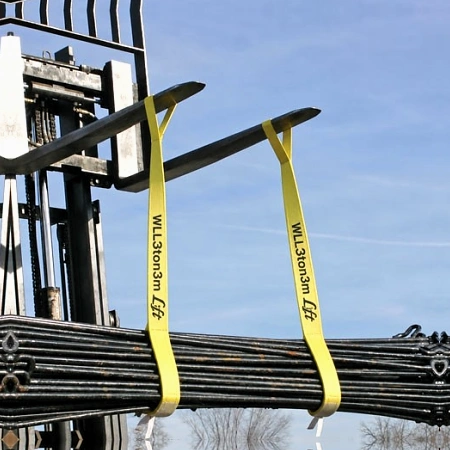
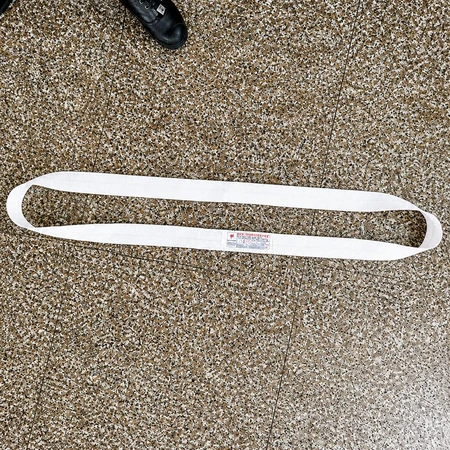
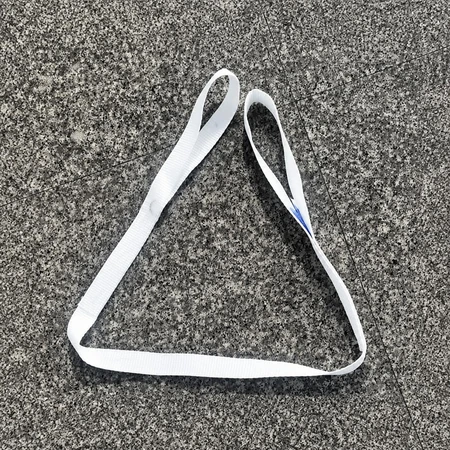
Kini “one way” decides, ati ohun ti ko ṣe
Two things follow from the word and one thing does not. It decides that the sling is issued with the load rather than drawn from a store and returned to one, which changes how it is bought, counted and stored. It decides that there is exactly one inspection in its life, ni ojuami ti oro, nigbati a ẹbi le tun ti wa ni rọpo. Ohun ti ko yipada ni imọ-ẹrọ: awọn ṣiṣẹ fifuye ifilelẹ, the marking, the factor and the length convention are specified on a one-way sling exactly as on an article that will be used for years.
The forms in this category
| Fọọmu naa | Kini o jẹ | Ibi ti o ti lo |
|---|---|---|
| Flat one-way sling with formed eyes | A flat woven band with a formed eye at each end, the working load limit and length printed on the band. | Fọọmu idi gbogbogbo: paipu, igi, panels and aluminium, picked in the vertical or basket arrangement. |
| Closed ring (iyika) ọkan-ọna sling | A band joined to itself into a closed loop, with no ends to thread and no eyes to place. | Where the load is wrapped rather than hooked: awọn edidi, coils and round sections. |
| Ring-and-buckle one-way strap | A flat band finished with a ring or a buckle at each end, so the sling can be made up around the load. | Where the band has to be threaded through or closed on the load itself. |
| Pipe and export one-way sling | Awọn ti ikede pato ni ayika paipu tabi tube consignment, with the pick positions and the supporting strap dealt with together. | Export pipe and tube, and any consignment that is re-slug at the far end. |
| Pre-slung one-way sling | Bands fitted to the consignment before it is placed, nitorina opin gbigba ko ni lati yan ọkan. | Loads that will be lifted where no rigger and no plan are available. |
Used with the lifting set: what the parts have to agree on
A one-way sling is rarely the only article in the arrangement, and the failures that matter are usually compatibility failures rather than strength failures. Four things have to agree, and each of them is a line on the enquiry rather than a decision at the load.
- The fitting at each end. A formed eye has to take the hook, the shackle or the pin that will actually be used — gbígbé ìkọ and shackles come in sizes, and an eye that is too small will not sit properly on a large hook.
- Eto naa. Inaro, basket or choker are three different duties on the same band, and the working load limit follows the arrangement you will really use, not the load as weighed.
- Anything rigid above the load. Where the lift needs a spreader or equalizing beam, the beam’s bottom points decide where the one-way slings attach, and the beam’s own mass has to be added to what the crane lifts.
- The mark. On a single-trip article the printed figures are the whole record of what it is, so the marking has to be legible in the condition the sling arrives in — which is a specification line, kii ṣe alaye.
Buying them as a quantity
One-way slings are bought, counted and issued in numbers rather than drawn one at a time, and the arithmetic of a consignment follows from that. The quantity and the total weight are decided together, because at the wider end of the range a bundle of bands is a handling exercise in its own right before it is a lifting device. Nothing comes back, so there is no return to reconcile and no second entry in the stock ledger — which is the whole commercial case for the article, and the reason it is specified for export packing, for one-off shipments and for work that ends on a customer’s site.
Siṣamisi, and the one inspection
A single-trip sling is checked once, ni oro, and that check is the only one that changes anything. Look at the weave where it meets the load, at the stitching or sleeving at the ends, ati ni aami. A band that fails the check is destroyed rather than returned to the rack, because a band that comes back to the store will be issued again and its marking will then be stating something that is no longer true.
One way is not the same word as endless
The two phrases are often used together and they answer different questions. Ona kan says what happens to the sling after the journey — it is not recovered. Ailopin says what shape the sling is — a closed loop rather than a band with two ends. A one-way sling can be flat or endless; an endless sling can be a returnable article. Where your question is the shape, awọn ona kan sling category and the endless sling pages should be read together, and where it is the journey, this page is the one to read.
Nigbagbogbo beere
Is a one-way sling weaker than a returnable one? Rara. Ọrọ naa ṣe apejuwe irin-ajo naa, kii ṣe ite: okun, wewewe, the factor and the working load limit are specified the same way, and the article is marked the same way.
Can I use it a second time if it looks perfect? Iyẹn gan-an ni ọran ti ibawi wa lati ṣe idiwọ. It looks perfect because a single lift does not visibly age a webbing band, ati lilo keji jẹ nkan ti ko ṣe ayẹwo ti n ṣe iṣẹ kan ti ẹnikan ko ni iwọn.
Do I need to state the arrangement? Bẹẹni - inaro, basket or choker decide what the band carries, and the figure is chosen from that arrangement rather than from the mass alone.
Can it be supplied marked with our own reference? Tell us what has to be identifiable. On a single-trip article the marking is what ties the band to the batch and the specification, and it is worth agreeing before the bands are cut.
Ibi ti lati lọ tókàn
Jẹmọ isori ati ojúewé: gbígbé sling, gbígbé tan ina, gbígbé ìkọ, eru net. For the article itself see disposable sling ati nikan lilo gbígbé sling, and for the same job decomposed by cargo see one way lifting sling for export steel and steel tube.
Olubasọrọ
Gbe Sling Rigging Co., Ltd - tẹlifoonu ati WeChat 18066002268, imeeli 702461526@qq.com, Lifute Industrial Park, Ilu Taizhou, Agbegbe Jiangsu, China. HS koodu 630790. Firanṣẹ ẹru naa, the packing, the arrangement and the quantity, and we will confirm the form and the marking before the bands are cut.