

Te mau huru tao'a
TE te hu'ahu'a is a flat band woven from high-strength synthetic fibre, with an eye or a loop formed at each end, used in place of a wire rope wherever the load must not be marked. The band is wide and flat, so the same load is carried over a large area instead of on a point: that is the whole reason this article exists, and it is why it is the first choice on machined faces, ohipa peni, coated tube, polished sheet and anything already finished before it is lifted.
Handling it is part of the argument too. It weighs a fraction of a wire rope of the same figure, it does not kink or develop meat hooks, and it cannot cut a hand. A faaite mai ia matou eaha te faateiteihia ra, the figure you need and how it will be hitched — vertical, basket or choked — and we will confirm the width, te roaraa, the end configuration and the marking before the band is woven.
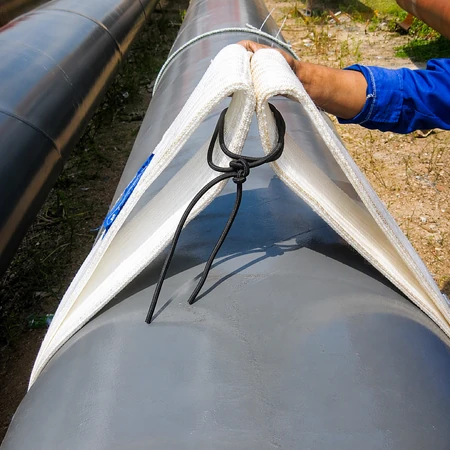
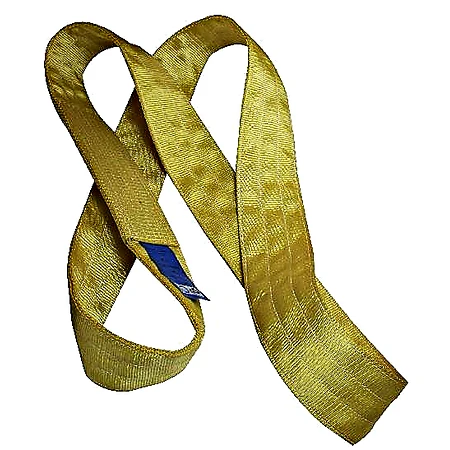
What it replaced, and why it won on finished work
A wire rope sling is stronger per millimetre of its own thickness and it survives abuse that would end a webbing sling’s life. So the swap is not a question of strength; it is a question of contact and handling. A steel rope presents a hard, narrow surface to the load and a fringe of broken wires to the hands that rig it, and on a finished article it does the damage before the lift begins. TE te hu'ahu'a presents a wide soft face to the load and a smooth one to the rigger, so it is chosen where the surface is worth more than the extra care a rope would need, and where the load is not so abrasive or so hot that the fibre is out of its depth.
Three things the name has to carry: hohoa, figure and ends
- Hohoa — sets the pressure on the load. A narrow band concentrates the load and is the right answer on a light, stiff article; a wide band spreads it and is the right answer on anything soft, coated or finished. It also sets what the band can be folded into.
- Fiu, per mode — a webbing sling does not have one capacity. It has a capacity in vertical, a different one in basket and a lower one choked, e te faaite ra te tapao i te reira tata'itahi. Purchasing on “te faito” alone is the single most common error in this category.
- Te hopea — flat loop, folded eye or reinforced eye; they decide how the band sits on a hook, whether it can be used in a choker, and how the last of the fibres at the end are protected. The end is where a band wears out first, so it is worth specifying deliberately rather than accepting by default.
Hoê pǔpǔ himene, several figures: the arrangement decides the rating
The figures below are the standard mode factors used across the market for flat webbing slings: each is multiplied by the sling’s own marked working load limit to give the capacity in that arrangement. Te koki, o te koki ïa o te avae i ni'a i te vertical, e te vai noa ra te tapao i nia i te tumu parau i nia i te tabula.
| Fa'ahou | Te huru | Te auraa o te reira i ni'a i te tahua |
|---|---|---|
| Tūti'a | 1.0 | Hoê avae, ti'a'tu i ni'a. Te ta'i nei te pŭpŭ e te amo nei. |
| Choked | 0.8 | E haati te pǔpǔ i te hopoi'a e e ho'i mai na roto i to'na iho mata. The wrap grips the load, and the band is loaded against itself. |
| Te ete, 0–45° | 2.0 | Te pŭpŭ i raro a'e i te hopoi'a, i nia i te matau, avae piri atu. |
| Te ete, 45–60° | 1.4 | Te ete e te mau avae; te mau haamâu'araa no te parareraa. |
| E piti avae, 0–45° | 1.4 | E piti pǔpǔ i te hoê matau, avae piri atu, tei faaitehia. |
| E piti avae, 45–60° | 1.0 | Te hoê â hoa faaipoipo e te mau avae e parare ra, o te hoê â ïa ereraa i te aravihi. |
| Three and four legs, 0–45° | 2.1 | E toru aore ra e maha avae; note it is not three or four times the figure, because the load rarely shares evenly. |
| Three and four legs, 45–60° | 1.5 | The same arrangement spread. Hi'opo'a faahou maoti i te mana'o. |
Two consequences worth stating plainly. A choked webbing sling is weaker than the same sling used vertically, no reira, e titauhia te hoê taamuraa rahi a'e no te hoê hopoia e tia ia hepohepohia, eiaha râ i te hoê taamuraa roroa a'e. E a parare ai te mau avae, e topa te aravihi, which is a geometric fact rather than a material one — it is answered by a wider angle-free arrangement, by a spreader, or by a bigger sling, e aore râ, na roto i te tahi atu mea.
Colour on the band is identification, not certification
Flat webbing slings are colour-coded by working load limit under the convention most of the market uses — 1 t, 2 t matie, 3 t re'are'a, 4 t hina, 5 t uteute, 6 t re'are'a, 8 t anaana, 10 t aramona. It is genuinely useful on a site: a rigger can spot a two-tonne band in a pile from across the yard. What the colour cannot do is replace the label, because the figure that applies is the one printed and affixed to that individual sling, and above the top of the coded range there is no colour to read at all. Treat the colour as the fast check and the label as the answer.
Replacing a wire rope: where the swap works and where it does not
| The condition | Te mau hu'ahu'a | Te taura aho |
|---|---|---|
| Finished or painted surface | The reason to choose it: wide soft contact, aita e tapa'o. | Marks and scuffs the surface; needs padding to compete. |
| Weight to be handled | A fraction of a rope of the same figure. | Tuʻutuʻu, stiff, and awkward above a certain size. |
| Sharp edges and burrs | Requires an edge protector or a sleeve, without exception. | Copes with much more, which is why it still owns the fabrication yard. |
| Hot surfaces and hot work | E otia ohipa to teie mau hu'ahu'a 100 °C and fail by melting, not by deforming politely. | Far more tolerant, though not unlimited. |
| Te vavahiraa, grit, dragging over concrete | Wears quickly; the cover can be added but the band’s life is measured in shifts. | The better answer where the environment itself is the attack. |
| Chemical contact | Depends on the fibre; acids, caustics and some solvents are hostile to most of them. | Steel is indifferent to most of what destroys a band. |
The practical rule is that a webbing sling is chosen for the sake of the load, not for the sake of the sling, and the environment the band works in is the price of that choice. Where both a finished surface and an abrasive environment are present, the answer is normally a covered or sleeved band rather than a return to wire rope — but that is a decision to take with the supplier on the specific job, e ere i te mea hape.
Te faateiteiraa, lashing and towing are three different duties
The same article is often bought for all three and should not be. They load the band differently and are rated differently, and the confusion is the reason this section exists.
| Fa'a'ōfa'i | How the band is loaded | What it has to be rated for | What must never happen |
|---|---|---|---|
| Te faateiteiraa | I roto i te hoê taime poto, ma te ite, with a person watching and a standing load. | A lifting rating, stated per hitch and per angle, with the marking that goes with it. | A band bought for restraint used to lift. |
| Lashing / te tape'araa | Tamau noa, i roto i te hepohepo, i roto i te haereraa, ma te haapa'o ore, with fatigue and vibration. | A restraint rating — a lashing capacity, tensioned by a ratchet or a buckle, e ere i te hoê faaho'iraa. | A lifting sling used as a lashing, or a lashing used as a sling. The duties do not transfer. |
| Towing and recovery | In snatch loads: repeated shock, far above the steady figure, plus elastic recoil if anything parts. | A purpose-made tow or recovery strap, built for shock loading, with its own rating and its own safe practice. | A lifting sling, or even a plain lashing, used as a tow rope. This is a fatal-practice, not a marginal one. |
Where a load has to be both lifted and held in transit, the correct answer is two articles rather than one used twice: a sling that lifts, e te hoê ratchet cargo lashing belt aore rā ratchet tie down strap that restrains. It costs less than the incident.
Edges, sleeves and the protection that is part of the specification
E haamata te hoê pǔpǔ tei tapaohia e te hoê hiti mai te hoê vahi nainai roa e e hope mai te hoê pau, so edge protection is a specification line rather than an accessory decision. Te vahi i reira te hopoi'a e poro oi ai, te hoê utu matini, te hoê burr, te hoê iri weld aore ra te hoê iri ino, e rima anei te rima, e te rima o te hoê ïa tuhaa o te ve'a, or the corner is protected with a pad or a corner piece that travels with the band. A ani i te reira i te taime uiuiraa: a sleeve added later cannot be retro-fitted to a band already woven, and a band ordered without one is a band that will be used without one.
Hi'opo'araa, and the conditions that end a band’s life
Hi'opo'a na mua a'e i te mau faaohiparaa atoa, e i roto i te area taime, ua haamauhia te mau ture o te tahua itenati. The conditions that remove a webbing sling from service are specific rather than a matter of judgement: te mau veavea ati aore ra te caustic, te re'are'a e aore râ, te auahi, Snags, Te mau ofa'i, te roimata aore ra te mau taparahiraa, te mau tuitui parari e aore râ, te mau, distortion of the fittings or the eyes, and a label that can no longer be read. A band with any of those is out of service, and it is out of service because the damage is in the load path, not because it looks untidy. Faaherehere ma e maro, i te maramarama o te mahana, and keep the record with the article.
Ui pinepine
Can a webbing sling really replace a wire rope of the same capacity? For the lift itself, ae, provided the figure is taken per hitch and the edges and the temperature are within the band’s limits. The two are not interchangeable in the environment, which is a different question from the load.
What width should I order? The narrowest width that will carry the figure without crushing the load, or the widest the load’s geometry will accept. Send the load and the figure, and the width follows.
Why is the choked figure lower? No te mea ua teimaha te pǔpǔ ia ' na iho e te mau tauihaa, so the fibres are working in a way the vertical figure does not describe. E mea tano, i ni'a i te tapa'o, and it is the reason a choke sometimes needs the next size up.
Can I use one sling as a lashing as well? E ere mai te hoê â tumu parau. Restraint is rated for continuous tension, eiaha no te hoê faateiteiraa, and the two duties are marked differently. Buy the lashing as a lashing.
How long will a band last? E faaoti te mau mea e haaati ra ia tatou, eiaha te kalena: a band on painted steel in a workshop gives years, the same band dragged over concrete and grit gives shifts. Inspect for condition rather than age, and never against a fixed service life.
Te faaite ra anei te tae ia ' u i te aravihi? It identifies the working load limit by convention, and it is not a substitute for the label. Where the colour and the label disagree, or the label is unreadable, aita te pǔpǔ e tavini ra.
E haere i hea i muri iho
Related categories and products: lifting sling, sling taura, te pou faateiteiraa, lifting hook, lifting chain. For the neighbouring articles see nylon woven flat sling, polypropylene flat sling, heavy duty lifting sling, Sling webbing mure ore, eye and eye type webbing sling, alkali resistant sling, lightweight UHMWPE endless loop flat webbing sling, flame resistant aramid webbing sling belt e Hoê noa faaohiparaa i te webbing hope ore.
Auē ho'i ē
A faateitei i te Sling Rigging Co., Ltd — niuniu paraparau e WeChat 18066002268, imera 702461526@qq.com, Te vahi faaapu no Lifute, Te oire no Taizhou, Mataeinaa no Jiangsu, Te fenua Taina. Waehere HS 630790. A tono i te hopoi'a, te numera i te hitch, the arrangement and the working environment, e e haapapu tatou i te rahi, te roaraa, the protection and the marking before the band is woven.
ZH