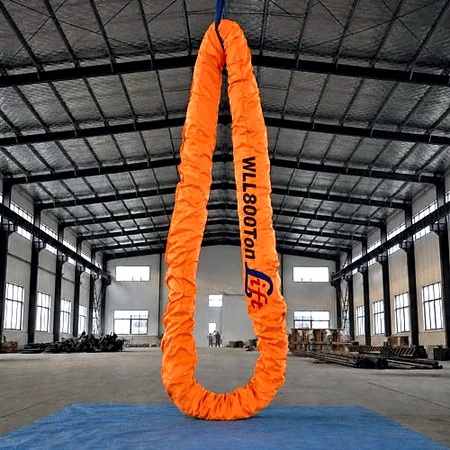
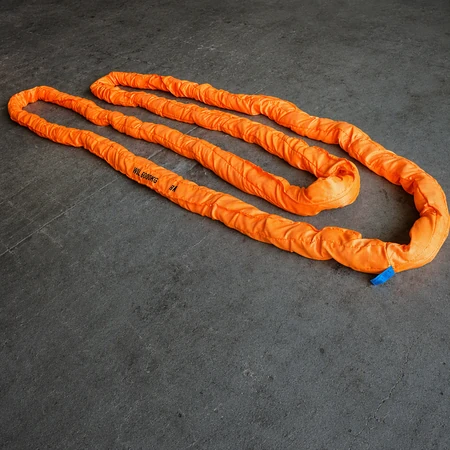
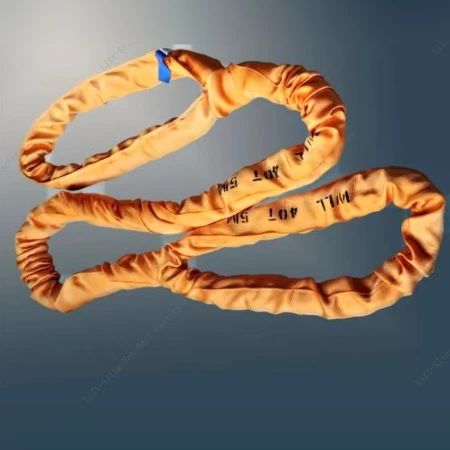
Lift sling rigging company produce 50T Heavy Duty Polyester Lifting Sling Endless Round Sling,50t Polyester Lifting Round Sling,50 Tonne Round Sling.
50T Heavy Duty Polyester Lifting Sling Endless Round Sling
50,000 kg ka leoto le 350,000 kg before it breaks, in a body with no metal, no ends and no stitching in the load path.
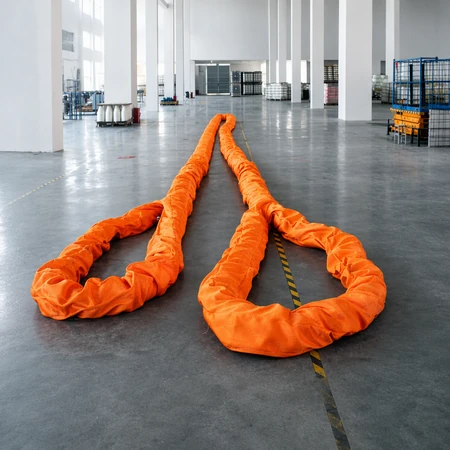
Re e haha ho tloha 1 m ho 30 m bolelele bo sebetsang, single or double sleeve, in polyester as standard, with the working load limit and the length printed on the sleeve and a sewn label carrying the serial. Every sling is proof loaded before dispatch and the test record is matched to that serial, kahoo setifikeiti se foldareng ke sa letjeketjane le ka har'a kreiti. The build follows EN 1492-2 and ASME B30.9 practice.
Part of the letjeketjane mefuta-futa. The tier below is the 40 tonne round sling; the tier above is the 60 tonne round sling. For the whole heavy series see heavy duty round slings.
Ke eng 50 t figure actually buys you
The number on the sleeve is the working load limit of leoto le le leng, e leketlileng ka ho otloloha. It is what the sling is proof loaded and certified against, and it is where a lifting plan starts — but it is not what the sling will pick up in the arrangement you are actually using. Liphetoho tse peli li fetola palo ea leoto le le leng hore e be setšoantšo se behiloeng, and both of them move it.
- Mokhoa. A choke costs 20 %; a basket at a shallow angle nearly doubles the figure; the same sling in a basket at 45–60° is back to its vertical rating.
- Lehlakore la leoto. The wider the legs spread from the hook, the more tension each one sees for the same load. A multi-leg set is also calculated on fewer legs than it has — four legs are taken as three, hobane mojaro oa 'nete ha o lule ka mokhoa o phethahetseng.
| Tlhophiso | Ntlha | Bokhoni |
|---|---|---|
| Lesela le le leng, e otlolohileng | × 1.0 | 50 t |
| Lesela le le leng, khangoa | × 0.8 | 40 t |
| Lesela le le leng, basket at 0–7° | × 2.0 | 100 t on the sling |
| Lesela le le leng, basket at 7–45° | × 1.4 | 70 t on the sling |
| Lesela le le leng, basket at 45–60° | × 1.0 | 50 t |
| Li-slings tse peli, 0-45° ho tloha ho tse otlolohileng | × 1.4 | 70 t beha |
| Four slings, 0-45° ho tloha ho tse otlolohileng | × 2.1 | 105 t beha |
Read the table from the load backwards. A 50 t jarisa litlhoko tsa maoto a mabeli 50 t slings at 0–45° (70 t beha) le 60 t slings once the legs pass 45°. Tse peli 30 t slings do not make 60 t, and two 40 t slings jara 56 t — which is why the tier is chosen from the arrangement rather than from the tonnage on the drawing.
Hokae 50 t sits against the tiers either side
At this size the sling is rarely the weak link: hokoe, theketla, the beam and the lifting point each carry their own rating, and the lift is limited by the lowest one. What the tier table settles is whether you buy 50 t slings or a pair of smaller ones.
| Sling | E otlolohileng, leoto le le leng | Two legs at 0–45° | Chosen when |
|---|---|---|---|
| 30 t | 30 t | 42 t | Up to about 40 t on two legs, e nang le moeli |
| 40 t | 40 t | 56 t | 45–55 t on two legs at a moderate angle |
| 50 t | 50 t | 70 t | 55–65 t on two legs, or unknown weights |
| 60 t | 60 t | 84 t | Legs opening past 45° on a 50–60 t load |
E le 'ngoe 50 t sling also makes sense where the hook is unknown or a fleet sling has to cover several jobs: the extra tonne of rating costs less than a second body, a second label and a second inspection.
The core carries the load, the sleeve decides the life
Lejoe le pota-potileng ke lihlooho tse peli ho e le 'ngoe, and the outer one is what retires it. The core is a parallel bundle of high-tenacity polyester filament, waxed and laid without twist; every filament shares the load, which is how a body this slim rates at 50 t. The sleeve is a woven tubular jacket that protects the core from abrasion, from the load and from daylight, and it is what the person making the lift reads.
The sleeve is the inspection window
Because the core cannot be seen, the sleeve is judged instead: maqeba, snags, qhoqhoa, ho silafatsa ka lik'hemik'hale, and the loop ends where the core turns. A sleeve cut through so that the core is visible retires the sling even if the core itself looks sound — a sling that cannot be judged cannot be used.
Mosebetsi o boima ke ho haha, eseng tekanyetso
The phrase describes the sleeve and the standard of make. A 50 t sling ke 50 t eng kapa eng eo sleeve; a second layer buys wear life rather than capacity. Where the load is abrasive, the yard is rough or the sling is a rental item, specify the letjeketjane la matsoho a mabeli — on a clean indoor lift it is money spent on nothing.
'Mele o sataletseng o hloka sebaka
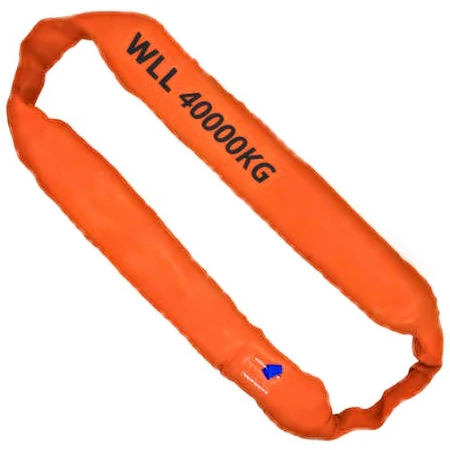
A 50 t 'mele ha o kobehe ho pota-pota radius e thata ka tsela a 10 t e mong o etsa joalo. E le molao o sebetsang, a very short body has no slack to seat in the hook and starts to fight the rigging; the minimum length at this rating is confirmed on the drawing issued with the quotation. Geometry e thata hangata e arajoa ka 'mele o molelele, a phahamiso ho tlisa maoto haufi le thipa, kapa a letjeketjane le nang le mahlo e entsoeng ka bolelele bo lekantsoeng.
Litekanyetso tsa tekheniki
| Paramethara | Tlhaloso |
|---|---|
| Sehlahisoa | 50 t heavy duty polyester lifting sling, letjeketjane le sa feleng, 50,000 kg e chitja e phahamisetsang letjeketjane |
| Kaho | Mokotla o sa khaotseng oa filament ka har'a letsoho le lohiloeng la tubula, e koetsoeng ka sekgoqetsane se sa feleng; ha ho tšepe tseleng ea mojaro |
| Ea mantlha | Polyester ea boleng bo phahameng (PES) multifilament, parallel lay, boka |
| Sleeve | Mosebetsi o boima o lohiloeng ka polyester e phahameng ea tenacity, lera le le leng joalo ka maemo; habeli sleeve ho laela |
| Moeli oa mojaro o sebetsang | 50,000 kg (50 t), leoto le le leng, e otlolohileng |
| Mojaro o robehang | 350,000 kg ho a 7:1 ntlha |
| Tšireletseho ntlha | 7:1 joalo ka maemo; lintlha tse ling tse hlahisoang ho laela moo maraka a hlokang |
| Elongation ho WLL | Approximately 2–3 % |
| Mocheso oa tšebeletso | −40 °C ho ea +100 °C |
| Bolelele bo sebetsang | 1–30 m made to order; bonyane bolelele bo sebetsa boemong bona |
| Mmala | Orange joalo ka maemo; mebala e meng sleeve ho odara |
| Ho tshwaya | WLL le bolelele bo hatisitsoeng letsohong; sewn label e nang le WLL, bolelele, serial, maemo le letsatsi |
| Standard | IN 1492-2 le mokhoa oa kaho oa ASME B30.9 |
| Teko | Bopaki bo kentsoeng pele bo romelloa; rekoto ea teko e tsamaellanang le nomoro ea serial |
| Ho paka | Koala ka mokotleng oa poly, lebokose le ngotsoeng; phalete kapa kreiti ka kopo |
| MOQ & OEM | MOQ e tlase bakeng sa taelo ea teko; OEM ka bolelele, mmala wa sleeve, fiber ea mantlha, sebopeho sa leibole le ho paka |
Bolelele: bolelele kapa sedikadikwe se sebetsang
Lejoe le sa feleng ha le fele, so its length can be quoted two ways and the two are a factor of two apart. Ena ke phoso e tloaelehileng ka ho fetisisa ea ho laela holim'a letjeketjane, le ho 50 t ke theko e boima ho lokisa ka mor'a ketsahalo.
| E qotsitsoe joalo ka | Ua amohela | E sebelisoa bakeng sa |
|---|---|---|
| Bolelele bo sebetsang bo sebetsang | Halofo ea circumference - hoka ho theosa le mojaro le ho kgutlela morao | Lilifi tse otlolohileng le tse khangoang, moo bophahamo bo leketlileng bo tsejoang |
| Potoloho | Bolelele bo felletseng ba loop | Libaskete li phahamisa, moo girth ea mojaro e tsamaisang bolelele |
A 4 m e sebetsang bolelele ke an 8 m loop. On our slings the figure printed on the sleeve is the effective length, kahoo mongolo le mantsoe a qotsitsoeng lia lumellana kamehla. Bakeng sa ho phahamisa baskete, nka seqhama sa mojaro, add the headroom to the hook and quote that: a sling that only just reaches forces the legs wide, e tshoanang le ho reka letjeketjane le lenyane.
Ho tshwaya, serial and proof-load traceability
Ka holimo 10 t the colour code stops identifying the sling, joalo ka 50 t the print and the label are the only things a rigger can read. Both are part of the specification, not decoration.
- The working load limit and the effective length are printed on the sleeve in characters sized to be read at arm’s length in a yard.
- Leibole e rokoang e na le WLL, bolelele, serial, maemo le letsatsi la tlhahiso; serial ke eona e hokahanyang letjeketjane la 'mele le lipampiri tsa eona.
- Every sling is proof loaded before dispatch and the test record is matched to that serial.
- Setifikeiti sa fiber le lipalo tsa batch lia fumaneha ha u kopa; if your market needs a specific standard marking, say so before the order rather than after.
Moo a 50 t sling earns its place
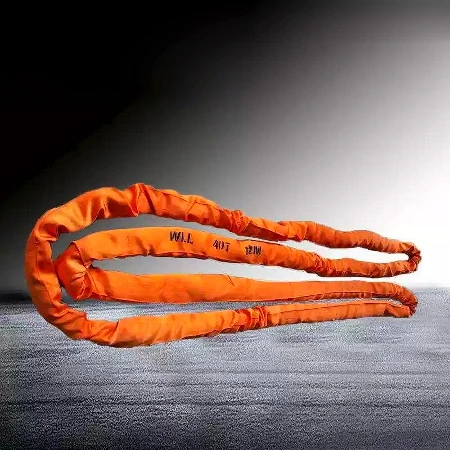
At this capacity the sling is chosen for what it does eseng do to the load — a wire rope grommet carries the same figure. Phapang ke ho kopana.
- Li-girders tsa precast le likarolo tsa borokho. Letsoai le le leng ntlheng e 'ngoe le e 'ngoe, girder lifted level; sleeve e sireletsa sefahleho se entsoeng le chamfer.
- Steel coils and plate packs. Basket under the pack, sleeve against the plate edge — the round body follows the coil rather than bearing on a line.
- Li-transformer, lijenereithara le libethe tsa mochini. Trunnions and lifting holes are small and the surfaces are machined or painted; nothing metal touches the load.
- Moulds, dies and skids. Lifting holes are drilled rather than designed for a fitting, so a soft loop threaded through the hole is the whole method.
- Li-blocks tsa sekepe le li-module. Lintlha tse 'ne tse nang le molatsoana ka holimo, moo lehlakore la letjeketjane ke phetoho e etsang qeto ea sete.
Tlhahlobo, tlhokomelo le ho tlohela mosebetsi
Hlahloba pele o sebelisoa, 'me ka mokhoa o hlophisitsoeng ka nako eo puso ea hau e e hlokang. The check is nearly all on the outside, because that is all there is to see.
- Sleeve along its full length: maqeba, snags, qhoqhoa, melts, ho silafatsa ka lik'hemik'hale.
- Loop ends, where the core turns inside the sleeve, and the stitching at the join.
- Leibole le ho hatisa: haeba WLL kapa bolelele bo ke ke ba hlola bo baloa, letjeketjane le ke ke la netefatswa.
- Grit inside the sleeve — it abrades the core from within long after the yard has been swept.
- Retire on any cut through to the core, mocheso o benyang, mokokotlo o tsamaileng o satalla kapa o qhitsa, chemical attack or a missing label.
- Boloka e phuthetsoe le ho tloha fatše, ho tsoa motshehare le hole le mocheso, solvents le weld spatter; le ka mohla u se ke ua boloka letjeketjane le le metsi ka mokotleng o koetsoeng, and never drag one under load.
E botsoa khafetsa
Can one 50 t sling lift 100 t ka basketeng?
Ka lehlakoreng la letjeketjane, ho joalo - 100 t ka 0-7°. Ka ts'ebetsong hook, master link kapa beam e kaholimo ho eona le eona e tlameha ho lekanyetsoa 100 t, 'me ka boholo bona crane hangata ha e joalo. Ke ka lebaka leo baskete ka 50 t ke qeto e tiileng pele le qeto ea bokhoni boemong ba bobeli.
Do two 50 t slings phahamisa 100 t?
Not at an angle. Two legs at 0–45° from vertical carry 70 t, le 50 t once the legs open past 45°. A genuine 100 t jarisa litlhoko tsa maoto a mabeli 75 t slings, which is why we ask for the arrangement before the price.
Polyester or UHMWPE at this capacity?
Polyester is the general-purpose core: kotlo e tlase, bophelo bo botle ba abrasion, −40 ho +100 °C, lowest cost at this rating. A UHMWPE mantlha is worth it where the sling’s own weight is the problem — long bodies, likhetho tse phahameng, kapa letjeketjane le tlamehang ho phahamisoa ka lere.
What about hot loads?
A standard polyester core is rated to +100 °C. Above that the fibre degrades, and the answer is an aramid core or a high temperature round sling rather than a thicker standard sleeve.
What length do I order — 4 m kapa 8 m?
Bolela hore na u bolela kopano efe. A 4 m e sebetsang bolelele ke an 8 m loop. For a vertical or choked lift the effective length is the distance from hook to load; for a basket, eketsa girth ea mojaro ho headroom le qotsa hore.
Ke litokomane life tse tlang le letjeketjane?
A sewn label carrying the WLL, bolelele le serial; rekoto ea boima e tsamaellanang le serial eo; setifikeiti sa fiber le lipalo tsa batch ka kopo. Re bolelle pele ho odara haeba mmaraka oa hau o hloka ho tšoaea maemo a itseng.
Can the sleeve be replaced or repaired?
Che. A sling is proof loaded as a complete article, and re-sleeving or re-stitching voids that record. A damaged sleeve retires the sling; the answer is a new body, or a double sleeve next time.
Kopa a 50 t khotheishene e chitja
Send the lift, get a drawing and a price
Mojaro ka leoto, the arrangement and the angle from vertical;
Distance between pick-up points and the headroom to the hook;
Effective length or circumference, tikoloho, and any sleeve or marking requirement.
Lift Sling Rigging Co., Ltd · Lifute Industrial Park, Taizhou, Jiangsu, China · HS khoutu 630790 · Tel +86 523 8693 5818 · WhatsApp +86 180 6600 2268
Lihlahisoa tse amanang
- Li-slings tsohle tse chitja, 1-1000 t — the full range this sling belongs to;
- WLL 40T polyester round slings — the tier below, same build;
- Li-slings tsa polyester tsa WLL 30T tse chitja — for 40 t loads on two legs;
- 60 tonne round sling — the tier above;
- Heavy duty round sling range - 50 t le holimo, heavier sleeves;
- Lesela le chitja le nang le mahlo — a measured length and two pick-up points;
- Flat webbing sling — the same rating in a thinner profile;
- Ho phahamisa maballo — to keep multi-leg sets closer to vertical.