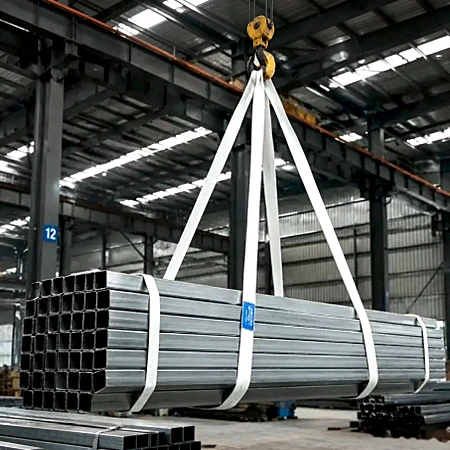
Lift sling rigging company produce One Way Endless Lifting Slings Single Eye For Lifting Steel Pipe And Tubing,steel pipe lifting sling,One Way Endless Slings Solutions for Export Packaging and Heavy Industrial Lifting,Eye and Eye Sling with Webbing Eyes for Secure Lifting.
One Way Endless Lifting Slings Single Eye For Lifting Steel Pipe And Tubing
A closed loop with one eye, e rekiloeng bakeng sa leeto le le leng: the choke grips the pipe by its own tension and the sling ships out with the consignment.
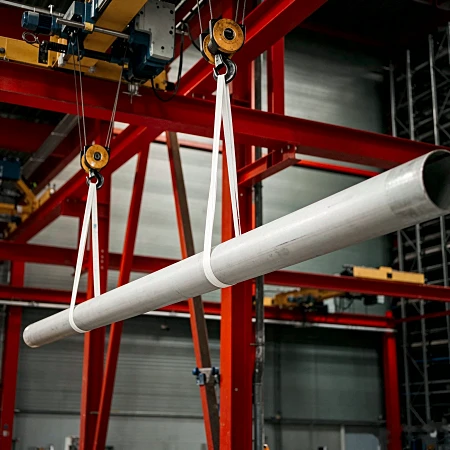
What the three words decide
The name carries three separate decisions and they are worth separating, because buyers often use the words interchangeably and then order the wrong article. One way says what happens after the lift. E sa feleng says the shape of the band. Leihlo le le leng says how the sling meets the load. Only the third one changes the lift itself.
| Lentsoe | Seo e se etsang qeto | What it does not change |
|---|---|---|
| One way | The sling travels with the load and is not recovered; tlhahlobo e le 'ngoe, ka taba; bought and counted in quantities | The weave, ntlha, the proof test or the marking — all identical to a returnable sling |
| E sa feleng | The band is closed into a loop with no free ends, so it can be wrapped round a section and closed on itself | Whether the article is reused; endless slings are made in both builds |
| Leihlo le le leng | A choke. Mohatla o potoloha mojaro ebe o khutlela morao ka leihlong, and the noose closes as the hook takes up | The vertical rating printed on the band — the choke derates it to 0.8 |
Read together, the phrase describes one article: a closed-loop polyester sling, finished with a single eye, issued for one pipe or tube consignment. Where the consignment is lifted and then re-slung at the far end, the same band is often supplied in the two-eye looped end single use lifting sling form instead, because the receiving site can then hang it without threading a choke.
Why a choke is the right grip for pipe
A pipe is the worst case for a sling that relies on friction: it is round, it rolls, the wall is thin at the contact line and the coating is softer than the steel under it. A choke answers all four problems at once.
- The grip is generated, not borrowed. The noose closes as the load comes on, so the band tightens round the pipe in proportion to the weight it is carrying; a vertical sling on a bare pipe has only friction and balance holding it.
- One contact line, chosen by you. The band bears on a single line of the wall. Set that line where the pipe is strongest — behind the end collar, away from a weld seam — and the load is carried where you put it.
- Ha ho letho la tšepe le amang phala. There are no hooks, shackles or buckles on the article, so a coated or painted pipe is not scratched at the sling point.
- The sling stays where it was fitted. On a one-way build the choke is made at loading and left closed, so the receiving site lifts the bundle with the same sling it arrived in, without a rigger and without a plan.
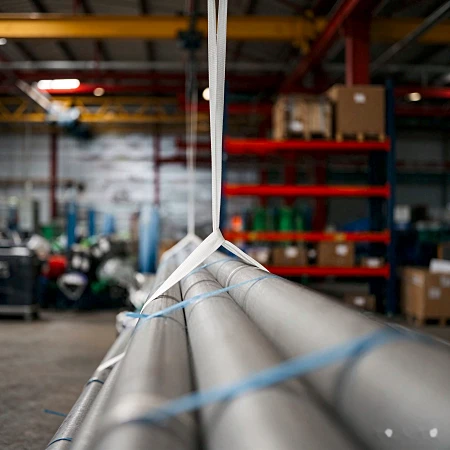
The trade-off is length: a choke consumes reach, because the tail has to come back through the eye and lie alongside the standing part. That is why a one-way pipe sling is ordered by the girth of the bundle rather than by the height of the hook, and why the length arithmetic further down this page starts from the circumference.
Tlhaloso
Four lines on the order decide the price — width, ntlha, length and marking — because the eye is formed from the same band and adds nothing to the cost but a stitch pattern.
| Paramethara | Mohaho o tloaelehileng | Lintlha |
|---|---|---|
| Webbing | Flat woven high-tenacity polyester, 25-300 mm bophara | 4 mm kapa 7.5 sehlopha sa mm; one to three plies at the heavy end |
| Moeli oa mojaro o sebetsang | 1 t - 24 t ka letjeketjane | E otlolohileng, single leg — the figure printed on the band |
| Ntlha ea moralo | 5:1 / 6:1 / 7:1 | The same WLL needs a wider band at 7:1 ho feta ho 5:1 |
| Sebopeho | Closed loop with one formed eye | Eye stitched and bar-tacked at the mouth |
| Bolelele | 0.5 m - 100 m of band | Quoted as band length; the choke takes up reach |
| Eye clear length | 250 mm ho 1 t ho 650 mm ho 15 t | Sized to the hook bowl or pin, plus about 10 mm |
| Mmala | Ho laela; IN 1492-1 code up to 10 t | Usually matched to the goods it travels with |
| Mocheso | −40 °C ho ea +100 °C | Polyester; attacked by concentrated acids |
| Ho tshwaya | SEBELE, bolelele, fiber, batch and your reference | Printed on the band and repeated on a sewn label |
| Ho paka | Koetsoe, banded in bales or cartoned | Can be packed into the crate or container with the goods |
| HS khoutu | 630790 | Packing list line, not a lifting register entry |
The size ladder: SEBELE, width and factor
The factor is a market decision as much as an engineering one: e tšoanang 5 t sling ke 125 mm ho 5:1, 250 mm ho 6:1 le 150 mm ho 7:1 ho a 4 sehlopha sa mm. Tell us the factor your market expects and the width follows from the ladder below.
| SEBELE | Ho 5:1 | Ho 6:1 | Ho 7:1 | Bonyane bolelele |
|---|---|---|---|---|
| 1 t | 25 mm | 50 mm | 30 mm | 0.5 m |
| 2 t | 50 mm | 100 mm | 60 mm | 1.0 m |
| 3 t | 75 mm | 150 mm | 90 mm | 1.0 m |
| 5 t | 125 mm | 250 mm | 150 mm | 1.5 m |
| 8 t | 200 mm | 200 mm | 240 mm | 2.0 m |
| 10 t | 250 mm | 250 mm | 300 mm | 2.0 m |
Widths as published on our single use slings ladder; the full range continues in double ply to 24 t. Where a row shows the same width at two factors, that is the current ladder quoted as it stands.
What a choke does to the figure on the band
The number printed on the band is the vertical, tekanyo ea leoto le le leng. A choker costs a fifth of it, and that is not a safety margin — it is the capacity. Decide the arrangement before the tonnage, then buy the sling that carries the load in that arrangement.
| Tokisetso | Ntlha | Bokhoni ba a 5 t tjeka |
|---|---|---|
| E otlolohileng, leoto le le leng | × 1.0 | 5,000 kg |
| Choked — the form on this page | × 0.8 | 4,000 kg |
| Baskete, two parts at 0–45° | × 2.0 | 10,000 kg |
| Baskete, two parts at 45–60° | × 1.4 | 7,000 kg |
| Two-leg assembly at 0–45° | × 1.4 | 7,000 kg per pair |
| Two-leg assembly at 45–60° | × 1.0 | 5,000 kg per pair |
| Three or four legs at 0–45° | × 2.1 | 10,500 kg set |
| Three or four legs at 45–60° | × 1.5 | 7,500 kg set |
A worked case from a pipe yard: a 9.6 t bundle of 508 mm tube, lifted on four chokes. Each sling carries 9,600 ÷ 4 = 2,400 kg, and because the hitch is a choke the rating has to be 2,400 ÷ 0.8 = 3,000 kg. A 3 t band at the factor your market uses is the answer — not a 2.4 t ngoe, which is the figure that comes out if the choke derate is forgotten. On two chokes the same bundle needs 6 t bands.
Bolelele: from the pipe circumference to the band you order
A choke is ordered by the girth of the load, not by the height of the hook. Measure the bundle — for a single pipe, π × outside diameter; for a square or rectangular pack, twice the width plus twice the height — then add what the choke itself consumes. In quotation we use:
Band length ≈ girth + eye and tail allowance + handling allowance, where the eye and tail allowance is about 0.3 m, and the handling allowance is 0.3–0.5 m for the tail to come back through the eye and lie alongside the standing part. Round up to the next half metre. The finished length is confirmed against your drawing before the bands are cut; the tolerance on a sewn article is ±2 %.
| Pipe OD | Girth (π × OD) | Starting band length | Typical arrangement |
|---|---|---|---|
| 168 mm | 0.53 m | 1.0 - 1.5 m | Two to four lengths |
| 219 mm | 0.69 m | 1.5 m | Two to three lengths |
| 273 mm | 0.86 m | 1.5 - 2.0 m | Two lengths |
| 325 mm | 1.02 m | 2.0 m | Two lengths |
| 406 mm | 1.28 m | 2.0 - 2.5 m | Single or paired |
| 508 mm | 1.60 m | 2.5 m | Single or paired |
| 610 mm | 1.92 m | 2.5 - 3.0 m | Motho a le mong |
| 762 mm | 2.39 m | 3.0 - 3.5 m | Motho a le mong |
Starting lengths assume a single wrap and a 0.6 m allowance. A bundle wider than one pipe, a double wrap, or a tail that has to be tied off adds to the figure — send the bundle dimensions and the length is quoted against them.
Mohlala o sebetsang: one length of 508 mm pipe, khama e le 'ngoe. Girth 1.60 m + 0.6 m = 2.2 m, rounded up to a 2.5 sehlopha sa m. A pair of the same pipes is measured on the pair, not on the pipe: 1.016 m wide by 0.508 m deep gives 2 × 1.016 + 2 × 0.508 = 3.05 m of girth, joalo 3.65 m with the allowance and a 4 sehlopha sa m.
Choosing the band for the pipe you have
The wall, the coating and the end finish decide the width more often than the tonnage does, because the failure on pipe work is a cut or a crush at one contact line rather than a break in the middle of the band. The widths below are the starting point we quote from; take one size up where the pipe is coated, painted or has a sheared end.
| Pipe outside diameter | Bare black pipe | E koahetsoeng, painted or lined |
|---|---|---|
| Ho fihlela ho 200 mm | 50 - 75 mm | 75 - 100 mm, sleeve moleng oa ho kopana |
| 200 - 400 mm | 75 - 100 mm | 100 - 150 mm |
| 400 - 600 mm | 100 - 150 mm | 150 mm, 7.5 sehlopha sa mm |
| Ka holimo 600 mm | 150 mm, 7.5 sehlopha sa mm | 150 - 200 mm with wear sleeve |
| Li-tubes le li-profile tse kopantsoeng | 75 - 200 mm | 200 mm if the ends are square-cut |
Three details are worth settling at the quotation rather than at the quay. A roala letsoho slid over the contact point takes the abrasion that would otherwise go into the load-bearing weave. A reinforced eye in a sleeve keeps a steel hook or shackle pin off the stitch line. And on thin-wall tube the choke should sit where the section is supported, not on an unsupported span — a 3 mm wall will oval under a choke that a 10 mm wall would not notice.
Ho tshwaya, packing and the one inspection
A one-way sling is inspected once, ka taba, and that inspection is the only one it will get. Everything the receiving site needs to know therefore has to be on the article, in a form that survives a sea freight and a forklift.
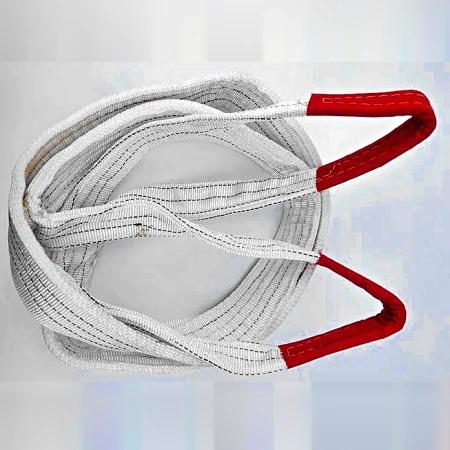
- Printed on the band: working load limit and length, at a size a rigger can read from the ground — for example “WLL 3ton 2.5m”.
- Sewn label at the eye: the same figures plus the fibre, sehlopha, the design factor and the standard; CE marking where the 7:1 series is supplied for a market that requires it, and type-test reports for other factors.
- Your reference: order, bundle or project number printed at the same time as the WLL — printed into the band, not applied as a sticker that lifts in the hold.
- Colour as a check: one colour per goods type or per customer, so the wrong bundle is not lifted at the far end with a sling that looks right.
- Ho paka: coiled and banded in bales for volume, cartoned for mixed sizes, or packed into the crate beside the goods so the slings arrive with the consignment instead of ahead of it.
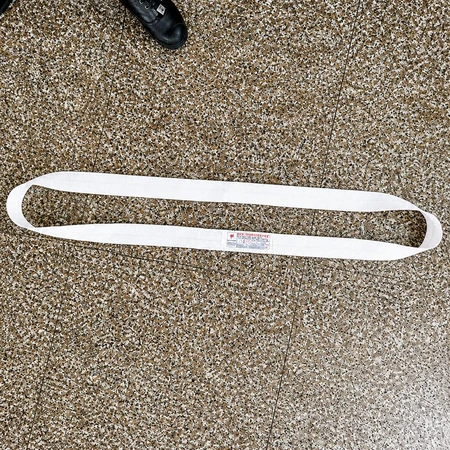
At issue, check three places: the eye — stitch line, bar-tack and eye mouth; the band along its length — cuts, snags, a thin patch that shows daylight, and any glazing or hardening from heat; and the print — if it cannot be read, the article cannot be rated. A sling that fails is destroyed rather than returned to a rack, because a band that comes back will be issued again carrying a marking nobody has checked.
Mmala, le palo e ka thōko ho eona
Ho fihlela ho 10 t, IN 1492-1 assigns a colour to each working load limit so a supervisor can spot a wrong sling at a distance. 'Mala ke cheke, never the authority: the label governs, le holimo 10 t — or on an undyed band — the print is the only statement of capacity.
| SEBELE | Mmala | Bophara ba tepo | Bonyane bolelele |
|---|---|---|---|
| 1,000 kg | Violet | 30 mm | 1.1 m |
| 2,000 kg | Botala | 60 mm | 1.2 m |
| 3,000 kg | Bosehla | 90 mm | 1.3 m |
| 4,000 kg | Hlooho | 120 mm | 1.4 m |
| 5,000 kg | Khubedu | 150 mm | 2.0 m |
| 6,000 kg | Brown | 180 mm | 2.0 m |
| 8,000 kg | Putsoa | 240 mm | 2.0 m |
| 10,000 kg | namunu | 300 mm | 3.0 m |
| 12,000 kg | Ha ho 'mala o tloaelehileng | 300 mm | 3.0 m |
The 2 t row is the one most pipe orders land on, and it shows the trade-off plainly: 2,000 kg in a 60 mm single-ply band, or the same rating in a 30 mm double-ply band that will pass a narrow eye but spreads the load over half the face. For pipe, the wider band is usually the right choice; the 2000KG e le 'ngoe e sebelisa li-slings tsa ho phahamisa page sets the two builds side by side.
E botsoa khafetsa
Is a single-eye endless sling the same as a round sling?
Che. A round sling is a bundle of filament inside a woven sleeve, with no eye and no ends; this article is a flat webbing band closed into a loop and finished with a sewn eye. The round sling conforms better and is kinder to a coated surface, the flat band is thinner, cheaper and easier to print. For a pipe that must not be marked at all, bapisa le ka tsela e 'ngoe ho pota-pota.
E ka sebelisoa lekhetlo la bobeli?
It is built, tshwailoe le ho rekoa bakeng sa leeto le le leng, and it is not inspected between lifts. A second use is an uninspected article doing a job nobody rated — which is exactly the failure the one-way discipline exists to prevent. If the sling is coming back into stock, buy the returnable letjeketjane la tepo with the same rating instead.
Why one eye rather than two for pipe?
Mahlo a mabeli a etsa letjeketjane le otlolohileng kapa basketeng, which needs a lifting point or a pair of legs to sit on. A pipe bundle usually has neither: it has to be gripped. One eye and a tail is the whole of a choke, and a choke is what a round, slippery or coated load wants.
Ke odara bolelele bofe?
The band length that gives the choke you need, worked out from the girth as in Table 5. Do not order by hook height: a 2.5 m band on a 508 mm pipe leaves only about 0.9 m of tail once the choke has closed, which is enough to pass back through the eye and no more.
How do I stop the pipe edge cutting the band?
Three ways, in order of cost: a wider band so the load is spread over more weave; a loose wear sleeve at the contact line, which is replaced with the sling rather than repaired; and edge protectors or a soft sling where the end is sheared or the wall is thin. On coated pipe the sleeve also protects the coating, which is usually the more expensive of the two losses.
Can it be printed with our reference and packed with the goods?
Ee. Setšoantšo sa WLL, bolelele, the batch and your own reference are printed on the band, a colour can be run per customer or per goods type, and the coils can be packed into the crate or the container with the consignment. The HS code is 630790 and the banded weight is confirmed on the quotation so the freight can be calculated before the order.
Kopa qotso
Five lines and we can quote the choke
The pipe or tube: bophara ba kantle, wall, ho roala, and whether it travels single or as a bundle;
The mass of one lift, and how many chokes you intend to use;
The factor your market expects — 5:1, 6:1 kapa 7:1 — and the hook or shackle the eye must pass;
Ho buuoa ka khatiso, mmala, and whether the slings ship inside the consignment.
Lift Sling Rigging Co., Ltd · Lifute Industrial Park, Motse oa Taizhou, Profinseng ea Jiangsu, China · HS khoutu 630790 · Tel / WeChat +86 180 6600 2268 · 702461526@qq.com
Moo u lokelang ho ea teng
- Tsela e 'ngoe ea letjeketjane - sehlopha sohle, by form and by consignment;
- Li-slings tsa tšebeliso e le 'ngoe — the complete ladder from 1 t ho 24 t;
- Thepa e lahliloeng e betsa leihlo le le leng — the same eye, the same choke, for rubber and sheet as well as pipe;
- Loped pheletsong e le 'ngoe e sebelisa letjeketjane le phahamisang — two eyes, where the bundle is re-slung at the far end;
- Tšebeliso e le 'ngoe ea li-slings tse tšoeu tsa ho phahamisa — undyed band where dye transfer is the concern;
- Lesela la marang-rang — the returnable version of the same band;
- Lisebelisoa tsa ho phahamisa — the hooks and shackles the eye has to fit;
- Letlooa la ho phahamisa thepa — where a whole consignment is wrapped as one body.