

Lift sling rigging company manufacture Webbing Cargo Lifting Net.
Webbing Cargo Lifting Net
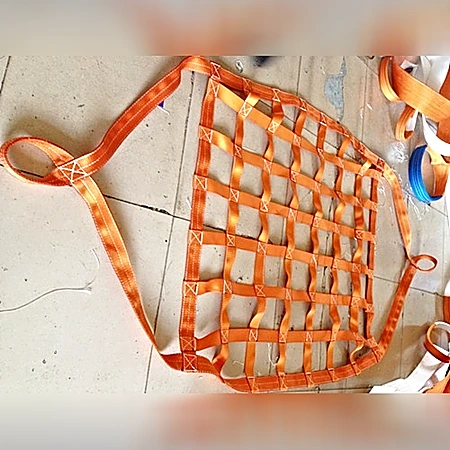
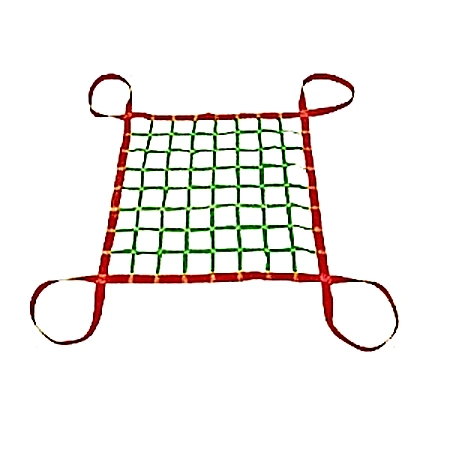
A webbing cargo lifting net is a heavy-duty lifting net woven from flat polyester webbing instead of wire rope. Lihlopha li tšela ka likhutlo tse nepahetseng ho etsa letlooeng le bulehileng la sekwere, the four sides and corners take the load, mme letlooa lohle le bonolo ho lekana ho lula khahlano le mokotla, lebokose, phahlo e pentiloeng kapa e entsoeng ka mochini ntle le ho e tšoaea. Phahamisa Sling Rigging Company (Phahamisa) manufactures webbing cargo lifting nets in Taizhou, Jiangsu — woven from 100% tepo ea polyester e phahameng haholo, rated from 2 t ho 10 t, le a 7:1 safety factor and four reinforced corner loops for crane, port and truck loading work.
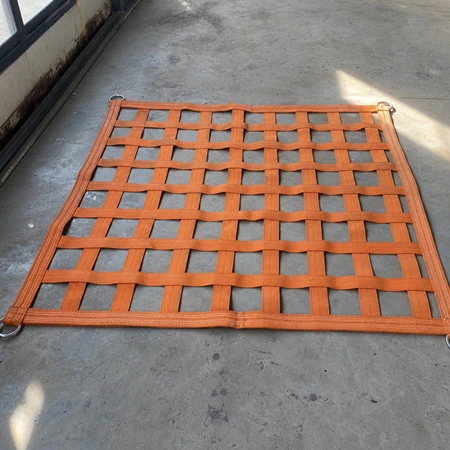
How a webbing cargo lifting net is built
Letlooa ke lesela, not a bag. Flat webbing bands are woven or cross-stitched into a square grid, so the load is carried by the bands across the whole underside of the cargo rather than by a few contact points. Four things decide how the net performs:
- The webbing - 100% polyester e phahameng haholo, 50 mm bophara joalo ka tloaelo, e lohiloeng leloaleng la rōna. It has low elongation, so the net does not stretch away from the load, and a soft surface that will not scratch paint, plating or machined faces.
- Letlooeng - a 100 x 100 mm lisekoere bula joalo ka maemo, small enough to hold bags, litene, mabokose le likaroloana tse nyane, open enough to keep the net light and easy to handle.
- Moeli — a double-layer stitched border runs around the whole net so that the edge bands cannot unroll or pull out under load.
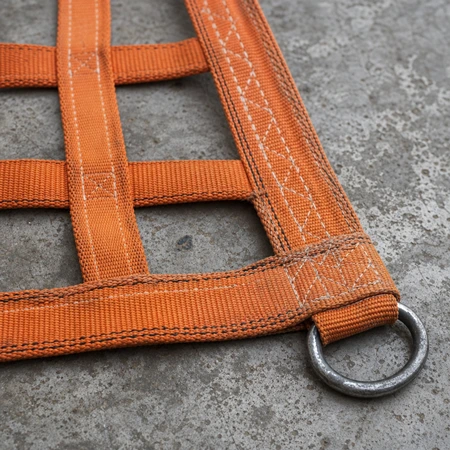
- Li-loops tsa sekhutlo — four reinforced corner loops, each stitched through the border, are what the crane hook, master ring or spreader beam lifts from. Put the load into the corners, never into the middle of a panel.
Litekanyetso tsa tekheniki
| Paramethara | Tlhaloso |
|---|---|
| Lintho tse bonahalang | 100% tepo ea polyester e phahameng haholo (nylon kapa polypropylene ka kopo) |
| Bophara ba tepo | 50 mm e tloaelehileng; 25 mm / 75 mm / 100 mm ka kopo |
| Ho bula letlooeng | 100 x 100 mm lisekoere letlooeng |
| E lekantsoeng ka matla | 2 t – 10 t; heavier loads built to order; breaking load tested per net |
| Tšireletseho ntlha | 7:1 |
| Edge and corners | Moeli o matlafalitsoeng oa mekhahlelo e 'meli; four reinforced corner loops |
| Mmala | namunu (ponahalo e phahameng) / putsoa / ntsho / botala / mmala o tlwaelehileng |
| Kalafo | e hanyetsanang le UV, thibela botsofali, e hlolehang ho taboha |
| Mocheso o sebetsang | -40 C ho +100 C (polyester tepo) |
| Setifikeiti | CE / ISO 9001; tlaleho ea tlhahlobo ea lintho tse bonahalang ka odara ka 'ngoe |
| Customization | OEM / boholo ba ODM, leibole le logo |
| Nete ea boholo | Bokhoni bo tloaelehileng | Tšebeliso e tloaelehileng |
|---|---|---|
| 2.5 x 2.5 m | 2 t – 5 t | Palletised le mekotla ea thepa, ho kenya setshelo |
| 2.5 x 6 m | 4 t – 10 t | Thepa e telele, ho kenya teraka le tereilara, dingata tsa liphaephe |
| 4 x 4 ft (1.2 x 1.2 m) | 2 t – 3 t | Meroalo e menyane, meropa, likarolo tsa mochini |
| 82 x 82 ho | 2 t – 5 t | Pallet e tloaelehileng ea mebaraka mebarakeng ea borena |
| E hahiloe ho taka | 2 t – 10 t + | Bethe ea teraka, setshelo, litekanyo tsa ho ts'oara le tsa sephara |
| Boitsebiso | Hobaneng ho le bohlokoa |
|---|---|
| Ho jara boima le sebopeho sa mojaro | Sets the rated capacity and the number of load-bearing bands under the load |
| Bolelele ba x bophara ba nete | Letlooa le tlameha ho ba le leholo ho feta leoto la mojaro hore mojaro o lule ka har'a letlooeng |
| Ho bula letlooeng | 100 x 100 mm e tloaelehileng; a smaller mesh is needed for small or loose items |
| Bophara ba tepo le mmala | 50 mm e tloaelehileng; colour is used for identification and for high-visibility sites |
| Lintlha tsa ho phahamisa | Likhoele tse 'nè tsa sekhutlo e le tse tloaelehileng, or additional loops for a spreader beam |
| Crane, hoko kapa sephara | Determines the ring or shackle fitted to the corner loops |
| Tikoloho | UV, metsi a letsoai, offshore or high-temperature use decides the webbing and treatment |
| Litokomane | Tell us if you need CE marking, a test report or own-brand labels |
Where webbing cargo lifting nets are used
- Crane hoisting of bagged, boxed and palletised cargo where a wire rope net would damage the packaging.
- Teraka, trailer and flat rack load securing, and loading and unloading at ports and terminals.
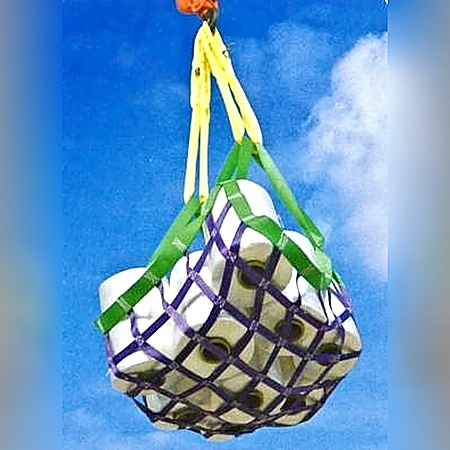
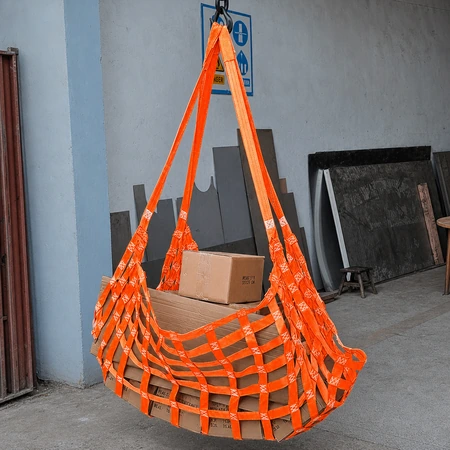
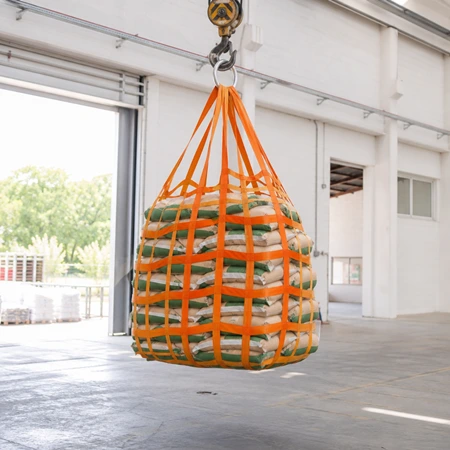
Webbing cargo lifting net carrying a stack of bagged goods, lifted by a crane hook from its four corner loops - Ho kenya setshelo le ho tlosa lintho, where the net is soft enough to be pulled around the cargo.
- Offshore and marine cargo transfer — rust-free, UV-resistant and safe to handle on a moving deck.
- Steel service centres and fabrication shops, lifting bundles, plate packs and machined parts.
- Military and disaster-relief cargo handling, where nets must be lifted by helicopter or crane and then folded away.

Webbing net or wire rope net?
| Sebopeho | Letlooa la ho phahamisa thepa | Wire rope cargo net |
|---|---|---|
| Khokahano ya bokahodimo | Bonolo, non-marking, suits painted and finished cargo | E thata, can mark and dent soft packaging |
| Boima ba 'mele | Leseli, one person can carry and fold it | E boima, needs two people and lifting gear |
| Kobo | Polyester e se nang mafome; suitable for marine use | Needs galvanising or stainless rope to resist rust |
| Ho khopa | Abrasion-resistant but must be kept away from sharp edges | Very high abrasion and cut resistance |
| Bokhoni bo tloaelehileng | 2 t ho 10 t in the standard range | Higher capacities and larger nets |
Mmala, ho tshwaya le ho tsebahatsa
- Orange is the high-visibility standard colour for lifting nets and is the easiest to see on a quay or in a container.
- Putsoa, ntsho, green and custom colours are available for fleet identification or to match a customer’s own equipment.
- Each net is supplied with a capacity label and can be stitched with a customer label, brand or instruction text on OEM orders.
- Nets can be packed in a bag or a crate, or supplied with a repair kit and a spare corner loop where the customer maintains their own fleet.
Using and inspecting a webbing cargo lifting net
- Read the capacity label before every lift and check that the load weight is inside the rated capacity for the way the net is being used.
- Check the webbing for cuts, ho khopa, ho silafatsa ka lik'hemik'hale, tshenyo ya mocheso, broken stitching and UV degradation, and check the corner loops and their stitching most carefully — this is where a net wears first.
- Load the net evenly, keep the load inside the mesh and away from the border, and protect the bands from sharp edges and hot surfaces with an edge sleeve or a suitable pad.
- Le ka mohla u se ke ua feta palo e reriloeng, never lift on fewer than the full set of corner loops, 'me u se ke ua sebelisa letlooa ho hula moroalo ka nqane.
- Boloka letlooa le hloekile ebile le omme, ho tloha fatshe le ho tsoa letsatsing le otlolohileng, mme le ka mohla o se ke wa lokisa letlooa la ho loma ka ho kokota, tjheseletsa kapa ho futhumatsa.
- Tlosa letlooa ts'ebeletso haeba ho na le sehlopha se tsamaisang meroalo, the border or a corner loop is damaged, and have it inspected by a competent person at the interval your site requires.
Why buy webbing cargo lifting nets from Lift
- 40 lilemo tsa tlhahiso ea lisebelisoa tsa ho phahamisa - e thehiloe ka 1985 naheng ea Taizhou, Jiangsu, ho feta 200 basebetsi, le e 'ngoe ea tse kholo ka ho fetisisa tsa China tse phahamisang letjeketjane le metheo ea tlhahiso ea letlooa.
- Re iketsetsa tepo ea rona - bophara, mmala, letlooeng le bokhoni li tlas'a taolo ea rona, so a net can be tuned to the load instead of bought in from a catalogue.
- Laboratori ea hae ea liteko le 1000 t mochini oa teko — breaking load is tested per net and documented, le lisebelisoa tsa rona li tšoara CNAS, Setifikeiti sa CE le DNV.
- Morekisi a le mong bakeng sa mefuta eohle ea thepa - matlooa a phahamisang thepa, matjeketjane a tepo, matjeketjane, ho phahamisa maballo a sephara, thapo e hula likausi, matlooa a thapo a sireletsehileng le vehicle lifting nets.
- OEM le ODM - li-label tsa mofuta oa hau, tepo e hatisitsoeng, mebala e tloahelehileng le ho pakela kantle ho naha bakeng sa barekisi le basebelisi ba ho qetela.
Lipotso tse botsoang khafetsa
- What is a webbing cargo lifting net made of?
- It is woven from 100% tepo ea polyester e phahameng haholo, 50 mm bophara joalo ka tloaelo, le a 100 x 100 mm lisekoere letlooeng, a double-layer reinforced stitched border and four reinforced corner loops. Nylon and polypropylene webbing are available on request.
- Ke bokhoni bofe boo u ka fanang ka bona?
- The standard range is 2 t ho 10 t, and the breaking load of every net is tested and documented. Heavier nets and larger mesh sizes are built to order.
- What sizes do you make?
- Standard sizes include 2.5 x 2.5 m, 2.5 x 6 m, 4 x 4 ft le 82 x 82 ho. Any other size is made to drawing, ho kenyelletsa le bethe ea literaka, setshelo le ho ts'oara litekanyo.
- Can the net lift bags, bricks or loose cargo?
- Yes — that is what the mesh is for. A 100 x 100 mm opening holds bagged and boxed cargo, litene, meropa le likaroloana tse nyane. For very small or loose items, ask for a smaller mesh opening.
- Is the net suitable for marine or offshore use?
- Ee. The polyester webbing is UV-resistant and anti-aging treated, will not rust, and works from -40 C ho +100 C, which suits ports, quays and offshore decks.
- Do you supply the net with a test certificate?
- Ee. Each net is supplied with a capacity label and material test report, and our facilities hold CE and ISO 9001 setifikeiti. Lileibole tsa mofuta oa hau le marang-rang a hatisitsoeng li fumaneha ka liodara tsa OEM.
Request a webbing cargo lifting net quotation
Re romelle boima ba moroalo le sebopeho, boholo ba letlooa, the mesh opening and the lifting points you need — or a drawing of the truck bed, setshelo kapa ho tshoara letlooa le tlameha ho lekana. Our engineers will confirm the rated capacity, the webbing width and the packing, and quote the net with its reinforced corner loops in one reply.
Phahamisa Sling Rigging Company - TaiZhou City, Profinseng ea JiangSu, China
Mohala: +86 523 8693 5818 | WhatsApp: +86 180 6600 2268 | E-mail: 702461526@qq.com
Ikopanye le rona bakeng sa khotheishene
Maqephe a amanang: Letlooa la ho phahamisa thepa · Cargo lifting net range · Vehicle lifting net · Tšireletso letlooa la thapo · Lesela la marang-rang · Serapa se chitja se sa feleng · Beam e phahamisang