


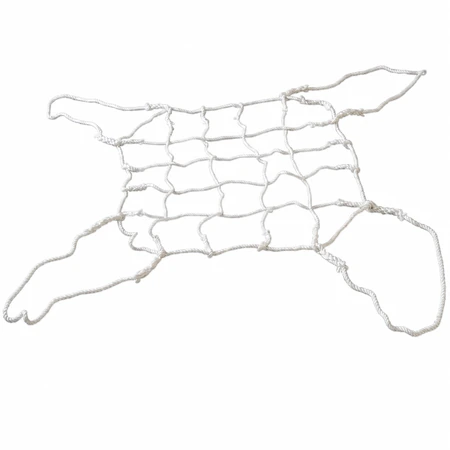
Shirkadda Lift Sling Rigging waxay soo saartaa Polyester Lifting Hoisting Net,Shabakadda Xamuulka ee Polyester,Safety Safety Net Suunka,Shabakadda Xamuulka ee Bungee,Shabagga Qaadista Xamuulka Polyester,Qaadista Sling Net,Shabakadda Qaadista Xadhkaha,Shabakadda Xamuulka ee Pallet,Beerta fuulka Net.
Shabakadda Sare u qaadida Polyester
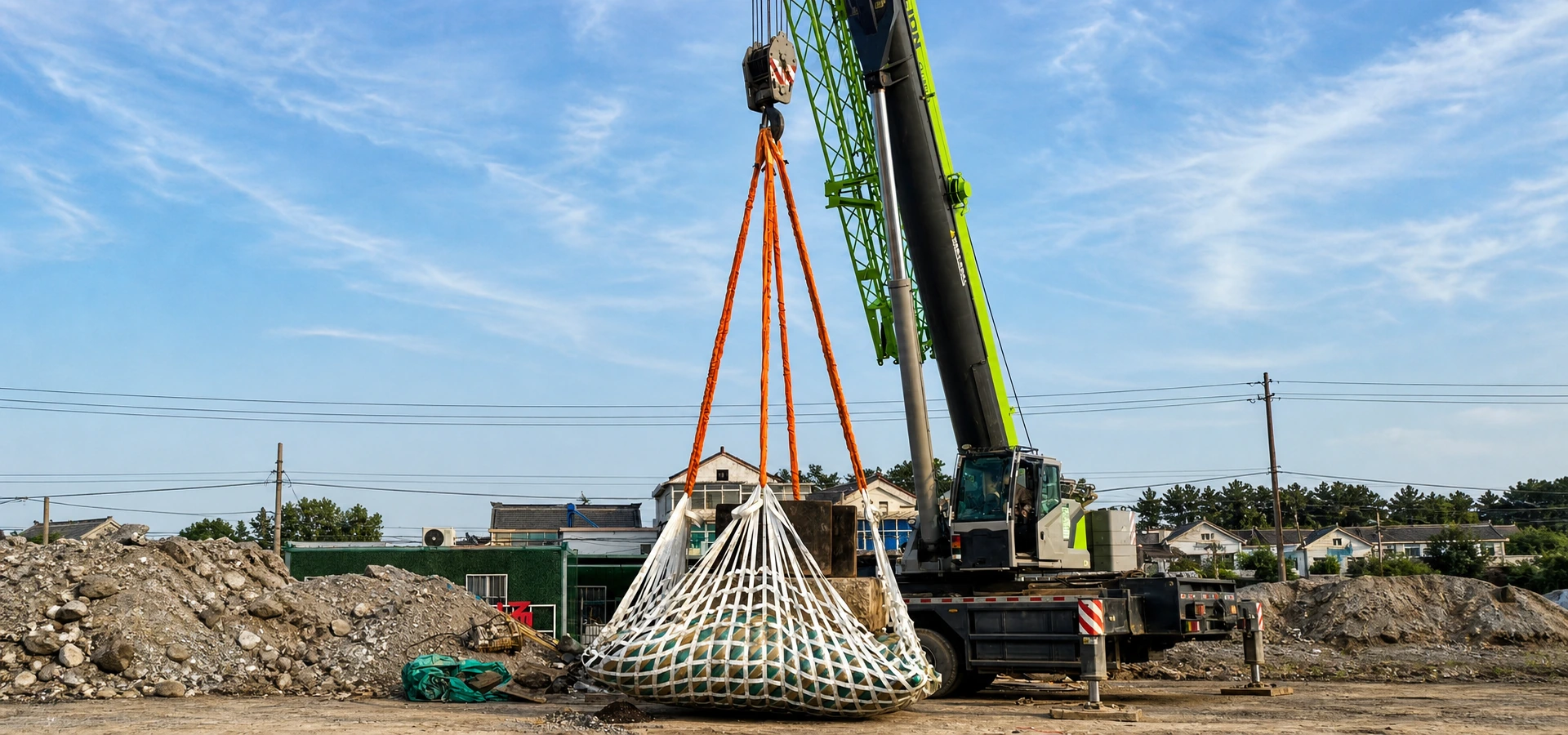
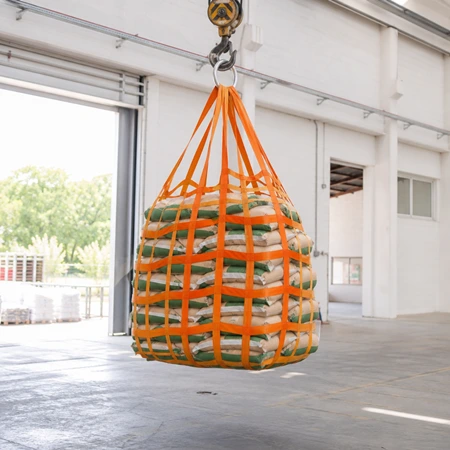
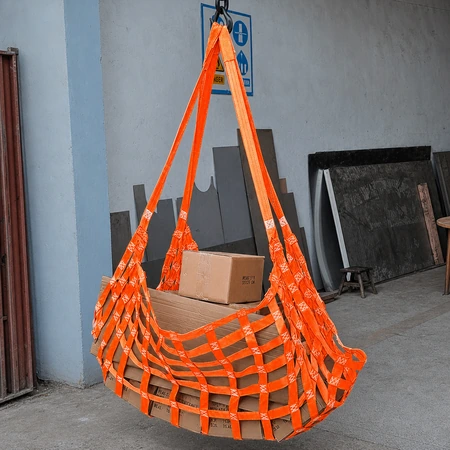
A polyester lifting hoisting net is a soft bag woven from high-tenacity polyester webbing, built to move bagged goods and bulk material in a single crane lift. The load is tipped into the bag, or the bag is laid flat and drawn up around a stack, and four corner loops carry the whole consignment to the hook. There is no pallet to return, no strapping to cut, and nothing to re-handle at the far end.
Because we weave the webbing in our own mill in Taizhou, Jiangsu, mesh furitaanka, bag footprint, qoto dheer, bottom construction and working load limit are all set to the cargo rather than to a fixed catalogue. Standard nets cover 0.5 t ku 20 t iyo 0.6 m³ in ka badan 10 m³, every net is proof-load tested before packing, and each shipment travels with a material test report. Nets are CE and GS certified, with webbing rated to the EN 1492-1 saldhig.
- Fully custom build – mesh, cabbirka bacda, qoto dheer, colour and safety factor (5:1, 6:1 ama 7:1) set to your specification.
- High-tenacity polyester webbing – 25 mm ku 100 guutooyin mm, kali ah, duplex or triplex, UV stabilised and rot-proof.
- Wear and heat resistant – working range -40 °C ku +100 °C, with a reinforced bottom for abrasive loads.
- Jilicsan, flexible and light – the flat band contacts the load over a wide area, so bags, cartons and finished surfaces are neither crushed nor marked.
- CE iyo GS la shahaado – tested on our own 1000 t mashiinka, with an ISO 9001 quality system and a CNAS-accredited laboratory behind it.
Why a webbing net bag, and not a rope net or a big bag
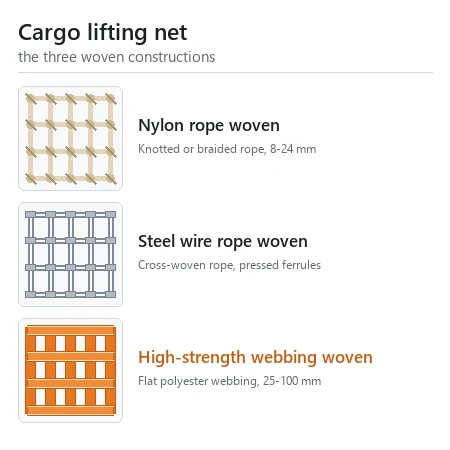
Three products are sold for the same job and they behave very differently once the load is in the air. A rope net concentrates the load on a few contact points. A big bag carries one free-flowing product and is itself the package. A webbing net bag spreads the pressure across flat bands, holds a stacked or mixed load together, and goes back to the store empty.
Shaxda 1 – How the four common ways of lifting loose cargo compare.
| Ikhtiyaarka | Dhismaha | La xidhiidh rarka | Best cargo | Limitation |
|---|---|---|---|---|
| Polyester webbing net bag | Flat woven bands, 25-100 mm, 25-300 mesh mm | Wide flat bands, low pressure per cm² | Boorsada, is dulsaaran, mixed and bulk cargo | Needs a crane or hook; not a sealed package for powder |
| Nylon rope net | Knotted or braided rope, 8-24 mm | Line contact at every rope | Irregular and heavy single items | Ropes mark soft cargo; a tight mesh adds weight |
| FIBC / big bag | Woven PP fabric with a liner | Full surface, sealed | One free-flowing product per bag | Single product only; the bag is the packaging |
| Pallet and strapping | Timber or plastic pallet plus bands | Rigid base | Unitised cartons | Pallet returned or lost; bands cut and discarded; no drainage |
Five decisions that set the specification
A polyester lifting hoisting net is quoted from five numbers. Get them right and the net arrives right; get the mesh wrong and no amount of extra tonnage will fix it later.
Shaxda 2 – What we need to know, and why each answer changes the net.
| Go'aan | Maxaa hagaajinaya | What to tell us |
|---|---|---|
| 1. Cargo form | Whether the net is a bag or a flat sheet, and how the bottom is built | How the cargo arrives: jawaanno, bacaha waaweyn, Bales, or loose material |
| 2. Weight per lift | Band width and layer count, and therefore the rated capacity | Miisaanka guud ee aad doonayso inaad kor u qaado, not the weight of the net |
| 3. Mug buuxa | Footprint and depth of the bag | Cufnaanta weyn (t/m³) for loose material, or the height of the stack for bagged goods |
| 4. Mesh furitaanka | The largest gap the cargo can pass through | The smallest unit in the load: a 25 kg bag, hadhuudh, aggregate or scrap |
| 5. Habka daadinta | xiran, xardhan, jeex ama hoos la safan | Whether the bag is tipped, untied over a hopper, or emptied by hand |
Weight and volume are two separate limits, and for light bulk the volume arrives first. Hadhuudh ku saabsan 0.7 t/m³ iyo jajabyo alwaax ah qiyaastii 0.3 t/m³ labaduba waxay buuxiyaan a 3.6 m³ bag, but one lift weighs about 2.5 t and the other about 1 t. Send the bulk density with the tonnage and we will size the bag so that a full bag is also a legal bag.
Xuduudaha farsamada
Jaantusyada hoose waxay daboolayaan bacaha caadiga ah iyo tirada guud. Mesh, raad, qoto dheer, bottom, loops and capacity are made to order, so treat this as the starting point for a quotation rather than a fixed catalogue.
Shaxda 3 – Polyester lifting hoisting net: xuduudaha farsamada.
| Halbeegga | Tilmaamid |
|---|---|
| Magaca alaabta | Polyester lifting hoisting net (boorsada shabagga ah ee polyester-ka) |
| Habaynta | Closed bag, release-bottom bag, or flat lifting net |
| Shabakadda internetka | 100 % polyester xoog badan (PET); nayloon adkeysi sare leh marka la codsado |
| Ballaca band | 25 / 38 / 50 / 75 / 100 mm (50 heerka mm) |
| Band construction | Lakab keli ah, duplex or triplex; woven selvedge, not a cut edge |
| dhumucda band | 1.8 mm – 4.5 mm waxay ku xidhan tahay ballaca iyo tirada lakabka |
| Mesh furitaanka | 100 × 100 heerka mm; 25 – 300 mm loo sameeyay si loo dalbado |
| Cabbirka saafiga ah | Lagu sameeyay raadka culeyska, truck bed or receiving hopper; see Table 4 |
| Moolka bacda | 0.8 m – 2.5 m, ama sawirid |
| Mug buuxa | Ku saabsan 0.6 m³ in ka badan 10 m³, set by footprint and depth |
| Xuduud | Laalaab iyo laba-tollan, reinforced at every lifting point |
| Dhibcaha qaadista | Heerka afar geesoodka gees; siddeed loogu talagalay laydhka fidsan; siddo kor iyo hoos marka la codsado |
| Awoodda la qiimeeyay (WLL) | 0.5 t – 20 t, dhigay by band, tirinta lakabka iyo habaynta qaadista |
| Qodobka badbaadada | 5:1 / 6:1 / 7:1 |
| Kordhinta WLL | 7 % ama ka yar |
| Midabka | Koodhka midabka iyadoo loo eegayo xadka culeyska shaqada, ama midab guri caadaystay |
| Heerkulka shaqada | -40 °C ku +100 °C |
| Weather and chemical | UV waa la xasiliyay, rot-proof, unaffected by rain, sea water and wash-down |
| Calaamadayn | WLL, mesh and batch printed on the belt, plus a sewn capacity label |
| Heerka caadiga ah | Webbing lagu qiimeeyay EN 1492-1 |
| Shahaado | CE, GS, ISO 9001, JIS on request; Shaybaadhka CNAS; DNV |
| Habaynta | OEM / Cabbirka ODM, midab, calaamad daabacan, sumadda iyo xirxirida |
| HS code | 6307.90 – nets and netting of textile materials |
Cabbirrada caadiga ah, volumes and working load limits
These six lines cover the great majority of bagged and bulk work. Filled volume is calculated from the footprint and the depth with an allowance for the rounded shape a loaded bag takes, so a material that settles well will carry slightly more and one that bridges will carry less.
Shaxda 4 – Standard net sizes at four corner loops gathered on one hook.
| Cabbirka saafiga ah (L × W) | Depth | Mug buuxa | Mesh | Kooxda | WLL | xamuulka caadiga ah |
|---|---|---|---|---|---|---|
| 1.0 × 1.0 m | 1.0 m | 0.6 m³ | 50-100 mm | 50 mm hal | 0.5-1.5 t | 25 bacaha kg, jawaano yaryar, Bales |
| 1.5 × 1.5 m | 1.2 m | 1.6 m³ | 50-100 mm | 50 mm duplex | 1-2.5 t | Badar bararsan, bacriminta, soo saar |
| 2.0 × 2.0 m | 1.5 m | 3.6 m³ | 50-100 mm | 50 mm duplex | 2-4 t | Hadhuudh badan, ciid, dhagax la jajabiyey |
| 2.5 × 2.5 m | 1.8 m | 6.8 m³ | 50-150 mm | 75 mm duplex | 3-6 t | Bacriminta badan, dhuxusha, qashinka, kalluunka |
| 3.0 × 3.0 m | 2.0 m | 10.8 m³ | 100-150 mm | 75 mm duplex | 4-8 t | Culaysyo waawayn, quay oo shaqada qabso |
| To drawing | 0.8-2.5 m | Si aad u dalbato | 25-300 mm | 25-100 mm | 0.5-20 t | Raad kasta, qoto dheer iyo xamuul |
The working load limits above assume a four-loop lift. A two-loop basket de-rates the net – ask for the derated figure rather than reading across from this table.
Mesh furitaanka, chosen from the cargo
Mesh is the one dimension that cannot be adjusted after the net is sewn, so it is sized from the smallest unit in the load rather than from the total weight.
Shaxda 5 – Mesh opening by cargo.
| Xamuulka | mesh lagu taliyay | Reason |
|---|---|---|
| 50 kg jawaanno, bacaha waaweyn, Bales | 100 mm | The sacks are far larger than the opening; the mesh only has to keep the stack together |
| 25 bacaha kg, jawaano yaryar | 50-75 mm | Small bags can squeeze through 100 mm once the load settles in the air |
| Hadhuudh, abuur, wax soo saarka la qalajiyey | 25-50 mm, ama xargaha xiran | Fine material must not sift out on the hook or in transit |
| Bacriminta, prills, budo | 25-50 mm, ama xargaha xiran | Fine and moisture-sensitive: a liner keeps the product in and the weather out |
| Ciid, quruurux, dhagax la jajabiyey | 50-100 mm | Way ku fiican tahay in lagu hayo tirada badan, open enough for rainwater to drain |
| Dhuxusha, kookaha | 100-150 mm | Large lumps; mesh ballaaran ayaa ilaaliya iftiinka saafiga ah oo si fiican u daadiya |
| Bir la iska xoqo, goyn | 100-150 mm | Open mesh with a reinforced bottom and wear pads at the contact points |
| Kalluunka, shellfish, soosaarka qoyan | 25-50 mm | Holds the catch, drains freely, keeps the weight honest |
| Logs, xabo, meelo waaweyn | 150-300 mm | Indivisible pieces: a wide mesh saves weight without losing the load |
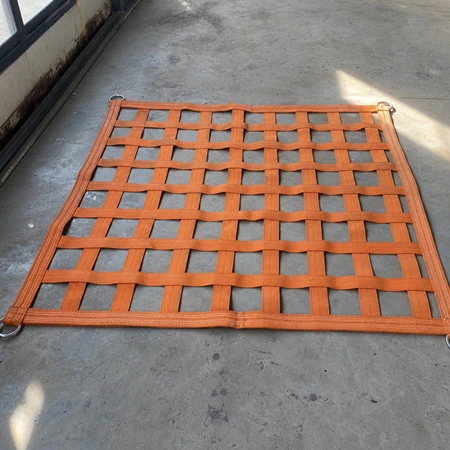
Bottom construction and discharge
How the load comes out is a design decision in its own right. For bagged cargo the answer is usually a person with a knife; for bulk it is usually gravity.
Shaxda 6 – Bottom options and how each one is emptied.
| Hoose | Sida ay u shaqeyso | Chosen when |
|---|---|---|
| xiran, si buuxda loo tolay | The bag holds the cargo permanently and is emptied by tipping or by hand | xamuulka bacaysan, and bulk tipped over a hopper or onto a pile |
| Release bottom, xardhan | Tolmo goglan oo xagga hoose ah ayaa laga furay meesha laga dareero, rarkuna wuu daadanayaa | Free-flowing bulk – ciid, hadhuudh, wadar ahaan – discharged without tipping the bag |
| Hooska hoose | The bag narrows to a chute opened over the receiving hopper | Controlled discharge into a hopper, doon ama gaadiid qaade |
| Closed with a liner | Maro maro ah ayaa dhex fadhiya shabagga | Dusty or moisture-sensitive bulk: hadhuudh, bacriminta, budo |
| Guddi hoose oo la xoojiyay | An extra layer of webbing is stitched across the base | Abrasive and heavy bulk: wadar ahaan, macdanta, qashinka |
| Loops top and bottom | Loops at both ends, so the bag can be lifted either way up | Loading at height, iyo faaruqinta adoo rogaya bacda jillaabka |
Lifting arrangements and fittings
Sida bacda loo laadlaadsan yahay ayaa go'aaminaysa inta culayska ay dhab ahaantii sidato, badiduna waa mid aan cafis lahayn sababtoo ah rarka ayaa ku socda gudaha bacda inta ay hawada ku jirto.
- Four loops on the hook – the standard for bagged and bulk work; the loops gather on the hook or a master ring and the bag closes around the cargo as the crane takes up the slack.
- Eight loops on a spreader beam – the bag stays square, rarka ayaa joogsanaya heerka, oo loop kastaa wuxuu sitaa saami la saadaalin karo; the right arrangement for large bags and high tonnage, noo arag kor u qaadida laydhka fidiyaha kala duwan.
- Two-loop basket – faster to rig, laakiin waxay hoos u dhigtaa shabagga; ask for the derated capacity instead of reading across from the four-loop figure.
- Loops top and bottom – lets the bag be lifted either way up, taas oo ah sida bacda xiran loo faaruqiyo iyada oo loo rogo boodboodka.
Fittings supplied or fitted on request: sewn webbing loops, master ring or master link, darajo 80 silsilado, laced release bottoms, chutes and discharge sleeves, inner liners, wear pads and protection sleeves for scrap and aggregate, and repair kits for fleets that maintain their own equipment.
Qalab, stitching and finish
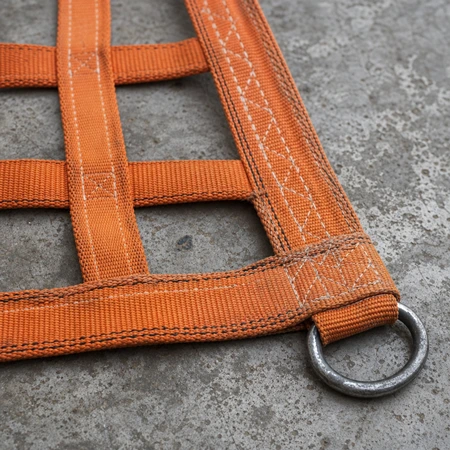
The belt is the product. We weave it on needle looms from high-tenacity polyester yarn, with a woven selvedge rather than a cut edge, so the band does not fray from the outside in.
- 100 % polyester xoog badan, dheerayn hoose (7 % or less at WLL), UV waa la xasiliyay, rot-proof and unaffected by moisture.
- Locked stitching in high-tenacity polyester thread, run in multiple rows along the border and box-X at every loop – on a cheap net it is the stitch line, not the belt, that fails first.
- Soohdin laablaaban iyo laba-tolan, so the edge of the mesh cannot unravel under load.
- Galvanised or stainless steel rings and master links on request.
- Polyester holds its strength from -40 °C ku +100 °C; above that, or in chemical exposure, tell us and we will quote nylon or another construction.
Tijaabinta, certification and traceability
- Forty years of lifting equipment manufacturing – lagu aasaasay 1985 Taizhou, Jiangsu, oo ka badan 200 employees and one of China’s largest lifting sling and net production bases.
- Every net is proof-load tested on our own 1000 t mashiinka tijaabada jiifka – tijaabiyey, not sampled.
- A material test report travels with each shipment, quoting the belt batch and the test load.
- CE declaration of conformity and GS certification, wata shahaadada JIS ee amarrada dhoofinta.
- ISO 9001 quality management system, a CNAS-accredited laboratory and DNV certification behind the plant.
- Every net is marked with its working load limit, mesh, rated volume and batch number before packing, markaa bacda iyo warqadaheedu mar walba waa ku heshiiyaan.
Certificates and test reports are available as PDFs for your tender or customs file – see the full shahaado dhigay.
Where these nets work
A polyester lifting hoisting net is used wherever loose cargo has to travel between a stack and a hook – quay, warshad, quarry, yard or hold. The sectors below are the ones where the bagged and bulk version earns its place.
Shaxda 7 – Applications by sector.
| Qaybta | Waxa shabaggu gacanta ku hayo | Waa maxay sababta shabakada polyester-ka ugu habboon tahay |
|---|---|---|
| Dekadaha, kaxaynta iyo terminalka | xamuulka bacaysan, hadhuudh, fertilizer and bulk between quay, barge and hold | Hal bac wiishkiiba, ma laha palette, rarkuna wuu ka daadanayaa markuu socdo |
| Beeraha iyo mashiinnada quudinta | Abuurka, hadhuudh, quudin, bacriminta iyo alaabta bacaysan | Shabag cidhiidhi ah ama xargaha ayaa alaabta ku ilaaliya cimiladuna dibadda |
| Qalabka dhismaha | Ciid, quruurux, dhagax la jajabiyey iyo sibidh baalaysan | Way ku fiican tahay in lagu hayo tirada badan, open enough for rainwater to drain |
| Macdanta iyo dhagax-dhigista | Isku geyn, bulk iyo macdan | Hooska la xoojiyay wuxuu qaataa nabarrada xirta shabagga |
| Kalluumeysiga iyo habaynta cuntada | Kalluun qoyan, shellfish iyo wax soo saarka | Marinnada mesh si xor ah u fur, which keeps the weight honest |
| Dib u warshadaynta iyo qashinka | balaastiig dabacsan, muraayad, bir iyo walxo isku dhafan | Contains loose material that would otherwise blow or fall |
| Biomass and power | Qoryaha looxa, jilif, pellets iyo shidaalka badan | Shandad weyn oo loogu talagalay tan dhexdhexaad ah, u dhigma xadka mugga |
| Construction sites and relief work | Bagged materials raised to upper floors, field cargo | No pallet, baan lahayn, waxaana si toos ah loogu faaruqi karaa dhulka |
Customisation and branding
A net that moves between quays, holds and yards has to be identifiable from a distance and has to keep its marking. Midabka, calaamad daabacan, working load limit and cargo type are all applied in our own plant, so the marking cannot be washed off or pulled away with a label.
- Koodhka midabka iyadoo loo eegayo xadka culeyska shaqada, or a custom house colour to separate your fleet from a competitor’s.
- Logo, brand name, warning text or certificate number printed on the belt, or woven in on larger orders.
- Cargo type printed on the bag, which stops a fine-mesh grain net being sent out for scrap.
- Sewn capacity label in addition to the print, so the net and its paperwork agree at every inspection.
- Packing folded into a bag or a crate – a set of ten net bags takes the space of one pallet.
Daryeel, kormeerka iyo hawlgabnimada
- Inspect the loops and their stitching first, ka dibna xuduudka, then the bottom closure – on a bulk net the bottom and the corners wear before the mesh does.
- Faaruqi bacda gebi ahaanba kaydinta ka hor; material left inside holds moisture, waxay kordhisaa miisaanka waxayna qarisaa dhaawaca.
- Raadi gooyo, naaxid, tolliin jabay, wasakhaynta kiimikada, dhaldhalaalka kulaylka iyo midabka ama dhalaalka ayaa isbeddelaya taas oo muujinaysa hoos u dhaca UV.
- Weigh a wet bag before lifting it. Roob, sea water and wet bulk can add far more than the cargo was rated at, shabagguna ma kala garanayo.
- Waligaa ha dhaafin awooda la qiimeeyay, waligaa ha qaadin wax ka yar siddooyinka buuxa ee buuxa, waligaa bac rartay ha u jiidin dhinaca wiishka.
- Ku kaydi nadiif ah oo engegan, ka baxsan dhulka iyo ka baxsan qorraxda tooska ah; never repair webbing by knotting, alxanka ama kuleylinta.
Su'aalaha soo noqnoqda
What is the difference between a polyester lifting hoisting net and a cargo net?
A lifting net is rated, marked and tested to carry a load on a crane hook. A cargo net is a restraint: it holds a load down in transit and is not designed to be lifted. If the net is going onto a hook, it must be the rated version – noo arag netka ilaalinta xamuulka for the tie-down case.
How do I choose the mesh opening?
From the smallest unit in the load, aan ka iman tan. A 25 kg bag needs 50-75 mm; grain or fertilizer needs 25-50 mm or a closed liner; scrap and coal can take 100-150 mm. Once the net is sewn the mesh cannot be changed, so this is the one number worth checking twice.
Why does the volume matter as much as the weight?
Sababtoo ah buka khafiifka ah ayaa buuxiya bacda ka hor intaysan gaarin miisaanka la qiimeeyay. A bag that is full at half its rating doubles the number of lifts and the crane time. Give us the bulk density with the tonnage and we will size the bag so a full bag is also a legal bag.
Ma la faaruqi karaa bacda iyada oo aan la taaban?
Haa. A laced release bottom or a chute bottom lets a free-flowing load be discharged straight into a hopper, doon ama gaadiid qaade. Bagged cargo is normally emptied by hand or with a forklift at the far end.
Shabagyadu ma qaadi doontaa xamuul qoyan?
The net itself is unaffected – polyester does not absorb water and does not rot, so rain, sea water and wash-down do no harm. Laba digtoonaan: wet cargo is heavier, and fine wet material can clog the mesh, taaso soo kordhisa culayska oo joojisa inay dareerto.
How is the working load limit proved?
Webbing-ka waxaa lagu qiimeeyay EN 1492-1 saldhig iyo shabagyada waxaa lagu bixiyaa at 5:1, 6:1 ama 7:1 sida loo cayimay. Every net is proof-load tested on our own 1000 t mashiinka, a material test report travels with the order, iyo alaabtu waxay wataan shahaadada CE iyo GS.
Do you make a flat version for palletised cargo?
Haa – the flat lifting net is the shabagga xamuulka wiishashka, and the material-led range is covered by the shabagyada polyester-ka ee kor u qaadista. The rope constructions sit alongside as the shabag qaadida xamuulka naylon iyo dharbaaxo shabag ah oo xamuul ah oo naylon ah.
What else do you make from the same webbing?
The same belt goes into our dharbaaxo iyo dharbaaxo wareeg ah oo aan dhammaad lahayn, and the wider cargo range is listed under shabagyada qaadista xamuulka – including the shabagga qaadista xamuulka webbing for flat work.
Codso xigasho
Send the cargo and whether it is bagged or bulk, cufnaanta bulk haddaad taqaan, miisaanka aad rabto wiishkiiba, mesh furitaanka, the discharge method and the environment the net will work in – or a sketch of the bag you have in mind. Injineeradayadu waxay xaqiijin doonaan cabbirka saafiga ah, qoto dheer, dhismaha hoose, band and packing and quote it in one reply. Si aad uga hadasho marka hore, la xidhiidh injineeradayada.
Shirkadda Lift Sling Rigging – Beerta Warshadaha ee Lifute, Magaalada Taizhou, Gobolka Jiangsu, Shiinaha
Tel: +86 523 8693 5818 | WhatsApp: +86 180 6600 2268 | E-mailka: lift98@jslift.com