

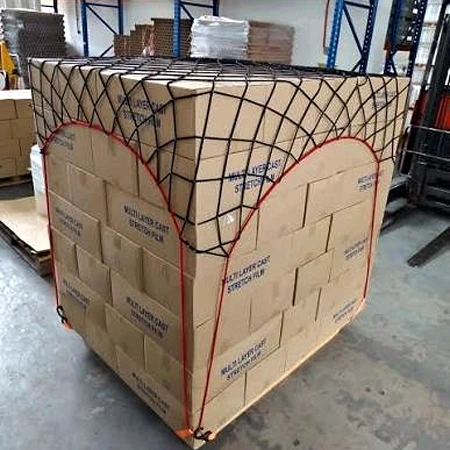
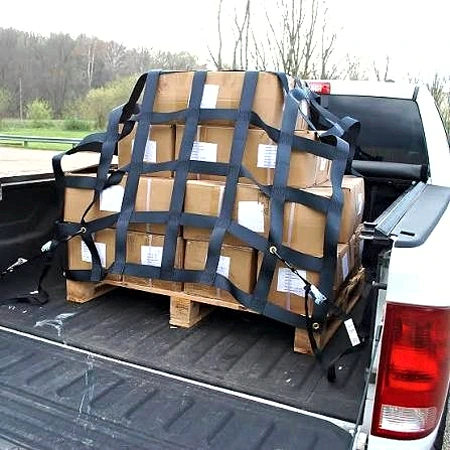
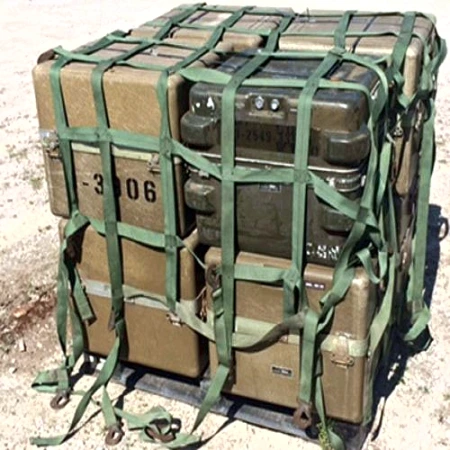
Shirkadda Lift Sling Rigging waxay soo saartaa Cargo Securing Net,Load Securing Net,Hubinta shabagga xamuulka mesh yar,Kontaynarada ilaalinta shabaqa,Xamuulka shabaqyada badbaadsan.
Securing Net
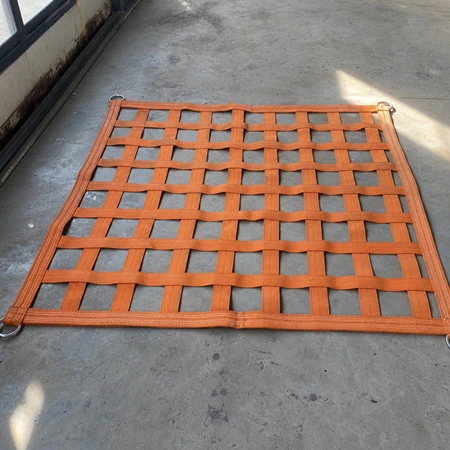
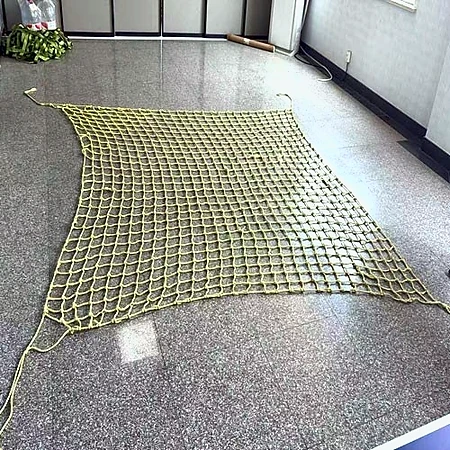
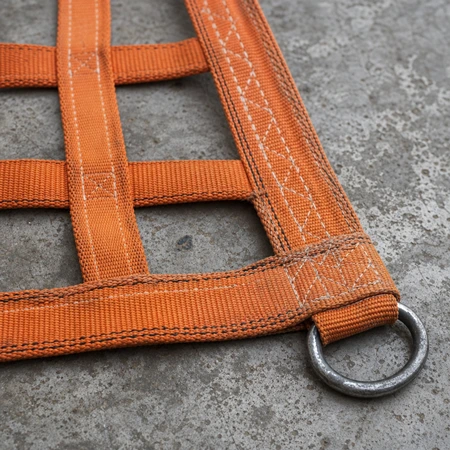
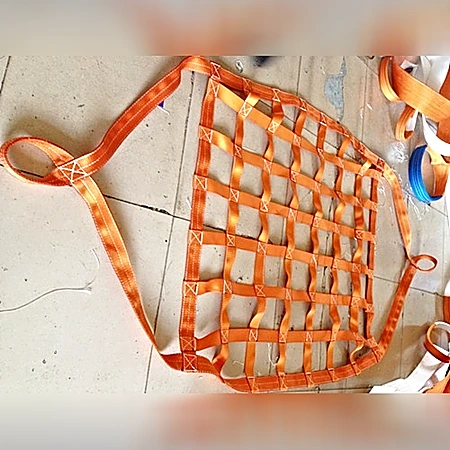
A cargo securing net is a flat-belt restraint net laid over a load and tensioned down to the deck, so that the cargo cannot slide, rock or topple on the way. The belts are woven from high-tenacity polyester into an open lattice, the border is folded and double-stitched, and the edge carries rated attachment points that are pulled down with ratchet tensioners until the load is pressed onto the vehicle or container floor.
The distinction that matters on this product is duty, not appearance. A cargo securing net restrains; it does not lift. Its label carries a lashing capacity (LC) and a standard tension force (STF) in daN, the arrangement is calculated to EN 12195-1 and the belts are type-tested to EN 12195-2 – not to a lifting working load limit. We weave the belts in our own mill in Taizhou, so net size, mesh, belt width, fittings and markings are set to your load, your vehicle and your anchor points.
- Restraint rating, ma aha qiimaynta wax qaadista – LC and STF marked in daN, calculated to EN 12195-1, belts type-tested to EN 12195-2.
- Flat high-tenacity polyester belts – 25 mm ku 100 mm, single or duplex, UV stabilised and rot-proof.
- Sized to the load or the aperture – cover nets, container doorway nets, partition nets and bag form, dhamaantood waa la dalbadaa.
- Rated fittings and tensioners – ratchets, qabatooyin, D-rings and lashing points, with anti-slip mats where the deck friction is low.
- CE iyo GS la shahaado – tolmo, tolsan, marked and tested in one plant, oo leh ISO 9001, CNAS and DNV behind it.

Restraint is not lifting – and the label says which one you have
The two products look alike, are made from the same belt and are often bought by the same fleet. Ma aha kuwo la is-beddeli karo, and the difference is not a formality: one is sized so a load cannot move, the other is sized so a load cannot fall. Using a restraint net on a crane hook, or a lifting net as a tensioned tie-down, is a safety failure rather than a paperwork problem.
Shaxda 1 – Why a securing rating and a lifting rating are not interchangeable.
| Barbardhigga | Badbaadinta shabagga (boggan) | Shabaq qaadista |
|---|---|---|
| Waxa ay qabato | Waxay xakameysaa culeyska saaran gaariga | Sidda culeyska buuxa ee culeyska hawada |
| Waxaa maamula | IN 12195-1 (xisaabinta sugidda ciidamada) iyo EN 12195-2 (dharbaaxo) | Heerarka kor u qaadista, with webbing rated on the EN 1492-1 saldhig |
| Lagu qiimeeyay | Karti dhirbaaxo (LC) iyo xoog kacsanaanta caadiga ah (STF), in daN | Xadka culeyska shaqada (WLL), oo tan ah |
| How it is sized | Sized to resist the acceleration and friction case for the journey | Lagu qiyaaso a 5:1, 6:1 ama 7:1 arrin iyo caddayn-lagu tijaabiyey dharbaaxadiiba |
| How it is tested | Belt and tensioner type-tested to EN 12195-2 | Every sling break-tested on our own 1000 t mashiinka |
| Siday u fashilanto | The load moves – a road accident | The sling breaks – a dropped load |
If the requirement is to lift – a pallet onto a roof, a bag into a hold – the right product is a lifting net: ah shabagga xamuulka wiishashka, ah shabagga kor u qaadaya polyester-ka ama ka dharbaaxo shabag ah oo xamuul ah oo naylon ah. If the requirement is to keep a load still from the loading bay to the delivery point, this page is the right one.
The forces the net has to answer for
A load on a moving vehicle is pushed in three directions, and each one is a design case rather than an accident. The accelerations below are the ones EN 12195-1 uses for road transport; other modes and national rules differ, which is why we ask where the load is travelling before we size the net.
Shaxda 2 – Design accelerations for road transport and what resists each one.
| Direction | Design acceleration | What resists it |
|---|---|---|
| Forward (braking) | 0.8 g | Blocking or a headboard first, then direct lashings to the front; friction contributes |
| Rearward (acceleration) | 0.5 g | Rear lashings and a tailboard; the net’s rear edge lines |
| Dhinac (cornering) | 0.5 g | Side lashings, containment by the lattice, and friction from the pre-tension |
| Toosan | Not a road design case | Held down by pre-tension and containment; a net reduces bounce but is not a substitute for blocking |
The practical consequence is that a net alone rarely carries the whole case. Blocking against a headboard does more for the braking case than any strap, and a net laid over the top does the rest. A good securing arrangement is a combination, and we will say so when a net is the wrong answer for your load.
Sida shabagga fidsan uu u xajiyo culayska
Shabakadda hubinta ahi waxay hal mar ku shaqaysaa saddex hab. Which one dominates depends on how the net is fitted, and that is decided at the vehicle rather than at the factory.
Shaxda 3 – The three mechanisms a securing net uses.
| Farsamaynta | Sida ay u shaqeyso | What it depends on |
|---|---|---|
| Kala jab (xidhxidhid) | Shabagga kacsan ayaa culeyska ku saaraya sagxada, iyo is jiid jiidka u dhexeeya rarka iyo sagxadda waxay ka hortagtaa simbiriirixidda. This is the main effect of a cover net | A nadiif ah, dry deck or anti-slip mats. Iyaga oo aan is khilaafin isla xakamaynta shabakada ayaa aad uga yar |
| Kasbashada | Shabaggu jir ahaan wuxuu joojiyaa rarka fiditaanka, rocking, or throwing individual items out | A mesh fine enough for the smallest item, and a net fitted tight rather than draped |
| Direct lashing | Where the edge belts run down to rated points on the vehicle, suunka laftiisa ayaa qaadaya xoogga xakamaynta | Certified anchor points on the vehicle – never a random protrusion or a load’s own packaging |
Two numbers decide whether the arrangement works, and both are usually ignored. The first is the angle: a tie-down belt is most effective between 75 iyo 90 darajo ilaa sagxada, and its effective capacity follows LC_eff = LC × sin α. Marka 30 degrees you keep roughly half the belt’s rating, so a net pulled down almost flat looks tidy and holds very little. The second is friction: the coefficient between a steel load and a steel deck is about 0.1 ku 0.2, steel on timber about 0.2 ku 0.3, timber on timber about 0.3 ku 0.4, and a good anti-slip mat takes a pallet on a deck to about 0.5 ku 0.6. Qoyan, oily or icy surfaces take all of these figures down, which is why the same net restrains very different loads on two different days.
Xuduudaha farsamada
Sawirada hoose waxay daboolayaan heerka sugitaanka. Suunka, mesh, cabbirka saafiga ah, Qalabka cidhifka iyo kiciyayaasha dhamaantood waa la dalbadaa, marka shaxdan ula dhaqan sidii meesha laga bilaabayo oraahda halkii aad ka ahaan lahayd buug go'an.
Shaxda 4 – Badbaadinta shabagga: xuduudaha farsamada.
| Halbeegga | Tilmaamid |
|---|---|
| Nooca alaabta | Badbaadinta shabagga (shabagga xakamaynta) – cover net, partition net, container doorway net or bag form. Ma aha qalabka wax lagu qaado |
| Belt material | 100 % polyester xoog badan (PET); nayloon adkeysi sare leh marka la codsado |
| Ballaca suunka | 25 / 35 / 50 / 75 / 100 mm |
| Belt construction | Hal lakab ama laba-lakab, woven selvedge, not a cut edge |
| Belt thickness | 1.8 mm – 4.0 mm waxay ku xidhan tahay ballaca iyo tirada lakabka |
| Mesh furitaanka | 100 × 100 heerka mm; 50 mm – 300 mm loo sameeyay si loo dalbado |
| Cabbirka saafiga ah | Lagu sameeyay raadka culeyska, sariirta gaariga, ama weelka ama daloosha albaabka |
| Karti dhirbaaxo (LC) | Ku saabsan 750 daN on a 25 mm belt to about 5,000 daN on a 100 mm duplex belt, marked per net |
| Xiisad ka hor (STF) | 250 – 500 daN depending on the tensioner supplied; marked on the label |
| Heerka caadiga ah | IN 12195-1 for the securing calculation; IN 12195-2 for the webbing lashing |
| Xuduud | Laalaab iyo laba-tollan; lagu xoojiyay bar kasta oo lifaaq ah |
| Qalabaynta | Ratchet kiraystayaasha, qabatooyin, D-rings, cam buckles and lashing points, darajo 80 steel where steel is used |
| Midabka | Orange for high visibility as standard; buluug, cagaar, black or a custom colour |
| Daawaynta | UV waa la xasiliyay, gabowga lidka ku ah, naaxinta iyo jeexjeexa u adkaysta, rot-proof |
| Heerkulka shaqada | -40 °C ku +100 °C |
| Shahaado | CE, GS, ISO 9001, JIS on request; Shaybaadhka CNAS; DNV |
| Habaynta | OEM / Cabbirka ODM, midab, printed belt, calaamad, logo and packing |
| HS code | 6307.90 – nets and netting of textile materials |
Cabbirrada caadiga ah, mesh and lashing capacity
A securing net is sized to the load it covers or the aperture it closes, never to a tonnage. The load has to be fully covered, and the border has to land on the deck or on the anchor points instead of hanging in mid-air, because an unsupported edge is an edge that can be pulled sideways.
Shaxda 5 – Standard securing net sizes, with the belt and capacity that normally go with them.
| Cabbirka saafiga ah (L × W) | Mesh | Suunka | LC per edge line | Isticmaalka caadiga ah |
|---|---|---|---|---|
| 1.2 × 1.2 m (4 × 4 ft) | 100 mm | 35 – 50 mm | 1,000 – 2,000 Iyo | Single pallet in a van or light truck |
| 2.5 × 1.2 m (8 × 4 ft) | 100 mm | 50 mm | 2,000 Iyo | Two pallets abreast in a van or curtain-sider |
| 2.5 × 2.5 m | 100 mm | 50 mm | 2,000 Iyo | Culaysyo fidsan, mashiinka, mixed cargo |
| 5.0 × 2.5 m | 100 – 150 mm | 50 – 75 mm | 2,000 – 3,500 Iyo | Dherer buuxa oo fidsan iyo culeysyo trailer ah |
| 2.4 × 2.6 m (weel) | 100 mm | 75 mm | 3,500 Iyo | Container doorway net, load held back from the doors |
| 1.5 × 1.5 m bag form | 50 – 100 mm | 50 mm | 2,000 Iyo | Loose or bagged goods that would spread on the deck |
| Loo sameeyay sawir | 50 – 300 mm | 25 – 100 mm | To calculation | Raad kasta, aperture or vehicle bed |
The capacity column is the restraint available per edge line, not a lifting limit. The number of edge lines, their angle and the friction under the load decide what the arrangement actually restrains.
Four forms of securing net
The same lattice is supplied in four arrangements, and choosing the right one is most of the job. Qalabku way ku kala duwan yihiin; mabda'a xakameyntu ma sameeyo.
Shaxda 6 – Dabool, partition, container and bag forms.
| Foomka | Sida loo rakibay | La isticmaalo marka |
|---|---|---|
| Shabagga dabool | Spread over the load and tensioned down to the deck or to the vehicle’s rated points | Gogol fidsan, curtain-sider and container loads that must not move in any direction – the most common arrangement |
| Partition net | Fixed upright across the vehicle body and tensioned against its own frame | Separating two loads in one vehicle, or holding cargo away from a bulkhead |
| Container doorway net | Fitted across the door aperture and hooked to the container’s own rings | Stopping cargo migrating to the doors during the journey, so the container is safe to open |
| Foomka bac | Closed at the bottom, with the cargo sitting inside the lattice | Loose or bagged goods that would otherwise spread across the deck |
Qalabaynta, tensioners and anti-slip
A securing net is only as good as the tensioner that pre-tensions it and the anchor point it pulls against. These are the parts that get specified last and fail first.
Shaxda 7 – Qalabaynta iyo kicinta.
| Ku habboon | Loo isticmaalo | Ogow |
|---|---|---|
| Xiisadaha ratchet | Shabagga dabool, foomka bacda | Dejiya xiisadda ka hor (STF). A ratchet that cannot reach the marked STF makes the net ineffective, whatever its LC |
| Cam ku xidhid | waajib khafiif ah | Faster than a ratchet but reaches a much lower pre-tension – for light loads only |
| Hooks iyo D-rings | Habayn kasta | The link between net and anchor point; darajo 80 bir meesha birta lagu rakibo lagu isticmaalo |
| Dhibcaha canaanta | Shabagga dabool | Rated anchor points in the vehicle structure – the restraint force has to go somewhere rated |
| Derin-ka-hortagga | Is-xakamaynta jajabka | Raises the friction coefficient under the load; usually the single most effective addition on a smooth deck |
| Gacanta ilaalinta | Culays af-filan | Ku habboon suunka korkiisa barta xiriirka; habka ugu jaban ee loo kordhiyo nolosha saafiga ah |
| Qalabka dayactirka | Fleet maintenance | Matching belt, dunta tolida iyo kiciye firaaqada ah |
Calaamadayn, colour and identification
A securing net is checked by the driver before every trip and by an inspector at the roadside, so the marking has to be readable at a distance and has to survive being dragged over a deck.
- Lashing capacity and standard tension force printed along the belt in daN – the units load securing is actually calculated in.
- Net size and date of manufacture printed as well, so the net can be matched to the vehicle and its age judged on the spot.
- A sewn capacity label in addition to the print, so the net and its paperwork always agree.
- Orange as the standard high-visibility colour, with blue, cagaar, black or a house colour for fleet identification.
- OEM orders can carry your brand, warning text or certificate number printed on the belt.
- Nets ship folded into a bag or a crate – a fleet order takes a fraction of the space of the same number of loose straps.
Tijaabinta, certification and traceability
- Forty years of lifting equipment manufacturing – lagu aasaasay 1985 Taizhou, Jiangsu, oo ka badan 200 shaqaalaha.
- Belts woven in our own mill, si ballac ah, layer count and colour are under our control rather than bought in.
- Webbing strength-tested on our own 1000 t horizontal machine before it is cut into nets.
- Belts supplied to the EN 12195-2 material requirements for securing duty, with the securing calculation following EN 12195-1.
- CE declaration of conformity and GS certification, with JIS on export orders; ISO 9001, CNAS laboratory accreditation and DNV certification behind the plant.
- Shabag kasta oo lagu asteeyay awooddiisa garaacid, kacsanaan ka hor, cabbirka iyo mesh ka hor inta aan la xidhin, and supplied with a material test report on request.
Certificates and test reports are available as PDFs for a tender file or a customs check – see the full shahaado dhigay.
Halka lagu isticmaalo shabaqyada ilaalinta xamuulka
The same net covers a road trailer, a container, a rail wagon and a barge. What changes is the number of anchor points, the mesh and how the net is tensioned – not the product itself.
Shaxda 8 – Applications by transport mode.
| Habka ama qaybta | Maxaa shabaggu xakameeyaa | Waa maxay sababta shabag-suunka fidsan ugu habboon tahay |
|---|---|---|
| Waddada – fidsan | Mashiinada, bir, alwaax, sariiraha, durbaanno iyo xamuul isku dhafan | Waxay ku dabooshaa dhammaan culeyska hal fal waxayna ku darsataa khilaaf iyo xakameyn |
| Waddada – daah-side | Palletised and boxed goods that shift against a soft curtain | Waxa ku jira culayska meesha daaha laftiisu aanu qaadin wax xakamayn ah |
| Gaadiidka konteenarada | Xamuulka albaabbada gadaashiisa, and cargo that must not migrate in transit | A doorway net makes the container safe to open and stops the load moving forward |
| Xamuulka xadiidka | Palletised and loose cargo in wagons and on flat wagons | Shabaqyada dhaadheer waxay dabooshaan sariirta gaadhiga waxaana lagu kicin karaa wakhtiyo joogto ah |
| marin-biyoodka badda iyo gudaha | xamuulka sagxada, iyo shixnado gudaha shixnadaha iyo kaydinta | Qulqulka, UV stabilised and unaffected by salt water |
| Xamuul culus iyo xamuul mashruuc | Transformers, rarka dhirta iyo kuwa ka baxsan | Waxaa lagu daraa karbaash toos ah iyo xannibaadyo aan la qaybsan karin |
| Qashin, dib u warshadaynta iyo beeraha | Bales, diid, compost iyo culaysyo badan oo saaran baabuurta furan | Haysashadu waxay joojisaa walxaha dabacsan ee ka tagaya baabuurka ku sii socda |
| Military and relief transport | Palletised and loose cargo in trucks and aircraft | Hal shabag halkii rar, degdeg ah in la codsado oo dib loo isticmaali karo safaro badan |
Daryeel, kormeerka iyo hawlgabnimada
- Check the net before every trip and record the check: the tensioner first, ka dibna tollida meel kasta oo lifaaq ah, ka dibna suumanka.
- Dii suunka kasta oo gooyo leh, dhaawac gees, tolliin jabay, wasakhaynta kiimikada, dhaldhalaalka kulaylka, or the colour and gloss change that signals UV degradation.
- Check the vehicle’s anchor points as carefully as the net. A perfect net on a corroded lashing point restrains nothing.
- Sagxada sagxada ka dhig mid nadiif ah oo engegan, and fit anti-slip mats wherever load-to-deck friction is low. That is a securing measure, ma turxaan bixin.
- Never use a securing net to lift, and never use a lifting net as a tensioned tie-down unless its label carries both ratings.
- Ku kaydi nadiif ah oo engegan, ka baxsan dhulka iyo ka baxsan qorraxda tooska ah; never repair a webbing belt by knotting, alxanka ama kuleylinta.
- Withdraw the net if a belt, khad tolmo ah ama kiciye ayaa dhaawac gaadhay, oo aad haysato shabagyada uu kormeero qof karti u leh muddada u dhexaysa kooxdaadu waxay u baahan tahay.
Su'aalaha soo noqnoqda
Can a cargo securing net be used to lift a load?
Maya. It is rated for restraint, aan qaadin, Labadaasna waxaa lagu xisaabiyaa saldhigyo gebi ahaanba kala duwan. If the load has to go onto a hook, use a lifting net with a working load limit and a per-sling proof test – the crane pallet cargo net or the polyester lifting hoisting net, both linked earlier on this page.
Waa maxay farqiga u dhexeeya LC iyo STF?
LC (awoodda dharbaaxada) waa xoogga xakamaynta suunka lagu qiimeeyay inuu qaado. STF (xoogga kacsanaanta caadiga ah) waa sida ay u adag tahay xiiqeeyaha ratchet-ku uu hore u sii kicin karo suunka. Both are marked in daN. LC ayaa ugu muhiimsan garaacista tooska ah, halkaasoo suunka laftiisa uu ku hayo culeyska; STF ayaa ugu muhimsan dhanka karbaashida, where the pre-tension creates the friction that does the holding.
Sidee bay u adag tahay shabaggu?
Ku dheggan si ay u gaadho xiisadda hore ee ku calaamadsan calaamadda, with the belts running as steeply to the deck as the load allows – 75 ku 90 degrees is where a tie-down belt works best. A belt laid almost flat keeps only about half its capacity, sidaas darteed shabag si fiican u daboolan ayaa hayn kara wax aad u yar.
Miyaan u baahanahay sariiraha ka-hortagga simbiriirrada??
If the restraint relies on friction – which is what a cover net does – then usually yes. On steel, aluminium or plastic surfaces the friction coefficient is low, and a mat often adds more restraint than an extra strap does. A nadiif ah, dry deck is the other half of the same measure.
Immisa karbaash ama dhibco barroosin ayaan u baahanahay?
Waxay ka soo raacdaa culeyska, khilaafka sagxada, the vehicle and the journey rather than from a rule of thumb. Direct lashing normally needs at least four anchor lines, laba dhinacba way ka gudbeen, with the vertical and plan-view angles between 30 iyo 60 shahaadooyinka. Noo soo dir faahfaahinta rarka iyo gaadiidka anaguna waan kula shaqayn doonaa habaynta.
Will a net stop cargo moving inside a container?
Shabagga albaabka ama qaybta qaybintu waxay joojisaa rarka u guuraya albaabbada waxayna ka dhigaysaa weelka mid ammaan ah in la furo. For the journey itself the load still has to be restrained as a whole, sidaas darteed weelka waxaa inta badan lagu xafidaa shabag qaybin oo lagu daray xannibaado ama godad halkii shabag keligiis ah.
Maxaa furida mesh ee aan dooranayaa?
Fine enough that the smallest item in the load cannot pass through. 100 mm waa halbeeggeena oo waxay haysaa sariiraha, kartoonada, bacaha iyo durbaannada; alaabta dabacsan ama yar yar waxay u baahan yihiin mesh adag, iyo culaysyo waaweyn oo aan la qaybsan karin ayaa qaadan kara mid ballaaran.
Maxaa kale oo aad u sameyso maaraynta rarka?
The same belts go into our dharbaaxo iyo dharbaaxo wareeg ah oo aan dhammaad lahayn, the wire rope range is under dharbaaxooyin xadhig, the rope itself under xadhkaha naylon, and RoRo and breakbulk work is covered by the shabagga qaadista gaadiidka. The lifting side of the net range starts at shabagyada qaadista xamuulka.
Codso xigasho
Send the transport mode, the load weight and dimensions, haddii uu fidi karo ama uu rogrogi karo, the deck material, cabbirka shabagga ama aperture-ka, the belt width and the anchor points you have – or a drawing of the load and the vehicle. Injineeradayada ayaa xaqiijin doona shabakada, qalabyada, tirada xadhkaha garaaca iyo baakaynta, oo hal jawaab ku soo qaado. Si aad uga hadasho marka hore, la xidhiidh injineeradayada.
Shirkadda Lift Sling Rigging – Beerta Warshadaha ee Lifute, Magaalada Taizhou, Gobolka Jiangsu, Shiinaha
Tel: +86 523 8693 5818 | WhatsApp: +86 180 6600 2268 | E-mailka: lift98@jslift.com