

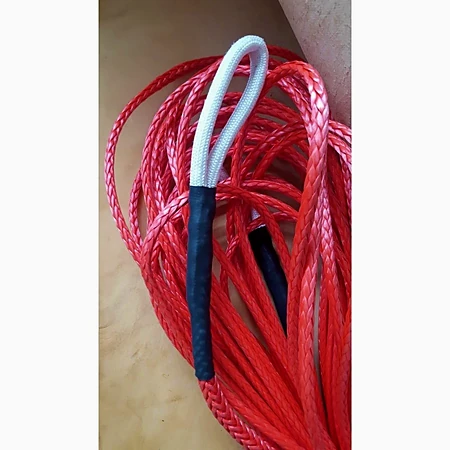
Lift sling rigging company produce Ultra high molecular weight polyethylene braided rope,high-strength UHMWPE cord,UHMWPE Rope,UHMWPE Mooring Rope,UHMWPE braided rope,12-strand UHMWPE Coated Rope,UHMWPE rope · HMPE rope · ultra high molecular weight polyethylene braided rope · 12-strand UHMWPE braided rope · 8-strand braid · 16-strand braid · double braid · UHMWPE cord · Dyneema-type braided rope · UHMWPE mooring rope · UHMWPE coated rope.
UHMWPE Braided Rope
A UHMWPE braided rope is a rope braided from ultra-high molecular weight polyethylene multifilament yarn — the fibre the rope trade calls HMPE, and sells under the brand names Dyneema and Spectra. It is specified for one combination that no other rope fibre offers together: the highest strength for its diameter and the lowest stretch. On top of that it floats and absorbs essentially no water, so it does not get heavy or lose strength when it is wet.
We braid UHMWPE rope in 8, 12 and 16-strand single braid and in double braid, from 6 mm to 32 mm as standard and up to 60 mm to order, in coils to 1000 m and in any cut length. Elongation at break is approximately 3–4 %, and a UHMWPE rope weighs roughly a seventh of a steel wire rope of the same breaking strength.
 A UHMWPE braided rope: 12-strand single braid, no rotation under load, and no core hidden inside a cover.
One Fibre, Four Names
Buyers reach this rope through four different words, and they all describe the same article. UHMWPE — ultra-high molecular weight polyethylene — is the polymer. HMPE is the short form used in rope specifications and by most rope makers. Dyneema and Spectra are brand names for the same fibre family. A rope quoted as Dyneema rope, HMPE rope or UHMWPE rope is the same construction under three labels, and the specification that tells you what you are getting is the braid, the diameter and the published breaking strength — not the word on the quotation.
What the fibre itself brings, at our published figures:
- Approximately 3–4 % elongation at break — the lowest of any common rope fibre, so the load stays where it was set and the height is not lost on the way up.
- Specific gravity 0.97 — it floats, where polyester (1.38) and nylon (1.14) both sink.
- Water absorption approximately 0 % — no strength loss when wet, and no stiffening in cold, wet conditions.
- Excellent abrasion resistance and good chemical resistance against acids, alkalis, salt water, oils and most organic solvents.
- Highest strength at equal diameter, which is why the same duty is served by a smaller, lighter rope — or by a lighter rope of the same diameter.
- Very low stored energy. Under load a UHMWPE rope stores almost nothing, so if it ever parts there is very little recoil — the opposite of steel wire rope.
 UHMWPE multifilament yarn gathering into the braid. The fibre, not the construction, is what makes the rope light and low-stretch.
Where UHMWPE Is the Wrong Choice
The same properties that make it the right rope for lifting and pulling make it the wrong rope for two other duties, and it is worth being plain about both before the order is placed.
- Heat. Approximate melting point 145 °C and a working range of −40 °C to +70 °C. UHMWPE is not a heat rope. Keep it off hot surfaces and exhausts, and where heat is the duty — berths, plant rooms, fire service — specify a para-aramid instead: see aramid braided rope and high heat resistance mooring rope.
- Shock loading. Absorption is low by design. Where the duty is repeated snatch and shock rather than a steady load, nylon absorbs the energy better — the trade-off is that nylon also stretches under a steady load.
- Sharp edges. Abrasion resistance is excellent, but any synthetic rope wants a chafe sleeve where it crosses a concrete kerb, a steel corner or a rough quay.
- Knots. UHMWPE is slippery and knots work loose, besides giving away a large part of the strength. It is spliced, not knotted.
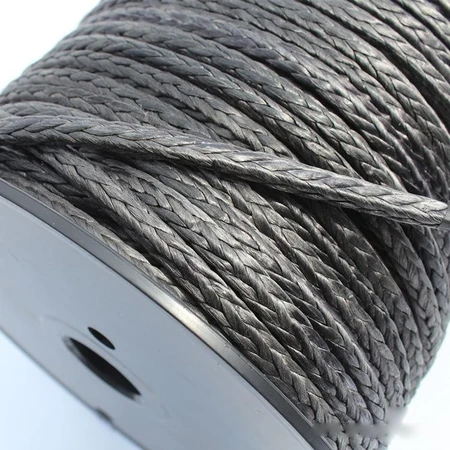
 The braid close up. Twelve strands interlace so the section is symmetrical — that is why a braided UHMWPE rope does not rotate or unwind under load, as a twisted one can.
Braided Construction — 8, 12, 16 Strand and Double Braid
UHMWPE is a slippery fibre, and that decides the construction: a twisted rope can unwind and rotate under load, while an interlaced braid holds its lay and stays neutral. Our standard construction is 12-strand single braid, and the alternatives each answer a particular job.
- 8-strand braid — economical and still non-rotating; suits general utility duty.
- 12-strand single braid — the standard UHMWPE construction, and the one the published strength tables on this page are quoted for. Every strand shares the load, and there is no cover to strip or core to hide damage.
- 16-strand braid — a finer surface with more strands over the circumference, for a better hand and more even abrasion behaviour.
- Double braid — a braided core inside a braided cover, so the cover takes the abrasion while the core carries the load, and the two can be chosen separately.
A polyurethane or marine coating is available on any of them: it locks the braid for splicing and handling, and it adds abrasion and UV protection to the outside of the rope.
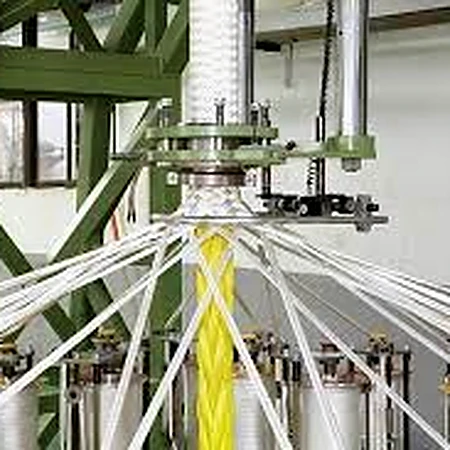
 Braiding in progress: the strands are interlaced, not twisted. The construction is set on the machine, so diameter and braid angle are controlled together.
Technical Parameters — UHMWPE Braided Rope
The series below is our standard 12-strand single braid. Breaking strengths and weights are published minimum values, and the reference working load applies a 5:1 safety factor and assumes a spliced termination rather than a knot.
| Diameter | Approx. weight (g/m) | Minimum breaking strength | Reference working load at 5:1 |
|---|---|---|---|
| 6 mm | ≈ 20 | 31 kN (3.2 t) | ≈ 6.2 kN |
| 8 mm | ≈ 30 | 54 kN (5.5 t) | ≈ 10.8 kN |
| 10 mm | ≈ 50 | 85 kN (8.7 t) | ≈ 17.0 kN |
| 12 mm | ≈ 70 | 122 kN (12.4 t) | ≈ 24.4 kN |
| 14 mm | ≈ 100 | 167 kN (17.0 t) | ≈ 33.4 kN |
| 16 mm | ≈ 130 | 218 kN (22.2 t) | ≈ 43.6 kN |
| 18 mm | ≈ 170 | 275 kN (28.0 t) | ≈ 55.0 kN |
| 20 mm | ≈ 200 | 340 kN (34.7 t) | ≈ 68.0 kN |
| 24 mm | ≈ 290 | 490 kN (50.0 t) | ≈ 98.0 kN |
| 28 mm | ≈ 400 | 666 kN (67.9 t) | ≈ 133.2 kN |
| 32 mm | ≈ 520 | 870 kN (88.7 t) | ≈ 174.0 kN |
| Item | Specification |
|---|---|
| Product names | UHMWPE braided rope · UHMWPE rope · HMPE rope · UHMWPE cord · 12-strand UHMWPE braided rope · UHMWPE mooring rope · UHMWPE coated rope · Dyneema-type braided rope |
| Model | LF-UH-12S (custom model codes available for OEM orders) |
| Material | 100 % UHMWPE (HMPE) multifilament yarn |
| Construction | 12-strand single braid as standard; 8-strand, 16-strand and double braid (braid-on-braid) on request |
| Standard diameters | 6 · 8 · 10 · 12 · 14 · 16 · 18 · 20 · 24 · 28 · 32 mm (custom range up to 60 mm) |
| Diameter tolerance | ± 3 % |
| Standard lengths | 50 m · 100 m · 200 m · 500 m · 1000 m — cut to any length, with or without metre markings |
| Elongation at break | Approximately 3–4 % |
| Specific gravity | 0.97 — the rope floats |
| Water absorption | Approximately 0 % — no loss of strength when wet |
| Working temperature | −40 °C to +70 °C |
| Melting point | Approximately 145 °C |
| Abrasion resistance | Excellent — better than polyester or nylon |
| UV resistance | Good; benefits from a protective coating for permanent outdoor exposure |
| Chemical resistance | Good against acids, alkalis, salt water, oils and most organic solvents |
| Coating / finish | Uncoated, or polyurethane / marine coating for abrasion and UV protection and a locked braid |
| Colour | Red · green · white · yellow · orange · black · grey · custom colours |
| End finishing | Hand-spliced eye · spliced eye with stainless thimble · hook · swivel · plain whipped or heat-sealed end; optional braided chafe sleeve on the working section |
| Marking | Diameter, breaking load, length and batch number on the label or worked into the braid |
| Packing | Coil with label, wooden reel or carton; custom label and barcode available |
| MOQ & OEM | Low MOQ for trial orders; full OEM — diameter, colour, length, splicing, printed logo and packaging |
Splicing — Where the Strength Is Kept or Lost
The ends decide how much of the rope you actually get to use. A 12-strand hand splice retains approximately 90 % of the rope’s strength, with no metal hardware and nothing to corrode. A knot gives away a large part of the strength, and on a slippery UHMWPE rope it is also the point most likely to work loose under load — which is why a load-bearing UHMWPE rope is specified with spliced ends.
Choose the termination for what the eye bears on: a plain spliced eye where it connects to a shackle or another splice, a stainless thimble eye where it wears against a hook, pin or drum, a hook where the rope is rigged and re-rigged by hand, and a whipped or heat-sealed plain end where it has to reeve through a sheave or be spliced on site. Remember that a finished end shortens the usable length, so allow for it in the figure you order.
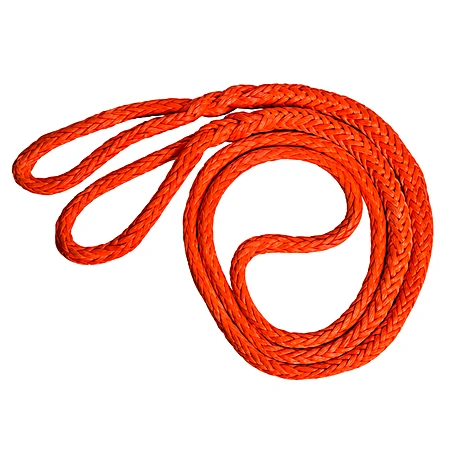
 A hand-spliced eye: the rope doubles back into itself, so the splice keeps around 90 % of the rope’s strength where a knot would give a large part of it away.
Where UHMWPE Braided Rope Is Used
- Lifting and rigging where low stretch and low weight both matter, and where the rope is treated as a marked load path rather than as general cordage.
- Cable pulling and stringing — a UHMWPE line is hand-hauled all day because it weighs a fraction of the steel it replaces. See cable pulling rope.
- Winch lines and vehicle recovery, where the very low stored energy means very little recoil if the line parts. See utility winch line.
- Mooring, towing and anchor lines, where the weight of steel is the problem and the rope needs to float.
- Yacht rigging, running rigging and control lines, where weight aloft and stretch both cost performance.
- Arborist, utility and access work, where a light, low-stretch, non-rotating line is handled to a height every day.
Two duties sit outside this list, and both are worth stating. Where a person could fall, the rope must be made and certified for that duty — a general-purpose UHMWPE rope, however strong, is not a fall-protection device: see safety lifeline rope and climbing rope. Where heat is the duty, the fibre to specify is aramid, not UHMWPE.
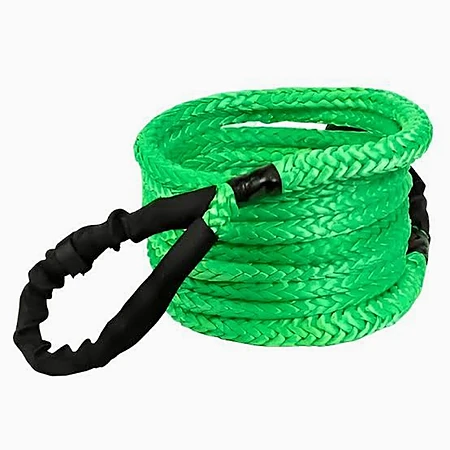
 As supplied: coiled, labelled, with the ends finished. Tell us the length and the termination and the coil arrives ready to rig.
Frequently Asked Questions
Is UHMWPE the same as Dyneema and HMPE?
In substance, yes. UHMWPE — ultra-high molecular weight polyethylene — is the polymer name. HMPE is the short form used in rope specifications. Dyneema and Spectra are brand names for the same fibre family. The rope you buy is the same article under all four words, so the specification that matters is the braid, the diameter and the published breaking strength. For the brand-name page and the cord, line and cable duties, see Dyneema rope cord line cable.
How strong is UHMWPE braided rope?
In our 12-strand single braid series, from 31 kN (3.2 t) minimum breaking strength at 6 mm to 870 kN (88.7 t) at 32 mm, with the weight rising from approximately 20 g/m to 520 g/m over the same range. Applying a 5:1 safety factor and a spliced termination, that is a reference working load of about 6.2 kN at 6 mm to about 174 kN at 32 mm. Treat the figures as minimums and confirm the final value on the order acknowledgement.
Does UHMWPE rope float?
Yes. Its specific gravity is 0.97, below water, where polyester at 1.38 and nylon at 1.14 both sink. It also absorbs essentially no water, so a UHMWPE rope does not get heavier or lose strength when it is wet — which is a large part of why it is chosen for marine duty.
What is the temperature limit?
Approximately 145 °C melting point, with a working range of −40 °C to +70 °C. That is the lowest of the common rope fibres, so UHMWPE is not the rope for hot work. Keep it away from exhausts, hot pipework and welding spatter; where heat is part of the duty, specify a para-aramid instead.
Why does it need a splice instead of a knot?
Because a knot costs strength and UHMWPE is slippery. A 12-strand hand splice retains approximately 90 % of the rope’s strength with no metal hardware at all, while a knot gives away a large part of it and, on this fibre, is likely to work loose under load. Specify spliced ends for anything that carries a load, and a thimble where the eye bears on metal.
Related Products
- Dyneema rope cord line cable — the same fibre under its brand name, for cord, line and cable duty
- Pulling rope — cable pulling, traction and towing, in UHMWPE and polyester
- Utility winch line — 12-strand braided winch rope and the termination options
- Aramid braided rope — the para-aramid braid for heat, stretch and strength
- High heat resistance mooring rope — aramid core, for berths and plant rooms
- Safety lifeline rope and climbing rope — the ropes made and certified for duties where a person could fall
- Fire rescue rope and fire escape rope — low-stretch escape lines
- Nylon rope — the full braided rope range and the duties it covers
Request a Quote for UHMWPE Braided Rope
Send us the duty, the load and how the rope is arranged, the diameter and length, the surfaces and rollers it will run over, and the termination you need at each end. If heat, shock loading or fall protection is part of the duty, say so — those are the cases where UHMWPE is the wrong fibre and a different rope should be quoted instead. We will confirm the braid, the diameter, the breaking strength and the ends before the rope is cut.
Lift Sling Rigging Company — Lifute Industrial Park, Taizhou City, Jiangsu Province, China. Tel: +86 523 8693 5818 | WhatsApp: +86 180 6600 2268 | E-mail: 702461526@qq.com | HS code 630790