

Lift sling rigging company produce Dyneema Rope Cord Line Cable,Dyneema braided rope,16 Strand Braided Dyneema Rope,double braided Dyneema rope.
Dyneema Rope Cord Line Cable
Dyneema is the best-known brand name for UHMWPE — ultra-high molecular weight polyethylene, called HMPE in rope specifications. This page covers that fibre in its rope form: braided cord, line and cable. Its two sister forms have their own pages — the flat woven Dyneema webbing sling and the sleeved-core Dyneema round sling — and this is the third: a round braided rope that can be spliced, coated and run over a sheave or a winch drum.
We braid Dyneema rope, cord, line and cable in 12 and 16-strand single braid and in double braid, from 6 mm to 32 mm as standard and up to 60 mm to order, uncoated or with a polyurethane coating, plain or sheathed, in coils to 1000 m and in any cut length. Elongation at break is approximately 3–4 %, it floats, and at equal breaking strength a Dyneema rope weighs roughly a seventh of a steel wire rope.
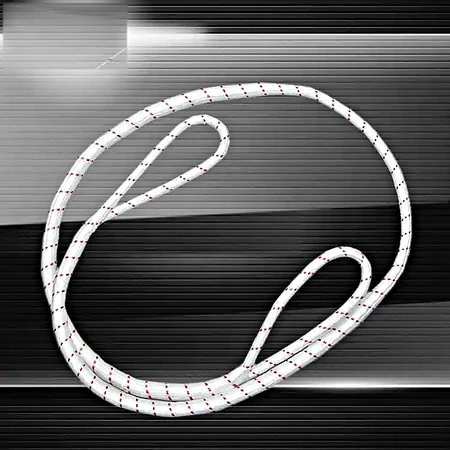
Cord, Line and Cable — Three Words, Three Products
Buyers ask for “Dyneema cord”, “Dyneema line” and “Dyneema cable” as if they were the same order, and they are not. The three words name three sizes and three finishes of the same braid, and the answers to how strong, how long and how is it finished are different for each.
| The word | What it names | Typical diameter in our series | Construction | Normally ordered by |
|---|---|---|---|---|
| Cord | Small-diameter braided rope, usually supplied as a finished piece with both ends done. | 6–10 mm | 12-strand single braid, uncoated or lightly coated; sewn or spliced eye | The piece — length and both ends specified together |
| Line | General-purpose rope for hauling, running and static duty, worked by hand or over a sheave. | 10–16 mm | 12-strand or 16-strand single braid, or double braid | The coil or the cut length |
| Cable | A coated or sheathed rope used where a steel cable would otherwise be specified. | 16–32 mm | 12-strand braid, polyurethane or marine coated; sheathing optional | The coil or the reel, often with a thimble eye |
The diameter bands above are our own indicative division of the published 6–32 mm series, not a limit — a Dyneema rope, cord or cable is the same braid throughout, and any diameter up to 60 mm can be built to order. What changes between the three is what the buyer is paying for: on a cord, the ends; on a line, the hand and the wear; on a cable, the coating and the sheath.
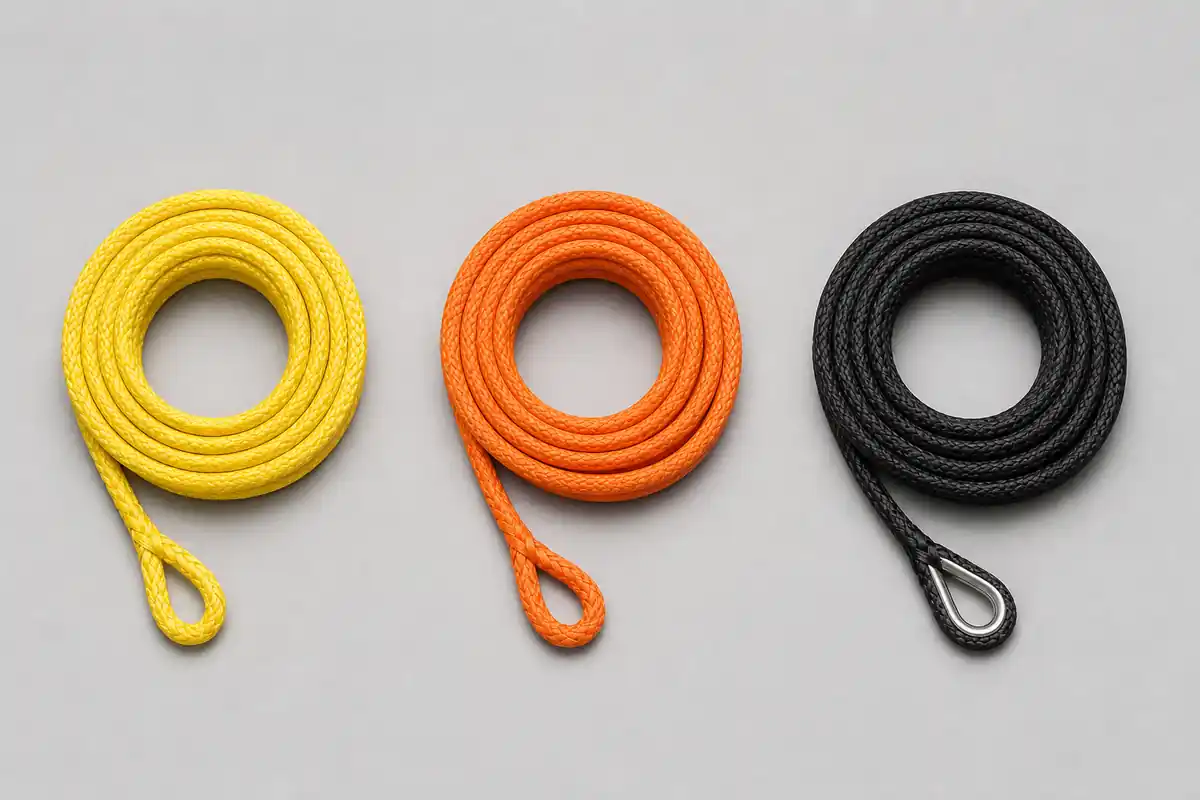
The Coated Cable — Where Dyneema Replaces Steel
A coated Dyneema rope is the article that most often replaces a steel cable, and the coating is doing real work rather than dressing the product. A polyurethane or marine coating locks the braid so it cannot pick or flatten, it adds abrasion and UV protection to the outside of the rope, and it stiffens the rope so that it handles and reeves more like the cable it is replacing. Where the rope has to run over rough ground or work repeatedly against a drum, a braided sheath or extruded cover over the working section takes the wear instead of the load-bearing braid.
What the substitution buys, at the figures already published for our braided synthetic lines:
- Roughly a seventh of the weight at the same breaking strength, so one person can carry and hand-haul a line that would otherwise need a crew and a winch.
- Very little stored energy. A steel cable under load holds energy that releases with a dangerous snap-back when it parts; a braided Dyneema rope releases almost nothing.
- No broken wires and nothing to corrode. It is soft on hands and gloves, and it does not care about salt water.
- Wash and dry, no lubrication — against the regular greasing a wire rope needs.
- Field repairable. It can be spliced or re-spliced on site, where a wire rope needs a swaging press or replacement.
- It floats, which for marine, dock and recovery work removes a whole class of handling problem.
Two limits belong with that list. The fibre melts at approximately 145 °C and works to +70 °C, so a Dyneema cable is not a hot-duty line and must be kept clear of exhausts, hot pipework and welding. And it wants a chafe sleeve wherever it crosses a sharp or abrasive edge, because the abrasion that a wire rope shrugs off will eventually wear any synthetic line.
 Cable pulling: the rope does the pulling and a woven grip takes the cable. Lighter line, no sharp ends to injure a crew.
Technical Parameters — Dyneema Rope, Cord and Cable
The series below is our standard 12-strand single braid. Breaking strengths and weights are published minimum values; the cord / line / cable class and the typical termination columns are indicative guidance for ordering, not a specification limit.
| Diameter | Minimum breaking strength | Approx. weight | Class | Typical termination |
|---|---|---|---|---|
| 6 mm | 31 kN (3.2 t) | ≈ 20 g/m | Cord | Spliced or sewn eye |
| 8 mm | 54 kN (5.5 t) | ≈ 30 g/m | Cord | Spliced eye, thimble |
| 10 mm | 85 kN (8.7 t) | ≈ 50 g/m | Cord / line | Spliced eye, thimble |
| 12 mm | 122 kN (12.4 t) | ≈ 70 g/m | Line | Spliced eye, thimble, hook |
| 14 mm | 167 kN (17.0 t) | ≈ 100 g/m | Line | Thimble, hook |
| 16 mm | 218 kN (22.2 t) | ≈ 130 g/m | Line / cable | Thimble, hook |
| 18 mm | 275 kN (28.0 t) | ≈ 170 g/m | Cable | Thimble, hook |
| 20 mm | 340 kN (34.7 t) | ≈ 200 g/m | Cable | Thimble |
| 24 mm | 490 kN (50.0 t) | ≈ 290 g/m | Cable | Thimble |
| 28 mm | 666 kN (67.9 t) | ≈ 400 g/m | Cable | Thimble |
| 32 mm | 870 kN (88.7 t) | ≈ 520 g/m | Cable | Thimble |
| Item | Specification |
|---|---|
| Product names | Dyneema rope · Dyneema braided rope · Dyneema cord · Dyneema line · Dyneema cable · 12-strand braided Dyneema rope · 16-strand braided Dyneema rope · double braided Dyneema rope · 12-strand UHMWPE coated rope · HMPE braided rope |
| Model | LF-DY-12S (12-strand) · LF-DY-16S (16-strand); custom model codes available for OEM orders |
| Fibre | 100 % UHMWPE (HMPE) multifilament — Dyneema-class high-modulus polyethylene |
| Construction | 12-strand single braid as standard; 16-strand single braid and double braid (braid-on-braid) available |
| Diameter | 6 mm to 32 mm as standard (cord sizes below 6 mm quoted to order); custom range up to 60 mm |
| Diameter tolerance | ± 3 % |
| Coating | Uncoated, or polyurethane / marine coating for abrasion and UV protection and a locked braid |
| Sheathing | Optional braided jacket or extruded cover over the working section |
| Lengths | 50 m · 100 m · 200 m · 500 m · 1000 m — cut to any length, with or without metre markings |
| Elongation at break | Approximately 3–4 % |
| Specific gravity | 0.97 — the rope floats |
| Water absorption | Approximately 0 % — no loss of strength when wet |
| Working temperature | −40 °C to +70 °C |
| Melting point | Approximately 145 °C |
| Abrasion resistance | Excellent — better than polyester or nylon |
| UV resistance | Good; a protective coating is recommended for permanent outdoor exposure |
| Chemical resistance | Good against acids, alkalis, salt water, oils and most organic solvents |
| Colour | White · natural · black · yellow · orange · red · green · grey · neon · custom colours |
| End finishing | Hand-spliced eye · sewn and welded eye · thimble eye · hook · swivel · plain whipped or heat-sealed end; optional chafe sleeve |
| Marking | Diameter, breaking load, length and batch number on the label or worked into the braid |
| Packing | Coil with label, wooden reel or carton; custom label and barcode available |
| MOQ & OEM | Low MOQ for trial orders; full OEM — diameter, colour, length, coating, splicing, printed logo and packaging |
Ends for Cord, Line and Cable
On a cord the ends are most of the product, and on a cable the end is where the load is transferred to the hardware. A 12-strand hand splice retains approximately 90 % of the rope’s strength with no metal hardware at all; a sewn and welded eye does the same job on cord too fine to hand-splice. Where the eye bears on metal, a thimble takes the wear instead of the rope.
| Termination | What it is | Best for |
|---|---|---|
| Spliced eye | 12-strand hand splice, no metal hardware, retains approximately 90 % of rope strength | Anything that carries a load — shackle connections, capstan winches, general pulling |
| Sewn and welded eye | Eye formed by stitching and fusing the braid | Small-diameter cord, lanyards and tethers where a hand splice is impractical |
| Thimble eye | Spliced eye fitted with a stainless thimble to protect the rope at the bearing point | Hook, pin and drum connections where the eye wears against metal |
| Hook | Spliced eye with a plain or self-locking hook | Towing, recovery and general utility work |
| Plain whipped end | Heat-sealed and hand-whipped | Reeving through sheaves and winch drums, or splicing on site |
| Chafe sleeve | Braided sleeve over the working section | Rough ground, concrete edges and abrasive surfaces |
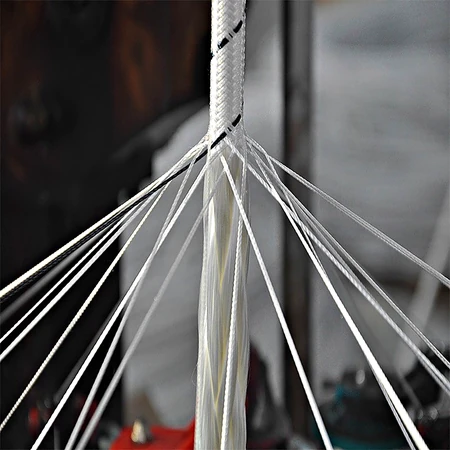
 A hand-spliced eye up close. The braid doubles back into itself, which is why a splice keeps around 90 % of the rope’s strength where a knot gives much of it away.
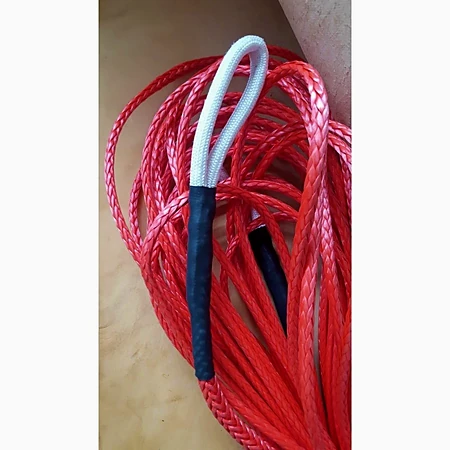
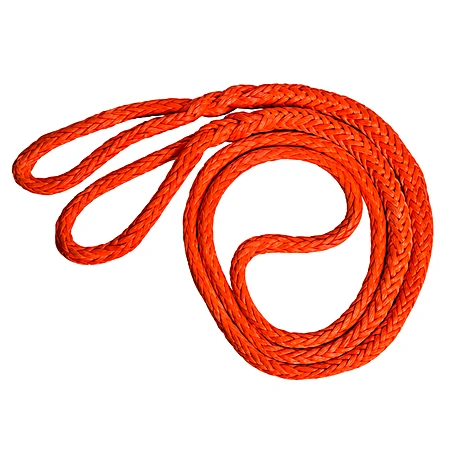
 A finished cord: thimble eyes, stainless hooks and whipped ends. Say which end goes where — a finished end shortens the usable length.
Where Dyneema Cord, Line and Cable Are Used
- Cable pulling and stringing — hand-hauled all day because the line weighs a fraction of the steel it replaces. See cable pulling rope and cable pulling socks and grips.
- Winch lines, capstan work and vehicle recovery, where low stored energy means very little recoil if the line parts. See utility winch line.
- Mooring, towing and anchor lines, where the weight of steel is the problem and the rope must float.
- Yacht rigging, running rigging and control lines, where weight aloft and stretch both cost performance.
- Arborist throw lines, rigging lines and utility lines, handled to a height every day.
- Lanyards, tethers and guy lines, where a fine, strong, non-marking cord is wanted.
- Stay wires and lashing in corrosive or salt-laden environments, where a wire rope would need regular greasing and eventual replacement.
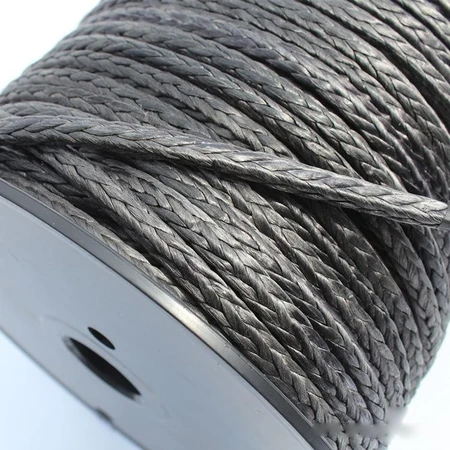
 On a capstan winch. The coated line grips the drum, and the same rope is soft enough to handle bare-handed all day.
Frequently Asked Questions
Is Dyneema the same as UHMWPE?
Yes in substance. UHMWPE — ultra-high molecular weight polyethylene — is the polymer name, HMPE is the rope-trade short form, and Dyneema and Spectra are brand names for the same fibre family. What differs between products is the braid, the diameter and the published breaking strength, not the word on the label. For the fibre itself and the full 6–32 mm series, see UHMWPE braided rope.
What is the difference between cord, line and cable?
Size, construction emphasis and finish. A cord is the small end — typically 6–10 mm — supplied as a finished piece with both ends done, where the ends are most of the product. A line is the mid range, 10–16 mm, bought by the coil for hauling and general duty. A cable is the large end, 16–32 mm, and usually coated or sheathed so it behaves like the steel cable it replaces. It is one braid throughout; the word tells you what you are paying for.
Can a Dyneema rope replace a steel cable?
For weight, handling, corrosion and recoil, yes — a Dyneema rope, cord or cable of the right diameter will do the work of the steel line it replaces, and often with a margin. At equal breaking strength it weighs roughly a seventh of a steel wire rope, it stores very little energy so there is minimal snap-back if it parts, it cannot corrode, and it can be re-spliced on site instead of needing a swaging press. Two things must be checked first: the working temperature, because the fibre melts at approximately 145 °C and is unsuitable near exhausts or hot plant; and every point where it crosses a sharp edge, which needs a chafe sleeve. Confirm the hardware suits the smaller diameter too.
Does the coating or sheath matter?
Yes, and it is worth specifying deliberately. A polyurethane or marine coating locks the braid so it cannot pick or flatten, and adds abrasion and UV protection. A braided or extruded sheath protects the working section where the rope rubs a drum, a fairlead or rough ground. Both are ordered with the rope — neither can be added afterwards.
How much length do I lose to the ends?
A finished end shortens the usable length, so the length you order should be the working length plus the allowance for the terminations at each end. Tell us the finished length you need and the ends you want, and we will make the cut accordingly — which is also why a cord is normally ordered as the piece rather than as a length of rope.
Related Products
- UHMWPE braided rope — the fibre itself, the braided constructions and the full published series
- Dyneema webbing sling — the same fibre as a flat woven band rather than a rope
- Dyneema round sling — the same fibre as a sleeved parallel core
- Pulling rope — cable pulling, traction and towing in UHMWPE and polyester
- Utility winch line — 12-strand braided winch rope and the termination options
- Cable pulling socks and grips — the woven grips that carry the cable
- Nylon rope — the full braided rope range and the duties it covers
Request a Quote for Dyneema Rope, Cord or Cable
Send us the duty and the load, whether you need Dyneema rope, cord, line or cable, the diameter and the finished length you need, the coating or sheathing, and the termination at each end. Calling it a rope, a cord, a line or a cable only tells us the form — what we quote back is the braid, the diameter, the breaking strength and the ends. If heat, shock loading or fall protection is part of the duty, say so, because those are the cases where a different fibre should be quoted instead. We will confirm everything before the rope is cut.
Lift Sling Rigging Company — Lifute Industrial Park, Taizhou City, Jiangsu Province, China. Tel: +86 523 8693 5818 | WhatsApp: +86 180 6600 2268 | E-mail: 702461526@qq.com | HS code 630790