

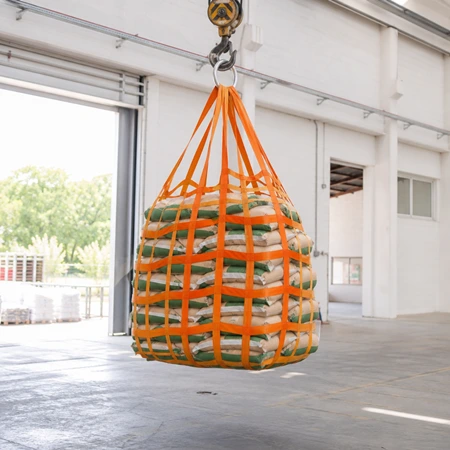
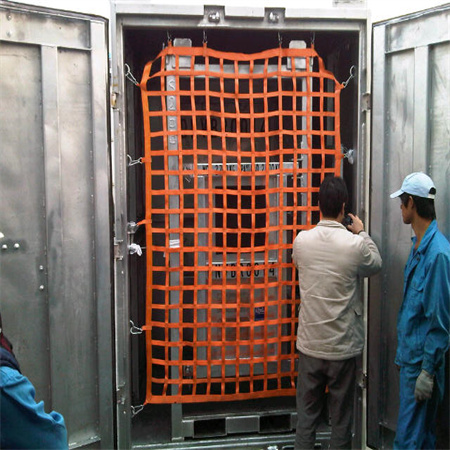
Kampani yonyamula gulaye yonyamula zitsulo imapanga Polyester Webbing Net for Lifting,Web Sling Lifting Cargo Net,Polyester Webbing Cargo Net,Flame Retardant Webbing Net,Ma Nets Onyamula Polyester Webbing,Cargo Lifting Net Web Sling,Polyester Nylon Webbing Lifting Cargo Net,Ukonde wonyamula katundu wa poliyesitala wolemera wokhala ndi lamba wosalala,Maukonde Akuluakulu Onyamula Katundu Kuti Anyamule Ntchito Yolemera.
Polyester Webbing Net for Lifting
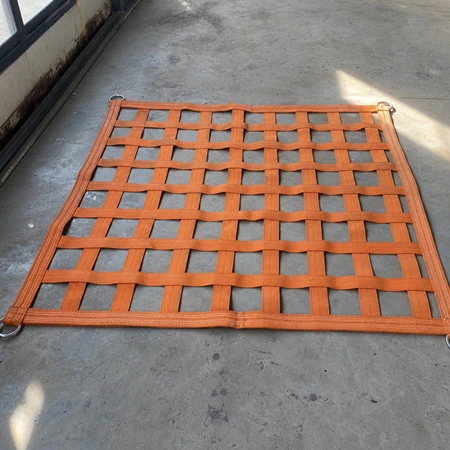
A polyester webbing net for lifting is a lattice of flat high-tenacity polyester (PET) magulu, stitched into a square mesh with a doubled border and reinforced corner loops. The cargo goes in, the four loops are gathered onto the hook or a master ring, and the whole consignment travels as one unit – no pallet, no strapping, nothing to re-handle at the far end.
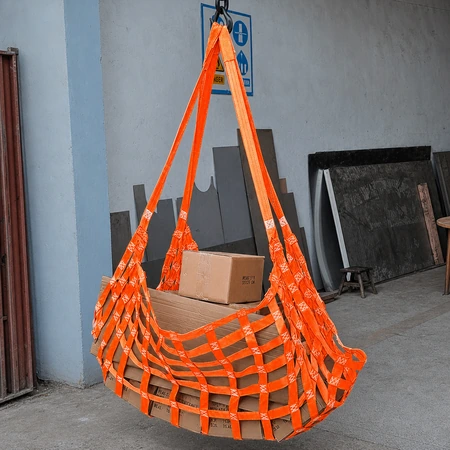
It is supplied in two forms. The flat net holds loads that keep their own shape – pallets, mitolo, zoziziritsa kukhosi, zigawo zamakina. The closed-bottom bag contains loads that would otherwise escape the mesh – matumba, njerwa, kuchotsera, mixed cargo. Both are cut to the drawing rather than to a catalogue: band wide, chiwerengero cha zigawo, mauna, kukula, lifting points and colour are all set before the first metre of webbing is woven, and the finished net is proof-load tested with a material test report.
- Flat PET band, 25-200 mm – wosakwatiwa, duplex or triplex, with a woven selvedge that does not fray.
- 2 t kuti 30 t ngati ukonde – the rating follows the band, the number of load-bearing bands under the cargo and the way the net is rigged.
- Kutambasula kochepa, za 3-7 % ku WLL – the net stays tight against the load instead of creeping open over a shift.
- Wet duty without loss of rating – polyester takes up almost no water and does not rot, so rain, wash-down and deck work are normal service.
- CE ndi GS satifiketi – nsalu, wosokedwa, marked and proof-load tested in one plant, ndi ISO 9001, CNAS and DNV behind it.
Njira yolemetsa: mbeza, loop, malire, gulu, mauna
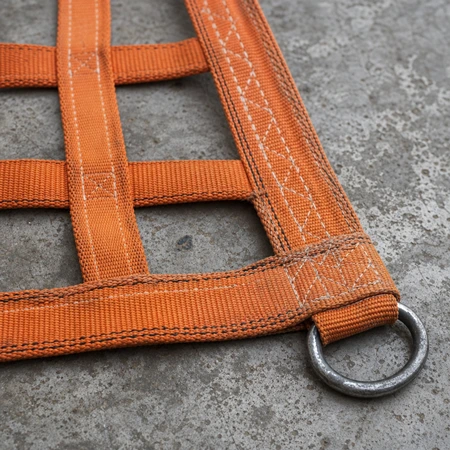
A polyester webbing net for lifting is not one component but five, and the load passes through them in a fixed order. Almost every net failure we are asked to investigate comes down to one link in that chain being built to a lower standard than the band itself – usually the stitching at the corner, which is the cheapest place to save money and the first place to fail.
Table 1 – The five links in the load path, and what each one has to do.
| Link | Zomwe zimanyamula katundu | What fails there first | How we build it |
|---|---|---|---|
| Hook or master ring | All four loops gathered to one point | Loops binding on a sharp hook or a worn shackle | Master mphete kapena kalasi 80 shackle offered with the net; loops sized to the fitting |
| Corner loop | The full rated capacity of one corner | Stitching pulling out of the border | Loop stitched through a doubled border with multi-row lock stitch, reinforced above 5 t |
| Border | The sum of the mesh, redistributed to the corners | Border folding or tearing at the corner radius | Doubled webbing, folded and stitched the full perimeter, wider at the corners |
| Load-bearing band | The cargo’s weight, band by band | Abrasion and cuts from pallet edges and nails | Woven sewedge, duplex or triplex where the net is dragged; sleeves at contact points |
| Mesh | Kusunga – keeping the cargo in | Items squeezing through an over-wide opening | Opening chosen from the smallest item in the load, 50-300 mm |
The practical consequence is that a net is not rated by its band alone. A 50 mm duplex band can carry 4 t as a single vertical leg, but the net it is woven into may be rated at 2 t because the corner stitching, osati gulu, amaika malire. That is why we test the finished net and print the net rating, never the band rating.
Polyester against nylon, polypropylene and wire rope
The fibre choice is usually made on price and then lived with for years. The four materials behave differently in ways that matter on a handling net, and none of them wins on every line.
Table 2 – The four net materials compared on the properties that decide service life.
| Katundu | Polyester (PET) | Nayiloni (PA) | Polypropylene (PP) | Wire rope |
|---|---|---|---|---|
| Kusintha kwa WLL | Za 3-7 % – zotsika kwambiri za ulusi wofewa | Roughly twice polyester | Higher again, and it creeps | Pansi 1 %, but the net is stiff and heavy |
| Madzi | Takes up almost no water; strength unchanged wet | Absorbs several per cent and loses some strength wet | Does not absorb water | Corrodes unless galvanised or stainless |
| Rot and mildew | Immune | Can mildew if stored wet | Immune | Not applicable |
| UV outdoors | Zabwino, and stabilised in the weave | Wapakati | Poor unless heavily stabilised | Osakhudzidwa |
| Dry abrasion | Zabwino – best of the soft fibres | Zabwino, slightly behind polyester | Wapakati | Zabwino kwambiri, but it abrades the cargo |
| Ma Acids | Good against most dilute acids | Kuwukiridwa ndi ma asidi amphamvu | Zabwino | Depends on coating |
| Alkalis | Kuwukiridwa ndi alkalis amphamvu | Zabwino | Zabwino | Generally good |
| Kulumikizana ndi katundu | Zofewa, lathyathyathya, osalemba | Zofewa, osalemba | Soft but slippery | Marks and crushes; needs sleeves |
| Rigging by hand | Kuwala, folds into a bag | Kuwala, folds into a bag | Chopepuka kwambiri | Needs two people and a trolley |
Two conclusions follow. Where the net works in cycles against pallets, concrete and truck beds, polyester is the default because low stretch keeps the mesh tight and dry abrasion is where it is strongest. Where the cargo shock-loads – zidutswa, demolition, rough castings – nylon’s give is an advantage and the gulayeni yolemetsa ya nayiloni yonyamula katundu is the better answer. And where the load is hot, or the net has to be rigid, neither soft fibre belongs on the job.
Band specification
The band is where a quotation is won or lost. Manambala asanu akufotokoza izo, all five are printed on the label, and all five are fixed on the drawing before weaving.
Table 3 – The five numbers that describe a polyester lifting band.
| Nambala | Zomwe izo ziri | Range timaluka |
|---|---|---|
| M'lifupi | Flat width of the webbing | 25 / 50 / 75 / 100 / 150 / 200 mm; 50 mm muyezo |
| Chiwerengero cha zigawo | Ndi maukonde angati omwe amasokedwa mugulu limodzi | Wokwatiwa, duplex (awiri) kapena triplex (atatu) |
| Makulidwe | Khazikitsani ndi m'lifupi ndi kuchuluka kwa zigawo | 1.8 mm – 6.0 mm |
| Weave density | Yarn count in warp and weft, zomwe zimakhazikitsa kulimbikira | Khazikitsani ku EN 1492-1 maziko a mphamvu zovoteledwa |
| M'mphepete | How the selvedge is finished | Woven selvedge monga muyezo; folded and stitched where the band is handled daily |
Table 4 – Working load limit per band, mwendo umodzi woyima, MU 1492-1 maziko.
| Band wide | Chigawo chimodzi | Duplex | Triplex |
|---|---|---|---|
| 25 mm | 1 t | 2 t | 3 t |
| 50 mm | 2 t | 4 t | 6 t |
| 75 mm | 3 t | 6 t | 9 t |
| 100 mm | 4 t | 8 t | 12 t |
| 150 mm | 6 t | 12 t | 18 t |
| 200 mm | 8 t | 16 t | 24 t |
This is a band figure, not a net rating. The net’s capacity follows from how many load-bearing bands sit under the cargo and how the net is rigged – which is why we quote the net, osati gulu.
Mesh, border and edge: the three decisions left
Once the band is fixed, three choices remain. They are decided on the drawing, and changing one later means a new net rather than a modification.
Table 5 – Mesh, border and edge options.
| Chosankha | Zosankha | Rule we apply |
|---|---|---|
| Kutsegula kwa mauna | 50 / 75 / 100 / 150 / 200 / 300 mm | Chosen from the smallest item in the load, osati kuchokera kulemera konse |
| Border | Single fold or doubled and multi-row stitched | Doubled as standard; a single-fold border is only offered on nets under 1 t |
| Edge treatment | Woven sewedge, folded edge, PU zokutira | Folded where the net is handled daily; PU coating where it is dragged or stored outdoors |
| Corner reinforcement | Standard loop or reinforced corner | Reinforced above 5 t, and on any net used with a spreader beam |
| Chitetezo | Nkhono, pad or double band at the contact point | Specified for pallets with nails, machined parts and any sharp edge |
Zosintha zaukadaulo
The figures below cover the standard polyester webbing net for lifting range. Every line is made to order, so treat the table as the starting point for a quotation rather than a fixed catalogue.
Table 6 – Polyester webbing net for lifting: magawo luso.
| Parameter | Kufotokozera |
|---|---|
| Mtundu wa mankhwala | Ukonde wokweza polyester – flat net or closed-bottom bag |
| Zida za band | 100 % polyester yapamwamba kwambiri (PET) kusaka |
| Band wide | 25 / 50 / 75 / 100 / 150 / 200 mm (50 mm muyezo) |
| Band construction | Chigawo chimodzi, duplex or triplex; woven selvedge, not a cut edge |
| Band makulidwe | 1.8 mm – 6.0 mm kutengera m'lifupi ndi wosanjikiza chiwerengero |
| Kutsegula kwa mauna | 100 × 100 mm lalikulu muyezo; 50 mm – 300 mm kuti |
| Net size | Length × width for a flat net; opening × depth for a bag; adapanga kujambula |
| Border | Doubled webbing, folded and multi-row stitched, reinforced at every corner |
| Malo okweza | Four reinforced corner loops standard; eyiti ya mtengo wowulutsira |
| Mphamvu zovoteledwa | 2 t – 30 t ngati ukonde, yolembedwa ndi band, chiwerengero cha zigawo, load-bearing bands and rigging |
| Chitetezo Factor | 5:1 / 6:1 / 7:1 |
| Kusintha kwa WLL | Za 3-7 % |
| Mtundu | Khodi yamtundu potengera malire a ntchito, kapena mtundu wanyumba wamba |
| Madzi ndi kuvunda | Takes up almost no water; does not rot or mildew |
| Kutentha kwa ntchito | -40 °C ku +100 °C |
| Chithandizo | UV yokhazikika, anti-kukalamba, kugonjetsedwa ndi abrasion ndi misozi |
| Maziko okhazikika | Mawebusayiti adavotera ku EN 1492-1 maziko |
| Chitsimikizo | CE, GS, JIS on request; ISO 9001; Laborator ya CNAS; Mtengo wa DNV |
| Kusintha mwamakonda | OEM / Mtengo wa ODM, mtundu, printed band, chizindikiro, logo and packing |
| HS kodi | 6307.90 – lifting nets of textile materials |
Standard sizes and rated capacities
Net size is measured along the border for a flat net, and as opening × depth for a bag. The load has to sit well inside the net: a net the same size as the cargo sheds it as soon as the crane takes up the slack.
Table 7 – Ma size okhazikika; makonda masaizi, mauna ndi malo okweza amapangidwa kuti azijambula.
| Net size | Mesh | Gulu | Kuchuluka kwanthawi zonse | Kugwiritsa ntchito mwachizolowezi |
|---|---|---|---|---|
| 1.0 × 1.0 m | 100 mm | 50 mm duplex | 2 – 3 t | Ng'oma, zigawo zamakina, mapaleti amodzi |
| 1.2 × 1.2 m (4 × 4 Ft) | 100 mm | 50 mm duplex | 2 – 4 t | Standard phazi phazi, katundu wamabokosi |
| 2.1 × 2.1 m (82 × 82 mu) | 100 mm | 50 mm duplex | 3 – 5 t | Zithunzi za Imperial pallet |
| 2.5 × 2.5 m | 100 – 150 mm | 75 mm duplex | 4 – 8 t | Katundu wamatumba, kutsegula chidebe |
| 2.5 × 6.0 m | 150 mm | 100 mm duplex | 6 – 12 t | Mitolo ya mabomba, long cargo, trailer loading |
| 4.0 × 4.0 m | 150 – 200 mm | 150 mm duplex | 10 – 20 t | Katundu wonyamula katundu wambiri, pallets zazikulu |
| 6.0 × 6.0 m | 200 mm | 150 mm katatu | 20 – 30 t | Port, barge and heavy bulk handling |
| Zapangidwa kuti zijambule | 50 – 300 mm | 25 – 200 mm | 2 – 30 t+ | Bedi lagalimoto, chotengera, hold and hopper sizes |
Pallet-sized versions are quoted from the pallet footprint and are covered by the crane pallet cargo net; long bulk consignments by the polyester kukweza hoisting ukonde; and the tensioned version for holding loads down in transit is the ukonde wotetezera katundu.
Rigging arrangements and fittings
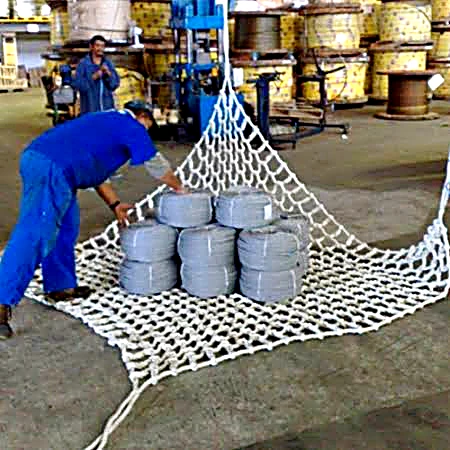
Mmene ukondewo umapachikidwira zimadalira kuchuluka kwa katundu umene uyenera kunyamula. Two arrangements cover most work, and both are rated for the net rather than assumed from the band.
- Four loops on the hook – muyezo. The loops gather on the hook or a master ring and the net closes on the cargo as the crane takes up the slack.
- Eight loops on a spreader beam – the net stays square, katundu amakhalabe mulingo ndipo ngodya iliyonse imakhala ndi gawo lodziwikiratu; the right answer for long or wide consignments, using a kukweza mtengo wa spreader.
- Chikwama fomu, closed bottom – contains loose cargo that would otherwise fall through the mesh; the form used for loading and unloading.
- Flat net over a load – for pallets, bundles and stillages that keep their own shape and only need holding together.
Fittings supplied or fitted on request: sewn webbing loops, master rings and master links, kalasi 80 shackles for beam lifts, PU-coated band for high-abrasion and outdoor duty, protection sleeves and pads for sharp edges, and repair kits with matching band and thread for fleets that maintain their own equipment.
Kujambula kwamitundu, chizindikiro ndi chizindikiritso
Flat webbing has one advantage a rope net does not: the band itself can carry the identification. We print the working load limit along the web and weave the standard colour into it, so a net can be read from across a yard before anyone picks up the label.
Table 8 – Khodi yamtundu wokhazikika potengera malire a ntchito.
| Malire olemetsa ogwira ntchito | Mtundu wa gulu | Malire olemetsa ogwira ntchito | Mtundu wa gulu |
|---|---|---|---|
| 1 t | Violet | 5 t | Chofiira |
| 2 t | Green | 6 t | Brown |
| 3 t | Yellow | 7 t | Buluu |
| 4 t | Imvi | 8 t | lalanje |
Two rules stand behind the colour. It is a convenience, not the identification – chizindikiro ndi, and it is read before every lift. And where a fleet uses a house colour, we weave that instead and print the capacity on the band, so no net is ever identified by colour alone. Sitima yapamadzi yopindika m'thumba kapena crate; six nets take the space of one pallet.
Yonyowa, hot and chemical: what polyester tolerates
Most net failures blamed on the material are really service conditions the buyer was never asked about. These are the limits we work to, and the questions we ask before quoting a net for a wash-down bay or a chemical plant.
Table 9 – Service conditions and how polyester behaves in them.
| Condition | Performance | What to do about it |
|---|---|---|
| Mvula, kusamba-pansi, deck work | No water uptake, osati kuvunda, rating unchanged wet | Palibe – store wet if space is short, but dry before inspection |
| Sun and UV | Kukana kwabwino, stabilised in the weave | Store out of direct sun where possible; retire on colour or gloss change |
| Abrasion on concrete and pallets | Good dry abrasion, best of the soft fibres | Duplex or triplex band, and a sleeve where the net is dragged |
| Heat up to +100 °C | Within range; no loss of rating | Keep clear of hot cargo, weld spatter and exhausts |
| Pamwamba +100 °C, hot material | Outside the range – polyester softens and loses strength | Use a heat-rated construction or a different product entirely |
| Dilute acids | Kukana kwabwino | Rinse after exposure and inspect the stitching |
| Strong alkalis | Attacked – strength loss is not visible | Specify nylon instead, and tell us the chemical |
| Oils and grease | Not absorbed, but they hide damage | Clean before inspection so cuts and abrasion can be seen |
| Mphepete zakuthwa | A textile cuts – this is the one limit that cannot be engineered out | Protection sleeve or pad at every contact point |
Kuyesa, certification and traceability
- Forty years of lifting equipment manufacturing – anakhazikitsidwa mu 1985 ku Taizhou, Jiangsu, ndi zambiri kuposa 200 antchito.
- Band woven in our own mill, kotero wide, chiwerengero cha zigawo, colour and printing stay under our control rather than being bought in.
- Every net proof-load tested on our own 1000 t horizontal machine – kuyesedwa, not sampled – with a material test report travelling with the order.
- CE declaration of conformity and GS certification, ndi satifiketi ya JIS pamaoda otumiza kunja.
- ISO 9001 quality management system, a CNAS-accredited laboratory and DNV certification behind the plant.
- Every net marked with its working load limit, kukula ndi mauna asananyamuke, kotero ukonde ndi zolemba zake zimagwirizana nthawi zonse.
Certificates and test reports are available as PDFs for a tender file or a customs check – see the full certification set.
Chisamaliro, kuyendera ndi kupuma pantchito
- Werengani zolembera zomwe zasindikizidwa komanso kuchuluka kwake musananyamule chilichonse, and check the load is inside the rating for the way the net is rigged.
- Inspect the corner loops and their stitching first, then the border, kenako zitsulo zonyamula katundu – that is the order in which a webbing net wears.
- Yang'anani mabala, abrasion, kusokera wosweka, kudetsa mankhwala, kutentha kwa glazing ndi kusintha kwa mtundu kapena gloss komwe kumawonetsa kuwonongeka kwa UV.
- Keep the cargo inside the mesh and off the border, and protect the bands from sharp edges with a sleeve or pad.
- Osapyola kuchuluka komwe adavotera, musakweze pang'ono kuposa magawo onse a malupu, and never drag a loaded net sideways with the crane.
- Sungani zoyera ndi zowuma, kuchokera pansi ndi kunja kwa dzuwa; never repair webbing by knotting, kuwotcherera kapena kuwotcha.
- Withdraw the net if a load-bearing band, malire, a loop or its stitching is damaged, ndi kukhala ndi maukonde owunikiridwa ndi munthu wodziwa nthawi yomwe tsamba lanu likufuna.
Mafunso omwe amafunsidwa pafupipafupi
What is a polyester webbing net for lifting used for?
Moving bagged, bokosi, palletised and mixed cargo as one unit on a crane hook. The flat form holds loads that keep their own shape; the closed-bottom bag contains loose cargo that would otherwise fall through the mesh. It replaces pallets, strapping and repacking at both ends of the trip.
Why polyester rather than nylon?
Chifukwa ukonde wogwira ntchito umagwira ntchito mozungulira. Polyester stretches far less at its working load, so the mesh does not creep open as the crane takes up the slack; it takes up almost no water, so the rating holds in wet duty; and it is stronger in dry abrasion against pallets and concrete. Choose nylon where the load shock-loads and a little give is safer.
Is the net rated by the band or as a finished net?
As a finished net. A 50 mm duplex band carries 4 t as a single vertical leg, but the corner stitching and the number of load-bearing bands may rate the net lower. We proof-load and mark the net, and quote the net capacity – the band table is only the starting point.
Ndi mafungulo ati omwe ndiyenera kusankha?
Kuchokera ku chinthu chaching'ono kwambiri chomwe chili mu katundu, osati kuchokera kulemera konse. 100 × 100 mm is standard and holds bags, block ndi boxed katundu; small or loose items need 50-75 mm, and large indivisible loads can take 150-300 mm.
Can it be used in the rain or on deck?
Inde. Polyester takes up almost no water, does not rot, and does not lose strength wet, so rain, wash-down and deck work are normal service. Dry the net before inspection so damage is visible.
Can I lift hot material with it?
Mpaka +100 °C. Above that polyester softens and loses strength, and hot cargo – zoponya, slag, asphalt – needs a different construction. Tell us the temperature and we will say plainly whether a webbing net belongs on the job.
Kukhoza kumatsimikiziridwa bwanji?
Mawebusayiti adavotera ku EN 1492-1 maziko ndi maukonde amaperekedwa pa 5:1, 6:1 kapena 7:1 monga tafotokozera. Every net is proof-load tested on our own 1000 t makina ndi lipoti la mayeso azinthu amayenda ndi dongosolo; the products are CE and GS certified.
Ndi chiyani chinanso chomwe mumapanga mu ukonde womwewo?
The same band goes into our matumba a ukonde ndi zopota zopanda malire, ndi net range ikupitilira ndi ukonde wonyamula katundu, ndi nayiloni flat webbing ukonde ndi ukonde wonyamulira katundu wa nayiloni. The whole category is listed under maukonde onyamulira katundu.
Pemphani mawu anu
To quote a polyester webbing net for lifting, send the load weight and shape, ukonde kapena kukula kwa thumba, kutseguka kwa mauna, band m'lifupi ndi wosanjikiza, the lifting points you need and how many cycles the net will run – kapena kujambula kwa bedi la galimoto, chotengera, kudumpha kapena kutsetsereka kumayenera kukwanira. Our engineers confirm the band, chiwerengero cha zigawo, mphamvu yovotera ndi kulongedza, ndi kulitchula mu yankho limodzi. Kuti tikambirane kaye, kulumikizana ndi mainjiniya athu.
Kampani ya Lift Sling Rigging Company – Lifute Industrial Park, Mzinda wa Taizhou, Chigawo cha Jiangsu, China
Tel: +86 523 8693 5818 | WhatsApp: +86 180 6600 2268 | Imelo: lift98@jslift.com