Produktkategorier

Løftenett i polyester

Kort beskrivelse:

Lift sling rigging selskapet produserer Polyester Lifting Hoisting Net,Lastenett i polyester,Sikkerhetsløftenettstropp,Bungee Cargo Net,Lastenett i polyester,Løfteslyngenett,Tauløftenett,Pall Cargo Net,Hageklatrenett.

Løftenett i polyester

A polyester lifting hoisting net is a soft bag woven from high-tenacity polyester webbing, built to move bagged goods and bulk material in a single crane lift. The load is tipped into the bag, or the bag is laid flat and drawn up around a stack, and four corner loops carry the whole consignment to the hook. There is no pallet to return, no strapping to cut, and nothing to re-handle at the far end.

Because we weave the webbing in our own mill in Taizhou, Jiangsu, nettingåpningen, bag footprint, dybde, bottom construction and working load limit are all set to the cargo rather than to a fixed catalogue. Standard nets cover 0.5 t til 20 t og 0.6 m³ til over 10 m³, every net is proof-load tested before packing, and each shipment travels with a material test report. Nets are CE and GS certified, with webbing rated to the EN 1492-1 basis.

  • Fully custom build – mesh, posestørrelse, dybde, colour and safety factor (5:1, 6:1 eller 7:1) set to your specification.
  • High-tenacity polyester webbing – 25 mm til 100 mm bånd, enkelt, tosidig eller tripleks, UV stabilised and rot-proof.
  • Wear and heat resistant – working range -40 °C til +100 °C, with a reinforced bottom for abrasive loads.
  • Myk, fleksibel og lett – the flat band contacts the load over a wide area, so bags, cartons and finished surfaces are neither crushed nor marked.
  • CE og GS sertifisert – testet på egen hånd 1000 t maskin, with an ISO 9001 quality system and a CNAS-accredited laboratory behind it.
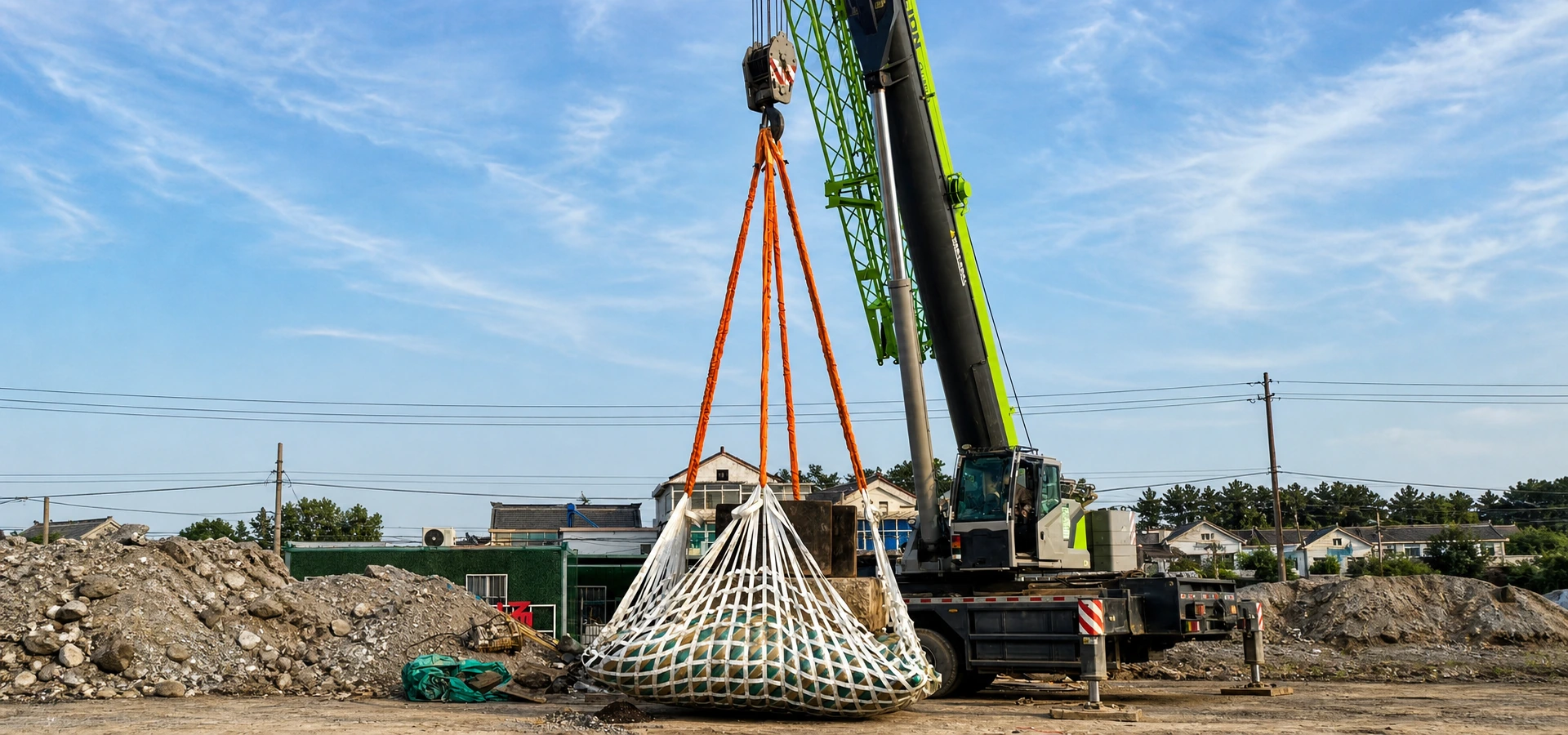
Polyester lifting hoisting net under a mobile crane carrying broken stone
A polyester lifting hoisting net in bulk service – the bag is filled with broken stone and lifted from its four loops by a mobile crane.

Why a webbing net bag, and not a rope net or a big bag

Three products are sold for the same job and they behave very differently once the load is in the air. A rope net concentrates the load on a few contact points. A big bag carries one free-flowing product and is itself the package. A webbing net bag spreads the pressure across flat bands, holds a stacked or mixed load together, and goes back to the store empty.

Bord 1 – How the four common ways of lifting loose cargo compare.

Alternativ Konstruksjon Kontakt med lasten Best cargo Limitation
Polyester webbing net bag Flat woven bands, 25-100 mm, 25-300 mm mesh Wide flat bands, low pressure per cm² Pakket, stablet, mixed and bulk cargo Needs a crane or hook; not a sealed package for powder
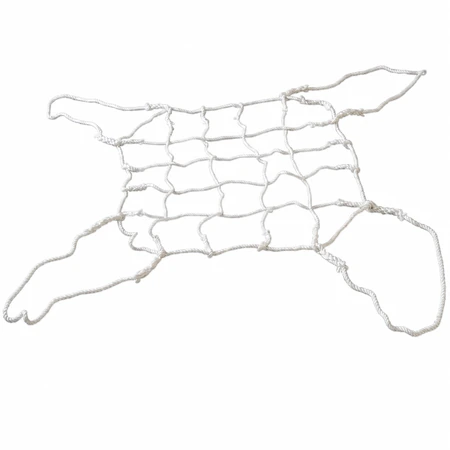
Nylon taunett Knotted or braided rope, 8-24 mm Line contact at every rope Irregular and heavy single items Ropes mark soft cargo; a tight mesh adds weight
FIBC / big bag Woven PP fabric with a liner Full surface, sealed One free-flowing product per bag Single product only; the bag is the packaging
Pallet and strapping Timber or plastic pallet plus bands Rigid base Unitised cartons Pallet returned or lost; bands cut and discarded; no drainage
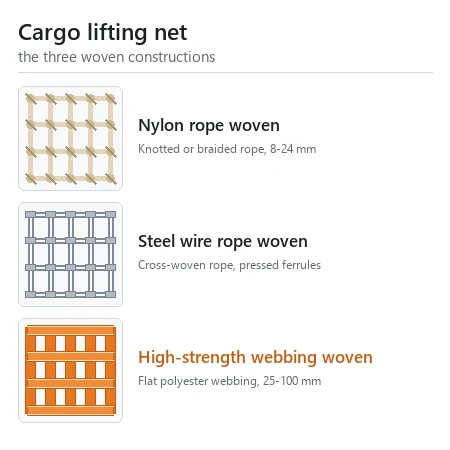
Diagram comparing nylon rope, steel wire rope and polyester webbing net constructions
Three woven constructions for cargo nets: nylon tau, steel wire rope and high-strength polyester webbing.

Five decisions that set the specification

A polyester lifting hoisting net is quoted from five numbers. Get them right and the net arrives right; get the mesh wrong and no amount of extra tonnage will fix it later.

Bord 2 – What we need to know, and why each answer changes the net.

Avgjørelse Hva det fikser What to tell us
1. Cargo form Whether the net is a bag or a flat sheet, and how the bottom is built How the cargo arrives: sekker, store sekker, baller, or loose material
2. Weight per lift Band width and layer count, and therefore the rated capacity Bruttovekten du har tenkt å løfte, not the weight of the net
3. Fylt volum Footprint and depth of the bag Bulk tetthet (t/m³) for loose material, or the height of the stack for bagged goods
4. Mesh åpning The largest gap the cargo can pass through The smallest unit in the load: en 25 kg bag, korn, aggregate or scrap
5. Utslippsmetode Lukket, snøret, renne eller foret bunn Whether the bag is tipped, untied over a hopper, or emptied by hand

Weight and volume are two separate limits, and for light bulk the volume arrives first. Korn ca 0.7 t/m³ og flis på ca 0.3 t/m³ fyller begge a 3.6 m³ bag, but one lift weighs about 2.5 t and the other about 1 t. Send the bulk density with the tonnage and we will size the bag so that a full bag is also a legal bag.
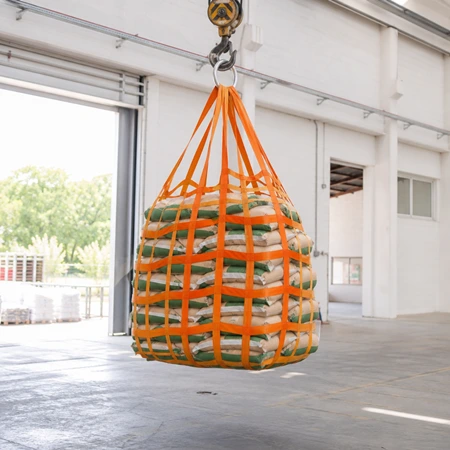
Polyester net bag lifting stacked 25 kg sacks in one crane lift
Bagged cargo in a polyester net bag – a stack of 25 kg sacks is closed in by the mesh and lifted as a single load.

Tekniske parametere

Figurene nedenfor dekker standardserien for sekker og bulk. Mesh, fotspor, dybde, bottom, loops and capacity are made to order, so treat this as the starting point for a quotation rather than a fixed catalogue.

Bord 3 – Polyester lifting hoisting net: tekniske parametere.

Parameter Spesifikasjon
Produktnavn Polyester lifting hoisting net (polyester webbing net bag)
Configurations Closed bag, release-bottom bag, or flat lifting net
Webbing materiale 100 % høyfast polyester (KJÆLEDYR); høyfast nylon på forespørsel
Båndbredde 25 / 38 / 50 / 75 / 100 mm (50 mm standard)
Bandkonstruksjon Enkelt lag, tosidig eller tripleks; vevd kant, ikke en kuttet kant
Båndtykkelse 1.8 mm – 4.5 mm avhengig av bredde og lagantall
Mesh åpning 100 × 100 mm standard; 25 – 300 mm laget på bestilling
Netto størrelse Laget til belastningens fotavtrykk, truck bed or receiving hopper; see Table 4
Posedybde 0.8 m – 2.5 m, eller til tegning
Fylt volum Om 0.6 m³ til over 10 m³, set by footprint and depth
Grense Brettet og dobbeltsydd, reinforced at every lifting point
Løftepunkter Fire hjørneløkker standard; åtte for en spredebjelke; løkker topp og bunn på forespørsel
Nominell kapasitet (WLL) 0.5 t – 20 t, satt av band, lagtelling og løftearrangement
Sikkerhetsfaktor 5:1 / 6:1 / 7:1
Forlengelse ved WLL 7 % eller mindre
Farge Fargekode etter arbeidsbelastningsgrense, eller en tilpasset husfarge
Arbeidstemperatur -40 °C til +100 °C
Weather and chemical UV stabilisert, rot-proof, unaffected by rain, sea water and wash-down
Merking WLL, mesh and batch printed on the belt, pluss en sydd kapasitetsetikett
Standard basis Webbing vurdert til EN 1492-1
Sertifisering CE, GS, ISO 9001, JIS på forespørsel; CNAS laboratorium; DNV
Tilpasning OEM / ODM-størrelse, farge, trykt logo, etikett og pakking
HS-kode 6307.90 – nets and netting of textile materials

Standard størrelser, volumes and working load limits

These six lines cover the great majority of bagged and bulk work. Filled volume is calculated from the footprint and the depth with an allowance for the rounded shape a loaded bag takes, so a material that settles well will carry slightly more and one that bridges will carry less.

Bord 4 – Standard net sizes at four corner loops gathered on one hook.

Netto størrelse (L × B) Depth Fylt volum Mesh Bånd WLL Typisk last
1.0 × 1.0 m 1.0 m 0.6 m³ 50-100 mm 50 mm enkelt 0.5-1.5 t 25 kg poser, små sekker, baller
1.5 × 1.5 m 1.2 m 1.6 m³ 50-100 mm 50 mm tosidig 1-2.5 t Korn i pose, gjødsel, produsere
2.0 × 2.0 m 1.5 m 3.6 m³ 50-100 mm 50 mm tosidig 2-4 t Bulk korn, sand, knust stein
2.5 × 2.5 m 1.8 m 6.8 m³ 50-150 mm 75 mm tosidig 3-6 t Bulkgjødsel, kull, skrap, fisk
3.0 × 3.0 m 2.0 m 10.8 m³ 100-150 mm 75 mm tosidig 4-8 t Store bulklaster, kai og hold arbeid
To drawing 0.8-2.5 m Å bestille 25-300 mm 25-100 mm 0.5-20 t Ethvert fotavtrykk, dybde og last

The working load limits above assume a four-loop lift. A two-loop basket de-rates the net – ask for the derated figure rather than reading across from this table.

Mesh åpning, chosen from the cargo

Mesh is the one dimension that cannot be adjusted after the net is sewn, so it is sized from the smallest unit in the load rather than from the total weight.

Bord 5 – Mesh opening by cargo.

Last Anbefalt mesh Grunn
50 kg sekker, store sekker, baller 100 mm The sacks are far larger than the opening; the mesh only has to keep the stack together
25 kg poser, små sekker 50-75 mm Small bags can squeeze through 100 mm once the load settles in the air
Korn, frø, tørkede produkter 25-50 mm, eller en lukket liner Fine material must not sift out on the hook or in transit
Gjødsel, priller, pulver 25-50 mm, eller en lukket liner Fine and moisture-sensitive: a liner keeps the product in and the weather out
Sand, grus, knust stein 50-100 mm Fin nok til å holde bulken, open enough for rainwater to drain
Kull, cola 100-150 mm Large lumps; et bredere nett holder nettet lett og drenerer godt
Skrapmetall, avskjæringer 100-150 mm Open mesh with a reinforced bottom and wear pads at the contact points
Fisk, skalldyr, våte produkter 25-50 mm Holds the catch, drains freely, keeps the weight honest
Logger, ved, store avskjæringer 150-300 mm Indivisible pieces: a wide mesh saves weight without losing the load
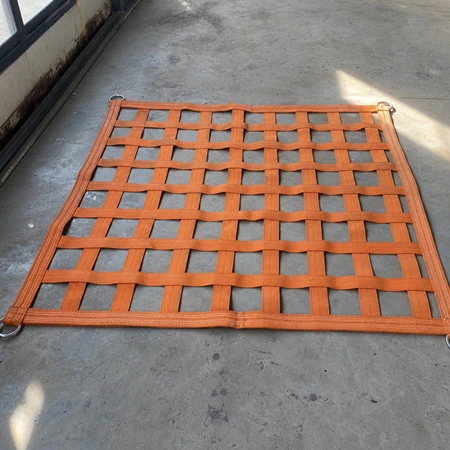
Orange polyester webbing lifting net laid flat with steel corner rings
A square polyester webbing net laid out flat: 100 mm mesh, 50 mm bånd, reinforced border and a steel ring at each corner.

Bottom construction and discharge

How the load comes out is a design decision in its own right. For bagged cargo the answer is usually a person with a knife; for bulk it is usually gravity.

Bord 6 – Bottom options and how each one is emptied.

Bunn Hvordan det fungerer Chosen when
Lukket, ferdig sydd The bag holds the cargo permanently and is emptied by tipping or by hand Innpakket last, and bulk tipped over a hopper or onto a pile
Release bottom, snøret En snøret søm over bunnen løsnes ved utløpspunktet og lasten faller ut Free-flowing bulk – sand, korn, samlet – discharged without tipping the bag
Rennebunn The bag narrows to a chute opened over the receiving hopper Controlled discharge into a hopper, en lekter eller en transportør
Closed with a liner En stofffôr sitter inne i nettet Dusty or moisture-sensitive bulk: korn, gjødsel, pulver
Forsterket bunnpanel An extra layer of webbing is stitched across the base Abrasive and heavy bulk: samlet, malm, skrap
Loops top and bottom Loops at both ends, so the bag can be lifted either way up Loading at height, og tømming ved å snu posen på kroken

Lifting arrangements and fittings

Hvordan posen henges opp avgjør hvor mye av lasten den egentlig bærer, og bulk er utilgivelig fordi lasten fortsetter å bevege seg inne i posen mens den er i luften.

  • Fire løkker på kroken – the standard for bagged and bulk work; the loops gather on the hook or a master ring and the bag closes around the cargo as the crane takes up the slack.
  • Åtte løkker på en spredebjelke – posen forblir firkantet, lasten holder seg vannrett, og hver sløyfe har en forutsigbar andel; the right arrangement for large bags and high tonnage, se vår løftende spredebjelke spekter.
  • Two-loop basket – faster to rig, men det de-rate nettet; ask for the derated capacity instead of reading across from the four-loop figure.
  • Loops top and bottom – lets the bag be lifted either way up, som er hvordan en lukket pose tømmes ved å snu den over en trakt.

Beslag leveres eller monteres på forespørsel: sydde webbingløkker, master ring or master link, karakter 80 lenker, laced release bottoms, chutes and discharge sleeves, inner liners, wear pads and protection sleeves for scrap and aggregate, and repair kits for fleets that maintain their own equipment.

Materiale, stitching and finish

The belt is the product. We weave it on needle looms from high-tenacity polyester yarn, with a woven selvedge rather than a cut edge, so the band does not fray from the outside in.

  • 100 % høyfast polyester, lav forlengelse (7 % eller mindre ved WLL), UV stabilisert, rot-proof and unaffected by moisture.
  • Locked stitching in high-tenacity polyester thread, run in multiple rows along the border and box-X at every loop – on a cheap net it is the stitch line, ikke beltet, that fails first.
  • Brettet og dobbeltsydd kant, so the edge of the mesh cannot unravel under load.
  • Galvanised or stainless steel rings and master links on request.
  • Polyester holds its strength from -40 °C til +100 °C; above that, or in chemical exposure, tell us and we will quote nylon or another construction.
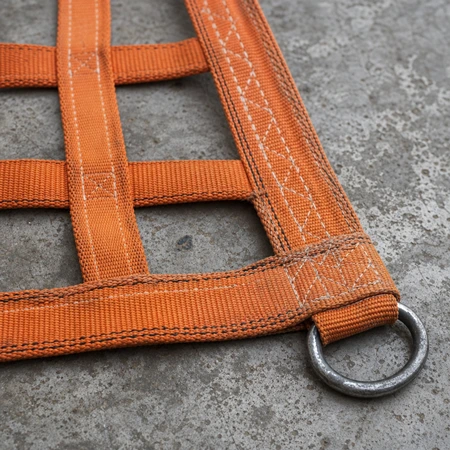
Close-up of webbing net border stitching and a galvanised D-ring
Border stitching and a galvanised D-ring at the corner – the two places a webbing net bag is most often overloaded.

Testing, sertifisering og sporbarhet

  • Førti år med produksjon av løfteutstyr – grunnlagt i 1985 i Taizhou, Jiangsu, med mer enn 200 ansatte og en av Kinas største løftestropper og nettproduksjonsbaser.
  • Hvert nett er prøvelastet på egen hånd 1000 t horisontal testmaskin – testet, ikke samplet.
  • A material test report travels with each shipment, quoting the belt batch and the test load.
  • CE-samsvarserklæring og GS-sertifisering, med JIS-sertifisering på eksportordrer.
  • ISO 9001 kvalitetsstyringssystem, et CNAS-akkreditert laboratorium og DNV-sertifisering bak anlegget.
  • Every net is marked with its working load limit, mesh, rated volume and batch number before packing, så posen og papirene stemmer alltid overens.

Certificates and test reports are available as PDFs for your tender or customs file – se hele sertifisering sett.

Where these nets work

A polyester lifting hoisting net is used wherever loose cargo has to travel between a stack and a hook – quay, mølle, quarry, yard or hold. The sectors below are the ones where the bagged and bulk version earns its place.

Bord 7 – Applications by sector.

Sektor Hva nettet takler Hvorfor et polyesternett passer det
Havner, kaier og terminaler Innpakket last, korn, fertilizer and bulk between quay, barge and hold En pose per løft, ingen pall, og lasten renner ut mens den beveger seg
Landbruk og fôrfabrikker Frø, korn, mate, gjødsel og poseprodukt Et tett netting eller en liner holder produktet inne og været ute
Byggematerialer Sand, grus, pukk og sement sement Fin nok til å holde bulken, open enough for rainwater to drain
Gruvedrift og steinbrudd Samlet, malm og mineralbulk En forsterket bunn tar ut slitasjen som sliter på et nett
Fiskeri og matforedling Våt fisk, skalldyr og produsere Åpne nettingavløp fritt, which keeps the weight honest
Gjenvinning og avfall Løs plast, glass, metall og blandet materiale Contains loose material that would otherwise blow or fall
Biomass and power Treflis, bark, pellets og drivstoff bulk En stor bag for en beskjeden tonnasje, samsvarer med volumgrensen
Construction sites and relief work Bagged materials raised to upper floors, field cargo No pallet, ingen banding, og den kan tømmes rett på bakken
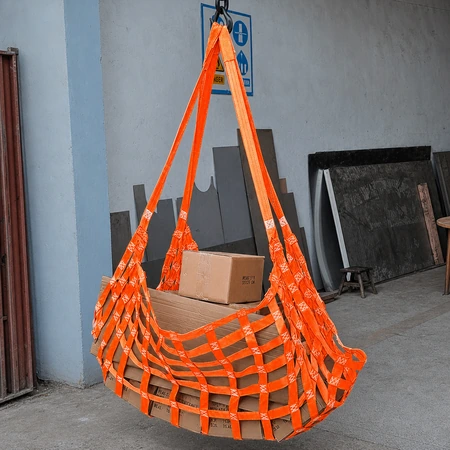
Orange webbing net bag lifting a carton with soft wide bands
Mixed cargo on site: a net bag takes a carton as readily as a stack of sacks, and the flat webbing spreads the load rather than cutting into it.

Customisation and branding

A net that moves between quays, holds and yards has to be identifiable from a distance and has to keep its marking. Farge, trykt logo, working load limit and cargo type are all applied in our own plant, so the marking cannot be washed off or pulled away with a label.

  • Fargekode etter arbeidsbelastningsgrense, or a custom house colour to separate your fleet from a competitor’s.
  • Logo, brand name, warning text or certificate number printed on the belt, or woven in on larger orders.
  • Cargo type printed on the bag, which stops a fine-mesh grain net being sent out for scrap.
  • Sewn capacity label in addition to the print, so the net and its paperwork agree at every inspection.
  • Packing folded into a bag or a crate – a set of ten net bags takes the space of one pallet.
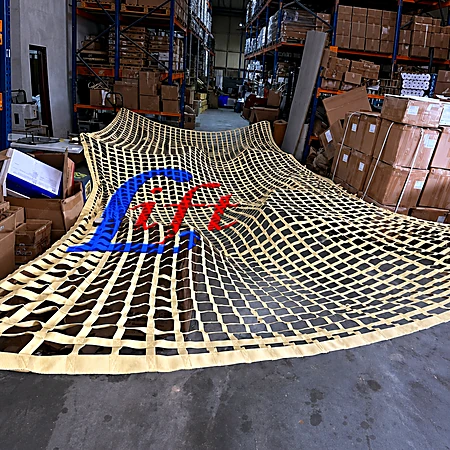
Polyester webbing cargo net printed with a customer logo in a warehouse
Buyer branding applied at the mill: the customer mark is printed directly on the webbing bands, not on a tag.
Beige polyester webbing net with printed logo laid out for inspection
Final inspection before packing – farge, trykt logo, mesh and working load limit are checked on the finished net.

Omsorg, inspeksjon og pensjonering

  • Inspect the loops and their stitching first, så grensen, then the bottom closure – on a bulk net the bottom and the corners wear before the mesh does.
  • Tøm posen helt før oppbevaring; material left inside holds moisture, legger vekt og skjuler skader.
  • Se etter kutt, slitasje, ødelagte sømmer, kjemisk farging, varmeglass og farge- eller glansendring som signaliserer UV-nedbrytning.
  • Weigh a wet bag before lifting it. Regn, sea water and wet bulk can add far more than the cargo was rated at, og et nett vet ikke forskjellen.
  • Overskrid aldri den nominelle kapasiteten, aldri løft på færre enn hele settet med løkker, og dra aldri en lastet pose sidelengs med kranen.
  • Oppbevares rent og tørt, fra bakken og utenfor direkte sol; reparer aldri webbing ved å knyte, sveising eller oppvarming.

Ofte stilte spørsmål

What is the difference between a polyester lifting hoisting net and a cargo net?

A lifting net is rated, marked and tested to carry a load on a crane hook. A cargo net is a restraint: it holds a load down in transit and is not designed to be lifted. If the net is going onto a hook, it must be the rated version – se vår lastesikringsnett for the tie-down case.

How do I choose the mesh opening?

From the smallest unit in the load, ikke fra tonnasjen. EN 25 kg bag needs 50-75 mm; grain or fertilizer needs 25-50 mm or a closed liner; scrap and coal can take 100-150 mm. Once the net is sewn the mesh cannot be changed, so this is the one number worth checking twice.

Why does the volume matter as much as the weight?

Fordi lett bulk fyller posen før den når merkevekten. A bag that is full at half its rating doubles the number of lifts and the crane time. Give us the bulk density with the tonnage and we will size the bag so a full bag is also a legal bag.

Kan posen tømmes uten å tippe den?

Ja. A laced release bottom or a chute bottom lets a free-flowing load be discharged straight into a hopper, en lekter eller en transportør. Bagged cargo is normally emptied by hand or with a forklift at the far end.

Vil nettet holde våt last?

The net itself is unaffected – polyester does not absorb water and does not rot, så regn, sea water and wash-down do no harm. To advarsler: wet cargo is heavier, and fine wet material can clog the mesh, som tilfører vekt og stopper det å drenere.

How is the working load limit proved?

Nettet er klassifisert til EN 1492-1 basis og garn leveres kl 5:1, 6:1 eller 7:1 som spesifisert. Hvert nett er prøvelastet på egen hånd 1000 t maskin, a material test report travels with the order, og produktene har CE- og GS-sertifisering.

Do you make a flat version for palletised cargo?

Ja – the flat lifting net is the kran pall lastenett, and the material-led range is covered by the nett i polyester for løfting. The rope constructions sit alongside as the nylon lastløftenett og den kraftig nylonlastnettslynge.

What else do you make from the same webbing?

The same belt goes into our båndslynger og endeløse runde slynger, and the wider cargo range is listed under lastløftenett – including the nett for lasteløfte for flat work.

Be om et tilbud

Send the cargo and whether it is bagged or bulk, massetettheten hvis du vet det, vekten du ønsker per løft, nettingåpningen, the discharge method and the environment the net will work in – or a sketch of the bag you have in mind. Våre ingeniører vil bekrefte nettostørrelsen, dybde, bunnkonstruksjon, band and packing and quote it in one reply. For å snakke gjennom det først, kontakt våre ingeniører.

Lift Sling Rigging Company – Lifute Industripark, Taizhou by, Jiangsu-provinsen, Kina
Tlf: +86 523 8693 5818 | WhatsApp: +86 180 6600 2268 | E-mail: lift98@jslift.com

Produktdetaljer

Lift sling rigging selskapet produserer Polyester Lifting Hoisting Net,Lastenett i polyester,Sikkerhetsløftenettstropp,Bungee Cargo Net,Lastenett i polyester,Løfteslyngenett,Tauløftenett,Pall Cargo Net,Hageklatrenett.

Løftenett i polyester

A polyester lifting hoisting net is a soft bag woven from high-tenacity polyester webbing, built to move bagged goods and bulk material in a single crane lift. The load is tipped into the bag, or the bag is laid flat and drawn up around a stack, and four corner loops carry the whole consignment to the hook. There is no pallet to return, no strapping to cut, and nothing to re-handle at the far end.

Because we weave the webbing in our own mill in Taizhou, Jiangsu, nettingåpningen, bag footprint, dybde, bottom construction and working load limit are all set to the cargo rather than to a fixed catalogue. Standard nets cover 0.5 t til 20 t og 0.6 m³ til over 10 m³, every net is proof-load tested before packing, and each shipment travels with a material test report. Nets are CE and GS certified, with webbing rated to the EN 1492-1 basis.

  • Fully custom build – mesh, posestørrelse, dybde, colour and safety factor (5:1, 6:1 eller 7:1) set to your specification.
  • High-tenacity polyester webbing – 25 mm til 100 mm bånd, enkelt, tosidig eller tripleks, UV stabilised and rot-proof.
  • Wear and heat resistant – working range -40 °C til +100 °C, with a reinforced bottom for abrasive loads.
  • Myk, fleksibel og lett – the flat band contacts the load over a wide area, so bags, cartons and finished surfaces are neither crushed nor marked.
  • CE og GS sertifisert – testet på egen hånd 1000 t maskin, with an ISO 9001 quality system and a CNAS-accredited laboratory behind it.
Polyester lifting hoisting net under a mobile crane carrying broken stone
A polyester lifting hoisting net in bulk service – the bag is filled with broken stone and lifted from its four loops by a mobile crane.

Why a webbing net bag, and not a rope net or a big bag

Three products are sold for the same job and they behave very differently once the load is in the air. A rope net concentrates the load on a few contact points. A big bag carries one free-flowing product and is itself the package. A webbing net bag spreads the pressure across flat bands, holds a stacked or mixed load together, and goes back to the store empty.

Bord 1 – How the four common ways of lifting loose cargo compare.

Alternativ Konstruksjon Kontakt med lasten Best cargo Limitation
Polyester webbing net bag Flat woven bands, 25-100 mm, 25-300 mm mesh Wide flat bands, low pressure per cm² Pakket, stablet, mixed and bulk cargo Needs a crane or hook; not a sealed package for powder
Nylon taunett Knotted or braided rope, 8-24 mm Line contact at every rope Irregular and heavy single items Ropes mark soft cargo; a tight mesh adds weight
FIBC / big bag Woven PP fabric with a liner Full surface, sealed One free-flowing product per bag Single product only; the bag is the packaging
Pallet and strapping Timber or plastic pallet plus bands Rigid base Unitised cartons Pallet returned or lost; bands cut and discarded; no drainage
Diagram comparing nylon rope, steel wire rope and polyester webbing net constructions
Three woven constructions for cargo nets: nylon tau, steel wire rope and high-strength polyester webbing.

Five decisions that set the specification

A polyester lifting hoisting net is quoted from five numbers. Get them right and the net arrives right; get the mesh wrong and no amount of extra tonnage will fix it later.

Bord 2 – What we need to know, and why each answer changes the net.

Avgjørelse Hva det fikser What to tell us
1. Cargo form Whether the net is a bag or a flat sheet, and how the bottom is built How the cargo arrives: sekker, store sekker, baller, or loose material
2. Weight per lift Band width and layer count, and therefore the rated capacity Bruttovekten du har tenkt å løfte, not the weight of the net
3. Fylt volum Footprint and depth of the bag Bulk tetthet (t/m³) for loose material, or the height of the stack for bagged goods
4. Mesh åpning The largest gap the cargo can pass through The smallest unit in the load: en 25 kg bag, korn, aggregate or scrap
5. Utslippsmetode Lukket, snøret, renne eller foret bunn Whether the bag is tipped, untied over a hopper, or emptied by hand

Weight and volume are two separate limits, and for light bulk the volume arrives first. Korn ca 0.7 t/m³ og flis på ca 0.3 t/m³ fyller begge a 3.6 m³ bag, but one lift weighs about 2.5 t and the other about 1 t. Send the bulk density with the tonnage and we will size the bag so that a full bag is also a legal bag.

Polyester net bag lifting stacked 25 kg sacks in one crane lift
Bagged cargo in a polyester net bag – a stack of 25 kg sacks is closed in by the mesh and lifted as a single load.

Tekniske parametere

Figurene nedenfor dekker standardserien for sekker og bulk. Mesh, fotspor, dybde, bottom, loops and capacity are made to order, so treat this as the starting point for a quotation rather than a fixed catalogue.

Bord 3 – Polyester lifting hoisting net: tekniske parametere.

Parameter Spesifikasjon
Produktnavn Polyester lifting hoisting net (polyester webbing net bag)
Configurations Closed bag, release-bottom bag, or flat lifting net
Webbing materiale 100 % høyfast polyester (KJÆLEDYR); høyfast nylon på forespørsel
Båndbredde 25 / 38 / 50 / 75 / 100 mm (50 mm standard)
Bandkonstruksjon Enkelt lag, tosidig eller tripleks; vevd kant, ikke en kuttet kant
Båndtykkelse 1.8 mm – 4.5 mm avhengig av bredde og lagantall
Mesh åpning 100 × 100 mm standard; 25 – 300 mm laget på bestilling
Netto størrelse Laget til belastningens fotavtrykk, truck bed or receiving hopper; see Table 4
Posedybde 0.8 m – 2.5 m, eller til tegning
Fylt volum Om 0.6 m³ til over 10 m³, set by footprint and depth
Grense Brettet og dobbeltsydd, reinforced at every lifting point
Løftepunkter Fire hjørneløkker standard; åtte for en spredebjelke; løkker topp og bunn på forespørsel
Nominell kapasitet (WLL) 0.5 t – 20 t, satt av band, lagtelling og løftearrangement
Sikkerhetsfaktor 5:1 / 6:1 / 7:1
Forlengelse ved WLL 7 % eller mindre
Farge Fargekode etter arbeidsbelastningsgrense, eller en tilpasset husfarge
Arbeidstemperatur -40 °C til +100 °C
Weather and chemical UV stabilisert, rot-proof, unaffected by rain, sea water and wash-down
Merking WLL, mesh and batch printed on the belt, pluss en sydd kapasitetsetikett
Standard basis Webbing vurdert til EN 1492-1
Sertifisering CE, GS, ISO 9001, JIS på forespørsel; CNAS laboratorium; DNV
Tilpasning OEM / ODM-størrelse, farge, trykt logo, etikett og pakking
HS-kode 6307.90 – nets and netting of textile materials

Standard størrelser, volumes and working load limits

These six lines cover the great majority of bagged and bulk work. Filled volume is calculated from the footprint and the depth with an allowance for the rounded shape a loaded bag takes, so a material that settles well will carry slightly more and one that bridges will carry less.

Bord 4 – Standard net sizes at four corner loops gathered on one hook.

Netto størrelse (L × B) Depth Fylt volum Mesh Bånd WLL Typisk last
1.0 × 1.0 m 1.0 m 0.6 m³ 50-100 mm 50 mm enkelt 0.5-1.5 t 25 kg poser, små sekker, baller
1.5 × 1.5 m 1.2 m 1.6 m³ 50-100 mm 50 mm tosidig 1-2.5 t Korn i pose, gjødsel, produsere
2.0 × 2.0 m 1.5 m 3.6 m³ 50-100 mm 50 mm tosidig 2-4 t Bulk korn, sand, knust stein
2.5 × 2.5 m 1.8 m 6.8 m³ 50-150 mm 75 mm tosidig 3-6 t Bulkgjødsel, kull, skrap, fisk
3.0 × 3.0 m 2.0 m 10.8 m³ 100-150 mm 75 mm tosidig 4-8 t Store bulklaster, kai og hold arbeid
To drawing 0.8-2.5 m Å bestille 25-300 mm 25-100 mm 0.5-20 t Ethvert fotavtrykk, dybde og last

The working load limits above assume a four-loop lift. A two-loop basket de-rates the net – ask for the derated figure rather than reading across from this table.

Mesh åpning, chosen from the cargo

Mesh is the one dimension that cannot be adjusted after the net is sewn, so it is sized from the smallest unit in the load rather than from the total weight.

Bord 5 – Mesh opening by cargo.

Last Anbefalt mesh Grunn
50 kg sekker, store sekker, baller 100 mm The sacks are far larger than the opening; the mesh only has to keep the stack together
25 kg poser, små sekker 50-75 mm Small bags can squeeze through 100 mm once the load settles in the air
Korn, frø, tørkede produkter 25-50 mm, eller en lukket liner Fine material must not sift out on the hook or in transit
Gjødsel, priller, pulver 25-50 mm, eller en lukket liner Fine and moisture-sensitive: a liner keeps the product in and the weather out
Sand, grus, knust stein 50-100 mm Fin nok til å holde bulken, open enough for rainwater to drain
Kull, cola 100-150 mm Large lumps; et bredere nett holder nettet lett og drenerer godt
Skrapmetall, avskjæringer 100-150 mm Open mesh with a reinforced bottom and wear pads at the contact points
Fisk, skalldyr, våte produkter 25-50 mm Holds the catch, drains freely, keeps the weight honest
Logger, ved, store avskjæringer 150-300 mm Indivisible pieces: a wide mesh saves weight without losing the load
Orange polyester webbing lifting net laid flat with steel corner rings
A square polyester webbing net laid out flat: 100 mm mesh, 50 mm bånd, reinforced border and a steel ring at each corner.

Bottom construction and discharge

How the load comes out is a design decision in its own right. For bagged cargo the answer is usually a person with a knife; for bulk it is usually gravity.

Bord 6 – Bottom options and how each one is emptied.

Bunn Hvordan det fungerer Chosen when
Lukket, ferdig sydd The bag holds the cargo permanently and is emptied by tipping or by hand Innpakket last, and bulk tipped over a hopper or onto a pile
Release bottom, snøret En snøret søm over bunnen løsnes ved utløpspunktet og lasten faller ut Free-flowing bulk – sand, korn, samlet – discharged without tipping the bag
Rennebunn The bag narrows to a chute opened over the receiving hopper Controlled discharge into a hopper, en lekter eller en transportør
Closed with a liner En stofffôr sitter inne i nettet Dusty or moisture-sensitive bulk: korn, gjødsel, pulver
Forsterket bunnpanel An extra layer of webbing is stitched across the base Abrasive and heavy bulk: samlet, malm, skrap
Loops top and bottom Loops at both ends, so the bag can be lifted either way up Loading at height, og tømming ved å snu posen på kroken

Lifting arrangements and fittings

Hvordan posen henges opp avgjør hvor mye av lasten den egentlig bærer, og bulk er utilgivelig fordi lasten fortsetter å bevege seg inne i posen mens den er i luften.

  • Fire løkker på kroken – the standard for bagged and bulk work; the loops gather on the hook or a master ring and the bag closes around the cargo as the crane takes up the slack.
  • Åtte løkker på en spredebjelke – posen forblir firkantet, lasten holder seg vannrett, og hver sløyfe har en forutsigbar andel; the right arrangement for large bags and high tonnage, se vår løftende spredebjelke spekter.
  • Two-loop basket – faster to rig, men det de-rate nettet; ask for the derated capacity instead of reading across from the four-loop figure.
  • Loops top and bottom – lets the bag be lifted either way up, som er hvordan en lukket pose tømmes ved å snu den over en trakt.

Beslag leveres eller monteres på forespørsel: sydde webbingløkker, master ring or master link, karakter 80 lenker, laced release bottoms, chutes and discharge sleeves, inner liners, wear pads and protection sleeves for scrap and aggregate, and repair kits for fleets that maintain their own equipment.

Materiale, stitching and finish

The belt is the product. We weave it on needle looms from high-tenacity polyester yarn, with a woven selvedge rather than a cut edge, so the band does not fray from the outside in.

  • 100 % høyfast polyester, lav forlengelse (7 % eller mindre ved WLL), UV stabilisert, rot-proof and unaffected by moisture.
  • Locked stitching in high-tenacity polyester thread, run in multiple rows along the border and box-X at every loop – on a cheap net it is the stitch line, ikke beltet, that fails first.
  • Brettet og dobbeltsydd kant, so the edge of the mesh cannot unravel under load.
  • Galvanised or stainless steel rings and master links on request.
  • Polyester holds its strength from -40 °C til +100 °C; above that, or in chemical exposure, tell us and we will quote nylon or another construction.
Close-up of webbing net border stitching and a galvanised D-ring
Border stitching and a galvanised D-ring at the corner – the two places a webbing net bag is most often overloaded.

Testing, sertifisering og sporbarhet

  • Førti år med produksjon av løfteutstyr – grunnlagt i 1985 i Taizhou, Jiangsu, med mer enn 200 ansatte og en av Kinas største løftestropper og nettproduksjonsbaser.
  • Hvert nett er prøvelastet på egen hånd 1000 t horisontal testmaskin – testet, ikke samplet.
  • A material test report travels with each shipment, quoting the belt batch and the test load.
  • CE-samsvarserklæring og GS-sertifisering, med JIS-sertifisering på eksportordrer.
  • ISO 9001 kvalitetsstyringssystem, et CNAS-akkreditert laboratorium og DNV-sertifisering bak anlegget.
  • Every net is marked with its working load limit, mesh, rated volume and batch number before packing, så posen og papirene stemmer alltid overens.

Certificates and test reports are available as PDFs for your tender or customs file – se hele sertifisering sett.

Where these nets work

A polyester lifting hoisting net is used wherever loose cargo has to travel between a stack and a hook – quay, mølle, quarry, yard or hold. The sectors below are the ones where the bagged and bulk version earns its place.

Bord 7 – Applications by sector.

Sektor Hva nettet takler Hvorfor et polyesternett passer det
Havner, kaier og terminaler Innpakket last, korn, fertilizer and bulk between quay, barge and hold En pose per løft, ingen pall, og lasten renner ut mens den beveger seg
Landbruk og fôrfabrikker Frø, korn, mate, gjødsel og poseprodukt Et tett netting eller en liner holder produktet inne og været ute
Byggematerialer Sand, grus, pukk og sement sement Fin nok til å holde bulken, open enough for rainwater to drain
Gruvedrift og steinbrudd Samlet, malm og mineralbulk En forsterket bunn tar ut slitasjen som sliter på et nett
Fiskeri og matforedling Våt fisk, skalldyr og produsere Åpne nettingavløp fritt, which keeps the weight honest
Gjenvinning og avfall Løs plast, glass, metall og blandet materiale Contains loose material that would otherwise blow or fall
Biomass and power Treflis, bark, pellets og drivstoff bulk En stor bag for en beskjeden tonnasje, samsvarer med volumgrensen
Construction sites and relief work Bagged materials raised to upper floors, field cargo No pallet, ingen banding, og den kan tømmes rett på bakken
Orange webbing net bag lifting a carton with soft wide bands
Mixed cargo on site: a net bag takes a carton as readily as a stack of sacks, and the flat webbing spreads the load rather than cutting into it.

Customisation and branding

A net that moves between quays, holds and yards has to be identifiable from a distance and has to keep its marking. Farge, trykt logo, working load limit and cargo type are all applied in our own plant, so the marking cannot be washed off or pulled away with a label.

  • Fargekode etter arbeidsbelastningsgrense, or a custom house colour to separate your fleet from a competitor’s.
  • Logo, brand name, warning text or certificate number printed on the belt, or woven in on larger orders.
  • Cargo type printed on the bag, which stops a fine-mesh grain net being sent out for scrap.
  • Sewn capacity label in addition to the print, so the net and its paperwork agree at every inspection.
  • Packing folded into a bag or a crate – a set of ten net bags takes the space of one pallet.
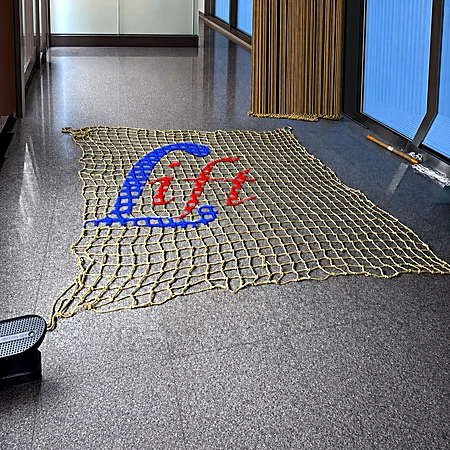
Polyester webbing cargo net printed with a customer logo in a warehouse
Buyer branding applied at the mill: the customer mark is printed directly on the webbing bands, not on a tag.
Beige polyester webbing net with printed logo laid out for inspection
Final inspection before packing – farge, trykt logo, mesh and working load limit are checked on the finished net.

Omsorg, inspeksjon og pensjonering

  • Inspect the loops and their stitching first, så grensen, then the bottom closure – on a bulk net the bottom and the corners wear before the mesh does.
  • Tøm posen helt før oppbevaring; material left inside holds moisture, legger vekt og skjuler skader.
  • Se etter kutt, slitasje, ødelagte sømmer, kjemisk farging, varmeglass og farge- eller glansendring som signaliserer UV-nedbrytning.
  • Weigh a wet bag before lifting it. Regn, sea water and wet bulk can add far more than the cargo was rated at, og et nett vet ikke forskjellen.
  • Overskrid aldri den nominelle kapasiteten, aldri løft på færre enn hele settet med løkker, og dra aldri en lastet pose sidelengs med kranen.
  • Oppbevares rent og tørt, fra bakken og utenfor direkte sol; reparer aldri webbing ved å knyte, sveising eller oppvarming.

Ofte stilte spørsmål

What is the difference between a polyester lifting hoisting net and a cargo net?

A lifting net is rated, marked and tested to carry a load on a crane hook. A cargo net is a restraint: it holds a load down in transit and is not designed to be lifted. If the net is going onto a hook, it must be the rated version – se vår lastesikringsnett for the tie-down case.

How do I choose the mesh opening?

From the smallest unit in the load, ikke fra tonnasjen. EN 25 kg bag needs 50-75 mm; grain or fertilizer needs 25-50 mm or a closed liner; scrap and coal can take 100-150 mm. Once the net is sewn the mesh cannot be changed, so this is the one number worth checking twice.

Why does the volume matter as much as the weight?

Fordi lett bulk fyller posen før den når merkevekten. A bag that is full at half its rating doubles the number of lifts and the crane time. Give us the bulk density with the tonnage and we will size the bag so a full bag is also a legal bag.

Kan posen tømmes uten å tippe den?

Ja. A laced release bottom or a chute bottom lets a free-flowing load be discharged straight into a hopper, en lekter eller en transportør. Bagged cargo is normally emptied by hand or with a forklift at the far end.

Vil nettet holde våt last?

The net itself is unaffected – polyester does not absorb water and does not rot, så regn, sea water and wash-down do no harm. To advarsler: wet cargo is heavier, and fine wet material can clog the mesh, som tilfører vekt og stopper det å drenere.

How is the working load limit proved?

Nettet er klassifisert til EN 1492-1 basis og garn leveres kl 5:1, 6:1 eller 7:1 som spesifisert. Hvert nett er prøvelastet på egen hånd 1000 t maskin, a material test report travels with the order, og produktene har CE- og GS-sertifisering.

Do you make a flat version for palletised cargo?

Ja – the flat lifting net is the kran pall lastenett, and the material-led range is covered by the nett i polyester for løfting. The rope constructions sit alongside as the nylon lastløftenett og den kraftig nylonlastnettslynge.

What else do you make from the same webbing?

The same belt goes into our båndslynger og endeløse runde slynger, and the wider cargo range is listed under lastløftenett – including the nett for lasteløfte for flat work.

Be om et tilbud

Send the cargo and whether it is bagged or bulk, massetettheten hvis du vet det, vekten du ønsker per løft, nettingåpningen, the discharge method and the environment the net will work in – or a sketch of the bag you have in mind. Våre ingeniører vil bekrefte nettostørrelsen, dybde, bunnkonstruksjon, band and packing and quote it in one reply. For å snakke gjennom det først, kontakt våre ingeniører.

Lift Sling Rigging Company – Lifute Industripark, Taizhou by, Jiangsu-provinsen, Kina
Tlf: +86 523 8693 5818 | WhatsApp: +86 180 6600 2268 | E-mail: lift98@jslift.com

Legg igjen din melding

Rull til toppen