

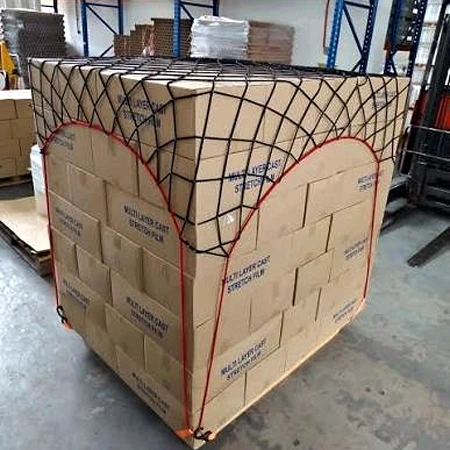
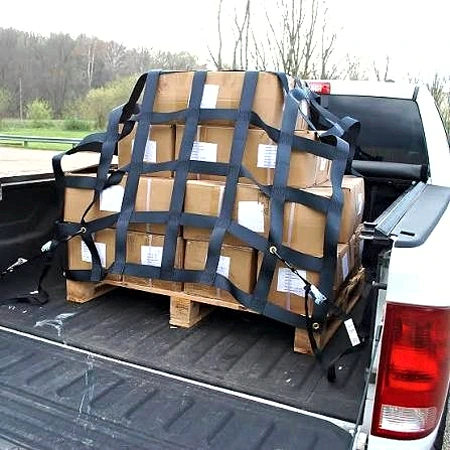
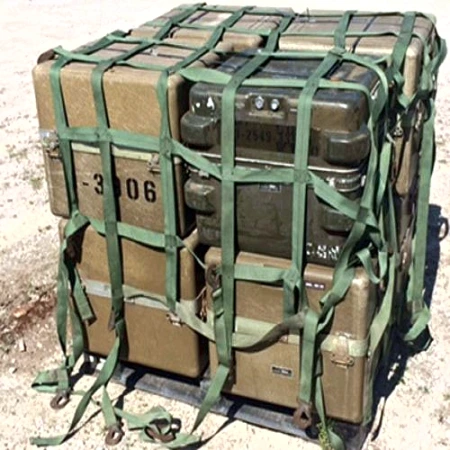
Lift sling rigging selskapet produserer Cargo Securing Net,Lastsikringsnett,Lite netting for lastesikring,Beholdersikringsnett,Lastsikkert nett.
Lastesikringsnett
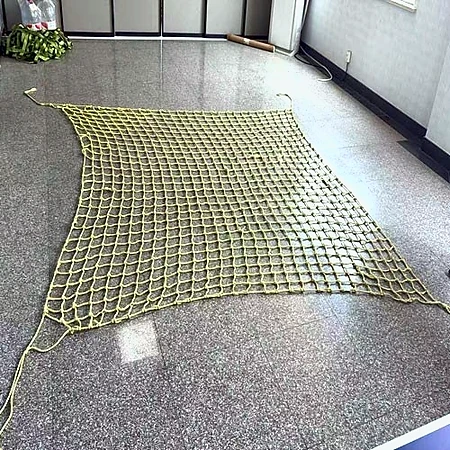
A cargo securing net is a flat-belt restraint net laid over a load and tensioned down to the deck, so that the cargo cannot slide, rock or topple on the way. The belts are woven from high-tenacity polyester into an open lattice, the border is folded and double-stitched, and the edge carries rated attachment points that are pulled down with ratchet tensioners until the load is pressed onto the vehicle or container floor.
The distinction that matters on this product is duty, not appearance. A cargo securing net restrains; it does not lift. Its label carries a lashing capacity (LC) and a standard tension force (STF) i daN, the arrangement is calculated to EN 12195-1 and the belts are type-tested to EN 12195-2 – not to a lifting working load limit. We weave the belts in our own mill in Taizhou, so net size, mesh, belt width, fittings and markings are set to your load, your vehicle and your anchor points.
- Restraint rating, ikke en løftevurdering – LC and STF marked in daN, calculated to EN 12195-1, belts type-tested to EN 12195-2.
- Flat high-tenacity polyester belts – 25 mm til 100 mm, single or duplex, UV stabilised and rot-proof.
- Sized to the load or the aperture – cover nets, container doorway nets, partition nets and bag form, alt laget på bestilling.
- Rated fittings and tensioners – ratchets, kroker, D-rings and lashing points, with anti-slip mats where the deck friction is low.
- CE og GS sertifisert – vevd, sydd, marked and tested in one plant, med ISO 9001, CNAS og DNV bak.

Restraint is not lifting – and the label says which one you have
The two products look alike, are made from the same belt and are often bought by the same fleet. They are not interchangeable, and the difference is not a formality: one is sized so a load cannot move, the other is sized so a load cannot fall. Using a restraint net on a crane hook, or a lifting net as a tensioned tie-down, is a safety failure rather than a paperwork problem.
Bord 1 – Why a securing rating and a lifting rating are not interchangeable.
| Sammenligningspunkt | Lastesikringsnett (denne siden) | Løftenett |
|---|---|---|
| Hva den gjør | Begrenser en last som forblir på kjøretøyet | Bærer hele vekten av en last i luften |
| Styres av | I 12195-1 (beregning av sikringskrefter) og EN 12195-2 (båndsurringer) | Løftestandarder, with webbing rated on the EN 1492-1 basis |
| Vurdert i | Surringskapasitet (LC) og standard strekkkraft (STF), i daN | Arbeidsbelastningsgrense (WLL), i tonn |
| How it is sized | Sized to resist the acceleration and friction case for the journey | Størrelse med a 5:1, 6:1 eller 7:1 faktor og prøvetestet per slynge |
| How it is tested | Belt and tensioner type-tested to EN 12195-2 | Every sling break-tested on our own 1000 t maskin |
| How it fails | The load moves – a road accident | The sling breaks – a dropped load |
If the requirement is to lift – a pallet onto a roof, a bag into a hold – the right product is a lifting net: de kran pall lastenett, de løftenett av polyester eller den kraftig nylonlastnettslynge. If the requirement is to keep a load still from the loading bay to the delivery point, this page is the right one.
The forces the net has to answer for
A load on a moving vehicle is pushed in three directions, and each one is a design case rather than an accident. The accelerations below are the ones EN 12195-1 uses for road transport; other modes and national rules differ, which is why we ask where the load is travelling before we size the net.
Bord 2 – Design accelerations for road transport and what resists each one.
| Direction | Design acceleration | What resists it |
|---|---|---|
| Forward (braking) | 0.8 g | Blocking or a headboard first, then direct lashings to the front; friction contributes |
| Rearward (acceleration) | 0.5 g | Rear lashings and a tailboard; the net’s rear edge lines |
| Sidelengs (cornering) | 0.5 g | Side lashings, containment by the lattice, and friction from the pre-tension |
| Vertikal | Not a road design case | Held down by pre-tension and containment; a net reduces bounce but is not a substitute for blocking |
The practical consequence is that a net alone rarely carries the whole case. Blocking against a headboard does more for the braking case than any strap, and a net laid over the top does the rest. A good securing arrangement is a combination, and we will say so when a net is the wrong answer for your load.
Hvordan et flatbeltenett holder en last
Et sikringsnett fungerer gjennom tre mekanismer samtidig. Which one dominates depends on how the net is fitted, and that is decided at the vehicle rather than at the factory.
Bord 3 – The three mechanisms a securing net uses.
| Mekanisme | Hvordan det fungerer | What it depends on |
|---|---|---|
| Friksjon (binding) | Det oppspente nettet presser lasten opp på dekket, og friksjon mellom last og dekk motstår glidning. This is the main effect of a cover net | En ren, dry deck or anti-slip mats. Uten friksjon begrenser det samme nettet langt mindre |
| Inneslutning | Gitteret stopper fysisk spredning av lasten, rocking, or throwing individual items out | A mesh fine enough for the smallest item, and a net fitted tight rather than draped |
| Direct lashing | Where the edge belts run down to rated points on the vehicle, selve beltet bærer sikringskraften | Certified anchor points on the vehicle – never a random protrusion or a load’s own packaging |
Two numbers decide whether the arrangement works, and both are usually ignored. The first is the angle: a tie-down belt is most effective between 75 og 90 grader til dekk, and its effective capacity follows LC_eff = LC × sin α. På 30 degrees you keep roughly half the belt’s rating, so a net pulled down almost flat looks tidy and holds very little. The second is friction: the coefficient between a steel load and a steel deck is about 0.1 til 0.2, steel on timber about 0.2 til 0.3, timber on timber about 0.3 til 0.4, and a good anti-slip mat takes a pallet on a deck to about 0.5 til 0.6. Våt, oily or icy surfaces take all of these figures down, which is why the same net restrains very different loads on two different days.
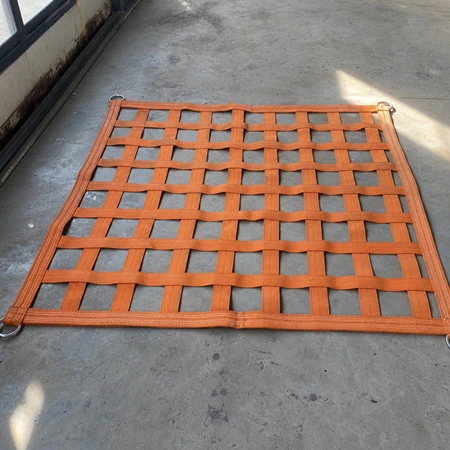
Tekniske parametere
Figurene nedenfor dekker standard sikringsområde. Belt, mesh, netto størrelse, kantbeslag og strammere lages på bestilling, så behandle denne tabellen som utgangspunktet for et tilbud i stedet for en fast katalog.
Bord 4 – Lastesikringsnett: tekniske parametere.
| Parameter | Spesifikasjon |
|---|---|
| Produkttype | Lastesikringsnett (lastsikringsnett) – cover net, partition net, container doorway net or bag form. Ikke en løfteanordning |
| Belt material | 100 % høyfast polyester (KJÆLEDYR); høyfast nylon på forespørsel |
| Belt width | 25 / 35 / 50 / 75 / 100 mm |
| Belt construction | Enkeltlag eller dupleks, vevd kant, ikke en kuttet kant |
| Belt thickness | 1.8 mm – 4.0 mm avhengig av bredde og lagantall |
| Mesh åpning | 100 × 100 mm standard; 50 mm – 300 mm laget på bestilling |
| Netto størrelse | Laget til belastningens fotavtrykk, kjøretøyets seng, eller beholderen eller døråpningen |
| Surringskapasitet (LC) | Om 750 daN on a 25 mm belt to about 5,000 daN on a 100 mm duplex belt, marked per net |
| Forspenning (STF) | 250 – 500 daN depending on the tensioner supplied; merket på etiketten |
| Standard basis | I 12195-1 for the securing calculation; I 12195-2 for the webbing lashing |
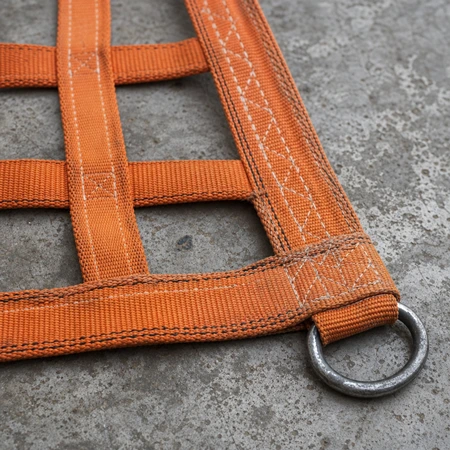
| Grense | Brettet og dobbeltsydd; forsterket ved hvert festepunkt |
| Beslag | Skrallestrammere, kroker, D-ringer, cam buckles and lashing points, karakter 80 steel where steel is used |
| Farge | Orange for high visibility as standard; blå, grønn, black or a custom colour |
| Behandling | UV stabilisert, anti-aldring, slitasje- og rivebestandig, rot-proof |
| Arbeidstemperatur | -40 °C til +100 °C |
| Sertifisering | CE, GS, ISO 9001, JIS på forespørsel; CNAS laboratorium; DNV |
| Tilpasning | OEM / ODM-størrelse, farge, printed belt, merkelapp, logo og innpakning |
| HS-kode | 6307.90 – nets and netting of textile materials |
Standard størrelser, mesh and lashing capacity
A securing net is sized to the load it covers or the aperture it closes, never to a tonnage. The load has to be fully covered, and the border has to land on the deck or on the anchor points instead of hanging in mid-air, because an unsupported edge is an edge that can be pulled sideways.
Bord 5 – Standard securing net sizes, with the belt and capacity that normally go with them.
| Netto størrelse (L × B) | Mesh | Belt | LC per edge line | Typisk bruk |
|---|---|---|---|---|
| 1.2 × 1.2 m (4 × 4 ft) | 100 mm | 35 – 50 mm | 1,000 – 2,000 Og | Single pallet in a van or light truck |
| 2.5 × 1.2 m (8 × 4 ft) | 100 mm | 50 mm | 2,000 Og | Two pallets abreast in a van or curtain-sider |
| 2.5 × 2.5 m | 100 mm | 50 mm | 2,000 Og | Flatbed laster, maskineri, blandet last |
| 5.0 × 2.5 m | 100 – 150 mm | 50 – 75 mm | 2,000 – 3,500 Og | Full lengde flatbed og tilhengerlaster |
| 2.4 × 2.6 m (container) | 100 mm | 75 mm | 3,500 Og | Container doorway net, load held back from the doors |
| 1.5 × 1.5 m bag form | 50 – 100 mm | 50 mm | 2,000 Og | Loose or bagged goods that would spread on the deck |
| Laget for å tegne | 50 – 300 mm | 25 – 100 mm | To calculation | Ethvert fotavtrykk, aperture or vehicle bed |
The capacity column is the restraint available per edge line, not a lifting limit. The number of edge lines, their angle and the friction under the load decide what the arrangement actually restrains.
Four forms of securing net
The same lattice is supplied in four arrangements, and choosing the right one is most of the job. Beslagene er forskjellige mellom dem; tvangsprinsippet gjør det ikke.
Bord 6 – Dekke, partition, container and bag forms.
| Skjema | Hvordan den er montert | Brukes når |
|---|---|---|
| Dekknett | Spread over the load and tensioned down to the deck or to the vehicle’s rated points | Flatbed, curtain-sider and container loads that must not move in any direction – the most common arrangement |
| Partition net | Fixed upright across the vehicle body and tensioned against its own frame | Separating two loads in one vehicle, or holding cargo away from a bulkhead |
| Container doorway net | Fitted across the door aperture and hooked to the container’s own rings | Stopping cargo migrating to the doors during the journey, so the container is safe to open |
| Poseform | Closed at the bottom, with the cargo sitting inside the lattice | Loose or bagged goods that would otherwise spread across the deck |
Beslag, tensioners and anti-slip
A securing net is only as good as the tensioner that pre-tensions it and the anchor point it pulls against. These are the parts that get specified last and fail first.
Bord 7 – Beslag og strammere.
| Tilpasning | Brukes med | Note |
|---|---|---|
| Skrallespenninger | Dekknett, poseform | Stiller inn forspenningen (STF). A ratchet that cannot reach the marked STF makes the net ineffective, whatever its LC |
| Kamspenne | Lett plikt | Faster than a ratchet but reaches a much lower pre-tension – for light loads only |
| Kroker og D-ringer | Enhver ordning | The link between net and anchor point; karakter 80 stål hvor det brukes stålbeslag |
| Surringspunkter | Dekknett | Rated anchor points in the vehicle structure – the restraint force has to go somewhere rated |
| Anti-skli matte | Friksjonsbegrensning | Raises the friction coefficient under the load; usually the single most effective addition on a smooth deck |
| Beskyttelseshylse | Skarpkantet last | Passer over beltet ved kontaktpunktet; den billigste måten å forlenge netto levetid |
| Reparasjonssett | Fleet maintenance | Matching belt, sytråd og en reservestrammer |
Merking, colour and identification
A securing net is checked by the driver before every trip and by an inspector at the roadside, so the marking has to be readable at a distance and has to survive being dragged over a deck.
- Lashing capacity and standard tension force printed along the belt in daN – the units load securing is actually calculated in.
- Net size and date of manufacture printed as well, so the net can be matched to the vehicle and its age judged on the spot.
- A sewn capacity label in addition to the print, så nettet og papirene er alltid enige.
- Orange as the standard high-visibility colour, with blue, grønn, black or a house colour for fleet identification.
- OEM orders can carry your brand, warning text or certificate number printed on the belt.
- Nets ship folded into a bag or a crate – a fleet order takes a fraction of the space of the same number of loose straps.
Testing, sertifisering og sporbarhet
- Førti år med produksjon av løfteutstyr – grunnlagt i 1985 i Taizhou, Jiangsu, med mer enn 200 ansatte.
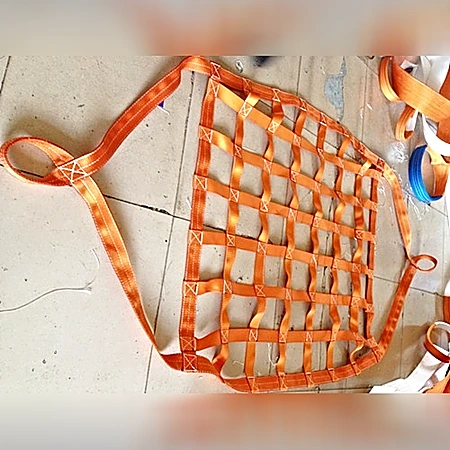
- Belts woven in our own mill, altså bredde, layer count and colour are under our control rather than bought in.
- Webbing strength-tested on our own 1000 t horizontal machine before it is cut into nets.
- Belts supplied to the EN 12195-2 material requirements for securing duty, with the securing calculation following EN 12195-1.
- CE-samsvarserklæring og GS-sertifisering, with JIS on export orders; ISO 9001, CNAS laboratory accreditation and DNV certification behind the plant.
- Hvert nett er merket med sin surringskapasitet, forspenning, størrelse og mesh før pakking, and supplied with a material test report on request.
Sertifikater og testrapporter er tilgjengelige som PDF-er for en anbudsfil eller en tollkontroll – se hele sertifisering sett.
Der det brukes lastesikringsnett
The same net covers a road trailer, a container, a rail wagon and a barge. What changes is the number of anchor points, the mesh and how the net is tensioned – not the product itself.
Bord 8 – Applications by transport mode.
| Modus eller sektor | Hva nettet begrenser | Hvorfor et flatbeltenett passer det |
|---|---|---|
| Vei – flatbed | Maskineri, stål, tømmer, paller, fat og blandet last | Dekker hele lasten i én handling og kombinerer friksjon med inneslutning |
| Vei – gardin-side | Palletised and boxed goods that shift against a soft curtain | Inneholder lasten der selve gardinen ikke har noen begrensninger |
| Containertransport | Last bak dørene, and cargo that must not migrate in transit | A doorway net makes the container safe to open and stops the load moving forward |
| Jernbanegods | Palletised and loose cargo in wagons and on flat wagons | Lange nett dekker en vognseng og kan strammes med jevne mellomrom |
| Sjø og indre vannvei | Dekkslast, og last inne i lektere og lasterom | Råtebestandig, UV stabilised and unaffected by salt water |
| Tungtransport og prosjektgods | Transformatorer, anlegg og belastninger utenfor sporvidde | Kombinert med direkte surringer og blokkering for udelelige laster |
| Sløseri, gjenvinning og landbruk | Baller, avslå, kompost og bulklaster på åpne kjøretøy | Innemming stopper løst materiale som forlater kjøretøyet under transport |
| Military and relief transport | Palletised and loose cargo in trucks and aircraft | Ett nett per lass, rask å påføre og gjenbrukbar over mange turer |
Omsorg, inspeksjon og pensjonering
- Check the net before every trip and record the check: the tensioner first, deretter sømmen ved hvert festepunkt, deretter beltene.
- Avvis ethvert belte med kutt, kantskade, ødelagte sømmer, kjemisk farging, varmeglass, or the colour and gloss change that signals UV degradation.
- Check the vehicle’s anchor points as carefully as the net. A perfect net on a corroded lashing point restrains nothing.
- Hold dekket rent og tørt, and fit anti-slip mats wherever load-to-deck friction is low. That is a securing measure, ikke en foredling.
- Never use a securing net to lift, and never use a lifting net as a tensioned tie-down unless its label carries both ratings.
- Oppbevares rent og tørt, fra bakken og utenfor direkte sol; never repair a webbing belt by knotting, sveising eller oppvarming.
- Withdraw the net if a belt, en stinglinje eller en strammer er skadet, og få garn inspisert av en kompetent person i intervallet flåten din krever.
Ofte stilte spørsmål
Can a cargo securing net be used to lift a load?
Ingen. It is rated for restraint, ikke løfter, og de to er beregnet på helt forskjellige grunnlag. If the load has to go onto a hook, use a lifting net with a working load limit and a per-sling proof test – the crane pallet cargo net or the polyester lifting hoisting net, both linked earlier on this page.
Hva er forskjellen mellom LC og STF?
LC (surringskapasitet) er fastholdelseskraften beltet er vurdert til å bære. STF (standard strekkkraft) er hvor hardt skrallestrammeren kan forspenne beltet. Both are marked in daN. LC betyr mest ved direkte surring, hvor selve beltet holder lasten; STF betyr mest ved surring, where the pre-tension creates the friction that does the holding.
Hvor tett skal nettet være?
Stram nok til å nå forspenningen merket på etiketten, with the belts running as steeply to the deck as the load allows – 75 til 90 degrees is where a tie-down belt works best. A belt laid almost flat keeps only about half its capacity, så et nett som ser pent dekket ut kan holde svært lite.
Trenger jeg anti-skli matter?
If the restraint relies on friction – which is what a cover net does – then usually yes. On steel, aluminium or plastic surfaces the friction coefficient is low, and a mat often adds more restraint than an extra strap does. En ren, dry deck is the other half of the same measure.
Hvor mange surringer eller ankerpunkter trenger jeg?
Det følger av belastningen, dekksfriksjonen, the vehicle and the journey rather than from a rule of thumb. Direct lashing normally needs at least four anchor lines, to per side og krysset, with the vertical and plan-view angles between 30 og 60 grader. Send oss last- og kjøretøydetaljene, så ordner vi avtalen med deg.
Will a net stop cargo moving inside a container?
En døråpning eller skillenett hindrer lasten i å vandre mot dørene og gjør beholderen trygg å åpne. For the journey itself the load still has to be restrained as a whole, så en container er vanligvis sikret med et skillenett pluss blokkering eller dunasje i stedet for med et nett alene.
Hvilken nettingåpning skal jeg velge?
Fine enough that the smallest item in the load cannot pass through. 100 mm er vår standard og holder paller, kartonger, poser og trommer; løse eller små gjenstander trenger et tettere netting, og store udelelige laster kan ta en bredere.
Hva annet gjør du for lasthåndtering?
The same belts go into our båndslynger og endeløse runde slynger, the wire rope range is under ståltaustropper, the rope itself under nylon tau, and RoRo and breakbulk work is covered by the kjøretøys løftenett. The lifting side of the net range starts at lastløftenett.
Be om et tilbud
Send the transport mode, the load weight and dimensions, om den kan spre seg eller velte, the deck material, nett- eller blenderåpningsstørrelsen, the belt width and the anchor points you have – or a drawing of the load and the vehicle. Våre ingeniører vil bekrefte nettet, beslagene, antall surringsliner og pakningen, og sitere det i ett svar. For å snakke gjennom det først, kontakt våre ingeniører.
Lift Sling Rigging Company – Lifute Industripark, Taizhou by, Jiangsu-provinsen, Kina
Tlf: +86 523 8693 5818 | WhatsApp: +86 180 6600 2268 | E-mail: lift98@jslift.com