

Lift sling rigging company produce Polypropylene Rope Cargo Net Sling,PP Cargo Net Sling,Polypropylene Cargo Net,Polypropylene Cargo Net Sling,High Quality Polypropylene Rope Thick Sturdy Safety Net,Cargo Lifting Mesh.
Polypropylene Rope Cargo Net Sling
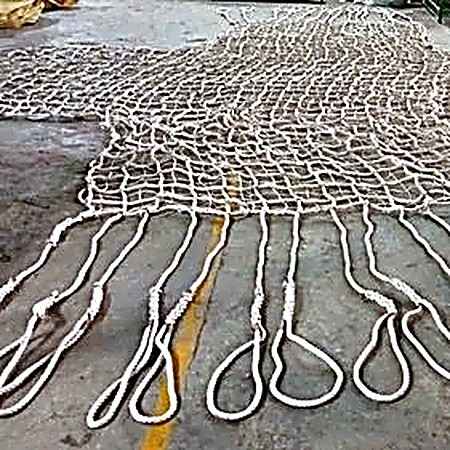
A polypropylene rope cargo net sling is a four-loop synthetic rope net built for general lifting. The cargo sits inside the rope lattice, the four corner loops gather onto the hook, and the net closes on the load as the crane takes up the slack. Every sling is braided from 100 % polypropylene rope in capacities from 0.5 t ny 20 t, rope diameters from 6 mm ny 24 mm and mesh openings from 100 mm ny 400 MG, and each one is load tested before it leaves the plant.
Polypropylene is the utility fibre of the rope range: the most economical of the common rope materials, the lightest, and the only one that floats and absorbs essentially no water. That combination is why this is the net that goes on wet work, on quays, in fish farms and in wash-down bays, and why fleet operators standardise on it for mixed general lifts where a nylon net would be over-specified and a wire rope net would damage the cargo.
| zavatra | Laharana mahazatra |
|---|---|
| fahafaha-manao naoty | 0.5 t – 20 t, four corner loops, rated on a three-leg basis |
| Tady | 100 % polypropylène, 6 – 24 MG, 3-strand laid or 8-strand braided |
| harato | 100 – 400 MG, efamira na diamondra, voafatotra na tsy misy fatotra |
| Lifting loops | Four spliced corner loops; thimble-lined or steel ring on request |
| Antony fiarovana | 5:1 / 6:1 / 7:1 |
| fitsaboana | Ultraviolet-stabilised (standard for this net) |
| Certification | AK / FAA / izy; ISO 9001; Ny laboratoara CNAS; DNV |
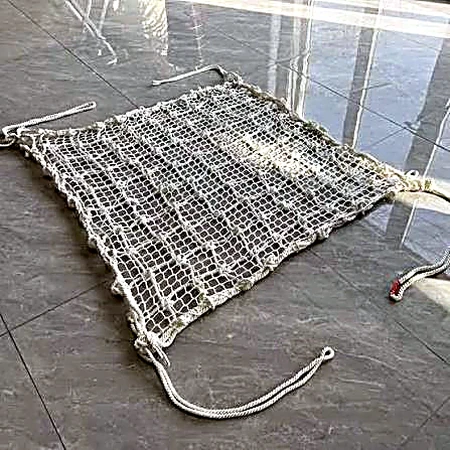
1. What a polypropylene rope cargo net sling is – ary izay tsy izy
Four features define the product. Each one changes what the net will and will not do, so each one is worth settling before you order.
- Tady, not webbing. A round-rope lattice is heavier and bulkier than a flat webbing net of the same capacity, but the strand rolls over the load instead of cutting into it, and a damaged rope net can be re-spliced on site – a torn webbing net cannot.
- Polypropylene, not nylon. PP costs less, weighs less, mitsingevana, and does not absorb water or rot. In exchange it is more temperature-sensitive, less abrasion-resistant and stiffer in the hand than nylon. Faritra 2 puts the three rope fibres side by side.
- Four lifting loops, one at each corner. This is the standard configuration for a general lifting net: the four loops gather onto the hook, the net closes over the load as the slack comes out, and nothing has to be threaded underneath the cargo.
- A doubled border rope. The border carries the whole load from the mesh into the loops, so it is a heavier rope than the mesh and it is spliced – tsy voafatotra – at every corner.
Inona no tsy izany: an open rope lattice is not a closed container. Small items fall through, so the mesh must be sized from the smallest item in the load, tsy avy amin'ny lanja manontolo. For genuinely loose or bulk material the correct product is a closed-bottom net – ny harato fanandratana polyester – rather than an open cargo net. Nor is it a hot-duty item: polypropylene softens well below nylon, so hot slag, hot castings and welding areas are out of scope at any capacity.
2. Why polypropylene rope – the material decision
Three synthetic fibres dominate lifting rope, ary tsy azo ovana. Choosing between them is the single biggest decision on this page, because it sets the price, the working life and the failure mode of the net.
| NY FANANANA | Polypropylene | Nylon | Polyester |
|---|---|---|---|
| hakitroky | 0.90 – 0.92 g/cm3 – mitsingevana | 1.14 g/cm3 – milentika | 1.38 g/cm3 – milentika |
| Fisorohana rano | Essentially nil, ETSY AMBANY 0.1 % | Absorbs water and loses strength when soaked | Tena ambany |
| Strength loss when wet | tsy misy | Small but real | tsy misy |
| Rot and odour | -kery fanefitra | Can rot and hold odour if stored wet | -kery fanefitra |
| Elongation amin'ny fiatoana | mampitony, About 15 – 20 % | Avo – absorbs shock best | IVA – least stretch |
| Ny fanoherana ny abrasion | Fair – the weakest of the three | Tsara | Tena tsara – the best of the three |
| Ultraviolet | Degrades quickly unless stabilised | mampitony | Tsara |
| fanoherana simika | Tsara manohitra asidra, alkalis and aqueous chemicals | Tafihin'ny asidra mahery | Tsara manohitra asidra, notafihan'ny alkali mahery |
| Temperature miasa | About -20 C ho +80 C | ambony | Avo indrindra amin'ny telo |
| Vidiny mifanandrify | ambany | Middle | ambony indrindra |
| Fidio rehefa | fahavaratra, chemical or general utility lifting on a budget | Shock loads and irregular impact | Maximum strength per diameter and best abrasion life |
Rope for these nets is braided in three polypropylene constructions, and the choice shows up in how the net handles and how long it lasts. Multifilament – many fine filaments twisted into each strand – is the softest and most flexible, the easiest to splice, and the construction most general lifting nets are made in. Monofilament – a single extruded filament per strand – is stiffer and smoother, resists surface dirt better, but is harsher on the hands and less forgiving over a load. Split-film, made from split polypropylene tape, is the most economical and perfectly serviceable for light duty, with lower abrasion resistance than the other two.
The rope comes off the same braiding floor as our tady nylon, and the mesh rope is matched to the diameters used in our harato tady fiarovana – so a mixed order of lifting nets and safety nets can be built from one rope specification.
3. How four corner loops actually share the load
Four loops on four corners is the configuration this product is built around, and it is also where most buyers make their only serious mistake. Four loops do not give four times the capacity of one loop.
Load share in a four-leg arrangement is rated on a three-leg basis. That is standard practice across lifting equipment, and it exists because a real load almost never sits perfectly symmetrically: one corner takes up first, one corner sits slack, the cargo shifts as it leaves the ground. Rating on three legs builds that asymmetry into the number on the label instead of leaving it to the rigger.
The second factor is the leg angle, refesina avy amin'ny mitsangana – not from the deck. As the four loops spread wider from the hook, the tension in each leg rises for the same load and the arrangement carries less. Loop length is what controls it: a longer loop lets the net drop further below the hook and opens the legs wider, so if you lengthen the loops for a deep load, re-check the rating rather than assuming it is unchanged.
| FANAPAHAN-KEVITRA | Nahoana no zava-dehibe izany |
|---|---|
| Loops spliced or knotted | A spliced eye keeps the full rope strength; a knot reduces it. Specify spliced for every lifting net |
| Thimble in the eye or not | A thimble protects the eye against the hook and against its own wear – recommended for heavy or daily use |
| halavan'ny loop | Sets how far the net drops below the hook and how steeply the legs sit, and therefore the leg angle |
| Corner reinforcement | The corner wears first on a rope net; a doubled border and a reinforced corner are what make the four loops last |
| Rohy master, hooks or beam | One master link gathers all four loops onto a single point; four separate hooks on a beam give a more predictable share than four loops on one hook |
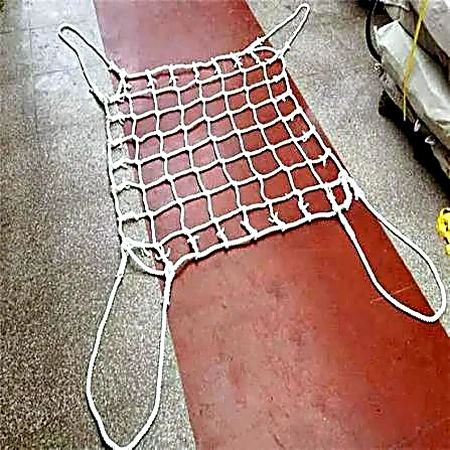
4. Parameter ara-teknika
The figures below describe the standard range. Savaivony tady, harato, habe net, sisintany, loop length and capacity are all made to order, so treat this table as the starting point for a quotation rather than a fixed catalogue page.
| fikirana | famaritana |
|---|---|
| Karazana vokatra | Polypropylene rope cargo net sling with four corner lifting loops |
| Rope material | 100 % polypropylène – multifilament, monofilament or split-film |
| Fanamboarana tady | 3-strand laid (Malagasy) or 8-strand braided |
| Savaivony tady | 6 / 8 / 10 / 12 / 14 / 16 / 20 / 24 MG; 12 mm ny standard |
| Fisokafana harato | 100 – 400 MG, efamira na diamondra; 200 mm ny standard |
| fatotra | Knotted (repairable on site) or knotless braided |
| sisintany | Tady sisin-tany avo roa heny, heavier than the mesh rope, spliced at each corner |
| Lifting loops | Efatra zoro tadivavarana fenitra – spliced eye, with or without thimble |
| halavan'ny loop | 300 – 600 MG, na hanafatra |
| Haben'ny harato | 1 x 1 m ny 8 x 8 m, or made to drawing |
| fahafaha-manao naoty | 0.5 t – 20 t, set by rope diameter, mesh and lifting arrangement |
| Rating basis | Three-leg basis – the standard assumption for a four-leg arrangement |
| Antony fiarovana | 5:1 / 6:1 / 7:1 |
| fitsaboana | Ultraviolet-stabilised – a requirement, not an option, for polypropylene outdoors |
| Color | Fotsy voajanahary, mainty, voasary, maitso, blue or a custom colour |
| Temperature miasa | -20 C ho +80 C |
| Certification | AK / FAA / izy; ISO 9001; Ny laboratoara CNAS; DNV |
| Customization | OEM / Haben'ny ODM, harato, COLOR, etikety, logo and packing |
5. Standard sizes and rated capacities
Capacity follows rope diameter, mesh and lifting arrangement together. The table below gives the working range for each net size at four corner loops, hook iray. Heavier duty is quoted from a thicker rope rather than from the same net at a higher number.
| Haben'ny harato | Rope dia. | harato | fahafaha-manao naoty | Fampiasana mahazatra |
|---|---|---|---|---|
| 1.0 x 1.0 m | 8 MG | 100 MG | 0.5 – 1 t | Small parts, amponga, machine components |
| 1.5 x 1.5 m | 10 MG | 150 MG | 1 – 2 t | Pallets, entana anaty boaty, fitaovana ao anaty kitapo |
| 2.0 x 2.0 m | 12 MG | 200 MG | 2 – 4 t | Fananganana ankapobeny, bagged and loose cargo |
| 2.5 x 2.5 m | 14 MG | 200 MG | 3 – 6 t | hazo, drums and mixed loads |
| 3.0 x 3.0 m | 16 MG | 200 MG | 5 – 8 t | Bulk material and scrap |
| 4.0 x 4.0 m | 20 MG | 250 MG | 8 – 12 t | Logs and large loose loads |
| 6.0 x 6.0 m | 24 MG | 300 MG | 12 – 20 t | Quay, hold and yard work |
| Natao hanao sary | 6 – 24 MG | 100 – 400 MG | 0.5 – 20 t | Any size, mesh and loop arrangement |
Where the four loops gather onto a beam instead of a single hook, the arrangement is rated by the beam – JEREO NY manainga andry mpanaparitaka. Where the load is palletised and needs a flat, closed underside, ny crane pallet entana harato is the closer match than an open lattice.
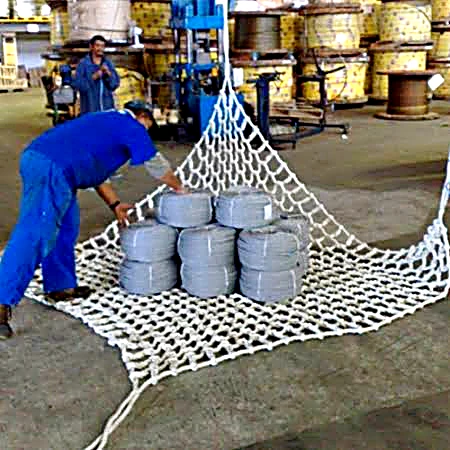
6. Tady, harato, border and loop options
Everything about the construction of the net itself is set on the drawing, and every line below is a choice rather than a default. The two that matter most are the mesh opening and the loop termination.
| zavatra | FANDIKANA | Fidio rehefa |
|---|---|---|
| Savaivony tady | 6 – 24 MG; 12 mm ny standard | Follows the load and the duty – a thicker rope lasts longer on rough work even at the same capacity |
| Fisokafana harato | 100 – 400 MG; 200 mm ny standard | Sized from the smallest item in the load, tsy avy amin'ny lanja manontolo |
| Mesh orientation | Square or diamond | Diamond follows an irregular load as it settles; square is easier to measure and inspect |
| Knot or knotless | Knotted or knotless braided | Knotted can be re-spliced on site; knotless has no knot to wear and hangs flatter |
| Tady sisin-tany | Doubled, heavier than the mesh rope | Always – the border is the load path from the mesh into the loops |
| Corner | Reinforced corner with spliced eye | Always for lifting duty, and essential above 3 t |
| Loop termination | maso misaraka, thimble-lined eye, or loop over a steel ring | Thimble protects the eye on a hook; a steel ring suits four loops gathering on one master point |
| MIARO | Sleeve or wear pad at contact points | Sharp sisiny, and structure the net rubs against |
7. Where a polypropylene net is the right answer – and where it is not
This net is sold for general lifting, and general means general: entana mifangaro, mixed sites, mixed weather. That is exactly what polypropylene rope is good at. It is equally important to know where it stops being the right choice, because buying the wrong fibre is the most common cause of a short service life.
| ADIDY | Is this the right net? | What to use instead |
|---|---|---|
| fahavaratra, Marina, quayside and wash-down work | ENY – the best of the rope nets here | Nothing needs changing: PP floats and does not absorb water |
| Chemical and fertiliser exposure | ENY, for aqueous chemicals | Check first for strong solvents and hot hydrocarbons |
| General utility lifting of mixed cargo | ENY – the most economical rope net | Polypropylene rope, araka ny voalaza |
| entana mafana, hot slag, welding areas | tsy misy – PP softens well below nylon and polyester | Tady antsamotady rated for the temperature, or a chain sling |
| Sharp, highly abrasive loads such as scrap plate | Marginal – PP abrades faster than nylon | ny antsamotady nylon entana mavesatra with protection sleeves |
| Shock loading and irregular impact | Marginal – PP stretches less than nylon | ny harato fanandratana entana nylon, which absorbs shock better |
| Maximum capacity from a thin rope | tsy misy – nylon and polyester are stronger per diameter | Nylon or polyester rope, or a flat webbing net |
| Long-term outdoor storage in strong sun | Only if ultraviolet-stabilised | Specify the stabilised rope and inspect for surface chalking |
If your duty falls in the right-hand column, the alternatives are on the same site: ny harato polyester webbing ho fanandratana, ny harato fanandratana entana SY, for tensioned restraint rather than lifting, ny harato fiarovana entana. Tell us the cargo and we will say which one fits rather than quoting the one you asked for.
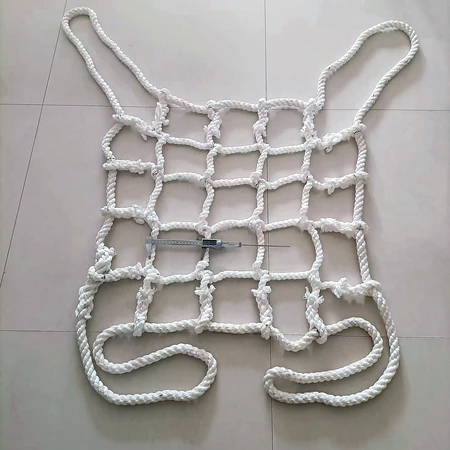
8. Color, marking and identification
A general lifting net moves between yards, trucks and sites, so it has to be identifiable wherever it ends up – and identifiable at the moment of inspection, when the label may already be dirty.
- Ny fetran'ny entana miasa, net size and mesh are carried on a sewn capacity label; the rope itself can also be marked.
- Because the rope is dyed rather than printed, colour is the most durable identification on a rope net: natural white, mainty, voasary, green and blue are standard, and a custom colour is possible on larger orders.
- The standard colour code can be applied to the label – violet 1 t, maitso 2 t, MAVO 3 t, Gray 4 t, MENA 5 t, volontany 6 t, manga 7 t, voasary 8 t – ka azo vakiana eny ampitan-tokotany ny harato.
- A contrasting border rope makes the edge and the four corners obvious at the moment of rigging.
- Ny baiko OEM dia afaka mitondra ny marikao manokana, adiresy, warning text or certificate number on the label and in the packing.
- Nets ship folded or coiled in a bag or a crate; a rope net is bulky against a webbing net of the same capacity, so allow for it in storage.
9. Fanaraha-maso kalitao sy fanamarinana
We braid the rope and make the net in the same plant, so diameter, harato, border and loop length are under our control rather than bought in from a third party and assembled.
- 40 taona amin'ny famokarana fitaovana fanandratana – niorina tamin'ny 1985 any Taizhou, Jiangsu, miaraka amin'ny mihoatra ny 200 mpiasa, iray amin'ireo antsamotady lehibe indrindra any Shina sy toby famokarana harato.
- CE sy GS fanamarinana vokatra manainga, miaraka amin'ny fanamarinana JIS momba ny baiko fanondranana.
- Own testing laboratory with CNAS laboratory accreditation, Eoropeana CE fanamarinana sy DNV fanamarinana, SY 15 patanty nahazo alalana amin'ny vokatra fanandratanay.
- 1000 t milina fitsapana marindrano – the breaking load of every sling is tested and documented rather than sampled, ary misy tatitra ara-pitaovana mandeha miaraka amin'ny baiko.
- Every net weighed, measured and marked with its working load limit, net size and mesh before packing.
The certificate set is published on our fanamarinana pejy, including the CE attestation of conformity to EN 1492-1 for our webbing slings and our ISO 9001 quality management certificate.
10. How to specify a polypropylene rope cargo net sling
Eight pieces of information are enough for us to quote correctly the first time. The two most often left out are the lifting arrangement and the working environment, and both of them change the recommendation.
| Information | Nahoana no zava-dehibe izany |
|---|---|
| Cargo and how it is presented | Loose, bagged, palletised, bundled or irregular – this decides the mesh and the net form |
| Gross weight per lift | Sets the rope diameter and the rated capacity |
| Load dimensions and shape | Sets the net size, and whether a flat net or a bag form is right |
| Fisokafana harato | Sized from the smallest item in the load, tsy avy amin'ny lanja manontolo |
| Lifting arrangement | Four loops on one hook, on a master link, or on a beam – this sets the rating |
| Loop length and type | Sets the leg angle, and whether the eye needs a thimble |
| TONTOLO IAINANA | Rano, AKORA SIMIKA, ultraviolet exposure, temperature and abrasion – this decides whether polypropylene is right at all |
| Documentation and packing | Antony fiarovana, AK / GS marika, tatitra fitsapana, own-brand labelling and export packing |
11. Fanontaniana apetraka matetika
What capacity can a four-loop polypropylene cargo net sling lift?
The capacity on the label, for the arrangement you actually use – and it is rated on a three-leg basis even though there are four loops, because a real load rarely sits perfectly symmetrically. Standard nets run from 0.5 t ny 20 t; anything above that needs a different product, not a longer label.
Does the leg angle really change the capacity?
ENY, and it is measured from the vertical, not from the deck. The wider the four legs spread from the hook, the greater the tension in each leg for the same load. Loop length controls the angle, so if you lengthen the loops for a deep load, re-check the rating instead of assuming it is unchanged.
Why choose polypropylene instead of nylon?
Price, water and chemicals. Polypropylene is the most economical rope fibre, it floats, it absorbs almost no water and it resists acids and alkalis. Nylon is stronger for a given diameter, stretches further and absorbs shock better, but it takes up water and costs more – so nylon is the right answer for impact duty, not for wet general lifting.
Is polypropylene suitable for outdoor use?
ENY, provided the rope is ultraviolet-stabilised, which we supply as standard for this net. Unstabilised polypropylene degrades in sunlight quickly: it goes dull and chalky and the filaments begin to crumble. Even stabilised, inspect for chalking and retire the net when the surface has gone friable.
Can the net be used in the sea or in a fish farm?
It is one of the best rope nets for it. The net floats, so it can be recovered if it goes over the side; tsy mitroka rano, so it does not get heavier or rot; and salt water does not affect it. Rinse it in fresh water and dry it in the shade before storage.
Can I lift bags or loose material in an open net?
Small items will pass through an open lattice. For bags, choose a mesh the smallest bag cannot squeeze through. For genuinely loose or bulk material, an open rope net is the wrong product – use a closed-bottom hoisting net instead.
Can a polypropylene rope net be repaired?
ENY, and this is the advantage of rope over webbing. A damaged section can be re-spliced or re-knotted with matching rope by a competent person, and the repair must be recorded. Withdraw the net if a splice has failed, a corner is damaged, or the rope has gone stiff and hard.
Ahoana no hanaporofoana ny fahaiza-manao?
Ny harato dia omena amin'ny 5:1, 6:1 na 7:1 araka ny voalaza. Ny antsamotady rehetra dia voazaha toetra samirery 1000 t milina sy tatitra ara-pitaovana dia mandeha miaraka amin'ny baiko; the products are CE and GS certified, our laboratory holds CNAS accreditation, and export orders can be supplied with JIS certification.
12. Why buy polypropylene rope cargo net slings from Lift
Nanamboatra fitaovana fanandratana izahay ao Taizhou, Jiangsu hatramin'izay 1985. Rope braiding, net making, testing and packing happen on one site, which is why a custom net is a production order rather than a special project.
- Own rope production. savaivony, harato, sisintany, colour and loop length are under our control, so the net is built to your job rather than assembled from a catalogue.
- Notsapaina isaky ny harato, not per batch. Breaking load is measured on a 1000 t horizontal machine and documented, miaraka amin'ny CE, FAA, izy, Fanamarinana CNAS sy DNV ao ambadiky ny sehatra.
- Built around the four-loop configuration. Spliced eyes, optional thimbles, loop length set to your leg angle, and a doubled border rope at every corner.
- Mpamatsy iray ho an'ny faritra fanaingoana rehetra. Rope net slings, webbing antsamotady, antsamotady boribory, antsamotady tady and lifting spreader beams.
- OEM sy ODM. Own-brand labelling, custom rope colours, custom sizes and export packing for distributors and fleet operators.
The rest of the net range is on the harato manainga entana hub, with the flat webbing version on the harato manainga entana page and the harato fisaka nylon for loads that need a closed, non-abrasive surface.
13. Mangataka quotation
Send the cargo, the gross weight per lift, the load dimensions, ny fanokafana harato, the lifting arrangement and the environment the net will work in – or a sketch of the net you have in mind – and our engineers will confirm the rope diameter, the capacity and the loop arrangement in writing. Mifandraisa aminay injeniera with your specification.
Ny orinasa Lift Sling Rigging Company – Lifute Industrial Park, Tanànan'i Taizhou, Faritanin'i Jiangsu, CHINE
Tel: +86 523 8693 5818 | WhatsApp: +86 180 6600 2268 | E-mail: 702461526@qq.com
HS code 630790 – lifting nets of textile materials.