

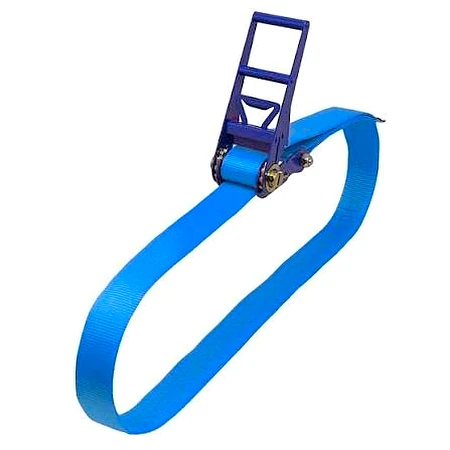
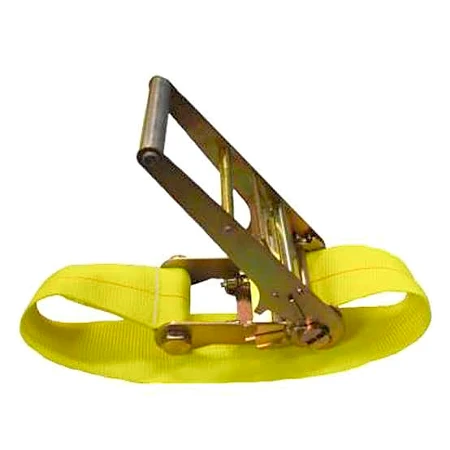
Lift sling rigging company produce Endless Loop Ratchet Strap,Endless Cargo Lashing Strap,Endless Ratchet Strap,Endless Ratchet Tie Down Strap,Endless Loop Tie Down Straps,Endless lashing straps with ratchet for secure cargo restraint,Endless Cargo Lashing Ratchet Tie Down Without Hook,Endless ratchet lashing strap.
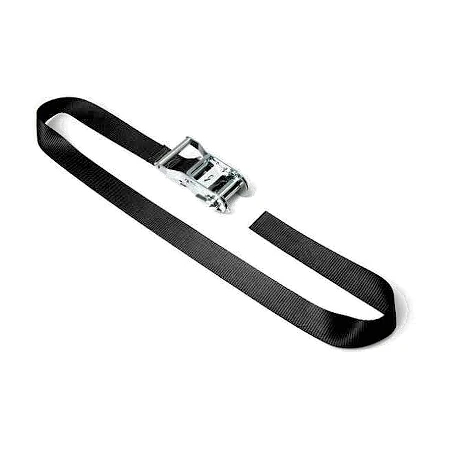
At a glance
- Hookless — closed polyester loop, ratchet the only metal part
- LC 400–5,000 daN, minimum breaking force 2 × LC (IN 12195-2)
- 25 / 35 / 50 / 75 mm high-tenacity polyester webbing
- STF 150–500 daN ntawm 50 thiab tes quab yuam
- 1–10 m flat, quoted as flat length or loop circumference
- Galvanised Cr3 txheem, 304 / 316 stainless on request
On this page
Why a hookless strap exists
A hook is a piece of engineering that assumes something to hook onto. On a lorry deck that assumption usually holds. On a trailer carrying a boat, a bundle, a coil or a crate it often does not, and the operator ends up improvising: hooking onto a body panel, over a brake line, through a hole that was never rated. The endless loop removes the improvisation. The strap closes on the load itself, so the load is the anchor.
Three specific problems disappear with it.
- Nothing has to line up. A loop is placed over or around the load, the tail is threaded back through the ratchet and tensioned. Tsis muaj qhov muag, ring or slot is needed, and no measurement of the distance between two anchor points.
- The buckle cannot open under a load it was not made for. Hooks fail in two well-known ways: the throat opens when the load sits on the point instead of the crown, and a hook hung on a sharp edge or on another hook walks out under vibration. A closed loop has neither failure mode.
- No metal touches the cargo. The ratchet rides outside the loop, so the only thing in contact with a gel coat, a polished tube, a painted panel or a coil wrap is polyester. That is the difference between a strap mark and a claim.
Kev sib pauv yog ncaj ncees: a hookless strap is slower to place on a vehicle that does have good lashing points, and it cannot be used where the load has no girth at all — a single crate with nothing to wrap around still needs a hook or a track fitting. Buy the endless form for the loads that have no anchor, and the hooked form for the ones that do. This page covers both, because the band and the stitching are identical and only the ends change. Txawm koj xaiv qhov twg, the article is a cargo lashing: it is rated in lashing capacity, tensioned by hand, and never used to lift.
Technical parameters
The table is the standard build for each width. What governs a delivery is the figure printed on the sewn label of the assembly you receive, not the table — a lashing is rated as band, stitching and hardware together, and a substitution in any of the three changes the number.
| Ref | Dav | Band thickness | lashing muaj peev xwm (LC) | Min. breaking force | STF at 50 thiab tes quab yuam | Ratchet frame |
|---|---|---|---|---|---|---|
| ELR-25 | 25 mm / 1 hauv | 1.4 mm | 400 Thiab | 800 Thiab | 150 Thiab | 25 mm, galvanized |
| ELR-35 | 35 mm / 1 3/8 hauv | 1.7 mm | 750 Thiab | 1,500 Thiab | 250 Thiab | 35 mm, galvanized |
| ELR-50 | 50 mm / 2 hauv | 1.8 mm | 2,500 Thiab | 5,000 Thiab | 350 Thiab | 50 mm, galvanized |
| ELR-75 | 75 mm / 3 hauv | 2.2 mm | 5,000 Thiab | 10,000 Thiab | 500 Thiab | 75 mm, galvanized |
| Khoom | Specification |
|---|---|
| Fiber ntau | 100 % high-tenacity polyester (PES), UV-stabilized |
| Weave | Plain weave, densified selvedge, single-ply as standard |
| Band loj | 88 g/m at 50 mm (indicative; the label and the pull record govern) |
| Elongation ntawm LC | 7 % or less — typically 5–6 % ntawm no weave |
| Width tolerance | ± 2 % on the nominal width |
| Kev pabcuam kub | -40 ° C rau +100 °C; the fibre melts rather than deforming above that |
| Loop closure | High-tenacity PES thread, 5-thread safety stitch, box-X at the buckle |
| Xim | Black, daj, txiv kab ntxwv, xiav, liab, ntsuab, olive; matched to a sample |
| Kos npe | Sewn woven label: LC, STF, flat length, dav, txheem, tus tsim, pawg |
| Ntim | Poly bag and header card, xim thawv, thawv 10 / 20 pcs, OEM daim ntawv lo |
| Lub luag haujlwm | Load restraint nyob rau hauv nro nkaus xwb - yeej tsis nqa, yeej tsis rub |
| HS code | 630790 |
LC, breaking force and strap count
Three numbers travel with every lashing and only one of them describes what the strap may hold in service. They are confused often enough that it is worth separating them once.
| Daim duab | Value on ELR-50 | Qhov nws piav | The mistake it invites |
|---|---|---|---|
| lashing muaj peev xwm (LC) | 2,500 Thiab | The restraint the assembly is rated to hold — the figure to design to | Muab piv rau kev nqa sling lub WLL, which is a different duty at a different safety factor |
| Minimum breaking force | 5,000 Thiab | Lub load uas lub rooj sib txoos ua tsis tau nyob rau hauv ib tug rub test | Read as the working figure, which overloads the vehicle |
| Txheem nro quab yuam (STF) | 350 Thiab | The tension one person reaches on the handle | Tsis meej pem nrog LC, yog li tus neeg teb xov tooj tseem winding dhau los ntawm qhov tseem ceeb |
IN 12195-2 requires a lashing strap to reach twice its lashing capacity before it breaks, uas yog qhov twg 2:1 kev sib raug zoo los ntawm. Lifting slings work at 7:1 — a different factor for a different duty. A lashing that has been used to lift has been loaded in a way its label never described, and it should be retired rather than re-used.
How many straps a load needs
A strap does not hold a mass; it holds a force. Restraint is calculated against acceleration in three directions, and forward is normally the governing case at about 0.8 g. Friction at the deck does part of the work, and the straps supply the rest by clamping the load down (top-over lashing) or by closing around it (the endless loop used as a bundle wrap).
The working relation for a top-over lashing is:
Straps needed = [ (a × m × g) − (μ × m × g) ] ÷ ( μ × 2 × STF × sin θ )
- ib — acceleration factor (0.8 forward, 0.5 sideways and rearward on most road markets)
- m — cargo mass in kg, g — 9.81 m/s²
- μ — friction coefficient: txog 0.3 timber on timber, 0.2 steel on steel, 0.1 wet aluminium, 0.6 with anti-slip mats
- θ — angle of the strap to the deck (60° is the usual compromise)
Ua haujlwm ntawm a 1,800 kg machine on a steel deck, μ ≈ 0.3, straps at 60°:
- Forward force: 1,800 × 0.8 × 9.81 ≈ 14,130 N (≈ 1,413 Thiab)
- Friction already resisting: 0.3 × 1,800 × 9.81 ≈ 5,300 N (≈ 530 Thiab)
- Residual for the lashings: ≈ 883 Thiab
- Clamping per 50 mm strap: 2 × 350 × sin 60° ≈ 606 Thiab, of which about 0.3 × 606 ≈ 182 Thiab becomes useful friction
- Straps: 883 ÷ 182 ≈ 4.9 → five straps, or three with anti-slip mats under the load
The answer is a count of straps, not a rule of thumb, and it changes with the deck. Anti-slip mats usually buy more restraint than another half-turn on the handle, and they cost less than two extra straps. Where a consignment is complex or the route is regulated, the lashing plan is signed off by a qualified load-securing planner — our figures are a selection aid, not a substitute for that plan.
Attachment and accessory parameters
On an endless strap the fittings list is short by design, but the few items on it decide whether the strap works: the buckle is the only metal part, and the sleeve is the only thing standing between a webbing edge and a sharp corner.
| Component | Khoom siv / ua kom tiav | Sizes and dimensions | What to confirm before ordering |
|---|---|---|---|
| Ratchet buckle (txheem) | Carbon steel frame, Zinc-plated Cr3; hardened pawl, stainless rivets optional | 25 / 35 / 50 / 75 mm frame; handle 200 / 240 / 300 mm | Buckle rated at or above the band’s breaking force; handle clears the load when tensioned |
| Long-lever ratchet | Aluminium kov ntawm forged steel ncej, zinc-plated | 50 mm × 300 mm luj | Higher preload by hand, gloved work; the aluminium is the handle, tsis yog tus ncej |
| Cam buckle (light duty) | Steel or aluminium, zinc-plated | 25 / 35 / 50 mm | Faster to set, develops far less tension — not a substitute where LC must be reached |
| Keeper / tail clip | Nylon or steel | Matched to band width | Holds the tail so it cannot whip or unthread in transit |
| Wear sleeve | PU-coated polyester tube, or split leather | 25-75 hli, 300–1,000 mm long | Must be specified with the order; a sleeve cannot be fitted after the loop is closed |
| Edge protector | Split leather or PU pad | Per corner | For coils, sawn ntoo arris, machined edges and castings |
| Anti-slip lev | PVC ua npuas ncauj los yog roj hmab granulate | Rau qhov deck bay | Raises the friction the whole calculation depends on; usually cheaper than extra straps |
| Stitching thread | High-tenacity PES, UV-stabilized | Tex 210–420 | Colour matched to the band; the stitch line is a load path, tsis yog seam |
| Daim ntawv lo | Woven polyester | 60 × 120 mm | LC, STF, flat length, dav, standard and batch still legible after a season outdoors |
If you need hooks after all
The same band is finished with hardware where the vehicle does offer an anchor, and this is where most orders actually land once the deck is inspected. Match the fitting to the anchor point rather than to the width:
| End fitting | Qhov ntev | Khoom siv / ua kom tiav | Siv thaum |
|---|---|---|---|
| Ob-J nuv | 25 / 35 / 50 mm, throat ≈ 28 mm | Forged hlau, zinc-plated | Deck lashing ntsiab lus, thawv fittings, D-rings — the general-purpose choice |
| tiaj tus nuv | 50 mm cev, 45 mm qhib | Stamped los yog forged steel, zinc-plated | Edge of a load bed or side rail; marks lub lawj tsawg kawg |
| S-nug, vinyl tes tsho | 25 / 35 / 50 mm | Hlau nrog PVC tes tsho | Nplhaib thiab qhov uas cov xim yuav tsum tau tiv thaiv |
| D-ring / delta ring end | 50 mm, 60 mm tug | Forged hlau, zinc-plated | Two straps to one point, los yog shackle take-off |
| E-khiav haum | 50 mm spring fitting | Hlau, zinc-plated | Track-equipped decks and van floors — check the track rating, not the strap’s |
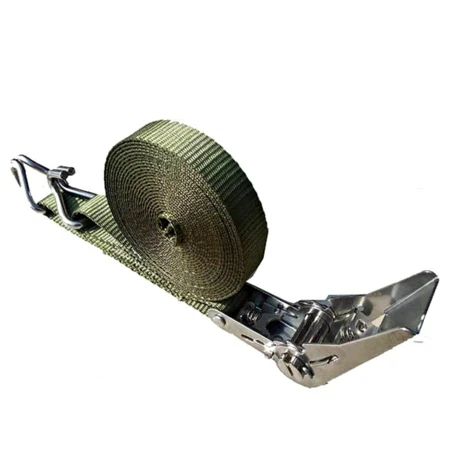
Whichever end is fitted, the rule is the same: the weakest component sets the rating of the assembly. A 5,000 daN band with a stamped hook that opens at 2,000 daN is a 2,000 daN strap, whatever the label on the band says. Hooked variants are covered in full on the 50 mm 5,000 kg ratchet lashing siv nplooj; the whole range sits under ratchet khi-down straps.
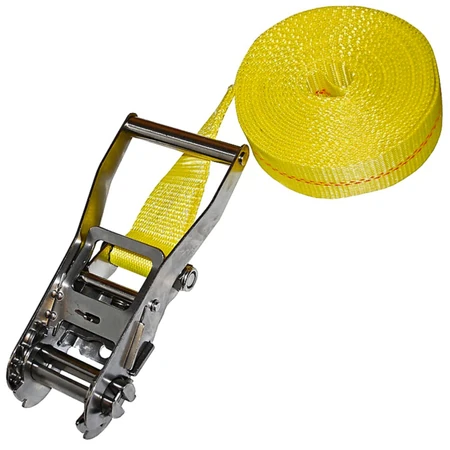
Ntev: tiaj tus, or circumference
Lub voj kaw tsis muaj qhov xaus los ntsuas nruab nrab, so the trade quotes it two ways and both are legitimate. Cov flat length is the webbing before it is joined. Cov ncig is the finished loop. For the same article the second is roughly twice the first, and a supplier who quotes “5 m” without saying which has quoted an ambiguity of about 100 %.
Qhia lub rooj sib txoos, or state the job instead — “it must go round a 2.2 m bundle and reach the ratchet” — and the conversion is done before the band is cut.
| Flat length | Loop ncig (kwv yees.) | Working girth (kwv yees., allowing ~1 m for buckle and tail) | Hom haujlwm |
|---|---|---|---|
| 1 m | 1.8 m | 0.8 m | Cov pob me me, cable coils, pipe packs |
| 2 m | 3.8 m | 2.8 m | Pallets, cov thawv, light machinery |
| 3 m | 5.8 m | 4.8 m | Ntoo pob khoom, drum groups, small hulls |
| 4 m | 7.8 m | 6.8 m | Boats on cradles, larger bundles |
| 5 m | 9.8 m | 8.8 m | Tshuab, containers of loose goods |
| 6 m | 11.8 m | 10.8 m | Ntev loads, ob-stacked pallets |
| 8 m | 15.8 m | 14.8 m | Deck cargo, tsob nroj oversize |
| 10 m | 19.8 m | 18.8 m | Ro-ro, project cargo, tarpaulin hold-down |
Two practical limits. A loop cannot be shortened on site: the ratchet takes up slack, it does not remove length, and cutting the band destroys the rating because the closed loop yog txoj kev thauj khoom. And long loops are woven as a single band rather than joined, because a join in the load path is both a weak point and an inspection problem.
Configurations
| Code | Daim ntawv | Standard flat length | Zoo tshaj rau | Saib xyuas |
|---|---|---|---|---|
| ELR-E | Single endless loop, ratchet fitted, tsis muaj qhov xaus | 1– 10 m | Pob, pallets, coils, hulls, ntoo pob | Needs a friction surface or a sleeve at any edge |
| ELR-EK | Endless loop with keeper clip | 2–8 m | Road transport where the tail whips | Keeper is not a load-bearing part |
| ELR-EC | Endless loop with cam buckle | 1–4 m | Lub luag haujlwm: npog, fenders, vaj tshuab | Lower tension than a ratchet; not for LC-critical work |
| ELR-ER | Loop with one sewn ring end | 2–8 m | Where a shackle or a second strap has to take off | The ring becomes the weak point if undersized |
| ELR-EH | Loop with one hooked end | 2–8 m | Deck with one good anchor point and one awkward load | Rating set by the hook, tsis yog band |
Where the endless form is specified
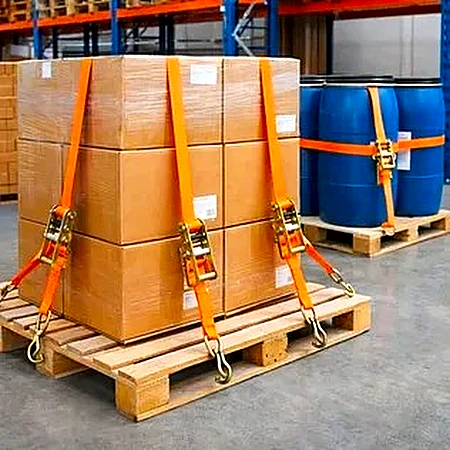
- Palletised freight and cartons. Four wraps and no hooks means no crushed corners and no hook holes in the cartons. The form is also why the same strap serves a pallet, a crate and a drum group without re-rigging.
- Yeeb, tube and timber bundles. The loop closes on the bundle, so the bundle is held as one body rather than pressed down at two points. Sleeves at the arris.
- Steel coils on pallets. Eye-to-sky through the coil bore, or top-over with edge protectors. No hook can score the wrap or the coil edge.
- Boats, kayaks and masts. Hull to cradle, deck to trailer, mast section to pulpit — the classic no-anchor job. Use the stainless steel endless ratchet strap where the strap sees salt.
- Machinery and plant skids. No lashing rings in reach on a skid, so the strap goes round the frame and tensions against itself.
- Tarpaulins, bulk bags and covers. Hold-down duty where speed matters more than tension; a cam-buckle version is often enough.
- Event and staging kit. Truss bundles, barrier stillages and cable drums, where a scratched anodised finish is the complaint that follows.
Galvanised or stainless
The band does not change; the hardware does. Galvanised carbon steel is the standard for dry inland transport, and it is the right answer for most orders. Stainless earns its cost where chloride is present — sea air, ramp spray, wash-down plants — because the buckle is the part that corrodes first while the webbing is still sound.
| Galvanised carbon steel | AISI 304 / 316 stainless | |
|---|---|---|
| Ib puag ncig | Qhuav, inland, covered trailers, occasional outdoor use | Coastal, dej hiav txwv, ntxuav, de-icing ntsev, food plants |
| Corrosion | Zinc is sacrificial: white bloom, then red rust once the coating is spent | Does not rust; 316 resists chloride pitting as well |
| Marks on the load | Zinc transfer possible on pale surfaces | No coating to transfer |
| Nqi | Lub hauv paus | Two to four times the hardware cost |
| Specify when | Corrosion is not the failure mode | Corrosion yog the failure mode |
Keep one grade across the assembly: ib 316 body with a 304 spring is the part that fails first, and it fails invisibly. Full specification of the marine version is on the endless stainless steel ratchet strap nplooj.
Inspection and retirement
Tshawb xyuas ua ntej txhua qhov kev siv, thiab raug cai ntawm lub caij nyoog lub chaw teeb tsa. A lashing is withdrawn for conditions, not for looking tired.
- Band cut, snagged, punctured or torn — including a single deep nick at a sleeve edge, because the band fails from the edge inward
- Stitching broken, worn or pulled: a lifted stitch line at the buckle is a rating problem, not a cosmetic one
- Thaum tshav kub kub puas: glazed, stiff or charred fibre, or a hard melt mark where the strap crossed an exhaust
- Tshuaj tua kab mob: fuzzing, softening or a colour change
- Ratchet that will not release cleanly, a bent frame, a missing rivet, or a pawl spring that has lost tension
- An illegible label — without the LC the assembly cannot be matched to a load, and an unidentifiable lashing is out of service
Khw coiled, huv thiab qhuav, off the floor and out of long sunlight. Polyester is UV-stabilised, which is not the same as UV-proof: a strap left on an open trailer for a season is not the strap that was delivered.
Yuav xaj li cas
- Width and LC — 25, 35, 50 los yog 75 mm, or the figure your lashing plan calls for.
- Flat length or circumference — say which, or give the load girth and we convert.
- Kho vajtse — galvanised or stainless; ratchet or cam buckle; hookless or one of the hooked ends.
- Xim — black, daj, txiv kab ntxwv, xiav, liab, ntsuab, olive, or a sample to match.
- Kev tiv thaiv — sleeve length and position, ntug tiv thaiv, anti-slip mats.
- Kos npe — your brand, ntu naj npawb, LC and STF in the unit your market reads, plus batch.
- Ntim — poly bag and header card, ob-txheej teeb, xim thawv, or bulk carton of 10 / 20.
- Test document — batch pull-test record, and a declaration of conformity to EN 12195-2 where the market requires it.
Cov lus nug uas nquag nug
Is an endless loop ratchet strap the same as an endless lifting sling?
Tsis muaj, and the distinction is a safety one. An endless sling is a lifting article with a working load limit, a colour code and a 7:1 yam. An endless ratchet strap is a lashing with a lashing capacity at 2:1, tensioned by hand. The strap must not lift, and the sling must not restrain.
How do I measure it?
Give the flat length of the band before joining, or the circumference of the finished loop — and say which. The circumference is roughly twice the flat length. Or give the girth of the load and the distance to the ratchet, and we convert before cutting.
Does it need hooks?
No — that is the point. The tail passes back through the ratchet and the loop closes on the load, so it works on a hull, a bundle, a coil or a pallet with no anchor at all. Hooks are added only where the vehicle does offer a ring, rail or track.
Can it be shortened on site?
Tsis muaj. The ratchet takes up slack, it does not remove length, and cutting the closed loop destroys the rating because the loop is the load path. Order the length you need.
What LC do I need for a 2 tonne pallet?
Mass is the start of the calculation, tsis yog teb. On a timber deck at 0.8 g forward with μ ≈ 0.3, ib 2,000 kg load leaves roughly 980 daN for the lashings — about five 50 mm straps at 60°, or fewer with anti-slip mats. Confirm the count for your route.
Will it mark a painted or polished surface?
The band is the only thing in contact, so no — provided the ratchet stays outside the contact area and a sleeve is fitted wherever the strap crosses an edge. That is exactly why the endless form is chosen for finished surfaces.
Qhov twg mus tom ntej
The lifting version of the same closed loop is on tsis kawg lifting sling, and the flat form on tsis muaj kev sib tw tiaj tus webbing sling. If the vehicle does have anchor points, the hooked article is the 50 mm 5,000 kg ratchet lashing siv. For the general theory see cargo lashing; for vehicle transport in recycled fibre, recycled-fibre car lashing belts; for loose rather than packed loads, cargo lifting nets; and for the hardware that takes a strap end, nqa khoom siv.
Request a quotation for endless loop ratchet straps
Send the load and its girth, qhov dav, the flat length you have in mind, the hardware grade and the environment. Peb lees paub LC, lub STF, the length convention and the marking before the band is cut.
Send your lashing specification — or write to lift98@jslift.com, xov tooj thiab WeChat +86 180 6600 2268.
Lift Sling Rigging Co., Ltd., Lifute Industrial Park, Taizhou nroog, Jiangsu xeev, Tuam Tshoj | HS code 630790 | Standard siv: IN 12195-2. Cov duab yog tus qauv tsim rau qhov ntau yam no; daim ntawv sewn ntawm lub rooj sib txoos uas koj tau txais kev tswj hwm.