

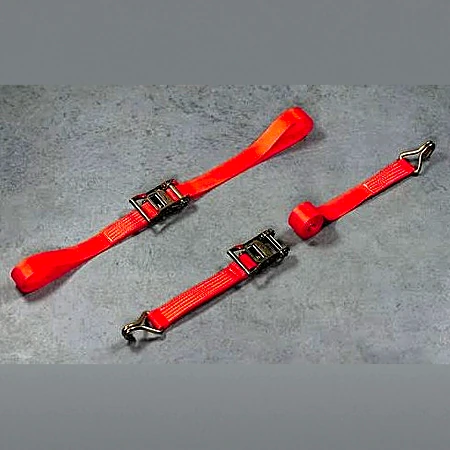
Lift sling rigging company produce 50MM 5000kg Ratchet Lashing Belt Ratchet Tie Down Straps,50mm Cargo Lashing Belt,5 Tonne Ratchet Strap,50mm Ratchet Lashing Strap – LC 2500daN (IN 12195-2),50mm 5000 Kg Ratchet Tie Down Lashing Straps With J-hook.
50mm 5000kg Ratchet Lashing Belt — Ratchet Tie Down Straps
This is the size most buyers end up with: ib 50 mm 5000 kg ratchet lashing belt — 2 inch polyester webbing, a forged ratchet buckle and a hook at each end, rated at a lashing capacity of LC 2,500 Thiab and a minimum breaking strength of 5,000 Thiab. Standard tension force is 350 daN at a hand force of 50 Thiab, and the assembly is built and marked to EN 12195-2.
It is the middle of the range and the reason is arithmetic rather than fashion. 25 mm thiab 35 mm belts are cheap but narrow: they concentrate the load, they run out of strength on anything above a van, and the buckle a narrow band needs is fiddly in gloves. 75 mm thiab 100 mm belts carry twice as much, and they are also twice as awkward on a load bed, twice as heavy in the hand and twice the price. Cov 50 mm sits where the strength is enough for a flatbed, a container or a plant trailer, and the band is still easy to throw over a load and pull through.
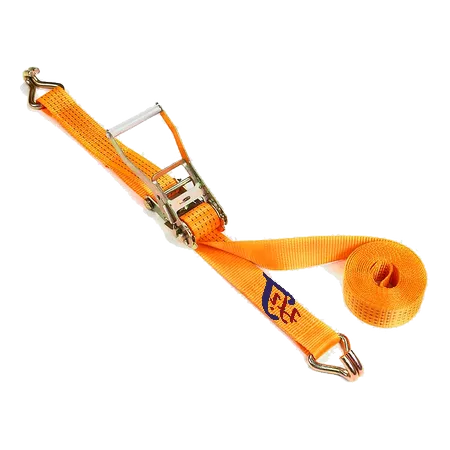
What “50mm 5000kg” Actually Means
Three different numbers get sold as “5000kg”, and only one of them describes what the strap may do in service. The sequence below is the one that matters at the counter.
| Daim duab | Value on this assembly | What it describes | How a buyer misreads it |
|---|---|---|---|
| Yam tsawg kawg tawg lub zog (MBL) | 5,000 Thiab (5,000 kg) | Lub load uas lub rooj sib txoos ua tsis tau nyob rau hauv ib tug rub test | Read as the working figure — this is the mistake that overloads a trailer |
| lashing muaj peev xwm (LC) | 2,500 Thiab (2.5 t) | The restraint the assembly is rated to hold, marked on the label | Compared against a lifting sling’s WLL, which is a different duty |
| Txheem nro quab yuam (STF) | 350 Thiab ntawm 50 daN hand force | The tension one person reaches with the ratchet | Confused with LC, so the operator keeps winding past the useful point |
If you are comparing quotations for 50 mm ratchet khi down straps, ask for the breaking strength in daN and the LC separately, and ask which one the price was quoted against. Two suppliers quoting “5 tonne” can mean the breaking strength and the working figure, and the difference is a factor of two.
Hauv qab EN 12195-2 the webbing of a lashing strap must reach at least twice its lashing capacity, which is where the 2:1 relationship comes from: 2,500 daN of rated restraint, 5,000 daN before anything breaks. A North American catalogue will often print the same article as “10,000 lb” because it quotes breaking strength in pounds. Same belt, different unit — and a genuine trap when two quotations are compared side by side.
Technical Parameters of the 50mm 5000kg Belt
Lub rooj yog tus qauv tsim. Ntev, end fitting, colour and marking are fixed on the order, because the rating applies to the finished assembly — band, stitching and hardware together — not to the roll of webbing it came from.
| Parameter | Specification |
|---|---|
| Khoom | 50 mm 5000 kg ratchet lashing belt / 50 mm ratchet tie down strap / 2 in cargo lashing belt |
| Webbing | 100 % high-tenacity polyester, twill weave, qis elongation, UV ruaj khov; 50 mm ± 2 % dav |
| Band thickness | 1.8 mm nominal |
| Band mass | 88 g / m |
| lashing muaj peev xwm (LC) | 2,500 Thiab (2.5 t) rau kev sib dhos |
| Yam tsawg kawg tawg lub zog | 5,000 Thiab (5,000 kg), verified by batch pull test |
| Txheem nro quab yuam (STF) | 350 daN at SHF 50 Thiab |
| Elongation at LC | ≤ 7 % (typical 5–6 % on this weave) |
| Tensioner | Forged carbon steel ratchet, zinc-plated Cr3; luv lever 240 mm or long aluminium lever 300 mm |
| Xaus fittings | Ob-J nuv, plhu, vinyl-sleeved S-hook, nplhaib, E-track fitting, or endless (nra hook) |
| Txheem ntev | 3 m / 5 m / 6 m / 8 m / 10 m; 10 ft / 15 ft / 27 ft; cut to order |
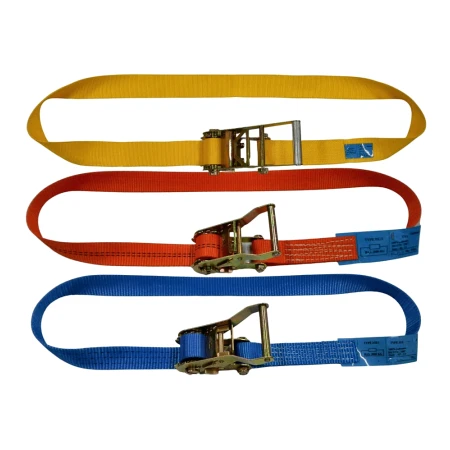
| Xim | Txiv kab ntxwv, xiav, daj, liab, dub, ntsuab; to your sample |
| Kos npe | Sewn daim ntawv lo: LC 2,500 Thiab, STF 350 Thiab, ntev, dav, tus tsim, pawg; IN 12195-2 ntawm kev thov |
| Ua haujlwm kub | -40 ° C rau +100 °C |
| Ntim | Ib leeg, 2-piece set with header card, colour box, bulk carton 10 / 20 pcs, OEM label |
| Lub luag haujlwm | Load restraint in tension only — never lifting, never towing |
| HS code | 630790 |
| Dav | LC | Lub zog tawg | Typical STF | What it is bought for |
|---|---|---|---|---|
| 25 mm / 1″ | 400 Thiab | 800 Thiab | 150 Thiab | Motorcycles, ATV, garden machinery |
| 35 mm / 1 3/8″ | 750 Thiab | 1,500 Thiab | 250 Thiab | Vans, small trailers, cov khoom dawb |
| 50 mm / 2″ | 2,500 Thiab | 5,000 Thiab | 350 Thiab | Flatbeds, thawv, plant trailers, pallets |
| 75 mm / 3″ | 5,000 Thiab | 10,000 Thiab | 500 Thiab | Hlau, coils, cog hnyav |
| 100 mm / 4″ | 10,000 Thiab | 20,000 Thiab | 500 Thiab | Deck cargo, ro-ro, tshuab |
Cov 50 mm advantage is not only strength. A 50 mm band spreads the same preload over twice the area of a 35 mm band, so it crushes a carton, a painted panel or a soft bag far less at the same tension. That is why buyers move up a size for the load’s sake rather than the rating’s.
Attachment Parameters — Buckle, Hooks and End Fittings
The band is the cheap half of the assembly and the fittings are what the buyer is really choosing, because they decide whether the strap fits the vehicle in front of them. Every item below is supplied on a 50 mm belt to your length, or on its own as a spare.
| Code | Attachment | Loj | Khoom siv / ua kom tiav | MBL | Siv thaum |
|---|---|---|---|---|---|
| A1 | Ratchet buckle, luv lever | 50 mm × 240 mm lever | Forged carbon steel, zinc-plated Cr3 | ≥ 5,000 Thiab | General flatbed and container work; compact, fits a tight rail |
| A2 | Ratchet buckle, long aluminium lever | 50 mm × 300 mm lever | Aluminium handle on forged steel frame | ≥ 5,000 Thiab | High preload by hand, gloved operation, wet or icy decks |
| A3 | Cam buckle (light duty only) | 50 mm | Aluminium or steel | 1,500 Thiab | Rarely on 50 mm; downgrades the assembly, so state it deliberately |
| B1 | Ob-J nuv, closed throat | 50 mm, throat 28 mm | Forged steel, zinc-plated | ≥ 5,000 Thiab | Deck lashing points, container fittings, D-rings |
| B2 | tiaj tus nuv | 50 mm, 45 mm qhib | Stamped or forged steel, zinc-plated | ≥ 5,000 Thiab | Edge of a load bed or rail; marks the deck least |
| B3 | S-nug, vinyl sleeved | 50 mm | Steel with PVC sleeve | 4,000 Thiab | Rings and holes where paint must be protected; the sleeve does the work |
| B4 | Swivel hook with safety latch | 50 mm, throat 26 mm | Forged steel, zinc-plated, spring latch | ≥ 5,000 Thiab | Anchor points that rotate; the latch stops the hook walking out |
| B5 | Delta ring / D-ring end | 50 mm, 60 mm bore | Forged steel, zinc-plated | ≥ 5,000 Thiab | Two belts to one point, or a shackle take-off |
| C1 | E-track / airline track fitting | 50 mm (2″) spring fitting | Hlau, zinc-plated | 2,000 Thiab | Track-equipped decks and van floors; check the track rating, not the belt |
| C2 | Bolt-on lashing ring | 50 mm bore | Forged steel, zinc-plated | ≥ 2,500 Thiab | Retrofit anchor on a plain flatbed; becomes the weak point |
| C3 | Soft loop / axle strap | 50 mm × 0.6 m / 0.9 m | Webbing loop with wear sleeve | = band | Round an axle or a rim without metal contact |
| D1 | Edge sleeve / hnav pad | 0.5–1 m | PU-coated webbing or split leather | — (protection) | Sharp deck edges, sawn timber arris, coil edges |
| D2 | Anti-slip mat | Per deck bay | PVC foam or rubber granulate | — (friction) | Raises the friction the preload depends on |
Ratchet buckle
The short-lever ratchet is the standard 50 mm buckle: one gloved hand, a pawl that holds what has been gained, and a drum that winds a few centimetres per stroke. The long aluminium lever trades speed for tension — it reaches the 350 daN STF in fewer strokes and it is the version specified where the operator is working in gloves, at height or in the wet. The buckle is a lever and a winch at once, and the number it produces is the STF on the label, not the LC. Grit in the pawl, a bent lever and a drum that no longer turns freely are the three ways it ends its life early.
Hooks, and why the anchor decides
Specify the anchor point rather than the hook. A double-J with a closed throat for a lashing point or a container fitting; ib tug flat nuv rau ntug ntawm ib lub txaj load, because it sits flat and marks the deck least; a vinyl-sleeved S-hook for a ring on light duty. A hook sitting half in its point is the commonest reason a lashing comes loose, and it lets go under braking — which is the moment the strap was bought for. Nplhaib, shackles and the hardware that takes a belt end are on the nqa khoom siv nplooj.
Endless and ring ends
With no hook at all, the belt is passed around the load and tensioned against itself — the configuration a bundle or a pallet needs, and the one that lets a single strap serve several load shapes. A ring end does the same job but leaves a hard point for a shackle or a second belt. Both keep the assembly’s rating, because the band and the stitching are unchanged; only the hardware is missing.
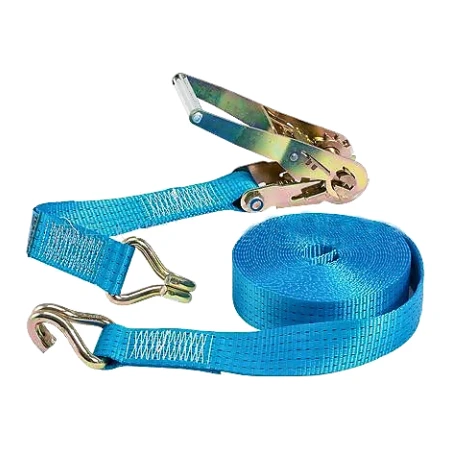
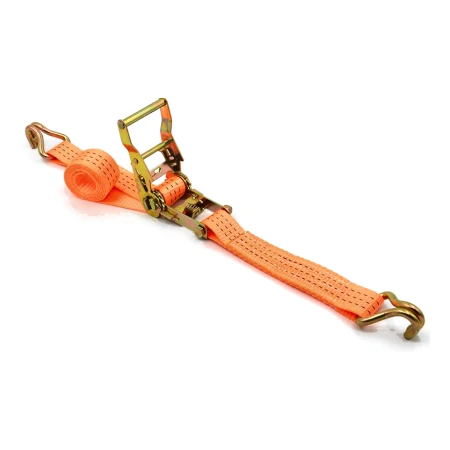
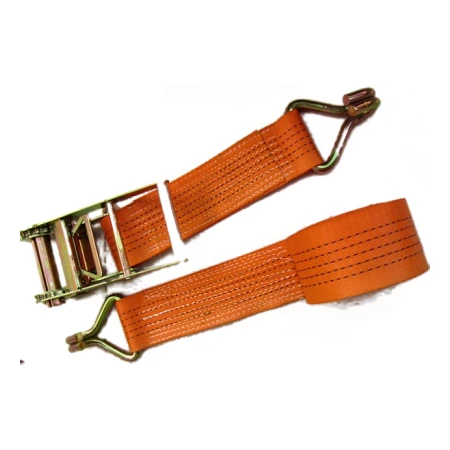
Five Ways the Assembly Is Configured
| Code | Xaus | Txheem ntev | Zoo tshaj rau | Saib xyuas |
|---|---|---|---|---|
| CLB-50-J | Double-J hook both ends | 6 m / 8 m | Flatbed, thawv, plant trailer — the default | Hook must sit fully in the point, not half in |
| CLB-50-F | Flat hook both ends | 6 m / 8 m | Load bed with a rail or a lip | Rail must be rated, not a body panel |
| CLB-50-R | Ring both ends | 6 m | Shackle take-off, two belts to one point | Ring is the weak point if undersized |
| CLB-50-E | Tsis kawg, nra hook | 3 m / 5 m | Pob, pallets, pipe and timber packs | Needs a friction surface or an edge sleeve |
| CLB-50-ET | E-track fitting one end, hook the other | 5 m / 6 m | Track-equipped deck or van floor | Track rating often below the belt’s LC |
| Ntev | Strap weight | Reach after buckle and hooks | Typical job |
|---|---|---|---|
| 3 m / 10 ft | ~0.7 kg | ~2.4 m | Short drops, machinery on a small trailer |
| 5 m / 15 ft | ~1.0 kg | ~4.4 m | Vans, car transporters, single pallet |
| 6 m / 20 ft | ~1.2 kg | ~5.4 m | The standard flatbed and container length |
| 8 m / 27 ft | ~1.5 kg | ~7.4 m | Long loads, ntoo, double-stacked pallets |
| 10 m / 33 ft | ~1.9 kg | ~9.4 m | Deck cargo, oversize plant, ro-ro |
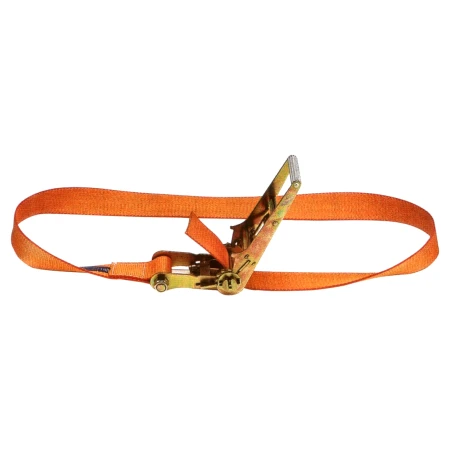
What Makes a Genuine 5,000 kg Belt — the Weakest Link
Every part of a lashing is rated, and the assembly is rated at the lowest of them. A supplier who quotes 5,000 kg from the webbing alone has quoted a number that does not exist in the box.
Band
50 mm high-tenacity polyester reaches roughly 5,000 daN at 1.8 mm thickness when the weave is dense and the yarn is specified by minimum tenacity. Cheaper band is thinner, lighter and reaches the same width with less strength — it also elongates further, which lets the load walk and then shocks the system when it catches. Ask for the band mass per metre: 88 g/m is this build, and a figure much below it is a different belt.
The stitching
The stitch is a load path, not a seam. A 50 mm belt carries a box-X pattern in high-tenacity polyester thread at every hook and buckle, with the run stitched in the same thread at a set pitch. tawg, worn or pulled stitching at the ends is a retirement condition, not a repair — a restitched belt has no rating unless the maker re-tests it.
Tus nuv
The hook’s minimum breaking strength has to be at or above the assembly’s, yog vim li cas a 50 mm J-hook is forged rather than stamped. A stamped hook on a 5,000 daN band is the single most common way a cheap belt fails: the band survives, the hook opens.
The ratchet
Tus ncej, the pawl and the drum all see the full tension. Zinc-plated forged steel is the material for this rating; the aluminium in a long-lever buckle is the handle, not the frame. A ratchet that lets go under vibration gives no warning from outside the drum, which is why a worn pawl spring is a retirement condition.
How to Check a 5,000 kg Strap on Arrival
- Nyeem daim ntawv lo, not the listing. LC 2,500 daN and STF 350 daN must be printed on a sewn label with the length, dav, maker and batch. A sticker is not a label.
- Weigh one strap. A 6 m 50 mm assembly of this build is about 1.2 kg. A strap that is half the weight is a thinner band with the same colour.
- Measure the band. 50 mm ± 2 % dav, 1.8 mm thick at the edge, and the weave should be dense enough that you cannot see daylight through it.
- Look at the hook. Forged hooks have a parting line and a solid throat; stamped hooks are folded sheet and open under load.
- Ask for the pull-test record. It is the one document that ties the figure on the label to the batch in the carton.
One more check that costs nothing: pull the strap through your hands and look for a splice, a heat-sealed join or a colour change mid-length. Band is woven in a continuous run and should never be joined.
Using a 5T Belt: Thauj khoom, Angle and Friction
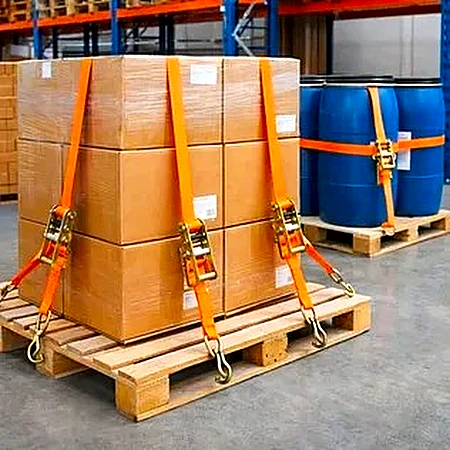
A 2,500 daN belt does not restrain 2.5 tonnes of cargo by itself, and the arithmetic is worth doing once so the number of straps stops being a habit. A load is held against acceleration in three directions and the forward case is normally the worst: most road markets size a lashing at around 0.8 g.
Worked on a 5,000 kg load on a steel deck with a friction coefficient of about 0.3, lashed top-over at 60 degrees to the deck, the standard relation gives:
- Forward force to be held: 5,000 × 0.8 × 9.81 ≈ 39,240 N, or about 3,924 Thiab.
- Friction already helping: 0.3 × 5,000 × 9.81 ≈ 14,715 N, txog 1,472 Thiab.
- Residual to be carried by the lashings: txog 2,452 Thiab of tension at the deck.
Each 50 mm belt contributes a vertical clamping component of 2 × STF × sin 60°, kwv yees 606 daN per belt, and that clamping force turns into friction at the deck. Five belts is the practical answer at 60 degrees — four on a timbered deck, six or more on wet aluminium, which is exactly why the count is a calculation and not a rule of thumb. Anti-slip mats under the load buy more restraint than another half-turn on the handle.
Lengths, Sets and Packing
On a ratchet tie down strap the packing is half the specification and most of the buying decision. A two-piece set with a printed header card is the retail norm for trailer work; a four-piece set is the DIY pack; distributors coj 10 los yog 20 straps rau ib lub thawv, banded, with the LC and the length on the outside. The sewn label is the part that cannot be changed after the fact: koj hom, koj tus lej, LC 2,500 daN and STF 350 daN in the unit your market reads, thiab cov batch yog tias koj qhov system xav tau.
For the container and flatbed trade the same belt is often bought as a 6 m single with a short lever and a J-hook, because that is the length that reaches from a deck ring over a pallet and back. If you are buying a mixed order, this is the size to standardise on: ib ntev, one hook, ib tag, thiab cov 25 mm thiab 75 mm become the exceptions rather than the rule.
Kev saib xyuas thiab nyiaj laus
- Cuts and nicks at an edge. Lub band tsis ua hauj lwm los ntawm ib tug puas ntug sab hauv; a nick reaching the warp is the end of the strap.
- Glazed or stiff fibre. Heat or chemical contact changes the yarn before it looks worn.
- Broken or worn stitching at a hook or buckle.
- A bent or opened hook — once an S-hook has opened it will open again under a smaller load.
- Ib tug hnav ratchet — a pawl that no longer snaps, a weak spring, a drum that drags.
- Ib daim ntawv lo nyeem tsis tau. Without the LC the belt cannot be matched to a load.
Khw coiled, huv thiab qhuav, tawm hauv pem teb thiab tawm ntawm tshav ntuj; ntxuav nrog dej thiab tshuaj ntxuav me me, yeej tsis hnyav. A 50 mm belt left on an open trailer for a season is not the belt that was delivered — polyester takes UV better than polypropylene, but it still fades, stiffens thiab poob lub zog ua ntej nws zoo li hnav.
Cov lus nug nquag
What does 5000kg mean on a 50mm ratchet lashing belt?
It is the minimum breaking strength of the assembly — 5,000 kg, los yog 5,000 daN — which is twice the lashing capacity. The figure the belt may be used at is LC 2,500 Thiab, txog 2.5 tonnes of restraint. Nothing in this range is rated to lift 5 tons.
Is a 50mm 5000kg strap the same as a 2 nti 5000 lb strap?
Tsis muaj. 50 mm is the same width as 2 nti, tab sis 5,000 kg is about 11,000 lb — roughly double a 5,000 lb strap. Compare the unit before the price: ib 50 mm belt sold in North America is often quoted at 10,000 lb breaking strength, which is the same article as this one.
What is the lashing capacity of a 50mm ratchet strap?
LC 2,500 daN for this build, which is 2.5 tonnes of restraint in the tensioned band. Hauv qab EN 12195-2 the webbing must reach at least twice the LC, so the assembly is break-tested above 5,000 Thiab.
How much tension can one person put in with the ratchet?
Txog 350 daN at the standard hand force of 50 daN on the handle — the STF printed on the label. Tension beyond that crushes the load and preloads the hooks without adding useful restraint.
Which hook should I order?
Match the hook to the anchor point: a double-J with a closed throat for a lashing point or container fitting, ib tug flat nuv rau ntug ntawm ib lub txaj load, a ring where a shackle has to take off, or no hook at all for a bundle lashed against itself.
Muaj pes tsawg 5 tonne straps do I need for a 5 tonne load?
The mass is the start of the calculation, tsis yog teb. Ntawm 0.8 g forward and a friction coefficient of 0.3, ib 5,000 kg load needs the tension from about five belts at 60 degrees to the deck; a timbered deck or anti-slip mats reduce the count.
Can the same belt be used for lifting?
Tsis muaj. A ratchet lashing belt is marked in LC and STF and rated for continuous tension in transit. Lifting needs a polyester webbing sling with a working load limit per hitch and a 7:1 safety factor — a different article with a different label.
Do you supply test certificates and private label?
Yog lawm. Each production batch carries a pull-test record for the assembly, and the sewn label can carry your brand, part number, LC and STF. Packing is poly bag and header card, two-piece set, colour box or bulk carton.
Yam khoom
- Ratchet khi-down straps — tag nrho cov ntau yam, 25-100 hli, if 50 mm is not the size you need.
- Cargo lashing — how the number of straps for a consignment is worked out.
- Recycled-fiber car lashing belts — the same size in rPET webbing, for vehicle transport.
- Webbing slings — the lifting article, with WLL and mode factors.
- 3 tonne flat webbing sling — the most-bought lifting size.
- Lifting li — hooks, shackles and rings at the belt end.
- Cargo nqa nqa — when the load is loose rather than packed.
- Round slings — soft lifting slings for machinery and shells.
Request a Quotation for 50mm 5000kg Ratchet Lashing Belts
Xa cov load thiab nws pawg, the anchor points and their spacing, lub kaum sab xis lub pluaj yuav khiav ntawm, the deck surface, and the hook or ring you need. Peb lees paub LC, the STF, the length and the marking before anything is cut — 50 mm, 5,000 Thiab, 3–10 m, nrog koj siv rau ntawm daim ntawv lo.
Send your lashing specification for a quotation
Xov tooj / WeChat: +86 180 6600 2268 | E-mail: 702461526@qq.com
Chaw nyob: Lifute Industrial Park, Taizhou nroog, Jiangsu xeev, Tuam Tshoj | HS code: 630790