

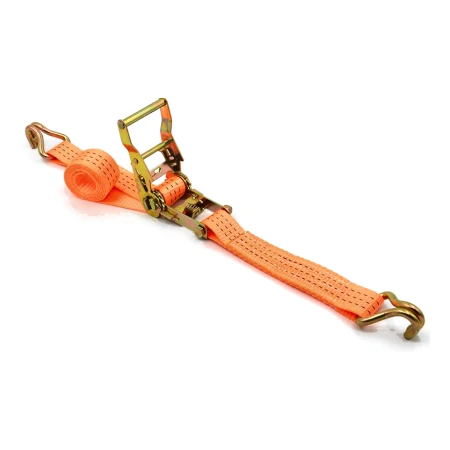
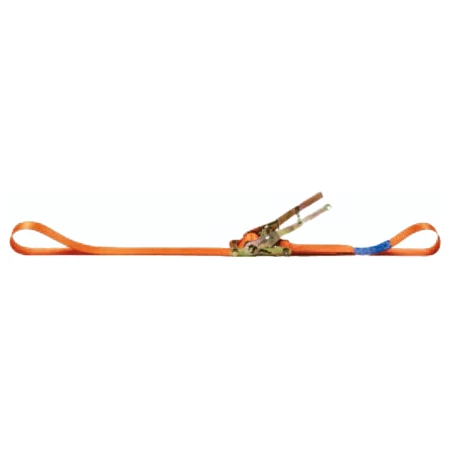
Lift sling rigging company produce Ratchet Tie-Down Straps,Heavy Duty Ratchet Strap,Ratchet Lashing Belt,Tie Down Strap,ratchet tie-down straps with s-hook,Ratchet Tie Down Straps,Heavy Duty Cargo Straps,ratchet tie-down straps with J-hook.
Ratchet Tie-Down Straps
A ratchet tie-down strap is the retail name for a polyester webbing strap with a ratchet tensioner and a hook at each end – the same article an industrial buyer calls a lashing. This page is about the strap as a product: the widths it is made in, the ends it is fitted with, the lengths it is cut to, and the way it is packed. The heaviest assembly in the range is rated at 10 t (10,000 daN) of lashing capacity.
The name matters commercially. “Tie-down strap” is what a buyer types when they want something for a trailer, a van or a motorcycle; “lashing” is what a freight forwarder writes on a specification. Both are the same construction, and both are rated by a number that has to be read carefully, because two markets print it two different ways – and one of them, printed carelessly, makes a strap look twice as strong as it is.
Why one hand is enough
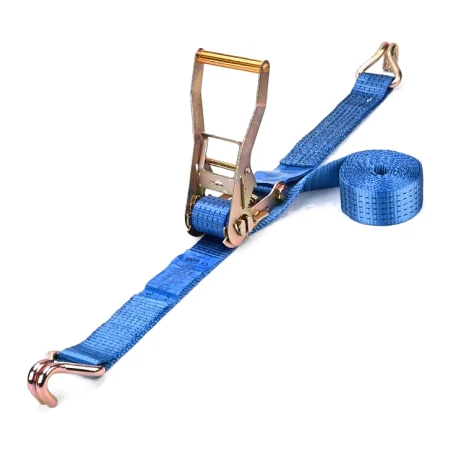
The reason a strap that weighs a kilo can hold ten tonnes is the ratchet, and the mechanism is worth one paragraph because it explains what the product can and cannot do. The handle is a lever, so the force at the drum is several times the force at the grip. The drum is a winch, so each stroke takes up a few centimetres of band against a load that is already lying still. The pawl drops into the ratchet wheel between strokes, so nothing runs back while the handle is returned.
Three consequences follow, and all three are about buying rather than about physics. First, no tools and no second person are needed, which is why the product sells into vans and trailers rather than only into yards. Second, the tension is limited by the hand, not by the band, so the weak points move outward – to the hook, to the anchor point, to the edge the band crosses. Third, the assembly is reusable almost indefinitely if it is looked after, which is what separates a tie-down strap from a single-use lashing.
Two markets, two labels, one number to ask for
Europe sells a strap on its lashing capacity, in daN or in tonnes. North America sells it on breaking strength, in pounds, and derives a working load limit of a third of that figure. A 10 t LC strap and a “22,000 lb” strap can be the same article described in two languages – or two very different articles described in one, if the label quotes the breaking strength and the buyer reads it as the working limit.
| Where the label is read | The figure printed | Unit | What it means in practice |
|---|---|---|---|
| Europe, and most export markets | LC – lashing capacity | daN or t | The load the assembly is rated to hold. This is the figure quoted for this range. |
| North America, trade | Breaking strength, with WLL = one third | lb | The load at which the assembly fails in a pull test; the working limit is a third of it, and that is the figure to compare with LC. |
| North America, retail shelf | Working load limit only, in lb | lb | The same figure as above, rounded and printed large; the breaking strength is often on the back of the card. |
Ask for the rating in the unit your market prints, and say which one you mean. A quotation that says “10 t” without saying which is a quotation that will be argued about at the border.
The four families
Almost every ratchet tie-down strap sold is one of four widths, and the width is chosen by the job rather than by the tonnage – a narrow strap on a wide load crushes it, and a wide strap on a motorcycle is simply awkward to use.
| Width | Usual ends | Bought for | How it is packed |
|---|---|---|---|
| 25 mm / 1 i loko | S-hook, cam buckle | Motorcycles, ATV and UTV, garden machinery, furniture, light cargo in a van or a boot | 2- or 4-piece set, poly bag with header card |
| 35 mm / 1 3/8 i loko | S-hook, J-hook | Small trailers, box bodies, white goods, flat-pack deliveries | 2-piece set, poly bag; bulk carton on request |
| 50 mm / 2 i loko | Double-J hook, flat hook | Flatbed and plant trailers, timber, containers, general freight | Single strap, 2-piece set, or bulk carton |
| 75-100 mm / 3-4 i loko | Flat hook, apo | Heavy plant, steel, coils, low-bed work | Single strap, bulk carton, no retail packing |
These are the market’s usual pairings, not a rating: the LC printed on the label is what applies, and it is quoted per assembly.
What the end decides
The hook is the part the customer actually handles, and on a ratchet tie-down strap it is the part that decides whether the strap fits the vehicle they already own. Four are usual, ʻaʻole hiki ke hoʻololi.
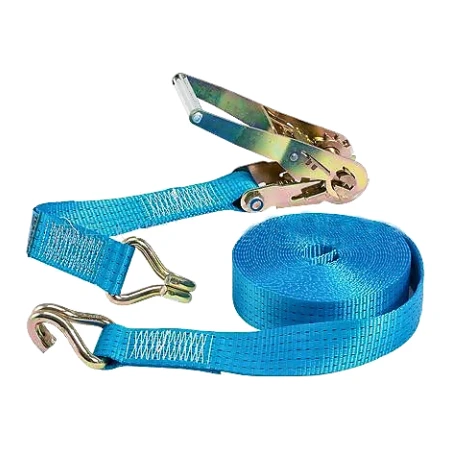
- S-hook. A plain open hook that drops into a ring, a hole or a rail; cheap, quick, and the standard end on 25 mm and 35 mm straps. It is also the end most easily straightened by a load that shifts, which is why the heavier sizes move to something with a closed throat.
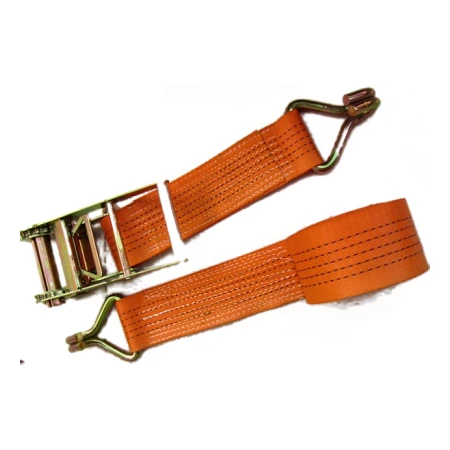
- Double-J hook. Two prongs with a closed throat, for lashing points and container fittings; it sits in the point rather than on the edge of it, and it is the end to specify for anything above a van.
- Flat hook. A wide flat hook that sits on the edge of a load bed or a rail; the flatbed trailer end, and the one that marks the load least.
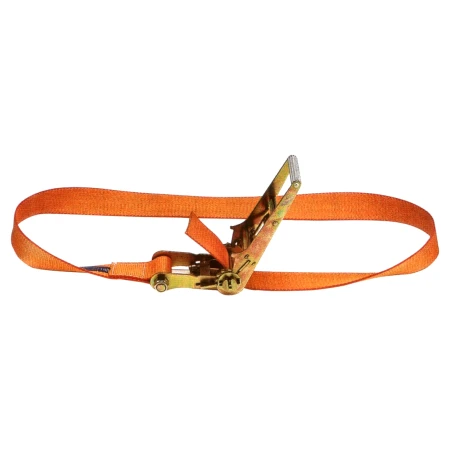
- Ring, or no hook. A ring takes a shackle or a second strap; a plain end lets the strap be passed around the load and tensioned against itself, which is what a bundle needs.
Ka lōʻihi, and the 10 ft problem
Tie-down straps are sold in feet in one market and in metres in another, and the two do not convert into each other’s habits: 10 ft is 3.05 m, 15 ft is 4.57 m, 27 ft is 8.23 m, and a buyer who asks for “a 3 metre strap” and receives a 10 ft one has a strap that is five centimetres short of the specification and a metre short of the reach they planned.
The second half of the length question is what the length means. A strap is quoted as the length of the band, but the reach it gives is shorter: the ratchet takes up a hand’s width, both hooks take their share, and a tail is needed to hold while tensioning. Quote the distance between the two anchor points and the strap length follows; quote the strap length and the fit is a guess.
Sets, packing and the OEM label
This is where ratchet tie-down straps stop behaving like industrial gear and start behaving like a retail product, and where most of the specification is actually decided. The strap is the easy part; the packing is what the buyer is buying.
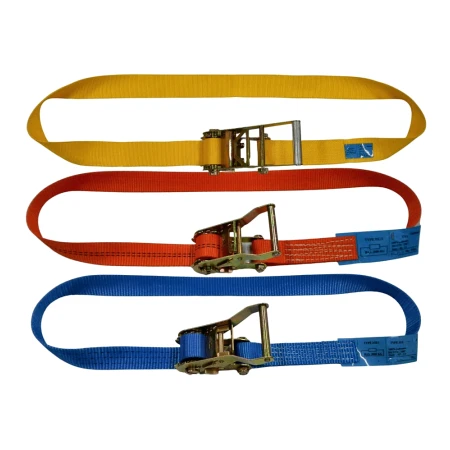
- Sets. Two-piece is the norm for trailer work, four-piece for retail and for anything sold as a kit. The set is usually one width, one colour, two lengths or two hook types, and the card says which.
- Header card and poly bag. Printed to the customer’s artwork, with the working load limit, the length, the quantity and a barcode. Where the market requires a warning panel, it is printed on the card rather than on the strap.
- Colour box. For retail chains: a printed box with a window, a hang tab and a carton quantity that matches the pallet plan.
- Bulk carton. For distributors and for industrial users: 20, 25 or 50 straps to a carton, banded, with the LC and length on the outside.
- The OEM label on the strap itself. Your brand, your part number, the LC or the breaking strength in the unit your market reads, and the batch if your system needs it. A sewn label is printed to the order, and it is the one part of a private-label strap that cannot be changed after the fact.
What the strap is asked to do
Four jobs cover almost every use, and they load the strap in different directions – which is why the same width behaves differently on two vehicles.
| The job | How it is rigged | What it loads |
|---|---|---|
| Hold down | Over the load, hook to hook on the deck, ratchet in the run | The band in tension and the anchor points in shear; the load is held by friction under the band |
| Hold back | From the load forward to a headboard or a rail, so the load cannot run at the cab | The anchor and the headboard, in the direction of braking |
| Bundle | Around the load and tensioned against itself, no hook at one end | The band in a loop; the load is compressed, so soft or hollow goods need a wider band |
| Locate | Through a ring or a purpose-made point, with the ratchet outside the load | The ring and the hook throat; the band carries little, which is why a light strap is enough here |
Five things that end a tie-down strap’s life
A tie-down strap is not a consumable in the way a single-use sling is, but it does retire, and the reasons are specific.
- Sunlight. Polyester takes UV better than polypropylene, but a strap left coiled on an open trailer for a season will fade, stiffen and lose strength before it looks worn. Store it out of the sun.
- A cut or a nick at an edge. The band fails from a damaged edge inward; a nick that reaches the warp is the end of the strap, not a blemish.
- A straightened or worn hook. Once an S-hook has opened, it will open again under a smaller load.
- A corroded or worn ratchet. Salt, grit and a pawl that no longer snaps are the failure that gives no warning from the outside.
- An unreadable label. Without the LC the strap cannot be matched to a load, and without a rating it is a rope with a handle.
Six lines on the enquiry
For this product the enquiry is mostly about the pack, so the six lines are short.
| # | The line | What it fixes | What goes wrong without it |
|---|---|---|---|
| 1 | Width and duty: what the strap has to hold | The band, the ratchet size and the LC | A 25 mm strap quoted for a job that needs 50 mm |
| 2 | Ka lōʻihi, and whether you mean band length or reach | The cut length and the tail | A strap that is 300 mm short once the ratchet is wound up |
| 3 | The end: S-hook, double-J, flat hook, ring or plain | The fitting and its throat | A hook that does not sit in the point on the customer’s trailer |
| 4 | The rating your market prints: LC, or breaking strength | The label, and the number on the card | A label that a North American buyer reads as half the strength it is |
| 5 | The pack: set size, card or box, artwork, barcode | The packing line and the carton quantity | A container that arrives in bulk when the order was retail |
| 6 | kalakala, and whether it is a stock colour or a sample | The dye lot and the lead time | A shade that does not match the shelf it was bought for |
Frequently asked questions
What is a ratchet tie-down strap?
A polyester webbing strap with a ratchet tensioner in its run and a hook at each end, used to hold a load on a trailer, in a van, in a container or on a deck. It is the same article an industrial buyer calls a lashing strap: ratchet tie down straps in most English-speaking markets, a ratchet lashing belt in the freight trade, and cargo straps on a builder’s merchant’s shelf.
What does 10 t mean on this product?
It is the lashing capacity of the largest assembly in the range – 10 t, or 10,000 daN, of restraint. It is not a lifting capacity, and it is not the breaking strength: the assembly is rated to hold 10 t, not to fail at 10 t.
What is the difference between 1 inch and 2 inch straps?
Width, and therefore what the strap is for. 25 mm is the motorcycle, ATV and light-cargo size; 50 mm is the trailer, plant and container size. The width spreads the pressure on the load, so a soft or hollow load needs the wider band even when the tonnage is modest.
Is the working load limit the same as the lashing capacity?
They are the same idea expressed in two markets. Europe prints LC in daN or tonnes; North America prints a working load limit derived from the breaking strength, and the working limit is a third of it. Compare like with like before you compare prices.
Should I choose an S-hook or a J-hook?
Choose the hook that matches the anchor point, not the one that looks stronger. An S-hook for a ring or a hole in light duty; a double-J hook with a closed throat for lashing points and container fittings; a flat hook for the edge of a load bed.
Can a tie-down strap be used for lifting?
ʻAʻole. It is rated for restraint in tension, marked in LC or in breaking strength, and never for a lift. A lifting sling carries a working load limit and a safety factor and is a different article with a different label.
Do you supply sets and private-label packing?
ʻAe. ʻelua- and four-piece sets, poly bag with a printed header card, colour box for retail, bulk cartons for distributors, and a sewn label with your brand and part number. Send the artwork and the carton quantity and the packing is quoted with the strap.
What lengths are standard?
3 m, 5 m a me 8 m in metric markets and 10 ft, 15 ft and 27 ft in imperial ones, with anything between cut to order. Quote the distance between the anchor points rather than the strap length, and the tail is sized with the reach.
Where the rest of the detail lives
This page covers the strap as a product. The rating, the pre-tension and the arithmetic behind a lashing calculation sit on the cargo lashing page, and the lifting side of the same webbing sits under webbing slings.
- Cargo lashing – LC, STF and how the count is worked out
- Webbing sling – the lifting article, with the full mode-factor table
- White flat webbing sling – the same band, undyed
- 3 tonne flat webbing sling – the most-bought lifting size
- Lifting devices – hooks, shackles and the hardware at the eye
- Cargo lifting net – when the load is loose rather than packed
Hoʻopili
Lift Sling Rigging Co., Ltd weaves the band and assembles the ratchet, the hooks, the label and the packing in one works.
Send the width, the length and what it has to hold, and we will confirm the assembly, the marking your market reads, and the packing before anything is cut.
- Telephone and WeChat: 18066002268
- leka uila: 702461526@qq.com
- Heluhelu: Pāka ʻOihana Lifute, Kulanakauhale o Taizhou, ʻĀpana ʻo Jiangsu, Kina
- HS code: 630790