

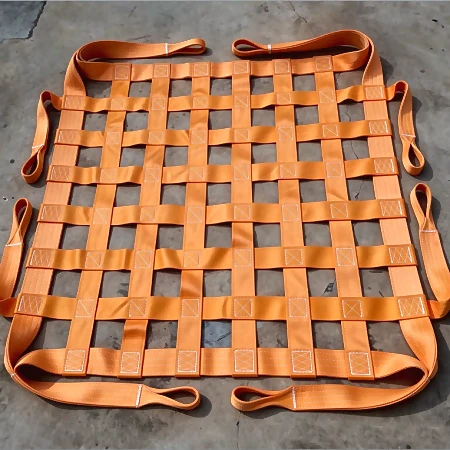
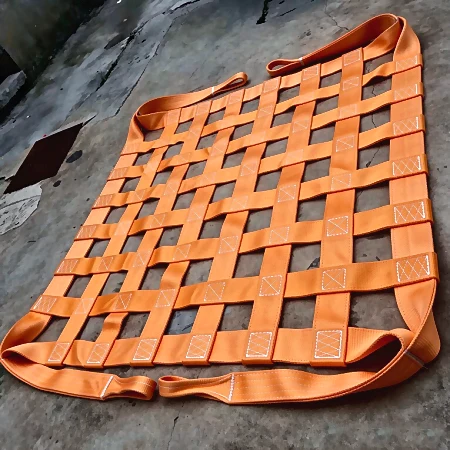
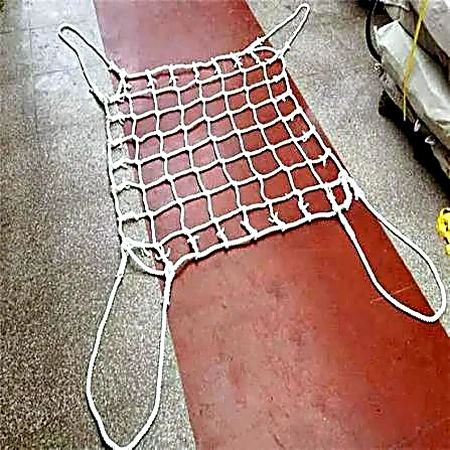
Lift sling rigging company produce Web Cargo Net,Polyester Webbing Cargo Net,Cargo Webbing Net,Nylon flat webbing net,Safety Web Cargo Net,upena ukana,Nylon Flat Webbing Netting,
Polyester webbing lifting & containment net
Web Cargo Net
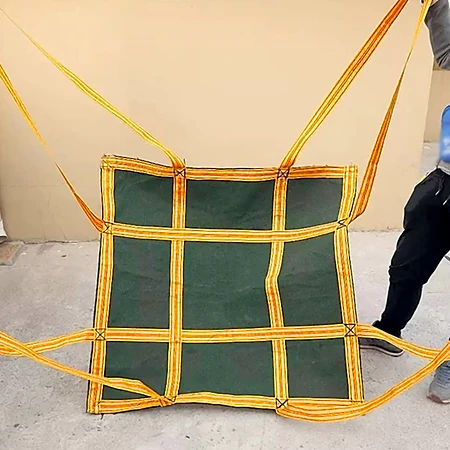
A web cargo net woven from 50 mm high-tenacity polyester webbing, rated for crane lifting and built for load containment. Mesh, nui, capacity and lifting points are made to your cargo — 2–10 t standard, 7:1 mea palekana, CE marked and proof-load tested net by net.
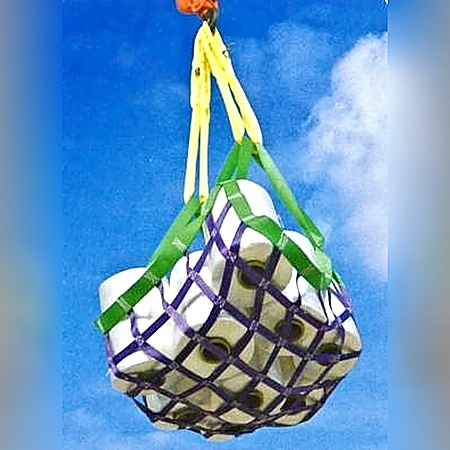
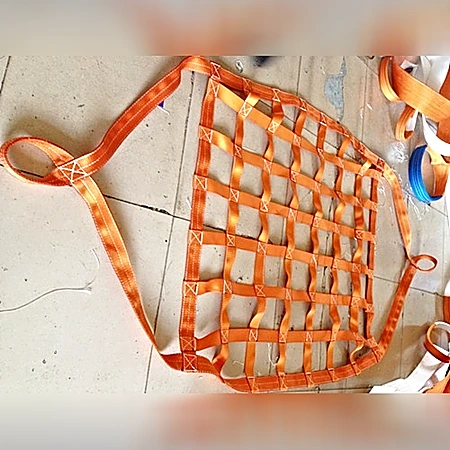
A web cargo net is a flat lifting net woven from high-tenacity polyester webbing, finished with a double-layer stitched border and reinforced corner loops. Ke hele nei nā ʻāpana ma nā kihi ʻākau e hana i kahi ʻāhaʻi hāmama, so a loose, stacked or bagged consignment can be closed inside one lattice and moved from the crane hook as a single unit — no pallet, no re-packing, no contact point pressing into the goods.
We weave the webbing, cut and stitch the net, press the fittings and proof-load test the finished assembly in the same plant. That is why the mesh, the band width, the working load limit and the colour on your quotation are the ones that arrive on site. Standard construction is rated 2 t i ka 10 t i a 7:1 mea palekana; heavier nets are built to order, and every net leaves with a capacity label and a material test report.
Key facts at a glance
- Kūkulu
- Flat woven net, 50 mm polyester webbing bands, kaʻa huinaha
- Mesh maʻamau
- 100 × 100 mm (50 – 300 mm ma ke noi)
- Hiki ke koho ʻia
- 2 – 10 t kūlana; ʻoi aku ke kaumaha i kūkulu ʻia e kauoha
- Mea palekana
- 7:1
- Nā wahi hāpai
- 4 reinforced corner loops standard; 8-mea kiko a me ke apo ma ke noi
- Dute
- Rated lifting net, or non-lifting containment net — stated on the label
What a web cargo net is — and what makes it different
A web cargo net is not a bag and not a sling. It is a woven lattice: flat webbing bands run in two directions and cross at right angles, the crossings are stitched, and a doubled border runs the full perimeter so the edge cannot unroll or pull apart under load. The cargo sits inside the lattice rather than on top of it, and the load path goes corner to border to mesh — never into the middle of a panel.
That geometry gives three practical advantages over lifting the same cargo with slings alone. Ka mua, the load is spread across a wide bearing face instead of being concentrated at a choke point, so contact pressure drops and painted, plated or machined surfaces are not marked. Ka lua, the net holds the cargo in three dimensions, so nothing can slide out sideways during the lift. Ke kolu, the net can be spread flat on the ground, loaded, and only then closed around the goods — the cargo never has to be lifted in order to be netted.
Uwelewele, rope or wire rope?
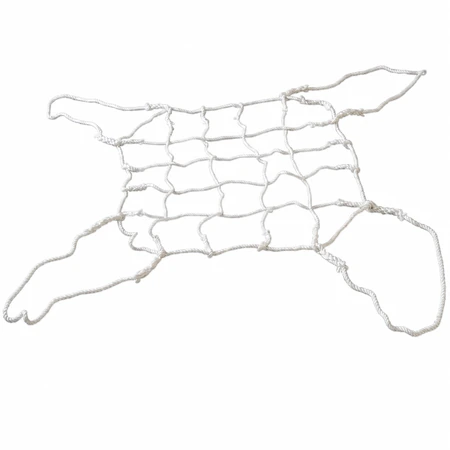
All three constructions do the same job, and the choice is normally decided by the cargo and the working environment rather than by tonnage. Web webbing carries the widest bearing face at the lowest net weight and does not mark finished goods; rope nets settle around irregular stacks; wire rope nets survive abrasion, sharp edges and hot material. The table below puts the difference in numbers.
| ʻĀpana | Web cargo net (polyester pūnaewele) | Nylon rope net | Steel wire rope net |
|---|---|---|---|
| Mea waiwai | 100% polyester kiʻekiʻe-tenacity; nylon or PP on request | 100% kiʻekiʻe-tenacity nylon multifilament | Galvanised wire rope; kuhiliʻole 304 / 316 ma ke noi |
| Strand / hui | 50 mm webbing standard; 25 / 75 / 100 mm ma ke noi | 8 – 24 mm kaula, 3-strand i kau ʻia a i ʻole 8 / 12-kaula wili | 6 × 19, 6 × 37 a i ʻole 6 × 36WS; 6 – 20 mm; FC or IWRC |
| Wehe maka | 100 × 100 mm huinahalike maʻamau; 50 – 300 mm ma ke noi | 100 – 300 mm, huinaha a daimana paha | 150 – 400 mm, huinaha |
| Huihui | Woven band crossings, stitched at the border | Netmaker’s knot or knotless braided splice | Pressed aluminium ferrule at every intersection |
| Palena | Double-layer stitched border, full perimeter | ʻO ke kaula palena ʻelua, spliced into the corners | Ke kaula palena mau, ferrule-paʻa i ka mesh |
| Nā wahi hāpai | 4 reinforced corner loops; 8-point and rings on request | 4 maka kihi; 8-kiko ma ke noi | ʻO nā maka kihi i kaomi ʻia me nā thimble, or rings |
| Hiki ke koho ʻia | 2 – 10 t kūlana; heavier to order | 1 – 50 t | 2 – 100 t |
| Mea palekana | 7:1 | 5:1 / 6:1 / 7:1 | 4:1 / 5:1 / 6:1 |
| ʻO ka lōʻihi | Haʻahaʻa, kokoke. 7% ma ka palena haawe hana | Kiʻekiʻe, kokoke. 18 – 22% at break — absorbs shock | Very low — mesh keeps its shape |
| Pili i luna | Softest — will not mark painted or machined parts | palupalu, but knots create local pressure points | Paʻakikī; sheath the contact sections |
| Abrasion / ʻoki | Maikaʻi loa, aka, e malama i ka oi | Maikaʻi loa; single strands can be replaced locally | Kiʻekiʻe loa o nā ʻekolu |
| ʻAiʻino / UV | Rust-free, Ua kūpaʻa ka UV | ʻAʻohe pala, suited to wet and salt-water duty | Galvanised standard; kuhili no ka moana |
| Mahana | -40 °C i +100 °C | -40 °C i +80 °C | Hot and dirty service — confirm duty |
| Palapala hōʻoia | CE, GS, ISO 9001; test report per net | CE, GS, ISO 9001 | CE, ISO 9001; CNAS and DNV certified facility |
ʻElua hana: lifting the cargo, and protecting it
The same woven form is used for two different jobs, and the difference has to be stated on the label, not assumed. A lifting web cargo net is a rated assembly: it is designed for a stated working load limit, proof-load tested, labelled and supplied with documentation. A containment net holds a load together or closes off an opening; it is not rated for lifting and must never be used to raise cargo. Mixing the two is the single most common and most dangerous mistake in this product family.
| Dute | Rated for lifting? | Usual form | Hana maʻamau |
|---|---|---|---|
| Hāpai ʻia | Yes — WLL marked on the net | Flat net with 4 a i ʻole 8 points, or closed bag form | Lifting bagged fertiliser, pōhaku, pahu pahu, pahu pahu, lāʻau |
| Load containment and securing | No — securing duty only | Flat net laid over the load and lashed to the deck or body | Moe kaʻa, ipu, trailer and stillage loads in transit |
| Personnel / debris protection | Separate product to the relevant net standard | Vertical or horizontal safety net with its own fixings | Palekana lihi, opening protection, ʻohi ʻōpala |
We make all three, and we will tell you which one your application needs. Where a net is bought for both duties on one site, order them as two separately labelled assemblies — a containment net that has been used for lifting can no longer be treated as a containment net either, because the load history is unknown.
Web cargo net technical parameters
The table below is the specification we quote from. Values are the standard production range for the webbing construction; anything outside it is built to drawing, and the rating that applies is the rating of the finished net in the configuration it is rigged in — not the capacity of the crane above it.
| ʻĀpana | Laulā maʻamau | Nā memo |
|---|---|---|
| Mea waiwai | 100% polyester kiʻekiʻe-tenacity (PET) uwelewele | Nylon for higher shock absorption, PP for light economical duty |
| Laulā kaha | 50 mm | 25 / 75 / 100 mm ma ke noi |
| Mānoanoa pūʻali | Ma kahi o. 2.0 – 2.4 mm ma 50 mm laula | Confirmed on the test report |
| Wehe maka | 100 × 100 mm square | 50 – 300 mm made to order |
| Upena nui | 2.0 × 2.0 m i ka 8.0 × 8.0 m kūlana | Moe kaʻa, ipu, hold and spreader sizes to drawing |
| Hiki ke koho ʻia (WLL) | 2 – 10 t | Heavier nets built to order |
| Mea palekana | 7:1 | Minimum breaking load = 7 x WLL, tested per net |
| Nā wahi hāpai | 4 reinforced corner loops | 8 points, steel rings, thimbles or shackles on request |
| Palena | Double-layer stitched, full perimeter | Extra wear layer on the contact edge on request |
| ʻO ka lōʻihi | Ma kahi o. 7% ma ka palena haawe hana | Low stretch keeps the mesh square during take-up |
| Hana wela | -40 °C i +100 °C | State the duty if the net works near hot material |
| kalakala | Orange high-visibility | Polū, ʻeleʻele, ʻōmaʻomaʻo, white or custom; colour coding to match your slings |
| Hoailona | WLL, kūkulu hale, serial number and standard on the label | Lepili inoa pono'ī, printed band text and fleet numbers available |
| Palapala | Capacity label, material test report, ʻōlelo hoʻohālikelike | hōʻailona CE; CNAS / DNV certified test facility |
Net size and rated capacity
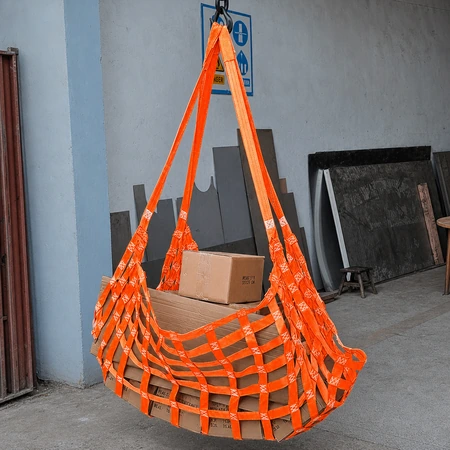
Standard sizes are held as production patterns. Moe kaʻa, ipu, hold and spreader dimensions are made to drawing, and the capacity quoted is the capacity of the finished net, tested before dispatch. Order the net larger than the load footprint so the cargo sits inside the mesh rather than on top of it — a net that only just covers the load pulls the corners in and loses capacity.
| Upena nui (L x W) | Kaha maʻamau | Hoʻohana maʻamau |
|---|---|---|
| 2.0 × 2.0 m | 1 – 3 t | Pahu, ʻāpana mīkini, nā mea liʻiliʻi |
| 2.5 × 2.5 m | 2 – 5 t | Palletised a ʻeke ukana, hoʻouka ipu |
| 2.5 × 6.0 m | 4 – 10 t | ukana lōʻihi, paipu paipu, kaʻa kaʻa a me ke kaʻa hoʻouka ʻana |
| 4 × 4 ft (1.2 × 1.2 m) | 2 – 3 t | Nā ukana liʻiliʻi, pahu pahu, ʻāpana mīkini (makeke aupuni) |
| 82 × 82 i loko | 2 – 5 t | Ka wāwae pallet maʻamau i nā mākeke imperial |
| 6.0 × 6.0 m | 10 – 25 t | ʻeke ʻeke nui, lāʻau, ʻōpala |
| 8.0 × 8.0 m | 25 – 50 t | Puke kaumaha, pōhaku, hana eli a me ka wawahi |
| Hana ʻia i ke kaha kiʻi | 1 – 100 t | Moe kaʻa, ipu, paʻa a me ka mea hoʻolaha kaola |
Wehe maka: choose it from the smallest dimension of the cargo
Mesh is the parameter buyers get wrong most often, because it is picked from the net size instead of from the load. The rule is one line long: the aperture must be smaller than the smallest dimension of the smallest piece that must not escape. A 6 m net with a 300 mm mesh will lose bricks no matter how strong the band is. The table below is the guide we apply on quotation.
| Smallest cargo dimension | Cargo example | Mesh to specify |
|---|---|---|
| Ma lalo 50 mm | Bottles, small castings, nuts and bolts, bulk components | 50 mm, or closed / near-closed bag form |
| 50 – 100 mm | Piliki, bagged fertiliser, boxed goods, FIBC big bags | 100 mm |
| 100 – 200 mm | Pahu, pahu pahu, pohaku moku, lāʻau ʻoki ʻia | 150 – 200 mm |
| Pau 200 mm | Palaka, lāʻau lāʻau, ʻōpala, ʻōpala wāwahi | 250 – 300 mm |
The four elements that set the rating
Every web cargo net is only as good as four details, and each of them can be tuned independently when the net is woven to order.
- ʻO ka hui. 50 mm high-tenacity polyester is the default because it carries the widest bearing face at the lowest net weight. 25 mm suits small mesh and light loads; 75 mm a 100 mm are used where the contact pressure has to be spread further or the edge has to resist abrasion.
- ʻO ka maka. The aperture decides what stays inside the net and how much the net weighs. It follows the smallest dimension of the cargo, never the outside size of the net.
- ʻO ka palena. A double-layer stitched border runs the full perimeter so the edge bands cannot unroll, spread apart or pull out under load. This is the second place a net wears, after the corners.
- The lifting points. Four reinforced corner loops are standard; eight points are specified where the net is lifted from a spreader beam. Load must enter the corners and the border – never the middle of a panel, which is the most common way a sound net is destroyed in service.
How a web cargo net is rigged
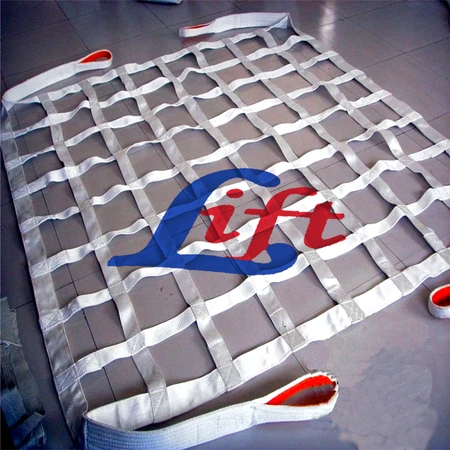
The same net gives a different rating for each arrangement, because the number of load-bearing corners changes. Quote the configuration you will actually use when you enquire – a rating copied from a catalogue without the configuration is not a rating.
| Hoʻonohonoho | Pehea e hana ai | ʻOi loa no |
|---|---|---|
| Four-point lift from a single hook | Hoʻopili ʻia nā puka puka ʻehā ma luna o ka makau a i ʻole ke apo haku, so the net closes around the cargo as the crane takes up | ʻeke ʻeke, palletised and unitised loads |
| Eight-point lift from a spreader beam | Four corners plus four side points keep the net square and the load level | Long or wide consignments; pairs with our lifting spreader beam |
| Bag form | A closed three-dimensional net for loose goods that must not escape | Piliki, pohaku moku, bottles, small castings, firewood |
| Flat net, cargo inside the mesh | The net is spread, loaded, then closed over the top and lifted | Palletised, puʻupuʻu a hui pū ʻia paha e hoʻopaʻa pū ʻia |
ʻO kēlā me kēia hoʻonohonoho, three habits destroy nets faster than any cargo: loading the middle of a panel, ka huki ʻana i ka ʻupena ma ka ʻaoʻao me ka crane, and lifting on fewer than the full set of lifting points.
Made to your load: what we customise
A web cargo net is a made-to-order item, not a catalogue SKU. The list below is what we change for a customer drawing; most of it costs nothing extra because the net is woven after the order is confirmed, not taken from stock.
| Customised item | Laulā | No ke aha ia mea |
|---|---|---|
| Upena lōʻihi x laula | Any size to drawing | The net must be larger than the load footprint |
| Wehe maka | 50 – 300 mm | Aperture smaller than the smallest piece of cargo |
| Laulā kaha | 25 / 50 / 75 / 100 mm | Bearing face, net weight and abrasion life |
| Mea waiwai | Polyester / nylon / PP | ʻO ka lōʻihi, UV and chemical resistance |
| Hiki ke koho ʻia | 1 – 100 t | Set by the load as it is presented, for the real rigging |
| Nā wahi hāpai | 4 / 6 / 8, loops or rings | Matches hook, master link or spreader beam |
| kalakala | Alani, polū, ʻeleʻele, ʻōmaʻomaʻo, keʻokeʻo, maʻamau | Site identification and sling colour coding |
| Hoailona | WLL, serial, maʻamau, brand, fleet number | Inspection records and traceability |
| Hoʻopili | Bag, bale or crate; repair kit on request | Export survival and fleet maintenance |
Where a web cargo net is used
| Sector | What the net does |
|---|---|
| Nā awa a me nā pani | ʻO ka pahu pahu a me ka hoʻopau ʻana, palletised and bagged cargo, quay and hold work with a net that is soft, rust-free and easy to fold |
| Steel and fabrication | Plate packs, pūʻolo, machined parts and stillage loads where the surface must not be marked |
| Pōhaku, quarry and aggregates | Split stone, poloka, cobbles and abrasive bulk; a heavier construction where cut resistance decides service life |
| ʻO ka lāʻau a me nā mea ulu lāʻau | Sawn packs and poles, lifted as one unit without banding |
| ʻO waho a me ka moana | Deck and over-the-side transfer; polyester drains freely and does not rust |
| Mahiʻai a me nā ʻeke nui | Mea hoʻomomona, palaoa, hua a hānai i loko o nā ʻeke a me nā ʻeke nui, lifted whole without repacking |
| Vehicle and plant loading | RoRo and breakbulk loading, where a wide net spreads the load across the body and chassis |
| Warehouse and logistics | Unitising mixed cartons for a single crane or hoist movement |
Hoʻāʻo, hōʻailona a me nā palapala
Every net is proof-load tested in our own plant before packing, and the capacity label is fixed to the net rather than to the bag. Our facility holds CNAS, CE a me ISO 9001 palapala hōʻoia, runs a 1000 t mīkini ho'āʻo pae, and has been building lifting equipment in Taizhou, Jiangsu mai 1985. Nets can be supplied with a material test report, a declaration of conformity, own-brand labels and printed band text for distributors.
For buyers who audit suppliers, ka certification and test records loaʻa ma ke noi, and the net can be supplied against your nominated standard rather than ours.
Nānā: what to check and when to retire a net
Inspect before every lift and record a formal inspection at the interval your site requires. Start at the corner loops and the corner stitching – that is where wear begins – then work round the border and the mesh.
| Check | Retire the net if |
|---|---|
| Corner loops and stitching | Stitching is broken, the loop is deformed, or the ring is cracked or worn |
| Palena | The border band is cut, unravelled or pulled out of the mesh |
| Bands | Any load-bearing band is cut, deeply abraded, heat-glazed or chemically stained |
| Crossings | A stitched crossing has opened, or the bands have shifted out of square |
| Webbing condition | Bands are powdered by UV, or contaminated with oil, paint or chemicals that cannot be removed |
| Labels | The capacity label is missing or illegible – an unlabelled net cannot be rated |
Never repair a net by knotting a broken band, stitching over a cut or heating a damaged section. Repairs belong to the maker or to a competent person using the original materials, followed by a re-test where the standard requires it. Store nets clean, dry and off the ground, mai ka lā pololei.
What is a web cargo net?
A web cargo net is a flat net woven from polyester webbing bands that cross at right angles, with a stitched border and reinforced corner loops. Cargo is placed inside the lattice and the whole consignment is lifted from the corners as one unit. A rated web cargo net carries a working load limit on its label and is proof-load tested before dispatch.
What load can a web cargo net lift?
Our standard webbing nets are rated 2 t i ka 10 t with a 7:1 mea palekana; heavier nets are built to order, and the cargo range across the family runs from 1 t i ka 100 t. The rating that applies is the rating of the finished net in the configuration it is rigged in – a four-point lift and an eight-point lift from a spreader beam give different figures.
Which mesh size do I need?
Choose the aperture from the smallest dimension of the smallest piece that must not escape, not from the net size. Ma lalo 50 mm of cargo needs a 50 mm mesh or a closed bag form; nā pōhaku lepo, bagged goods and cartons work with 100 mm; pahu pahu, split stone and sawn timber with 150 – 200 mm; poloka, logs and scrap with 250 – 300 mm.
Can the net be made to my size and colour?
ʻAe. Nui, makaʻu, laula hui, mea waiwai, kaha helu, helu o nā wahi hāpai, kala kala, marking and packing are all made to order, me kahi moe kaʻa, ipu, paʻa a hoʻolaha ana. Send a drawing or the internal dimensions of the space the net has to work in, and we will confirm the construction in one reply.
Is a web cargo net the same as a safety net?
ʻAʻole. A lifting net holds cargo and is rated for a working load limit; a safety net protects people or contains debris and is built to a different standard with different fixings. We make both, and they are supplied as separate assemblies with separate labels. A cargo net must never be used as fall protection, and a containment net must never be used to lift.
Will the webbing net mark painted or machined parts?
ʻAʻole – that is the main reason buyers choose webbing over chain or wire rope. ʻO ka 50 mm flat bands spread the load over a wide bearing face, so contact pressure stays low and coated, painted or plated surfaces are left intact. Kahi i ʻaʻahu ʻia ai ka ukana, e ʻōlelo pēlā ma ka nīnau a ua koho ʻia ka mesh a me ka pale ʻana me ka noʻonoʻo.
What is the safety factor and can it be changed?
Standard webbing nets are 7:1, meaning the minimum breaking load is seven times the working load limit. Other factors are available where your site standard requires them; confirm the factor at enquiry rather than assuming the lowest option is acceptable.
What documentation comes with each net?
A capacity label fixed to the net, a material test report and, ma ke noi, a declaration of conformity. Our facility holds CNAS, CE a me ISO 9001 palapala hōʻoia. Lepili inoa pono'ī, printed band text and fleet numbering are available on OEM orders.
What is the minimum order quantity and how is the net packed?
There is no fixed minimum for standard constructions – a single net for a trial is possible, and batch quantities can combine mixed sizes and colours in one order. Nets are folded and strapped with the label and test report attached, then bag or crate packed for sea freight.
Do you print our logo on the net?
ʻAe. We weave and print our own webbing, so brand names, capacity text, fleet numbers and colour coding can be built into the net rather than added as a tag. Send the artwork with the enquiry.
Request a web cargo net quotation
Send six things and we can quote without a second round of questions: the load weight and shape, ka nui o ka upena (or the space it has to fit), ka wehe ʻana o ka maka, na wahi hapai, the crane or spreader it hangs from, a me ke kaiapuni. Drawings and photos of the load are welcome.
| ʻIkepili | No ke aha ia mea |
|---|---|
| Load weight and shape | Sets the rated capacity and the number of load-bearing bands under the cargo |
| Upena lōʻihi x laula | Pono e ʻoi aku ka nui o ka ʻupena ma mua o ke kapuaʻi ukana no laila e noho ka ukana i loko o ka mesh |
| Wehe maka | 100 × 100 mm is our webbing standard; smaller or loose items need a smaller aperture |
| Laulā kaha | Sets strength, net weight and the bearing face on the cargo |
| Nā wahi hāpai | Four corners as standard, or eight points and rings for a spreader beam |
| Crane, makau a mea hoolaha paha | Determines whether the corners carry loops, nā apo, shackles or thimbles |
| Kaiapuni | UV, wai paʻakai, offshore or high-temperature duty decides the material and treatment |
| Palapala | hōʻailona CE, test report, declaration of conformity or own-brand labels |
Lift Sling Rigging Co., Ltd – Pāka ʻOihana Lifute, Kulanakauhale o Taizhou, ʻĀpana ʻo Jiangsu, Kina. Tel +86 523 8693 5818, WhatsApp +86 180 6600 2268, e-mail lift98@jslift.com. HS code 630790. Contact our engineers for a same-day reply on standard constructions.
Why buy web cargo nets from Lift Sling Rigging
- 40+ nā makahiki o ka hana ʻana i nā lako hana – founded in 1985 ma Taizhou, ʻO Jiangsu, me ka oi aku 200 employees and one of China’s largest sling and net production bases.
- Uli mākou i kā mākou pūnaewele ponoʻī – laula hui, kala kala, Aia ka mesh a me ka mana ma lalo o kā mākou mana, so a net is tuned to the load instead of being bought in from a catalogue.
- Own test laboratory and a 1000 t mīkini ho'āʻo pae – breaking load is tested per net and documented, under CNAS, CE and DNV certified systems, me 15 palapala ʻae ʻia.
- One supplier for the whole lift – web cargo nets, maʻa pūnaewele, maa poepoe pau ole, maa kaula uwea, ka hāpai ʻana i nā kaola hohola a kaula nylon, matched in elongation and colour coding.
- OEM a me ODM – lepili inoa ponoi, paiʻia pūnaewele, nā waihoʻoluʻu maʻamau a me ka hoʻopili ʻana i waho no nā mea hoʻolaha a me nā mea hoʻohana hope.
Related nets and slings
A web cargo net is normally bought alongside other nets, and it matters which one is rated for what. For the rope and wire rope versions of the same product, ike i ka upena lawe ukana laula; for irregular stacks and wet deck work, ka ʻupena hāpai ukana nylon settles around the load; for a heavier webbing build, ka upena lawe ukana carries the same construction in larger sizes.
For securing rather than lifting, ike i ka upena ukana kalaka a ʻupena ukana pahu ranges. Where the net protects people instead of holding cargo, start from ʻupena kaula palekana. A securing net is not rated for lifting, and a lifting net is not a fall-arrest product.
Tell us the load — we will confirm the net
Send the load weight and shape, ka nui o ka upena, ka wehe ʻana o ka maka, the lifting points and the environment, or a drawing of the truck bed, ʻo ka pahu a paʻa paha ka ʻupena e kūpono. Our engineers confirm the construction, ka palena haawe hana, the band width and the packing, and quote in one reply.
Lift Sling Rigging Co., Ltd · Lifute Industrial Park, Kulanakauhale o Taizhou, ʻĀpana ʻo Jiangsu, Kina · HS code 630790
Page reviewed and updated 19 Nowemapa 2026 by the engineering team at Lift Sling Rigging Co., Ltd. Figures describe our standard production range and are confirmed against the quotation and the test report issued with each net.