

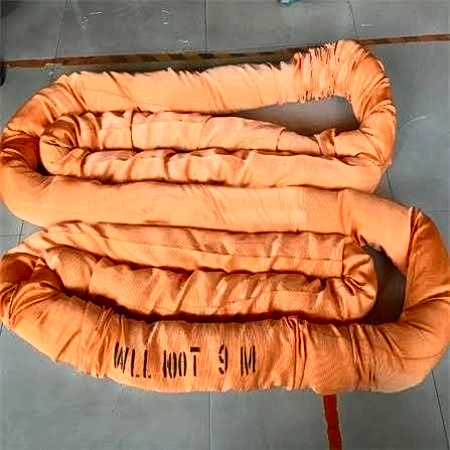
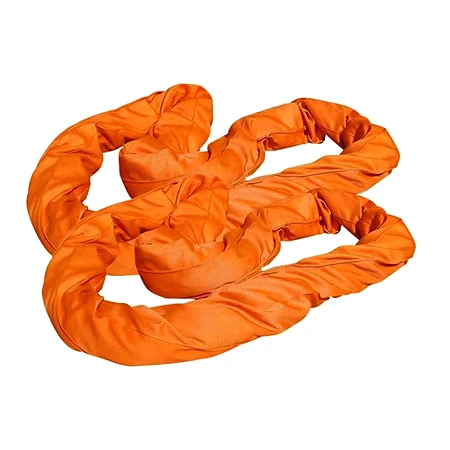
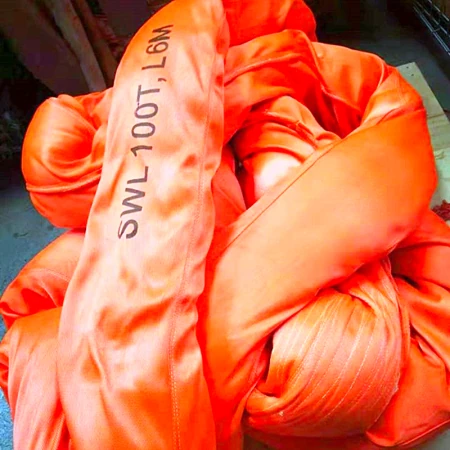
Lift sling rigging company produce WLL 100T Heavy Duty Round Slings With Eyes,100 T Endless round textile slings,100 Tonne round sling.
WLL 100T Heavy Duty Round Slings With Eyes
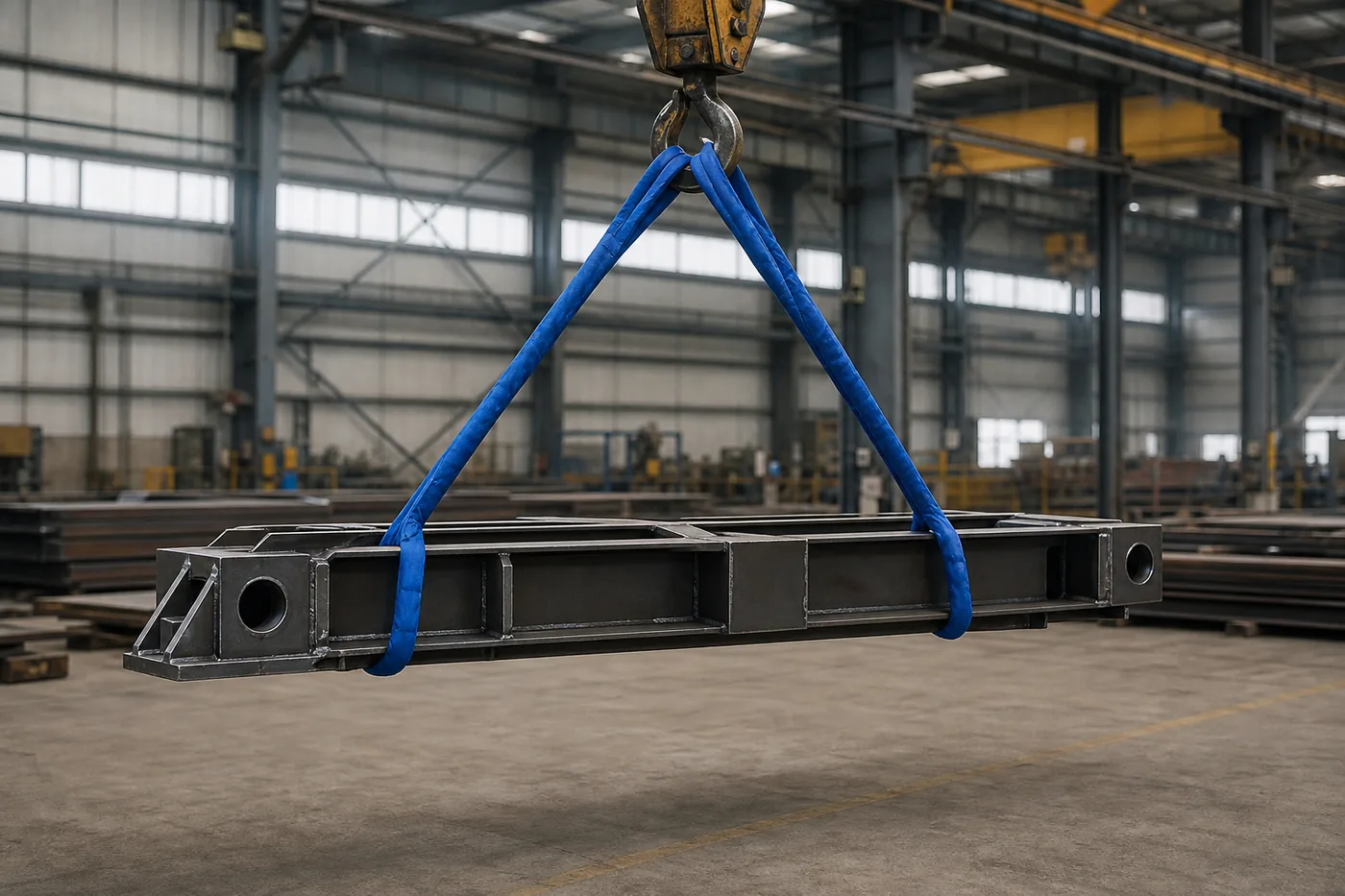
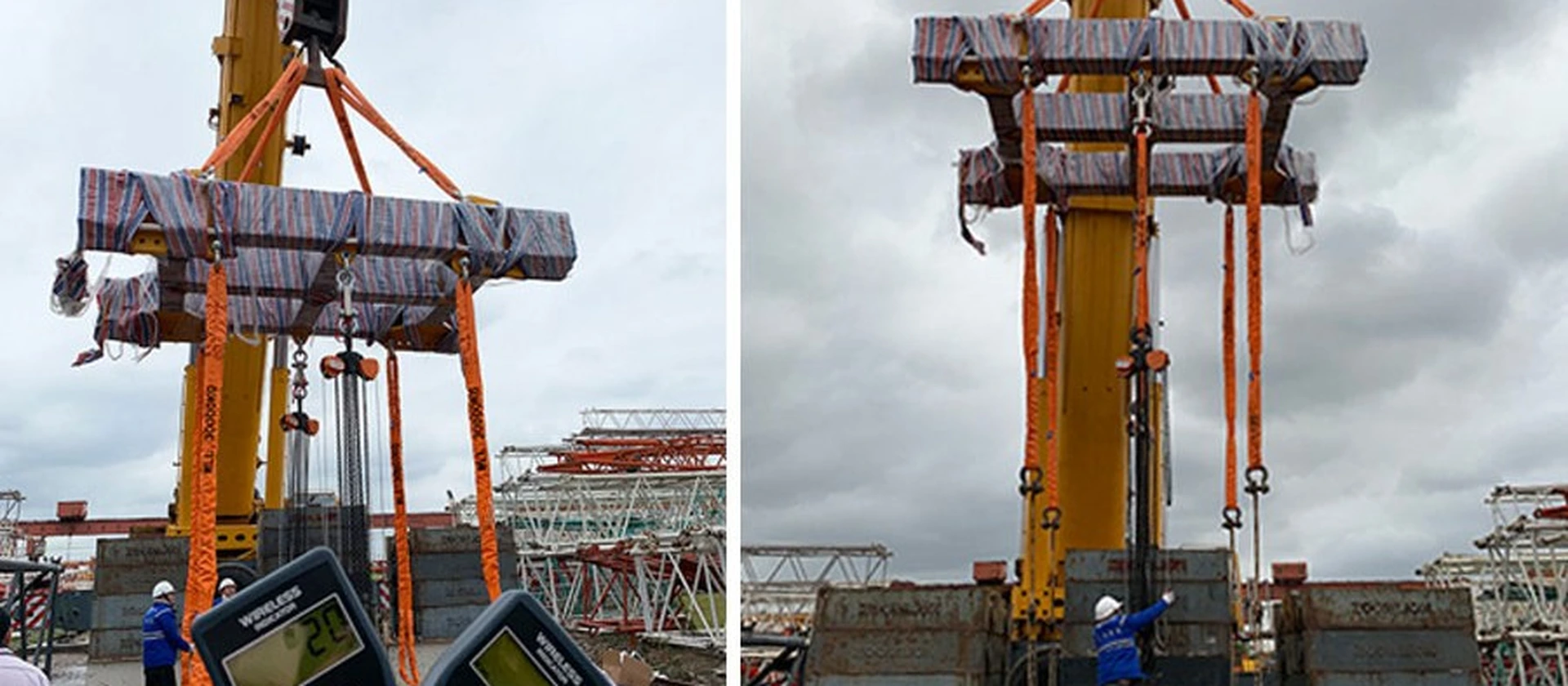
These WLL 100T heavy duty round slings with eyes sit at the top of the round sling range. A continuous parallel-fibre core carries 100 tonnes — 100,000 kg — inside a heavy-duty woven sleeve, and the sleeve is gathered and stitched at each end into two reinforced eyes. The result is a sling with a defined length and two defined pick-up points that hooks and shackles cleanly, which is what a 100-tonne lift needs.
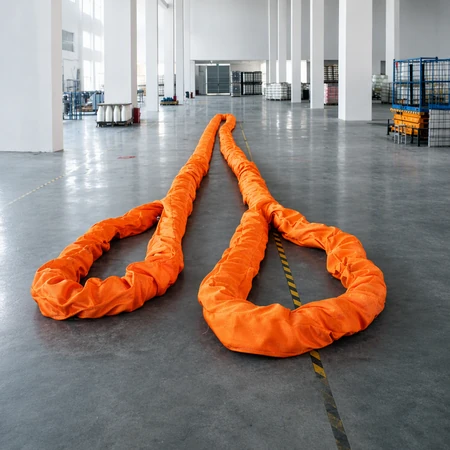
It is specified where a lift cannot be broken down into smaller pieces, and where a marked or painted surface is not acceptable. There is no metal anywhere on the article, so machined, coated and painted surfaces come out of the lift untouched. For 1 t to 12 t capacities we make the same eye-and-eye pattern in the standard range; this page covers the 100 t heavy-duty build.
Key Features
- 100 t vertical working load limit — 100,000 kg per sling, with a minimum breaking load of 700 t at a 7:1 aminci factor.
- Reinforced stitched eyes — a formed termination at each end that sits in a hook bowl or a shackle instead of bunching where it is caught.
- Heavy-duty double-layer sleeve — the abrasion layer that protects the core on rough plant and in repeated handling.
- Length to your measurement — eye-to-eye, so a repeat lift repeats at the same geometry.
- Soft, non-marking body — conforms to curved and finished surfaces and will not bruise a machined face.
- Fibre options — high-tenacity polyester as standard, aramid for hot loads and UHMWPE when the weight of the sling itself matters.
Technical Specifications
| Parameter | Specification |
|---|---|
| Product | WLL 100T heavy duty round slings with eyes / 100 ton eye and eye round sling / 100 tonne round sling |
| Working load limit | 100 t (100,000 kg), vertical |
| Minimum breaking load | 700 t at a 7:1 aminci factor (calculated from the WLL) |
| Construction | Continuous parallel-fibre core inside a woven tubular sleeve, the sleeve gathered and stitched at each end into two eyes |
| Core | High-tenacity polyester parallel yarn as standard; aramid or UHMWPE to order |
| Sleeve | Heavy-duty double-layer woven polyester; wear pads and reinforced eyes optional |
| Eye type | Flat stitched eye as standard; reinforced eye or wear pad for hard service |
| Length | Eye-to-eye, made to order; the minimum length rises with capacity and is confirmed on the approval drawing |
| Elongation | Low stretch; a polyester core is typically around 3% at WLL — the test certificate governs |
| Temperature | Standard polyester about −40 °C to +100 °C; aramid core version for higher temperatures |
| Design reference | EN 1492-2 practice, 7:1; other safety factors produced to order |
| Marking | Sewn label with WLL, eye-to-eye length and batch; above 12 t the sleeve colour no longer identifies capacity, so the label governs |
| Packing | Coiled, poly bag, labelled carton or wooden case for export |
| MOQ and OEM | Low MOQ for trial orders; OEM capacity, tsayi, sleeve colour, fibre, label layout and packing |
| HS code | 630790 |
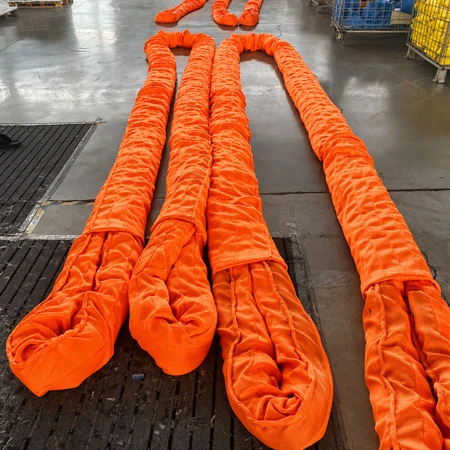
Working Load Limits by Configuration
The figure on the label is the vertical rating. Every other arrangement is derived from it by a mode factor, and the same sling carries very differently in each one.
| Configuration | Mode factor | WLL | WLL in kg |
|---|---|---|---|
| Vertical | 1.0 | 100 t | 100,000 kg |
| Choked | 0.8 | 80 t | 80,000 kg |
| Basket, 0–7° | 2.0 | 200 t | 200,000 kg |
| Basket, 7–45° | 1.4 | 140 t | 140,000 kg |
| Basket, 45–60° | 1.0 | 100 t | 100,000 kg |
Figures apply to a single sling. In a two-leg or four-leg assembly the capacity of each leg further depends on the included angle, and the assembly rating — not the sling rating — governs the lift. Confirm the arrangement before use.
Why the Eye Termination Decides a 100 t Lift
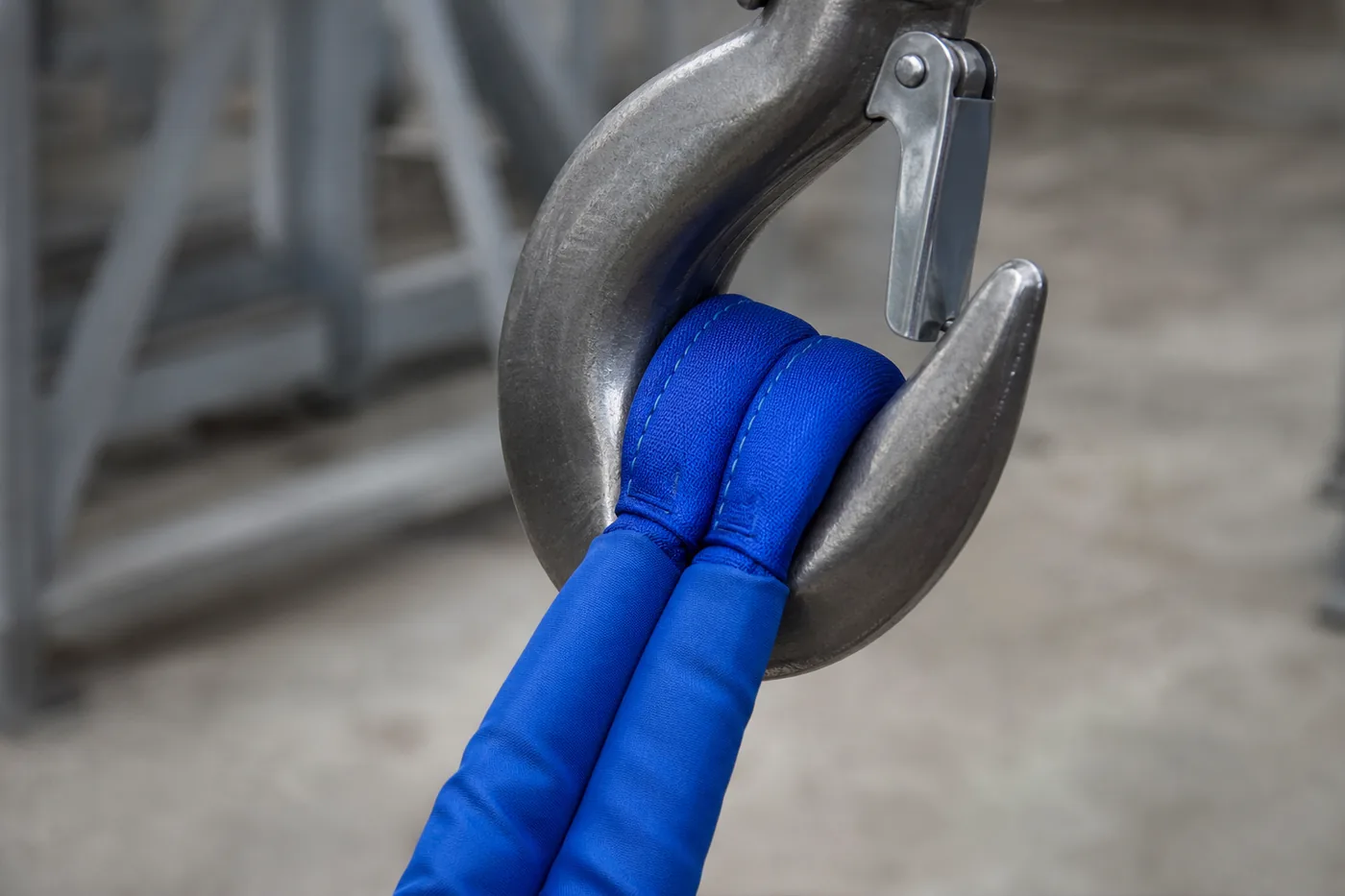
At one tonne the eye is a detail. On a WLL 100T heavy duty round sling with eyes it is the part that carries the whole lift: the load runs from the hook, through the eye stitching, into the core, and back out through the other eye. That makes two places on the sling critical rather than one, and it changes how the sling is rigged and inspected.
- It seats instead of bunching. A formed eye sits in the hook bowl or the shackle as a unit, so the load enters the termination squarely rather than gathering the sleeve into a lump.
- The pick-up points are where you left them. A defined eye-to-eye length means the legs hang at the angle the lift was planned around, every time.
- The eyes are inspectable. Stitch rows, the gather where the sleeve narrows and the sleeve inside the eye can all be seen before every lift.
- It hooks and shackles like a web sling. No threading the body back through itself, which matters when the sling weighs more than the rigger wants to handle.
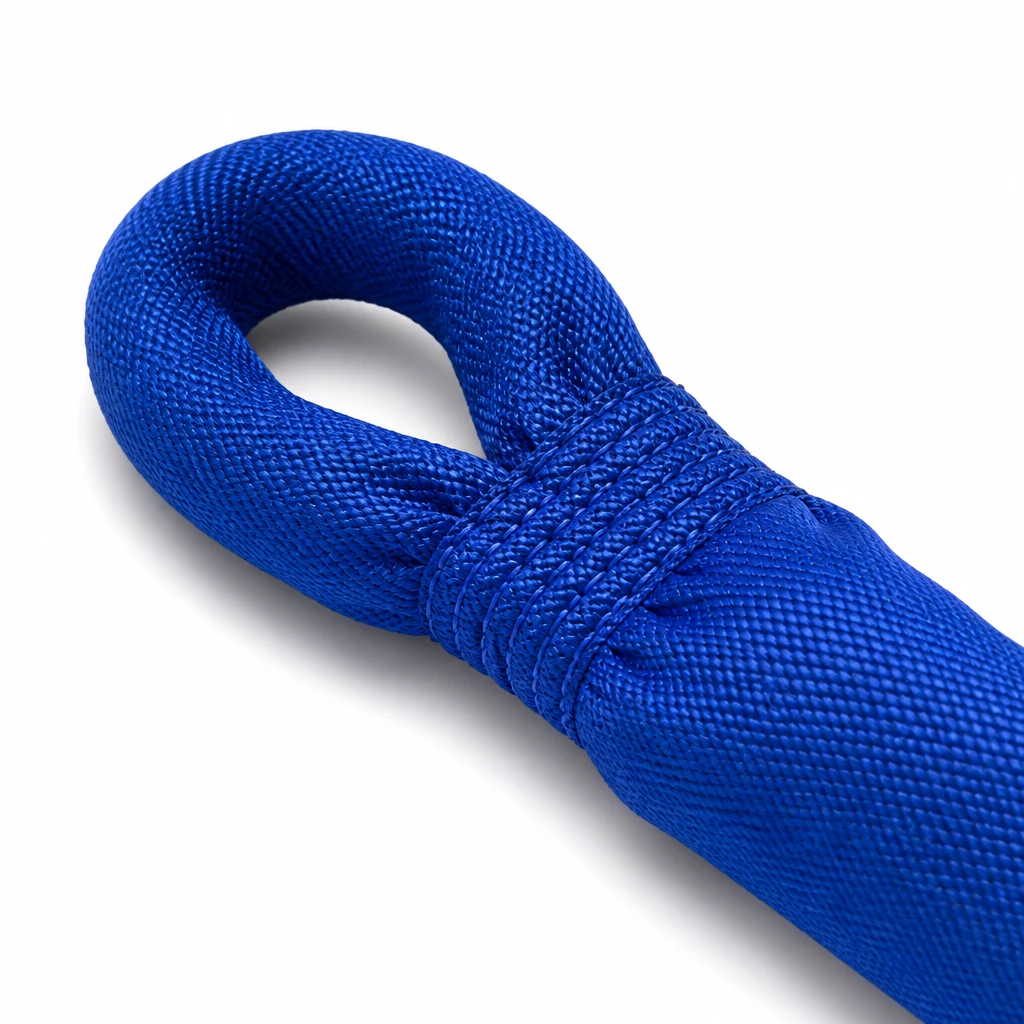
Construction: Core, Sleeve and Stitched Eye
The cibiya is the load path: a continuous bundle of parallel high-tenacity polyester yarn, with the filament count and lay checked before the sleeve is closed. Because the fibres run parallel rather than woven, a 100 t core stays remarkably compact for its capacity.
The sleeve takes the abrasion, the dirt and the daylight, and it carries the marking. It is sacrificial by design: a sleeve worn through so that the core is visible retires the sling, even if the core itself looks sound. On this build it is a double-layer woven polyester sleeve, with wear pads available where the sling meets a corner.
The eye is where the sleeve is gathered and stitched with multiple rows through the full thickness of the termination. It is the highest-stress point on an eye-and-eye sling, and it is the reason the eyes are inspected first and the body second.
100 T Round Sling vs Other Heavy Lift Options
| Property | Round sling with eyes | Heavy-duty web sling | Wire rope grommet | Chain sling |
|---|---|---|---|---|
| Weight at 100 t | Lightest of the four | Heavier — wide webbing | Heavy | Heavy |
| Contact with the load | Soft, no metal | Flat, wide face | Hard, can mark | Hard, can mark |
| Curved loads | Body wraps the curve | Touches along a line | Bridges the curve | Bridges the curve |
| Abrasion | Sleeve is sacrificial | Wear acts on the load path | Good | Excellent |
| Heat | Limited, about 100 °C | Limited, about 100 °C | High | High |
| Inspection | Sleeve and eyes; core hidden | Load path fully visible | Wires visible | Links visible |
| Best for | Finished heavy machinery, curved and awkward loads | Wide flat loads and tight hook openings | Hot or abrasive work | Foundry and hot work |
Applications
These WLL 100T heavy duty round slings with eyes are specified for:
- Wind turbine components — hubs, nacelle parts, tower sections and blade roots
- Power transformers, generators and heavy electrical plant
- Rolling mill rolls, press frames, machine beds and machine tools
- Bridge girders, welded steel structures and fabrication assemblies
- Precast concrete segments, moulds and formwork
- Ship sections, marine modules and offshore fabrications
How to Specify a 100 T Round Sling With Eyes
A WLL 100T heavy duty round sling with eyes is built to a particular lift, so the enquiry starts with the geometry of that lift rather than with a catalogue number.
- The eye-to-eye length you need — measured from the inside of one eye to the inside of the other, not the overall length including both eyes.
- The headroom — the eyes have to reach the hook comfortably; a sling that only just reaches forces the legs into a wide angle and throws capacity away.
- The arrangement — vertical, basket or choked, and whether a spreader beam or katako mai ɗagawa keeps the legs vertical above the load.
- The load and its centre of gravity — mass at each pick-up point, and whether the load is rigid or will distort in the lift.
- The environment — temperature, chemicals, water, daylight and how much abrasion the sleeve will see.
- Marking and certification — the capacity and identification your receiving site needs to read, and any certificate that must travel with the consignment.
A 100 t sleeve cannot be gathered into a short eye-to-eye distance. Send the capacity and the length together and we will confirm what is possible on the approval drawing before production.
Inspection and Care
- Inspect the two eyes first: stitch rows, the gather, and the sleeve inside the eye.
- Then the sleeve along its whole length for cuts, abrasion, chemical staining and heat glazing.
- Take the sling out of service if the core is visible anywhere, or if stitching is broken, slack or pulled.
- Never drag a loaded sling sideways, and never rig the body over an unprotected sharp edge.
- Store it dry, off the floor and out of direct sunlight, and record the lifts and any damage.
Frequently Asked Questions
What does WLL 100T mean on these slings?
It is the working load limit in the vertical arrangement: 100 tonnes, or 100,000 kg. It is not the breaking strength. At the 7:1 safety factor used for this build, the minimum breaking load is 700 t. In a choke or at a wide basket angle the usable capacity is lower, and the label figure is always the vertical one.
How much can a 100 t round sling lift in a basket?
Up to 200 t with the legs at 0–7° to the vertical, 140 t between 7° and 45°, and 100 t between 45° and 60°. In a basket two parts of the sling share the load, which is where the extra capacity comes from — but the body also takes a longer path under the load, so the length has to allow for it.
Can you make it at a custom eye-to-eye length?
Ee. Length is part of the specification, measured between the eyes. A minimum applies and it rises with capacity, so send the capacity and the length together. We confirm the figure on the approval drawing before the sling is made.
Is a 100 t round sling lighter than a 100 t chain sling?
Considerably. The parallel-fibre core carries the load in a slim, soft body, so the sling can be carried to the machine by hand where a chain assembly of the same capacity needs mechanical handling. A UHMWPE core version is lighter again, at a higher cost per sling.
What is the difference between this and an endless round sling?
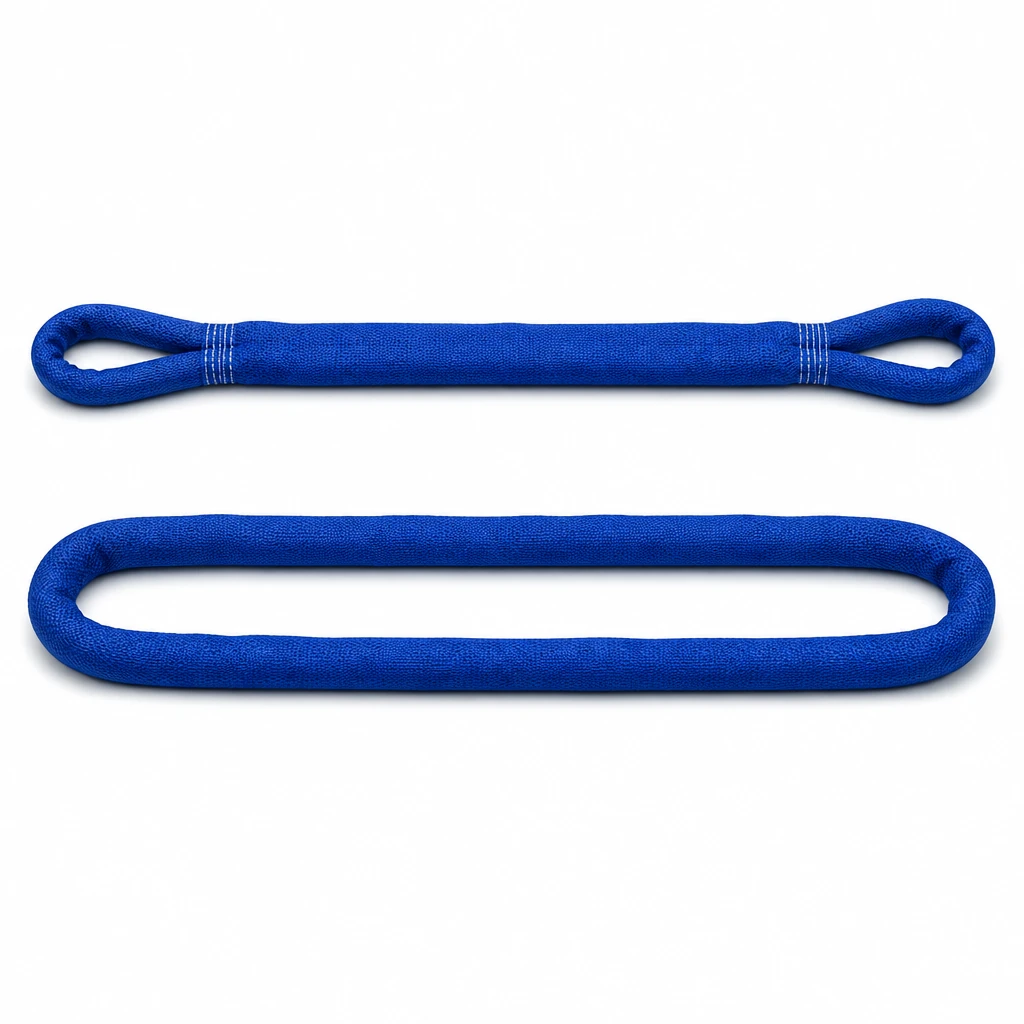
Only the termination. An endless round sling is a closed loop with no ends, rigged wherever it lands and rotated to spread wear. This one has two stitched eyes, a defined length and defined pick-up points. Both are made from the same core and sleeve at the same capacities, so it is a rigging choice rather than a capacity one.
Do you supply a test certificate?
Ee, on request, together with the fibre certificate and the batch figures for the consignment. Tell us the standard marking or certificate your market requires before the order and we will confirm exactly what can be provided for this capacity and construction.
Request a Quote for WLL 100T Heavy Duty Round Slings With Eyes
Send us the load, the distance between your pick-up points, the headroom, the arrangement and the environment — plus any marking or certification your market requires. We will come back with the sleeve, the length, a sample and a factory-direct price.
Lift Sling Rigging Co., Ltd — telephone and WeChat 18066002268, e-mail 702461526@qq.com, Lifute Industrial Park, Taizhou City, Jiangsu Province, China. HS code 630790.
Related Products
- The full round sling range — polyester, nylon and UHMWPE cores
- Dyneema round sling — the lightest option at high capacity
- Aramid round sling — for hot loads and resistance to heat
- High temperature round sling — where the load itself is hot
- Heavy-duty eye and eye web sling — the flat alternative
- Wire rope grommet — for abrasive and hot work
- C-hooks for coil handling — for steel coil lifts