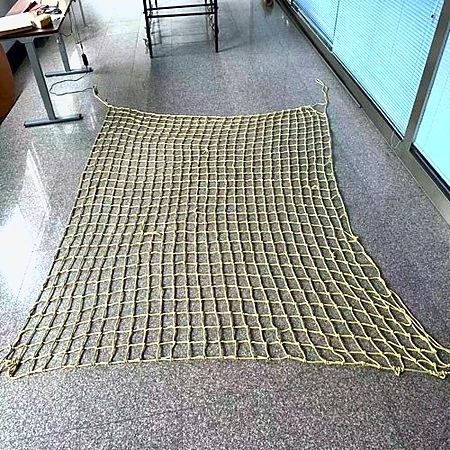
Lift sling rigging company produce Kevlar/aramid thread mesh,Fireproof Thread mesh,Kevlar rope mesh.
Kevlar/Aramid Thread Mesh
Kevlar/aramid thread mesh is a fine aramid netting made from braided aramid line rather than from heavy rope: 2–6 mm line, 20–100 mm apertures, light enough to be cut, hemmed and hung like a fabric, and stable enough to sit in front of a welding arc or a hot surface all day. It is a screen and a barrier, not a load path — no one hangs a load from it and no one falls into it.
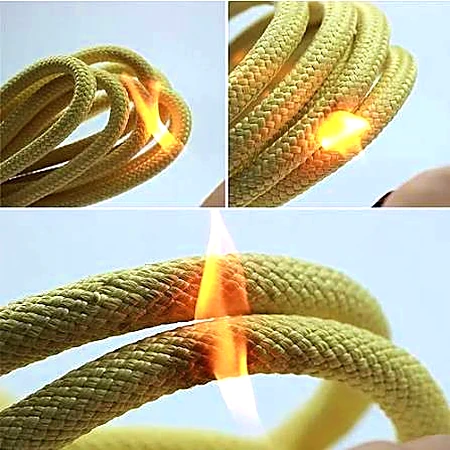
The fibre is what makes it work. Aramid does not melt and does not drip: heated, it chars and holds its shape, so a spark that lands on the mesh does not open a hole that grows. That is the difference between this and a flame-retardant polyester or nylon mesh, which self-extinguishes but still softens and can drip under sustained heat.
Where Thread Mesh Sits Against Rope Net
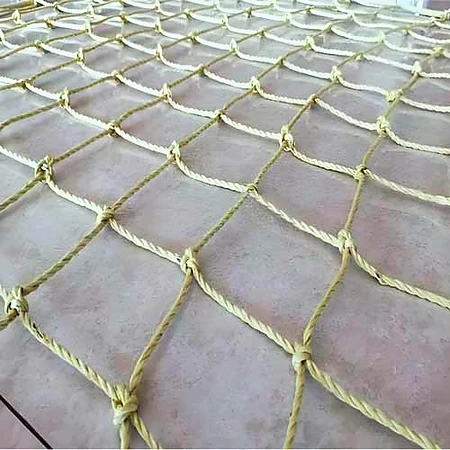
The distinction matters because both are sold as aramid netting and they are not interchangeable. A braided aramid rope net is built from 4–16 mm rope with 50–200 mm mesh, spliced borders and anchor points, and it carries load — people, cargo, debris. Thread mesh is built from 2–6 mm line with a much tighter aperture, and its job is to stand between a hazard and what is behind it: sparks, slag, radiant heat, hot particles, swarf.
| Aramid thread mesh | Braided aramid rope net | |
|---|---|---|
| Line / rope | 2–6 mm braided aramid line | 4–16 mm braided aramid rope |
| Aperture | 20–100 mm | 50–200 mm |
| Weight | About 0.3–2.5 kg/m² | About 0.35–5.15 kg/m² |
| Edge | Hemmed, sewn, eyelets, or rope border | Spliced border rope with anchor fittings |
| Carries load | No — screening and separation only | Yes — designed and rated for it |
| Typical use | Spark curtains, heat shields, covers, guards | Fall protection, cargo, debris catch |
Kevlar/Aramid Thread Mesh Specifications
| Parameter | Specification |
|---|---|
| Material | 100 % para-aramid filament (Kevlar-type); meta-aramid on request |
| Line construction | Braided, 8-strand; twisted line on request |
| Line diameter | 2 mm, 3 mm, 4 mm, 5 mm, 6 mm |
| Mesh opening | 20 mm, 30 mm, 50 mm, 75 mm, 100 mm — square or diamond |
| Mesh weight | About 0.3–2.5 kg/m² depending on line and aperture |
| Panel size | Panels to 5 × 10 m; rolls to 1.5 m wide, 50 m long |
| Edge finish | Hemmed and double-stitched, eyelets at 300–500 mm, or rope border for large panels |
| Fixing | Brass or stainless eyelets, sewn tabs, Velcro or zip closure on curtains |
| Flame behaviour | Does not melt, does not drip; chars and holds |
| Limiting oxygen index | About 29 % (inherent in the fibre, not an additive finish) |
| Thermal service | Continuous to about 200 °C; short excursions higher; carbonises from about 400 °C |
| Elongation at break | About 3–4 % |
| Colour | Natural yellow, black, or to order |
| Options | Aluminised facing for radiant heat, PU coating for abrasion, printed or stitched branding |
| Testing | Flame test to the standard your market requires — NFPA 701, EN 13501-1 or GB 8624 — on request |
| HS code | 630790 |
Line diameter, aperture and weight are manufacturing ranges. Fire performance is a property of the finished article, so the test report is issued against the construction actually supplied — confirm the standard your insurer or authority requires at enquiry.
Fire Behaviour: Why Aramid and Not FR Polyester
Flame-retardant treatments work by interrupting combustion in a polymer that would otherwise burn, and they are effective — but the polymer underneath is still thermoplastic. Hold an FR polyester mesh in a hot enough place and it softens, shrinks and can drip, and a dripping thermoplastic carries fire downwards. Aramid has no melting point in service: it degrades and chars from roughly 400 °C and keeps its geometry, so the mesh does not open up under the heat it is meant to screen.
- No melting, no dripping — the failure mode that matters most above a walkway or a cable tray.
- Inherent flame resistance — no additive finish to wash out, abrade away or expire with washing.
- LOI about 29 % — the fibre sustains combustion only in an oxygen-enriched atmosphere.
- Low smoke — aramid chars rather than burning, which matters in enclosed plant rooms and tunnels.
- Cut and abrasion resistant — the mesh survives contact with sharp scrap and hot slag particles.
Choosing the Aperture
Aperture is a compromise between what must be stopped and what must pass. A fine mesh holds sparks and small particles but blocks light and air and adds weight; a coarse mesh ventilates but lets slag through. Work from the particle size and the duty behind the mesh.
| Duty | Line Ø | Aperture |
|---|---|---|
| Grinding and welding spark screen | 2–3 mm | 10–20 mm |
| Hot-work curtain — sparks and slag | 3–4 mm | 20–30 mm |
| Heat shield over hoses, cables and actuators | 3–5 mm | 30–50 mm |
| Foundry and molten splash guard | 4–6 mm | 30–50 mm |
| Coarse barrier and personnel warning | 4–6 mm | 50–100 mm |
Aperture is quoted between line centres. If you need a clear opening figure, say so — the two numbers differ by one line diameter.
Forms We Supply
- Rolls — 1.5 m wide, up to 50 m long, for cutting on site.
- Panels — cut and hemmed to size, with eyelets at the spacing your frame needs.
- Curtains — hung from a top rail or ring set, with Velcro or zip closure where two curtains meet.
- Covers and sleeves — sewn to a pattern for hoses, cables, flanges and valve bodies.
- Layered or faced — a second layer for extra spark retention, or an aluminised facing where radiant heat is the main load.
Where It Is Used
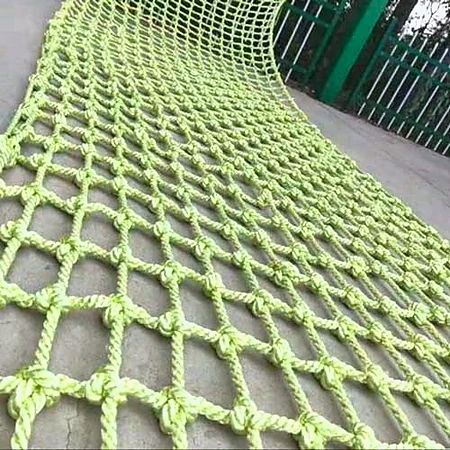
- Welding bays and hot-work areas — spark screens between the arc and everything behind it
- Grinding and cutting stations, where sparks travel further than expected
- Foundries, steel mills and slag areas — splash guards and heat screens
- Plant rooms, tunnels and cable trays — heat shields and fire barriers over services
- Expansion joints, penetration seals and ducting where a flexible heat-resistant screen is needed
- Machinery guards, engine bays and exhaust areas — hot-surface separation
- Marine engine rooms and offshore modules — lightweight, non-melting screening
- Theatre, studio and event rigging — heat screening near lamps and pyrotechnics
How to Specify
These Kevlar/aramid thread mesh items are made to a size and a duty, so five answers are enough to quote: what is behind the mesh, what is in front of it, the size of the opening, how it is fixed, and the standard the finished article has to be tested to.
- The hazard — spark, slag, radiant heat, hot particle or flame, and how far it travels.
- The opening — width × height, and whether the mesh hangs flat, curves or is sewn to a shape.
- The fixing — frame, rail, ring set or eyelets, and their spacing; the top edge takes most of the handling load.
- The environment — indoor or outdoor, UV exposure (aramid needs a coating or a cover outdoors), chemicals and abrasion.
- The documentation — the flame test standard and marking your market or insurer requires.
Cutting, Care and Inspection
- Cut with a hot knife or sharp shears and seal the cut line by hemming or stitching — an unsealed cut edge is where the mesh starts to run.
- Do not hang weight from the mesh; use the hem, the border or a separate sling. Thread mesh is a screen, not a sling.
- Wipe or wash with fresh water and mild detergent. Strong acids and bleach attack aramid.
- Inspect at a fixed interval: chafed or cut lines, opened apertures, glazed or charred patches, loose eyelets and torn hems.
- A bleached, fuzzy surface is UV degradation. Indoors it is slow; outdoors, use a coated or faced mesh and replace on condition.
Frequently Asked Questions
Is Kevlar the same as aramid?
Kevlar is one brand of para-aramid fibre; the fibre family also includes Twaron and several Asian-produced equivalents. We supply mesh of equivalent performance and can quote a named-brand fibre if your specification calls for one. We are not affiliated with DuPont.
Does the mesh melt or drip in a fire?
No. Aramid has no melting point in service — it chars from about 400 °C and keeps its shape, so the aperture does not open up and nothing drips away. That is the main reason to specify it over a flame-retardant polyester or nylon mesh, which self-extinguishes but still softens and can drip under sustained heat.
What aperture should I use for welding sparks?
10–30 mm for a spark screen, depending on how far the sparks travel and what is behind the mesh. Grinding throws finer, faster particles than welding, so grinding screens are usually at the finer end. Send us the duty and the distance and we will confirm the line and aperture together.
Can it be cut, sewn and fitted with eyelets?
Yes — that is what separates thread mesh from rope net. It is hemmed and double-stitched, fitted with brass or stainless eyelets at 300–500 mm centres, closed with Velcro or a zip, or sewn to a pattern for covers and sleeves.
Is it a load-bearing net?
No. Thread mesh is specified for screening, separation and heat resistance. If the requirement is to carry a person, cargo or debris, use a braided aramid rope net sized and rated for that load — the two products look similar and are not interchangeable.
Will it survive outdoors?
Aramid is more UV-sensitive than polyester. For permanent outdoor use specify a PU-coated or faced mesh, keep the panel shaded where possible, and replace on condition rather than on age. Indoors, under a roof, uncoated mesh is normally fine.
Request a Quote for Kevlar/Aramid Thread Mesh
Send the duty, the opening, the fixing method and the test standard you need, and our engineers will confirm the line diameter, aperture, weight, edge finish and packing — with the flame test documentation your market requires — before the mesh is woven. Repeat orders are matched to the original specification.
Lift Sling Rigging Co., Ltd — telephone and WeChat +86 180 6600 2268, e-mail 702461526@qq.com, Lifute Industrial Park, Cathair Taizhou, Cúige Jiangsu, tSín. HS code 630790.
Táirgí Gaolmhara
- Safety rope nets — full range of panels, meshes and edge details
- Braided aramid rope net — the load-bearing version, 4–16 mm rope
- Aramid fall protection safety net — where the net has to catch a person
- Fire prevention anti drone mesh — interception panels over fire-risk sites
- Aramid braided téad — the line our thread mesh is braided from
- Téad tarrthála dóiteáin — flame-resistant rope for response teams
- Téad múrála friotaíocht teasa ard — heat-stable rope for hot plant
- Nylon and polyester rope range for lashings and edge lines