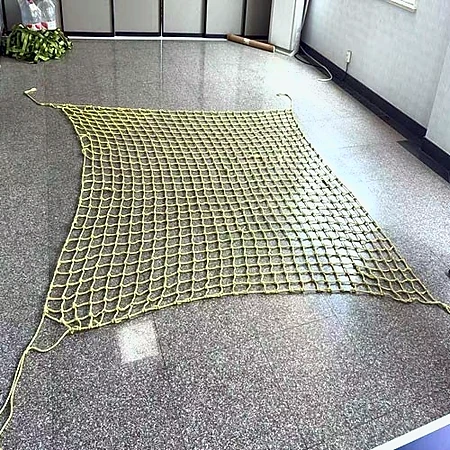
Lift sling rigging company manufacture fire prevention anti drone mesh,Drone protection net,fire prevention anti drone net,Flame-Retardant Drone Safety Net,high strength drone containment netting.
Fire Prevention Anti Drone Mesh
Fire prevention anti drone mesh is a rope net specified as a physical barrier against small unmanned aircraft. It does not detect a drone and it does not jam one: it stands in a plane across an opening — over a tank bund, along a perimeter, above a yard or a roof — and stops the aircraft from crossing it. The fire prevention half of the name is a material requirement. The net is made from flame-retardant fibre so that a panel hanging over a site where a spark, a flare or a vapour cloud is the real hazard does not itself become the fuel, and so that a drone arriving on fire is caught in something that will not sustain a flame.
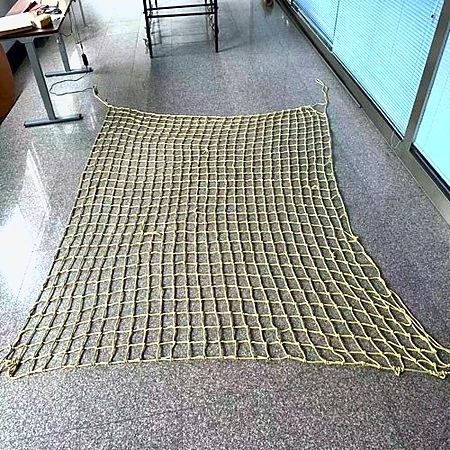
Panels are made to the opening rather than to a catalogue size: flame-retardant high-tenacity polyester or nylon rope as standard, aramid where radiant heat governs, knotless or knotted mesh, a heavier spliced border rope and corner eyes at the spacing your supports need. The aperture is chosen from the smallest thing that must not pass — normally the propeller disc of the drone you expect.
What Fire Prevention Means on a Drone Net
Fire prevention and fireproof are used as if they were the same claim, and on a net they are not. A flame-retardant (FR) polyester or nylon net is treated so that it stops burning when the ignition source is taken away: it self-extinguishes, and a typical FR polyester reaches a limiting oxygen index (LOI) of about 28 % or above, against roughly 20–21 % for the untreated polymer. It is still a thermoplastic — held at high temperature it melts and can drip. Aramid does not melt at all; it carbonises from about 400 °C and keeps its geometry. That difference decides which net belongs over which hazard.
Specify FR polyester where the net has to survive a brief ignition source: a burning drone, a dropped flare, sparks from hot work, a fire in vegetation below the panel. Specify aramid where the panel sits in radiant heat or over a process that can release burning material — flare areas, coke drums, molten metal — and take that decision on the aramid fall protection net or the braided aramid rope net page, where heat is the primary case rather than the secondary one.
| Property | FR polyester | FR nylon | Aramid |
|---|---|---|---|
| Flame behaviour | Self-extinguishing, LOI about 28 % or above | Self-extinguishing, LOI about 28 % or above | Does not melt; carbonises from about 400 °C |
| Melting | Melts at about 250–260 °C | Melts at about 220–265 °C, depending on type | No melting point |
| Continuous service | About −40 to +70 °C | About −40 to +70 °C | About −70 to +200 °C |
| Outdoor UV | Good with UV-stabilised fibre; coating recommended | Moderate; coating recommended | Moderate; coated panel recommended outdoors |
| Strength for weight | Good | Good, and more elastic | Highest of the three |
| Where it is used | Venue, perimeter and yard nets over fire-risk sites | Panels where deflection has to absorb the impact | Radiant heat, flare areas, molten splash |
Fire Prevention Anti Drone Mesh Specifications
| Parameter | Specification |
|---|---|
| Material | Flame-retardant high-tenacity polyester (standard); FR nylon; aramid for heat |
| Rope construction | 8-strand or 12-strand braided |
| Rope diameter, mesh | 4 mm, 5 mm, 6 mm, 8 mm, 10 mm |
| Rope diameter, border | 10 mm or 12 mm — always heavier than the mesh rope |
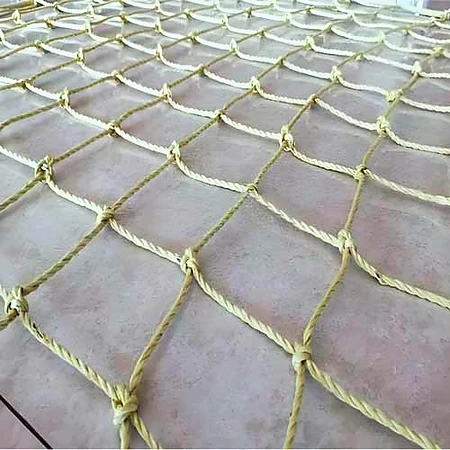
| Mesh opening | 50 mm, 75 mm, 100 mm for drone interception; 25–40 mm for debris retention |
| Mesh construction | Knotless braided as standard, or knotted where on-site repair is preferred |
| Panel size | 2 × 2 m up to 20 × 20 m; larger openings made as joined panels |
| Panel joint | Border ropes laced or spliced together — never mesh tied to mesh |
| Edge | Spliced border rope all round, reinforced corners |
| Fixing points | Corner eyes, stainless thimbles, eyelets or D-rings at your support spacing |
| Flame retardancy | FR fibre, self-extinguishing; LOI about 28 % or above; test report to your market’s standard on request |
| Colour | Beige, green, black, orange, or to order |
| Coating | Uncoated, or PU / PVC coated for UV and abrasion on permanent outdoor panels |
| Service temperature | About −40 to +70 °C in FR polyester; up to +200 °C in aramid |
| Marking | Tag with panel size, rope diameter, mesh, fibre and batch number |
| HS code | 630790 |
| Origin | Lift Sling Rigging Co., Ltd — Taizhou, Jiangsu, tSín |
Figures are manufacturing ranges, not a performance guarantee. Interception performance belongs to the whole installation — panel, border, supports, stand-off and the aircraft it has to stop — and is confirmed on the approval drawing.
Mesh Size: What the Net Has to Stop
Aperture is the parameter buyers ask for first and the one most often quoted without saying what it has to retain. Work from the aircraft, not from a preferred mesh: the opening has to be small enough that the part which would pass first cannot get through.
| What must be retained | Aperture | Why that opening |
|---|---|---|
| Propeller disc of a small multirotor | 50 mm | A blade cannot pass; an arm enters and the airframe is caught at the crossing |
| Airframe of a consumer drone | 75–100 mm | The body is caught while the panel stays light enough to handle and to support |
| Larger UAS and fixed-wing | 100 mm with a heavier rope | Energy is taken by panel deflection, so the rope and border carry the load, not the mesh |
| Dropped payload, tools and debris | 25–40 mm | Secondary containment below the flight path, emptied on inspection |
State the measuring convention when you specify: aperture is normally given between rope centres, which is a larger figure than the clear opening between inner edges.
Rope, Border and Panel Construction
- Mesh rope — 8- or 12-strand braid in 4–10 mm. Polyester holds the panel stable in a plane; nylon is chosen when deflection has to absorb more of the impact.
- Border rope — 10–12 mm, spliced around the perimeter rather than knotted to it. Every load that enters the panel leaves through the border, so it is sized for the anchor load and not for the mesh.
- Corners — reinforced, with a stainless thimble or an eye, because the corner is where a taut panel concentrates load first.
- Panels — made to the opening and joined on site by lacing or splicing the border ropes. Tying mesh to mesh transfers load through knots and is not a joint.
- Fixings — at the interval your structure allows, closer at corners and at the top edge where a panel works hardest in wind.
- Coating — PU or PVC where the panel is permanent outdoors; it slows UV degradation and takes the abrasion where the net meets structure.
Where It Is Specified
- Refineries, tank farms and fuel depots — panels over bunds and process areas where a burning drone is the second hazard, not the first
- Chemical and petrochemical plants, LPG storage and loading terminals
- Airports and helipads — perimeter and approach-zone interception where a net is part of a wider counter-UAS design
- Stadiums, arenas and open-air event sites, including drone-show flight boxes and crowd areas
- Prisons and correctional facilities — contraband delivery by air is the usual driver
- Data centres, substations and other sites where a dropped payload or a crashed airframe is the risk
- Ports, container terminals and rail yards — large openings closed with joined panels
- Industrial roofs, skylights and cooling areas that a drone can enter from above
How to Specify
These fire prevention anti drone mesh panels are made from a drawing, so the enquiry is a drawing exercise. What we need to quote a panel you can actually install:
- The opening — width, height, plan shape, and anything the net has to pass around.
- The supports — what the panel fixes to, and at what spacing; this sets the border and the fixing points.
- Stand-off — how far the net stands from the asset it protects, which decides whether an intercepted drone reaches it.
- The aircraft — size, mass and approach speed you are designing against, so the aperture and rope can be chosen together.
- The fire case — ignition source, radiant heat, and the standard the panel has to be tested or marked to in your market.
- Wind — design wind speed and exposure, because on a vertical panel wind is usually the governing load, not the drone.
- Access — how the panel will be inspected, emptied and replaced, which decides where the openings and joints go.
Wind Load, Installation and Inspection
A drone net is a large, light plane. Its solidity is low, but the area is large, and the support structure rather than the net is normally what limits the design. Fix the panel all round with no gap at an edge or a corner, keep it taut enough not to flutter and slack enough not to shock-load the corners, and never cut mesh for access — put a reinforced opening on the drawing instead.
- Inspect at a fixed interval: chafed strands where the panel crosses structure, pulled or bent fixings, corrosion on fittings, and knots that have worked loose.
- A bleached, fuzzy surface is UV degradation; a glazed or stiffened rope has seen heat. Withdraw the panel if either is widespread.
- After an interception, treat the panel as proof-loaded by an uncontrolled event. Inspect the mesh, the border and the anchors before it goes back into service, and replace it if the border or a corner has taken damage.
- Keep the panel clear of hot surfaces and of anything that can cut it; a coated net is more tolerant of abrasion but not of a sharp edge under load.
Frequently Asked Questions
Is fire prevention anti drone mesh fireproof?
Not in the strict sense. A flame-retardant polyester or nylon net self-extinguishes when the ignition source is removed and typically reaches an LOI of about 28 % or above, but it is still a thermoplastic and will melt under sustained high heat. If the requirement is a net that does not melt at all, specify aramid: it carbonises from about 400 °C and holds its shape. Tell us the fire case and we will confirm which of the two the panel should be made from.
What mesh size stops a drone?
50 mm where the propeller disc is what must not pass, 75–100 mm where the airframe is the target and the panel has to stay light, and 100 mm with a heavier rope for larger aircraft where deflection takes the energy. The mesh follows the aircraft you are designing against — send the size and mass and we will confirm the aperture and rope diameter together.
Does the net detect or jam a drone?
No. This is a passive physical barrier and nothing more. It is specified alongside detection, identification and, where permitted, electronic countermeasures — never as a substitute for them. A net decides what happens at the boundary; it does not decide what is coming.
Can it be installed horizontally over a crowd or a roof?
Tá, and it is a structural design rather than a net purchase. A horizontal panel carries wind uplift as well as impact, needs clearance below to deflect into, and must be anchored to structure rated for both. It is not a fall-arrest net and must not be used to catch people — for that, use a net designed and tested for the purpose.
How are large openings covered?
With joined panels. Each panel is made to a size that can be handled and inspected, and the border ropes are laced or spliced so the load passes border to border. Send the opening and the support positions and the panel breakdown comes back with the quotation.
Can the panel be repaired on site?
On knotted construction, a local repair with the same rope is normally possible and should be recorded. A damaged border rope, a pulled corner or a large area of mesh is repaired properly or replaced. What must never happen is a repair that nobody wrote down.
Request a Quote for Fire Prevention Anti Drone Mesh
Send the opening, the supports and their spacing, the stand-off, the aircraft you are designing against and the fire case, and our engineers will confirm the fibre, mesh, rope diameter, border detail and fixing layout — with the test documentation your market requires — before the panel is woven. Repeat orders are matched to the original specification.
Lift Sling Rigging Co., Ltd — telephone and WeChat +86 180 6600 2268, e-mail 702461526@qq.com, Lifute Industrial Park, Cathair Taizhou, Cúige Jiangsu, tSín. HS code 630790.
Táirgí Gaolmhara
- Safety rope nets — full range of panels, meshes and edge details
- Aramid fall protection safety net — where heat and fall arrest meet
- Kevlar / aramid thread mesh — fine aramid mesh for heat and debris
- Kevlar braided aramid rope net — high-temperature rope netting
- Cargo lifting net — load-bearing nets for crane handling
- Aramid braided téad — the rope our aramid panels are braided from
- Téad tarrthála dóiteáin — flame-resistant rope for response teams
- Nylon and polyester rope range for edge ropes and lashings