

Lift sling rigging company produce Endless Stainless Steel Ratchet Strap,Stainless Steel Ratchet Strap With Stainless Steel Wire Hooks,316 Stainless Steel Ratchet Straps for Yachts & Boats,304 Stainless Steel Ratchet Strap,Heavy Duty Stainless Steel Ratchet Belt,Endless Ratchet Stainless Steel Tie Down Straps.
Endless Stainless Steel Ratchet Strap
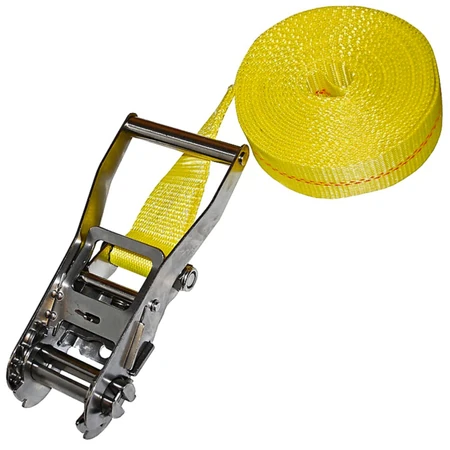
A ratchet strap is normally sold on its lashing capacity. This one is chosen for what it refuses to do. It does not rust through a winter on a trailer, it does not seize at the buckle, and it puts no plated fitting against a hull, a polished tube or a coil. The endless stainless steel ratchet strap is a polyester loop closed through a stainless ratchet: gjin heak, gjin ein fitting, nothing to attach to the load. Wrap it, thread the tail back through the ratchet, lûke, and the loop holds itself.
That closed form is the reason the strap is bought. The loads it serves rarely offer anything to hook: a hull on a cradle, a mast section, a bundle of stainless tube, a kayak on a roof rack, a coil on a pallet, crates under a tarpaulin. Where a hook needs an eye, a ring or a hole, an endless strap simply goes round, and the only metal in the whole assembly sits on the outside of the loop where it cannot touch the load.
We weave the webbing, stitch the loop and fit the ratchet in one shop: 25 mm oan 50 mm breedte, 304 of 316 stainless hardware, with or without stainless wire hooks.
What the word endless changes
Three things follow from having no ends, and they are practical rather than semantic.
- There is nothing to hook. The strap closes on the load: the tail passes through the ratchet slot and back on itself. Nothing has to line up with an eye, and nothing hard can mark the surface.
- The ratchet is the only fitting. It rides outside the loop, so the load sees webbing only. That is also why the stainless grade matters twice, because the buckle is the part that lives in the weather.
- Length is quoted in two conventions. In sletten lus hat gjin einen om tusken te mjitten, so the trade quotes circumference and flat length, and for the same strap the two differ by about a factor of two. Neam de konvinsje, or name the girth of the thing the strap must go round, and the ambiguity disappears before the webbing is cut.
One thing it does not change: an endless strap is still a lashing. Its figure is a lashing capacity (LC), not a working load limit, and it must not be used to lift. A strap bought for restraint and used as a sling is the most common misuse in this category, and it is a fatal one.
304 of 316: the decision that actually matters
Both grades are austenitic stainless, both are annealed to a comparable strength, and the difference between them is corrosion, not load. The molybdenum in 316 buys resistance to chloride pitting. That is the whole purchase. Paying for 316 in the belief that it is stronger is paying for the wrong property.
| AISI 304 (1.4301) | AISI 316 (1.4401 / 1.4404) | |
|---|---|---|
| Typical composition | 18% Cr, 8% Ni | 17% Cr, 10% Ni, 2-3% Mo |
| Handles well | Rein, fresh water, condensation, indoor wash-down, general outdoor hardware | Salt spray, sea-water splash, marina and dock air, de-icing sâlt, fish and food plants |
| Struggles with | Chlorides: coastal air and road salt pit it slowly, from the surface inward | Concentrated acids and some chlorine solutions; stainless is not chemically universal |
| Sterkte | Comparable | Comparable, which is not where the difference lies |
| Kosten | Leger | Heger, and worth it only where chloride is present |
| Spesifisearje it wannear | Inland transport, covered trailers, fresh-water craft, factory wash-down | Sea, coast, boatyard, live-aboard, chemical and food duty, anything that stays outdoors |
Grade is a material choice, not a guarantee. Where the application is safety-related, confirm the grade on the mill certificate rather than on the invoice description.
Two notes that come from the shop rather than the catalogue. Stainless threads gall: a dry 316 nut run hard onto a 316 stud can seize, so the ratchet is assembled with a suitable lubricant and should be re-lubricated rather than forced with a bar. And stainless bolted to aluminium in salt water forms a galvanic pair, so where the strap anchors to an aluminium frame or a painted alloy fitting, isolate the contact.
Two end configurations
Einleaze loop: no metal at the load
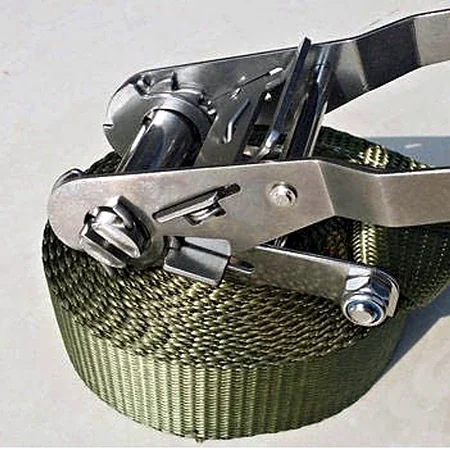
The standard form. The webbing is closed on itself, the ratchet rides the loop, and the tail threads through the ratchet slot. It is the version for hulls, buis bondels, masts, coils and anything with a girth but no anchor point. Nothing touches the load but polyester, so it will not scratch gel coat, anodising, chrome or polished stainless.
Stainless wire hook: where there is an anchor
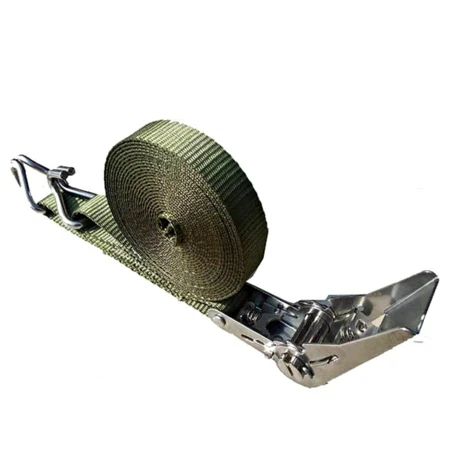
Where the frame does offer an eye, a rail or a ring, the same strap is finished with stainless wire hooks: dûbel-J, S-hook or spring carabiner. The hook is matched to the strap’s LC rather than chosen by size, and it must sit in the eye with the load on the crown. A hook hung on a sharp edge, or hung on the point of another hook, is a hook that opens.
Technyske parameters
The table below is the standard range. Breedten, lengths and colours outside it are made to order. The figure that governs the article is the one printed on its label, not the one in this table.
| Ref | Breedte | Dikte | LC | Webbing break | Ratchet frame | Handle | STF (hand) |
|---|---|---|---|---|---|---|---|
| XSR-25 | 25 mm | 1.4 mm | 400 En | ca. 800 kg | 25 mm, 304/316 | 200 mm | ca. 40 En |
| XSR-35 | 35 mm | 1.7 mm | 750 En | ca. 1,500 kg | 35 mm, 304/316 | 250 mm | ca. 75 En |
| XSR-38 | 38 mm | 1.9 mm | 1,000 En | ca. 2,000 kg | 38 mm, 304/316 | 250 mm | ca. 100 En |
| XSR-50 | 50 mm | 2.2 mm | 2,500 En | ca. 5,000 kg | 50 mm, 304/316 | 300 mm | ca. 250 En |
LC is stated to EN 12195-2. The assembly is rated at a 2:1 safety factor against webbing break, so the breaking strength is twice the lashing capacity. STF is the tension a hand-operated ratchet is expected to develop, oer 0.10 x LC; the STF printed on the label governs. Selection guide, not a certificate.
| Besit | Spesifikaasje |
|---|---|
| Fiber | 100% hege sterkte polyester (PES), UV-stabilisearre |
| Weave | Plain weave, densified selvedge, single-ply as standard |
| Elongation at LC | 7% of minder |
| Width tolerance | plus or minus 2 mm |
| Service temperatuer | -40 °C oan +100 °C; the fibre is thermoplastic and melts rather than deforming above that |
| Kleur | Giel, olive, swart, blau, read, griis, or matched to a sample |
| Ends | Hot-cut and sealed; loop closed with high-tenacity PES thread, 5-thread safety stitch |
| Markearje | Geweven label: LC, STF, lingte, standert, stainless grade, batch |
Fittings and accessory parameters
Fittings are where a stainless strap is either made or ruined. IN 316 buckle on a 304 heak, or a hook whose opening is too small for the eye it has to reach, both fail the job without failing a load test. The table is the list we confirm before the webbing is cut.
| Komponint | Materiaal | Maten / ôfmjittings | What to check before ordering |
|---|---|---|---|
| Ratchet buckle | AISI 304 of 316 roestfrij, stainless rivets and spring | 25 / 35 / 38 / 50 mm frame; handle 200-300 mm | Grade matches the rest of the hardware; handle clears the load when the strap is tensioned |
| Double-J wire hook | 304 of 316, 8-10 mm wire | 25 / 38 / 50 mm; opening 12-20 mm | Opening clears the eye or rail; throat at least as wide as the webbing |
| S-haak | 304 of 316, 8-10 mm wire | 25 / 38 / 50 mm | Both ends seat without point loading on a weld or a casting edge |
| Spring carabiner hook | 304 of 316 lichem, stainless spring | 25 / 38 / 50 mm; gate opening 15-22 mm | Gate springs freely after salt exposure; no plated or dissimilar-metal spring |
| Cam gesp (alternative) | 304 of 316 | 25 / 35 / 50 mm | Faster to set but develops less tension; not a substitute where LC must be reached |
| Keeper / tail clip | Stainless steel | Matched to webbing width | Holds the tail so it cannot whip in transit or unthread on the road |
| Beskermjende sleeve | Polyester tubular sleeve | 25-50 mm, 300-1,000 mm long | Fitted at the stitched loop wherever an edge is present; it cannot be added later |
| Stitching thread | High-tenacity PES, UV-stabilisearre | Tex 210-420 | Colour matched to the webbing; unaffected by the stainless grade |
| Etiket | Geweven polyester | 60 x 120 mm | LC, STF, lingte, standard and grade still legible after a season outdoors |
Three points that decide most orders. Earste, keep one grade across the assembly: in 316 body with a 304 spring is the one part that will fail first, and it will be invisible until it does. Twadde, match the hook to the LC, not to the width: in 25 mm strap with a hook rated below its capacity is a 25 mm strap with a lower capacity. Tredde, decide the sleeve at the enquiry stage, because a sleeve specified later has to be sewn in, not slipped on.
Lingte, and how to state it
A closed loop is quoted two ways: as the circumference of the loop, and as the flat length of the webbing before it is joined. For the same article the first is roughly twice the second, and both are legitimate. State the convention alongside the figure, or state the job instead (“it must go round a 1.8 m hull at the bilge and reach the trailer rail”), en wy sille it omsette.
Standard loops run 1 m oan 10 m flat. Longer lengths are woven as a single band rather than joined, because a join in the load path is a weak point and an inspection problem. And an endless loop cannot be shortened on site: the ratchet takes up slack, it does not remove length.
Where this strap is specified
- Boat and yacht transport. Hull to cradle, deck to trailer, mast section to pulpit. 316 wherever the strap sees salt, and a sleeve wherever it crosses a gunwale or a stanchion base.
- Marina and dock. Fender lines, tarpaulin hold-downs, pontoon lashing, winter covers. On a galvanised strap the buckle is what corrodes first; here it is the part that lasts longest.
- Stainless and aluminium fabrication. Tube bundles, polished sections and sheet, where a hook would mark and a chain would scratch.
- Food, beverage and chemical plant. Wash-down areas where a plated ratchet bleeds rust onto the floor and into the product zone. Confirm chemical compatibility before specifying.
- Car wash and valeting. The one environment where a plated buckle fails in months rather than years.
- Roof racks, kayaks, ladders and site kit. Endless form for a roof bar with no eye; hooks where the bar has a slot.
Stainless against galvanised
| Stainless (304 / 316) | Galvanisearre stiel | |
|---|---|---|
| Salt air | Does not rust; 316 resists pitting as well | Zinc is sacrificial: it goes white, then red |
| Wash-down plant | Unaffected by water and most detergents | Coating wears at every contact point |
| Marking the load | No coating to transfer; smooth cast surface | Zinc transfer and rust staining on pale surfaces |
| First cost | Two to four times the hardware cost | Leechste |
| Libben | Years in conditions that end a plated buckle in a season | Consumable in marine and wash-down duty |
| Choose when | Corrosion is the failure mode, not overload | Droech, inland, ynsidintele gebrûk |
The economic case is plain. A galvanised ratchet strap is cheaper to buy and more expensive to own wherever chloride is present, because the webbing outlives the buckle by several years and the whole assembly is thrown away for the sake of a casting. A stainless buckle is bought once, against the life of the band.
Ynspeksje, and when a strap is finished
Kontrolearje foar elk gebrûk, en formeel op it ynterval dat de side set. A lashing is withdrawn for specific conditions rather than for looking tired.
- Webbing cut, snagged, punctured or torn, including a single deep nick at the sleeve edge
- Stitching broken, worn or pulled: a lifted stitch line is a rating problem, net in kosmetyske
- Heat skea: glêzen, stiff or charred fibre, or a hard melt mark where the strap crossed an exhaust
- Gemyske oanfal: fuzzing, softening or colour change, which is why the chemical is checked before the strap is specified
- Ratchet that will not release cleanly, a bent frame, a missing rivet, or a spring that has lost tension
- Hooks with an opened throat, a bent body, or a latch that does not seat
- An illegible label: without LC and grade the assembly cannot be identified, and an unidentifiable lashing is out of service
Rinse with fresh water after salt exposure, dry before storage, and keep the band out of long sunlight. Polyester is UV-stabilised, which is not the same as UV-proof.
Faak frege
Is an endless ratchet strap the same as an endless lifting sling?
Nee, and the distinction is a safety one. An endless sling is a lifting article with a working load limit and a colour code. An endless ratchet strap is a lashing with a lashing capacity, tensioned by hand. The strap must not lift, and the sling must not restrain.
304 of 316 for a boat that lives on a trailer?
316 where the strap sees sea air or salt water at the ramp; 304 if the boat is fresh water and the trailer is kept under cover. The buckle, net de riem, is the part that decides.
How do I measure the length?
Give either the loop circumference or the flat webbing length, and say which. Or give the girth of the load and the distance to the anchor, and we will work it out before the webbing is cut.
Can it be used for lifting if the LC is high enough?
Nee. A lashing capacity is not a working load limit. The article carries no lifting mark, no mode factors and no lifting inspection regime. Use a sling for a lift.
Will stainless scratch a gel coat or a polished tube?
The webbing is what touches the load, so no, provided the ratchet stays outside the contact and a sleeve is fitted where the strap crosses an edge. That is exactly why the endless form is chosen for finished surfaces.
Can it be branded?
Ja: a woven label with your mark, and LC, STF, length and grade printed as required. The label is part of the product, so marking is set before the webbing is cut rather than applied afterwards.
Wêr te gean neist
For the lifting version of the same closed loop see einleaze lifting slings and the flat form at einleaze platte webbing sling. For galvanised truck duty with J-hooks, de 50 mm 5,000 kg ratchet lashing belt is the right page rather than this one; for general restraint see cargo lashing strap en recycled-fibre car lashing belts. Wider and multi-layer bands are covered under multi-ply webbing sling, and the whole flat-band family sits under singel slinger. Stainless wire-rope hardware is in the stainless steel cable pulling grip en de wire tou sling berik.
Stjoer de lading, its girth, the stainless grade and the anchor, or tell us there is no anchor. Wy sille befêstigje de breedte, the length and the end configuration in one reply, before the webbing is cut.
Kontakt
Lift Sling Rigging Co., Ltd. Telefoan en WeChat 18066002268, e-post : lift98@jslift.com, Lifute Industrial Park, Taizhou City, Jiangsu Provinsje, Sina. HS koade 630790.