


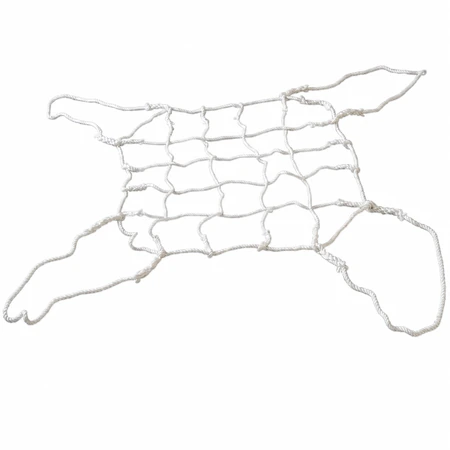
Lift sling rigging company produce Polyester Lifting Hoisting Net,Polyester Cargo Net,Safety Lifting Net Strap,Bungee Cargo Net,Polyester Cargo Lifting Net,Lifting Sling Net,Rope Lifting Net,Pallet Cargo Net,Garden Climbing Net.
Polyester Lifting Hoisting Net
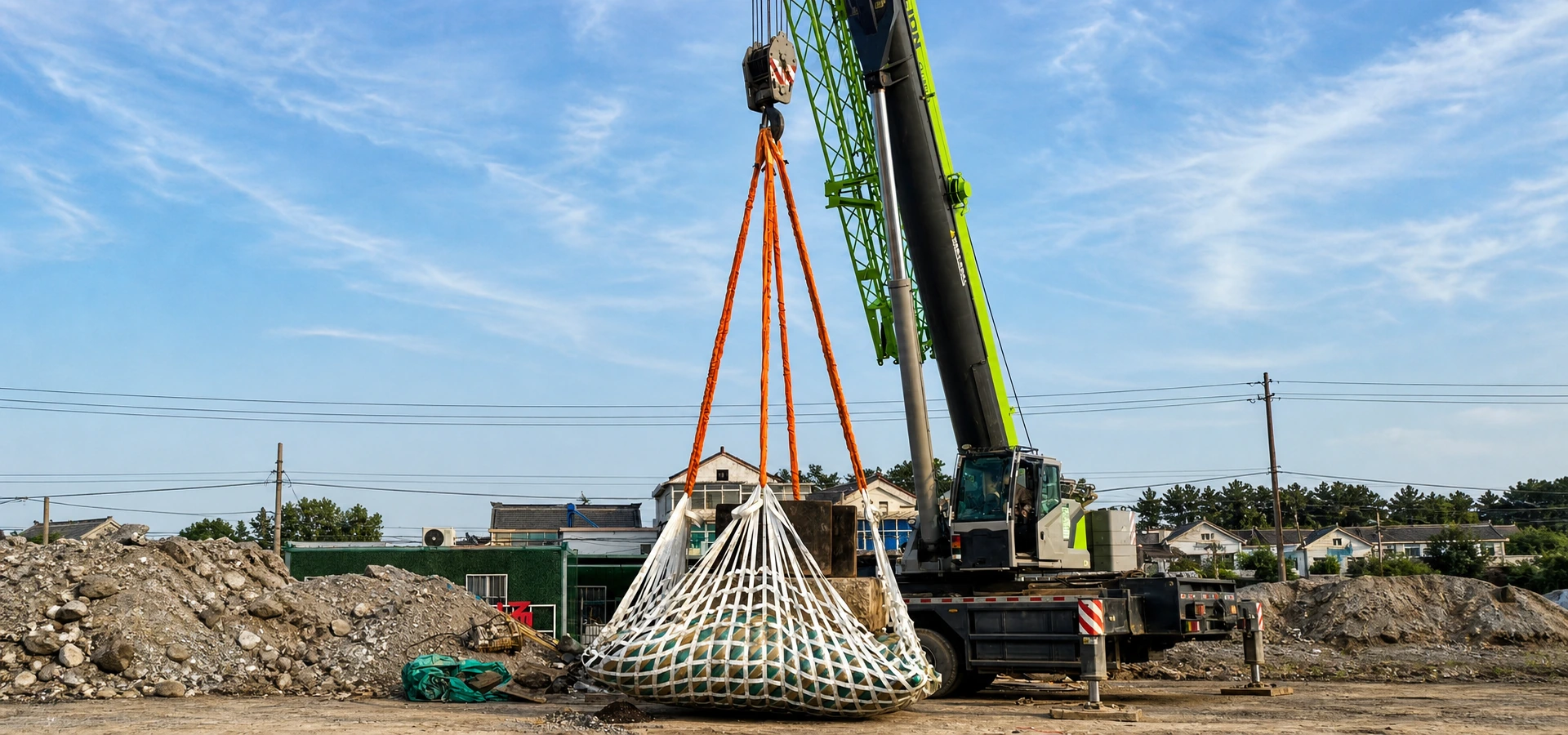
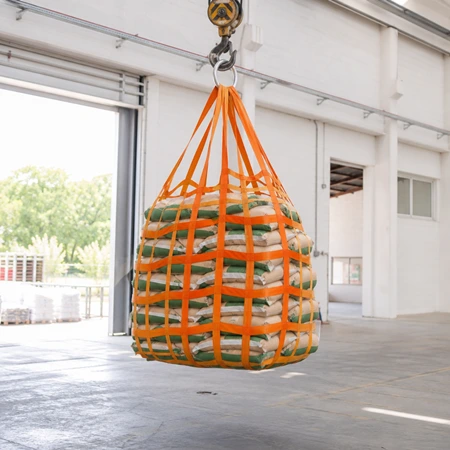
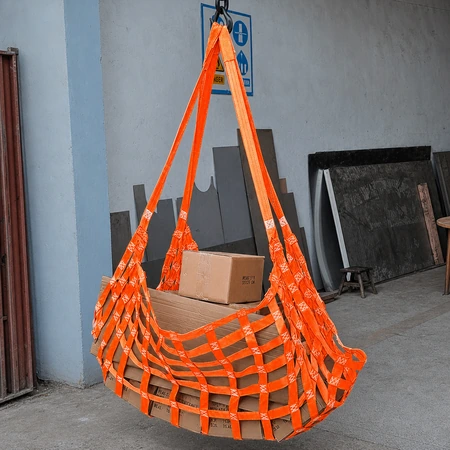
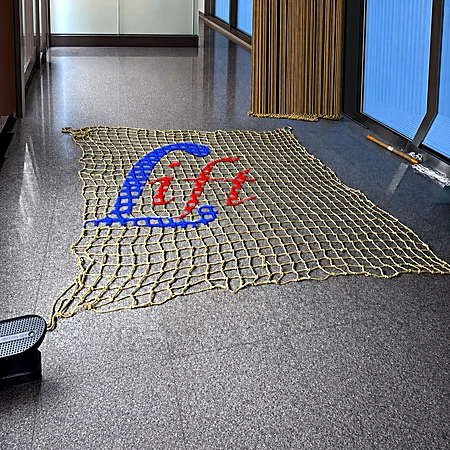
A polyester lifting hoisting net is a soft bag woven from high-tenacity polyester webbing, built to move bagged goods and bulk material in a single crane lift. The load is tipped into the bag, or the bag is laid flat and drawn up around a stack, and four corner loops carry the whole consignment to the hook. There is no pallet to return, no strapping to cut, and nothing to re-handle at the far end.
Because we weave the webbing in our own mill in Taizhou, Jiangsu, ang pagbubukas ng mesh, bag footprint, depth, bottom construction and working load limit are all set to the cargo rather than to a fixed catalogue. Standard nets cover 0.5 t sa 20 t at 0.6 m³ to over 10 m³, every net is proof-load tested before packing, and each shipment travels with a material test report. Nets are CE and GS certified, with webbing rated to the EN 1492-1 batayan.
- Fully custom build – mesh, bag size, depth, colour and safety factor (5:1, 6:1 o 7:1) set to your specification.
- High-tenacity polyester webbing – 25 mm sa 100 mga bandang mm, walang asawa, duplex or triplex, UV stabilised and rot-proof.
- Wear and heat resistant – working range -40 °C hanggang +100 °C, with a reinforced bottom for abrasive loads.
- Malambot, flexible and light – the flat band contacts the load over a wide area, so bags, cartons and finished surfaces are neither crushed nor marked.
- CE at GS certified – nasubok sa ating sarili 1000 t makina, with an ISO 9001 quality system and a CNAS-accredited laboratory behind it.
Why a webbing net bag, and not a rope net or a big bag
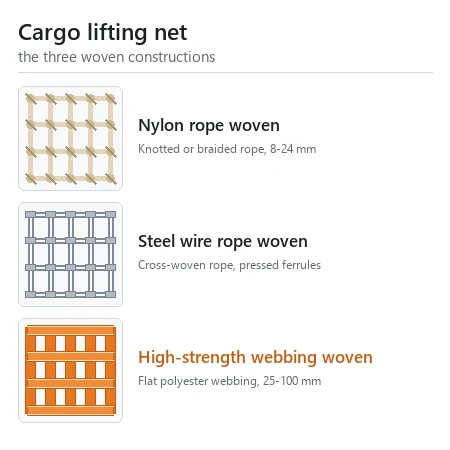
Three products are sold for the same job and they behave very differently once the load is in the air. A rope net concentrates the load on a few contact points. A big bag carries one free-flowing product and is itself the package. A webbing net bag spreads the pressure across flat bands, holds a stacked or mixed load together, and goes back to the store empty.
mesa 1 – How the four common ways of lifting loose cargo compare.
| Pagpipilian | Konstruksyon | Makipag-ugnayan sa load | Best cargo | Limitation |
|---|---|---|---|---|
| Polyester webbing net bag | Flat woven bands, 25-100 mm, 25-300 mm mesh | Wide flat bands, low pressure per cm² | Naka-sako, nakasalansan, mixed and bulk cargo | Needs a crane or hook; not a sealed package for powder |
| lambat na naylon na lubid | Knotted or braided rope, 8-24 mm | Line contact at every rope | Irregular and heavy single items | Ropes mark soft cargo; a tight mesh adds weight |
| FIBC / big bag | Woven PP fabric with a liner | Full surface, sealed | One free-flowing product per bag | Single product only; the bag is the packaging |
| Pallet and strapping | Timber or plastic pallet plus bands | Rigid base | Unitised cartons | Pallet returned or lost; bands cut and discarded; no drainage |
Five decisions that set the specification
A polyester lifting hoisting net is quoted from five numbers. Get them right and the net arrives right; get the mesh wrong and no amount of extra tonnage will fix it later.
mesa 2 – What we need to know, and why each answer changes the net.
| Desisyon | Kung ano ang inaayos nito | What to tell us |
|---|---|---|
| 1. Cargo form | Whether the net is a bag or a flat sheet, and how the bottom is built | How the cargo arrives: mga sako, malalaking bag, bales, or loose material |
| 2. Weight per lift | Band width and layer count, and therefore the rated capacity | Ang kabuuang timbang na balak mong buhatin, not the weight of the net |
| 3. Puno ng volume | Footprint and depth of the bag | Bulk density (t/m³) for loose material, or the height of the stack for bagged goods |
| 4. Pagbukas ng mesh | The largest gap the cargo can pass through | The smallest unit in the load: a 25 kg bag, butil, aggregate or scrap |
| 5. Paraan ng paglabas | sarado, may laced, chute o may linya sa ibaba | Whether the bag is tipped, untied over a hopper, or emptied by hand |
Weight and volume are two separate limits, and for light bulk the volume arrives first. Butil sa tungkol sa 0.7 t/m³ at wood chips sa halos 0.3 t/m³ parehong punan a 3.6 m³ bag, but one lift weighs about 2.5 t and the other about 1 t. Send the bulk density with the tonnage and we will size the bag so that a full bag is also a legal bag.
Mga teknikal na parameter
Ang mga figure sa ibaba ay sumasaklaw sa karaniwang bagged at bulk range. Mesh, footprint, depth, bottom, loops and capacity are made to order, so treat this as the starting point for a quotation rather than a fixed catalogue.
mesa 3 – Polyester lifting hoisting net: teknikal na mga parameter.
| Parameter | Pagtutukoy |
|---|---|
| Pangalan ng produkto | Polyester lifting hoisting net (polyester webbing net bag) |
| Mga pagsasaayos | Closed bag, release-bottom bag, or flat lifting net |
| Materyal sa webbing | 100 % high-tenacity polyester (PET); high-tenacity na nylon kapag hiniling |
| Lapad ng banda | 25 / 38 / 50 / 75 / 100 mm (50 mm pamantayan) |
| Band construction | Isang layer, duplex or triplex; woven selvedge, not a cut edge |
| Kapal ng banda | 1.8 mm – 4.5 mm depende sa lapad at bilang ng layer |
| Pagbukas ng mesh | 100 × 100 mm pamantayan; 25 – 300 mm ginawa sa order |
| Laki ng net | Ginawa sa load footprint, truck bed or receiving hopper; see Table 4 |
| Lalim ng bag | 0.8 m – 2.5 m, o sa pagguhit |
| Puno ng volume | Tungkol sa 0.6 m³ to over 10 m³, set by footprint and depth |
| Border | Nakatupi at naka-double-stitch, reinforced at every lifting point |
| Mga punto ng pag-aangat | Apat na sulok na mga loop na pamantayan; walo para sa isang spreader beam; mga loop sa itaas at ibaba kapag hiniling |
| Na-rate na kapasidad (WLL) | 0.5 t – 20 t, itinakda ng banda, bilang ng layer at pag-aayos ng pag-angat |
| Salik ng kaligtasan | 5:1 / 6:1 / 7:1 |
| Pagpahaba sa WLL | 7 % o mas kaunti |
| Kulay | Color code sa pamamagitan ng working load limit, o isang pasadyang kulay ng bahay |
| Temperatura ng pagtatrabaho | -40 °C hanggang +100 °C |
| Weather and chemical | Nag-stabilize ang UV, rot-proof, unaffected by rain, sea water and wash-down |
| Pagmamarka | WLL, mesh and batch printed on the belt, plus a sewn capacity label |
| Karaniwang batayan | Ang webbing ay na-rate sa EN 1492-1 |
| Sertipikasyon | CE, GS, ISO 9001, JIS on request; Laboratory ng CNAS; DNV |
| Pagpapasadya | OEM / Laki ng ODM, kulay, naka-print na logo, label at pag-iimpake |
| HS code | 6307.90 – nets and netting of textile materials |
Mga karaniwang sukat, volumes and working load limits
These six lines cover the great majority of bagged and bulk work. Filled volume is calculated from the footprint and the depth with an allowance for the rounded shape a loaded bag takes, so a material that settles well will carry slightly more and one that bridges will carry less.
mesa 4 – Standard net sizes at four corner loops gathered on one hook.
| Laki ng net (L × W) | Depth | Puno ng volume | Mesh | banda | WLL | Karaniwang kargamento |
|---|---|---|---|---|---|---|
| 1.0 × 1.0 m | 1.0 m | 0.6 m³ | 50-100 mm | 50 mm single | 0.5-1.5 t | 25 kg bag, maliliit na sako, bales |
| 1.5 × 1.5 m | 1.2 m | 1.6 m³ | 50-100 mm | 50 mm duplex | 1-2.5 t | Sako na butil, fertilizer, gumawa |
| 2.0 × 2.0 m | 1.5 m | 3.6 m³ | 50-100 mm | 50 mm duplex | 2-4 t | Bultuhang butil, sand, durog na bato |
| 2.5 × 2.5 m | 1.8 m | 6.8 m³ | 50-150 mm | 75 mm duplex | 3-6 t | Bultuhang pataba, coal, scrap, isda |
| 3.0 × 3.0 m | 2.0 m | 10.8 m³ | 100-150 mm | 75 mm duplex | 4-8 t | Malaking bulk load, pantalan at humawak ng trabaho |
| To drawing | 0.8-2.5 m | Upang mag-order | 25-300 mm | 25-100 mm | 0.5-20 t | Anumang bakas ng paa, lalim at kargamento |
The working load limits above assume a four-loop lift. A two-loop basket de-rates the net – ask for the derated figure rather than reading across from this table.
Pagbukas ng mesh, chosen from the cargo
Mesh is the one dimension that cannot be adjusted after the net is sewn, so it is sized from the smallest unit in the load rather than from the total weight.
mesa 5 – Mesh opening by cargo.
| Cargo | Inirerekomendang mesh | Dahilan |
|---|---|---|
| 50 kg sako, malalaking bag, bales | 100 mm | The sacks are far larger than the opening; the mesh only has to keep the stack together |
| 25 kg bag, maliliit na sako | 50-75 mm | Small bags can squeeze through 100 mm once the load settles in the air |
| butil, binhi, tuyong ani | 25-50 mm, o isang saradong liner | Fine material must not sift out on the hook or in transit |
| Pataba, prills, mga pulbos | 25-50 mm, o isang saradong liner | Fine and moisture-sensitive: a liner keeps the product in and the weather out |
| buhangin, graba, durog na bato | 50-100 mm | Sapat na hawakan ang bulk, open enough for rainwater to drain |
| uling, coke | 100-150 mm | Large lumps; ang isang mas malawak na mesh ay nagpapanatili ng liwanag ng net at mahusay na umaagos |
| Scrap metal, offcuts | 100-150 mm | Open mesh with a reinforced bottom and wear pads at the contact points |
| Isda, shellfish, basang ani | 25-50 mm | Holds the catch, drains freely, keeps the weight honest |
| Mga log, panggatong, malalaking offcuts | 150-300 mm | Indivisible pieces: a wide mesh saves weight without losing the load |
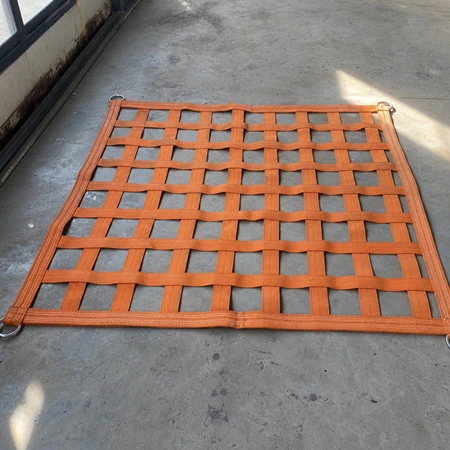
Bottom construction and discharge
How the load comes out is a design decision in its own right. For bagged cargo the answer is usually a person with a knife; for bulk it is usually gravity.
mesa 6 – Bottom options and how each one is emptied.
| Ibaba | Paano ito gumagana | Chosen when |
|---|---|---|
| sarado, fully sewn | The bag holds the cargo permanently and is emptied by tipping or by hand | Naka-sako na kargamento, and bulk tipped over a hopper or onto a pile |
| Release bottom, may laced | A laced seam across the bottom is untied at the discharge point and the load falls out | Free-flowing bulk – sand, butil, pinagsama-sama – discharged without tipping the bag |
| Chute bottom | The bag narrows to a chute opened over the receiving hopper | Controlled discharge into a hopper, a barge or a conveyor |
| Closed with a liner | A fabric liner sits inside the net | Dusty or moisture-sensitive bulk: butil, fertilizer, mga pulbos |
| Pinatibay na panel sa ibaba | An extra layer of webbing is stitched across the base | Abrasive and heavy bulk: pinagsama-sama, mineral, scrap |
| Loops top and bottom | Loops at both ends, so the bag can be lifted either way up | Loading at height, at pag-alis ng laman sa pamamagitan ng pagbaligtad ng bag sa kawit |
Lifting arrangements and fittings
Kung paano isinasabit ang bag ay nagpapasya kung gaano karami ang talagang dinadala nito, at ang bulto ay hindi mapagpatawad dahil ang load ay patuloy na gumagalaw sa loob ng bag habang ito ay nasa hangin.
- Four loops on the hook – the standard for bagged and bulk work; the loops gather on the hook or a master ring and the bag closes around the cargo as the crane takes up the slack.
- Eight loops on a spreader beam – the bag stays square, nananatiling level ang load, at ang bawat loop ay nagdadala ng isang predictable na bahagi; the right arrangement for large bags and high tonnage, tingnan ang aming pag-aangat ng spreader beam saklaw.
- Two-loop basket – faster to rig, ngunit de-rate nito ang net; ask for the derated capacity instead of reading across from the four-loop figure.
- Loops top and bottom – lets the bag be lifted either way up, na kung paano ang isang saradong bag ay walang laman sa pamamagitan ng pagbaligtad nito sa ibabaw ng isang hopper.
Fittings supplied or fitted on request: sewn webbing loops, master ring or master link, grado 80 kadena, laced release bottoms, chutes and discharge sleeves, inner liners, wear pads and protection sleeves for scrap and aggregate, and repair kits for fleets that maintain their own equipment.
Materyal, stitching and finish
The belt is the product. We weave it on needle looms from high-tenacity polyester yarn, with a woven selvedge rather than a cut edge, so the band does not fray from the outside in.
- 100 % high-tenacity polyester, mababang pagpahaba (7 % o mas mababa sa WLL), Nag-stabilize ang UV, rot-proof and unaffected by moisture.
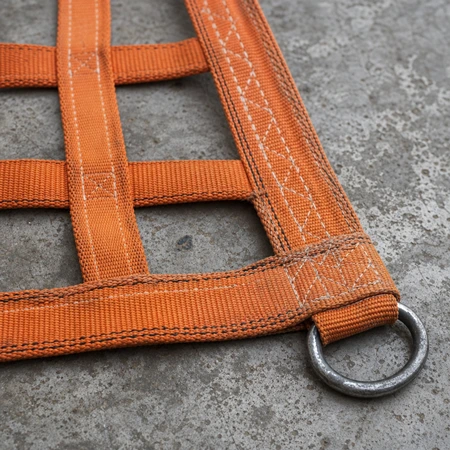
- Locked stitching in high-tenacity polyester thread, run in multiple rows along the border and box-X at every loop – on a cheap net it is the stitch line, hindi ang sinturon, that fails first.
- Nakatupi at naka-double-stitched na hangganan, so the edge of the mesh cannot unravel under load.
- Galvanised or stainless steel rings and master links on request.
- Polyester holds its strength from -40 °C hanggang +100 °C; above that, or in chemical exposure, tell us and we will quote nylon or another construction.
Pagsubok, certification and traceability
- Forty years of lifting equipment manufacturing – itinatag sa 1985 sa Taizhou, Jiangsu, na may higit sa 200 employees and one of China’s largest lifting sling and net production bases.
- Every net is proof-load tested on our own 1000 t horizontal test machine – sinubok, not sampled.
- A material test report travels with each shipment, quoting the belt batch and the test load.
- CE declaration of conformity and GS certification, na may sertipikasyon ng JIS sa mga order sa pag-export.
- ISO 9001 quality management system, a CNAS-accredited laboratory and DNV certification behind the plant.
- Every net is marked with its working load limit, mesh, rated volume and batch number before packing, kaya laging magkasundo ang bag at papeles nito.
Certificates and test reports are available as PDFs for your tender or customs file – see the full sertipikasyon itakda.
Where these nets work
A polyester lifting hoisting net is used wherever loose cargo has to travel between a stack and a hook – quay, gilingan, quarry, yard or hold. The sectors below are the ones where the bagged and bulk version earns its place.
mesa 7 – Mga aplikasyon ayon sa sektor.
| Sektor | Ano ang pinangangasiwaan ng net | Bakit nababagay dito ang isang polyester net |
|---|---|---|
| Mga daungan, mga pantalan at mga terminal | Naka-sako na kargamento, butil, fertilizer and bulk between quay, barge and hold | Isang bag bawat elevator, walang papag, at ang load ay umaagos habang ito ay naglalakbay |
| Agrikultura at feed mill | Binhi, butil, magpakain, pataba at sako na produkto | Ang isang masikip na mesh o isang liner ay nagpapanatili sa produkto sa loob at sa labas ng panahon |
| Mga materyales sa gusali | buhangin, graba, dinurog na bato at sako na semento | Sapat na hawakan ang bulk, open enough for rainwater to drain |
| Pagmimina at pag-quarry | Pinagsama-sama, bulto ng mineral at mineral | Ang isang reinforced bottom ay tumatagal ng abrasion na nagsusuot ng lambat |
| Pangingisda at pagproseso ng pagkain | Basang isda, shellfish at ani | Buksan ang mesh drains nang malaya, which keeps the weight honest |
| Pag-recycle at basura | Maluwag na mga plastik, salamin, metal at halo-halong materyal | Contains loose material that would otherwise blow or fall |
| Biomass and power | Wood chips, tumahol, pellets at bulto ng gasolina | Isang malaking bag para sa isang maliit na tonelada, tumugma sa limitasyon ng volume |
| Construction sites and relief work | Bagged materials raised to upper floors, field cargo | No pallet, walang banding, at maaari itong i-emptied diretso sa lupa |
Customisation and branding
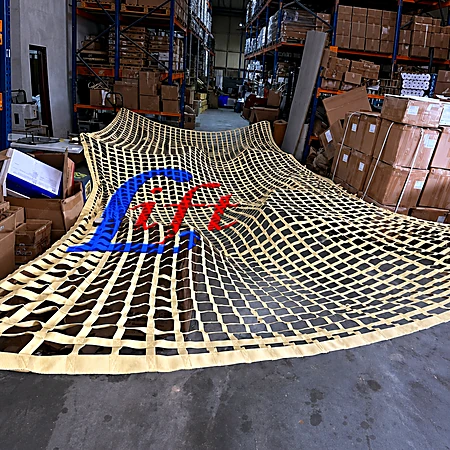
A net that moves between quays, holds and yards has to be identifiable from a distance and has to keep its marking. Kulay, naka-print na logo, working load limit and cargo type are all applied in our own plant, so the marking cannot be washed off or pulled away with a label.
- Color code sa pamamagitan ng working load limit, or a custom house colour to separate your fleet from a competitor’s.
- Logo, brand name, warning text or certificate number printed on the belt, or woven in on larger orders.
- Cargo type printed on the bag, which stops a fine-mesh grain net being sent out for scrap.
- Sewn capacity label in addition to the print, so the net and its paperwork agree at every inspection.
- Packing folded into a bag or a crate – a set of ten net bags takes the space of one pallet.
Pag-aalaga, inspeksyon at pagreretiro
- Inspect the loops and their stitching first, pagkatapos ay ang hangganan, then the bottom closure – on a bulk net the bottom and the corners wear before the mesh does.
- Alisin nang lubusan ang bag bago itago; material left inside holds moisture, nagdaragdag ng timbang at nagtatago ng pinsala.
- Maghanap ng mga hiwa, hadhad, sirang tahi, paglamlam ng kemikal, heat glazing at ang pagbabago ng kulay o gloss na nagpapahiwatig ng pagkasira ng UV.
- Weigh a wet bag before lifting it. ulan, sea water and wet bulk can add far more than the cargo was rated at, at ang isang lambat ay hindi alam ang pagkakaiba.
- Huwag kailanman lalampas sa na-rate na kapasidad, hindi kailanman mag-angat sa mas kaunti kaysa sa buong hanay ng mga loop, at huwag kailanman i-drag ang isang load bag patagilid sa crane.
- Mag-imbak ng malinis at tuyo, sa lupa at sa labas ng direktang araw; never repair webbing by knotting, hinang o pinapainit ito.
Mga madalas itanong
What is the difference between a polyester lifting hoisting net and a cargo net?
A lifting net is rated, marked and tested to carry a load on a crane hook. A cargo net is a restraint: it holds a load down in transit and is not designed to be lifted. If the net is going onto a hook, it must be the rated version – tingnan ang aming cargo secured net for the tie-down case.
How do I choose the mesh opening?
From the smallest unit in the load, hindi mula sa tonelada. A 25 kg bag needs 50-75 mm; grain or fertilizer needs 25-50 mm or a closed liner; scrap and coal can take 100-150 mm. Once the net is sewn the mesh cannot be changed, so this is the one number worth checking twice.
Why does the volume matter as much as the weight?
Dahil pinupuno ng light bulk ang bag bago ito umabot sa rated weight. A bag that is full at half its rating doubles the number of lifts and the crane time. Give us the bulk density with the tonnage and we will size the bag so a full bag is also a legal bag.
Maaari bang walang laman ang bag nang walang tipping ito?
Oo. A laced release bottom or a chute bottom lets a free-flowing load be discharged straight into a hopper, a barge or a conveyor. Bagged cargo is normally emptied by hand or with a forklift at the far end.
Magtataglay ba ng basang kargada ang lambat?
The net itself is unaffected – polyester does not absorb water and does not rot, so rain, sea water and wash-down do no harm. Dalawang pag-iingat: wet cargo is heavier, and fine wet material can clog the mesh, na nagdaragdag ng timbang at humihinto sa pag-draining nito.
How is the working load limit proved?
Ang webbing ay na-rate sa EN 1492-1 batayan at mga lambat ay ibinibigay sa 5:1, 6:1 o 7:1 gaya ng tinukoy. Every net is proof-load tested on our own 1000 t makina, a material test report travels with the order, at ang mga produkto ay may sertipikasyon ng CE at GS.
Do you make a flat version for palletised cargo?
Oo – the flat lifting net is the crane pallet cargo net, and the material-led range is covered by the polyester webbing net para sa pag-aangat. The rope constructions sit alongside as the nylon cargo lifting net at ang heavy duty nylon cargo net sling.
What else do you make from the same webbing?
The same belt goes into our webbing slings at walang katapusang bilog na lambanog, and the wider cargo range is listed under mga lambat sa pag-aangat ng kargamento – including the webbing cargo lifting net for flat work.
Humiling ng isang quotation
Send the cargo and whether it is bagged or bulk, ang bulk density kung alam mo ito, ang bigat na gusto mo sa bawat pag-angat, ang pagbubukas ng mesh, the discharge method and the environment the net will work in – or a sketch of the bag you have in mind. Kukumpirmahin ng aming mga inhinyero ang laki ng net, depth, konstruksiyon sa ilalim, band and packing and quote it in one reply. Para pag-usapan muna, makipag-ugnayan sa aming mga inhinyero.
Kumpanya ng Lift Sling Rigging – Lifute Industrial Park, Lungsod ng Taizhou, Lalawigan ng Jiangsu, Tsina
Tel: +86 523 8693 5818 | WhatsApp: +86 180 6600 2268 | E-mail: lift98@jslift.com