

Ang kumpanya ng lift sling rigging ay gumagawa ng Cargo Securing Net,Load Securing Net,Maliit na mesh cargo securing net,Lalagyan na sinisiguro ang lambat,Cargo secure webbing net.
Cargo Securing Net
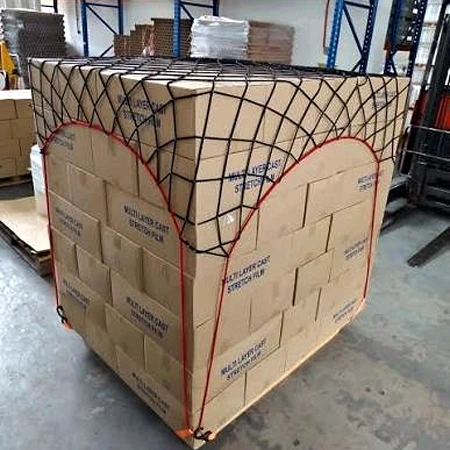
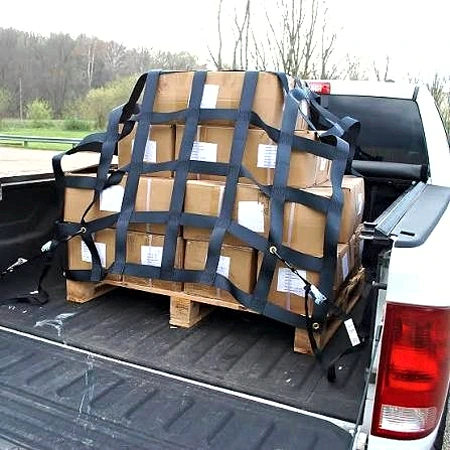
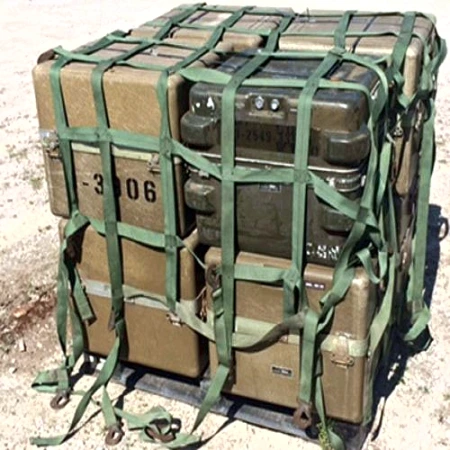
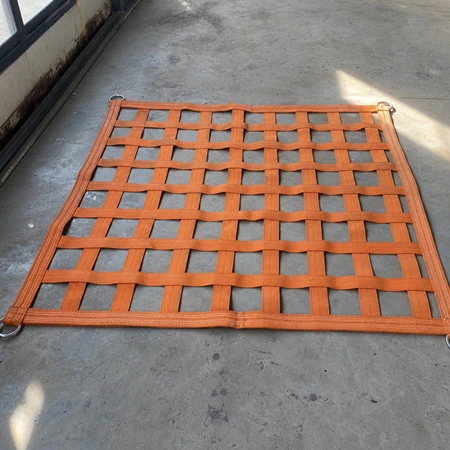
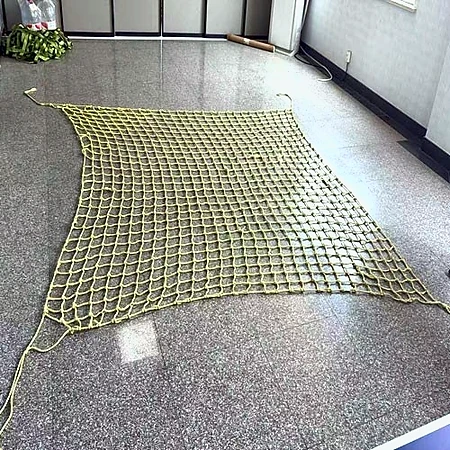
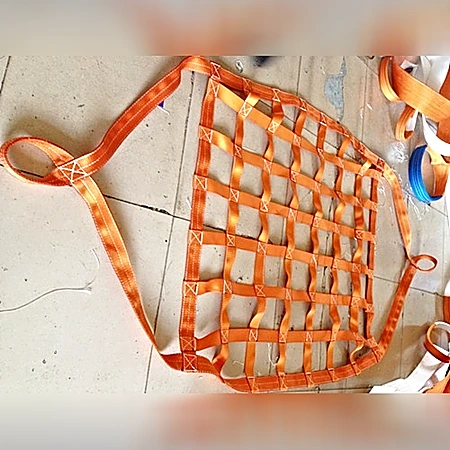
A cargo securing net is a flat-belt restraint net laid over a load and tensioned down to the deck, so that the cargo cannot slide, rock or topple on the way. The belts are woven from high-tenacity polyester into an open lattice, the border is folded and double-stitched, and the edge carries rated attachment points that are pulled down with ratchet tensioners until the load is pressed onto the vehicle or container floor.
The distinction that matters on this product is duty, not appearance. A cargo securing net restrains; it does not lift. Its label carries a lashing capacity (LC) and a standard tension force (STF) sa daN, the arrangement is calculated to EN 12195-1 and the belts are type-tested to EN 12195-2 – not to a lifting working load limit. We weave the belts in our own mill in Taizhou, so net size, mesh, belt width, fittings and markings are set to your load, your vehicle and your anchor points.
- Restraint rating, hindi nakakataas na rating – LC and STF marked in daN, calculated to EN 12195-1, belts type-tested to EN 12195-2.
- Flat high-tenacity polyester belts – 25 mm sa 100 mm, single or duplex, UV stabilised and rot-proof.
- Sized to the load or the aperture – cover nets, container doorway nets, partition nets and bag form, lahat ginawa sa order.
- Rated fittings and tensioners – ratchets, mga kawit, D-rings and lashing points, with anti-slip mats where the deck friction is low.
- CE at GS certified – pinagtagpi, tinahi, marked and tested in one plant, may ISO 9001, CNAS and DNV behind it.

Restraint is not lifting – and the label says which one you have
The two products look alike, are made from the same belt and are often bought by the same fleet. They are not interchangeable, and the difference is not a formality: one is sized so a load cannot move, the other is sized so a load cannot fall. Using a restraint net on a crane hook, or a lifting net as a tensioned tie-down, is a safety failure rather than a paperwork problem.
mesa 1 – Why a securing rating and a lifting rating are not interchangeable.
| Punto ng paghahambing | Cargo securing net (pahinang ito) | Pag-aangat ng lambat |
|---|---|---|
| Ano ang ginagawa nito | Pinipigilan ang isang load na nananatili sa sasakyan | Dala ang buong bigat ng isang karga sa hangin |
| Pinamamahalaan ng | SA 12195-1 (pagkalkula ng mga securing forces) at EN 12195-2 (webbing lashings) | Mga pamantayan sa pag-aangat, with webbing rated on the EN 1492-1 batayan |
| Na-rate sa | Lashing kapasidad (LC) at karaniwang puwersa ng pag-igting (STF), sa daN | Limitasyon ng pagkarga sa pagtatrabaho (WLL), sa tonelada |
| How it is sized | Sized to resist the acceleration and friction case for the journey | Sukat ng a 5:1, 6:1 o 7:1 factor at proof-tested bawat lambanog |
| How it is tested | Belt and tensioner type-tested to EN 12195-2 | Every sling break-tested on our own 1000 t makina |
| Paano ito nabigo | The load moves – a road accident | The sling breaks – a dropped load |
If the requirement is to lift – a pallet onto a roof, a bag into a hold – the right product is a lifting net: ang crane pallet cargo net, ang polyester lifting hoisting net o ang heavy duty nylon cargo net sling. If the requirement is to keep a load still from the loading bay to the delivery point, this page is the right one.
The forces the net has to answer for
A load on a moving vehicle is pushed in three directions, and each one is a design case rather than an accident. The accelerations below are the ones EN 12195-1 uses for road transport; other modes and national rules differ, which is why we ask where the load is travelling before we size the net.
mesa 2 – Design accelerations for road transport and what resists each one.
| Direction | Design acceleration | What resists it |
|---|---|---|
| Forward (braking) | 0.8 g | Blocking or a headboard first, then direct lashings to the front; friction contributes |
| Rearward (acceleration) | 0.5 g | Rear lashings and a tailboard; the net’s rear edge lines |
| Nakatagilid (cornering) | 0.5 g | Side lashings, containment by the lattice, and friction from the pre-tension |
| Patayo | Not a road design case | Held down by pre-tension and containment; a net reduces bounce but is not a substitute for blocking |
The practical consequence is that a net alone rarely carries the whole case. Blocking against a headboard does more for the braking case than any strap, and a net laid over the top does the rest. A good securing arrangement is a combination, and we will say so when a net is the wrong answer for your load.
Paano ang isang flat-belt net ay may hawak na load
Ang isang secure na net ay gumagana sa pamamagitan ng tatlong mekanismo nang sabay-sabay. Which one dominates depends on how the net is fitted, and that is decided at the vehicle rather than at the factory.
mesa 3 – The three mechanisms a securing net uses.
| Mekanismo | Paano ito gumagana | What it depends on |
|---|---|---|
| alitan (pagkakatali) | Ang tensioned net ay pinindot ang load papunta sa deck, at ang alitan sa pagitan ng load at deck ay lumalaban sa pag-slide. This is the main effect of a cover net | Isang malinis, dry deck or anti-slip mats. Nang walang alitan ang parehong net ay pumipigil nang mas kaunti |
| Containment | Pisikal na pinipigilan ng sala-sala ang pagkalat ng load, rocking, or throwing individual items out | A mesh fine enough for the smallest item, and a net fitted tight rather than draped |
| Direct lashing | Where the edge belts run down to rated points on the vehicle, ang sinturon mismo ang nagdadala ng puwersa ng pagpigil | Certified anchor points on the vehicle – never a random protrusion or a load’s own packaging |
Two numbers decide whether the arrangement works, and both are usually ignored. The first is the angle: a tie-down belt is most effective between 75 at 90 degrees sa deck, and its effective capacity follows LC_eff = LC × sin α. Sa 30 degrees you keep roughly half the belt’s rating, so a net pulled down almost flat looks tidy and holds very little. The second is friction: the coefficient between a steel load and a steel deck is about 0.1 sa 0.2, steel on timber about 0.2 sa 0.3, timber on timber about 0.3 sa 0.4, and a good anti-slip mat takes a pallet on a deck to about 0.5 sa 0.6. basa, oily or icy surfaces take all of these figures down, which is why the same net restrains very different loads on two different days.
Mga teknikal na parameter
Ang mga figure sa ibaba ay sumasaklaw sa karaniwang hanay ng pag-secure. sinturon, mesh, laki ng net, edge fittings at tensioners are all made to order, kaya ituring ang talahanayang ito bilang panimulang punto para sa isang panipi sa halip na isang nakapirming catalog.
mesa 4 – Cargo securing net: teknikal na mga parameter.
| Parameter | Pagtutukoy |
|---|---|
| Uri ng produkto | Cargo securing net (load restraint net) – cover net, partition net, container doorway net or bag form. Hindi isang nakakataas na aparato |
| Belt material | 100 % high-tenacity polyester (PET); high-tenacity na nylon kapag hiniling |
| Lapad ng sinturon | 25 / 35 / 50 / 75 / 100 mm |
| Belt construction | Isang layer o duplex, woven selvedge, not a cut edge |
| Belt thickness | 1.8 mm – 4.0 mm depende sa lapad at bilang ng layer |
| Pagbukas ng mesh | 100 × 100 mm pamantayan; 50 mm – 300 mm ginawa sa order |
| Laki ng net | Ginawa sa load footprint, ang kama ng sasakyan, o ang lalagyan o siwang ng pintuan |
| Lashing kapasidad (LC) | Tungkol sa 750 daN on a 25 mm belt to about 5,000 daN on a 100 mm duplex belt, marked per net |
| Pre-tension (STF) | 250 – 500 daN depending on the tensioner supplied; minarkahan sa label |
| Karaniwang batayan | SA 12195-1 for the securing calculation; SA 12195-2 for the webbing lashing |
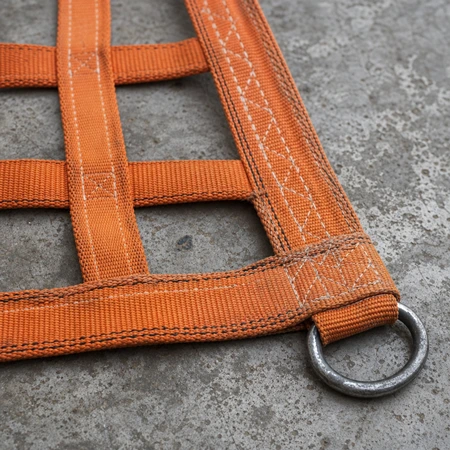
| Border | Nakatupi at naka-double-stitch; pinalakas sa bawat attachment point |
| Mga kabit | Ratchet tensioners, mga kawit, D-ring, cam buckles and lashing points, grado 80 steel where steel is used |
| Kulay | Orange for high visibility as standard; asul, berde, black or a custom colour |
| Paggamot | Nag-stabilize ang UV, anti-aging, abrasion at lumalaban sa luha, rot-proof |
| Temperatura ng pagtatrabaho | -40 °C hanggang +100 °C |
| Sertipikasyon | CE, GS, ISO 9001, JIS on request; Laboratory ng CNAS; DNV |
| Pagpapasadya | OEM / Laki ng ODM, kulay, printed belt, label, logo at pag-iimpake |
| HS code | 6307.90 – nets and netting of textile materials |
Mga karaniwang sukat, mesh and lashing capacity
A securing net is sized to the load it covers or the aperture it closes, never to a tonnage. The load has to be fully covered, and the border has to land on the deck or on the anchor points instead of hanging in mid-air, because an unsupported edge is an edge that can be pulled sideways.
mesa 5 – Standard securing net sizes, with the belt and capacity that normally go with them.
| Laki ng net (L × W) | Mesh | sinturon | LC per edge line | Karaniwang gamit |
|---|---|---|---|---|
| 1.2 × 1.2 m (4 × 4 ft) | 100 mm | 35 – 50 mm | 1,000 – 2,000 At | Single pallet in a van or light truck |
| 2.5 × 1.2 m (8 × 4 ft) | 100 mm | 50 mm | 2,000 At | Two pallets abreast in a van or curtain-sider |
| 2.5 × 2.5 m | 100 mm | 50 mm | 2,000 At | Flatbed load, makinarya, mixed cargo |
| 5.0 × 2.5 m | 100 – 150 mm | 50 – 75 mm | 2,000 – 3,500 At | Full-length flatbed at trailer load |
| 2.4 × 2.6 m (lalagyan) | 100 mm | 75 mm | 3,500 At | Container doorway net, load held back from the doors |
| 1.5 × 1.5 m bag form | 50 – 100 mm | 50 mm | 2,000 At | Loose or bagged goods that would spread on the deck |
| Ginawa sa pagguhit | 50 – 300 mm | 25 – 100 mm | To calculation | Anumang bakas ng paa, aperture or vehicle bed |
The capacity column is the restraint available per edge line, not a lifting limit. The number of edge lines, their angle and the friction under the load decide what the arrangement actually restrains.
Four forms of securing net
The same lattice is supplied in four arrangements, and choosing the right one is most of the job. Ang mga kabit ay naiiba sa pagitan nila; ang prinsipyo ng pagpigil ay hindi.
mesa 6 – Takpan, partition, container and bag forms.
| Form | Paano ito nilagyan | Ginamit noong |
|---|---|---|
| Takpan ang lambat | Spread over the load and tensioned down to the deck or to the vehicle’s rated points | Flatbed, curtain-sider and container loads that must not move in any direction – the most common arrangement |
| Partition net | Fixed upright across the vehicle body and tensioned against its own frame | Separating two loads in one vehicle, or holding cargo away from a bulkhead |
| Container doorway net | Fitted across the door aperture and hooked to the container’s own rings | Stopping cargo migrating to the doors during the journey, so the container is safe to open |
| Form ng bag | Closed at the bottom, with the cargo sitting inside the lattice | Loose or bagged goods that would otherwise spread across the deck |
Mga kabit, tensioners and anti-slip
A securing net is only as good as the tensioner that pre-tensions it and the anchor point it pulls against. These are the parts that get specified last and fail first.
mesa 7 – Mga kabit at tensioner.
| Angkop | Ginamit sa | Tandaan |
|---|---|---|
| Ratchet tensyon | Takpan ang lambat, anyo ng bag | Itinatakda ang pre-tension (STF). A ratchet that cannot reach the marked STF makes the net ineffective, whatever its LC |
| Cam buckle | Banayad na tungkulin | Faster than a ratchet but reaches a much lower pre-tension – for light loads only |
| Hooks at D-ring | Kahit anong arrangement | The link between net and anchor point; grado 80 bakal kung saan ginagamit ang steel fitting |
| Mga punto ng paghampas | Takpan ang lambat | Rated anchor points in the vehicle structure – the restraint force has to go somewhere rated |
| Anti-slip na banig | Frictional restraint | Raises the friction coefficient under the load; usually the single most effective addition on a smooth deck |
| Proteksyon manggas | Mga matulis na kargada | Kasya sa ibabaw ng sinturon sa contact point; ang pinakamurang paraan para pahabain ang buhay ng net |
| Repair kit | Fleet maintenance | Matching belt, stitching thread at isang ekstrang tensioner |
Pagmamarka, colour and identification
A securing net is checked by the driver before every trip and by an inspector at the roadside, so the marking has to be readable at a distance and has to survive being dragged over a deck.
- Lashing capacity and standard tension force printed along the belt in daN – the units load securing is actually calculated in.
- Net size and date of manufacture printed as well, so the net can be matched to the vehicle and its age judged on the spot.
- A sewn capacity label in addition to the print, kaya laging magkasundo ang net at ang mga papeles nito.
- Orange as the standard high-visibility colour, with blue, berde, black or a house colour for fleet identification.
- OEM orders can carry your brand, warning text or certificate number printed on the belt.
- Nets ship folded into a bag or a crate – a fleet order takes a fraction of the space of the same number of loose straps.
Pagsubok, certification and traceability
- Forty years of lifting equipment manufacturing – itinatag sa 1985 sa Taizhou, Jiangsu, na may higit sa 200 mga empleyado.
- Belts woven in our own mill, kaya lapad, layer count and colour are under our control rather than bought in.
- Webbing strength-tested on our own 1000 t horizontal machine before it is cut into nets.
- Belts supplied to the EN 12195-2 material requirements for securing duty, with the securing calculation following EN 12195-1.
- CE declaration of conformity and GS certification, with JIS on export orders; ISO 9001, CNAS laboratory accreditation and DNV certification behind the plant.
- Ang bawat lambat ay minarkahan ng kapasidad nitong paghagupit, pre-tension, laki at mesh bago i-pack, and supplied with a material test report on request.
Certificates and test reports are available as PDFs for a tender file or a customs check – see the full sertipikasyon itakda.
Kung saan ginagamit ang mga lambat sa pag-secure ng kargamento
The same net covers a road trailer, a container, a rail wagon and a barge. What changes is the number of anchor points, the mesh and how the net is tensioned – not the product itself.
mesa 8 – Applications by transport mode.
| Mode o sektor | Ang pinipigilan neto | Bakit nababagay dito ang isang flat-belt net |
|---|---|---|
| Daan – flatbed | Makinarya, bakal, kahoy, mga papag, mga tambol at pinaghalong kargamento | Sinasaklaw ang buong load sa isang aksyon at pinagsasama ang friction sa containment |
| Daan – tabing-side | Palletised and boxed goods that shift against a soft curtain | Naglalaman ng pagkarga kung saan ang kurtina mismo ay hindi nagdadala ng pagpigil |
| Transportasyon ng lalagyan | Cargo sa likod ng mga pinto, and cargo that must not migrate in transit | A doorway net makes the container safe to open and stops the load moving forward |
| kargamento sa riles | Palletised and loose cargo in wagons and on flat wagons | Sakop ng mahahabang lambat ang isang bagon bed at maaaring paigtingin sa mga regular na pagitan |
| Daan ng dagat at panloob na tubig | Deck cargo, at kargamento sa loob ng mga barge at hold | Mabubulok-patunay, UV stabilised and unaffected by salt water |
| Mabigat na paghakot at kargamento ng proyekto | Mga transformer, planta at out-of-gauge load | Pinagsama sa mga direktang paghampas at pagharang para sa hindi mahahati na pagkarga |
| Basura, recycle at agrikultura | Bales, tanggihan, compost at bulk load sa mga bukas na sasakyan | Pinipigilan ng containment ang maluwag na materyal na nag-iiwan sa sasakyan na nasa transit |
| Military and relief transport | Palletised and loose cargo in trucks and aircraft | Isang net bawat load, mabilis na ilapat at magagamit muli sa maraming biyahe |
Pag-aalaga, inspeksyon at pagreretiro
- Check the net before every trip and record the check: the tensioner first, pagkatapos ay ang stitching sa bawat attachment point, pagkatapos ay ang mga sinturon.
- Tanggihan ang anumang sinturon na may mga hiwa, pinsala sa gilid, sirang tahi, paglamlam ng kemikal, init glazing, or the colour and gloss change that signals UV degradation.
- Check the vehicle’s anchor points as carefully as the net. A perfect net on a corroded lashing point restrains nothing.
- Panatilihing malinis at tuyo ang kubyerta, and fit anti-slip mats wherever load-to-deck friction is low. That is a securing measure, hindi isang pagpipino.
- Never use a securing net to lift, and never use a lifting net as a tensioned tie-down unless its label carries both ratings.
- Mag-imbak ng malinis at tuyo, sa lupa at sa labas ng direktang araw; never repair a webbing belt by knotting, hinang o pinapainit ito.
- Withdraw the net if a belt, nasira ang linya ng tahi o tensioner, at magpasuri ng mga lambat ng isang karampatang tao sa pagitan na kailangan ng iyong fleet.
Mga madalas itanong
Can a cargo securing net be used to lift a load?
Hindi. It is rated for restraint, hindi nagbubuhat, at ang dalawa ay kinakalkula sa ganap na magkaibang mga base. If the load has to go onto a hook, use a lifting net with a working load limit and a per-sling proof test – the crane pallet cargo net or the polyester lifting hoisting net, both linked earlier on this page.
Ano ang pagkakaiba ng LC at STF?
LC (kapasidad ng paghampas) ay ang puwersa ng pagpigil na na-rate ang sinturon upang dalhin. STF (karaniwang puwersa ng pag-igting) ay kung gaano kahirap ang ratchet tensioner ay maaaring pre-tension ang sinturon. Both are marked in daN. Ang LC ang pinakamahalaga sa direktang paghampas, kung saan ang sinturon mismo ang humahawak ng pagkarga; Ang STF ang pinakamahalaga sa tie-down lashing, where the pre-tension creates the friction that does the holding.
Gaano dapat kahigpit ang lambat?
Sapat na masikip upang maabot ang pre-tension na minarkahan sa label, with the belts running as steeply to the deck as the load allows – 75 sa 90 degrees is where a tie-down belt works best. A belt laid almost flat keeps only about half its capacity, kaya ang isang lambat na mukhang maayos na natatakpan ay maaaring may hawak na napakaliit.
Kailangan ko ba ng anti-slip mat?
If the restraint relies on friction – which is what a cover net does – then usually yes. On steel, aluminium or plastic surfaces the friction coefficient is low, and a mat often adds more restraint than an extra strap does. Isang malinis, dry deck is the other half of the same measure.
Ilang lashings o anchor point ang kailangan ko?
Ito ay sumusunod mula sa pagkarga, ang alitan ng kubyerta, the vehicle and the journey rather than from a rule of thumb. Direct lashing normally needs at least four anchor lines, dalawa bawat gilid at tumawid, with the vertical and plan-view angles between 30 at 60 digri. Ipadala sa amin ang mga detalye ng pagkarga at sasakyan at gagawin namin ang pagsasaayos sa iyo.
Will a net stop cargo moving inside a container?
Pinipigilan ng doorway o partition net ang pag-load patungo sa mga pinto at ginagawang ligtas na bumukas ang lalagyan. For the journey itself the load still has to be restrained as a whole, kaya ang isang lalagyan ay karaniwang sini-secure gamit ang isang partition net kasama ang pagharang o dunnage kaysa sa isang net lamang.
Anong mesh opening ang dapat kong piliin?
Fine enough that the smallest item in the load cannot pass through. 100 mm ang aming pamantayan at may hawak na mga papag, mga karton, mga bag at tambol; Ang maluwag o maliliit na bagay ay nangangailangan ng mas mahigpit na mesh, at ang malalaking hindi mahahati na load ay maaaring tumagal ng mas malawak.
Ano pa ang ginagawa mo para sa paghawak ng load?
The same belts go into our webbing slings at walang katapusang bilog na lambanog, the wire rope range is under wire rope slings, the rope itself under naylon na mga lubid, and RoRo and breakbulk work is covered by the lambat ng pag-angat ng sasakyan. The lifting side of the net range starts at mga lambat sa pag-aangat ng kargamento.
Humiling ng isang quotation
Send the transport mode, the load weight and dimensions, kung ito ay maaaring kumalat o bumagsak, the deck material, ang laki ng net o siwang, the belt width and the anchor points you have – or a drawing of the load and the vehicle. Kukumpirmahin ng aming mga inhinyero ang net, ang mga kabit, ang bilang ng mga lashing lines at ang packing, at sipiin ito sa isang tugon. Para pag-usapan muna, makipag-ugnayan sa aming mga inhinyero.
Kumpanya ng Lift Sling Rigging – Lifute Industrial Park, Lungsod ng Taizhou, Lalawigan ng Jiangsu, Tsina
Tel: +86 523 8693 5818 | WhatsApp: +86 180 6600 2268 | E-mail: lift98@jslift.com