

Lift sling rigging company produce Heavy Duty Nylon Flat Webbing Cargo Net,Nylon Flat Webbing Net,Nylon webbing cargo net,Flat Nylon Sling Lifting Net,Nylon Flat Webbing Netting,Heavy-Duty Cargo Bungee Net,Heavy-Duty Cargo Net with Ratchet,Polyester Webbing Cargo Lifting Net.
Heavy Duty Nylon Flat Webbing Cargo Net
An open lattice of flat high-tenacity nylon bands that lifts like a wire rope net, weighs a fraction of one, and leaves the cargo unmarked.
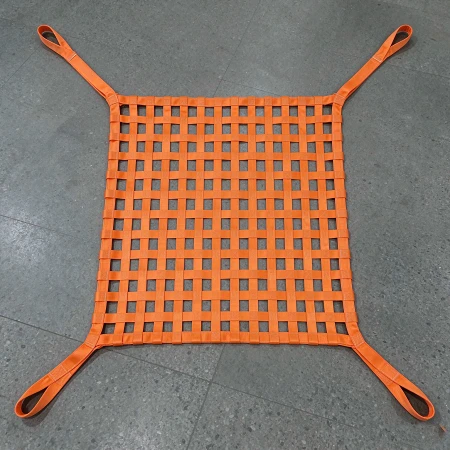
Lift Sling Rigging Company weaves the band, stitches the net and proof-tests every one in Taizhou, Jiangsu. Band width runs from 25 mm kuni 100 mm, võrk alates 50 mm kuni 300 mm, and the rated capacity of a single net from 0.5 t kuni 10 t standardina, with heavy-duty nets built to order well beyond that — the tens-of-tonnes class is a build, not a catalogue item.
Miks nailon, and why flat webbing
Three things separate this construction from a rope net: the shape of the bearing face, kiudaineid, and the way the load is shared.
- Lame riba, lai nägu. A 50 mm band lies against the cargo along its whole width. A wire rope touches on a line a few millimetres wide and concentrates everything into it — that is what dents a painted panel or bursts a paper sack.
- Nylon takes the shock. Nailon (PA) stretches further before it parts than polyester, so a load that lands or swings is absorbed rather than transmitted to the hook. Where the lift is a steady, repetitive crane cycle, polyester is the lower-stretch choice; where the cargo is slammed down on a quay, nylon is the more forgiving net.
- Load shared across the lattice. Every band under the load carries a share, so the net does not depend on four hard points. That is also why the same net can hold a bag stack, a pallet of bricks or a bundle of plate without repacking it.
What “tens of tonnes” actually means
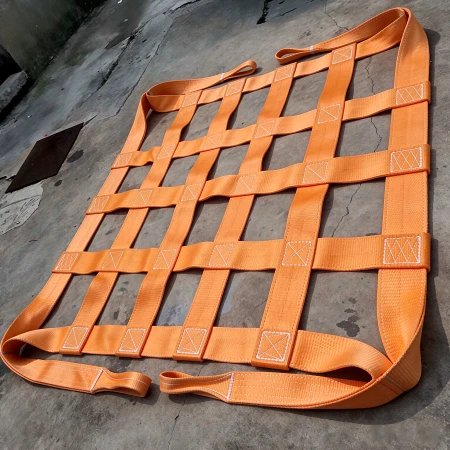
A 30 t net is not a 3 t net made bigger. Capacity is built up from four things, and each of them has to move together:
| Load band | Bänd / ehitada | Võrk | Tõstepunktid | What else changes |
|---|---|---|---|---|
| 0.5 – 2 t | 25–50 mm single layer | 50-100 mm | 4 nurgad | One-person handling, light cargo, bags and small parts |
| 2 – 5 t | 50 mm single layer, double-stitched border | 100 mm | 4 nurgad | The standard port and warehouse net |
| 5 – 10 t | 50-75 mm, duplex bands on the load-bearing run | 100 mm | 4 nurgad, 8 nõudmisel | Heavier border, reinforced loops, thicker stitch pattern |
| 10 – 30 t | 75–100 mm duplex, band count set by the load face | 100-150 mm | 8 points | Spreader beam or master link in the assembly; net built to drawing |
| 30 t ja üle selle | 100 mm duplex or multi-layer, band spacing engineered to the load | 150-200 mm | 8 points or more | Built and proof-tested to the lift, certificate per net |
Load bands and build steps are our standard practice; the rating of any net above 10 t is fixed by its own proof test, and we quote it from that certificate.
The arithmetic behind it is plain: a band has a certified strength, the load face has a known number of bands beneath it, and the assembly is rated at the lowest of the band run, the corner loops, the master link and the sling above it. Add bands, widen them, double them, and the net grows; but the corner loops and the hardware have to grow with it, which is why the big nets are designed as a whole rather than bought by the metre.
Flat webbing against wire rope
This is the comparison buyers usually arrive with, and it is worth stating plainly — including where the wire net still wins.
| Nylon flat webbing net | Tross lastivõrk | |
|---|---|---|
| Contact with the cargo | Lame riba, lai nägu, märgistamata | Liini kontakt, jäljed ja mõlgid |
| Effect on packaging | Paper sacks, cartons and shrink wrap survive | Sacks burst, cartons crush at the rope line |
| Kaal | One person carries and folds a 2.5 × 2.5 m net | Needs two people and lifting gear |
| Korrosioon | Rust-free, suited to quays and offshore decks | Needs galvanised or stainless rope |
| Edge and cut resistance | Hea, but sharp plate and flame need a sleeve or pad | Very high — the reason wire nets survive scrap yards |
| Remont | Re-stitch or replace a band; no swaging | Cut and re-splice by a rigger |
| Handling noise and injury risk | Quiet, no wire spikes | Loud, and wire spikes cut gloves |
Spetsifikatsioon
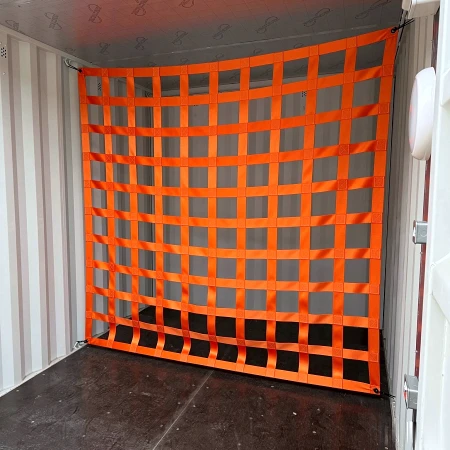
The table is the standard nylon flat webbing net. Riba laius, layer count, võrk, neto suurus, lifting points and printing are all made to order, so read it as the starting point for a quotation rather than a fixed catalogue.
| Parameeter | Spetsifikatsioon |
|---|---|
| Tüüp | Open flat webbing lattice, no closed bottom; four or eight lifting points |
| Bändi materjal | 100 % ülitugev nailon (PA); polüester (PET) or polypropylene (PP) nõudmisel |
| Riba laius | 25 / 30 / 50 / 75 / 100 mm |
| Riba paksus | 1.5 – 3.2 mm sõltuvalt laiusest |
| Bändi kiht | Vallaline, or duplex (kahekordne kiht) for abrasion resistance and higher capacity |
| Võrgusilma avamine | 50 – 300 mm; 100 × 100 mm standard |
| Mesh form | Square (standard) or diamond on request |
| Neto suurus | 1.0 × 1.0 m kuni 4.0 × 4.0 m standard; 2.5 × 6 m and any size to drawing |
| Nimivõimsus | 0.5 – 10 t standard; heavier nets built to order and rated from their own proof test |
| Ohutusfaktor | 7:1 |
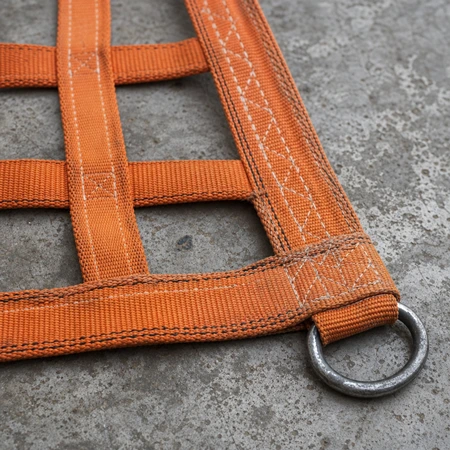
| Piir ja nurgad | Folded double-stitched border; reinforced lifting loops, four or eight |
| Värv | Oranž suure nähtavuse standard; sinine, must, green or custom |
| Ravi | UV-resistant and anti-aging; abrasion-resistant finish |
| Töötemperatuur | −40 °C kuni +100 °C (polüester); nylon lower at the top end — tell us the duty |
| Märgistus | WLL, neto suurus, mesh and date stitched on a label; WLL and brand printable on the band |
| Sertifitseerimine | CE / GS / TEMA / ISO 9001 töötab; breaking-load test on our own 1000 t masin |
| HS kood | 630790 |
Standard sizes
| Neto suurus | Tüüpiline võimsus | Typical load |
|---|---|---|
| 1.0 × 1.0 m | 0.5 – 2 t | Machine parts, trummid, väikesed kaubaalused |
| 2.5 × 2.5 m | 2 – 5 t | Kaubaalustele ja kottidesse pakitud kaubad, container work |
| 2.5 × 6 m | 4 – 10 t | Pikad kaubad, pipe and plate bundles, truck beds |
| 4.0 × 4.0 m | 5 – 10 t | Puistekotid, stacked sacks, teki lasti |
| Ehitatud joonistamiseks | 10 t and well above | Hold, flat rack, spreader and plant dimensions |
Where the soft face pays for itself
- Painted and coated steel — plate packs, kaetud toru, galvanised sections: no rope line to score the finish.
- Bagged and boxed cargo — fertiliser, tsement, teravilja, resin: the flat band does not cut into the bag.
- Machined and plated parts — no dent, no wire mark, no rework before dispatch.
- Marine and offshore transfer — rust-free, UV-ga töödeldud, quiet on a moving deck.
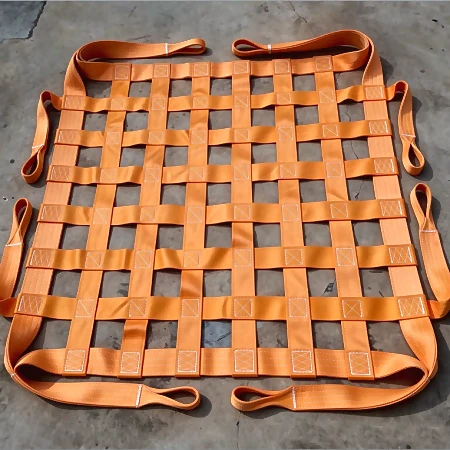
- Konteinerite täitmine ja täidise eemaldamine — light enough to pull around the cargo and fold away afterwards.
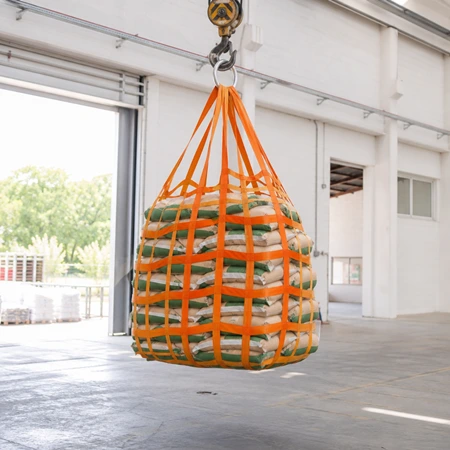
It is not the right tool everywhere, ja seda tasub öelda: a webbing net is not a scrap-yard net. Sharp plate edges, torn steel and hot slag will cut or burn a band. Where the cargo is sharp, the net is supplied with edge sleeves or a heavier wear band, and the sleeves are inspected with the net.
Rigging it so the load stays inside the mesh
- Lay the net out flat, set the load down inside the mesh and keep it clear of the border — the border is stitch, not bearing face.
- Gather all the lifting loops onto the hook, master ring or spreader; never lift on fewer loops than the net was built with.
- With eight points, use a spreader or two matched slings so the load is shared evenly; a net pulled from four points only will lift less than its rating allows.
- Square the mesh under the load before taking up slack, so the bands line up with the load face instead of pulling diagonally.
- Never drag a load sideways with the net, and never use it as a tow or lashing substitute for a load it was not rated for.
Märgistus, trükkimine ja identifitseerimine
Every net leaves with a sewn label carrying the working load limit, neto suurus, the mesh and the date. On top of that the band itself can be printed — WLL, net number, fleet code and your own brand — which matters where a yard runs a hundred nets and needs to know at a glance which one is which, and where an inspector needs the rating without hunting for a tag.
Ülevaatus ja pensionile jäämine
- Read the label before the lift and confirm the load is inside the rating for the way the net is rigged.
- Check every load-bearing band for cuts, hõõrdumine, keemiline värvimine, heat glazing and broken stitching; check the border and the loops most carefully — that is where wear starts.
- Check the printing is still legible: an unreadable WLL is a net out of service.
- Retire the net if a band, the border or a loop is damaged, or if the mesh has been distorted by an overload. Never knot, weld or heat-repair a webbing net.
- Hoida puhtana ja kuivana, maapinnast eemal ja otsese päikesevalguse eest, and have the net examined by a competent person at the interval your site sets.
Sageli küsitakse
Can a webbing net really lift tens of tonnes?
Jah, as a build rather than a stock item. Bands get wider and duplex, the band count under the load face goes up, lifting points go from four to eight, and a spreader or master link joins the assembly. Each net of that class is proof-tested and its WLL is taken from the test, so ask for the certificate rather than a catalogue figure.
Will it mark painted or galvanised cargo?
No — that is the main reason buyers move from wire rope to webbing. The band presents a flat, soft face over its full width; a wire net concentrates the same load on a line a few millimetres wide. What a webbing net will not tolerate is a sharp edge, which is what the sleeves are for.
Nailon või polüester?
Nylon for shock and impact — slamming a load down, rough quay handling, cargo that swings. Polyester where the lift is steady and repetitive and you want the least stretch under load. Polypropylene for wet or chemical duty and where weight matters most.
What mesh should I take?
100 × 100 mm covers bags, tellised, kastid, drums and small components. Go smaller (50-75 mm) for loose small parts, and larger (150-200 mm) on big heavy nets where band strength matters more than containment.
How is the capacity proven?
Every net is breaking-load tested on our own 1000 t machine and supplied with a capacity label and a material test report; our works hold CE, GS, JIS and ISO 9001 sertifitseerimine, and the test facilities are CNAS and DNV recognised.
Can you print our brand and the WLL on the band?
Jah. WLL, neto suurus, fleet number and your own brand can be printed along the band, with a sewn label as well. That is the usual request from distributors and from yards that run a fleet of nets.
Küsi hinnapakkumist
Saatke koorem, not just a size
The cargo — what it is, kuidas see on pakitud, and its weight as presented for the lift;
The load face — length × width, and whether the net must contain it or only hold it together;
The lifting arrangement — four or eight points, konks, master ring or spreader, and the sling above;
The environment — quay, konteiner, offshore deck, or a coated and painted product;
The paperwork — CE marking, test report and own-brand printing if you need them.
Kuhu edasi minna
- Vööga lasti tõstevõrk — the polyester version, 2–10 t, 50 mm riba;
- Nylon flat webbing net — the full lattice range, 25–100 mm band;
- Tugev nailonist lastivõrgu tropp — closed bottom for loose cargo;
- Web cargo net ja the whole cargo lifting net range;
- Trosstropid where a hard, cut-resistant sling is the right answer;
- Turvaköisvõrgud for fall protection rather than lifting.