

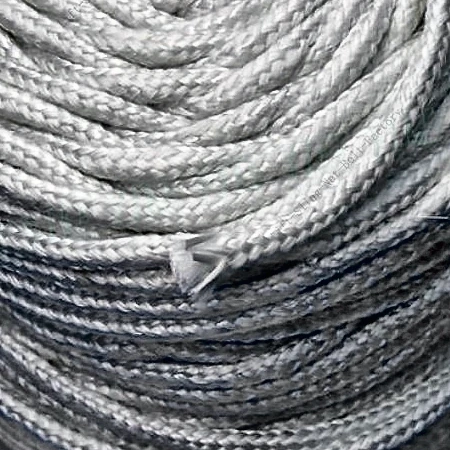
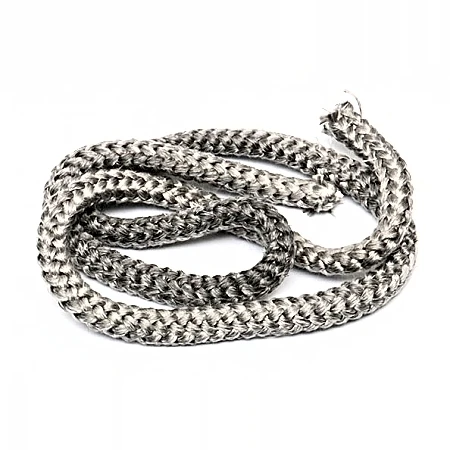
Lift sling rigging company produce Fiberglass rope,Fiberglass braided rope,Fiberglass Round Braided Rope,Fiberglass Round Rope,Fireplace sealing rope,Braided Fiberglass Rope,Heat Resistant Fiberglass Rope,Fiberglass Insulation Rope,Fiberglass Cord Rope,Fiberglass Rectangular Braided Rope,Glass fibre rope,Heat-Resistant Rope,Fiberglass Gasket Rope,Glass Fibre Lagging Rope.
Fiberglass Rope: Round and Square Braided Glass Rope
Fiberglass rope is continuous E-glass filament, texturised and braided into a round or square section. It is the flexible answer where rigid insulation will not go: a door groove, a valve bonnet, a pipe bend, a cable run, a joint that opens and closes as it heats.
We braid both members of the family at our Taizhou works. Round braided fiberglass rope runs from 3 mm a 25 milímetros; square braided fiberglass rope from 4 × 4 mm a 25 × 25 milímetros. Both come uncoated, or finished in graphite, PTFE or silicone, on 5–25 kg coils or cut to length.
The braid is the product, not the fibre
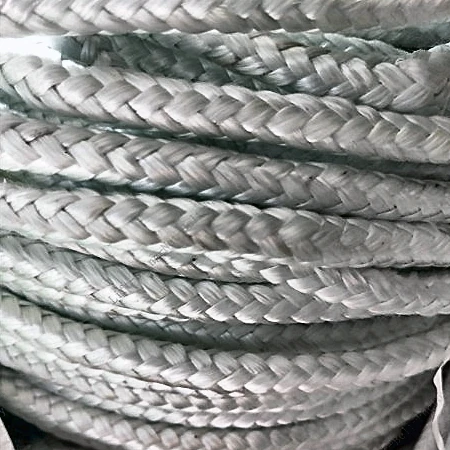
Glass filament is brittle. Twisted into a rope it takes tension but not a tight bend: below roughly ten diameters the outside filaments snap, the rope furs, and the section flattens where it was tied.
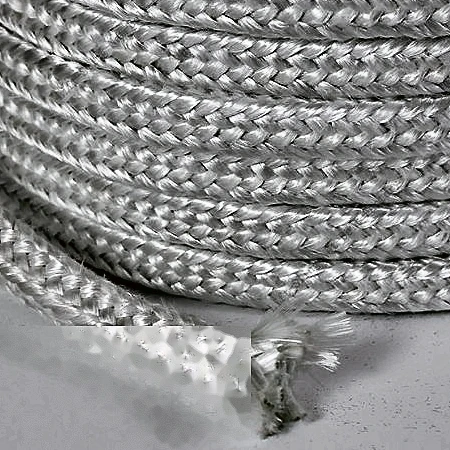
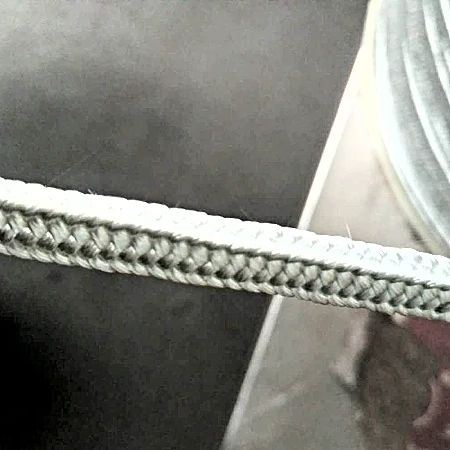
Braiding changes that. Each carrier travels a longer helical path than the rope axis, so a bend opens the braid angle and the filaments slide over one another instead of being strained to failure. The cut end below shows the result — a braided sheath locked over a core of parallel glass yarn. That core is what keeps the section from collapsing once the rope is pushed into a groove and closed on.
Round or square: pick the gap, not the drawing
Both sections are the same glass. They fill a gap differently, and that is the whole choice.
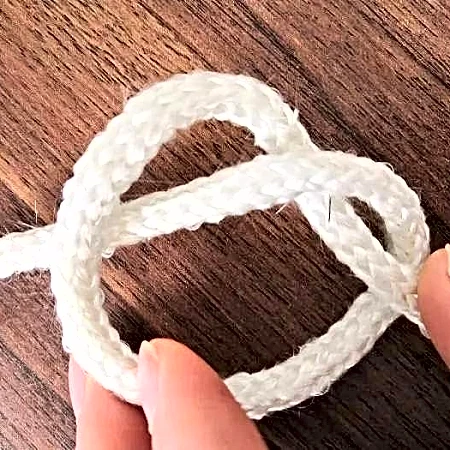
The round braid is the general-purpose rope. It rolls into a machined round groove, follows a pipe bend, threads through a gland and ties off. On a flat face it seals on a line of contact, so the joint has to be stiff enough to hold that line shut.
The square braid is a packing section. Its flat faces present a braided land rather than a round edge, so the same groove width carries noticeably more glass, and it will not roll on a frame that closes slightly out of parallel — which is why flat-face and kiln-car joints take square, and pipe work takes round.
| Especificación | Round braided fiberglass rope | Square braided fiberglass rope |
|---|---|---|
| Section as supplied | 3–25 mm diameter, coil or cut length | 4 × 4 a 25 × 25 milímetros; rectangular sections to order |
| Sits in | Round groove, U-channel, packing gland | Rectangular groove, flat-face joint |
| Seals on | A line of contact | A flat land, more glass per mm of groove width |
| In service | Rolls, follows bends, ties off easily | Will not roll or twist; less forgiving on a tight bend |
| Deber típico | Pipe and vessel lagging, valve bonnets, round-groove door seals, cable protection | Kiln car and flat-face joints, rectangular channels, expansion joint packing, blanket edging |
Parámetros técnicos
| Parameter | Value (standard E-glass grade) |
|---|---|
| Yarn | E-glass, texturised, 9–13 µm filament |
| Fibre density | 2.5–2.6 g/cm³ |
| Braid | 8, 12 o 16 carrier over a parallel glass core |
| Continuous service | 540 °C |
| Short excursion | 700 °C, up to 30 minutes |
| Low temperature | −50 °C |
| Thermal conductivity | 0.05–0.08 W/(m·K) en 200 °C |
| Elongation at break | ≈ 3 % |
| Loss on ignition | ≤ 2 % uncoated |
| Chemical resistance | Most acids; not hydrofluoric acid, hot phosphoric acid or strong alkali |
| Electrical | Non-conductive, dielectric |
| Tolerance | ± 0.5 mm a 10 milímetros; ± 5 % arriba 10 milímetros |
| Standard pack | 5, 10 y 25 kg coils; cut lengths to 3 metro |
| Silica grade option | 1000 °C continuous, 1260 °C peak |
What 540 °C buys you, and what it does not
540 °C is the continuous limit of standard E-glass. The filament itself softens near 840 °C, so the rating already carries margin, and a short excursion to 700 °C is survivable for about half an hour — once.
What ends the life of a glass rope is rarely temperature. It is abrasion where the rope rubs a steel edge, chemical attack (hydrofluoric acid at any strength, hot phosphoric acid, strong alkali), or compaction: a rope crushed past about 40 % of its section takes a set and stops recovering. Arriba 600 °C continuous the answer is the silica grade, not a thicker glass rope.
Four finishes, four different problems solved
Every finish goes onto the same braided fiberglass rope. Only the silicone sheath moves the temperature rating — downwards.
- Uncoated: cheapest and the best insulator, but sheds sizing dust through its first hour of service.
- Graphite: black, low friction, for rope that slides in a packing gland and has to come back out.
- PTFE: for chemical duty and non-marking contact; stops the glass sticking to hot metal.
- Silicone: a rubber sheath that suppresses dust and makes the rope handleable, at the cost of capping the working temperature near 260 °C — well below the glass inside it.
Where fiberglass rope earns its place
- Flange and valve-bonnet lagging on steam and exhaust lines, where a blanket cannot be wrapped tight.
- Expansion joint packing, round section, compressed by the joint rather than by a door.
- Door and frame seals with a round groove: see our oven door sealing rope for the compression and groove geometry in detail.
- Thermocouple, lance and cable protection through furnace walls and burner openings.
- Chimney, flue and damper seals, and the edge reinforcement of removable insulation jackets.
- Blanket edging and kiln car joints, where the square braid sits flat and stays put.
Specifying an order
Four lines are enough for a quotation: section and size, grade (E-glass or silica), finish, and coil weight or cut length. Fiberglass rope above 25 milímetros, and non-standard rectangular sections, are braided to order on a two to three week lead time.
Fiberglass rope FAQ
Is fiberglass rope a direct replacement for asbestos rope?
Mechanically, yes — same braided form, same groove, same handling. Match the section to the old rope only after measuring the groove: a rope that has been compressed for years reads 10–15 % thinner than the size that has to go back in. Uncoated E-glass is the usual drop-in; on a gland that has to be re-packed regularly, graphite is the better match.
Can it be used as a lifting sling?
No. There is no WLL on a glass rope and no safety factor to work to. Heat-resistant lifting uses aramid webbing or aramid round slings; glass rope is a sealing and insulation product.
How long does it last?
In a static seal below 400 °C with no abrasion, several years. In a gland with sliding contact, life is set by abrasion, not heat — the rope furs, the diameter drops, and packing is added again.
Do you supply cut lengths?
Sí, cut to 3 m or to your door and joint sizes, with the ends taped or whipped so the braid does not run. Coils of 5, 10 y 25 kg are the standard pack.
Send the section, the temperature and the quantity to our sales team and we will quote from the braiding schedule, with a datasheet for the exact batch. Round and square braids, E-glass and silica, uncoated or finished.