

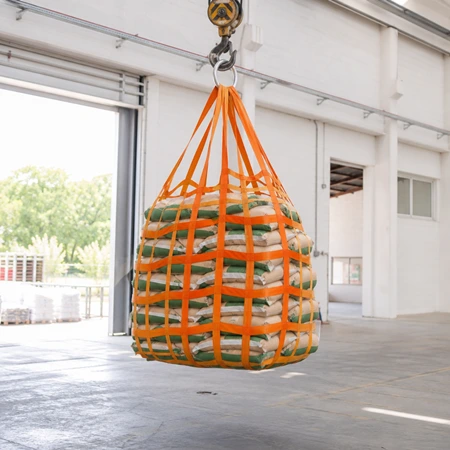

Lift sling rigging company produce Polyester Webbing Net for Lifting,Web Sling Lifting Cargo Net,Poliestera Reto Kargo,Flame Retardant Webbing Net,Cargo Nets Of Polyester Webbing,Cargo Lifting Net Web Sling,Poliestera Nylon Webbing Levanta Karga Reto,Heavy-duty polyester cargo net with flat sling strap,Large Capacity Cargo Lifting Nets for Heavy-Duty Lifting.
Polyester Webbing Net for Lifting
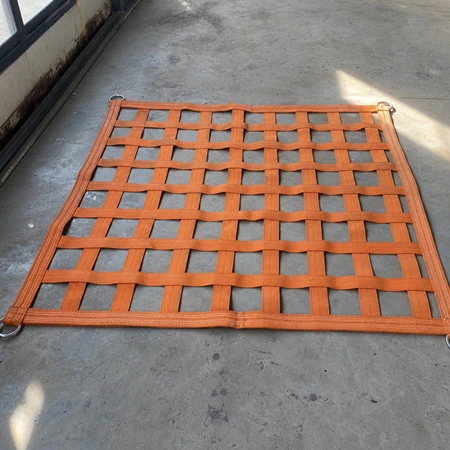
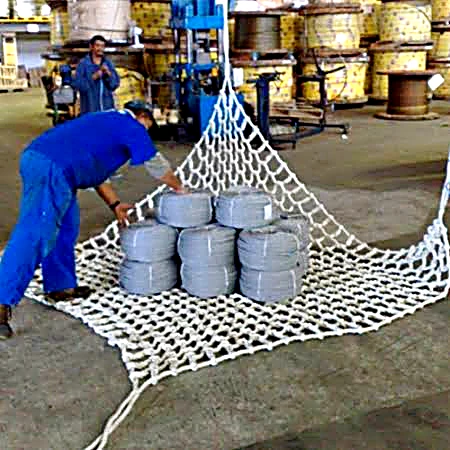
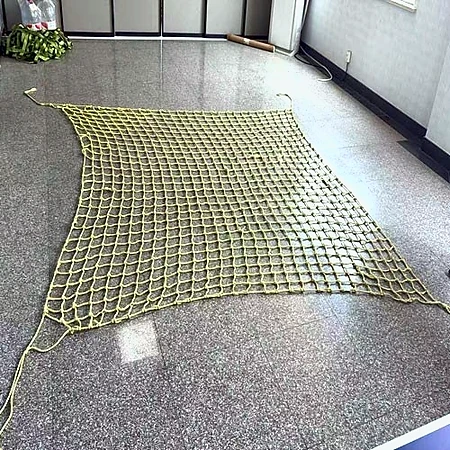
A polyester webbing net for lifting is a lattice of flat high-tenacity polyester (PET) bandoj, stitched into a square mesh with a doubled border and reinforced corner loops. The cargo goes in, the four loops are gathered onto the hook or a master ring, and the whole consignment travels as one unit – neniu paleto, no strapping, nothing to re-handle at the far end.
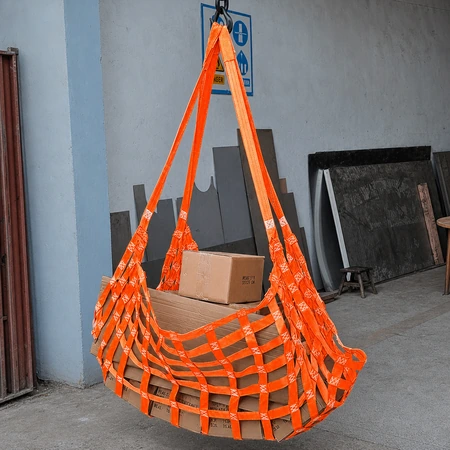
It is supplied in two forms. The flat net holds loads that keep their own shape – paletoj, faskoj, kvietaĵoj, maŝinpartoj. The closed-bottom bag contains loads that would otherwise escape the mesh – sakoj, brikoj, eltranĉaĵoj, miksita kargo. Both are cut to the drawing rather than to a catalogue: bendolarĝo, tavolkalkulo, maŝo, grandeco, lifting points and colour are all set before the first metre of webbing is woven, and the finished net is proof-load tested with a material test report.
- Flat PET band, 25-200 mm – ununura, duplex or triplex, with a woven selvedge that does not fray.
- 2 t al 30 t as a net – the rating follows the band, the number of load-bearing bands under the cargo and the way the net is rigged.
- Malalta streĉado, pri 3-7 % ĉe WLL – the net stays tight against the load instead of creeping open over a shift.
- Wet duty without loss of rating – polyester takes up almost no water and does not rot, so rain, wash-down and deck work are normal service.
- CE kaj GS atestita – teksita, kudrita, marked and proof-load tested in one plant, kun ISO 9001, CNAS kaj DNV malantaŭ ĝi.
The load path: hoko, loop, limo, bando, maŝo
A polyester webbing net for lifting is not one component but five, and the load passes through them in a fixed order. Almost every net failure we are asked to investigate comes down to one link in that chain being built to a lower standard than the band itself – usually the stitching at the corner, which is the cheapest place to save money and the first place to fail.
Tablo 1 – The five links in the load path, and what each one has to do.
| Link | Kio portas la ŝarĝon | What fails there first | How we build it |
|---|---|---|---|
| Hook or master ring | All four loops gathered to one point | Loops binding on a sharp hook or a worn shackle | Majstra ringo aŭ grado 80 shackle offered with the net; loops sized to the fitting |
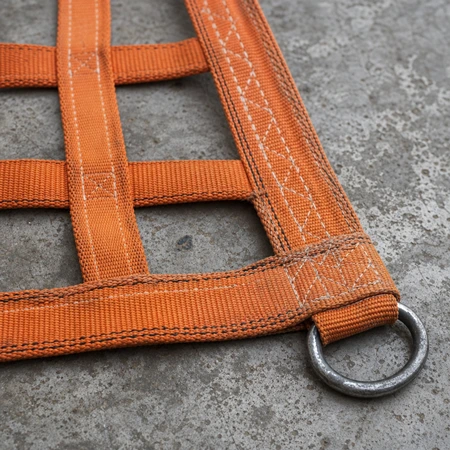
| Corner loop | The full rated capacity of one corner | Stitching pulling out of the border | Loop stitched through a doubled border with multi-row lock stitch, reinforced above 5 t |
| Limo | The sum of the mesh, redistributed to the corners | Border folding or tearing at the corner radius | Duobligita teksaĵo, folded and stitched the full perimeter, wider at the corners |
| Load-bearing band | The cargo’s weight, band by band | Abrasion and cuts from pallet edges and nails | Woven selvedge, duplex or triplex where the net is dragged; sleeves at contact points |
| Maŝo | Enteno – keeping the cargo in | Items squeezing through an over-wide opening | Opening chosen from the smallest item in the load, 50-300 mm |
The practical consequence is that a net is not rated by its band alone. A 50 mm duplex band can carry 4 t as a single vertical leg, but the net it is woven into may be rated at 2 t because the corner stitching, ne la bando, fiksas la limon. That is why we test the finished net and print the net rating, never the band rating.
Polyester against nylon, polypropylene and wire rope
The fibre choice is usually made on price and then lived with for years. The four materials behave differently in ways that matter on a handling net, and none of them wins on every line.
Tablo 2 – The four net materials compared on the properties that decide service life.
| Proprieto | Poliestero (PET) | Nilono (PA) | Polipropileno (PP) | Wire rope |
|---|---|---|---|---|
| Plilongigo ĉe WLL | Pri 3-7 % – the lowest of the soft fibres | Roughly twice polyester | Higher again, and it creeps | Sub 1 %, but the net is stiff and heavy |
| Akvo | Takes up almost no water; strength unchanged wet | Absorbs several per cent and loses some strength wet | Does not absorb water | Corrodes unless galvanised or stainless |
| Rot and mildew | Immune | Can mildew if stored wet | Immune | Not applicable |
| UV outdoors | Bone, and stabilised in the weave | Modera | Poor unless heavily stabilised | Unaffected |
| Dry abrasion | Bone – best of the soft fibres | Bone, slightly behind polyester | Modera | Bonega, but it abrades the cargo |
| Acidoj | Good against most dilute acids | Atakita de fortaj acidoj | Bone | Depends on coating |
| Alkaloj | Atakita de fortaj alkalioj | Bone | Bone | Generally good |
| Kontaktu kun la ŝarĝo | Mola, plata, ne-markado | Mola, ne-markado | Soft but slippery | Marks and crushes; needs sleeves |
| Rigging by hand | Lumo, folds into a bag | Lumo, folds into a bag | Plej malpeza | Needs two people and a trolley |
Two conclusions follow. Where the net works in cycles against pallets, concrete and truck beds, polyester is the default because low stretch keeps the mesh tight and dry abrasion is where it is strongest. Where the cargo shock-loads – peceto, demolition, rough castings – nylon’s give is an advantage and the peza devo nilona ŝarĝa reto slingo is the better answer. And where the load is hot, or the net has to be rigid, neither soft fibre belongs on the job.
Band specification
The band is where a quotation is won or lost. Five numbers describe it, all five are printed on the label, and all five are fixed on the drawing before weaving.
Tablo 3 – The five numbers that describe a polyester lifting band.
| Number | Kio ĝi estas | Range we weave |
|---|---|---|
| Larĝo | Flat width of the webbing | 25 / 50 / 75 / 100 / 150 / 200 mm; 50 mm normo |
| Layer count | How many webs are stitched into one band | Unuopa, dupleksa (du) or triplex (tri) |
| Dikeco | Set by width and layer count | 1.8 mm – 6.0 mm |
| Weave density | Yarn count in warp and weft, which sets tenacity | Set to the EN 1492-1 basis for the rated capacity |
| Rando | How the selvedge is finished | Woven selvedge as standard; folded and stitched where the band is handled daily |
Tablo 4 – Working load limit per band, vertical single leg, EN 1492-1 bazo.
| Larĝo de bando | Ununura tavolo | Dupleksa | Triplex |
|---|---|---|---|
| 25 mm | 1 t | 2 t | 3 t |
| 50 mm | 2 t | 4 t | 6 t |
| 75 mm | 3 t | 6 t | 9 t |
| 100 mm | 4 t | 8 t | 12 t |
| 150 mm | 6 t | 12 t | 18 t |
| 200 mm | 8 t | 16 t | 24 t |
This is a band figure, not a net rating. The net’s capacity follows from how many load-bearing bands sit under the cargo and how the net is rigged – which is why we quote the net, ne la bando.
Maŝo, border and edge: the three decisions left
Once the band is fixed, three choices remain. They are decided on the drawing, and changing one later means a new net rather than a modification.
Tablo 5 – Maŝo, border and edge options.
| Decision | Opcioj | Rule we apply |
|---|---|---|
| Mesh malfermo | 50 / 75 / 100 / 150 / 200 / 300 mm | Chosen from the smallest item in the load, neniam de la tuta pezo |
| Limo | Single fold or doubled and multi-row stitched | Doubled as standard; a single-fold border is only offered on nets under 1 t |
| Edge treatment | Woven selvedge, folded edge, PU tegaĵo | Folded where the net is handled daily; PU coating where it is dragged or stored outdoors |
| Corner reinforcement | Standard loop or reinforced corner | Reinforced above 5 t, and on any net used with a spreader beam |
| Protekto | Maniko, pad or double band at the contact point | Specified for pallets with nails, machined parts and any sharp edge |
Teknikaj parametroj
The figures below cover the standard polyester webbing net for lifting range. Every line is made to order, so treat the table as the starting point for a quotation rather than a fixed catalogue.
Tablo 6 – Polyester webbing net for lifting: teknikaj parametroj.
| Parametro | Specifo |
|---|---|
| Produkta tipo | Polyester webbing lifting net – flat net or closed-bottom bag |
| Bandmaterialo | 100 % alta tenaceca poliestero (PET) retaĵo |
| Larĝo de bando | 25 / 50 / 75 / 100 / 150 / 200 mm (50 mm normo) |
| Bandkonstruo | Ununura tavolo, duplex or triplex; teksita rando, ne tranĉita rando |
| Bando dikeco | 1.8 mm – 6.0 mm depende de larĝo kaj tavolkalkulo |
| Mesh malfermo | 100 × 100 mm kvadrata normo; 50 mm – 300 mm mendi |
| Reta grandeco | Length × width for a flat net; opening × depth for a bag; farita al desegnado |
| Limo | Duobligita teksaĵo, faldita kaj plurvica kudrita, reinforced at every corner |
| Levpunktoj | Four reinforced corner loops standard; ok por disvastiga trabo |
| Taksita kapacito | 2 t – 30 t as a net, set by band, tavolkalkulo, load-bearing bands and rigging |
| Sekureca faktoro | 5:1 / 6:1 / 7:1 |
| Plilongigo ĉe WLL | Pri 3-7 % |
| Koloro | Kolorkodo laŭ laborŝarĝa limo, aŭ laŭmenda doma koloro |
| Akvo kaj putro | Takes up almost no water; does not rot or mildew |
| Labora temperaturo | -40 °C al +100 °C |
| Traktado | UV stabiligita, kontraŭmaljuniĝo, imuna al abrazio kaj larmo |
| Norma bazo | Reto taksita al la EN 1492-1 bazo |
| Atestado | CE, GS, JIS laŭ peto; ISO 9001; CNAS-laboratorio; DNV |
| Personigo | OEM / ODM-grandeco, koloro, presita bando, etikedo, emblemo kaj pakado |
| HS-kodo | 6307.90 – levante retojn el teksaj materialoj |
Standard sizes and rated capacities
Net size is measured along the border for a flat net, and as opening × depth for a bag. The load has to sit well inside the net: a net the same size as the cargo sheds it as soon as the crane takes up the slack.
Tablo 7 – Standard net sizes; kutimaj grandecoj, maŝo kaj levpunktoj estas faritaj al desegno.
| Reta grandeco | Maŝo | Bando | Tipa kapablo | Tipa uzo |
|---|---|---|---|---|
| 1.0 × 1.0 m | 100 mm | 50 mm dupleksa | 2 – 3 t | Tamburoj, maŝinpartoj, unuopaj paledoj |
| 1.2 × 1.2 m (4 × 4 ft) | 100 mm | 50 mm dupleksa | 2 – 4 t | Norma paleta piedsigno, boxed cargo |
| 2.1 × 2.1 m (82 × 82 en) | 100 mm | 50 mm dupleksa | 3 – 5 t | Imperia paleta piedsigno |
| 2.5 × 2.5 m | 100 – 150 mm | 75 mm dupleksa | 4 – 8 t | Ensakigita kargo, ŝarĝo de ujo |
| 2.5 × 6.0 m | 150 mm | 100 mm dupleksa | 6 – 12 t | Pipaj pakoj, long cargo, trailer loading |
| 4.0 × 4.0 m | 150 – 200 mm | 150 mm dupleksa | 10 – 20 t | Pogranda ensakigita kargo, large pallets |
| 6.0 × 6.0 m | 200 mm | 150 mm triplex | 20 – 30 t | Haveno, barge and heavy bulk handling |
| Farita al desegno | 50 – 300 mm | 25 – 200 mm | 2 – 30 t+ | Kamionlito, ujo, hold and hopper sizes |
Pallet-sized versions are quoted from the pallet footprint and are covered by the gruo paleta kargoreto; long bulk consignments by the poliestera levo levo-reto; and the tensioned version for holding loads down in transit is the kargo sekuriganta reton.
Rigging arrangements and fittings
Kiel la reto estas pendigita decidas kiom da la ŝarĝo ĝi efektive portas. Two arrangements cover most work, and both are rated for the net rather than assumed from the band.
- Kvar bukloj sur la hoko – la normo. The loops gather on the hook or a master ring and the net closes on the cargo as the crane takes up the slack.
- Ok bukloj sur disvastiga trabo – la reto restas kvadrata, la ŝarĝo restas ebena kaj ĉiu angulo portas antaŭvideblan parton; the right answer for long or wide consignments, using a levante disvastigan trabon.
- Formo de sako, closed bottom – contains loose cargo that would otherwise fall through the mesh; the form used for loading and unloading.
- Flat net over a load – for pallets, bundles and stillages that keep their own shape and only need holding together.
Gardaĵoj liveritaj aŭ ekipitaj laŭ peto: kudritaj teksaĵbukloj, majstraj ringoj kaj majstraj ligiloj, grado 80 katenoj por trabo-liftoj, PU-coated band for high-abrasion and outdoor duty, protection sleeves and pads for sharp edges, kaj riparkompletoj kun kongrua bando kaj fadeno por flotoj kiuj konservas sian propran ekipaĵon.
Kolora kodigo, markado kaj identigo
Flat webbing has one advantage a rope net does not: the band itself can carry the identification. We print the working load limit along the web and weave the standard colour into it, so a net can be read from across a yard before anyone picks up the label.
Tablo 8 – Standard colour code by working load limit.
| Limo de laborŝarĝo | Band colour | Limo de laborŝarĝo | Band colour |
|---|---|---|---|
| 1 t | Viola | 5 t | Ruĝa |
| 2 t | Verda | 6 t | Bruna |
| 3 t | Flava | 7 t | Blua |
| 4 t | Griza | 8 t | Oranĝo |
Two rules stand behind the colour. It is a convenience, not the identification – la etikedo estas, and it is read before every lift. And where a fleet uses a house colour, we weave that instead and print the capacity on the band, so no net is ever identified by colour alone. Retoj ŝipo falditaj en sako aŭ kesto; six nets take the space of one pallet.
Malseka, hot and chemical: what polyester tolerates
Most net failures blamed on the material are really service conditions the buyer was never asked about. These are the limits we work to, and the questions we ask before quoting a net for a wash-down bay or a chemical plant.
Tablo 9 – Service conditions and how polyester behaves in them.
| Condition | Performance | What to do about it |
|---|---|---|
| Pluvo, lavu malsupren, deck work | No water uptake, ne putri, rating unchanged wet | Nenio – store wet if space is short, but dry before inspection |
| Sun and UV | Bona rezisto, stabilised in the weave | Store out of direct sun where possible; retire on colour or gloss change |
| Abrasion on concrete and pallets | Good dry abrasion, best of the soft fibres | Duplex or triplex band, and a sleeve where the net is dragged |
| Heat up to +100 °C | Within range; no loss of rating | Keep clear of hot cargo, weld spatter and exhausts |
| Supre +100 °C, hot material | Outside the range – polyester softens and loses strength | Use a heat-rated construction or a different product entirely |
| Dilute acids | Bona rezisto | Rinse after exposure and inspect the stitching |
| Strong alkalis | Attacked – strength loss is not visible | Specify nylon instead, and tell us the chemical |
| Oils and grease | Not absorbed, but they hide damage | Clean before inspection so cuts and abrasion can be seen |
| Akraj randoj | A textile cuts – this is the one limit that cannot be engineered out | Protection sleeve or pad at every contact point |
Testado, atestado kaj spurebleco
- Kvardek jaroj da leva ekipaĵo fabrikado – fondita en 1985 en Taizhou, Jiangsu, kun pli ol 200 dungitoj.
- Band woven in our own mill, do larĝa, tavolkalkulo, koloro kaj presado restas sub nia kontrolo prefere ol esti aĉetitaj.
- Ĉiu neta pruvo-ŝarĝo provita memstare 1000 t horizontala maŝino – provita, ne provita – kun materiala testraporto vojaĝanta kun la mendo.
- CE-deklaro de konformeco kaj GS-atestilo, kun JIS-atestilo pri eksportaj mendoj.
- ISO 9001 sistemo de administrado de kvalito, CNAS-akreditita laboratorio kaj DNV-atestilo malantaŭ la planto.
- Ĉiu reto markita kun sia laborŝarĝa limo, grandeco kaj maŝo antaŭ pakado, do la reto kaj ĝia papero ĉiam konsentas.
Atestiloj kaj testaj raportoj estas haveblaj kiel PDF-oj por licita dosiero aŭ dogana kontrolo – vidi la plenan atestado aro.
Zorgo, inspektado kaj izoliteco
- Legu la presitan markadon kaj la kapacitan etikedon antaŭ ĉiu lifto, and check the load is inside the rating for the way the net is rigged.
- Unue inspektu la angulbuklojn kaj ilian kudradon, poste la limo, poste la ŝarĝobendoj – that is the order in which a webbing net wears.
- Serĉu tranĉojn, abrazio, rompita kudrado, kemia makulo, varmega glazuro kaj la koloro aŭ briloŝanĝo kiu signalas UV-degeneron.
- Keep the cargo inside the mesh and off the border, and protect the bands from sharp edges with a sleeve or pad.
- Neniam superu la taksitan kapaciton, neniam levu malpli ol la plena aro de maŝoj, kaj neniam trenu ŝarĝitan reton flanken per la gruo.
- Konservu pura kaj seka, de la tero kaj ekster rekta suno; neniam riparu teksaĵon per nodado, veldi aŭ varmigi ĝin.
- Withdraw the net if a load-bearing band, la limo, a loop or its stitching is damaged, kaj inspektu retojn de kompetenta persono je la intervalo, kiun via retejo postulas.
Oftaj demandoj
What is a polyester webbing net for lifting used for?
Moving bagged, boksis, palletised and mixed cargo as one unit on a crane hook. The flat form holds loads that keep their own shape; the closed-bottom bag contains loose cargo that would otherwise fall through the mesh. It replaces pallets, strapping and repacking at both ends of the trip.
Why polyester rather than nylon?
Because a handling net works in cycles. Polyester stretches far less at its working load, so the mesh does not creep open as the crane takes up the slack; it takes up almost no water, so the rating holds in wet duty; and it is stronger in dry abrasion against pallets and concrete. Choose nylon where the load shock-loads and a little give is safer.
Is the net rated by the band or as a finished net?
As a finished net. A 50 mm duplex band carries 4 t as a single vertical leg, but the corner stitching and the number of load-bearing bands may rate the net lower. We proof-load and mark the net, and quote the net capacity – the band table is only the starting point.
Kian retmalfermon mi elektu?
From the smallest item in the load, neniam de la tuta pezo. 100 × 100 mm is standard and holds bags, block and boxed goods; small or loose items need 50-75 mm, and large indivisible loads can take 150-300 mm.
Can it be used in the rain or on deck?
Jes. Polyester takes up almost no water, does not rot, and does not lose strength wet, so rain, wash-down and deck work are normal service. Dry the net before inspection so damage is visible.
Can I lift hot material with it?
Ĝis +100 °C. Above that polyester softens and loses strength, and hot cargo – fandadoj, skorio, asphalt – needs a different construction. Tell us the temperature and we will say plainly whether a webbing net belongs on the job.
Kiel pruviĝas la kapablo?
La retaĵo estas taksita al la EN 1492-1 bazo kaj retoj estas liveritaj ĉe 5:1, 6:1 aŭ 7:1 kiel specifite. Every net is proof-load tested on our own 1000 t maŝino kaj materiala testa raporto vojaĝas kun la mendo; the products are CE and GS certified.
What else do you make in the same webbing?
The same band goes into our retŝnuroj kaj senfinaj rondaj skarpoj, and the net range continues with the retlevo de kargo levo, la nilona plata teksaĵa reto kaj la nilona kargo-levoreto. La tuta kategorio estas listigita sub retoj de ŝarĝo levado.
Petu citaĵon
To quote a polyester webbing net for lifting, send the load weight and shape, the net or bag size, la maŝo malfermo, la bendolarĝo kaj tavolo, the lifting points you need and how many cycles the net will run – aŭ desegnaĵo de la kamionolito, ujo, skip or hopper it has to fit. Our engineers confirm the band, la tavolkalkulo, la taksita kapablo kaj la pakado, kaj citi ĝin en unu respondo. Unue priparoli ĝin, kontaktu niajn inĝenierojn.
Lift Sling Rigging Company – Lifute Industria Parko, Urbo Taizhou, Jiangsu-provinco, Ĉinio
Tel: +86 523 8693 5818 | WhatsApp: +86 180 6600 2268 | Retpoŝto: lift98@jslift.com