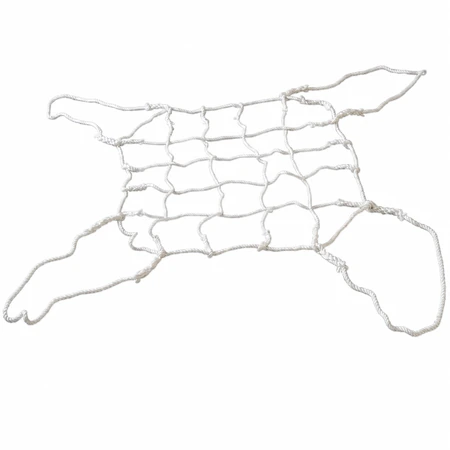
Produktaj Kategorioj

Poliestera Leva Leva Reto

Mallonga Priskribo:

Lift sling rigging firmao produktas Poliestera Lifting Hoisting Net,Poliestera Karga Reto,Sekureca Leva Reta Rimeno,Bungee Cargo Net,Poliestera Kargo Leva Reto,Leva Slinga Reto,Ŝnuro Leva Reto,Paleta Karga Reto,Ĝardena Grimpreto.

Poliestera Leva Leva Reto

A polyester lifting hoisting net is a soft bag woven from high-tenacity polyester webbing, built to move bagged goods and bulk material in a single crane lift. The load is tipped into the bag, or the bag is laid flat and drawn up around a stack, and four corner loops carry the whole consignment to the hook. There is no pallet to return, no strapping to cut, and nothing to re-handle at the far end.

Because we weave the webbing in our own mill in Taizhou, Jiangsu, la maŝo malfermo, bag footprint, profundo, bottom construction and working load limit are all set to the cargo rather than to a fixed catalogue. Standard nets cover 0.5 t al 20 t kaj 0.6 m³ al super 10 m³, every net is proof-load tested before packing, and each shipment travels with a material test report. Nets are CE and GS certified, with webbing rated to the EN 1492-1 bazo.

  • Fully custom build – maŝo, sako grandeco, profundo, colour and safety factor (5:1, 6:1 aŭ 7:1) set to your specification.
  • High-tenacity polyester webbing – 25 mm al 100 mm bendoj, ununura, duplex or triplex, UV stabiligita kaj putrrezista.
  • Wear and heat resistant – working range -40 °C al +100 °C, with a reinforced bottom for abrasive loads.
  • Mola, flexible and light – the flat band contacts the load over a wide area, so bags, cartons and finished surfaces are neither crushed nor marked.
  • CE kaj GS atestita – provita memstare 1000 t maŝino, with an ISO 9001 quality system and a CNAS-accredited laboratory behind it.
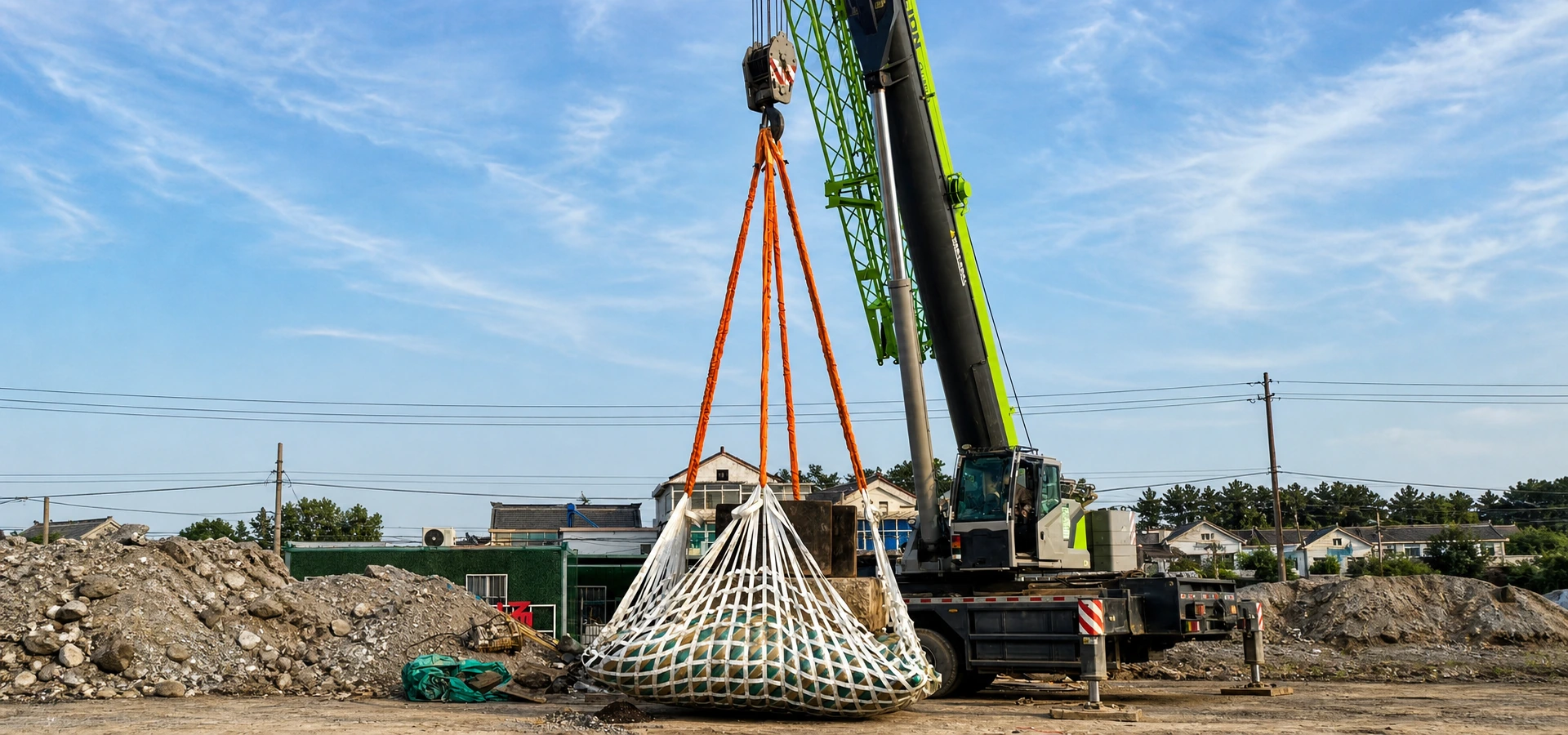
Polyester lifting hoisting net under a mobile crane carrying broken stone
A polyester lifting hoisting net in bulk service – the bag is filled with broken stone and lifted from its four loops by a mobile crane.

Why a webbing net bag, and not a rope net or a big bag

Three products are sold for the same job and they behave very differently once the load is in the air. A rope net concentrates the load on a few contact points. A big bag carries one free-flowing product and is itself the package. A webbing net bag spreads the pressure across flat bands, holds a stacked or mixed load together, and goes back to the store empty.

Tablo 1 – How the four common ways of lifting loose cargo compare.

Opcio Konstruo Kontaktu kun la ŝarĝo Best cargo Limitation
Polyester webbing net bag Flat woven bands, 25-100 mm, 25-300 mm maŝo Wide flat bands, low pressure per cm² Ensakigita, stacked, mixed and bulk cargo Needs a crane or hook; not a sealed package for powder
Nilona ŝnura reto Knotted or braided rope, 8-24 mm Line contact at every rope Irregular and heavy single items Ropes mark soft cargo; a tight mesh adds weight
FIBC / big bag Woven PP fabric with a liner Full surface, sealed One free-flowing product per bag Single product only; the bag is the packaging
Pallet and strapping Timber or plastic pallet plus bands Rigid base Unitised cartons Pallet returned or lost; bands cut and discarded; no drainage
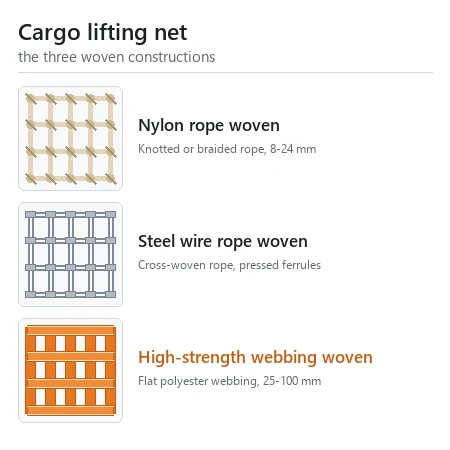
Diagram comparing nylon rope, steel wire rope and polyester webbing net constructions
Three woven constructions for cargo nets: nilona ŝnuro, steel wire rope and high-strength polyester webbing.

Five decisions that set the specification

A polyester lifting hoisting net is quoted from five numbers. Get them right and the net arrives right; get the mesh wrong and no amount of extra tonnage will fix it later.

Tablo 2 – What we need to know, and why each answer changes the net.

Decision Kion ĝi riparas What to tell us
1. Cargo form Whether the net is a bag or a flat sheet, and how the bottom is built How the cargo arrives: sakoj, grandaj sakoj, pakbuloj, or loose material
2. Weight per lift Band width and layer count, and therefore the rated capacity La malneta pezo, kiun vi intencas levi, not the weight of the net
3. Filled volume Footprint and depth of the bag Granda denseco (t/m³) for loose material, or the height of the stack for bagged goods
4. Mesh malfermo The largest gap the cargo can pass through The smallest unit in the load: a 25 kg bag, greno, aggregate or scrap
5. Elŝuta metodo Closed, laced, deklivo aŭ tetita fundo Whether the bag is tipped, untied over a hopper, or emptied by hand

Weight and volume are two separate limits, and for light bulk the volume arrives first. Greno proksimume 0.7 t/m³ kaj lignopecetoj ĉ 0.3 t/m³ ambaŭ plenigas a 3.6 m³ bag, but one lift weighs about 2.5 t and the other about 1 t. Send the bulk density with the tonnage and we will size the bag so that a full bag is also a legal bag.
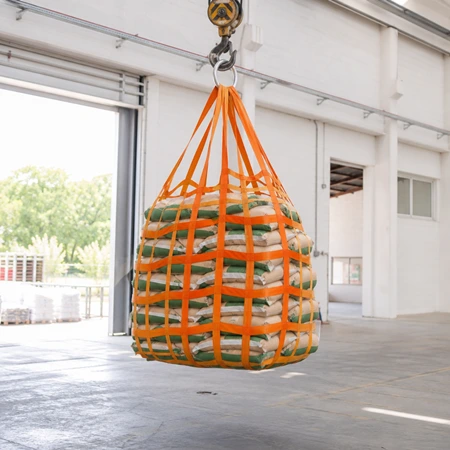
Polyester net bag lifting stacked 25 kg sacks in one crane lift
Bagged cargo in a polyester net bag – a stack of 25 kg sacks is closed in by the mesh and lifted as a single load.

Teknikaj parametroj

La malsupraj ciferoj kovras la norman ensakigitan kaj pograndan gamon. Maŝo, footprint, profundo, bottom, loops and capacity are made to order, do traktu ĉi tion kiel la deirpunkton por citaĵo prefere ol fiksita katalogo.

Tablo 3 – Polyester lifting hoisting net: teknikaj parametroj.

Parametro Specifo
Produkta nomo Polyester lifting hoisting net (polyester webbing net bag)
Agordoj Closed bag, release-bottom bag, or flat lifting net
Tegmaterialo 100 % alta tenaceca poliestero (PET); alttena nilono laŭ peto
Larĝo de bando 25 / 38 / 50 / 75 / 100 mm (50 mm normo)
Bandkonstruo Ununura tavolo, duplex or triplex; teksita rando, ne tranĉita rando
Bando dikeco 1.8 mm – 4.5 mm depende de larĝo kaj tavolkalkulo
Mesh malfermo 100 × 100 mm normo; 25 – 300 mm farita laŭ mendo
Reta grandeco Farita al la ŝarĝa piedsigno, truck bed or receiving hopper; see Table 4
Sako profundo 0.8 m – 2.5 m, or to drawing
Filled volume Pri 0.6 m³ al super 10 m³, set by footprint and depth
Limo Faldita kaj duoble kudrita, reinforced at every lifting point
Levpunktoj Kvar angulbukloj normaj; ok por disvastiga trabo; loops top and bottom on request
Taksita kapacito (WLL) 0.5 t – 20 t, set by band, tavolkalkulo kaj leva aranĝo
Sekureca faktoro 5:1 / 6:1 / 7:1
Plilongigo ĉe WLL 7 % aŭ malpli
Koloro Kolorkodo laŭ laborŝarĝa limo, aŭ laŭmenda doma koloro
Labora temperaturo -40 °C al +100 °C
Weather and chemical UV stabiligita, putrrezista, unaffected by rain, sea water and wash-down
Markado WLL, mesh and batch printed on the belt, plus a sewn capacity label
Norma bazo Reto taksita al EN 1492-1
Atestado CE, GS, ISO 9001, JIS laŭ peto; CNAS-laboratorio; DNV
Personigo OEM / ODM-grandeco, koloro, presita emblemo, etikedo kaj pakado
HS-kodo 6307.90 – retoj kaj retoj de teksaj materialoj

Normaj grandecoj, volumes and working load limits

These six lines cover the great majority of bagged and bulk work. Filled volume is calculated from the footprint and the depth with an allowance for the rounded shape a loaded bag takes, so a material that settles well will carry slightly more and one that bridges will carry less.

Tablo 4 – Standard net sizes at four corner loops gathered on one hook.

Reta grandeco (L × W) Depth Filled volume Maŝo Bando WLL Tipa kargo
1.0 × 1.0 m 1.0 m 0.6 m³ 50-100 mm 50 mm unuopa 0.5-1.5 t 25 kg-sakoj, malgrandaj sakoj, pakbuloj
1.5 × 1.5 m 1.2 m 1.6 m³ 50-100 mm 50 mm dupleksa 1-2.5 t Ensakigita greno, sterko, produkti
2.0 × 2.0 m 1.5 m 3.6 m³ 50-100 mm 50 mm dupleksa 2-4 t Pogranda greno, sablo, dispremita ŝtono
2.5 × 2.5 m 1.8 m 6.8 m³ 50-150 mm 75 mm dupleksa 3-6 t Pogranda sterko, karbo, peceto, fiŝoj
3.0 × 3.0 m 2.0 m 10.8 m³ 100-150 mm 75 mm dupleksa 4-8 t Grandaj pograndaj ŝarĝoj, kajo kaj teni laboron
To drawing 0.8-2.5 m Por mendi 25-300 mm 25-100 mm 0.5-20 t Ajna piedsigno, profundo kaj ŝarĝo

The working load limits above assume a four-loop lift. A two-loop basket de-rates the net – petu la malpliigitan figuron prefere ol legi trans ĉi tiu tabelo.

Mesh malfermo, chosen from the cargo

Mesh is the one dimension that cannot be adjusted after the net is sewn, so it is sized from the smallest unit in the load rather than from the total weight.

Tablo 5 – Mesh opening by cargo.

Kargo Rekomendita maŝo Reason
50 kg-sakoj, grandaj sakoj, pakbuloj 100 mm The sacks are far larger than the opening; the mesh only has to keep the stack together
25 kg-sakoj, malgrandaj sakoj 50-75 mm Small bags can squeeze through 100 mm once the load settles in the air
Grain, semo, sekigitaj produktoj 25-50 mm, aŭ fermita ekskursoŝipo Fine material must not sift out on the hook or in transit
Sterko, priloj, pulvoroj 25-50 mm, aŭ fermita ekskursoŝipo Fine and moisture-sensitive: a liner keeps the product in and the weather out
Sablo, gruzo, dispremita ŝtono 50-100 mm Sufiĉe bone por teni la plej grandan parton, open enough for rainwater to drain
Karbo, kolao 100-150 mm Large lumps; pli larĝa maŝo tenas la retan lumon kaj dreniĝas bone
Rubmetalo, eltranĉaĵoj 100-150 mm Open mesh with a reinforced bottom and wear pads at the contact points
Fiŝoj, mariskoj, malseka produkto 25-50 mm Holds the catch, drains freely, keeps the weight honest
Ŝtipoj, brulligno, grandaj eltranĉaĵoj 150-300 mm Indivisible pieces: a wide mesh saves weight without losing the load
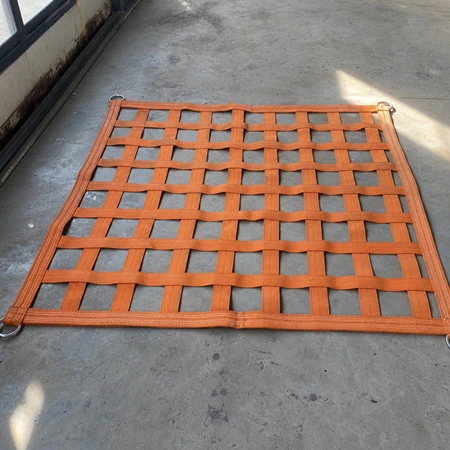
Orange polyester webbing lifting net laid flat with steel corner rings
A square polyester webbing net laid out flat: 100 mm maŝo, 50 mm bendoj, reinforced border and a steel ring at each corner.

Bottom construction and discharge

How the load comes out is a design decision in its own right. For bagged cargo the answer is usually a person with a knife; for bulk it is usually gravity.

Tablo 6 – Bottom options and how each one is emptied.

Fundo Kiel ĝi funkcias Chosen when
Closed, fully sewn The bag holds the cargo permanently and is emptied by tipping or by hand Ensakigita kargo, and bulk tipped over a hopper or onto a pile
Release bottom, laced A laced seam across the bottom is untied at the discharge point and the load falls out Free-flowing bulk – sablo, greno, entute – discharged without tipping the bag
Chute bottom The bag narrows to a chute opened over the receiving hopper Controlled discharge into a hopper, barĝo aŭ transportilo
Closed with a liner Ŝtofa tegaĵo sidas ene de la reto Dusty or moisture-sensitive bulk: greno, sterko, pulvoroj
Plifortigita malsupra panelo An extra layer of webbing is stitched across the base Abrasive and heavy bulk: entute, erco, peceto
Loops top and bottom Loops at both ends, so the bag can be lifted either way up Loading at height, kaj malplenigo renversante la sakon sur la hoko

Lifting arrangements and fittings

Kiel la sako estas pendigita decidas kiom da la ŝarĝo ĝi vere portas, kaj groco estas nepardona ĉar la ŝarĝo daŭre moviĝas ene de la sako dum ĝi estas en la aero.

  • Kvar bukloj sur la hoko – the standard for bagged and bulk work; the loops gather on the hook or a master ring and the bag closes around the cargo as the crane takes up the slack.
  • Ok bukloj sur disvastiga trabo – the bag stays square, la ŝarĝo restas ebena, kaj ĉiu buklo portas antaŭvideblan parton; the right arrangement for large bags and high tonnage, vidu nian levante disvastigan trabon gamo.
  • Two-loop basket – faster to rig, sed ĝi malpliigas la reton; ask for the derated capacity instead of reading across from the four-loop figure.
  • Loops top and bottom – lets the bag be lifted either way up, kio estas kiel fermita sako estas malplenigita renversante ĝin super salteto.

Gardaĵoj liveritaj aŭ ekipitaj laŭ peto: kudritaj teksaĵbukloj, master ring or master link, grado 80 katenoj, laced release bottoms, chutes and discharge sleeves, inner liners, wear pads and protection sleeves for scrap and aggregate, and repair kits for fleets that maintain their own equipment.

Materialo, stitching and finish

The belt is the product. We weave it on needle looms from high-tenacity polyester yarn, with a woven selvedge rather than a cut edge, so the band does not fray from the outside in.

  • 100 % alta tenaceca poliestero, malalta plilongiĝo (7 % or less at WLL), UV stabiligita, rot-proof and unaffected by moisture.
  • Locked stitching in high-tenacity polyester thread, run in multiple rows along the border and box-X at every loop – on a cheap net it is the stitch line, ne la zonon, that fails first.
  • Folded and double-stitched border, so the edge of the mesh cannot unravel under load.
  • Galvanised or stainless steel rings and master links on request.
  • Polyester holds its strength from -40 °C al +100 °C; above that, or in chemical exposure, tell us and we will quote nylon or another construction.
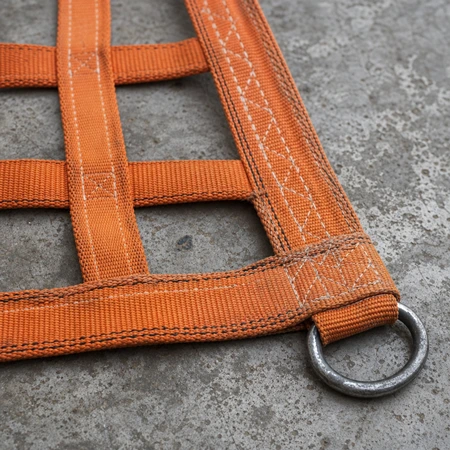
Close-up of webbing net border stitching and a galvanised D-ring
Border stitching and a galvanised D-ring at the corner – the two places a webbing net bag is most often overloaded.

Testado, atestado kaj spurebleco

  • Kvardek jaroj da leva ekipaĵo fabrikado – fondita en 1985 en Taizhou, Jiangsu, kun pli ol 200 employees and one of China’s largest lifting sling and net production bases.
  • Every net is proof-load tested on our own 1000 t horizontala testmaŝino – provita, ne provita.
  • A material test report travels with each shipment, quoting the belt batch and the test load.
  • CE-deklaro de konformeco kaj GS-atestilo, kun JIS-atestilo pri eksportaj mendoj.
  • ISO 9001 sistemo de administrado de kvalito, CNAS-akreditita laboratorio kaj DNV-atestilo malantaŭ la planto.
  • Every net is marked with its working load limit, maŝo, rated volume and batch number before packing, do la sako kaj ĝia papero ĉiam konsentas.

Certificates and test reports are available as PDFs for your tender or customs file – vidi la plenan atestado aro.

Where these nets work

A polyester lifting hoisting net is used wherever loose cargo has to travel between a stack and a hook – quay, muelejo, quarry, yard or hold. The sectors below are the ones where the bagged and bulk version earns its place.

Tablo 7 – Aplikoj laŭ sektoro.

Sektoro Kion la reto manipulas Kial poliestera reto konvenas al ĝi
Havenoj, kajoj kaj terminaloj Ensakigita kargo, greno, fertilizer and bulk between quay, barge and hold Unu sako por lifto, neniu paleto, kaj la ŝarĝo dreniĝas dum ĝi vojaĝas
Agrikulturo kaj furaĝfabrikoj Semo, greno, nutri, sterko kaj ensakigita produkto Streĉita maŝo aŭ tegaĵo tenas la produkton en kaj la veteron ekstere
Konstruaj materialoj Sablo, gruzo, dispremita ŝtono kaj ensakigita cemento Sufiĉe bone por teni la plej grandan parton, open enough for rainwater to drain
Minado kaj minado Entute, erco kaj minerala groco Plifortigita fundo prenas la abrazion, kiu eluzas reton
Fiŝfarmoj kaj nutraĵprilaborado Malseka fiŝo, mariskoj kaj produktaĵoj Malferma maŝo dreniĝas libere, which keeps the weight honest
Reciklado kaj malŝparo Malfiksaj plastoj, vitro, metalo kaj miksita materialo Contains loose material that would otherwise blow or fall
Biomass and power Lignopecetoj, bojo, buletoj kaj brulaĵo groco Granda sako por modesta tunaro, kongruis al la volumlimo
Construction sites and relief work Bagged materials raised to upper floors, field cargo No pallet, neniu banding, kaj ĝi povas esti malplenigita rekte sur la teron
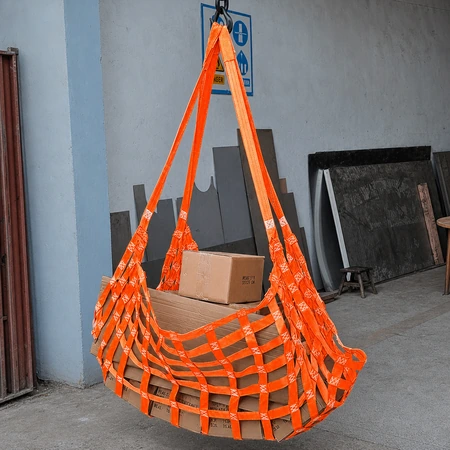
Orange webbing net bag lifting a carton with soft wide bands
Mixed cargo on site: a net bag takes a carton as readily as a stack of sacks, and the flat webbing spreads the load rather than cutting into it.

Customisation and branding

A net that moves between quays, holds and yards has to be identifiable from a distance and has to keep its marking. Koloro, presita emblemo, working load limit and cargo type are all applied in our own plant, so the marking cannot be washed off or pulled away with a label.

  • Kolorkodo laŭ laborŝarĝa limo, or a custom house colour to separate your fleet from a competitor’s.
  • Logo, brand name, averta teksto aŭ atestilnumero presita sur la zono, or woven in on larger orders.
  • Cargo type printed on the bag, which stops a fine-mesh grain net being sent out for scrap.
  • Sewn capacity label in addition to the print, so the net and its paperwork agree at every inspection.
  • Packing folded into a bag or a crate – a set of ten net bags takes the space of one pallet.
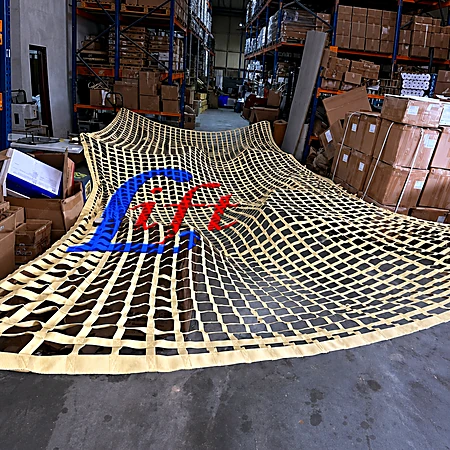
Polyester webbing cargo net printed with a customer logo in a warehouse
Buyer branding applied at the mill: the customer mark is printed directly on the webbing bands, not on a tag.
Beige polyester webbing net with printed logo laid out for inspection
Final inspection before packing – koloro, presita emblemo, mesh and working load limit are checked on the finished net.

Zorgo, inspektado kaj izoliteco

  • Inspect the loops and their stitching first, poste la limo, then the bottom closure – on a bulk net the bottom and the corners wear before the mesh does.
  • Malplenigu la sakon tute antaŭ stokado; material left inside holds moisture, aldonas pezon kaj kaŝas damaĝon.
  • Serĉu tranĉojn, abrazio, rompita kudrado, kemia makulo, varmega glazuro kaj la koloro aŭ briloŝanĝo kiu signalas UV-degeneron.
  • Weigh a wet bag before lifting it. Pluvo, sea water and wet bulk can add far more than the cargo was rated at, kaj reto ne konas la diferencon.
  • Neniam superu la taksitan kapaciton, neniam levu malpli ol la plena aro de maŝoj, kaj neniam trenu ŝarĝitan sakon flanken per la gruo.
  • Konservu pura kaj seka, de la tero kaj ekster rekta suno; neniam riparu teksaĵon per nodado, veldi aŭ varmigi ĝin.

Oftaj demandoj

What is the difference between a polyester lifting hoisting net and a cargo net?

A lifting net is rated, marked and tested to carry a load on a crane hook. A cargo net is a restraint: it holds a load down in transit and is not designed to be lifted. If the net is going onto a hook, it must be the rated version – vidu nian kargo sekuriganta reton for the tie-down case.

How do I choose the mesh opening?

From the smallest unit in the load, ne el la tunaro. A 25 kg bag needs 50-75 mm; grain or fertilizer needs 25-50 mm or a closed liner; scrap and coal can take 100-150 mm. Once the net is sewn the mesh cannot be changed, so this is the one number worth checking twice.

Why does the volume matter as much as the weight?

Ĉar malpeza groco plenigas la sakon antaŭ ol ĝi atingas la taksitan pezon. A bag that is full at half its rating doubles the number of lifts and the crane time. Give us the bulk density with the tonnage and we will size the bag so a full bag is also a legal bag.

Ĉu la sako povas esti malplenigita sen renversi ĝin?

Jes. A laced release bottom or a chute bottom lets a free-flowing load be discharged straight into a hopper, barĝo aŭ transportilo. Bagged cargo is normally emptied by hand or with a forklift at the far end.

Ĉu la reto tenos malsekan kargon?

The net itself is unaffected – polyester does not absorb water and does not rot, so rain, sea water and wash-down do no harm. Du singardoj: wet cargo is heavier, and fine wet material can clog the mesh, kiu aldonas pezon kaj maldaŭrigas ĝin.

How is the working load limit proved?

La retaĵo estas taksita al la EN 1492-1 bazo kaj retoj estas liveritaj ĉe 5:1, 6:1 aŭ 7:1 kiel specifite. Every net is proof-load tested on our own 1000 t maŝino, a material test report travels with the order, kaj la produktoj portas CE kaj GS-atestilon.

Do you make a flat version for palletised cargo?

Jes – the flat lifting net is the gruo paleta kargoreto, and the material-led range is covered by the poliestera retaĵo por levado. The rope constructions sit alongside as the nilona kargo-levoreto kaj la peza devo nilona ŝarĝa reto slingo.

What else do you make from the same webbing?

The same belt goes into our retŝnuroj kaj senfinaj rondaj skarpoj, and the wider cargo range is listed under retoj de ŝarĝo levado – including the retlevo de kargo levo for flat work.

Petu citaĵon

Send the cargo and whether it is bagged or bulk, la pogranda denseco se vi konas ĝin, la pezon, kiun vi volas per levo, la maŝo malfermo, the discharge method and the environment the net will work in – or a sketch of the bag you have in mind. Niaj inĝenieroj konfirmos la retan grandecon, profundo, malsupra konstruo, band and packing and quote it in one reply. Unue priparoli ĝin, kontaktu niajn inĝenierojn.

Lift Sling Rigging Company – Lifute Industria Parko, Urbo Taizhou, Jiangsu-provinco, Ĉinio
Tel: +86 523 8693 5818 | WhatsApp: +86 180 6600 2268 | Retpoŝto: lift98@jslift.com

Produkta Detalo

Lift sling rigging firmao produktas Poliestera Lifting Hoisting Net,Poliestera Karga Reto,Sekureca Leva Reta Rimeno,Bungee Cargo Net,Poliestera Kargo Leva Reto,Leva Slinga Reto,Ŝnuro Leva Reto,Paleta Karga Reto,Ĝardena Grimpreto.

Poliestera Leva Leva Reto

A polyester lifting hoisting net is a soft bag woven from high-tenacity polyester webbing, built to move bagged goods and bulk material in a single crane lift. The load is tipped into the bag, or the bag is laid flat and drawn up around a stack, and four corner loops carry the whole consignment to the hook. There is no pallet to return, no strapping to cut, and nothing to re-handle at the far end.

Because we weave the webbing in our own mill in Taizhou, Jiangsu, la maŝo malfermo, bag footprint, profundo, bottom construction and working load limit are all set to the cargo rather than to a fixed catalogue. Standard nets cover 0.5 t al 20 t kaj 0.6 m³ al super 10 m³, every net is proof-load tested before packing, and each shipment travels with a material test report. Nets are CE and GS certified, with webbing rated to the EN 1492-1 bazo.

  • Fully custom build – maŝo, sako grandeco, profundo, colour and safety factor (5:1, 6:1 aŭ 7:1) set to your specification.
  • High-tenacity polyester webbing – 25 mm al 100 mm bendoj, ununura, duplex or triplex, UV stabiligita kaj putrrezista.
  • Wear and heat resistant – working range -40 °C al +100 °C, with a reinforced bottom for abrasive loads.
  • Mola, flexible and light – the flat band contacts the load over a wide area, so bags, cartons and finished surfaces are neither crushed nor marked.
  • CE kaj GS atestita – provita memstare 1000 t maŝino, with an ISO 9001 quality system and a CNAS-accredited laboratory behind it.
Polyester lifting hoisting net under a mobile crane carrying broken stone
A polyester lifting hoisting net in bulk service – the bag is filled with broken stone and lifted from its four loops by a mobile crane.

Why a webbing net bag, and not a rope net or a big bag

Three products are sold for the same job and they behave very differently once the load is in the air. A rope net concentrates the load on a few contact points. A big bag carries one free-flowing product and is itself the package. A webbing net bag spreads the pressure across flat bands, holds a stacked or mixed load together, and goes back to the store empty.

Tablo 1 – How the four common ways of lifting loose cargo compare.

Opcio Konstruo Kontaktu kun la ŝarĝo Best cargo Limitation
Polyester webbing net bag Flat woven bands, 25-100 mm, 25-300 mm maŝo Wide flat bands, low pressure per cm² Ensakigita, stacked, mixed and bulk cargo Needs a crane or hook; not a sealed package for powder
Nilona ŝnura reto Knotted or braided rope, 8-24 mm Line contact at every rope Irregular and heavy single items Ropes mark soft cargo; a tight mesh adds weight
FIBC / big bag Woven PP fabric with a liner Full surface, sealed One free-flowing product per bag Single product only; the bag is the packaging
Pallet and strapping Timber or plastic pallet plus bands Rigid base Unitised cartons Pallet returned or lost; bands cut and discarded; no drainage
Diagram comparing nylon rope, steel wire rope and polyester webbing net constructions
Three woven constructions for cargo nets: nilona ŝnuro, steel wire rope and high-strength polyester webbing.

Five decisions that set the specification

A polyester lifting hoisting net is quoted from five numbers. Get them right and the net arrives right; get the mesh wrong and no amount of extra tonnage will fix it later.

Tablo 2 – What we need to know, and why each answer changes the net.

Decision Kion ĝi riparas What to tell us
1. Cargo form Whether the net is a bag or a flat sheet, and how the bottom is built How the cargo arrives: sakoj, grandaj sakoj, pakbuloj, or loose material
2. Weight per lift Band width and layer count, and therefore the rated capacity La malneta pezo, kiun vi intencas levi, not the weight of the net
3. Filled volume Footprint and depth of the bag Granda denseco (t/m³) for loose material, or the height of the stack for bagged goods
4. Mesh malfermo The largest gap the cargo can pass through The smallest unit in the load: a 25 kg bag, greno, aggregate or scrap
5. Elŝuta metodo Closed, laced, deklivo aŭ tetita fundo Whether the bag is tipped, untied over a hopper, or emptied by hand

Weight and volume are two separate limits, and for light bulk the volume arrives first. Greno proksimume 0.7 t/m³ kaj lignopecetoj ĉ 0.3 t/m³ ambaŭ plenigas a 3.6 m³ bag, but one lift weighs about 2.5 t and the other about 1 t. Send the bulk density with the tonnage and we will size the bag so that a full bag is also a legal bag.

Polyester net bag lifting stacked 25 kg sacks in one crane lift
Bagged cargo in a polyester net bag – a stack of 25 kg sacks is closed in by the mesh and lifted as a single load.

Teknikaj parametroj

La malsupraj ciferoj kovras la norman ensakigitan kaj pograndan gamon. Maŝo, footprint, profundo, bottom, loops and capacity are made to order, do traktu ĉi tion kiel la deirpunkton por citaĵo prefere ol fiksita katalogo.

Tablo 3 – Polyester lifting hoisting net: teknikaj parametroj.

Parametro Specifo
Produkta nomo Polyester lifting hoisting net (polyester webbing net bag)
Agordoj Closed bag, release-bottom bag, or flat lifting net
Tegmaterialo 100 % alta tenaceca poliestero (PET); alttena nilono laŭ peto
Larĝo de bando 25 / 38 / 50 / 75 / 100 mm (50 mm normo)
Bandkonstruo Ununura tavolo, duplex or triplex; teksita rando, ne tranĉita rando
Bando dikeco 1.8 mm – 4.5 mm depende de larĝo kaj tavolkalkulo
Mesh malfermo 100 × 100 mm normo; 25 – 300 mm farita laŭ mendo
Reta grandeco Farita al la ŝarĝa piedsigno, truck bed or receiving hopper; see Table 4
Sako profundo 0.8 m – 2.5 m, or to drawing
Filled volume Pri 0.6 m³ al super 10 m³, set by footprint and depth
Limo Faldita kaj duoble kudrita, reinforced at every lifting point
Levpunktoj Kvar angulbukloj normaj; ok por disvastiga trabo; loops top and bottom on request
Taksita kapacito (WLL) 0.5 t – 20 t, set by band, tavolkalkulo kaj leva aranĝo
Sekureca faktoro 5:1 / 6:1 / 7:1
Plilongigo ĉe WLL 7 % aŭ malpli
Koloro Kolorkodo laŭ laborŝarĝa limo, aŭ laŭmenda doma koloro
Labora temperaturo -40 °C al +100 °C
Weather and chemical UV stabiligita, putrrezista, unaffected by rain, sea water and wash-down
Markado WLL, mesh and batch printed on the belt, plus a sewn capacity label
Norma bazo Reto taksita al EN 1492-1
Atestado CE, GS, ISO 9001, JIS laŭ peto; CNAS-laboratorio; DNV
Personigo OEM / ODM-grandeco, koloro, presita emblemo, etikedo kaj pakado
HS-kodo 6307.90 – retoj kaj retoj de teksaj materialoj

Normaj grandecoj, volumes and working load limits

These six lines cover the great majority of bagged and bulk work. Filled volume is calculated from the footprint and the depth with an allowance for the rounded shape a loaded bag takes, so a material that settles well will carry slightly more and one that bridges will carry less.

Tablo 4 – Standard net sizes at four corner loops gathered on one hook.

Reta grandeco (L × W) Depth Filled volume Maŝo Bando WLL Tipa kargo
1.0 × 1.0 m 1.0 m 0.6 m³ 50-100 mm 50 mm unuopa 0.5-1.5 t 25 kg-sakoj, malgrandaj sakoj, pakbuloj
1.5 × 1.5 m 1.2 m 1.6 m³ 50-100 mm 50 mm dupleksa 1-2.5 t Ensakigita greno, sterko, produkti
2.0 × 2.0 m 1.5 m 3.6 m³ 50-100 mm 50 mm dupleksa 2-4 t Pogranda greno, sablo, dispremita ŝtono
2.5 × 2.5 m 1.8 m 6.8 m³ 50-150 mm 75 mm dupleksa 3-6 t Pogranda sterko, karbo, peceto, fiŝoj
3.0 × 3.0 m 2.0 m 10.8 m³ 100-150 mm 75 mm dupleksa 4-8 t Grandaj pograndaj ŝarĝoj, kajo kaj teni laboron
To drawing 0.8-2.5 m Por mendi 25-300 mm 25-100 mm 0.5-20 t Ajna piedsigno, profundo kaj ŝarĝo

The working load limits above assume a four-loop lift. A two-loop basket de-rates the net – petu la malpliigitan figuron prefere ol legi trans ĉi tiu tabelo.

Mesh malfermo, chosen from the cargo

Mesh is the one dimension that cannot be adjusted after the net is sewn, so it is sized from the smallest unit in the load rather than from the total weight.

Tablo 5 – Mesh opening by cargo.

Kargo Rekomendita maŝo Reason
50 kg-sakoj, grandaj sakoj, pakbuloj 100 mm The sacks are far larger than the opening; the mesh only has to keep the stack together
25 kg-sakoj, malgrandaj sakoj 50-75 mm Small bags can squeeze through 100 mm once the load settles in the air
Grain, semo, sekigitaj produktoj 25-50 mm, aŭ fermita ekskursoŝipo Fine material must not sift out on the hook or in transit
Sterko, priloj, pulvoroj 25-50 mm, aŭ fermita ekskursoŝipo Fine and moisture-sensitive: a liner keeps the product in and the weather out
Sablo, gruzo, dispremita ŝtono 50-100 mm Sufiĉe bone por teni la plej grandan parton, open enough for rainwater to drain
Karbo, kolao 100-150 mm Large lumps; pli larĝa maŝo tenas la retan lumon kaj dreniĝas bone
Rubmetalo, eltranĉaĵoj 100-150 mm Open mesh with a reinforced bottom and wear pads at the contact points
Fiŝoj, mariskoj, malseka produkto 25-50 mm Holds the catch, drains freely, keeps the weight honest
Ŝtipoj, brulligno, grandaj eltranĉaĵoj 150-300 mm Indivisible pieces: a wide mesh saves weight without losing the load
Orange polyester webbing lifting net laid flat with steel corner rings
A square polyester webbing net laid out flat: 100 mm maŝo, 50 mm bendoj, reinforced border and a steel ring at each corner.

Bottom construction and discharge

How the load comes out is a design decision in its own right. For bagged cargo the answer is usually a person with a knife; for bulk it is usually gravity.

Tablo 6 – Bottom options and how each one is emptied.

Fundo Kiel ĝi funkcias Chosen when
Closed, fully sewn The bag holds the cargo permanently and is emptied by tipping or by hand Ensakigita kargo, and bulk tipped over a hopper or onto a pile
Release bottom, laced A laced seam across the bottom is untied at the discharge point and the load falls out Free-flowing bulk – sablo, greno, entute – discharged without tipping the bag
Chute bottom The bag narrows to a chute opened over the receiving hopper Controlled discharge into a hopper, barĝo aŭ transportilo
Closed with a liner Ŝtofa tegaĵo sidas ene de la reto Dusty or moisture-sensitive bulk: greno, sterko, pulvoroj
Plifortigita malsupra panelo An extra layer of webbing is stitched across the base Abrasive and heavy bulk: entute, erco, peceto
Loops top and bottom Loops at both ends, so the bag can be lifted either way up Loading at height, kaj malplenigo renversante la sakon sur la hoko

Lifting arrangements and fittings

Kiel la sako estas pendigita decidas kiom da la ŝarĝo ĝi vere portas, kaj groco estas nepardona ĉar la ŝarĝo daŭre moviĝas ene de la sako dum ĝi estas en la aero.

  • Kvar bukloj sur la hoko – the standard for bagged and bulk work; the loops gather on the hook or a master ring and the bag closes around the cargo as the crane takes up the slack.
  • Ok bukloj sur disvastiga trabo – the bag stays square, la ŝarĝo restas ebena, kaj ĉiu buklo portas antaŭvideblan parton; the right arrangement for large bags and high tonnage, vidu nian levante disvastigan trabon gamo.
  • Two-loop basket – faster to rig, sed ĝi malpliigas la reton; ask for the derated capacity instead of reading across from the four-loop figure.
  • Loops top and bottom – lets the bag be lifted either way up, kio estas kiel fermita sako estas malplenigita renversante ĝin super salteto.

Gardaĵoj liveritaj aŭ ekipitaj laŭ peto: kudritaj teksaĵbukloj, master ring or master link, grado 80 katenoj, laced release bottoms, chutes and discharge sleeves, inner liners, wear pads and protection sleeves for scrap and aggregate, and repair kits for fleets that maintain their own equipment.

Materialo, stitching and finish

The belt is the product. We weave it on needle looms from high-tenacity polyester yarn, with a woven selvedge rather than a cut edge, so the band does not fray from the outside in.

  • 100 % alta tenaceca poliestero, malalta plilongiĝo (7 % or less at WLL), UV stabiligita, rot-proof and unaffected by moisture.
  • Locked stitching in high-tenacity polyester thread, run in multiple rows along the border and box-X at every loop – on a cheap net it is the stitch line, ne la zonon, that fails first.
  • Folded and double-stitched border, so the edge of the mesh cannot unravel under load.
  • Galvanised or stainless steel rings and master links on request.
  • Polyester holds its strength from -40 °C al +100 °C; above that, or in chemical exposure, tell us and we will quote nylon or another construction.
Close-up of webbing net border stitching and a galvanised D-ring
Border stitching and a galvanised D-ring at the corner – the two places a webbing net bag is most often overloaded.

Testado, atestado kaj spurebleco

  • Kvardek jaroj da leva ekipaĵo fabrikado – fondita en 1985 en Taizhou, Jiangsu, kun pli ol 200 employees and one of China’s largest lifting sling and net production bases.
  • Every net is proof-load tested on our own 1000 t horizontala testmaŝino – provita, ne provita.
  • A material test report travels with each shipment, quoting the belt batch and the test load.
  • CE-deklaro de konformeco kaj GS-atestilo, kun JIS-atestilo pri eksportaj mendoj.
  • ISO 9001 sistemo de administrado de kvalito, CNAS-akreditita laboratorio kaj DNV-atestilo malantaŭ la planto.
  • Every net is marked with its working load limit, maŝo, rated volume and batch number before packing, do la sako kaj ĝia papero ĉiam konsentas.

Certificates and test reports are available as PDFs for your tender or customs file – vidi la plenan atestado aro.

Where these nets work

A polyester lifting hoisting net is used wherever loose cargo has to travel between a stack and a hook – quay, muelejo, quarry, yard or hold. The sectors below are the ones where the bagged and bulk version earns its place.

Tablo 7 – Aplikoj laŭ sektoro.

Sektoro Kion la reto manipulas Kial poliestera reto konvenas al ĝi
Havenoj, kajoj kaj terminaloj Ensakigita kargo, greno, fertilizer and bulk between quay, barge and hold Unu sako por lifto, neniu paleto, kaj la ŝarĝo dreniĝas dum ĝi vojaĝas
Agrikulturo kaj furaĝfabrikoj Semo, greno, nutri, sterko kaj ensakigita produkto Streĉita maŝo aŭ tegaĵo tenas la produkton en kaj la veteron ekstere
Konstruaj materialoj Sablo, gruzo, dispremita ŝtono kaj ensakigita cemento Sufiĉe bone por teni la plej grandan parton, open enough for rainwater to drain
Minado kaj minado Entute, erco kaj minerala groco Plifortigita fundo prenas la abrazion, kiu eluzas reton
Fiŝfarmoj kaj nutraĵprilaborado Malseka fiŝo, mariskoj kaj produktaĵoj Malferma maŝo dreniĝas libere, which keeps the weight honest
Reciklado kaj malŝparo Malfiksaj plastoj, vitro, metalo kaj miksita materialo Contains loose material that would otherwise blow or fall
Biomass and power Lignopecetoj, bojo, buletoj kaj brulaĵo groco Granda sako por modesta tunaro, kongruis al la volumlimo
Construction sites and relief work Bagged materials raised to upper floors, field cargo No pallet, neniu banding, kaj ĝi povas esti malplenigita rekte sur la teron
Orange webbing net bag lifting a carton with soft wide bands
Mixed cargo on site: a net bag takes a carton as readily as a stack of sacks, and the flat webbing spreads the load rather than cutting into it.

Customisation and branding

A net that moves between quays, holds and yards has to be identifiable from a distance and has to keep its marking. Koloro, presita emblemo, working load limit and cargo type are all applied in our own plant, so the marking cannot be washed off or pulled away with a label.

  • Kolorkodo laŭ laborŝarĝa limo, or a custom house colour to separate your fleet from a competitor’s.
  • Logo, brand name, averta teksto aŭ atestilnumero presita sur la zono, or woven in on larger orders.
  • Cargo type printed on the bag, which stops a fine-mesh grain net being sent out for scrap.
  • Sewn capacity label in addition to the print, so the net and its paperwork agree at every inspection.
  • Packing folded into a bag or a crate – a set of ten net bags takes the space of one pallet.
Polyester webbing cargo net printed with a customer logo in a warehouse
Buyer branding applied at the mill: the customer mark is printed directly on the webbing bands, not on a tag.
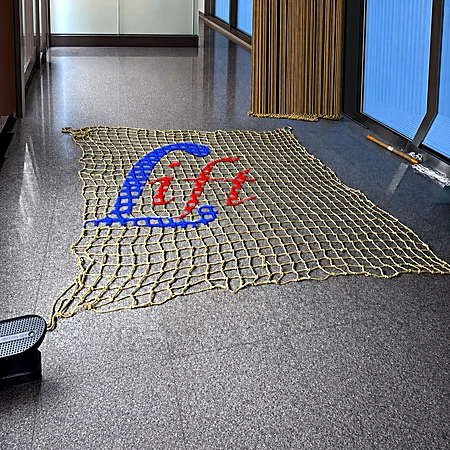
Beige polyester webbing net with printed logo laid out for inspection
Final inspection before packing – koloro, presita emblemo, mesh and working load limit are checked on the finished net.

Zorgo, inspektado kaj izoliteco

  • Inspect the loops and their stitching first, poste la limo, then the bottom closure – on a bulk net the bottom and the corners wear before the mesh does.
  • Malplenigu la sakon tute antaŭ stokado; material left inside holds moisture, aldonas pezon kaj kaŝas damaĝon.
  • Serĉu tranĉojn, abrazio, rompita kudrado, kemia makulo, varmega glazuro kaj la koloro aŭ briloŝanĝo kiu signalas UV-degeneron.
  • Weigh a wet bag before lifting it. Pluvo, sea water and wet bulk can add far more than the cargo was rated at, kaj reto ne konas la diferencon.
  • Neniam superu la taksitan kapaciton, neniam levu malpli ol la plena aro de maŝoj, kaj neniam trenu ŝarĝitan sakon flanken per la gruo.
  • Konservu pura kaj seka, de la tero kaj ekster rekta suno; neniam riparu teksaĵon per nodado, veldi aŭ varmigi ĝin.

Oftaj demandoj

What is the difference between a polyester lifting hoisting net and a cargo net?

A lifting net is rated, marked and tested to carry a load on a crane hook. A cargo net is a restraint: it holds a load down in transit and is not designed to be lifted. If the net is going onto a hook, it must be the rated version – vidu nian kargo sekuriganta reton for the tie-down case.

How do I choose the mesh opening?

From the smallest unit in the load, ne el la tunaro. A 25 kg bag needs 50-75 mm; grain or fertilizer needs 25-50 mm or a closed liner; scrap and coal can take 100-150 mm. Once the net is sewn the mesh cannot be changed, so this is the one number worth checking twice.

Why does the volume matter as much as the weight?

Ĉar malpeza groco plenigas la sakon antaŭ ol ĝi atingas la taksitan pezon. A bag that is full at half its rating doubles the number of lifts and the crane time. Give us the bulk density with the tonnage and we will size the bag so a full bag is also a legal bag.

Ĉu la sako povas esti malplenigita sen renversi ĝin?

Jes. A laced release bottom or a chute bottom lets a free-flowing load be discharged straight into a hopper, barĝo aŭ transportilo. Bagged cargo is normally emptied by hand or with a forklift at the far end.

Ĉu la reto tenos malsekan kargon?

The net itself is unaffected – polyester does not absorb water and does not rot, so rain, sea water and wash-down do no harm. Du singardoj: wet cargo is heavier, and fine wet material can clog the mesh, kiu aldonas pezon kaj maldaŭrigas ĝin.

How is the working load limit proved?

La retaĵo estas taksita al la EN 1492-1 bazo kaj retoj estas liveritaj ĉe 5:1, 6:1 aŭ 7:1 kiel specifite. Every net is proof-load tested on our own 1000 t maŝino, a material test report travels with the order, kaj la produktoj portas CE kaj GS-atestilon.

Do you make a flat version for palletised cargo?

Jes – the flat lifting net is the gruo paleta kargoreto, and the material-led range is covered by the poliestera retaĵo por levado. The rope constructions sit alongside as the nilona kargo-levoreto kaj la peza devo nilona ŝarĝa reto slingo.

What else do you make from the same webbing?

The same belt goes into our retŝnuroj kaj senfinaj rondaj skarpoj, and the wider cargo range is listed under retoj de ŝarĝo levado – including the retlevo de kargo levo for flat work.

Petu citaĵon

Send the cargo and whether it is bagged or bulk, la pogranda denseco se vi konas ĝin, la pezon, kiun vi volas per levo, la maŝo malfermo, the discharge method and the environment the net will work in – or a sketch of the bag you have in mind. Niaj inĝenieroj konfirmos la retan grandecon, profundo, malsupra konstruo, band and packing and quote it in one reply. Unue priparoli ĝin, kontaktu niajn inĝenierojn.

Lift Sling Rigging Company – Lifute Industria Parko, Urbo Taizhou, Jiangsu-provinco, Ĉinio
Tel: +86 523 8693 5818 | WhatsApp: +86 180 6600 2268 | Retpoŝto: lift98@jslift.com

Lasu Vian Mesaĝon

Rulumu al la supro